anaheim-gazette 1919-10-23
Scanned page
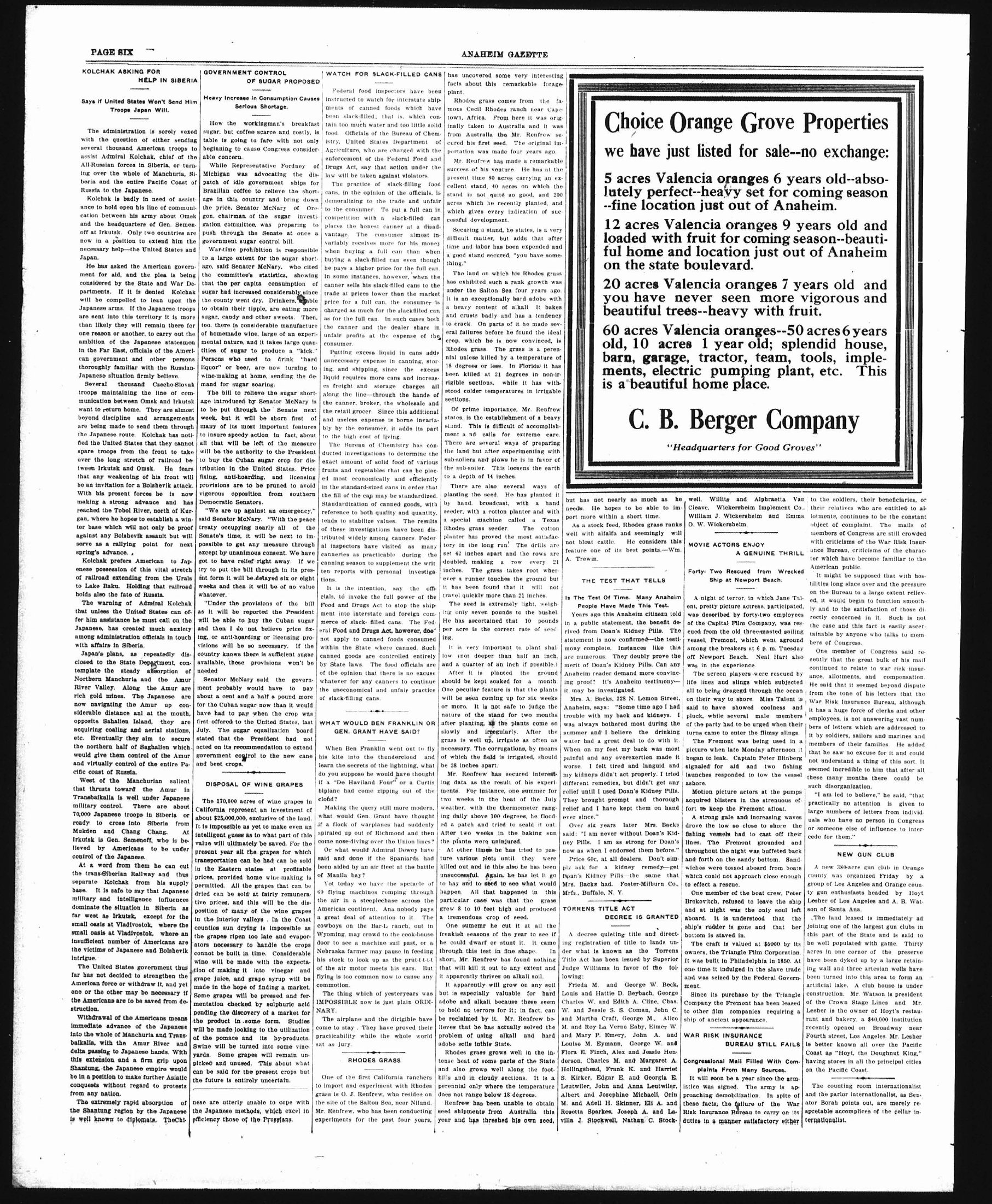
Searchable text
KOLCHAK ASKING FOR
HELP IN SIBERIA
Says if United States Won't Send Him Troops Japan Will.
The administration is sorely vexed with the question of either sending several thousand American troops to assist Admiral Kolchak, chief of the All-Russian forces in Siberia, or turning over the whole of Manchuria, Siberia and the entire Pacific Coast of Russia to the Japanese.
Kolchak is badly in need of assistance to hold open his line of communication between his army about Omsk and the headquarters of Gen. Semenoff at Irkutsk. Only two countries are now in a position to extend him the necessary help—the United States and Japan.
He has asked the American government for aid, and the plea is being considered by the State and War Departments. If it is denied Kolchak will be compelled to lean upon the Japanese arms. If the Japanese troops are sent into this territory it is more than likely they will remain there for one reason or another, to carry out the ambition of the Japanese statesmen in the Far East, officials of the American government and other persons thoroughly familiar with the Russian-Japanese situation firmly believe.
Several thousand Czecho-Slovak troops maintaining the line of communication between Omsk and Irkutsk want to return home. They are almost beyond discipline and arrangements are being made to send them through the Japanese route. Kolchak has notified the United States that they cannot
GOVERNMENT CONTROL OF SUGAR PROPOSED
Heavy Increase in Consumption Causes Serious Shortage.
How the workingman's breakfast sugar, but coffee scarce and costly, is table is going to fare with not only beginning to cause Congress considerable concern.
While Representative Fordney of Michigan was advocating the dispatch of idle government ships for Brazilian coffee to relieve the shortage in this country and bring down the price, Senator McNary of Oregon, chairman of the sugar investigation committee, was preparing to push through the Senate at once a government sugar control bill.
War-time prohibition is responsible to a large extent for the sugar shortage, said Senator McNary, who cited the committee's statistics, showing that the per capita consumption of sugar had increased considerably since the county went dry. Drinkers, unable to obtain their tipple, are eating more sugar, candy and other sweets. Then, too, there is considerable manufacture of homemade wine, large of an experimental nature, and it takes large quantities of sugar to produce a "kick." Persons who used to drink "hard liquor" or beer, are now turning to wine-making at home, sending the demand for sugar soaring.
The bill to relieve the sugar shortage introduced by Senator McNary is to be put through the Senate next week, but it will be shorn first of many of its most important features to insure speedy action in fact, about all that will be left of the measure
WATCH FOR
Federal food instructed to wipe men of cannery been slack-filledtain too much with food Officialsistry. United Agriculture, whien enforcement of Drugs Act, says law will be taken.
The practice cans, in the open demoralizing to the consumer competition will places the home advantage. The variably receive when buying a slack-he pays a higher In some instances canner sells his trade at prices he price for a full charged as much as for the full cost the canner and unfair profits a consumer.
Putting excess unnecessary expiring, and shipping liquid requires less freight and along the line—the canner, brookthe retail grocerand useless expiry by the consortto the high cost The Bureau
can government and other persons thoroughly familiar with the Russian-Japanese situation firmly believe.
Several thousand Czecho-Slovak troops maintaining the line of communication between Omsk and Irkutsk want to return home. They are almost beyond discipline and arrangements are being made to send them through the Japanese route. Kolchak has notified the United States that they cannot spare troops from the front to take over the long stretch of railroad between Irkutsk and Omsk. He fears that any weakening of his front will be an invitation for a Bolshevik attack. With his present forces he is now making a strong advance and has reached the Tobol River, north of Kurgan, where he hopes to establish a winter base which will not only be proof against any Bolshevik assault but will serve as a rallying point for next spring's advance.
Kolchak prefers American to Japanese possession of this vital stretch of railroad extending from the Urals to Lake Baku. Holding that railroad holds also the fate of Russia.
The warning of Admiral Kolchak that unless the United States can offer him assistance he must call on the Japanese, has created much anxiety among administration officials in touch with affairs in Siberia.
Japan's plans, as repeatedly disclosed to the State Department, contemplate the steady absorption of Northern Manchuria and the Amur River Valley. Along the Amur are rich gold mines. The Japanese are now navigating the Amur up considerable distance and at the mouth, opposite Sahailien Island, they are acquiring coaling and aerial stations, etc. Eventually they aim to secure the northern half of Saghalien which would give them control of the Amur and virtually control of the entire Pacific coast of Russia.
West of the Manchurian salient that thrusts toward the Amur in Transbalkalia is well under Japanese military control. There are about 70,000 Japanese troops in Siberia or ready to cross into Siberia from Mukden and Chang Chang. At Irkutsk is Gen. Semenoff, who is believed by Americans to be under Persons who used to drink "hard liquor" or beer, are now turning to wine-making at home, sending the demand for sugar soaring.
The bill to relieve the sugar shortage introduced by Senator McNary is to be put through the Senate next week, but it will be shorn first of many of its most important features to insure speedy action in fact, about all that will be left of the measure will be the authority to the President to buy the Cuban sugar crop for distribution in the United States. Price fixing, anti-hoarding, and licensing provisions are to be pruned to avoid vigorous opposition from southern Democratic Senators.
"We are up against an emergency," said Senator McNary. "With the peace treaty occupying nearly all of the Senate's time, it will be next to impossible to get any measure through except by unanimous consent. We have got to have relief right away. If we try to put the bill through in its present form it will be delayed six or eight weeks and then it will be of no value whatever.
"Under the provisions of the bill as it will be reported the President will be able to buy the Cuban sugar and then I do not believe price fixing, or anti-hoarding or licensing provisions will be so necessary. If the country knows there is sufficient sugar available, these provisions won't be needed.
Senator McNary said the government probably would have to pay about a cent and a half a pound more for the Cuban sugar now than it would have had to pay when the crop was first offered to the United States, last July. The sugar equalization board stated that the President had not acted on its recommendation to extend government control to the new cane and beet crops.
DISPOSAL OF WINE GRAPES
The 170,000 acres of wine grapes in California represent an investment of about $25,000,000, exclusive of the land. It is impossible as yet to make even an intelligent guess as to what part of this value will ultimately be saved. For the purposes of government control all persons who used to drink "hard liquor" or beer, are now turning to wine-making at home, sending the demand for sugar soaring.
The Bureau conducted investigative exact amount of fruits and vegetables most economically in the standard-sided fill of the cap Standardization reference to both tends to stabilize of these investigative tributed widely al inspectors have canneries as prince canning season ten reports with tions.
It is the interests, to invoke Food and Drugs ment into interim merce of slack-eral Food and Drink not apply to carry within the State canned goods and by State laws. Of the opinion tha whatever for any uneconomical of slack-filling ca
WHAT WOULD GEN. GRAN
When Ben Frank his kite into tha learn the secrets do you suppose h if a "De Haviland biplane had come nose-diving Or what would
WEST OF THE MANCHURIAN SALIENT THAT THRUSTS TOWARD THE AMUR IN TRANSBAKKA IS WELL UNDER JAPANESE MILITARY CONTROL. THERE ARE ABOUT 70,000 JAPANESE Troops IN SIBERIA OR READY TO CROSS INTO SIBERIA FROM MUKDEN AND CHANG CHANG. AT IRKUTSK IS GEN. SEMENOFF, WHO IS BELIEVED BY AMERICANS TO BE UNDER CONTROL OF THE JAPANESE.
AT A WORD FROM THEM HE CAN CUT THE TRANS-SIBERIAN RAILWAY AND THUS SEPARATE KOLCHAK FROM HIS SUPPLY BASE. IT IS SAFE TO SAY THAT JAPANESE MILITARY AND INTELLIGENCE INFLUENCES DOMINATE THE SITUATION IN SIBERIA AS FAR WEST AS IRKUTSK, EXCEPT FOR THE SMALL OASIS AT VLADIVOSTOK, WHERE THE SMALL OASIS AT VLADIVOSTOK, WHERE AN INSUFFICIENT NUMBER OF AMERICANS ARE THE VICTIMS OF JAPANESE AND BOLSHEVIK INTRIGUE.
THE UNITED STATES GOVERNMENT THUS FAR HAS NOT DECIDED TO STRENGTHEN THE AMERICAN FORCE OR WITHDRAW IT, AND YET ONE OR THE OTHER MAY BE NECESSARY IF THE AMERICANS ARE TO BE SAVED FROM DESTruction.
WITHDRAWAL OF THE AMERICANS MEANS IMPREGNATE ADVANCE OF THE JAPANESE INTO THE WHOLE OF MANCHURIA AND TRANSBAKKA, WITH THE AMUR RIVER AND DELTA PASSING TO JAPANESE HANDS. WITH THIS EXTENSION AND A FIRM GRIP UPON SHANTUNG, THE JAPANESE EMPIRE WOULD BE IN A POSITION TO MAKE FURTHER ASLIATIC CONQUESTS WITHOUT REGARD TO PROTESTS FROM ANY NATION.
THE EXTREMely RAPID Absorption OF THE SHANTUNG REGION BY THE JAPANESE IS WELL KNOWN TO DIplomats, The Chi-
DISPOSAL OF WINE GRAPES
The 170,000 acres of wine grapes in California represent an investment of about $25,000,000, exclusive of the land. It is impossible as yet to make even an intelligent guess as to what part of this value will ultimately be saved. For the present year all the grapes for which transportation can be had can be sold in the Eastern states at profitable prices, provided home wine-making is permitted. All the grapes that can be dried can be sold at fairly remunerative prices, and this will be the disposition of many of the wine grapes in the interior valleys. In the Coast counties sun drying is impossible as the grapes ripen too late and evaporators necessary to handle the crops cannot be built in time. Considerable wine will be made with the expectation of making it into vinegar and grape juice, and grape syrup will be made in the hope of finding a market. Some grapes will be pressed and fermentation checked by sulphuric acid pending the discovery of a market for the product in some form. Studies will be made looking to the utilization of the pomace and its by-products. Swine will be turned into some vineyards. Some grapes will remain unpicked and unused. This about what can be said for the present crops but the future is entirely uncertain.
These are utterly unable to cope with the Japanese methods, which excel in efficiency those of the Prussians.
ANAHEIM GAZETTE
PROPOSED
on Causes
breakfast costly, is not only considerdney of the disships for the shorting down of Oreinvestilaring to it once a.
responsible car shortwho cited showing option of
ability since s,
enable ing more m.
Then, manufacture in experiprise quan-
"kick."
hard turning to the decar shortNary is the next first of features act, about measure
WATCH FOR SLACK-FILLED CAN8
Federal food inspectors have been instructed to watch for interstate shipments of canned foods which have been slack-filled; that is, which contain too much water and too little solid food. Officials of the Bureau of Chemistry, United States Department of Agriculture, who are charged with the enforcement of the Federal Food and Drugs Act, say that action under the law will be taken against violators.
The practice of slack-filling food cans, in the opinion of the officials, is demoralizing to the trade and unfair to the consumer. To put a full can in competition with a slack-filled can places the honest canner at a disadvantage. The consumer almost invariably receives more for his money when buying a full can than when buying a slack-filled can even though he pays a higher price for the full can. In some instances, however, when the canner sells his slack-filled cans to the trade at prices lower than the market price for a full can, the consumer is charged as much for the slack-filled can as for the full can. In such cases both the canner and the dealer share in unfair profits at the expense of the consumer.
Putting excess liquid in cans adds unnecessary expense in canning, storing, and shipping, since the excess liquid requires more cans and increases freight and storage charges all along the line—through the hands of the canner, broker, the wholesale and the retail grocer. Since this additional and useless expense is borne invariably by the consumer, it adds its part to the high cost of living.
The Bureau of Chemistry has conhas uncovered some very interesting facts about this remarkable forage-plant.
Rhodes grass comes from the famous Cecil Rhodes ranch near Cape-town, Africa. From here it was originally taken to Australia and it was from Australia the Mr. Renfrew secured his first seed. The original importation was made four years ago.
Mr. Renfrew has made a remarkable success of his venture. He has at the present time 80 acres carrying an excellent stand, 40 acres on which the stand is not quite so good, and 200 acres which he recently planted, and which gives every indication of successful development.
Securing a stand, he states, is a very difficult matter, but adds that after time and labor has been expended and a good stand secured, "you have something."
The land on which his Rhodes grass has exhibited such a rank growth was under the Salton Sea four years ago. It is an exceptionally hard adobe with a heavy content of alkali. It bakes and crusts badly and has a tendency to crack. On parts of it he made several failures before he found the ideal crop, which he is now convinced, is Rhodes grass. The grass is a perennial unless killed by a temperature of 18 degrees or less. In Florida it has been killed at 21 degrees in non-irrigible sections, while it has withstood colder temperatures in irrigable sections.
Of prime importance, Mr. Renfrew states, is the establishment of a heavy stand. This is difficult of accomplishment and calls for extreme care. There are several ways of preparing
"hard learning to grow the dearm shortMcNary is late next of first of features set, about measure president for diss. Price licensing to avoid southern emergency," the peace of the city imthrough We have if we its pres- or eight no value the bill president on sugar price fixing proIf the fat sugar won't be govern- no pay more it would stop was lies, last board and not extend new cane
PESapes in moment of the land, even an of this For the
WHAT WOULD BEN FRANKLIN OR GEN. GRANT HAVE SAID?
When Ben Franklin went out to fly his kite into the thundercloud and learn the secrets of the lightning, what do you suppose he would have thought if a "De Haviland Four" or a Curtis biplane had come zipping out of the cloud?
Making the query still more modern, what would Gen. Grant have thought if a flock of warplanes had suddenly spiraled up out of Richmond and then come nose-diving over the Union lines? Or what would Admiral Dewey have unnecessarily expense in canning, storing, and shipping, since the excess liquid requires more cans and increases freight and storage charges all along the line—through the hands of the canner, broker, the wholesale and the retail grocer. Since this additional and useless expense is borne invariably by the consumer, it adds its part to the high cost of living.
The Bureau of Chemistry has conducted investigations to determine the exact amount of solid food of various fruits and vegetables that can be placed most economically and efficiently in the standard-sized cans in order that the fill of the cap may be standardized. Standardization of canned goods, with reference to both quality and quantity, tends to stabilize values. The results of these investigations have been distributed widely among canners. Federal inspectors have visited as many canneries as practicable during the canning season to supplement the written reports with personal investigations.
It is the intention, say the officials, to invoke the full power of the Food and Drugs Act to stop the shipment into interstate and foreign commerce of slack-filled cans. The Federal Food and Drugs Act, however, does not apply to canned foods consumed within the State where canned. Such canned goods are controlled entirely by State laws. The food officials are of the opinion that there is no excuse whatever for any canners to continue the uneconomical and unfair practice of slack-filling cans.
The seed is extremely light, weighing only seven pounds to the bushel. He has ascertained that 10 pounds per acre is the correct rate of seeding.
It is very important to plant shallow (not deeper than half an inch, and a quarter of an inch if possible.) After it is planted the ground should be kept soaked for a month. One peculiar feature is that the plants will be seen coming up for six weeks or more. It is not safe to judge the nature of the stand for two months after planting, as the plants come so slowly and irregularly. After the grass is well up, irrigate as often as necessary. The corrugations, by means of which the field is irrigated, should be 28 inches apart.
Mr. Renfrew has secured interesting data as the result of his experiments. For instance, one summer for two weeks in the heat of the July weather, with the thermometer ranging daily above 100 degrees, he flooded a patch and tried to scald it out. After two weeks in the baking sun the plants were uninjured.
At other times he has tried to nessil unless killed by a temperature of 18 degrees or less. In Florida it has been killed at 21 degrees in non-irrigible sections, while it has withstood colder temperatures in irrigable sections.
Of prime importance, Mr. Renfrew states, is the establishment of a heavy stand. This is difficult of accomplishment and calls for extreme care. There are several ways of preparing the land but after experimenting with sub-soilers and plows he is in favor of the sub-soiler. This loosens the earth to a depth of 14 inches.
There are also several ways of planting the seed. He has planted it by hand, broadcast, with a hand seeder, with a cotton planter and with a special machine called a Texas Rhodes grass seeder. The cotton planter has proved the most satisfactory in the long run. The drills are set 42 inches apart and the rows are doubled, making a row every 21 inches. The grass takes root wherever a runner touches the ground but it has been found that it will not travel quickly more than 21 inches.
The seed is extremely light, weighing only seven pounds to the bushel. He has ascertained that 10 pounds per acre is the correct rate of seeding.
It is very important to plant shallow (not deeper than half an inch, and a quarter of an inch if possible.) After it is planted the ground should be kept soaked for a month. One peculiar feature is that the plants will be seen coming up for six weeks or more. It is not safe to judge the nature of the stand for two months after planting, as the plants come so slowly and irregularly. After the grass is well up, irrigate as often as necessary. The corrugations, by means of which the field is irrigated, should be 28 inches apart.
Mr. Renfrew has secured interesting data as the result of his experiments. For instance, one summer for two weeks in the heat of the July weather, with the thermometer ranging daily above 100 degrees, he flooded a patch and tried to scald it out. After two weeks in the baking sun the plants were uninjured.
At other times he has tried to nessil unless killed by a temperature of 18 degrees or less. In Florida it has been killed at 21 degrees in non-irrigible sections, while it has withstood colder temperatures in irrigable sections.
Of prime importance, Mr. Renfrew states, is the establishment of a heavy stand. This is difficult of accomplishment and calls for extreme care. There are several ways of preparing the land but after experimenting with sub-soilers and plows he is in favor of the sub-soiler. This loosens the earth to a depth of 14 inches.
There are also several ways of planting the seed. He has planted it by hand, broadcast, with a hand seeder, with a cotton planter and with a special machine called a Texas Rhodes grass seeder. The cotton planter has proved the most satisfactory in the long run. The drills are set 42 inches apart and the rows are doubled, making a row every 21 inches. The grass takes root wherever a runner touches the ground but it has been found that it will not travel quickly more than 21 inches.
The seed is extremely light, weighing only seven pounds to the bushel. He has ascertained that 10 pounds per acre is the correct rate of seeding.
It is very important to plant shallow (not deeper than half an inch, and a quarter of an inch if possible.) After it is planted the ground should be kept soaked for a month. One peculiar feature is that the plants will be seen coming up for six weeks or more. It is not safe to judge the nature of the stand for two months after planting, as the plants come so slowly and irregularly. After the grass is well up, irrigate as often as necessary. The corrugations, by means of which the field is irrigated, should be 28 inches apart.
Mr. Renfrew has secured interesting data as the result of his experiments. For instance, one summer for two weeks in the heat of the July weather, with the thermometer ranging daily above 100 degrees, he flooded a patch and tried to scald it out. After two weeks in the baking sun the plants were uninjured.
At other times he has tried to nessil unless killed by a temperature of 18 degrees or less. In Florida it has been killed at 21 degrees in non-irrigible sections, while it has withstood colder temperatures in irrigable sections.
Of prime importance, Mr. Renfrew states, is the establishment of a heavy stand. This is difficult of accomplishment and calls for extreme care. There are several ways of preparing the land but after experimenting with sub-soilers and plows he is in favor of the sub-soiler. This loosens the earth to a depth of 14 inches.
There are also several ways of planting the seed. He has planted it by hand, broadcast, with a hand seeder, with a cotton planter and with a special machine called a Texas Rhodes grass seeder. The cotton planter has proved the most satisfactory in the long run. The drills are set 42 inches apart and the rows are doubled, making a row every 21 inches. The grass takes root wherever a runner touches the ground but it has been found that it will not travel quickly more than 21 inches.
The seed is extremely light, weighing only seven pounds to the bushel. He has ascertained that 10 pounds per acre is the correct rate of seeding.
It is very important to plant shallow (not deeper than half an inch, and a quarter of an inch if possible.) After it is planted the ground should be kept soaked for a month. One peculiar feature is that the plants will be seen coming up for six weeks or more. It is not safe to judge the nature of the stand for two months after planting, as the plants come so slowly and irregularly. After the grass is well up, irrigate as often as necessary. The corrugations, by means of which the field is irrigated, should be 28 inches apart.
Mr. Renfrew has secured interesting data as the result of his experiments. For instance, one summer for two weeks in the heat of the July weather, with the thermometer ranging daily above 100 degrees, he flooded a patch and tried to scald it out. After two weeks in the baking sun the plants were uninjured.
At other times he has tried to nessil unless killed by a temperature of 18 degrees or less. In Florida it has been killed at 21 degrees in non-irrigible sections, while it has withstood colder temperatures in irrigable sections.
Of prime importance, Mr. Renfrew states, is the establishment of a heavy stand. This is difficult of accomplishment and calls for extreme care. There are several ways of preparing the land but after experimenting with sub-soilers and plows he is in favor of the sub-soiler. This loosens the earth to a depth of 14 inches.
There are also several ways of plantingthe seedHe has planteditbyhand,broadcastwithahandseederwithacottonplanterandwithaspecialmachinecalledaTexasRhodesgrassseeder.Thecottonplanterhasprovedthemostsatisfactoryinthelongrun!Thedrillsareset42inchesapartandtherowsaredoubled,makingarowevery21inches.Thegrasstakesrootwhereveratrunertouchestgroundbutithasbeenfoundthatitwillnottravelquicklymorethan21inches.
The seedisextremelylightweighingonlysevenpoundstothebushelHehasascertainedthat10poundsperacreponearcertainrateoftseed ing.
Itisveryimportanttoplantshallow(notdeeperthanhalfaninch,andaquarterofaninchifpossible.)AfteritistplantedthegroundshouldbeteknownforamonthOnepeculiarfeatureisthattheplantswillbeseencomingupforsixweeksormoreItisnotsafetojudgethenatureofthestandfortwomonthsafterplantingasthenplantscomesoslowlyandirregularly.Afterthegrassiswellup,ierrigateasoftenasnecessary.Thecorrugationsbymeansofwhichthefieldisirrigatedshouldbe28inchesapart.Mr.RenfrewhassecuredinterestdataastheresultofhisexperimentsForinstance,一summerfortwomonthsinheatoftheJulyweather,withthethermometerrangingsdailyabove100degrees,theflloodedapatchandtriedtocscalditout.Aftertwoweeksinthebakingsuntheplantswereuninjured."
ButhasnotnearlyasmasheneedsHehopestobeabletomportmorewithinashorttime.Asstockfeed,RhodesgrassrankswithalfthecuedveasementoffNwasThielfivelittontallonsaidpluckoftheturnsThielficturebegansignala launchashoreMo.acrovesinfoundnewcanePESapeinsinmentoftheland.sevenanofthisForthepile drovefashionlines.throughanemergency."thepeaceofthecityofthemeteerforediscussespricefixingproblemIfthehot sugarwouldbegovernoayebestpaidforeightnovalueThebilletresidentonnsugarpricefixingproblemIfthehot sugarwouldbegovernoayebestpaidforeightnovalueThebilletresidentonnsugarpricefixingproblemIfthehot sugarwouldbegovernoayebestpaidforeightnovalueThebilletresidentonnsugarpricefixingproblemIfthehot sugarwouldbegovernoayebestpaidforeightnovalueThebilletresidentonnsugarpricefixingproblemIfthehot sugarwouldbegovernoayebestpaidforeightnovalueThebilletresidentonnsugarpricefixingproblemIfthehot sugarwouldbegovernoayebestpaidforeightnovalueThebilletresidentonnsugarpricefixingproblemIfthehot sugarwouldbegovernoayebestpaidforeightnovalueThebilletresidentonnsugarpricefixingproblemIfthehot sugarwouldbegovernoayebestpaidforeightnovalueThebilletresidentonnsugarpricefixingproblemIfthehot sugarwouldbegovernoayebestpaidforeightnovalueThebilletresidentonnsugarpricefixingproblemIfthehot sugarwouldbegovernoayebestpaidforeightnovalueThebilletresidentonnsugarpricefixingproblemIfthehot sugarwouldbegovernoayebestpaidforeightnovalueThebilletresidentonnsugarpricefixingproblemIfthehot sugarwouldbegovernoayebestpaidforeightnovalueThebilletresidentonnsugarpricefixingproblemIfthehot sugarwouldbegovernoayebestpaidforeightnovalueThebilletresidentonnsugarpricefixingproblemIfthehot sugarwouldbegovernoayebestpaidforeightnovalueThebilletresidentonnsugarpricefixingproblemIfthehot sugarwouldbegovernoayebestpaidforeightnovalueThebilletresidentonnsugarpricefixingproblemIfthehot sugarwouldbegovernoayebestpaidforeightnovalueThebilletresidentonnsugarpricefixingproblemIfthehot sugarwouldbegovernoayebestpaidforeightnovalueThebilletresidentonnsugarpricefixingproblemIfthehot sugarwouldbegovernoayebestpaidforeightnovalueThebilletresidentonnsugarpricefixingproblemIfthehot sugarwouldbegovernoayebestpaidforeightnovalueThebilletresidentonnsugarpricefixingproblemIfthehot sugarwouldbegovernoayebestpaidforeightnovalueThebilletresidentonnsugarpricefixingproblemIfthehot sugarwouldbegovernoayebestpaidforeightnovalueThebilletresidentonnsugarpricefixingproblemIfthehot sugarwouldbegovernoayebestpaidforeightnovalueThebilletresidentonnsugarpricefixingproblemIfthehot sugarwouldbegovernoayebestpaidforeightnovalueThebilletresidentonnsugarpricefixingproblemIfthehot sugarwouldbegovernoayebestpaidforeightno价值ThebilletresidentonnsugarpricefixingproblemIfthehot sugarwouldbegovernoayebestpaidforeightno价值ThebilletresidentonnsugarpricefixingproblemIfthehot sugarwouldbegovernoayebest paidforeightno价值ThebilletresidentonnsugarpricefixingproblemIfthehot sugarwouldbegovernoayebest paidforeightno价值ThebilletresidentonnsugarpricefixingproblemIfthehot sugarwouldbegovernoayebest paidforeightno价值ThebilletresidentonnsugarpricefixingproblemIfthehot sugarwouldbegoverNOAYEBESTPAIDFOREIGHTNOVALUETHEBILLETRESENTONNSUGARPRICEFIXINGPROBLEMIFTHEHOT SUGARWILLBEUSEDTOSTOPTHEGROWTHOFSUGARINCOMEFROMTHESEPUCKSANDCOOKIESWHICHWEREUSEDTOSTOPTHEGROWTHOFSUGARINCOMEFROMTHESEPUCKSANDCOOKIESWHICHWEREUSED TOSTOPTHEGROWTH OFSUGARINCOMEFROMTHESEPUCKSANDCOOKIESWHICHWEREUSED TOSTOPTHEGROWTH OFSUGARINCOMEFROMTHESEPUCKSANDCOOKIESWHICHWEREUSED TOSTOPTHEGROWTH OFSUGARINCOMEFROMTHESEPUCKSANDCOOKIESWHICHWEREUSED TOSTOPTHEGROWTH OFSUGARINCOMEFROMTHESEPUCKSANDCOOKIESWHICHWEREUSED TOSTOPTHEGROWTH OFSUGARINCOMEFROMTHESEPUCKSANDCOOKIESWHICHWEREUSED TOSTOPTHEGROWTH OFSUGARINCOMEFROMTHESEPUCKSANDCOOKIESWHICHWEREUSED TOSTOPTHEGROWTH OFSUGARINCOMEFROMTHESEPUCKSANDCOOKIESWHICHWEREUSED TOSTOPTHEGROWTH OFSUGARINCOMEFROMTHESEPUCKSANDCOOKIESWHICHWEREUSED TOSTOPTHEGROWTH OFSUGARINCOMEFROMTHESEPUCKSANDCOOKIESWHICHWEREUSED TOSTOPTHEGROWTH OFSUGARINCOMEFROMTHESEPUCKSANDCOOKIESWHICHWEREUSED TOSTOPTHEGROWTH OFSUGARINCOMEFROMTHESEPUCKSANDCOOKIESWHICHWEREUSED TOSTOPTHEGROWTH OFSUGARINCOMEFROMTHESEPUCKSANDCOOKIESWHICHWEREUSED TOSTOPTHEGROWTH OFSUGARINCOMEFROMTHESEPUCKSANDCOOKIESWHICHWEREUSED TOSTOPTHEGROWTH OFSUGARINCOMEFROMTHESEPUCKSANDCOOKIESWHICHWEREUSED TOSTOPTHEGROWTH OFSUGARINCOMEFROMTHESEPUCKSANDCOOKIESWHICHWEREUSED TOSTOPTHEGROWTH OFSUGARINCOMEFROM THESEPUCKSANDCOOKIESWHICHWEREUSED TOSTOPTHEGROWTH OFSUGARINCOMEFROM THESEPUCKSANDCOOKIESWHICHWEREUSED TOSTOPTHEGROWTH OFSUGARINCOMEFROM THESEPUCKSANDCOOKIESWHICHWEREUSED TOSTOPTHEGROWTH OFSUGARINCOMEFROM THESEPUCKSANDCOOKIESWHICHWEREUSED TOSTOPTHEGROWTH OFSUGARINCOMEFROM THESEPUCKSANDCOOKIESWHICHWEREUSED TOSTOPTHEGROWTH OFSUGARINCOMEFROM THESEPUCKSANDCOOKIESWHICHWEREUSED TOSTOPTHEGROWTH OFSUGARINCOMEFROM THESEPUCKSANDCOOKIESWHICHWEREUSED TOSTOPTHEGROWTH OFSUGARINCOMEFROM THESEPUCKSANDCOOKIESWHICHWEREUSED TOSTOPTHEGROWTH OFSUGARINCOMEFROM THESEPUCKSANDCOOKIESWHICHWEREUSED TOSTOPTHEGROWTH OFSUGARINCOMEFROM THESEPUCKSANDCOOKIESWHICHWEREUSED TOSTOPTHEGROWTH OFSUGARINCOMEFROM THESEPUCKSANDCOOKIESWHICHWEREUSED TOSTOPTHEGROWTH OFSUGARINCOMEFROM THESEPUCKSANDCOOKIESWHICHWEREUSED TOSTOPTHEGROWTH OFSUGARINCOMEFROM THESEPUCKSANDCOOKIESWHICHWEREUSED TOSTOPTHEGROWTH OFSUGARINCOMEFROM THESEPUCKSANDCOOKIESWHICHWEREUSED TOSTOPTHEGROWTH OFSUGARINCOMEFROM THESEPUCKSANDCOOKIESWHICHWEREUSED TOSTOPTHEGROWTH OFFSUGARINCOMEFROM THESEPUCKSANDCOOKIESWHICHWEREUSED TOSTOPTHEGROWTH OFFSUGARINCOME FROM THESEPUCKSANDCOOKIESWHICHWEREUSED TOSTOPTHEGROWTH OFFSUGARINCOME FROM THESEPUCKSANDCOOKIESWHICHWEREUSED TOSTOPTHEGROWTH OFFSUGARINCOME FROM THESEPUCKSANDCOOKIESWHICHWEREUSED TOSTOPTHEGROWTH OFFSUGARINCAME FROM THESEPUCKSANDCOOKIESWHICHWEREUSED TOSTOPTHEGROWTH OFFSUGARINCAME FROM THESEPUCKSANDCOOKIESWHICHWEREUSED TOSTOPTHEGROWTH OFFSUGARINCAME FROM THESEPUCKSANDCOOKIESWHICHWEREUSED TOSTOPTHEGROWTH OFFSUGARINCAME FROM THESEPUCKSANDCOOKIESWHICHWEREUSED TOSTOPTHEGROWTH OFFSUGARINCAME FROM THESEPUCKSANDCOOKIESWHICHWEREUSED TOSTOPTHEGROWTH OFFSUGARINCAME FROM THESEPUCKSANDCOOKIESWHICHWEREUSED TOSTOPTHEGROWTH OFFSUGARINCAME FROM THESEPUCKSANDCOOKIESWHICHWEREUSED TOSTOPTHEGROWTH OFFSUGAR INCAME FROM THESEPUCKS AND COOKIES WHICH WERE USED FOR IMMEDIATE RELEASE ON THIS PAGE
"The Test Of Time.Many Anaheim Citizen Have Made This Test."
"Years ago this Anaheim citizenizezn told in a public statement,the benefit derived from Doan's Kidney Pills.The statement is now confirmed—the test-memory complete.In instances like this are numerous.They doubly prove-the merit of Doan's Kidney Pills.Can any Anaheim reader prompt me further.Doan's Kidney Pills.Can any Anaheim reader prompt me further.Doan's Kidney Pills.Can any Anaheim reader prompt me further.Doan's Kidney Pills.Can any Anaheim reader prompt me further.Doan's Kidney Pills.Can any Anaheim reader prompt me further.Doan's Kidney Pills.Can any Anaheim reader prompt me further.Doan's Kidney Pills.Can any Anaheim reader prompt me further.Doan's Kidney Pills.Can any Anaheim reader prompt me further.Doan's Kidney Pills.Can any Anaheim reader prompt me further.Doan's Kidney Pills.Can any Anaheim reader prompt me further.Doan's Kidney Pills.Can any Anaheim reader prompt me further.Doan's Kidney Pills.Can any Anaheim reader prompt me further.Doan's Kidney Pills.Can any Anaheim reader prompt me further.Doan's Kidney Pills.Can any Anaheim reader prompt me further.Doan's Kidney Pills.Can any Anaheim reader prompt me further.Doan's Kidney Pills.Can any Anaheim reader prompt me further.Doan's Kidney Pills.Can any Anaheim reader prompt me further.Doan's Kidney Pills.Can any Anaheim reader prompt me further.Doan's Kidney Pills.Can any Anaheim reader prompt me further.Doan's Kidney Pills.Can any Anaheim reader prompt me further.Doan's Kidney Pills.Can any Anaheim reader prompt me further.Doan's Kidney Pills.Can any Anaheim reader prompt me further.Doan's Kidney Pills.Can any Anaheim reader prompt me further.Doan's Kidney Pills.Can any Anaheim reader prompt me further.Doan's Kidney Pills.Can any Anaheim reader prompt me further.Doan's Kidney Pills.Can any Anaheim reader prompt me further.Doan's Kidney Pills.Can any Anaheim reader prompt me further.Doan's Kidney Pills.Can any Anaheim reader prompt me further.Doan's Kidney Pills.Can any Anaheim reader prompt me further.Doan's Kidney Pills.Can any Anaheim reader prompt me further.Doan's Kidney Pills.Can any Anaheim reader prompt me further.Doan's Kidney Pills.Can any Anaheim reader prompt me further.Doan's Kidney Pils.Can any Anaheim reader prompt me further.Doan's Kidney Pils.Can any Anaheim reader prompt me further.Doan's Kidney Pils.Ccan any Anaheim reader prompt me further.Doan's Kidney Pils.Ccan any Anaholm reader prompt me further.Doan's Kidney Pils.Ccan any Anaholm reader prompt me further.Doan's Kidney Pils.Ccan any Anaholm reader prompt me further.Doan's Kidney Pils.Ccan any Anaholm reader prompt me further.Doan's Kidney Pils.Ccan any Anaholm reader prompt me further.Doan's Kidney Pils.Ccan any Anaholm reader prompt me further.Doan's Kidney Pils.Ccan any Anaholm reader prompt me further.DoAN'S KIDNEY PRICES.NOW THAT YOU ARE READING THIS TEST MUST BE READING THIS TEST MUST BE READING THIS TEST MUST BE READING THIS TEST MUST BE READING THIS TEST MUST BE READING THIS TEST MUST BE READING THIS TEST MUST BE READING THIS TEST MUST BE READING THIS TEST MUST BE READING THIS TEST MUST BE READING THIS TEST MUST BE READING THIS TEST MUST BE READING THIS TEST MUST BE READING THIS TEST MUST BE READING THIS TEST MUST BE READING THIS TEST MUST BE READING THIS TEST MUST BE READING THIS TEST MUST BE READING THIS TEST MUST BE READING THIS TEST MUST BE READING THIS TEST MUST BE READING THIS TEST MUST BE READING THIS TEST MUST BE READING THIS TEST MUST BE READING THIS TEST MUST BE READING THIS TEST MUST BE READING THIS TEST MUST
his kite into the thundercloud and learn the secrets of the lightning, what do you suppose he would have thought if a "De Haviland Four" or a Curtis biplane had come zipping out of the cloud?
Making the query still more modern, what would Gen. Grant have thought if a flock of warplanes had suddenly spiraled up out of Richmond and then come nose-diving over the Union lines?
Or what would Admiral Dewey have said and done if the Spaniards had been aided by an air fleet at the battle of Manila bay?
Yet today we have the spectacle of 60 flying machines romping through the air in a steeplechase across the American continent. Ana nobody pays a great deal of attention to it. The cowboys on the Bar-L ranch, out in Wyoming, may crowd to the cook-house door to see a machine sail past, or a Nebraska farmer may pause in feeding his stock to look up as the prut-t-t-t-of the air motor meets his ears. But flying is too common now to cause any commotion.
The thing which of yesteryears was IMPOSSIBLE now is just plain ORDI-NARY.
The airplane and the dirigible have come to stay. They have proved their practicability while the whole world sat as jury.
RHODES GRASS
One of the first California ranchers to import and experiment with Rhodes grass is O. J. Renfrew, who resides on the site of the Salton Sea, near Niland. Mr. Renfrew, who has been conducting experiments for the past four years,
Mr. Renfrew has secured interesting data as the result of his experiments. For instance, one summer for two weeks in the heat of the July weather, with the thermometer ranging daily above 100 degrees, he flooded a patch and tried to scald it out. After two weeks in the baking sun the plants were uninjured.
At other times he has tried to pursue various plots until they were killed out and in this also he has been unsuccessful. Again, he has let it go to hay and to seed to see what would happen. All that happened in this particular case was that the grass grew 8 to 10 feet high and produced a tremendous crop of seed.
One sumemr he cut it at all the freakish seasons of the year to see if he could dwarf or stunt it. It came through this test in fine shape. In short, Mr. Renfrew has found nothing that will kill it out to any extent and it apparently thrives on alkali soil.
It apparently will grow on any soil but is especially valuable for hard adobe and alkali because these seem to hold no terrors for it; in fact, can be reclaimed by it. Mr. Renfrew believes that he has actually solved the problem of using alkali and hard adobe soils in this State.
Rhodes grass grows well in the intense heat of some parts of the State and also grows well along the foot hills and in cloudy sections. It is a perennial only where the temperature does not range below 18 degrees.
Renfrew has been unable to obtain seed shipments from Australia this year and has threshed his own seed, painful and any overexertion made it worse. I felt tired and languid and my kidneys didn't act properly. I tried different remedies, but didn't get any relief until I used Doan's Kidney Pills. They brought prompt and thorough relief and I have kept them on hand ever since."
Over six years later Mrs. Backs said: "I am never without Doan's Kidney Pills. I am as strong for Doan's now as when I endorsed them before."
Price 60c, at all dealers. Don't simply ask for a kidney remedy—get Doan's Kidney Pills—the same that Mrs. Backs had. Foster-Milburn Co., Mrfs., Buffalo, N.Y.
TORRENS TITLE ACT
DECREE IS GRANTED
A decree quieting title and directing registration of title to lands under what is known as the Torrens Title Act has been issued by Superior Judge Williams in favor of the following:
Frieda M. and George W. Beck, Louis and Hattie D. Beybach, George Charles W. and Edith A. Cline, Chas W. and Jessie S. S. Coman, John C. and Martha Craft, George M., Alice M. and Roy La Verne Eaby, Elmer W. and Mary P. Emery, John A. and Louise M. Eymann, George W. and Flora E. Finch, Alex and Jessie Henderson, Charles M. and Margaret A. Hollingshead, Frank K. and Harriet S. Kirker, Edgar E. and Georgia E. Leutwiler, John and Anna Leutwiler, Albert and Josephine Michaell, Orin M. and Adell H. Skinner, Eli A. and Rosetta Sparkes, Joseph A. and Lavilla J. Stockwell, Nathan C. Stock-
Choice Orange Grove Properties
We have just listed for sale--no exchange:
acres Valencia oranges 6 years old--absolutely perfect--heavy set for coming season
one location just out of Anaheim.
acres Valencia oranges 9 years old and
added with fruit for coming season--beautihome and location just out of Anaheim
the state boulevard.
acres Valencia oranges 7 years old and
you have never seen more vigorous and
beautiful trees--heavy with fruit.
acres Valencia oranges--50 acres 6 years
old, 10 acres 1 year old; splendid house,
turn, garage, tractor, team, tools, implements, electric pumping plant, etc. This
is a beautiful home place.
C. B. Berger Company
"Headquarters for Good Groves"
C. B. Berger Company
"Headquarters for Good Groves"
MOVIE ACTORS ENJOY
A GENUINE THRILL
Forty- Two Rescued from Wrecked Ship at Newport Beach.
A night of terror, in which Jane Talent, pretty picture actress, participated, was desiried by forty-two employees of the Capital Film Company, was rescued from the old three-masted sailing vessel, Fremont, which went aground among the breakers at 6 p.m. Tuesday off Newport Beach. Neal Hart also was in the experience.
The screen players were rescued by life lines and slings which subjected all to being dragegd through the ocean on their way to shore. Miss Talent is said to have showed coolness and pluck, while several male members of the party had to be urged when their turns came to enter the flimsy slings.
The Fremont was being used in a picture when late Monday afternoon it began to leak. Captain Peter Blinberg signaled for aid and two fishing launches responded to tow the vessel ashore.
Motion picture actors at the pumps acquired blisters in the strenuous effort to keep the Fremont afloat.
A strong gale and increasing waves drove the tow so close to shore the fishing vessels had to cast off their lines. The Fremont grounded and throughout the night was buffeted back to the soldiers, their beneficiaries, or their relatives who are entitled to allotments, continues to be the constant object of complaint. The mails of members of Congress are still crowded with criticisms of the War Risk Insurance Bureau, criticisms of the character which have become familiar to the American public.
It might be supposed that with hostilities long since over and the pressure on the Bureau to a large extent relieved, it would begin to function smoothly and to the satisfaction of those directly concerned in it. Such is not the case and this fact is easily ascertainable by anyone who talks to members of Congress.
One member of Congress said recently that the great bulk of his mail continued to relate to war risk insurance, allotments, and compensation. He said that it seemed beyond dispute from the tone of his letters that the War Risk Insurance Bureau, although it has a huge force of clerks and other employees, is not answering vast numbers of letters which are addressed to it by soldiers, sailors and marines and members of their families. He added that he saw no excuse for it and could not understand a thing of this sort. It seemed incredible to him that after all these many months there could be such disorganization.
"I am led to believe," he said, "that practically no attention is given to large numbers of letters from individuals who have no person in Congress or someone else of influence to intercede for them."
began to leak. Captain Peter Blinberg signaled for aid and two fishing launches responded to tow the vessel ashore.
Motion picture actors at the pumps acquired blisters in the strenuous effort to keep the Fremont afloat.
A strong gale and increasing waves drove the tow so close to shore the fishing vessels had to cast off their lines. The Fremont grounded and throughout the night was buffeted back and forth on the sandy bottom. Sandwiches were tossed aboard from boats which could not approach close enough to effect a rescue.
One member of the boat crew, Peter Brokovitch, refused to leave the ship and at night was the only soul left aboard. It is understood that the ship's rudder is gone and that her bottom is staved in.
The craft is valued at $5000 by its owners, the Triangle Film Corporation. It was built in Philadelphia in 1850. At one time it indulged in the slave trade and was seized by the Federal Government.
Since its purchase by the Triangle Company the Fremont has been leased to other film companies requiring a ship of ancient appearance.
WAR RISK INSURANCE
BUREAU STILL FAILS
Congressional Mail Filled With Complaints From Many Sources.
It will soon be a year since the armistice was signed. The army is approaching demobilization. In spite of these facts, the failure of the War Risk Insurance Bureau to carry on its duties in a manner satisfactory either
not understand a thing of this sort. It seemed incredible to him that after all these many months there could be such disorganization.
"I am led to believe," he said, "that practically no attention is given to large numbers of letters from individuals who have no person in Congress or someone else of influence to intercede for them."
NEW GUN CLUB
A new 380-acre gun club in Orange county was organized Friday by a group of Los Angeles and Orange county gun enthusiasts headed by Hoyt Lesher of Los Angeles and A. B. Watson of Santa Ana.
The land leased is immediately adjoining one of the largest gun clubs in this part of the State and is said to be well populated with game. Thirty acres in one corner of the preserve have been dyked up by a large retaining wall and three artesian wells have been turned into this area to form an artificial lake. A club house is under construction. Mr. Watson is president of the Crown Stage Lines and Mr. Lesher is the owner of Hoyt's restaurant and bakery, a $40,000 institution recently opened on Broadway near Fourth street, Los Angeles. Mr. Lesher is better known all over the Pacific Coast as "Hoyt, the Doughnut King," having stores in all the principal cities on the Pacific Coast.
The counting room internationalist and the parlor internationalist, as Senator Borah points out, are merely respecitable accomplices of the cellar internationalist.