anaheim-gazette 1919-02-27
Scanned page
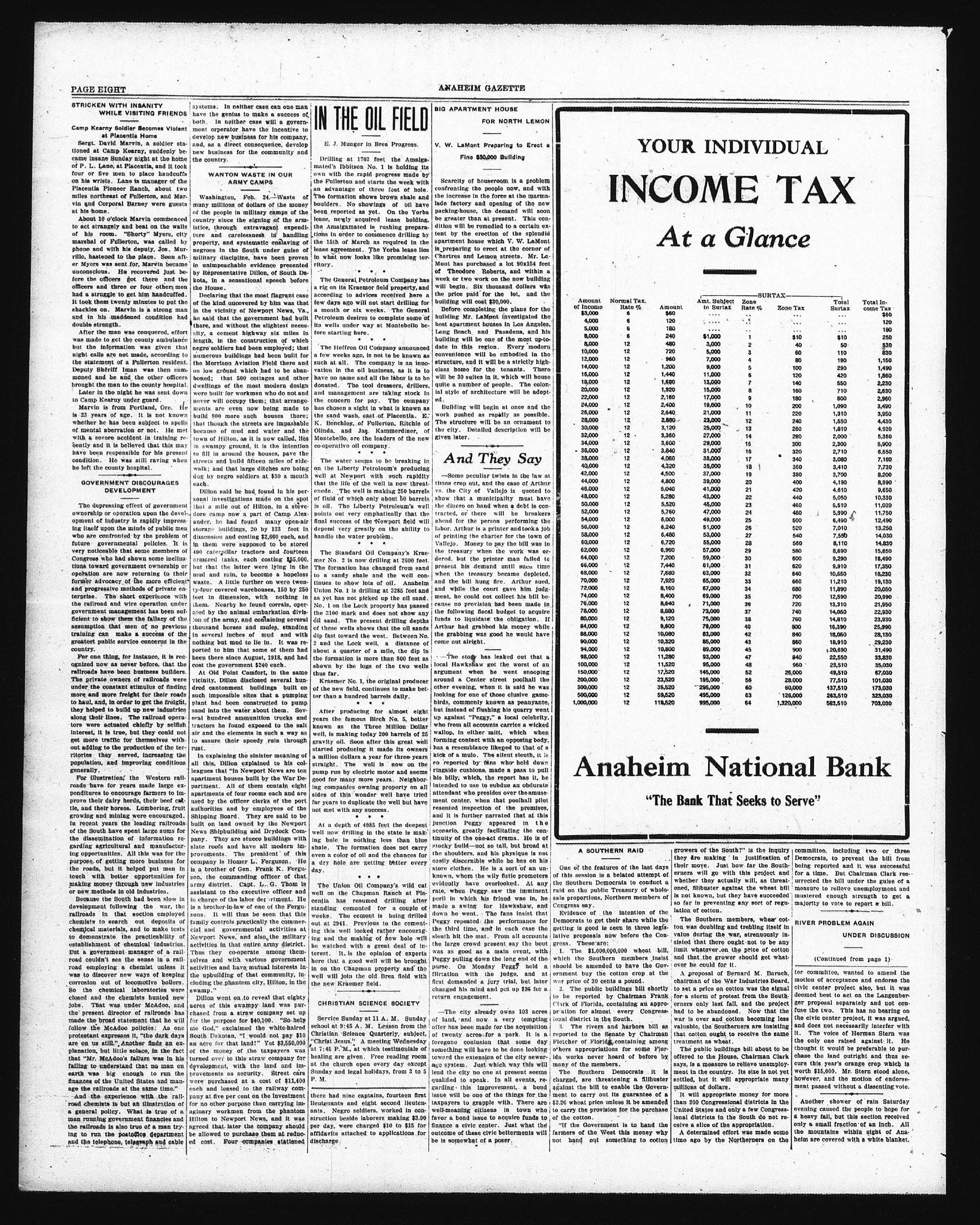
Searchable text
STRICKEN WITH INSANITY
WHILE VISITING FRIENDS
Camp Kearny Soldier Becomes Violent at Placentia Home
Sergt. David Marvin, a soldier stationed at Camp Kearny, suddenly became insane Sunday night at the home of P. L. Lane, at Placentia, and it took four or five men to place handcuffs on his wrists. Lane is manager of the Placentia Pioneer Ranch, about two miles northeast of Fullerton, and Marvin and Corporal Barney were guests at his home.
About 10 o'clock Marvin commenced to act strangely and beat on the walls of his room. "Shorty" Myers, city marshal of Fullerton, was called by phone and with his deputy, Jos. Murillo, hastened to the place. Soon after Myers was sent for, Marvin became unconscious. He recovered just before the officers got there and the officers and three or four other men had a struggle to get him handcuffed. It took them twenty minutes to put the shackles on. Marvin is a strong man and in his maddened condition had double strength.
After the man was conquered, effort was made to get the county ambulance but the information was given that night calls are not made, according to the statement of a Fullerton resident. Deputy Sherriff Iman was then summoned and he and the other officers brought the man to the county hospital.
Later in the night he was sent down to Camp Kearny under guard.
Marvin is from Portland, Ore. He is 23 years of age. It is not known whether he has been subject to spells of mental aberration or not. He met with a severe accident in training recently and it is believed that this may have been responsible for his present systems. In neither case can one man have the genius to make a success of both. In neither case will a government operator have the incentive to develop new business for his company, and, as a direct consequence, develop new business for the community and the country.
WANTON WASTE IN OUR ARMY CAMPS
Washington, Feb. 24.—Waste of many millions of dollars of the money of the people in military camps of the country since the signing of the armistice, through extravagant expenditure and carelessness in handling property, and systematic enslaving of negroes in the South under gulse of military discipline, have been proven in unimpeachable evidence presented by Representative Dillon, of South Dakota, in a sensational speech before the House.
Declaring that the most flagrant case of the kind uncovered by him was that in the vicinity of Newport News, Va., he said that the government had built there, and without the slightest necessity, a cement highway six miles in length, in the construction of which negro soldiers had been employed; that numerous buildings had been built for the Morrison Aviation Field there and on low ground which had to be abanboned; that 500 cottages and other dwellings of the most modern design were built for workmen who do not and never will occupy them; that arrangements are even now being made to build 800 more such houses; that though the streets are impassable because of mud and water and the town of Hilton, as it is now called, lies in swampy ground, it is the intention to fill in around the houses, pave the
IN THE
E. J. Munger
Drilling at 170 mated's Ibbitson own with the rapture the Fullerton and an advantage of The formation she boulders. No she been reported as lease, newly acquired Amalgamated tions in order to be the 15th of Marcel lease agreement. In what now look ritory.
The General Petra rig on its Kraem according to advice few days ago will a month or six Petroleum desires its wells under w fore starting here.
The Heffron Oil a few weeks ago, such at all. The vation in the oil have no name and donated. The to and management the concern for has chosen a sigh the sand wash, e K. Benchley, of Olinda, and Jag Montebello, are the co-operative oil co-
GOVERNMENT DISCOURAGES DEVELOPMENT
The depressing effect of government ownership or operation upon the development of industry is rapidly impressing itself upon the minds of public men who are confronted by the problem of future governmental policies. It is very noticeable that some members of Congress who had shown some inclinations toward government ownership or operation are now returning to their former advocacy of the more efficient and progressive methods of private enterprise. The short experience with the railroad and wire operation under government management has been sufficient to show them the fallacy of the assumption that men of no previous training can make a success of the greatest public service concerns in the country.
For one thing, for instance, it is recognized now as never before, that the railroads have been business builders. The private owners of railroads were under the constant stimulus of finding more and more freight for their roads to haul, and, in order to get the freight, they helped to build up new industries along their lines. The railroad operators were actuated chiefly by selfish interest, it is true, but they could not get more traffic for themselves without adding to the production of the territories they served, increasing the population, and improving conditions generally.
For illustration, the Western railroads have for years made large expenditures to encourage farmers to improve their dairy herds, their beef cattle, and their horses. Lumbering, fruit growing and mining were encouraged. In recent years the leading railroads of the South have spent large sums for the dissemination of information regarding agricultural and manufacturing opportunities. All this was for the purpose of getting more business for the Morrison Aviation Field there and on low ground which had to be abanboned; that 500 cottages and other dwellings of the most modern design were built for workmen who do not and never will occupy them; that arrangements are even now being made to build 800 more such houses there; that though the streets are impassable because of mud and water and the town of Hilton, as it is now called, lies in swampy ground, it is the intention to fill in around the houses, pave the streets and build fifteen miles of sidewalk; and that large ditches are being dug by negro soldiers at $30 a month each.
Dillon said he had found in his personal investigations made on the spot that a mile out of Hilton, in a stevedore camp now a part of Camp Alexander, he had found many open-air storage buildings, 20 by 133 feet in dimension and costing $2,660 each, and in them were supposed to be stored 400 caterpillar tractors and fourteen armored tanks, each costing $55,000, but that the latter were lying in the mud and rain, to become a hopeless waste. A little further on were twenty-four covered warehouses, 150 by 250 feet in dimension, with nothing in them. Nearby he found corrals, operated by the animal embarkation division of the army, and containing several thousand horses and mules, standing in several inches of mud and with nothing but mud to lie in. It was reported to him that some of them had been there since August, 1918, and had cost the government $240 each.
At Old Point Comfort, in the same vicinity, Dillon disclosed several hundred cantonment buildings built on such impossible sites that a pumping plant had been constructed to pump sand into the water about them. Several hundred ammunition trucks and tractors he found exposed to the salt air and the elements in such a way as to assure their speedy ruin through rust.
In explaining the sinister meaning of all this, Dillon explained to his colleagues that "in Newport News are ten apartment houses built by the War Department. All of them contain eight apartments of four rooms each and are used by the officer clerks of the port authorities and by employees of the Shipping Board. They are said to be built on land owned by the Newport News Shipbuilding and Drydock Company. They are stucco buildings with slate roofs and have all modern improvements. The president of this company is Homer L. Ferguson. He
The water seeped on the Liberty Pond well at Newport; that life of the eneade. The well of fluid of which he is oil. The Liberty points out very early success of the depend very great handle the water.
The Standard mer No. 2 is now. The formation has to a sandy shale tinues to show how Union No. 1 is dry as yet has not placed No. 1 on the Lockheed the 3100 mark and oil sand. The price of these wells shows dip fast toward the 2 and the Lockheed about a quarter of the formation is now shown by the log thus far.
Kraemer No. 1, of the new field, compared than a hundred years the famous known as the Twell, is making too gravity oil. Soon started producing a million dollars a straight. The pump run by electric good for many mooring companies own sides of this won for years to duplicate not met with any s
At a depth of 4 well now drilling hole in nooth shade. The former even a color of oil a dry hole are
For illustration, the Western railroads have for years made large expenditures to encourage farmers to improve their dairy herds, their beef cattle, and their horses. Lumbering, fruit growing and mining were encouraged. In recent years the leading railroads of the South have spent large sums for the dissemination of information regarding agricultural and manufacturing opportunities. All this was for the purpose of getting more business for the roads, but it helped put men in touch with better opportunities for making money through new industries or new methods in old industries.
Because the South had been slow in development following the war, the railroads in that section employed chemists to search out deposits of chemical materials, and to make tests to demonstrate the practicability of establishment of chemical industries. But a government manager of a railroad couldn't see the sense in a railroad employing a chemist unless it was to discover new ways of keeping corrosion out of locomotive boilers. So the chemical laboratories were closed and the chemists hunted new jobs. That was under McAdoo, and the present director of railroads has made the broad statement that he will follow the McAdoo policies: As one protestant expresses it, "the dark days are on us still." Another finds an explanation, but little solace, in the fact that "Mr. McAdoo's failure was in his falling to understand that no man on earth was big enough to run the finances of the United States and manage the railroads at the same time."
And the experience with the railroad chemists is but an illustration of a general policy. What is true of a man running government finances and the railroads is also true of a man trying to run the postoffice department and the telephone, telegraph and cable leagues that "in Newport News are ten apartment houses built by the War Department. All of them contain eight apartments of four rooms each and are used by the officer clerks of the port authorities and by employees of the Shipping Board. They are said to be built on land owned by the Newport News Shipbuilding and Drydock Company. They are stucco buildings with slate roofs and have all modern improvements. The president of this company is Homer L. Ferguson. He is a brother of Gen. Frank K. Ferguson, the commanding officer of that army district. Capt. L. G. Thom is assistant to the executive officer and in charge of the labor department. He is a brother-in-law of one of the Fergusons. It will thus be seen that this family controls practically the commercial and governmental activities at Newport News, and also, the military activities in that entire army district. Thus they co-operate among themselves and with various government activities and have mutual interests in the upbuilding of that community, including the phantom city, Hilton, in the swamp."
Dillon went on to reveal that eighty acres of this swampy land was purchased from a straw company set up for the purpose for $40,100. "So help me God," exclaimed the white-haired South Dakotan, "I would not pay $10 an acre for that land!" Yet $3,550,000 of the money of the taxpayers was turned over to this straw company for development, with the land and improvements as security. Street cars were purchased at a cost of $11,400 each and leased to the railway company at five per cent on the investment for no other purpose than carrying imaginary workmen from the phantom Hilton to Newport News, and it was agreed that later the company should be allowed to purchase them at reduced cost. Four companies stationed
IN THE OIL FIELD
E. J. Munger in Brea Progress.
Drilling at 1703 feet the Amalgamated's Ibbitson No. 1 is holding its own with the rapid progress made by the Fullerton and starts the week with an advantage of three feet of hole. The formation shows brown shale and boulders. No showings of oil have been reported as yet. On the Yorba lease, newly acquired lease holding, the Amalgamated is rushing preparations in order to commence drilling by the 15th of March as required in the lease agreement. The Yorba lease lies in what now looks like promising territory.
The General Petroleum Company has a rig on its Kraemer field property, and according to advices received here a few days ago will not start drilling for a month or six weeks. The General Petroleum desires to complete some of its wells under way at Montebello before starting here.
The Heffron Oil Company announced a few weeks ago, is not to be known as such at all. The company is an innovation in the oil business, as it is to have no name and all the labor is to be donated. The tool dressers, drillers, and management are taking stock in the concern for pay. The company has chosen a sight in what is known as the sand wash, east of Placentia. E. K. Benchley, of Fullerton, Ritchie of Olinda, and Jag. Kammordiner, of Montebello, are the leaders of the new co-operative oil company.
BIG APARTMENT HOUSE
FOR NORTH LEMON
V. W. LaMont Preparing to Erect a Fine $30,000 Building
Scarcity of houseroom is a problem confronting the people now, and with the increase in the force at the marma-lade factory and opening of the new packing-house, the demand will soon be greater than at present. This condition will be remedied to a certain extent by the erection of the splendid apartment house which V. W. LaMont is preparing to erect at the corner of Chartres and Lemon streets. Mr. LaMont has purchased a lot 90x154 feet of Theodore Roberts, and within a week or two work on the new building will begin. Six thousand dollars was the price paid for the lot, and the building will cost $30,000.
Before completing the plans for the building Mr. LaMont investigated the best apartment houses in Los Angeles, Long Beach and Pasadena, and his building will be one of the most up-to-date in this region. Every modern convenience will be embodied in the structure, and it will be a strictly high-class home for the tenants. There will be 30 suites in it, which will house quite a number of people. The colonial style of architecture will be adopted.
Building will begin at once and the work pushed as rapidly as possible. The structure will be an ornament to the city. Detailed description will be given later.
The water seems to be breaking in on the Liberty Petroleum's producing well at Newport with such rapidity that the life of the well is now threatened. The well is making 250 barrels of fluid of which only about 50 barrels is oil. The Liberty Petroleum's well points out very emphatically that the final success of the Newport field will depend very greatly on the ability to handle the water problem.
The Standard Oil Company's Kraemer No. 2 is now drilling at 2600 feet. The formation has changed from sand to a sandy shale and the well continues to show lots of oil. Anaheim Union No. 1 is drilling at 3285 feet and as yet has not picked up the oil sand. No. 1 on the Lock property has passed the 3100 mark and does not show any oil sand. The present drilling depths of these wells shows that the oil sands dip fast toward the west. Between No. 2 and the Lock well, a distance of about a quarter of a mile, the dip in the formation is more than 800 feet as shown by the logs of the two wells thus far.
Kraemer No. 1, the original producer of the new field, continues to make better than a hundred barrels daily.
After producing for almost eight years the famous Birch No. 5, better known as the Three Million Dollar well, is making today 200 barrels of 25 gravity oil. Soon after this great well started producing it made its owners a million dollars a year for three years straight. The well is now on the pump run by electric motor and seems good for many more years. Neighboring companies owning property on all sides of this wonder well have tried for years to duplicate the well but have not met with any success.
At a depth of 4985 feet the deepest well now drilling in the state is making hole in nothing less than blue shale. The formation does not carry even a color of oil and the chances for a dry hole are getting better every structure, and it will be a strictly high-class home for the tenants. There will be 30 suites in it, which will house quite a number of people. The colonial style of architecture will be adopted.
Building will begin at once and the work pushed as rapidly as possible. The structure will be an ornament to the city. Detailed description will be given later.
And They Say
Some peculiar twists in the law at times crop out, and the case of Arthur vs. the City of Vallejo is quoted to show that a municipality must have the dinero on hand when a debt is contracted, or there will be breakers ahead for the person performing the labor. Arthur is a printer and took a job of printing the charter for the town of Vallejo. Money to pay the bill was in the treasury when the work was ordered, but the printer man failed to present his demand until such time when the treasury became depleted, and the bill hung fire. Arthur sued, and while the court gave him judgment, he could not collect his bill because no provision had been made in the following fiscal budget to acquire funds to liquidate the obligation. If Arthur had grabbed his money while the grabbing was good he would have come out alright.
The story has leaked out that a local Hawkshaw got the worst of an argument when he went snooping around a Center street poolhall the other evening, when it is said he was looking for one of those elusive game-birds, commonly known as pennynante, but instead of flushing his quarry went up against "Peggy," a local celebrity, who from all accounts carries a wicked wallop, in either mitt, which when forming contact with an opposing body, has a resemblance likened to that of a kick of a mule. The silent sleuth, it is so reported by fans who held down ringside cushions, made a pass to pull his billy, which, the report has it, he intended to use to subdue an obdurate attendant who presides over the amusement center, when that poolhall pilot resented inspection of the premises, and it is further narrated that at this junction Peggy appeared in the scenario, greatly facilitating the continuity of the one-act drama. He is of stocky build—not so tall, but broad at the shoulders, and his physique is not easily discernible while he has on his
At a depth of 4985 feet the deepest well now drilling in the state is making hole in nothing less than blue shale. The formation does not carry even a color of oil and the chances for a dry hole are getting better every day.
The Union Oil Company's wild cat well on the Chapman Ranch at Placentia has resumed drilling after standing cemented for a couple of weeks. The cement is being drilled out at 2941. Previous to the cementing this well looked rather encouraging and the making of new hole will be watched with a great deal of interest. It is the opinion of experts here that a good well will be brought in on the Chapman property and the well will join the old Brea field with the new Kraemer field.
CHRISTIAN SCIENCE SOCIETY
Service Sunday at 11 A.M. Sunday school at 9:45 A.M. Lesson from the Christian Science Quarterly, subject, "Christ Jesus." A meeting Wednesday at 7:45 P.M., at which testimonials of healing are given. Free reading room at the church open every day except Sunday and legal holidays, from 3 to 5 P.M.
there had nine captains, fourteen first lieutenants and eight second lieutenants. Negro soldiers, worked in construction beside laborers making $3.00 per day, were charged $10 to $15 for affidavits attached to applications for discharge.
The city already owns 103 acres of land, and now a very tempting offer has been made for the acquisition of twenty acres for a park. It is a foregone conclusion that some day something will have to be done looking toward the extension of the city sewerage system. Just which way this will lead the city no one at present seems qualified to speak. In all events, regarding this improvement, a bond issue will be one of the things for the taxpayers to grapple with. There are well-meaning citizens in town who favor a bond issue to acquire funds to finance a civic center. Just what the outcome of these civic betterments will be is somewhat of a poser.
A SOUTHERN RAID
One of the features of the last days of this session is a belated attempt of the Southern Democrats to conduct a raid on the public Treasury of wholesale proportions, Northern members of Congress say.
Evidence of the intention of the Democrats to get their share while the getting is good is seen in three legislative proposals now before the Congress. These are:
1. The $1,000,000,000 wheat bill, which the Southern members insist should be amended to have the Government buy the cotton crop at the war price of 30 cents a pound.
2. The public buildings bill shortly to be reported by Chairman Frank Clark of Florida, containing an appropriation for almost every Congressional district in the South.
3. The rivers and harbors bill as reported to the Senate by Chairman Fletcher of Florida, containing among others appropriations for some Florida works never heard of before by many of the members.
The Southern Democrats it is charged, are threatening a filibuster against the bill to enable the Government to carry out its guarantee of a $2.26 wheat price unless it be amended to carry the provision for the purchase of the cotton.
"If the Government is to hand the farmers of the West this money why not hand out something to cotton..."
YOUR INDIVIDUAL
INCOME TAX
At a Glance
SURTAX
Normal Tax Rate % Amount Amt. Subject to Surtax Zone Rate % Zone Tax Total Surtax Total Income Tax
6 $60 ... ... ... $60
6 120 ... ... ... 120
6 180 ... ... ... 180
6 240 $1,000 1 $10 $10 250
12 480 3,000 2 40 50 530
12 720 5,000 3 60 110 830
12 960 7,000 4 80 190 1,150
12 1,200 9,000 5 100 290 1,490
12 1,440 11,000 6 120 420 1,860
12 1,680 13,000 7 140 550 2,230
12 1,920 15,000 8 160 710 2,630
12 2,160 17,000 9 180 800 2,960
12 2,400 19,000 10 200 1,090 3,490
12 2,640 21,000 11 220 1,310 3,950
12 2,880 23,000 12 240 1,550 4,430
12 3,120 25,000 13 260 1,810 4,930
12 3,360 27,000 14 280 2,000 5,360
12 3,600 29,000 15 300 2,300 5,900
12 3,840 31,000 16 320 2,710 6,550
Aheim National Bank
"The Bank That Seeks to Serve"
"The Bank That Seeks to Serve"
INTENTION OF THE COIR SHARE WHILE THE QUEEN IN THREE LEGISLATION BEFORE THE CONFEDERATE GOVERNMENT TO HAVE THE GOVT. COTTON CROP AT THE IS A Pound.
BUILDINGS BILL SHORTLY CHAIRMAN FRANK CONTAINING AN APPROACH TO EVERY CONGRESSIONAL SOUTH.
AND HARBORS BILL ASSEMBLED BY CHAIRMAN CONTAINING AMONG US FOR SOME FLOORARD OF BEFORE BY DEMOCRATS.
DEMOCRATS IT IS OPENING A FILIBUSTER MANAGEMENT GUARANTEE OF A MASSITO IT BE AMENDED FOR THE PURCHASE.
IT IS TO HAND THE MONEY WHY NOT SOMETHING TO COTTON
growers of the South?" is the inquiry they are making in justification of their move. Just how far the Southerners will go with this project and whether they actually will, as threatened, filibuster against the wheat bill is not known, but they have succeeded so far in preventing any sort of regulation of cotton.
The Southern members, when cotton was doubling and trebling itself in value during the war, strenuously insisted that there ought not to be any limit whatever on the price of cotton and that the grower should get whatever he could for it.
A proposal of Bernard M. Baruch, chairman of the War Industries Board, to set a price on cotton was the signal for a storm of protest from the Southerners only last fall, and the project had to be abandoned. Now that the war is over and cotton becoming less valuable, the Southerners are insisting that cotton ought to receive the same treatment as wheat.
The public buildings bill about to be offered to the House, Chairman Clark says, is a measure to relieve unemployment in the country. Its size is not yet settled, but it will appropriate many millions of dollars.
It will appropriate money for more than 200 Congressional districts in the United States and only a few Congressional districts in the South do not receive a slice of the appropriation.
A determined effort was made some time ago by the Northerners on the committee, including two or three Democrats, to prevent the bill from being reported and it was successful for a time. But Chairman Clark resurrected the bill under the guise of a measure to relieve unemployment and mustered enough strength to get a majority to vote to report a bill.
RIVER PROBLEM AGAIN UNDER DISCUSSION
(Continued from page 1)
ter committee, wanted to amend the motion of acceptance and endorse the civic center project also, but it was deemed best to act on the Langenberger proposal separately and not confuse the two. This has no bearing on the civic center project, it was argued, and does not necessarily interfere with it. The voice of Herman Stern was the only one raised against it. He thought it would be preferable to purchase the land outright and thus secure this year's orange crop which is worth $15,000. Mr. Stern stood alone, however, and the motion of endorsement passed without a dissenting vote.
Another shower of rain Saturday evening caused the people to hope for a heavy fall, but this section received only a small fraction of an inch. All the mountains within sight of Anaheim are covered with a white blanket.