anaheim-gazette 1919-02-06
Scanned page
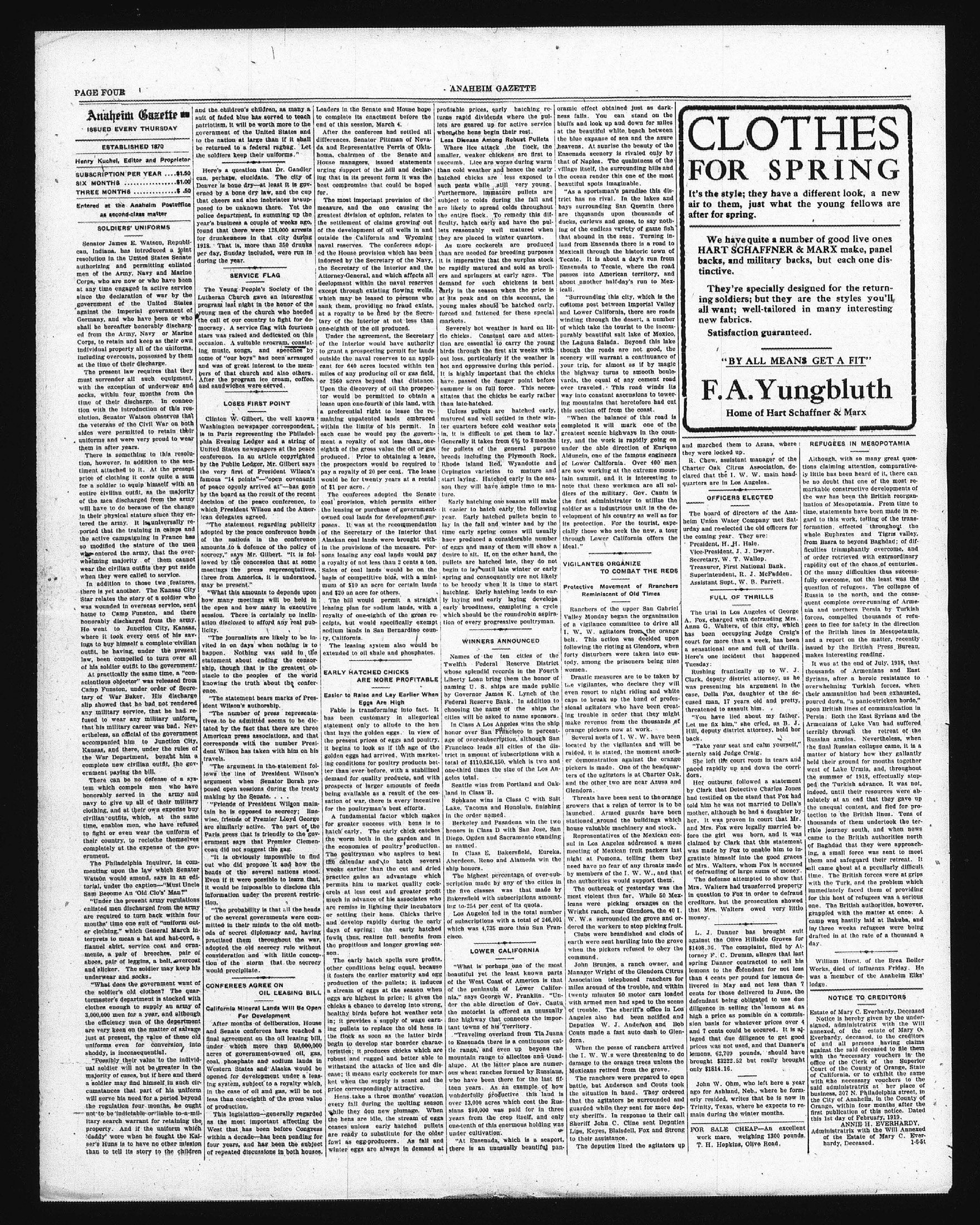
Searchable text
Anaheim Gazette
ISSUED EVERY THURSDAY
ESTABLISHED 1870
Henry Kuchel, Editor and Proprietor
SUBSCRIPTION PER YEAR ... $1.50
SIX MONTHS ... $1.00
THREE MONTHS ... $ .50
Entered at the Anaheim Postoffice as second-class matter
SOLDIERS' UNIFORMS
Senator James E. Watson, Republican, Indiana, has introduced a joint resolution in the United States Senate authorizing and permitting enlisted men of the Army, Navy and Marine Corps, who are now or who have been at any time engaged in active service since the declaration of war by the government of the United States against the Imperial government of Germany, and who have been or who shall be hereafter honorably discharged from the Army, Navy or Marine Corps, to retain and keep as their own individual property all of the uniforms, including overcoats, possessed by them at the time of their discharge.
The present law requires that they must surrender all such equipment, with the exception of underwear and socks, within four months from the time of their discharge. In connection with the introduction of this resolution, Senator Watson observes that the veterans of the Civil War on both sides were permitted to retain their uniforms and were very proud to wear them in after years.
There is something to this resoluand the children's children, as many a suit of faded blue has served to teach patriotism, it will be worth more to the government of the United States and to the nation at large than if it shall be returned to a federal ragbag. Let the soldiers keep their uniforms."
Here's a question that Dr. Gandler can, perhaps, elucidate. The city of Denver is bone dry—at least it is governed by a bone dry law, and the cup that cheers and also inebriates is supposed to be unknown there. Yet the police department, in summing up the year's business a couple of weeks ago, found that there were 128,000 arrests for drunkenness in that city during 1918. That is, more than 350 drunks per day, Sunday included, were run in during the year.
SERVICE FLAG
The Young People's Society of the Lutheran Church gave an interesting program last night in the honor of the young men of the church who heeded the call of our country to fight for democracy. A service flag with fourteen stars was raised and dedicated on this occasion. A suitable program, consisting music, songs, and speeches by some of "our boys" had been arranged and was of great interest to the members of that church and also others. After the program ice cream, coffee, and sandwiches were served.
LOSES FIRST POINT
Clinton W. Gilbert, the well known Washington newspaper correspondent, is in Paris representing the Philadelphia Evening Ledger and a string of United States newspapers at the peace conference. In an article copyrighted
Leaders in the Sect to complete its end of this session.
After the confidences, Senda and Representahoma, chairmen of House managers urging support owing that in its pristine compromises for.
The most important measure, and the greatest division in the settlement of the development outside the Califnaval reserves,
ed the House preindorsed by the Sectory oi Attorney-General development with except through which may be sank them, provinat a royalty to tary of the Int'l one-eighth of tha
Under the age of the Interior to grant a prospose outside the naval cant for 640 acmiles of any preor 2560 acres l Upon the discoverer would be lease upon one-t
a preferential mainaining unpatched within the limite each case he ment a royalty eighth of the gr
produced Pri
The present law requires that they must surrender all such equipment, with the exception of underwear and socks, within four months from the time of their discharge. In connection with the introduction of this resolution, Senator Watson observes that the veterans of the Civil War on both sides were permitted to retain their uniforms and were very proud to wear them in after years.
There is something to this resolution, however, in addition to the sentiment attached to it. At the present price of clothing it costs quite a sum for a soldier to equip himself with an entire civilian outfit, as the majority of the men discharged from the army will have to do because of the change in their physical stature since they entered the army. It is universally reported that the training in camps and the active campaigning in France has so modified the stature of the men who entered the army, that the overwhelming majority of them cannot wear the civilian outfits they put aside when they were called to service.
In addition to those two features, there is yet another. The Kansas City Star relates the story of a soldier who was wounded in overseas service, sent home to Camp Funston, and there honorably discharged from the army. He went to Junction City, Kansas, where it took every cent of his savings to buy himself a complete civilian outfit, he having, under the present law, been compelled to turn over all of his soldier outfit to the government:
At practically the same time, a "conscientious objector" was released from Camp Funston, under order of Secretary of War Baker. His discharge slip showed that he had not rendered any military service, that he had refused to wear any military uniform, that his military career was bad. Nevertheless, an official of the government accompanied him to Junction City, Kansas, and there, under the rules of the War Department, bought him a complete new civilian outfit, the government paying the bill.
There can be no defense of a system which compels men who have honorably served in the army and navy to give up all of their military clothing, and at their own expense buy civilian outfits, which, at the same time, enables men, who have refused to fight or even wear the uniform of their country, to reclothe themselves completely at the expense of the government.
The Philadelphia Inquirer, in com-
LOSES FIRST POINT
Clinton W. Gilbert, the well known Washington newspaper correspondent, is in Paris representing the Philadelphia Evening Ledger and a string of United States newspapers at the peace conference. In an article copyrighted by the Public Ledger, Mr. Gilbert says the very first of President Wilson's famous "14 points"—"open covenants of peace openly arrived at"—has gone by the board as the result of the recent decision of the peace conference, to which President Wilson and the American delegates agreed.
"The statement regarding publicity adopted by the peace conference heads of the nations in the conference amounts to a defence of the policy of secrecy," says Mr. Gilbert. "It is followed by the concession that at some meetings the press representatives, three from America, it is understood, may be present."
"What this amounts to depends upon how many meetings will be held in the open and how many in executive session. There is certainly no inclination disclosed to afford any real publicity."
"The journalists are likely to be invited in on days when nothing is to happen. Nothing was said in the statement about ending the censorship, though that is the greatest obstacle to the peoples of the world knowing the truth about the conference.
"The statement bears marks of President Wilson's authorship.
"The number of press representatives to be admitted seems to be dictated by the fact that there are three American press associations, and that corresponds with the number President Wilson has taken with him on his travels.
"The argument in the statement follows the line of President Wilson's argument when Senator Borah proposed open sessions during the treaty making by the Senate.
"Friends of President Wilgon maintain he is opposed to secrecy; linewise, friends of Premier Lloyd George are similarly active. The part of the Paris press that is friendly to the government says that Premier Clemenceau did not suggest the gag.
"It is obviously impossible to find out who did propose it and how she and was of great interest to the members of that church and also others. After the program ice cream, coffee, and sandwiches were served."
There can be no defense of a system which compels men who have honorably served in the army and navy to give up all of their military clothing, and at their own expense buy civilian outfits, which, at the same time, enables men, who have refused to fight or even wear the uniform of their country, to reclothe themselves completely at the expense of the government.
The Philadelphia Inquirer, in commenting upon the law which Senator Watson would amend, says in an editorial, under the caption—"Must Uncle Sam Become An 'Old Clo's' Man?"
"Under the present army regulations enlisted men discharged from the army are required to turn back within four months' time one suit of "uniform outer clothing," which General March interprets to mean a hat and hat-cord, a flannel shirt, service coat and ornaments, a pair of breeches, pair of shoes, pair of leggins, a belt, overcoat and slicker. The soldier may keep his underwear and socks.
"What does the government want of the soldier's old clothes? The quartermaster's department is stocked with clothes enough to supply an army of 3,000,000 men for a year, and although the efficiency men of the department are very keen on the matter of salvage just at present, the value of these old uniforms even for conversion into shoddy, is inconsequential.
"Possibly their value to the individual soldier will not be greater in the majority of cases, but if here and there a soldier may find himself in such circumstances that part of his uniform will serve his need for a period beyond the regulation four months, he ought not to be indictable or liable to a military search warrant for retaining the property. And if the uniform which 'daddy' wore when he fought the Kaiser's Huns is to have no other mission than to tell its story to the children lowers the line of President Wilson's argument when Senator Borah proposed open sessions during the treaty making by the Senate.
"Friends of President Wilgon maintain he is opposed to secrecy; linewise, friends of Premier Lloyd George are similarly active. The part of the Paris press that is friendly to the government says that Premier Clemenceau did not suggest the gag.
"It is obviously impossible to find out who did propose it and how the heads of the several nations stood. Even if it were possible to learn that, it would be impossible to disclose this information under the present restriction.
"The probability is that all the heads of the several governments were committed in their minds to the old methods of secret diplomacy and, having practised them throughout the war, adopted the old secrecy rule without consideration and with little conception of the storm that the secrecy would precipitate."
CONFEREES AGREE ON OIL LEASING BILL
California Mineral Lands Will Be Open For Development
After months of deliberation, House and Senate conferees have reached a final agreement on the oil leasing bill, under which more than 50,000,000 acres of government-owned oil, gas, coal, phosphate and sodium lands in Western States and Alaska would be opened for development under a leasing system, subject to a royalty which, in the case of oil and gas, will be not less than one-eighth of the gross value of production.
This legislation—generally regarded as the most important affecting the West that has been before Congress within a decade—has been pending for four years, and has been the subject of repeated discussions in both houses.
A fundament for greater safety early, the worm boots economies. The poultry rises the calendar weeks earlier practice gains permits him erals at less much in advantage are remiss in or setting tha and develop days of spring fowls thus. re the propitious son.
The early other condition it fosters the production o stream of eggs are high chicks a change healthy birds in; it providing pullets to the flock as begin to develop characteristics; it p robust and re withstand th ease; it means ket when the price corresponde.
Hens take every fall du while they d hens are ceases unless are ready to fowl as egg winter eggs.
ANAHEIM GAZETTE
many a man to teach the states and it shall bring. Let us."
Gandler city of it is governed by the cup is supposed.
Yet the up the weeks ago, arrests during drunks run in.
y of the interesting horror of the heeded it for fourteen and on this consistaches by arranged the memoir others, coffee,
will known respondent, Philadelphi string of the peace copyrighted.
Leaders in the Senate and House hope to complete its enactment before the end of this session, March 4.
After the conferees had settled all differences, Senator Pittman of Nevada and Representative Ferris of Oklahoma, chairmen of the Senate and House managers, issued statements urging support of the bill and declaring that in its present form it was the best compromise that could be hoped for.
The most important provision of the measure, and the one causing the greatest division of opinion, relates to the settlement of claims growing out of the development of oil wells in and outside the California and Wyoming naval reserves. The conferees adopted the House provision which has been indorsed by the Secretary of the Navy, the Secretary of the Interior and the Attorney-General, and which affects all development within the naval reserves except through existing flowing wells, which may be leased to persons who sank them, providing no fraud exists, at a royalty to be hired by the Secretary of the Interior at not less than one-eighth of the oil produced.
Under the agreement, the Secretary of the Interior would have authority to grant a prospecting permit for lands outside the naval reserves to an applicant for 640 acres located within ten miles of any producing oil or gas field, or 2560 acres beyond that distance. Upon the discovery of oil the prospector would be permitted to obtain a lease upon one-fourth of this land, with a preferential right to lease the remaining unpatented lands embraced within the limits of his permit. In each case he would pay the government a royalty of not less than one-eighth of the gross value of the oil or gas produced. Prior to obtaining a lease,
profitable prices, early hatching returns rapid dividends where the pullets are geared up for active service when the hens begin their rest.
Less Disease Among Robust Pullets
Where lice attack the flock, the smaller, weaker chickens are first to succumb. Lice are worse during warm than cold weather and hence the early hatched chicks are less exposed to such pests while still very young. Furthermore, immature pullets are subject to colds during the fall and are likely to spread colds throughout the entire flock. To remedy this difficulty, hatch early and have the pullets reasonably well matured when they are placed in winter quarters.
As more cockerels are produced than are needed for breeding purposes it is imperative that the surplus stock be rapidly matured and sold as broilers and springers at early ages. The demand for such chickens is best early in the season when the price is at its peak and on this account, the young males should be hatched early, forced and fattened for these special markets.
Severely hot weather is hard on little chicks. Constant care and attention are essential to carry the young birds through the first six weeks without loss, particularly if the weather is hot and oppressive during this period. It is highly important that the chicks have passed the danger point before summer is on full force. This necessitates that the chicks be early rather than late-hatched.
Unless pullets are hatched early, matured and well settled in their winter quarters before cold weather sets in, it is difficult to get them to lay. Generally it takes from 6½ to 8 months for pullets of the general purpose breeds including the Plymouth Rock,
oramic effect obtained just as darkness falls. You can stand on the bluffs and look up and down for miles at the beautiful white beach between the blue expanse of sea and the azure heavens. At sunrise the beauty of the Ensenada scenery is rivaled only by that of Naples. The quaintness of the village itself, the surrounding hills and the ocean render this one of the most beautiful spots imaginable.
"As a sportsman's paradise this district has no rival. In the lakes and bays surrounding San Quentin there are thousands upon thousands of ducks, curlews and geese, to say nothing of the endless variety of game fish that abound in the seas. Turning inland from Ensenada there is a road to Mexicali through the historic town of Tecate. It is about a day's run from Ensenada to Tecate, where the road passes into American territory, and about another half-day's run to Mexicali.
"Surrounding this city, which is the customs post between Imperial Valley and Lower California, there are roads winding through the desert, a number of which take the tourist to the incomparably beautiful salt lake of Mexico, the Laguna Salada. Beyond this lake though the roads are not good, the scenery will warrant a continuance of your trip, for almost as if by magic the highway turns to smooth boulevards, the equal of any cement road ever traveled. This road winds its way into constant ascensions to towering mountains that heretofore had cut this section off from the coast.
"When the balance of this road is completed it will mark one of the greatest scenic highways in the country, and the work is rapidly going on under the able direction of Enrique Alduncan, one of the famous engineers."
All known respondent, Philadelphi string of the peace copyrighted Robert says Wilson's coovenants has gone the recent reference to the Amerpublicity heads conference policy of "It is foll at some sentatives understood,
ends upon held in executive no inclin real pubto be inning is to hold in the censor greatest obj the world the conferkks of Presrepresenta to be dic are three and thatuber Presi him on his
Element follt Wilson's Borah prothe treaty
Algon mainecy; lineoyd George part of the to the gover Clemengole to find and how the
EARLY HATCHED CHICKS ARE MORE PROFITABLE
Easier to Raise and Lay Earlier When Eggs Are High
Fable is transforming into fact. It has been customary in allegorical statement only to allude to the ben that lays the golden eggs. In view of the present prices of eggs and poultry, it begins to look as if the age of the golden eggs had arrived. With marketing conditions for poultry products better than ever before, with a stabilized demand for quality products, and with prospects of larger amounts of feeds being available as a result of the cessation of war, there is every incentive for the poultryman's best efforts.
A fundamental factor which makes for greater success with hens is to hatch early. The early chick catches the worm both in the garden and in the economies of poultry production. The poultryman who aspires to beat the calendar and to hatch several cant for 640 acres located within ten miles of any producing oil or gas field, or 2560 acres beyond that distance. Upon the discovery of oil the prospector would be permitted to obtain a lease upon one-fourth of this land, with a preferential right to lease the remaining unpatented lands embraced within the limits of his permit. In each case he would pay the government a royalty of not less than one-eighth of the gross value the oil or gas produced. Prior to obtaining a lease, the prospectors would be required to pay a royalty of 20 per cent. The lease would be for twenty years at a rental of $1 per acre.
The conferees adopted the Senate coal provision, which permits either the leasing or purchase of government-owned coal lands for development purposes. It was at the recommendation of the Secretary of the Interior that Alaskan coal lands were brought within the provisions of the measure. Persons leasing any coal lands would pay a royalty of not less than 2 cents a ton. Sales of coal lands would be on the basis of competitive bids, with a minimum of $10 an acre for certain lands and $20 an acre for others.
The bill would permit a straight leasing plan for sodium lands, with a royalty of one-eighth of the gross receipts, but would specifically exempt sodium lands in San Bernardino county, California.
The leasing system also would be extended to oil shale and phosphates.
EARLY HATCHED CHICKS ARE MORE PROFITABLE
Easier to Raise and Lay Earlier When Eggs Are High
Fable is transforming into fact. It has been customary in allegorical statement only to allude to the ben that lays the golden eggs. In view of the present prices of eggs and poultry, it begins to look as if the age of the golden eggs had arrived. With marketing conditions for poultry products better than ever before, with a stabilized demand for quality products, and with prospects of larger amounts of feeds being available as a result of the cessation of war, there is every incentive for the poultryman's best efforts.
A fundamental factor which makes for greater success with hens is to hatch early. The early chick catches the worm both in the garden and in the economies of poultry production. The poultryman who aspires to beat the calendar and to hatch several cant for 640 acres located within ten miles of any producing oil or gas field, or 2560 acres beyond that distance. Upon the discovery of oil the prospector would be permitted to obtain a lease upon one-fourth of this land, with a preferential right to lease the remaining unpatented lands embraced within the limits of his permit. In each case he would pay the government a royalty of not less than one-eighth of the gross value the oil or gas produced. Prior to obtaining a lease, the prospectors would be required to pay a royalty of 20 per cent. The lease would be for twenty years at a rental of $1 per acre.
The conferees adopted the Senate coal provision, which permits either the leasing or purchase of government-owned coal lands for development purposes. It was at the recommendation of the Secretary of the Interior that Alaskan coal lands were brought within the provisions of the measure. Persons leasing any coal lands would pay a royalty of not less than 2 cents a ton. Sales of coal lands would be on the basis of competitive bids, with a minimum of $10 an acre for certain lands and $20 an acre for others.
The bill would permit a straight leasing plan for sodium lands, with a royalty of one-eighth of the gross receipts, but would specifically exempt sodium lands in San Bernardino county, California.
The leasing system also would be extended to oil shale and phosphates.
EARLY HATCHED CHICKS ARE MORE PROFITABLE
Easier to Raise and Lay Earlier When Eggs Are High
Fable is transforming into fact. It has been customary in allegorical statement only to allude to the ben that lays the golden eggs. In view of the present prices of eggs and poultry, it begins to look as if the age of the golden eggs had arrived. With marketing conditions for poultry products better than ever before, with a stabilized demand for quality products, and with prospects of larger amounts of feeds being available as a result of the cessation of war, there is every incentive for the poultryman's best efforts.
A fundamental factor which makes for greater success with hens is to hatch early. The early chick catches the worm both in the garden and in the economies of poultry production. The poultryman who aspires to beat the calendar and to hatch several cant for 640 acres located within ten miles of any producing oil or gas field, or 2560 acres beyond that distance. Upon the discovery of oil the prospector would be permitted to obtain a lease upon one-fourth of this land, with a preferential right to lease the remaining unpatented lands embraced within the limits of his permit. In each case he would pay the government a royalty of not less than one-eighth of the gross value the oil or gas produced. Prior to obtaining a lease, the prospectors would be required to pay a royalty of 20 per cent. The lease would be for twenty years at a rental of $1 per acre.
The conferees adopted the Senate coal provision, which permits either the leasing or purchase of government-owned coal lands for development purposes. It was at the recommendation of the Secretary of the Interior that Alaskan coal lands were brought within the provisions of the measure. Persons leasing any coal lands would pay a royalty of not less than 2 cents a ton. Sales of coal lands would be on the basis of competitive bids, with a minimum of $10 an acre for certain lands and $20 an acre for others.
The bill would permit a straight leasing plan for sodium lands, with a royalty of one-eighth of the gross receipts, but would specifically exempt sodiumlands in San Bernardino county, California.
The leasing system also would be extended to oil shale and phosphates.
EARLY HATCHED CHICKS ARE MORE PROFITABLE
Easier to Raise and Lay Earlier When Eggs Are High
Fable is transforming into fact. It has been customary in allegorical statement only to allude to the ben that lays the golden eggs. In view of the present prices of eggs and poultry, it begins to look as if the age of the golden eggs had arrived. With marketing conditions for poultry products better than ever before, with a stabilized demand for quality products, and with prospects of larger amounts of feeds being available as a result of the cessation of war, there is every incentive for the poultryman's best efforts.
A fundamental factor which makes for greater success with hens is to hatch early. The early chick catches the worm both in the garden and in the economies of poultry production. The poultryman who aspires to beat the calendar and to hatch several cant for 640 acres located within ten miles of any producing oil or gas field, or 2560 acres beyond that distance. Upon the discovery of oil the prospector would be permitted to obtain a lease upon one-fourth of this land, with a preferential right to lease the remaining unpatented lands embraced within the limits of his permit. In each case he would pay the government a royalty of not less than one-eighth of the gross value the oil or gas produced. Prior to obtaining a lease, the prospectors would be required to pay a royalty of 20 per cent. The lease would be for twenty years at a rental of $1 per acre.
The conferees adopted the Senate coal provision, which permits either the leasing or purchase of government-owned coal lands for development purposes. It was at the recommendation of the Secretary of the Interior that Alaskan coal lands were brought within the provisions of the measure. Persons leasing any coal lands would pay a royalty of not less than 2 cents a ton. Sales of coal lands would be on the basis of competitive bids, with a minimum of $10 an acre for certain lands and $20 an acre for others.
The bill would permit a straight leasing plan for sodium lands, with a royalty of one-eighth of the gross receipts, but would specifically exempt sodiumlands in San Bernardino county, California.
The leasing system also would be extended to oil shale and phosphates.
VIGILANTES ORGANIZE TO COMBAT THE REDS
Protective Movement of Ranchers Reminiscent Of Old Times
Ranchers of the upper San Gabriel Valley Monday began the organization of a vigilance committee to drive all I.W.W. agitators from the orange belt. This action was decided upon following rioting at Glendora, when forty disturbers were taken into custody among prisoners being nine women.
Drastic measures are to be taken by these vigilantes, who declare they will even resort to night riding and white caps to break up the band of professional agitators who have been creating trouble in order that they might make revenue from the thousands of orange pickers now at work.
Several nests of I.W.W. have been located by these vigilantes and will be raided, it is stated,the moment another demonstration againstthe orange pickers is made. Oneofthe headquartersoftheagitatorsisatCharterOak,andtheothertwoarenearAzusaandGlendora.
Threats have been sent tothe orange growers thata reignofterroristobelaunched.Aarmedguardshavebeenstationedaroundthebuildingswhichhousevaluablemachineryandstock.
RepresentativesoftheMexicanconsidertInLosAngelesaddressedamassmeetingofMexicanfruitpackerslastnightatPomona,tellingthemtheyneedhaveno fearofany threatsmade
Wilson's Borah protect the treaty
Gon mainecy; linedy George
part of the
to the gover Clemeng.
to find how the
cons stood.
learn that,
disclose this
sent restriction.
the heads
were come old methand, having
at the war,
rule without
battle concepthe secrecy
BING BILL
Will Be Open
tion, House
reached a leasvalty which,
will be not
gross value
only regarded affecting the
Congress spending for
the subject both houses.
The early hatch spells sure profits,
other conditions being equal, because it fosters the earlier maturity and egg production of the pullets; it induces a stream of eggs at the season when eggs are highest in price; it gives the chicks a chance to develop into strong, healthy birds before hot weather sets in; it provides a supply of wage earning pullets to replace the old hens in the flock as soon as the latter birds begin to develop star boarder characteristics; it produces chicks which are robust and rugged and better able to withstand the attacks of lice and disease; it means early cockerels for market when the supply is scant and the price correspondingly attractive.
Hens take a three months' vacation every fall during the molting season while they don new plumage. When the hens are idle, the stream of eggs ceases unless early hatched pullets are ready to substitute for the older fowl as egg-producers. As fall and winter eggs are always in demand at one-third times the size of the Los Angeles total.
Seattle wins from Portland and Oakland in Class B.
Spbkane wins in Class C with Salt Lake, Tacoma and Honolulu, finishing in the order named.
Berkeley and Pasadena win the two honors in Class D with San Jose, San Diego, Ogden and Sacramento standing as named.
In Class E, Bakersfield, Eureka, Aberdeen, Reno and Alameda win the ship honors.
The highest percentage of over-subscription made by any of the cities in the five classes was that made by Bakersfield with subscriptions amounting to 254 per cent of its quota.
Los Angeles led in the total number of subscriptions with a total of 246,001 which was 4,735 more than San Francisco.
LOWER CALIFORNIA
"What is perhaps one of the most beautiful yet the least known parts of the West Coast of America is that of the peninsula of Lower California," says George W. Franklin. "Under the able direction of Gov. Cantu the motorist is offered an unusually fine highway that connects the important towns of his Territory.
"Traveling overland from Tia Juana to Ensenada there is a continuous cattle range, and even up beyond the mountain range to allecitos and Guadalupe. At the latter place are numerous wheat ranches formed by Russians, who have been there for the last fifteen years. As an example, of how wonderfully productive this land is over 13,000 acres which cost the Russians $90,000 was paid for in three years from the crop itself, and only one-tenth of this enormous holding was under cultivation.
"At Ensenada, which is a seaport, there is an unusually beautiful pan-
Threats have been sent to the orange growers that a reign of terror is to be launched. Armed guards have been stationed around the buildings which house valuable machinery and stock.
Representatives of the Mexican consul in Los Angeles addressed a mass meeting of Mexican fruit packers last night at Pomona, telling them they need have no fear of any threats made by members of the I. W. W., and that the authorities would support them.
The outbreak of yesterday was the most violent thus far. While 50 Mexicans were picking oranges on the Wright ranch, near Glendora, the 40 I. W. W.s surrounded the grove and ordered the workers to stop picking fruit.
Clubs were brandished and clods of earth were sent hurtling into the grove when the pickers refused to obey the command.
John Brunjes, a ranch owner, and Manager Wright of the Glendora Citrus Association telephoned ranchers for miles around of the trouble, and within twenty minutes 50 motor cars loaded with armed men had sped to the scene of trouble. The sheriff's office in Los Angeles also had been notified and Deputies W. J. Anderson and Bob Couts made a fast auto dash to Glendora.
When the posse of ranchers arrived I. W. W.s were threatening to do damage to the orange trees unless the Mexicans retired from the grove.
The ranchers were prepared to open battle, but Anderson and Couts took the situation in hand. They ordered that the agitators be surrounded and guarded while they sent for more deputy sheriffs. In response to their call Sheriff John C. Cline sent Deputies Lips, Keyes, Blaisdell, Fox and Strong to their assistance.
The deputies lined the agitators up
CLOTHES FOR SPRING
It's the style; they have a different look, a new air to them, just what the young fellows are after for spring.
We have quite a number of good live ones HART SGHAFFNER & MARX make, panel backs, and military backs, but each one distinctive.
They're specially designed for the returning soldiers; but they are the styles you'll all want; well-tailored in many interesting new fabrics.
Satisfaction guaranteed.
"BY ALL MEANS GET A FIT"
F.A.Yungbluth
Home of Hart Schaffner & Marx
and marched them to Azusa, where they were locked up.
R. Chew, assistant manager of the Charter Oak Citrus Association, declared that the I. W. W. main headquarters are in Los Angeles.
OFFICERS ELECTED
The board of directors of the Anaheim Union Water Company met Saturday and re-elected the old officers for the coming year. They are:
President, H. H. Hale.
Vice-President, J. J. Dwyer.
Secretary, W. T. Wallop.
Treasurer, First National Bank.
Superintendent, R. J. McFadden.
Assistant Supt., W. B. Parrett.
FULL OF THRILLS
The trial in Los Angeles of George A. Fox, charged with defrauding Mrs. Anna G. Walters, of this city, which has been occupying Judge Craig's court for more than a week, has been a sensational one and full of thrills. Here's one incident that happened Tuesday:
Rushing frantically up to W. J. Clark, deputy district attorney, as he was presenting his argument in the case, Della Fox, daughter of the accused man, 17 years old and pretty, threatened to assault him.
"You have lied about my father. Let me fix him," she cried, as B. J. Hill, deputy district attorney, held her back.
"Take your seat and calm yourself," sternly said Judge Craig.
She left the court room in tears and paced rapidly up and down the corridors.
Her outburst followed a statement by Clark that Detective Charles Jones had testified on the stand that Fox had told him he was not married to Della's mother, although he had a daughter by her. It was proven in court that Mr. and Mrs. Fox were legally married before the girl was born, and it was claimed by Clark that this statement was made by Fox to enable him to gratify himself into the good graces of Mrs. Walters whom Fox is accused of all these things.
REFUGEES IN MESOPOTAMIA
Although, with so many great questions claiming attention, comparatively little has been heard of it, there can be no doubt that one of the most remarkable constructive developments of the war has been the British reorganization of Mesopotamia. From time to time, statements have been made in regard to this work, telling of the transformation effected throughout the whole Euphrates and Tigris valley, from Basra to beyond Baghdad; of difficulties triumphantly overcome, and of order retrieved with extraordinary rapidity out of the chaos of centuries. Of the many difficulties thus successfully overcome, not the least was the question of refugees. The collapse of Russia to the north, and the consequent complete over-running of Armenia and northern Persia by Turkish forces, compelled thousands of refugees to flee for safety in the direction of the British lines in Mesopotamia, and a report on the matter, recently issued by the British Press Bureau, makes interesting reading.
It was at the end of July, 1918, that thousands of Armenians and East Syrians, after a heroic resistance to overwhelming Turkish forces, when their ammunition had been exhausted, poured down, "a panic-stricken horde," upon British lines of communication in Persia. Both the East Syrians and the Armenians of Lake Van had suffered terribly through the retreat of the Russian armies. Nevertheless, when the final Russian collapse came, it is a matter of history how they gallantly held their ground for months together west of Lake Urmia, and, throughout the summer of 1918, effectively stopped the Turkish advance. It was not indeed, until their resources were absolutely at an end that they gave up the unequal contest, and fled for protection to the British lines. Tens of thousands of them undertook the terrible journey south, and when news came to the British authorities north of Baghdad that they were approaching, a small force was sent to meet them and safeguard their retreat.
Her outburst followed a statement by Clark that Detective Charles Jones had testified on the stand that Fox had told him he was not married to Della's mother, although he had a daughter by her. It was proven in court that Mr. and Mrs. Fox were legally married before the girl was born, and it was claimed by Clark that this statement was made by Fox to enable him to ingrate himself into the good graces of Mrs. Walters, whom Fox is accused of defrauding of large sums of money.
The defense attempted to show that Mrs. Walters had transferred property in question to Fox in order to defraud creditors, but the prosecution showed that Mrs. Walters owed very little money.
L. J. Danner has brought suit against the Olive Hillside Groves for $1408.36. The complaint, filed by Attorney F. C. Drumm, alleges that last spring Danner contracted to sell his lemons to the defendant for not less than 4 cents per pound for lemons delivered in May and not less than 7 cents for those delivered in June, the defendant being obligated to use due diligence in selling the lemons at high a price as possible on a commission basis for whatever prices over 4 and 7 cents could be secured. It is alleged that due diligence to get good prices was not used, and that Danner's lemons, 62,709 pounds, should have brought $3222.52 but really brought only $1814.16.
John W. Ohm, who left here a year ago for Ashland, Neb., where he formerly resided, writes that he is now in Trinity, Texas, where he expects to remain during the winter months.
FOR SALE CHEAP—An excellent work mare, weighing 1300 pounds. T. H. Hopkins, Olive Road.
NOTICE TO CREDITORS
Estate of Mary C. Everhardy, Deceased
Notice is hereby given by the undersigned, administratrix with the Will annexed, of the estate of Mary O. Everhardy, deceased, to the creditors of and all persons having claims against the said deceased to file them with the necessary vouchers in the office of the Clerk of the Superior Court of the County of Orange, State of California, or to exhibit the same with the necessary vouchers to the said administratrix at her place of business, 307 N. Philadelphia street, in the City of Anaheim, in the County of Orange, within four months after the first publication of this notice. Dated this 1st day of February, 1919.
ANNIE H. EVERHARDY,
Administratrix with the Will Annexed
of the Estate of Mary C. Everhardy, Deceased.
1-6-5t