anaheim-gazette 1919-02-06
Scanned page
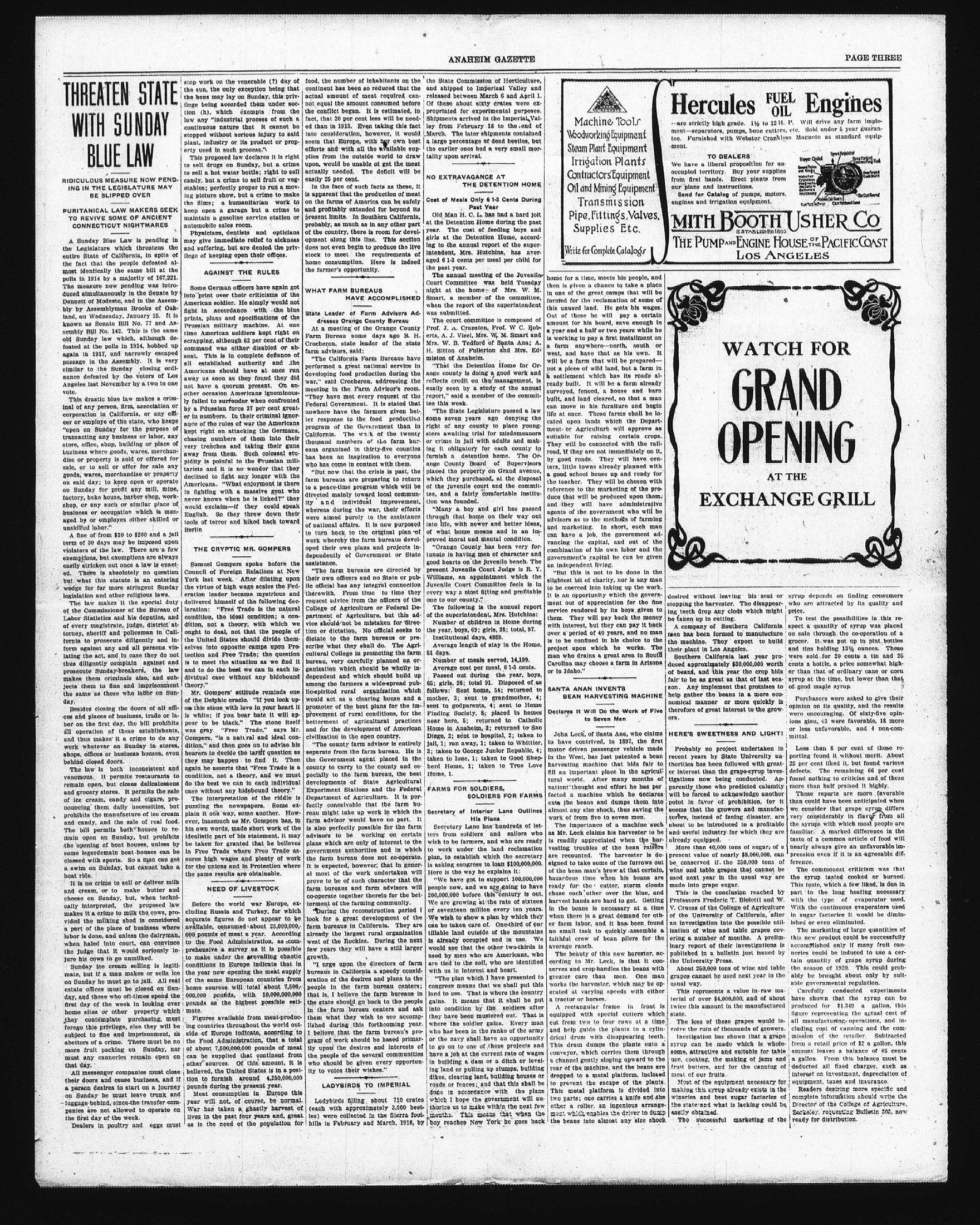
Searchable text
THREATEN STATE WITH SUNDAY BLUE LAW
RIDICULOUS MEASURE NOW PENDING IN THE LEGISLATURE MAY BE SLIPPED OVER
PURITANICAL LAW MAKERS SEEK TO REVIVE SOME OF ANCIENT CONNECTICUT NIGHTMARES
A Sunday Blue Law is pending in the Legislature which threatens the entire State of California, in spite of the fact that the people defeated almost identically the same bill at the polls in 1914 by a majority of 167,221. The measure now pending was introduced simultaneously in the Senate by Dennett of Modesto, and in the Assembly by Assemblyman Brooks of Oakland, on Wednesday, January 15. It is known as Senate Bill No. 77 and Assembly Bill No. 142. This is the same old Sunday law which, although defeated at the polls in 1914, bobbed up again in 1917, and narrowly escaped passage in the Assembly. It is very similar to the Sunday closing ordinance defeated by the voters of Los Angeles last November by a two to one vote.
This drastic blue law makes a criminal of any person, firm, association or corporation in California, or any officer or employee of the state, who keeps "open on Sunday for the purpose of transacting any business or labor, any store, office, shop, building or place of business where goods, wares, merchandise stop work on the venerable (?) day of the sun, the only exception being that the hens may lay on Sunday, this privilege being accorded them under section (h), which exempts from the law any "industrial process of such a continuous nature that it cannot be stopped without serious injury to said plant, industry or its product or property used in such process."
This proposed law declares it is right to sell drugs on Sunday, but a crime to sell a hot water bottle; right to sell candy, but a crime to sell fruit or vegetables; perfectly proper to run a moving picture show, but a crime to make the films; a humanitarian work to keep open a garage but a crime to maintain a gasoline service station or automobile sales room.
Physicians, dentists and opticians may give immediate relief to sickness and suffering, but are denied the privilege of keeping open their offices.
AGAINST THE RULES
Some German officers have again got into print over their criticisms of the American soldier. He simply would not fight in accordance with the blue prints, plans and specifications of the Prussian military machine. At one time American soldiers kept right on scrapping, although 62 per cent of their command was either disabled or absent. This is in complete defiance of all established authority and the Americans should have at once run away as soon as they found they did not have a quorum present. On another occasion Americans ignominiously failed to surfender when confronted by a Pdussian force 37 per cent greater in numbers. In their criminal ignorance of the rules of war the Americans kept right on attacking the Germans, chasing numbers of them into their very trenches and taking their guns away from them. Such colossal stuff, the number of continents has been so actual amount of matter not equal the amount the conflict began. Fact, that 20 per cent ed than in 1913. Even into consideration, I seem that Europe, we efforts and with all plies from the outside upon, would be unable actually needed. The easily 25 per cent.
In the face of such is apparent that the pro on the farms of America and profitably extend present limits. In So probably, as much as of the country, there opment along this does not even begin stock to meet the home consumption. The farmer's opportunity.
WHAT FARM BURNS HAVE
State Leader of Farms dresses Orange Cropcheron, state lead farm advisors, said:
"The California Farm performed a great many developing food proc war," said Crocheron meeting in the Farm.
"They have met ever Federal Government nowhere have the fter response to the program of the Government. The w thousand members eaus organized in th has been an inspir
This drastic blue law makes a criminal of any person, firm, association or corporation in California, or any officer or employee of the state, who keeps "open on Sunday for the purpose of transacting any business or labor, any store, office, shop, building or place of business where goods, wares, merchandise or property is sold or offered for sale, or to sell or offer for sale any goods, wares, merchandise or property on said day; to keep open or operate on Sunday for profit any mill, mine, factory, bake house, barber shop, workshop, or any such or similar place of business or occupation which is managed by or employees either skilled or unskilled labor."
A fine of from $10 to $200 and a jail term of 30 days may be imposed upon violators of the law. There are a few exemptions, but exemptions are always easily stricken out once a law is enacted. There is absolutely no question but what this statute is an entering wedge for far more stringent Sunday legislation and other religious laws.
The law makes it the special duty of the Commissioner of the Bureau of Labor Statistics and his deputies, and of every magistrate, judge, district attorney, sheriff and policeman in California to prosecute diligently and inform against any and all persons violating the act, and in case they do not thus diligently complain against and prosecute Sunday-breakers, the law makes them criminals also, and subjects them to fine and imprisonment the same as those who labor on Sunday.
Besides closing the doors of all offices and places of business, trade or labor on the first day, the bill prohibits all operation of these establishments, and thus makes it a crime to do any work whatever on Sunday in stores, shops, offices or business houses, even behind closed doors.
The law is both inconsistent and venomous. It permits restaurants to remain open, but closes delicatessens and grocery stores. It permits the sale of ice cream, candy and cigars, pronouncing them daily necessities, but prohibits the manufacture of ice cream and candy, and the sale of real food. The bill permits bath houses to remain open on Sunday, but prohibits the opening of boat houses, unless by some legerdemain boat-houses can be classed with sports. So a man can get all established authority and the Americans should have at once run away as soon as they found they did not have a quorum present. On another occasion Americans ignominiously failed to surfender when confronted by a Pdussian force 37 per cent greater in numbers. In their criminal ignorance of the rules of war the Americans kept right on attacking the Germans, chasing numbers of them into their very trenches and taking their guns away from them. Such colossal stupidity is poinful to the Prussian militarists and it is no wonder that they declined to fight any longer with the Americans. "What enjoyment is there in fighting with a massive gent who never knows when he is licked?" they would exclaim—if they could speak English. So they threw down their tools of terror and hiked back toward Berlin.
THE CRYPTIC MR. GOMPERS
Samuel Gompers spoke before the Council of Foreign Relations at New York last week. After dilating upon the virtue of high wage scales the Federation leader became mystrious and delivered himself of the following declaration: "Free Trade is the natural condition, the ideal condition; a condition, not a theory, with which we ought to deal, not that the people of the United States should divide themselves into opposite camps upon Protection and Free Trade; the question is to meet the situation as we find it and to do the best we can in each individual case without any hidebound theory."
Mr. Gompers' attitude reminds one of the Delphic oracle. "If you look upon this stone with love in your heart it is white; if you bear hate it will appear to be black." The stone itself was gray. "Free Trade," says Mr. Gompers, "is a natural and ideal condition," and then goes on to advise his hearers to decide the tariff question as they may happen to find it. Then again he asserts that "Free Trade is a condition, not a theory, and we must do the best we can in each individual case without any hidebound theory."
The interpretation of the riddle is puzzling the newspapers. Some explain it one way, some another. However, inasmuch as Mr. Gompers has, in his own words, made short work of the idealistic part of his statement, it may be taken for granted that he believes in Free Trade where Free Trade assures high wages and plenty of work for the unions and in Protection where all established authority and the Americans should have at once run away as soon as they found they did not have a quorum present. On another occasion Americans ignominously failed to surfender when confronted by a Pdussian force 37 per cent greater in numbers. In their criminal ignorance of the rules of war the Americans kept right on attacking the Germans, chasing numbers of them into their very trenches and taking their guns away from them. Such colossal stupidity is poinful to the Prussian militarists and it is no wonder that they declined to fight any longer with the Americans. "What enjoyment is there in fighting with a massive gent who never knows when he is licked?" they would exclaim—if they could speak English. So they threw down their tools of terror and hiked back toward Berlin.
"The farm bureaue are prepared to a peace-time program directed mainly towards individuals whereas during the war were aimed purely of national affairs." But now that they farm bureaue are prepared to a peace-time program directed mainly towards individuals whereas during the war were aimed purely of national affairs.
"The farm bureaue are prepared to a peace-time program directed mainly towards individuals whereas during the war were aimed purely of national affairs."
"The farm bureaue are prepared to a peace-time program directed mainly towards individuals whereas during the war were aimed purely of national affairs."
The law is both inconsistent and venomous. It permits restaurants to remain open, but closes delicatessens and grocery stores. It permits the sale of ice cream, candy and cigars, pronouncing them daily necessities, but prohibits the manufacture of ice cream and candy, and the sale of real food. The bill permits bath houses to remain open on Sunday, but prohibits the opening of boat houses, unless by some legerdemain boat-houses can be classed with sports. So a man can get a swim on Sunday, but cannot take a boat ride.
It is no crime to sell or deliver milk and cream, or to make butter and cheese on Sunday, but, when technically interpreted, the proposed law makes it a crime to milk the cows, provided the milking shed is considered a part of the place of business where labor is done, and unless the dairyman, when haled into court, can convince the judge that it would seriously injure his cows to go unmilked.
Sunday ice cream selling is legitimate, but if a man makes or sells ice on Sunday he must go to jail. All real estate offices must be closed on Sunday, and those who oft-times spend the first day of the week in looking over home sites or other property which they contemplate purchasing, must forego this privilege, else they will be subject to fine and imprisonment, as abettors of a crime. There must be no more fruit packing on Sunday, nor must any canneries remain open on that day.
All messenger companies must close their doors and cease business, and if a person desires to start on a journey on Sunday he must leave trunk and luggage behind, since the transfer companies are not allowed to operate on the first day of the week.
Dealers in poultry and eggs must again he asserts that Free Trade is a condition, not a theory, and we must do the best we can in each individual case without any hidebound theory."
The interpretation of the riddle is puzzling the newspapers. Some explain it one way, some another. However, inasmuch as Mr. Gompers has, in his own words, made short work of the idealistic part of his statement, it may be taken for granted that he believes in Free Trade where Free Trade assures high wages and plenty of work for the unions and in Protection where the same results are obtainable.
NEED OF LIVESTOCK
Before the world war Europe, excluding Russia and Turkey, for which accurate figures do not appear to be available, consumed about 25,000,000-000 pounds of meat a year. According to the Food Administration, as comprehensive a survey as it is possible to make under the prevailing chaotic conditions in Europe indicate that in the year now opening the meat supply of the same European countries from home sources will total about 7,500-000,000 pounds, with 10,000,000,000 pounds as the highest possible estimate.
Figures available from meat-producing countries throughout the world outside of Europe indicate, according to the Food Administration, that a total of about 7,500,000,000 pounds of meat can be supplied that continent from other sources. Of this amount, it is believed, the United States is in a position to furnish around 4,250,000,000 pounds during the present year.
Meat consumption in Europe this year will not, of course, be normal. War has taken a ghastly harvest of lives in the past four years and, great as is the need of the population for
ANAHEIM GAZETTE
food, the number of inhabitants on the continent has been so reduced that the actual amount of meat required cannot equal the amount consumed before the conflict began. It is estimated, in fact, that 20 per cent less will be needed than in 1913. Even taking this fact into consideration, however, it would seem that Europe, with her own best efforts and with all the available supplies from the outside world to draw upon, would be unable to get the meat actually needed. The deficit will be easily 25 per cent.
In the face of such facts as these, it is apparent that the production of meat on the farms of America can be safely and profitably extended for beyond its present limits. In Southern California, probably, as much as in any other part of the country, there is room for development along this line. This section does not even begin to produce the live stock to meet the requirements of home consumption. Here is indeed the farmer's opportunity.
WHAT FARM BUREAUS HAVE ACCOMPLISHED
State Leader of Farm Advisers Addresses Orange County Bureau
At a meeting of the Orange County Farm Bureau some days ago B. H. Crocheron, state leader of the state farm advisors, said:
"The California Farm Bureaus have performed a great national service in developing food production during the war," said Crocheron, addressing the meeting in the Farm Advisor's room. "They have met every request of the Federal Government. It is stated that nowhere have the farmers given better response to the food production program of the Government than in California. The work of the twenty thousand members of the farm bureaus organized in thirty-five counties has been an inspiration to everyone
the State Commission of Horticulture, and shipped to Imperial Valley and released between March 6 and April 1. Of these about sixty crates were expropriated for experimental purposes. Shipments arrived in the Imperial Valley from February 18 to the end of March. The later shipments contained a large percentage of dead beetles, but the earlier ones had a very small mortality upon arrival.
NO EXTRAVAGANCE AT THE DETENTION HOME
Cost of Meals Only 6 1-3 Cents During Past Year
Old Man H. C. L. has had a hard jolt at the Detention Home during the past year. The cost of feeding boys and girls at the Detention Home, according to the annual report of the superintendent, Mrs. Hutchins, has averaged 6 1-3 cents per meal per child for the past year.
The annual meeting of the Juvenile Court Committee was held Tuesday night at the home of Mrs. W. M. Smart, a member of the committee, when the report of the superintendent was submitted.
The court committee is composed of Prof. J. A. Cranston, Prof. W C. Roberts, A. J. Visel, Mrs. W. M. Smart and Mrs. W. B. Tedford of Santa Ana; A. H. Sitton of Fullerton and Mrs. Edmiston of Anaheim.
"That the Detention Home for Orange county is doing a good work and reflects credit on the management, is easily seen by a study of the annual report," said a member of the committee this week.
"The State Legislature passed a law some seven years ago denying the right of any county to place youngsters awaiting trial for misdemeanors or crime in jail with adults and making it obligatory for each county to furnish a detention home. The Or-
home for a time, meets his people, and then is given a chance to take a place in one of the great camps that will be formed for the reclamation of some of this unused land. He gets his wages. Out of these he will pay a certain amount for his board, save enough in a year and a half or two years while he is working to pay a first installment on a farm anywhere—north, south or west, and have that as his own. It will be a farm that will be prepared—not a piece of wild land, but a farm in a settlement which has its roads already built. It will be a farm already surveyed, fenced, a house and barn built, and land cleared, so that a man can move in his furniture and begin life at once. These farms shall be located upon lands which the Department or Agriculture will approve as suitable for raising certain crops. They will be connected with the railroad, if they are not immediately on it."
performed a great national service in developing food production during the war," said Crocheron, addressing the meeting in the Farm Advisor's room. "They have met every request of the Federal Government. It is stated that nowhere have the farmers given better response to the food production program of the Government than in California. The work of the twenty thousand members of the farm bureau organized in thirty-five counties has been an inspiration to everyone who has come in contact with them.
"But now that the crisis is past, the farm bureaus are preparing to return to a peace-time program which will be directed mainly toward local community and individual improvement, whereas during the war, their efforts were aimed purely to the assistance of national affairs. It is now purposed to turn back to the original plan of work whereby the farm bureaus developed their own plans and projects independently of Government or State assistance.
"The farm bureaus are directed by their own officers and no State or public official has any integral connection therewith. From time to time they request advice from the officers of the College of Agriculture or Federal Department of Agriculture, but this advice should not be mistaken for direction or dictation. No official seeks to dictate to the farm bureaus or prescribe what they shall do. The Agricultural College in promoting the farm bureau, very carefully planned an organization which should be wholly independent and which should build up among the farmers a wide-spread public-spirited rural organization which would act as a clearing house and a promoter of the best plans for the improvement of rural conditions, for the betterment of agricultural practices and for the development of American civilization in the open country.
"The county farm advisor is entirely separate from the farm bureau. He is the Government agent placed in the county to carry to the county and especially to the farm bureau, the best developments of State Agricultural Experiment Stations and the Federal Department of Agriculture. It is perfectly conceivable that the farm bureau might take up work in which the farm advisor would have no part. It is also perfectly possible for the farm advisors to be working on certain plans which are only of interest to the government authorities and in which the farm bureau does not co-operate. It is expected however that in general
"That the Detention Home for Orange county is doing a good work and reflects credit on the management, is easily seen by a study of the annual report," said a member of the committee this week.
"The State Legislature passed a law some seven years ago denying the right of any county to place youngsters awaiting trial for misdemeanors or crime in jail with adults and making it obligatory for each county to furnish a detention home. The Orange County Board of Supervisors placed the property on Grand avenue, which they purchased, at the disposal of the juvenile court and the committee, and a fairly comfortable institution was founded.
"Many a boy and girl has passed through that home on their way out into life, with newer and better ideas, of what home means and in an improved moral and mental condition.
"Orange County has been very fortunate in having men of character and good hearts on the juvenile bench. The present Juvenile Court Judge is R. Y. Williams, an appointment which the Juvenile Court Committee feels is in every way a most fitting and profitable one to our county."
The following is the annual report of the superintendent, Mrs. Hutchins: Number of children in Home during the year, boys, 69; girls, 28; total, 97. Institutional days, 4959. Average length of stay in the Home, 51 days.
Number of meals served, 14,199. Average cost per meal, 61-3 cents. Passed out during the year, boys, 65; girls, 26; total 91. Disposed of as follows: Sent home, 54; returned to mother, 3; sent to grandmother, 4; sent to godparents, 4; sent to Home Finding Society, 8; placed in homes near here, 5; returned to Catholic Home in Anaheim, 3; returned to San Diego, 2; sent to hospital, 2; taken to jail, 1; ran away, 1; taken to Whittier, 3; taken to George Junlor Republic, 4; taken to Ione, 1; taken to Good Shepherd Home, 1; taken to True Love Home, 1.
FARMS FOR SOLDIERS,
SOLDIERS FOR FARMS
Secretary of Interior Lane Outlines His Plans
Secretary Lane has hundreds of letters from soldiers and sailors who wish to be farmers, and who are ready to work under the land reclamation plan, to establish which the secretary is asking congress to loan $100,000,000.
The importance of a machine such as Mr. Lock claims his harvester to be readily appreciated when the harvesting troubles of the bean raisers are recounted. The harvester is designed to take some of the furrows out will be a farm that will be prepared—not a piece of wild land, but a farm in a settlement which has its roads already built. It will be a farm already surveyed, fenced, a house and barn built, and land cleared, so that a man can move in his furniture and begin life at once. These farms shall be located upon lands which the Department or Agriculture will approve as suitable for raising certain crops. They will be connected with the railroad. If they are not immediately on it, by good roads. They will have centers, little towns already planned with a good school house up and ready for the teacher. They will be chosen with reference to the marketing of the produce that will be produced upon them; and they will have administrative agents of the government who will be advisers as to the methods of farming and marketing. In short, each man can have a job, the government advancing the capital, and out of the combination of his own labor and the government's capital he can be given an independent living.
"But this is not to be done in the slightest bit of charity, nor is any man to be coerced into taking up the work. It is an opportunity which the government out of appreciation for the fine service rendered by its boys given to them. They will pay back the money with interest, but they can pay it back over a period of 40 years, and no man is to be confined in his choice to the project upon which he works. The man who drains a great area in South Carolina may choose a farm in Arizona or in Idaho."
SANTA ANAN INVENTS
BEAN HARVESTING MACHINE
Declares It Will Do the Work of Five Seven Men
John Leck, of Santa Ana, who claims to have contrived, in 1897, the first motor driven passenger vehicle made in the West, has just patented a bean harvesting machine that bids fair to fill an important place in the agricultural world. After many months of patient thought and effort he has perfected a machine which he declares cuts the beans and dumps them into almost any size shock, thus saving the work of from five to seven men.
Proba recent teorities er intertgations parently will be point im seems turters l about to and uset already More present ta be consi
FARMS FOR SOLDIERS,
SOLDIERS FOR FARMS
Secretary of Interior Lane Outlines His Plans
Secretary Lane has hundreds of letters from soldiers and sailors who wish to be farmers, and who are ready to work under the land reclamation plan, to establish which the secretary is asking congress to loan $100,000,000.
Here is the way he explains it:
"We have got to support 100,000,000 people now, and we are going to have 200,000,000 before this century is out. We are growing at the rate of sixteen or seventeen million every ten years. We wish to show a plan by which they can be taken care of. One-third of our tillable land outside of the mountains is already occupied and in use. We would see that the other two-thirds is used by men who are Americans, who are tied to the soil, who are identified with us in interest and heart."
"The plan which I have presented to congress means that we shall put this land to use. That is where the country gains. It means that it shall be put into condition by the soldiers after they have been mustered out. That is where the soldier gains. Every man who has been in the ranks of the army or the navy have an opportunity to go on to one of these projects and have a job at the current rate of wages in building a dam or a ditch or leveling land or pulling up stumps; building dikes, clearing land, building houses or roads or fences; and that this shall be done in accordance with the plans which I hope the government will authorize us to make within the next few months. This means that when the boy reaches New York he goes back fill an important place in the agricultural world. After many months of patient thought and effort he has perfected a machine which he declares cuts the beans and dumps them into almost any size shock, thus saving the work of from five to seven men.
The importance of a machine such as Mr. Leck claims his harvester to be readily appreciated when the harvesting troubles of the bean raisers are recounted. The harvester is designed to take some of the furrows out of the bean man's brow at that certain, hazardous time when his beans are ready for the cutter, storm clouds chase each other over the blue, and harvest hands are hard to get. Getting in the beans is necessary at a time when there is a great demand for other farm labor, and it has been found no small task to quickly assemble a faithful crew of bean pilers for the average ranch.
The beauty of this new harester, according to Mr. Leck, is that it conserves and crop-handles the beans with greater care than men. One man works the harvester, which may be operated at varying speeds with either a tractor or horses.
A rectangular frame in front is equipped with special cutters which cut from two to four rows at a time and help guide the plants to a cylindrical drum with disappearing teeth. This drum dumps the plants onto a conveyor, which carries them through a channel gently sloping upward to the rear of the machine, and the beans are dropped to a metal platform, inclosed to prevent the escape of the plants. This metal platform is divided into two parts; one carries a knife and the other a roller, an ingenious arrangement which enables the driver to dump the beans into almost any size shock."
Hercules FUEL OIL Engines
are strictly high grade. 1½ to 12 H.P. Will drive any farm implement—separators, pumps, bone cutters, etc. Sold under 5 year guarantee. Furnished with Webster Crankless Magneto as standard equipment.
TO DEALERS
We have a liberal proposition for unoccupied territory. Buy your supplies from first hands. Erect plants from our plans and instructions.
Send for Catalog of pumps, motors, engines and irrigation equipment.
MITH BOOTH USHER CO
ESTABLISHED 1893
THE PUMP AND ENGINE HOUSE OF THE PACIFIC COAST
LOS ANGELES
WATCH FOR
GRAND OPENING
GRAND OPENING
AT THE
EXCHANGE GRILL
desired without leaving his seat or stopping the harvester. The disappearing teeth drop any clods which might be taken up in cutting.
A company of Southern California men has been formed to manufacture the machine. They expect to build their plant in Los Angeles.
Southern California last year produced approximately $30,000,000 worth of beans, and this year the crop bids fair to be as great as that of last season. Any implement that promises to help gather the beans in a more economical manner or more quickly is therefore of great interest to the growers.
HERE'S SWEETNESS AND LIGHT!
Probably no project undertaken in recent years by State University authorities has been followed with greater interest than the grape-syrup investigations now being conducted. Apparently those who predicted calamity will be forced to acknowledge another point in favor of prohibition, for it seems that the growers and manufacturers, instead of facing disaster, are about to be introduced to a profitable and useful industry for which they are already equipped.
More than 40,000 tons of sugar, of a present value of nearly $8,000,000, can be conserved if the 250,000 tons of syrup depends on finding consumers who are attracted by its quality and price.
To test the possibilities in this respect a quantity of syrup was placed on sale through the co-operation of a grocer. It was put up in pint bottles and tins holding 13½ ounces. These were sold for 20 cents a tin and 25 cents a bottle, a price somewhat higher than that of ordinary cane or corn syrup at the time, but lower than that of good maple syrup.
Purchasers were asked to give their opinion on its quality, and the results were encouraging. Of sixty-five opinions given, 43 were favorable, 18 more or less unfavorable, and 4 non-committal.
Less than 8 per cent of those reporting found it without merit. About 25 per cent liked it, but found various defects. The remaining 66 per cent found nothing to criticise and of these more than half praised it highly.
These reports are more favorable than could have been anticipated when we consider that grape syrup differs very considerably in flavor from all the syrups with which most people are familiar. A marked difference in the taste of a common article of food will nearly always give an unfavorable impression even if it is an agreeable difference.
in the agriculture many months of
effort he has perwhich he declares
bumps them into
thus saving the
even men.
a machine such
as harvester to be
used when the harthe bean raisers
harvester is defected the furrows out
at that certain,
his beans are
storm clouds
over the blue, and
to get. Getting
essary at a time
demand for othhas been found
weekly-assemble a
pilers for the
new harester, accident is that it consumes the beans with
men. One man
which may be opneeds with either
due in front is
real cutters which
rows at a time
plants to a cylinappearing teeth.
the plants onto a
ties them through
upward to the
and the beans are
platform, inclosed
one of the plants.
is divided into
is a knife and the
ingenious arrangesize driver to dump
any size shock
or interest than the grape-syrup investigations now being conducted. Apparently those who predicted calamity will be forced to acknowledge another point in favor of prohibition, for it seems that the growers and manufacturers, instead of facing disaster, are about to be introduced to a profitable and useful industry for which they are already equipped.
More than 40,000 tons of sugar, of a present value of nearly $8,000,000, can be conserved if the 250,000 tons of wine and table grapes that cannot be used next year in the usual way are made into grape sugar.
This is the conclusion reached by Professors Frederic T. Bioletti and W. V. Cruess of the College of Agriculture of the University of California, after an investigation into the possible utilization of wine and table grapes covering a number of months. A preliminary report of their investigations is published in a bulletin just issued by the University Press.
About 250,000 tons of wine and table grapes cannot be used next year in the usual way.
This represents a value in raw material of over $4,000,000; and of about twice this amount in the manufactured state.
The loss of these grapes would involve the ruin of thousands of growers.
Investigation has shown that a grape syrup can be made which is wholesome, attractive and suitable for table use, cooking, the making of jams and fruit butters, and for the canning of most of our fruits.
Most of the equipment necessary for making this syrup already exists in the wineries and beat sugar factories of the state; and what is lacking could be easily obtained.
The successful marketing of the
defects. The remaining 66 per cent found nothing to criticise and of these more than half praised it highly.
These reports are more favorable than could have been anticipated when we consider that grape syrup differs very considerably in flavor from all the syrups with which most people are familiar. A marked difference in the taste of a common article of food will nearly always give an unfavorable impression even if it is an agreeable difference.
The commonest criticism was that the syrup tasted cooked or burned. This taste, which a few liked, is due in part to the long heating necessary with the type of evaporator used. With the continuous evaporators used in sugar factories it would be diminished or even eliminated.
The marketing of large quantities of this new product could be successfully accomplished only if many fruit caneries could be induced to use a certain quantity of grape syrup during the season of 1920. This could probably be brought about only by suitable governmental regulation.
Carefully conducted experiments have shown that the syrup can be produced for $1.349 a gallon, this figure representing the actual cost of all manufacturing operations, and including cost of canning and the commission of the retailer. Subtracted from a retail price of $2 a gallon, this amount leaves a balance of 65 cents a gallon. From this balance must be deducted all fixed charges, such as interest on investment, depreciation of equipment, taxes and insurance.
Readers desiring more specific and complete information should write the Director of the College of Agriculture, Berkeley, requesting Bulletin 303, now ready for distribution.