anaheim-gazette 1919-01-23
Scanned page
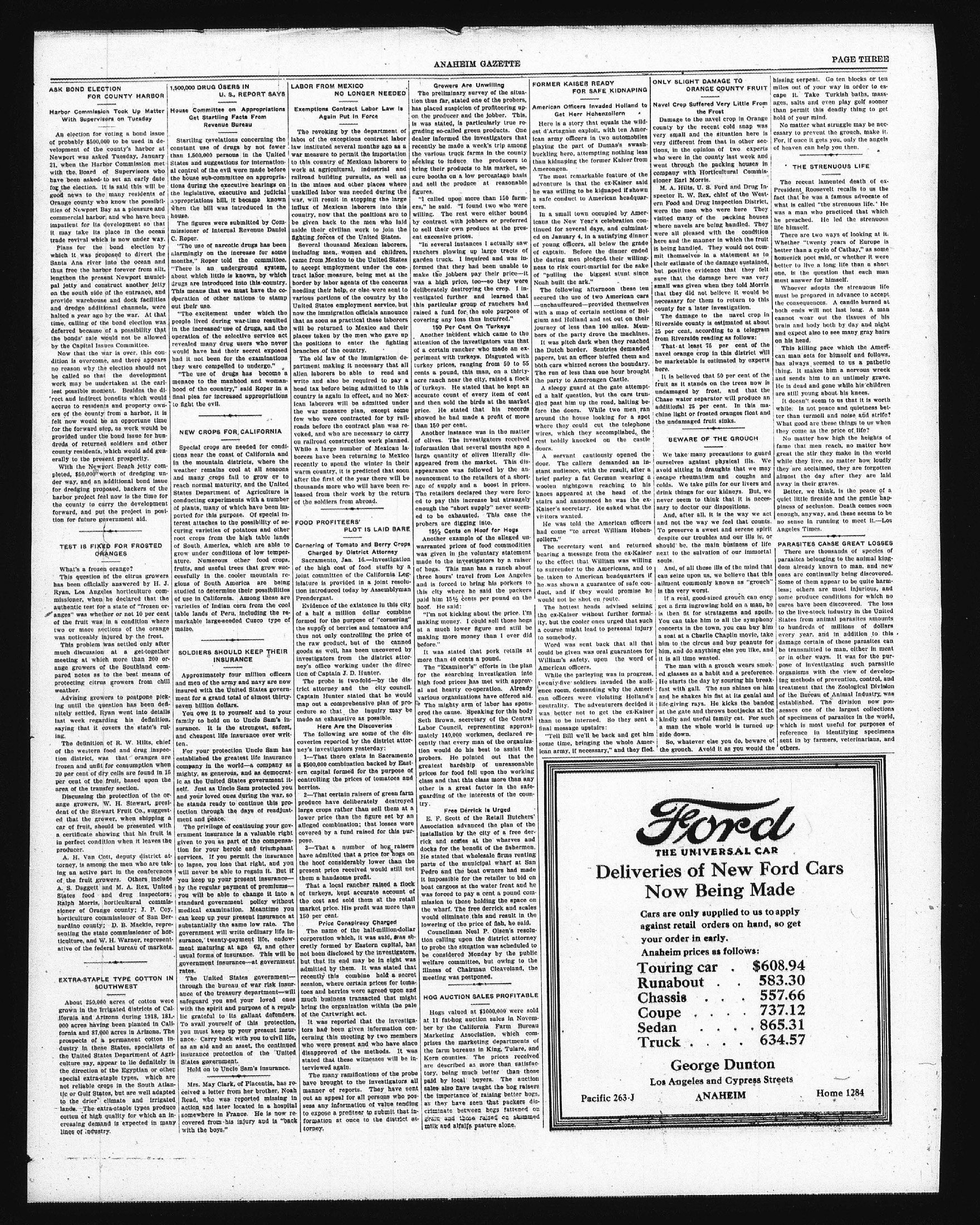
Searchable text
ASK BOND ELECTION
FOR COUNTY HARBOR
Harbor Commission Took Up Matter With Supervisors on Tuesday
An election for voting a bond issue of probably $500,000 to be used in development of the county's harbor at Newport was asked Tuesday, January 21, when the Harbor Commission met with the Board of Supervisors who have been asked to set an early date for the election. It is said this will be good news to the many residents of Orange county who know the possibilities of Newport Bay as a pleasure and commercial harbor, and who have been impatient for its development so that it may take its place in the ocean trade revival which is now under way.
Plans for the bond election by which it was proposed to divert the Santa Ana river into the ocean and thus free the harbor forever from silt, lengthen the present Newport municipal jetty and construct another jetty on the south side of the entrance, and provide warehouse and dock facilities and dredge additional channels, were halted a year ago by the war. At that time, calling of the bond election was deferred because of a possibility that the bonds' sale would not be allowed by the Capital Issues Committee.
Now that the war is over, this condition is overcome, and there appears no reason why the election should not be called so that the development work may be undertaken at the earliest possible moment. Besides the direct and indirect benefits which would accrue to residents and property owners of the county from a harbor, it is felt now would be an opportune time for the forward step, as work would be provided under the bond issue for hundreds of returned soldiers and other county residents, which would add gen-
TEST IS FIXED FOR FROSTED ORANGES
What's a frozen orange?
This question of the citrus growers has been officially answered by H. J. Ryan, Los Angeles horticulture commissioner, when he declared that the authentic test for a state of "frozen oranges" was whether or not 10 per cent of the fruit was in a condition where two or more sections of the orange was noticeably injured by the frost.
This problem was settled only after much discussion at a get-together meeting at which more than 200 orange growers of the Southland compared notes as to the best means of protecting citrus growers from chill weather.
Advising growers to postpone picking until the question has been definitely settled, Ryan went into details last week regarding his definition, saying that it covers the state's ruling.
The definition of R. W. Hilts, chief of the western food and drug inspection district, was that oranges are frozen and unfit for consumption when 20 per cent of dry cells are found in 15 per cent of the fruit, based upon the area of the transfer section.
Discussing the protection of the orange growers, W. H. Stewart, president of the Stewart Fruit Co., suggested that the grower, when shipping a car of fruit, should be presented with a certificate showing that his fruit is in perfect condition when it leaves the producer.
A. H. Van Cott, deputy district attorney, is among the men who are takedown is overcome, and there appears no reason why the election should not be called so that the development work may be undertaken at the earliest possible moment. Besides the direct and indirect benefits which would accrue to residents and property owners of the county from a harbor, it is felt now would be an opportune time for the forward step, as work would be provided under the bond issue for hundreds of returned soldiers and other county residents, which would add generally to the present prosperity.
With the Newport Beach jetty completed, $50,000 worth of dredging under way, and an additional bond issue for dredging proposed, backers of the harbor project feel now is the time for the county to carry the development forward, and put the project in position for future government aid.
NEW CROPS FOR CALIFORNIA
Special crops are needed for conditions near the coast of California and in the mountain districts, where the weather remains cool at all seasons and many crops fail to grow or to reach normal maturity, and the United States Department of Agriculture is conducting experiments with a number of plants, many of which have been imported for this purpose. Of special interest attaches to the possibility of securing varieties of potatoes and other root crops from the high table lands of South America, which are able to grow under conditions of low temperature. Numerous other food crops, fruits, and useful trees that grow successfully in the cooler mountain regions of South America are being studied to determine their possibilities of use in California. Among these are varieties of Indian corn from the cool table lands of Peru, including the remarkable large-seeded Cuzco type of maize.
SOLDIERS SHOULD KEEP THEIR INSURANCE
Approximately four million officers and men of the army and navy are now insured with the United States government for a grand total of almost thirty-seven billion dollars.
You owe it to yourself and to your family to hold on to Uncle Sam's insurance. It is the strongest, safest, and cheapest life insurance ever written.
For your protection Uncle Sam has established the greatest life insurance company in the world—a company as mighty, as generous, and as democratic as the United States government itself. Just as Uncle Sam protected you and your loved ones during the war, so he stands ready to continue this protection through the days of readjustment and peace.
The privilege of continuing your government insurance is a valuable right given to you as part of the compensation for your heroic and triumphant services. If you permit the insurance to lapse, you lose that right, and you had it not seen for the commencement they were compelled to undergo."
"The use of drugs has become a menace to the manhood and womanhood of the country," said Roper in a final plea for increased appropriations to fight the evil.
FOOD PROFITEERS' PLOT IN
Cornering of Tomato and Charged by District Sacramento, Jan. 16. Of the high cost of food joint committee of the islature is provided in institution introduced today by Prendergast.
Evidence of the existence of a half a million deformed for the purposes supply of berries and thus not only controlling raw product, but goods as well, has been investigators from the neey's office working unification of Captain J. D. Hu.
The probe is two-fold trict attorney and the Captain Hunter stated map out a comprehensive cedure so that the made as exhaustive as here Are the Dis
The following are so coveries reported by thieney's investigators yesterday:
1—That there exists a $500,000 combination anern capital formed for controlling the prices of berries.
2—That certain raise produce have deliberate large crops rather than lower price than the falleged combination; it covered by a fund raise pose.
3—That a number have admitted that a phe hoof considerably
EXTRA-STAPLE TYPE COTTON IN SOUTHWEST
About 250,000 acres of cotton were grown in the irrigated districts of California and Arizona during 1918, 181,000 acres having been planted in California and 87,600 acres in Arizona. The prospects of a permanent cotton industry in these States, specialists of the United States Department of Agriculture say, appear to lie definitely in the direction of the Egyptian or other special extra-staple types, which are not reliable crops in the South Atlantic or Gulf States, but are well adapted to the drier climate and irrigated lands. The extra-staple types produce cotton of high quality for which an increasing demand is expected in many lines of industry.
Mrs. May Clark, of Placentia, has received a letter from her brother, Noah Read, who was reported missing in action and later located in a hospital somewhere in France. He is now recovered from his injury and is "back with the boys."
ANAHEIM GAZETTE
LABOR FROM MEXICO
NO LONGER NEEDED
Exemptions Contract Labor Law Is Again Put In Force
The revoking by the department of labor of the exceptions contract labor law instituted several months ago as a war measure to permit the importation to this country of Mexican laborers to work at agricultural, industrial and railroad building pursuits, as well as in the mines and other places where unskilled labor was needed during the war, will result in stopping the large influx of Mexican laborers into this country, now that the positions are to be given back to the men who laid aside their civilian work to join the fighting forces of the United States.
Several thousand Mexican laborers, including men, women and children, came from Mexico to the United States to accept employment under the contract labor measure, being met at the border by labor agents of the concerns needing their help, or else were sent to various portions of the country by the United States employment service, but now the immigration officials announce that as soon as practical these laborers will be returned to Mexico and their places taken by the men who gave up the positions to enter the fighting branches of the country.
The old law of the immigration department making it necessary that all alien laborers be able to read and write and also be required to pay a head tax before being admitted to this country is again in effect, and no Mexican laborers will be admitted under the war measure plan, except some few who were contracted for by railroads before the contract plan was revoked, and who are necessary to carry on railroad construction work planned. While a large number of Mexican laborers have been returning to Mexico
Growers Are Unwilling
The preliminary survey of the situation thus far, stated one of the probers, has placed suspicion of profiteering upon the producer and the jobber. This, is was stated, is particularly true regrading so-called green products. One dealer informed the investigators that recently he made a week's trip among the various truck farms in the county seeking to induce the producers to bring their products to his market, secure booths on a low percentage basis and sell the produce at reasonable figures.
"I called upon more than 150 farmers," he said. "I found two who were willing. The rest were either bound by contract with jobbers or preferred to sell their own produce at the present excessive prices.
"In several instances I actually saw ranchers plowing up large tracts of garden truck. I inquired and was informed that they had been unable to make the jobbers pay their price—it was a high price, too—so they were deliberately destroying the crop. I investigated further and learned that this particular group of ranchers had raised a fund for the sole purpose of covering any loss thus incurred."
150 Per Cent On Turkeys
Another incident which came to the attention of the investigators was that of a certain rancher who made an experiment with turkeys. Disgusted with turkey prices, ranging from 50 to 55 cents a pound, this man, on a thirty-acre ranch near the city, raised a flock of turkeys. He stated that he kept an accurate count of every item of cost and then sold the birds at the market price. He stated that his records showed he had made a profit of more than 150 per cent.
Another instance was in the matter of olives. The investigators received information that several months ago a large quantity of olives literally dis-
FORMER KAISER READY FOR SAFE KIDNAPING
American Officers Invaded Holland to Get Herr Hohenzollern
Here is a story that equals the wildest d'Artagnan exploit, with ten American army officers in two automobiles playing the part of Dumas's swash-buckling hero, attempting nothing less than kidnaping the former Kaiser from Amerongen.
The most remarkable feature of the adventure is that the ex-Kaiser said he was willing to be kidnapped if shown a safe conduct to American headquarters.
In a small town occupied by Americans the New Year's celebration continued for several days, and culminated on January 4, in a satisfying dinner of young officers, all below the grade of captain. Before the dinner ended the daring men pledged their willingness to risk court-martial for the sake of "pulling the biggest stunt since Noah built the ark."
The following afternoon these ten secured the use of two American cars—unchauffeured—provided themselves with a map of certain sections of Belgium and Holland and set out on their journey of less than 100 miles. Members of the party drove the machines.
It was pitch dark when reached the Dutch border. Sentries demanded papers, but an officer bluffed them and both cars whizzed across the boundary. The run of less than one hour brought the party to Amerongen Castle.
A sleepy guard at the gate attempted a half question, but the cars trundled past him up the road, halting before the doors. While two men ran around the house looking for a spot where they could cut the telephone wires, which they accomplished, the rest boldly knocked on the castle doors.
A servant cautiously opened the ONLY SLIGHT OF Navel Crop S
Damage to county by very small area very different tions, in the who were in went through sioner Earl M.
M. A. Hilts spector R. Wern Food and were the men visited many where navels were all plea here and there is being handled mit themselves their estimate but positive sure that the small was given that they did necessary for county for a
The damage Riverside covered 25 per cent, from Riverale That at least navel orange be marketable here.
It is believ fruit as it still undamaged Chase water additional 28 chine light on the undamaged BEWARE We take n
partment making it necessary that all alien laborers be able to read and write and also be required to pay a head tax before being admitted to this country is again in effect, and no Mexican laborers will be admitted under the war measure plan, except some few who were contracted for by railroads before the contract plan was revoked, and who are necessary to carry on railroad construction work planned. While a large number of Mexican laborers have been returning to Mexico recently to spend the winter in their warm country, it is predicted that soon after the first of the year there will be thousands more who will have been released from their work by the return of the soldiers from abroad.
FOOD PROFITEERS'
PLOT IS LAID BARE
Cornering of Tomato and Berry Crops
Charged by District Attorney
Sacramento, Jan. 16.—Investigation of the high cost of food stuffs by a joint committee of the California Legislature is provided in a joint resolution introduced today by Assemblyman Prendergast.
Evidence of the existence in this city of a half a million dollar combine formed for the purpose of "cornering" the supply of berries and tomatoes and thus not only controlling the price of the raw product, but of the canned goods as well, has been uncovered by investigators from the district attorney's office working under the direction of Captain J. D. Hunter.
The probe is two-fold—by the district attorney and the city council, Captain Hunter stated that he would map out a comprehensive plan of procedure so that the inquiry may be made as exhaustive as possible.
Here Are the Discoveries
The following are some of the discoveries reported by the district attorney's investigators yesterday:
1—That there exists in Sacramento a $500,000 combination backed by Eastern capital formed for the purpose of controlling the prices of tomatoes and berries.
2—That certain raisers of green farm produce have deliberately destroyed large crops rather than sell them at a lower price than the figure set by an alleged combination; that losses were covered by a fund raised for this purpose.
3—That a number of hog raisers have admitted that a price for hogs on the hoof considerably lower than the turkey prices, ranging from 50 to 55 cents a pound, this man, on a thirty-acre ranch near the city, raised a flock of turkeys. He stated that he kept an accurate count of every item of cost and then sold the birds at the market price. He stated that his records showed he had made a profit of more than 150 per cent.
Another instance was in the matter of olives. The investigators received information that several months ago a large quantity of olives literally disappeared from the market. This disappearance was followed by the announcement to the retailers of a shortage of supply and a boost in prices. The retailers declared they were forced to pay this increase but strangely enough the "short supply" never seemed to be exhausted. This case the probers are digging into.
15½ Cents on Hoof for Hogs
Another example of the alleged unwarranted prices of food commodities was given in the voluntary statement made to the investigators by a raiser of hogs. This man has a ranch about three hours' travel from Los Angeles and is forced to bring his porkers to this city where he said the packers paid him 15½ cents per pound on the hoof. He said:
"I'm not kicking about the price. I'm making money. I could sell those hogs at a much lower figure and still be making more money than I ever did before."
It was stated that pork retails at more than 40 cents a pound.
The "Examiner's" efforts in the plan for the searching investigation into high food prices has met with approval and hearty co-operation. Already various organizations have offered aid.
The mighty arm of labor has sponsored the cause. Speaking for this body Seth Brown, secretary of the Central Labor Council, representing approximately 140,000 workmen, declared recently that every man of the organization would do his best to assist the probers. He pointed out that the greatest hardship of unreasonable prices for food fell upon the working class and that this class more than any other is a great factor in the safeguarding of the interests of the country.
Free Derrick Is Urged
E. F. Scott of the Retail Butchers' Association advanced the plan of installation by the city of a free derrick and scales at the wharves and docks for the benefit of the fishermen. He stated that wholesale firms renting parts of the municipal wharf at San
2—That certain raisers of green farm produce have deliberately destroyed large crops rather than sell them at a lower price than the figure set by an alleged combination; that losses were covered by a fund raised for this purpose.
3—That a number of hog raisers have admitted that a price for hogs on the hoof considerably lower than the present price received would still net them a handsome profit.
That a local rancher raised a flock of turkeys, kept accurate account of the cost and sold them at the retail market price. His profit was more than 150 per cent.
Price Conspiracy Charged
The name of the half-million-dollar corporation which, it was said, was secretly formed by Eastern capital, has not been disclosed by the investigators, but that its end may be in sight was admitted by them. It was stated that recently this combine held a secret session, where certain prices for tomatoes and berries were agreed upon and much business transacted that might bring the organization within the pale of the Cartwright act.
It was reported that the investigators had been given information concerning this meeting by two members who were present and who have since disapproved of the methods. It was stated that these witnesses will be interviewed again.
The many ramifications of the probe have brought to the investigators all manner of reports. They have sent out an appeal for all persons who possess any information of value tending to expose a profiteer to submit that information at once to the district attorney.
Hogs valued at $1000,000 were sold at 11 fat-hog auction sales in November by the California Farm Bureau Marketing Association, which comprises the marketing departments of the farm bureaus in King, Tulare, and Kern counties. The prices received are described as more than satisfactory, being much better than those paid by local buyers. The auction sales also have taught the hog raisers the importance of raising better hogs, as they have seen that packers discriminate between hogs fattened on grain and those raised on skimmed milk and alfalfa pasture alone.
ONLY SLIGHT DAMAGE TO ORANGE COUNTY FRUIT
Navel Crop Suffered Very Little From the Frost
Damage to the navel crop in Orange county by the recent cold snap was very small and the situation here is very different from that in other sections, in the opinion of two experts who were in the county last week and went through the packing houses in company with Horticultural Commissioner Earl Morris.
M. A. Hilts, U. S. Ford and Drug Inspector R. W. Rex, chief of the Western Food and Drug Inspection District, were the men who were here They visited many of the packing houses where navels are being handled. They were all pleased with the condition here and the manner in which the fruit is being handled. They would not commit themselves in a statement as to their estimate of the damage sustained, but positive evidence that they felt sure that the damage here was very small was given when they told Morris that they did not believe it would be necessary for them to return to this county for a later investigation.
The damage to the navel crop in Riverside county is estimated at about 25 per cent, according to a telegram from Riverside reading as follows:
That at least 75 per cent of the navel orange crop in this district will be marketable is estimated by experts here.
It is believed that 50 per cent of the fruit as it stands on the trees now is undamaged by frost, and that the Chase water separator will produce an additional 25 per cent. In this machine light or frosted oranges float and the undamaged fruit sinks.
BEWARE OF THE GROUCH
We take many precautions to guard hissing serpent. Go ten blocks or ten miles out of your way in order to escape it. Take Turkish baths, massages, salts and even play golf sooner than permit this deadly thing to get hold of your mind.
No matter what struggle may be necessary to prevent the grouch, make it. For, if once it gets you, only the angels of heaven can help you then.
THE STRENUOUS LIFE
The recent lamented death of ex-President Roosevelt recalls us the fact that he was a famous advocate of what is called "the strenuous life." He was a man who practiced that which he preached. He led the strenuous life himself.
There are two ways of looking at it. Whether "twenty years of Europe is better than a cycle of Cathay," as some homesick poet said, or whether it were better to live a long life than a short one, is the question that each man must answer for himself.
Whoever adopts the strenuous life must be prepared in advance to accept the consequences. A candle burned at both ends will not last long. A man cannot wear out the tissues of his brain and body both by day and night and expect also to see many gray hairs on his head.
This killing pace which the American man sets for himself and follows, has always seemed to us a pathetic thing. It makes him a nervous wreck and sends him to an untimely grave. He is dead and gone while his children are still young about his knees.
It doesn't seem to us that it is worth while. Is not peace and quietness better than turmoll and noise and strife? What good are these things to us when they come as the price of life?
No matter how high the heights of fame that men reach, no matter how great the stir they make in the world
BEWARE OF THE GROUCH
We take many precautions to guard ourselves against physical illness. We avoid sitting in draughts that we may escape rheumatism and coughs and colds. We take pills for our livers and drink things for our kidneys. But, we never seem to think that it is necessary to doctor our dispositions.
And, after all, it is the way we act and not the way we feel that counts. To preserve a sweet and serene spirit despite our troubles and our illis is, or should be, the main business of life next to the salvation of our immortal souls.
And, of all these illis of the mind that can seize upon us, we believe that this alliment commonly known as "grouch" is the very worst.
If a real, good-sized grouch can once get a firm ingrowing hold on a man, he is then fit for stratagems and spoils. You can take him to all the symphony concerts in the town, you can buy him a seat at a Charlie Chaplin movie, take him to the circus and buy peanuts for him, and do anything else you like, and it is all time wasted.
The man with a grouch wears smoked glasses as a habit and a preference. He starts the day by souring his breakfast with gall. The sun shines on him and he shakes his fist at its genial and life-giving rays. He kicks the bandog at the gate and throws bootjacks at the kindly and useful family cat. For such a man the whole world is turned upside down.
So, whatever else you do, beware of the grouch. Avoid it as you would the has always seemed to us a pathetic thing. It makes him a nervous wreck and sends him to an untimely grave. He is dead and gone while his children are still young about his knees.
It doesn't seem to us that it is worth while: Is not peace and quietness better than turmoll and noise and strife? What good are these things to us when they come as the price of life?
No matter how high the heights of fame that men reach, no matter how great the stir they make in the world while they live, no matter how loudly they are acclaimed, they are forgotten almost the day after they are laid away in their graves.
Better, we think, is the peace of a quiet little fireside and the gentle happiness of seclusion. Death comes soon enough, anyway, and these seems to be no sense in running to meet it.—Los Angeles Times.
PARASITES CAHSE GREAT LOSSES
There are thousands of species of parasites belonging to the animal kingdom already known to man, and new ones are continually being discovered. Some of them appear to be quite harmless; others are most injurious, and some produce conditions for which no cures have been discovered. The loss to the live-stock industry in the United States from animal parasites amounts to hundreds of millions of dollars every year, and in addition to this damage certain of these parasites can be transmitted to man, either in meat or in other ways. It was for the purpose of investigating such parasitic organisms with the view of developing methods of prevention, control, and treatment that the Zoological Division of the Bureau of Animal Industry was established. The division now possesses one of the largest collections of specimens of parasites in the world, which is most useful for purposes of reference in identifying specimens sent in by farmers, veterinarians, and others.
Ford
THE UNIVERSAL CAR
Deliveries of New Ford Cars
Now Being Made
Cars are only supplied to us to apply against retail orders on hand, so get your order in early.
Anaheim prices as follows:
Touring car . $608.94
Runabout . 583.30
Chassis . 557.66
Coupe . 737.12
Sedan . 865.31
Truck . 634.57
George Dunton
Los Angeles and Cypress Streets
ANAHEIM Home 1284