anaheim-gazette 1919-01-02
Scanned page
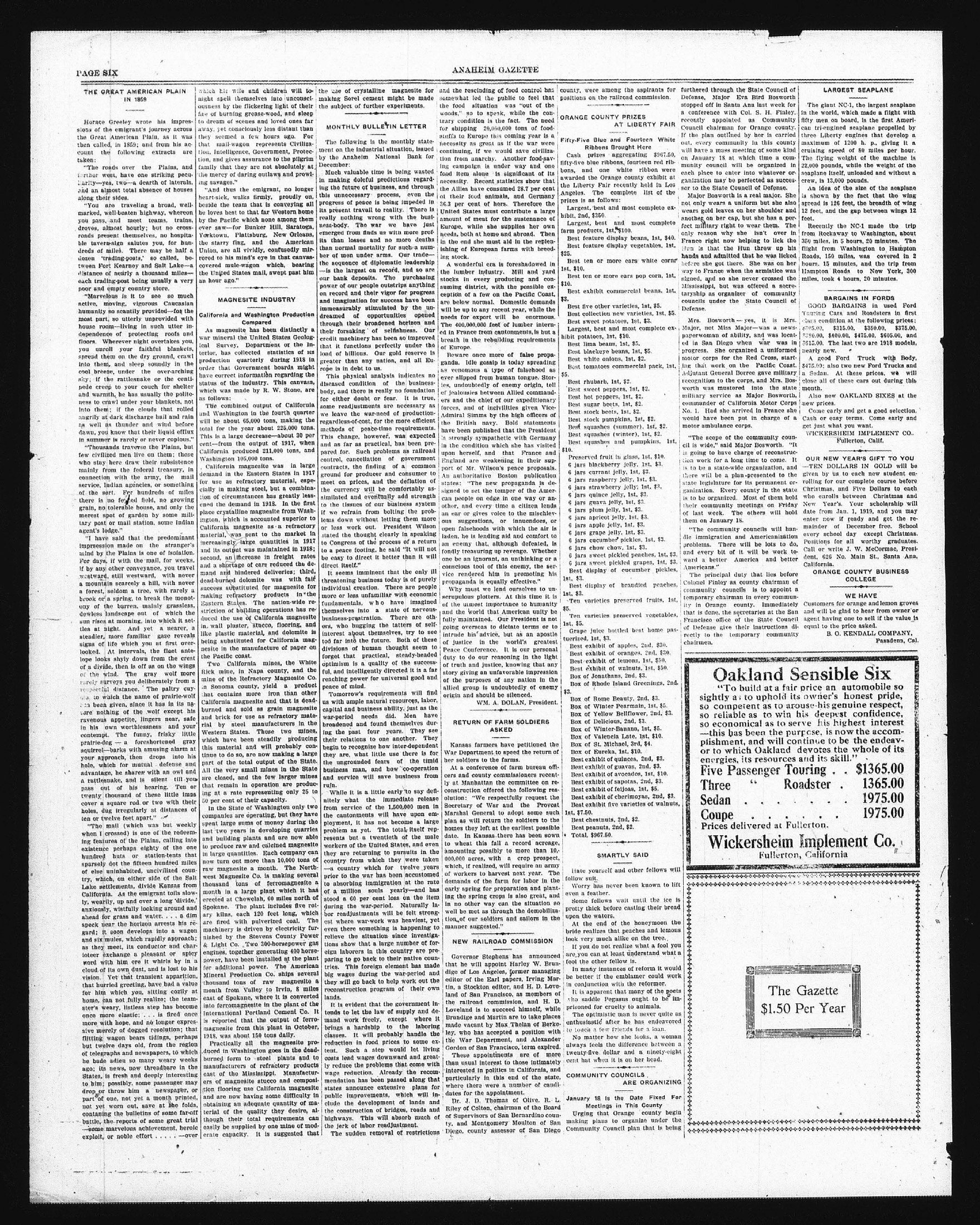
Searchable text
THE GREAT AMERICAN PLAIN
IN 1859
Horace Greeley wrote his impressions of the emigrant's journey across the Great American Plain, as it was then called, in 1859; and from his account the following extracts are taken:
"The roads over the Plains, and further west, have one striking peculiarity—yes, two—a dearth of laterals, and an almost total absence of houses along their sides.
"You are traveling a broad, well-marked, well-beaten highway, whereon you pass, and meet teams, trains, droves, almost hourly; but no cross-roads present themselves, no hospitable tavern-sign salutes you, for hundreds of miles. There may be half a dozen 'trading-posts,' so called, between Fort Kearney and Salt Lake—a distance of nearly a thousand miles—each trading-post being usually a very poor and empty country store.
"Marvelous is it to see so much active, moving, vigorous Caucasian humanity so scantily provided—for the most part, so utterly unprovided with house room—living in such utter independence of protecting roofs and floors. Wherever night overtakes you, you unroll your faithful blankets, spread them on the dry ground, crawl into them, and sleep soundly in the cool breeze, under the over-arching sky; if the rattlesnake or the centipede creep to your couch for shelter and warmth, he has usually the politeness to crawl under your blankets, not into them; if the clouds that rolled angrily at dark discharge hail and rain as well as thunder and wind before dawn, you know that their liquid efflux in summer is rarely or never copious."
"Thousands traverse the Plains, but few civilized men live on them; those which his wife and children will tonight spell themselves into unconsciousness by the flickering light of their fire of burning grease-wood, and sleep to dream of scenes and loved ones far away, yet consciously less distant than they seemed a few hours ago. For that mail-wagon represents Civilization, Intelligence, Government, Protection, and gives assurance to the pilgrim family that they are not absolutely at the mercy of daring outlaws and prowling savages."
"And thus the emigrant, no longer heart-sick, walks firmly, proudly on beside the team that is conveying all he loves best to that far Western home by the Pacific which none among them ever saw—for Bunker Hill, Saratoga, Yorktown, Plattsburg, New Orleans, the starry flag, and the American Union, are all vividly confusedly mirrored to his mind's eye in that canvas-covered mule-wagon which, bearing the United States mail, swept past him an hour ago."
MAGNESITE INDUSTRY
California and Washington Production Compared
As magnesite has been distinctly a war mineral in the United States Geological Survey, Department or the Interior, has collected statistics of its production quarterly during 1918 in order that Government boards might have correct information regarding the status of the industry. This canvass, which was made by R. W. Stone, are as follows:
The combined output of California and Washington in the fourth quarter will be about 65,000 tons, making the total for the year about 225,000 tons. This is a large decrease—about 30 percent—from the output of 1917, when California produced 211,000 tons, and the use of cryoscience making Sorel coarse for the subject of fracking.
MONTHLY BUDGET
The following mentions on the indictment by the Anaheim December:
Much valuable in making dolls ing the future of this unnecessary progress of peace its present travel really nothing new body. The emerged from its than losses than normal more of men under the sequence of is the largest our bank deposit power of our pet on record and t and imagination immeasurably through their their forsaking credit machinery that it function load of billions greater than any rope is in debt.
This physical diseased condition body, and there for either doubts some readjustment we leave the regardless-of-cost methods of pea This change, b and as far as p paired for. Succ
into them, and sleep soundly in the cool breeze, under the over-arching sky; if the rattlesnake or the centipede creep to your couch for shelter and warmth, he has usually the politeness to crawl under your blankets, not into them; if the clouds that rolled angrily at dark discharge hail and rain as well as thunder and wind before dawn, you know that their liquid efflux in summer is rarely or never copious."
"Thousands traverse the Plains, but few civilized men live on them; those who stay here draw their subsistence mainly from the federal treasury, in connection with the army, the mail service, Indian agencies, or something of the sort. For hundreds of miles there is no fenced field, no growing grain, no tolerable house, and only the merest spot of garden by some military post or mail station, some Indian agent's lodge."
"I have said that the predominant imprsession made on the stranger's mind by the Plains is one of isolation. For days, if with the mail, for weeks, if by any other conveyance, you travel westward, still westward, with never a mountain scarcely a hill, with never a forest, seldom a tree, with rarely a brook or a spring, to break the monotony of the barren, mainly grassless, dewless landscape out of which the sun rises at morning, into which it settles at night. And yet a nearer, a steadier, more familiar gaze reveals signs of life which you at first overlooked. At intervals, the fleet antelope looks shyly down from the crest of a divide, then is off as on the wings of the wind. The gray wolf more rarely surveys you deliberately from a respectful distance. The paltry cuckoo to which the name of prairie-wolf has been given, since it has in its nature nothing of the wolf except his ravenous appetite, lingers near, safe in his own worthlessness and your contempt. The funny, frisky little prairie-dog — a foreshortened gray squirrel—barks with amusing alarm at your approach, then drops into his hole, which for mutual defense and advantage, he shares with an owl and a rattlesnake, and is silent till you pass out of his hearing. Ten or twenty thousand of these little imps cover a square rod or two with their holes, dug irregularly at distances of ten or twelve feet apart."
"The mail (which was but weekly when I crossed) is one of the redeeming features of the Plains, calling into existence perhaps eighty of the one hundred huts or station-tents that sparsely dot the fifteen hundred miles production quarterly during 1918 in order that Government boards might have correct information regarding the status of the industry. This canvass, which was made by R. W. Stone, are as follows:
The combined output of California and Washington in the fourth quarter will be about 65,000 tons, making the total for the year about 225,000 tons. This is a large decrease—about 30 percent—from the output of 1917, when California produced 211,000 tons, and Washington 105,000 tons.
California magnesite was in large demand in the Eastern States in 1917 for use as refractory material, especially in making steel, but a combination of circumstances has greatly lessened the demand in 1918. In the first place crystalline magnesite from Washington, which is accounted superior to California magnesite as a refractory material, was sent to the market in increasingly large quantities in 1917 and its output was maintained in 1918; second, an increase in freight rates and a shortage of cars reduced the demand and hindered deliveries; third, dead-burned dolomite was with half success substituted for magnesite for making refractory products in the Eastern States. The nation-wide restriction of building operations has reduced the use of California magnesite in wall plaster, stucco, flooring, and like plastic material, and dolomite is being substituted for California magnesite in the manufacture of paper on the Pacific coast.
Two California mines, the White Rick mine, in Napa county, and the mine of the Refractory Magnesite Co. Sonoma county, yield a product that contains more iron than other California magnesite and that is dead-burned and sold as grain magnesite and brick for use as refractory material by steel manufacturers in the Western States. These two mines, which have been steadily producing this material and will probably continue to do so, are now making a large part of the total output of the State. All the very small mines in the State are closed, and the few larger mines that remain in operation are producing at a rate representing only 25 to 50 per cent of their capacity.
In the State of Washington only two companies are operating, but they have spent large sums of money during the last two years in developing quarries and building plants and are now able to produce raw and calcined magnesite in large quantities. Each company can now turn out more than 10,000 tons of
This physical diseased condition body, and therefore some readjustment we leave the way regardless-of-cost methods of payment. This change, he and as far as possible prepared for. Such control, cancellations,the ground for procurement on prices,the currency was simulated and cooled to the tissues of if we refrain from leams down within or less work stated the thought to Congress of to a peace footnote be easy to direct itself."
It seems immense threatening business individual creation more or less unfundamentals themselves into business-presturers who hugger interest about too far into the divisions of his forget that profit optimism is a fulful,and intelligent reaching power peace of mind.
Tomorrow's us with ample capital and bus war-period new broadened and ing the past their relations begin to recognize they are what the ungrounded business man,and service worker ruin.
While it is not nitely what from service to cantonment ployment,它 problem as ye resents but all workers of they they are return country from
advantage, he shares with an owl and a rattlesnake, and is silent till you pass out of his hearing. Ten or twenty thousand of these little imps cover a square rod or two with their holes, dug irregularly at distances of ten or twelve feet apart."
"The mail (which was but weekly when I crossed) is one of the redeeming features of the Plains, calling into existence perhaps eighty of the one hundred huts or station-tents that sparsely dot the fifteen hundred miles of else uninhabited, uncivilized country, which, on either side of the Salt Lake settlements, divide Kansas from California. As the emigrant toils slowly, wearily, up and over a long 'divide,' anxiously, wistfully looking around and ahead for grass and water. . . a dim speck near the horizon arrests his regard; it soon develops into a wagon and six mules, which rapidly approach; as they meet, its conductor and charlotte exchange a pleasant or spicy word with him ere it whirls by in a cloud of its own dust, and is lost to his vision. Yet that transient apparition, that hurried greeting, have had a value for him which you, sitting cozily at home, can not fully realize; the teamster's weary, listless step has become once more elastic; . . . is fired once more with hope, and no longer expressive merely of dogged resolution; that flitting wagon bears tidings, perhaps but twelve days old, from the region of telegraphs and newspapers, to which he bade adieu so many weary weeks ago; its news, now threadbare in the States, is fresh and deeply interesting to him; possibly, some passenger may drop or throw him a newspaper, or part of one, not yet a month printed, not yet worn out, save at the folds, containing the bulletins of some far-off battle, the reports of some great trial—some marvelous achievement, heroic exploit, or noble effort . . . —over all the very small mines in the State are closed, and the few larger mines that remain in operation are producing at a rate representing only 25 to 50 per cent of their capacity.
In the State of Washington only two companies are operating, but they have spent large sums of money during the last two years in developing quarries and building plants and are now able to produce raw and calcined magnesite in large quantities. Each company can now turn out more than 10,000 tons of raw magnesite a month. The Northwest Magnesite Co. is making several thousand tons of ferromagnesite a month in a large plant which it has erected at Chewelah, 60 miles north of Spokane. The plant includes five rotary kilns, each 120 feet long, which are fired with pulverized coal. The machinery is driven by electricity furnished by the Stevens County Power & Light Co. Two 300-horsepower gas engines, together generating 400 horsepower, have been installed at the plant for additional power. The American Mineral Production Co. ships several thousand tons of raw magnesite a month from Valley to Irvin, 8 miles east of Spokane, where it is converted into ferromagnesite in the plant of the International Portland Cement Co. It is reported that the output of ferromagnesite from this plant in October, 1918, was about 150 tons daily.
Practically all the magnesite produced in Washington goes in the dead-burned form to steel plants and to manufacturers of refractory products east of the Mississippi. Manufacturers of magnesite stucco and composition flooring use California magnesite and are now having some difficulty in obtaining an adequate quantity of material of the quality they desire, although their total requirements can easily be supplied by one mine of moderate capacity. It is suggested that
ANAHEIM GAZETTE
MONTHLY BULLETIN LETTER
The following is the monthly statement on the industrial situation, issued by the Anaheim National Bank for December:
Much valuable time is being wasted in making doleful predictions regarding the future of business, and through this unnecessary process, even the progress of peace is being impeded in its present travail to reality. There is really nothing wrong with the business-body. The war we have just emerged from finds us with more profits than losses and no more deaths than normal mortality for such a number of men under arms. Our trade—the sequence of diplomatic leadership—is the largest on record, and so are our bank deposits. The purchasing power of our people outstrips anything on record and their vigor for progress and imagination for success have been immeasurably stimulated by the undreamed of opportunities opened through their broadened horizon and their forsaking of selfishness. Our credit machinery has been so improved that it functions perfectly under the load of billions. Our gold reserve is greater than any nation, and all Europe is in debt to us.
This physical analysis indicates no diseased condition of the business-body, and there is really no foundation for either doubt or fear. It is true, some readjustments are necessary as we leave the war-need of production-regardless-of-cost, for the more efficient methods of peace-time requirements. This change, however, was expected and as far as practical, has been prepared for. Such problems as railroad and the rescinding of food control has somewhat led the public to feel that the food situation was "out of the woods," so to speak, while the contrary condition is the fact. The need for shipping 20,000,000 tons of food stuffs to Europe this coming year is a necessity as great as if the war were continuing, if we would save civilization from anarchy. Another food-saving campaign is under way and one food item alone is significant of its necessity. Recent statistics show that the Allies have consumed 28.7 per cent of their food animals, and Germany 36.3 per cent of hers. Therefore the United States must contribute a large amount of meat for the sustenance of Europe, while she supplies her own needs, both at home and abroad. Then in the end she must aid in the replenishing of European farms with breeding stock.
A wonderful era is foreshadowed in the lumber industry. Mill and yard stocks in every producing and consuming district, with the possible exception of a few on the Pacific Coast, are below normal. Domestic demands will be up to any recent year, while the needs for export will be enormous. The 400,000,000 feet of lumber interned in France from cantonments, is but a breath in the rebuilding requirements of Europe.
Reware once more of false propaganda. Idle gossip is today spreading as venomous a type of falsehood as ever slipped from human tongue. Stories, undoubtedly of enemy origin, tell of jealousies between Allied commanders and the chief of our expeditionary forces, and of incivilities given Vice-Admiral Simms by the high officers of the British navy. Bold statements have been published that the President is strongly sympathetic with Germany in the condition which she has visited upon herself, and that France and county, were among the aspirants for positions on the railroad commission.
ORANGE COUNTY PRIZES AT LIBERTY FAIR
Fifty-Five Blue and Fourteen White Ribbons Brought Here
Cash prizes aggregating $967.50, fifty-five blue ribbons, fourteen red ribbons, and one white ribbon were awarded the Orange county exhibit at the Liberty Fair recently held in Los Angeles. The complete list of the prizes is as follows:
Largest, best and most complete exhibit, 2nd,$350.
Largest, best and most complete farm products, 1st,$100.
Best feature display beans, 1st,$40.
Best feature display vegetables, 1st,$25.
Best ten or more ears white corn, 1st,$10.
Best ten or more ears pop corn, 1st,$10.
Best exhibit commercial beans, 1st,$3.
Best five other varieties, 1st,$5.
Best collection new varieties, 1st,$5.
Best sweet potatoes, 1st,$3.
Largest, best and most complete exhibit potatoes, 1st,$10.
Best lima beans, 1st,$5.
Best blackeye beans, 1st,$5.
Best white onions, 1st,$2.
Best tomatoes commercial pack, 1st,$5.
Best rhubarb, 1st,$2.
Best sweet peppers, 1st,$2.
Best hot peppers, 1st,$2.
Best sugar beets, 1st,$2.
Best stock beets, 1st,$2.
Best stock pumpkins, 1st,$2.
Best squashes (summer), 1st,$2.
Best squashes (winter), 1st,$2.
Best squashes and pumpkins, 1st,$10.
Preserved fruit in glass, 1st,$10.
California in quarter taking the 1000 tons. but 30 per 17, when tons, and in large is in 1917 special, especially less the first from Wash.-superior to factory market in 1917 and in 1918; light rates used the de-ness; third, with half sites for in the wide-rea-ment has remagnesite mining, and dolomite is ornia mag-paper on the White and the magnesite Co. product than other that is dead-magnesite story materials in the two mines, producing easily con-ing a large State. In the State larger mines have produc-ion only 25 to only two they have during the quarries now able magnesite company can 1000 tons of
This physical analysis indicates no diseased condition of the business-body, and there is really no foundation for either doubt or fear. It is true, some readjustments are necessary as we leave the war-need of production-regardless-of-cost, for the more efficient methods of peace-time requirements. This change, however, was expected and as far as practical, has been prepared for. Such problems as railroad control, cancellation of government contracts, the finding of a common ground for producer and consumer meet on prices, and the deflation of the currency will be comfortably assimilated and eventually add strength to the tissues of our business system if we refrain from bolting the problems down without letting them more or less work out. President Wilson stated the thought clearly in speaking to Congress of the process of a return to a peace footing, he said "It will not be easy to direct it better than it will direct itself."
It seems imminent that the only ill threatening business today is of purely individual creation. There are people more or less unfamiliar with economic fundamentals, who have imagined themselves into a state of nervous-business-prestation. There are others, who hugging the tatters of self-interest about themselves, try to see too far into the future. Both of these divisions of human thought seem to forget that practical, steady-headed optimism is a quality of the successful, and intelligently directed it is a far reaching power for universal good and peace of mind.
Tomorrow's requirements will find us with ample natural resources, labor, capital and business ability, just as the war-period needs did. Men have broadened and found themselves during the past four years. They see their relations to one another. They begin to recognize how inter-dependent they are, what little use there is for the ungrounded fears of the timid business man, and how co-operation and service will save business from ruin.
While it is a little early to say definitely what the immediate release from service of the 1,500,000 men in the cantonments will have upon employment, it has not become a large problem as yet. The total itself represents but a twentieth of the male workers of the United States, and even they are returning to pursuits in the country from which they were taken
Idle gossip is today spreading as venomous a type of falsehood as ever slipped from human tongue. Stories, undoubtedly of enemy origin, tell of jealousies between Allied commanders and the chief of our expeditionary forces, and of incivilities given Vice-Admiral Simms by the high officers of the British navy. Bold statements have been published that the President is strongly sympathetic with Germany in the condition which she has visited upon herself, and that France and England are weakening in their support of Mr. Wilson's peace proposals. An authoritative Boston publication states: "The new propaganda is designed to set the temper of the American people on edge in one way or another, and every time a citizen lends an ear or gives voice to the mischievous suggestions, or innuendoes, or open falsehoods with which the air is laden, he is lending aid and comfort to an enemy that, although defeated, is fondly treasuring up revenge. Whether one be an ignorant, an unthinking or a conscious tool of this enemy, the service rendered him in promoting his propaganda is equally effective."
Why must we lend ourselves to unscrupulous plotters. At this time it is of the utmost importance to humanity and the world that American unity be fully maintained. Our President is not going overseas to dictate terms or to intrude his advice, but as an apostle of justice in the world's greatest Peace Conference. It is our personal duty to do our reasoning in the light of truth and justice, knowing that any story giving an unfavorable impression of the purposes of any nation in the allied group is undoubtedly of enemy origin and should be silenced.
WM. A. DOLAN, President.
RETURN OF FARM SOLDIERS ASKED
Kansas farmers have petitioned the War Department to speed the return of her soldiers to the farms.
At a conference of farm bureau officers and county commissioners recently at Manhattan the committee on reconstruction offered the following resolution: "We respectfully request the Secretary of War and the Provost Marshal General to adopt some such plan as will return the soldiers to the homes they left at the earliest possible date. In Kansas there has been sown to wheat this fall a record acreage, amounting possibly to more than 10,000,000 acres, with a crop prospect, which if realized will require an army.
Best white onions, 1st,$5.
Best rhubarb, 1st,$2.
Best sweet peppers, 1st,$2.
Best hot peppers, 1st,$2.
Best sugar beets, 1st,$2.
Best stock beets, 1st,$2.
Best stock pumpkins, 1st,$2.
Best squashes (summer), 1st,$2.
Best squashes (winter), 1st,$2.
Best squashes and pumpkins, 1st,$10.
Preserved fruit in glass, 1st,$10.
6 jars blackberry jelly, 1st,$3.
6 jars currant jelly, 1st,$3.
6 jars raspberry jelly, 1st,$3.
6 jars strawberry jelly; 1st,$3.
6 jars quince jelly, 1st,$3.
6 jars guava jelly, 1st,$3.
6 jars plum jelly, 1st,$3.
6 jars apricot jelly, 1st,$3.
6 jars apple jelly, 1st,$3.
6 jars grape jelly, 1st,$3.
6 jars cucumber pickles, 1st,$3.
6 jars chow chow, 1st,$3.
6 jars sweet pickled peaches, 1st,$3.
6 jars sweet pickled grapes, 1st,$3.
Best display of cucumber pickles, 1st,$3.
Best display of brandied peaches, 1st,$3.
Ten varieties preserved fruits, 1st,$5.
Ten varieties preserved vegetables, 1st,$5.
Grape juice bottled best home pas-tuerized, 1st,$3.
Best exhibit of apples, 2nd,$30.
Best exhibit of oranges, 2nd,$30.
Best exhibit of lemons, 1st,$50.
Best exhibit of walnuts, 1st,$50.
Box of Jonathans, 2nd,$3.
Box of Rhode Island Greenings, 2nd.$3.
Box of Rome Beauty, 2nd,$3.
Box of Winter Pearmain, 1st,$5.
Box of Yellow Bellflower, 2nd,$3.
Box of Delicious, 2nd,$3.
Box of Winter-Banana, 1st,$5.
Box of Valencia Late, 1st,$10.
Box of St. Michael, 3rd,$4.
Box of Eureka, 1st,$10.
Best exhibit of quinces, 2nd,$3.
Best exhibit of guavas, 2nd,$3.
Best exhibit of avocados, 1st,$10.
Best exhibit of sapotas, 2nd,$3.
Best exhibit of feljoas, 1st,$5.
Best exhibit of cherimoyas, 2nd,$3.
Best exhibit five varieties of walnuts,
1st,$7.50.
Best chestnuts, 2nd,$2.
Best peanuts, 2nd,$2.
Total $967.50.
While it is a little early to say definitely what the immediate release from service of the 1,500,000 men in the cantonments will have upon employment, it has not become a large problem as yet. The total itself represents but a twentieth of the male workers of the United States, and even they are returning to pursuits in the country from which they were taken—a country which for twelve years prior to the war has been accustomed to absorbing immigration at the rate of a million souls yearly—and has stood a 60 per cent loss on the item during the war-period. Naturally labor readjustments will be felt strongest where war-work was heaviest, yet even there something is happening to relieve the situation since investigations show that a large number of foreign laborers in this country are preparing to go back to their native countries. This foreign element has made big wages during the war-period and they will go back to help work out the reconstruction program of their own lands.
It is evident that the government intends to let the law of supply and demand work freely, except where it brings a hardship to the laboring classes. It will probably handle the reduction in food prices to some extent. Such a step would let living costs lead wages downward and greatly reduce the problems that come with wage reduction. Already the recommendation has been passed along that states announce extensive plans for public improvements, which will include the development of lands and the construction of bridges, roads and highways. This will absorb much of the jerk of labor readjustment.
The sudden removal of restrictions
At a conference of farm bureau officers and county commissioners recently at Manhattan the committee on reconstruction offered the following resolution: "We respectfully request the Secretary of War and the Provost Marshal General to adopt such plan as will return the soldiers to the homes they left at the earliest possible date. In Kansas there has been sown to wheat this fall a record acreage, amounting possibly to more than 10,000,000 acres, with a crop prospect, which, if realized, will require an army of workers to harvest next year. The demands of the farm for labor in the early spring for preparation and planting the spring crops is also great, and in no other way can the situation so well be met as through the demobilization of our soldiers and sailors in the manner suggested."
NEW RAILROAD COMMISSION
Governor Stephens has announced that he will appoint Harley W. Brundige of Los Angeles, former managing editor of the Earl papers, Irving Martin, a Stockton editor, and H. D. Loveland of San Francisco, as members of the railroad commission, and H. D. Loveland is to succeed himself, while Brundige and Martin are to take places made vacant by Max Thelan of Berkeley, who has accepted a position with the War Department, and Alexander Gordon of San Francisco, term expired.
These appointments are of more than usual interest to those intimately interested in politics in California, and particularly in this end of the state, where there were a number of candidates for the appointment.
Dr. J. D. Thomas of Olive. R. L. Riley of Colten, chairman of the Board of Supervisors of San Bernardino county, and Montgomery Moulton of San Diego, county assessor of San Diego
SMARTLY SAID
Hate yourself and other fellows will follow suit.
Worry has never been known to lift even a feather.
Some fellows wait until the ice is pretty thick before casting their bread upon the waters.
At the end of the honeymoon the bride realizes that peaches and lemons look very much alike on the tree.
If you do not realize what a fool you are you can at least understand what a fool the other fellow is.
In many instances of reform it would be better if the emblamer could work in conjunction with the reformer.
It is apparent that many of the poets who saddle Pegasus ought to be imprisoned for cruelty to animals.
The optimistic man is never quite as enthusiastic after he has endeavored to touch a few friends for a loan.
No matter how she looks, a woman always feels the difference between a twenty-five dollar and a ninety-eight cent hat when it is on her head.
COMMUNITY COUNCILS ARE ORGANIZING
January 18 is the Date Fixed For Meetings in This County
Urging that Orange county begin making plans to organize under the Community Council plan that is being
THE ASPIRANTS FOR
MILITARY PRIZES
AT LIBERTY FAIR
AND FOURTEEN WHITE
BROUGHT HERE
Aggregating $967.50,
tons, fourteen red ribbons,
white ribbon were
large county exhibit at
recently held in Los
complete list of the
sports.
AND MOST COMPLETE EXPLOYING BEANS, 1st, $40.
PLAY VEGETABLES, 1st.
ORE CARS WHITE CORN.
EARS POP CORN, 1st.
COMMERCIAL BEANS, 1st.
VARIETIES, 1st, $5.
NEW VARIETIES, 1st, $5.
TOES, 1st, $3.
AND MOST COMPLETE EXPLOYING BEANS, 1st, $5.
BEANS, 1st, $5.
INS, 1st, $2.
COMMERCIAL PACK, 1st.
ST, $2.
BOERS, 1st, $2.
YS, 1st, $2.
IS, 1st, $2.
IS, 1st, $2.
BPKINS, 1st, $2.
(SUMMER), 1st, $2.
(WINTER), 1st, $2.
AND PUMPKINS, 1st,
IN GLASS, 1st, $10.
furthered through the State Council of Defense, Major Eva Bird Bosworth stopped off in Santa Ana last week for a conference with Col. S. H. Finley, recently appointed as Community Council chairman for Orange county. If the plan outlined by her is carried out, every community in this county will have a mass meeting of some kind on January 18 at which time a community council will be organized in each place to enter into whatever organization may be perfected as successor to the State Council of Defense.
Major Bosworth is a real major. She not only wears a uniform but she also wears gold leaves on her shoulder and another on her cap, but she has a perfect military right to wear them. The only reason why she isn't over in France right now helping to lick the Hun is that the Hun threw up his hands and admitted that he was licked before she got there. She was on her way to France when the armistice was signed, and so she never crossed the Mississippi, but was offered a secretaryship as organizer of community councils under the State Council of Defense.
Mrs. Bosworth — yes, it is Mrs. Major, not Miss Major—was a newspaperwoman of ability, and was located in San Diego when war was in progress. She organized a uniform motor corps for the Red Cross, starting that work on the Pacific Coast. Adjutant General Borree gave military recognition to the corps, and Mrs. Bosworth was mustered into the state military service as Major Bosworth, commander of California Motor Corps No. 1. Had she arrived in France she would have been put in charge of a motor ambulance corps.
"The scope of the community council is wide," said Major Bosworth. "It is going to have charge of reconstruc-
LARGEST SEAPLANE
The giant NC-1, the largest seaplane in the world, which made a flight with fifty men on board, is the first American tri-engined seaplane propelled by three Liberty engines that develop a maximum of 1200 h.p., giving it a cruising speed of 80 miles per hour. The flying weight of the machine is 22,000 pounds, while the weight of the seaplane itself, unloaded and without a crew, is 13,000 pounds.
An idea of the size of the seaplane is shown by the fact that the wing spread is 126 feet, the breadth of wing 12 feet, and the gap between wings 12 feet.
Recently the NC-1 made the trip from Rockaway to Washington, about 350 miles, in 5 hours, 20 minutes. The flight from Washington to Hampton Roads, 150 miles, was covered in 2 hours. 15 minutes, and the trip from Hampton Roads to New York, 300 miles, took 4 hours, 20 minutes.
BARGAINS IN FORDS
GOOD BARGAINS in used Ford Touring Cars and Roadsters in first class condition at the following prices:
$305.00; $315.00; $350.00; $375.00;
$380.00; $400.00; $475.00; $605.00; and
$615.00. The last two are 1918 models, nearly new.
A good Ford Truck with Body,
$475.00; also two new Ford Trucks and a Sedan. At these prices, we will close all of these cars out during this month.
Also new OAKLAND SIXES at the new prices.
Come early and get a good selection. Cash or easy terms. Come early and get just what you want.
WICKERSHEIM IMPLEMENT CO.
Fullerton, Calif.
commercial pack, 1st,
st, $2.
pers, 1st, $2.
ms, 1st, $2.
s, 1st, $2.
bpkins, 1st, $2.
(summer), 1st, $2.
winter), 1st, $2.
and pumpkins, 1st,
in glass, 1st, $10.
ery jelly, 1st, $3.
jelly, 1st, $3.
ery jelly, 1st, $3.
ery jelly; 1st, $3.
jelly, 1st, $3.
jelly, 1st, $3.
ly, 1st, $3.
ly, 1st, $3.
ly, 1st, $3.
pickles, 1st, $3.
ow, 1st, $3.
ckled peaches, 1st, $3.
ckled grapes, 1st, $3.
of cucumber pickles,
brandied peaches,
preserved fruits, 1st,
preserved vegetables,
tattled best home pasapples, 2nd, $30.
oranges, 2nd, $30.
lemons, 1st, $50.
walnuts, 1st, $50.
ns, 2nd, $3.
island Greenings, 2nd.
Beauty, 2nd, $3.
Pearmain, 1st, $5.
Bellflower, 2nd, $3.
rus, 2nd, $3.
Banana, 1st, $5.
La Late, 1st, $10.
hael, 3rd, $4.
1st, $10.
quinces, 2nd, $3.
guavas, 2nd, $3.
avocados, 1st, $10.
asapotas, 2nd, $3.
feijoaas, 1st, $5.
cherimoyas, 2nd, $3.
the varieties of walnuts,
2nd, $2.
nd, $2.
ing that work on the Pacific Coast. Adjutant General Borree gave military recognition to the corps, and Mrs. Bosworth was mustered into the state military service as Major Bosworth, commander of California Motor Corps No. 1. Had she arrived in France she would have been put in charge of a motor ambulance corps.
"The scope of the community council is wide," said Major Bosworth. "It is going to have charge of reconstruction work for a long time to come. It is to be a state-wide organization, and there will be a plan-presented to the state legislature for its permanent organization. Every county in the state is to be organized. Most of them held their community meetings on Friday of last week. The others will hold them on January 18."
"The community councils will handle immigration and Americanization problems. There will be lots to do, and every bit of it will be work toward a better America and better Americans."
The principal duty that lies before Colonel Finley as county chairman of community councils is to appoint a temporary chairman in every community in Orange county. Immediately that is done, the secretaries at the San Francisco office of the State Council of Defense give their instructions directly to the temporary community chairmen.
OUR NEW YEAR'S GIFT TO YOU — TEN DOLLARS IN GOLD will be given by us to each new student enrolling for our complete course before Christmas, and Five Dollars to each who enrolls between Christmas and New Year's. Your scholarship will date from Jan. 1, 1919, and you may enter now if ready and get the remainder of December free. School every school day except Christmas. Positions for all worthy graduates. Call or write J. W. McCormac, President, 626 No. Main St., Santa Ana, California.
ORANGE COUNTY BUSINESS COLLEGE
WE HAVE Customers for orange and lemon groves and will be glad to hear from owner or agent having one to sell if the value is equal to the price asked.
B. O. KENDALL COMPANY,
Pasadena, Cal.
Oakland Sensible Six
"To build at a fair price an automobile so sightly as to uphold its owner's honest pride,
so competent as to arouse his genuine respect,
so reliable as to win his deepest confidence,
so economical as to serve his highest interest
—this has been the purpose, is now the accomplishment,and will continue to be the endeavor to which Oakland devotes the whole of its energies,其 resources and its skill."
Five Passenger Touring . . . $1365.00
Three “ Roadster . . . 1365.00
Sedan . . . . . . . . . . . . . . . . . . . . . . . . . . . . . . . . . . . . . . . . . . . . . . . . . . . . . . . . . . . . . .
Coupe . . . . . . . . . . . . . . . . . . . . . . . . . . . . . . . . . . . . . . . . . . . . . . .
Prices delivered at Fullerton.
Wickersheim Implement Co.
Fullerton, California
Five Passenger Touring . . $1365.00
Three “ Roadster . . 1365.00
Sedan . . . . . . 1975.00
Coupe . . . . . . 1975.00
Prices delivered at Fullerton.
Wickersheim Implement Co.
Fullerton, California
The Gazette
$1.50 Per Year