anaheim-gazette 1918-11-21
Scanned page
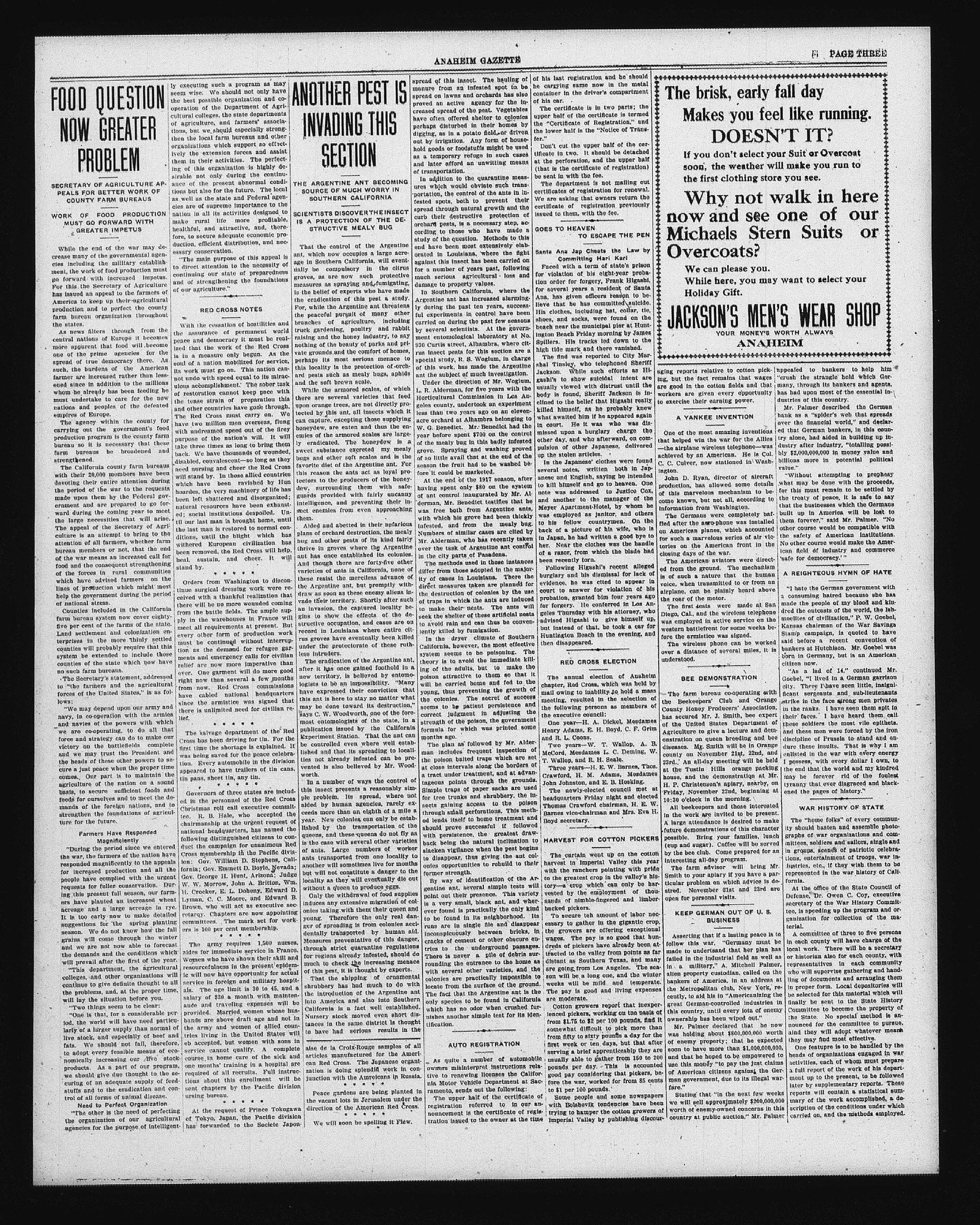
Searchable text
FOOD QUESTION NOW GREATER PROBLEM
SECRETARY OF AGRICULTURE APPEALS FOR BETTER WORK OF COUNTY FARM BUREAUS
WORK OF FOOD PRODUCTION MUST GO FORWARD WITH GREATER IMPETUS
While the end of the war may decrease many of the governmental agencies including the military establishment, the work of food production must go forward with increased impetus. For this the Secretary of Agriculture has issued an appeal to the farmers of America to keep up their agricultural production and to perfect the county farm bureau organization throughout the states.
As news filters through from the central nations of Europe it becomes more apparent that food will become one of the prime agencies for the spread of true democracy there. As such, the burdens of the American farmer are increased rather than lessened since in addition to the millions whom he already has been feeding he must undertake to care for the new nations and peoples of the defeated empires of Europe.
The agency within the county for carrying out the government's food production program is the county farm bureau so it is necessary that these farm bureaus be broadened andly executing such a program as may seem wise. We should not only have the best possible organization and cooperation of the Department of Agricultural colleges, the state departments of agriculture, and farmers' associations, but we should especially strengthen the local farm bureaus and other organizations which support so effectively the extension forces and assist them in their activities. The perfecting of this organization is highly desirable not only during the continuance of the present abnormal conditions but also for the future. The local as well as the state and Federal agencies are of supreme importance to the nation in all its activities designed to make rural life more profitable, healthful, and attractive, and, therefore, to secure adequate economic production, efficient distribution, and necessary conservation.
"The main purpose of this appeal is to direct attention to the necessity of continuing our state of preparedness and of strengthening the foundations of our agriculture."
RED CROSS NOTES
With the cessation of hostilities and the assurance of permanent world peace and democracy it must be realized that the work of the Red Cross is in a measure only begun. As the soul of a nation mobilized for service, its work must go on. This nation cannot undo with speed equal to its miraculous accomplishment: The sober task of restoration cannot keep pace with the tense strain of preparation this and other countries have gone through. The Red Cross must carry on. We have two million men overseas, flung with undreamed speed out of the firey purpose of the nation's will. It will take three times as long to bring them back. We have thousands of wounded,
ANOTHER PINVADING SECTION
THE ARGENTINE ANTI-SOURCE OF MUCH SOUTHERN CALIFORNIA
SCIENTISTS DISCOVER IS A PROTECTION OF STRUCTIVE MEANS
That the control of ant, which now occupies age in Southern California usually be compulsory groves, as are now supers measures as spraying ars is the belief of experts with the eradication of this ant. For, while the Argentine the peaceful pursuit of branches of agriculture truck gardening, poultry raising and the honey industry nothing of the beauty of vate grounds and the con perhaps its most serious locality is the protection pests such as mealworms and the soft brown scaly.
While the armored seattle there are several varieties upon orange trees, are protected by this ant, all it can capture, excepting th honeydew, are eaten and emies of the armored so ly eradicated. The h sweet substance excreting
spread of true democracy there. As such, the burdens of the American farmer are increased rather than lessened since in addition to the millions whom he already has been feeding he must undertake to care for the new nations and peoples of the defeated empires of Europe.
The agency within the county for carrying out the government's food production program is the county farm bureau so it is necessary that these farm bureaus be broadened and strengthened.
The California county farm bureaus with their 20,000 members have been devoting their entire attention during the period of the war to the requests made upon them by the Federal government and are prepared to go forward during the coming year to meet the large necessities that will arise. The appeal of the Secretary of Agriculture is an attempt to bring to the attention of all farmers, whether farm bureau members or not, that the end of the war means an increased call for food and the consequent strengthening of the forces in rural communities which have advised farmers on the lines of production which might most help the government during the period of national stress.
Counties included in the California farm bureau system now cover eighty-five per cent of the farms of the state. Land settlement and colonization enterprises in the more thinly settled counties will probably require that this system be extended to include those counties of the state which now have no such farm bureaus.
The Secretary's statement, addressed to "the farmers and the agricultural forces of the United States," is as follows:
"We may depend upon our army and navy, in co-operation with the armies and navies of the powers with which we are co-operating, to do all that force and strategy can do to make our victory on the battlefields complete and we may trust the President and the heads of these other powers to secure a just peace when the proper time comes. Our part is to maintain the agriculture of the nation on a sound basis, to secure sufficient foods and feeds for ourselves and to meet the demands of the foreign nations, and to strengthen the foundations of agriculture for the future."
Farmers Have Responded Magnificently
"During the period since we entered the war, the farmers of the nation have responded magnificently to the appeals
soul of a nation mobilized for service, its work must go on. This nation cannot undo with speed equal to its miraculous accomplishment.' The sober task of restoration cannot keep pace with the tense strain of preparation this and other countries have gone through. The Red Cross must carry on. We have two million men overseas, flung with undreamed speed out of the firey purpose of the nation's will. It will take three times as long to bring them back. We have thousands of wounded, disabled, convalescent—so long as they need nursing and cheer the Red Cross will stand by. In those allied countries which have been ravished by Hun hoardes, the very machinery of life has been left shattered and disorganized; natural resources have been exhausted; social institutions despoiled. Until our last man is brought home, until the last man is restored to normal conditions, until the blight which has withered European civilization has been removed, the Red Cross will help, heal, sustain, and cheer. It will stand by.
Orders from Washington to discontinue surgical dressing work were received with a thankful realization that there will be no more wounded coming from the battle fields. The ample supply in the warehouses in France will meet all requirements at present. But every other form of production work must be continued without interruption as the demand for refugee garments and emergency calls for civilian relief are now more imperative than ever. One garment will do more good right now than several a few months from now. Red Cross commissions have cabled national headquarters since the armistice was signed that there is unlimited need for civilian relief.
The salvage department of the Red Cross has been driving for tin. For the first time the shortage is explained. It was being saved for the peace celebration. Every automobile in the division appeared to have trailers of tin cans, tin pans, sheet tin, any tin.
Governors of three states are included in the personnel of the Red Cross Christmas roll call executive committee. R. B. Hale, who accepted the chairmanship at the urgent request of national headquarters, has named the following distinguished citizens to conduct the campaign for unanimous Red Cross membership in the Pacific division: Gov. William D. Stephens, Cali-
While the armored so there are several variants upon orange trees, are protected by this ant, all in can capture, excepting honeydew, are eaten and emiles of the armored so easily eradicated. The sweet substance excretes bugs and other soft scars favorite diet of the Argentine this reason the ants act protectors to the producer dew, surrounding them guards provided with intelligence, and prevent enemies from ever them.
Aided and abetted in plans of orchard destruction bug and other pests of thrive in groves where ant has once established And though there are varieties of ants in California these resist the merciless Argentine ant, but draw as soon as these oveade their territory. Shan invasion, the captains gins to show the effective occupation, a record in Louisiana weirus groves have eventually under the protectorate less intruders.
The eradication of this after it has once galvanized new territory, is believed logists to be an impossive have expressed their this ant is here to stay may be done toward says C. W. Woodworth most entomologists of publication issued by Experiment Station. Be controlled even well lished and that its sprites not already infested vented is also believable worth.
In a number of ways this insect presents a ple problem. Its spines aided by human agentsceeds more than an e-year. New colonies collapsed by the transqueens, and these queens is the case with severenof ants. Large numntants transported from another will sometimes
Farmers Have Responded Magnificently
"During the period since we entered the war, the farmers of the nation have responded magnificently to the appeals for increased production and all the people have complied with the urgent requests for fuller conservation. During this present fall season, our farmers have planted an increased wheat acreage and a large acreage in rye. It is too early now to make detailed suggestions for the spring planting season. We do not know how the fall grains will come through the winter and we are not now able to forecast the demands and the conditions which will prevail after the first of the year.
"This department, the agricultural colleges, and other organizations will continue to give definite thought to all the problems, and, at the proper time, will lay the situation before you.
"Two things seem to be clear:
"One is that, for a considerable period, the world will have need particularly of a larger supply than normal of live stock, and especially of beef and fats. We should not fail, therefore, to adopt every feasible means of economically increasing our live stock products. As a part of our program, we should give due thought to the securing of an adequate supply of feedstuffs and to the eradication and control of all forms of animal disease."
Need to Perfect Organization
"The other is the need of perfecting the organization of our agricultural agencies for the purpose of intelligent-
Governors of three states are included in the personnel of the Red Cross Christmas roll call executive committee. R. B. Hale, who accepted the chairmanship at the urgent request of national headquarters, has named the following distinguished citizens to conduct the campaign for unanimous Red Cross membership in the Pacific division: Gov. William D. Stephens, California; Gov. Emmett D. Boyle, Nevada; Gov. George H. Hunt, Arizona; Judge W. W. Morrow, John A. Britton, Wm. H. Crocker, E. L. Doheny, Edward D. Lyman, C. C. Moore, and Edward B. Brown, who will act as executive secretary. Chapters are now appointing committees. The mark set for workers is 100 per cent membership.
The army requires 1,500 nurses, aides for immediate service in France. Women who have shown their skill and resourcefulness in the present epidemic will now have opportunity for actual service in foreign and military hospitals. The age limit is 30 to 45, and a salary of $30 a month with maintenance and travelling expenses will be provided. Married women whose husbands are above draft age and not in the army and women of allied countries living in the United States will be accepted, but women with sons in service cannot qualify. A complete course in home care of the sick and one months' training in a hospital are required of all recruits. Full instructions about this enrollment will be sent chapters by the Pacific division nursing bureau.
At the request of Prince Tokogawa of Tokyo, Japan, the Pacific division has forwarded to the Societe Japon-
In a number of ways this insect presents a ple problem. Its spotted by human ageceeds more than an e-year. New colonies collapsed by the transqueens, and these queens is the case with several ants. Large numbers transported from another will sometimes but will not constitute locality as they will do without a queen to prince.
Only the withdrawals induce any extensive ones taking with them young. Therefore the larger of spreading is frent dentally transported Measures preventative through strict quarantine for regions already in much to check the life of this pest, it is thought.
That the shipping shrubbery has had the introduction of into America and a California is a fact Nursery stock moves tances in the same way to have had serious
ANOTHER PEST IS INVADING THIS SECTION
THE ARGENTINE ANT BECOMING SOURCE OF MUCH WORRY IN SOUTHERN CALIFORNIA
SCIENTISTS DISCOVER THE INSECT IS A PROTECTION OF THE DESTRUCTIVE MEALY BUG
That the control of the Argentine ant, which now occupies a large acreage in Southern California, will eventually be compulsory in the citrus groves, as are now such protective measures as spraying and fumigating, is the belief of experts who have made the eradication of this pest a study. For, while the Argentine ant threatens the peaceful pursuit of many other branches of agriculture, including truck gardening, poultry and rabbit raising and the honey industry, to say nothing of the beauty of parks and private grounds, and the comfort of homes, perhaps its most serious menace to this locality is the protection of orchard pests such as mealy bugs, aphids and the soft brown scale.
While the armored scales, of which there are several varieties that feed upon orange trees, are not directly protected by this ant, all insects which it can capture, excepting those supplying honeydew, are eaten and thus the enemies of the armored scales are largely eradicated. The honeydew is a sweet substance excreted my mealy bug and other soft scales and is the spread of this insect. The hauling of manure from an infested spot to be spread on lawns and orchards has also proved an active agency for the increased spread of the pest. Vegetables have often offered shelter to colonies perhaps disturbed in their homes by digging, as in a potato field, or driven out by irrigation. Any form of household goods or foodstuffs might be used as a temporary refuge in such cases and later afford an unwitting means of transportation.
In addition to the quarantine measures which would obviate such transportation, the control of the ants in infested spots, both to prevent their spread through natural growth and the curb their destructive protection of orchard pests, is a necessary step, according to those who have made a study of the question. Methods to this end have been most extensively elaborated in Louisiana, where the fight against this insect has been carried on for a number of years past, following much serious agricultural loss and damage to property values.
In Southern California, where the Argentine ant has increased alarmingly during the past ten years, successful experiments in control have been carried on during the past few seasons by several scientists. At the government entomological laboratory at No. 930 Curtis street, Alhambra, where citrus insect pests for this section are a special study, R. S. Woglum, in charge of this work, has made the Argentine ant the subject of much investigation.
Under the direction of Mr. Woglum, L. R. Alderman, for five years with the Horticultural Commission in Los Angeles county, undertook an experiment less than two years ago on an eleven-acre orchard at Alhambra belonging to W. G. Benedict. Mr. Benedict had the year before spent $700 on the control of the mealy bug in this badly infested grove. Spraying and washing proved of his last registration and he should be carrying same now in the metal container in the driver's compartment of his car.
The certificate is in two parts; the upper half of the certificate is termed the "Certificate of Registration," and the lower half is the "Notice of Transfer."
Don't cut the upper half of the certificate in two. It should be detached at the perforation, and the upper half (that is the certificate of registration) be sent in with the fee.
The department is not mailing out certificates of registration for renewal. We are asking that owners return the certificate of registration previously issued to them, with the fee.
GOES TO HEAVEN
TO ESCAPE THE PEN
Santa Ana Jap Cheats the Law by Committing Hari Karl
Faced with a term of state's prison for violation of his eight-year probation order for forgery, Frank Higashi, for several years a resident of Santa Ana, has given officers reason to believe that he has committed suicide. His clothes, including hat, collar, tie, shoes, and socks, were found on the beach near the municipal pier at Huntington Beach Friday morning by James Spillers. His tracks led down to the high tide mark and there vanished.
The find was reported to City Marshal Tinsley, who telephoned Sheriff Jackson. While such efforts as Higashi's to show suicidal intent are usually viewed with distrust until the body is found, Sheriff Jackson is inclined to the belief that Higashi really killed himself, as he probably knew what awaited him if he appeared again in court. He it was who was dismissed upon a burglary charge the other day, and who afterward, on compulsion of other Japanese, delivered up the stolen articles.
While the armored scales, of which there are several varieties that feed upon orange trees, are not directly protected by this ant, all insects which it can capture, excepting those supplying honeydew, are eaten and thus the enemies of the armored scales are largely eradicated. The honeydew is a sweet substance excreted my mealy bugs and other soft scales and is the favorite diet of the Argentine ant. For this reason the ants act as loyal protectors to the producers of the honeydew, surrounding them with safeguards provided with fairly uncanny intelligence, and preventing their insect enemies from even approaching them.
Aided and abetted in their nefarious plans of orchard destruction, the mealy bug and other pests of its kind fairly thrive in groves where the Argentine ant has once established its colonies. And though there are forty-five other varieties of ants in California, none of these resist the merciless advance of the Argentine ant, but promptly withdraw as soon as these enemy aliens invade their territory. Shortly after such an invasion, the captured locality begins to show the effects of the destructive occupation, and cases are on record in Louisiana where entire citrus groves have eventually been killed under the protectorate of these ruthless intruders.
The eradication of the Argentine ant, after it has once gained foothold in a new territory, is believed by entomologists to be an impossibility. "Many have expressed their conviction that this ant is here to stay no matter what may be done toward its destruction," says C. W. Woodworth, one of the foremost entomologists of the state, in a publication issued by the California Experiment Station. That the ant can be controlled even where well established and that its spreading to localities not already infested can be prevented is also believed by Mr. Woodworth.
In a number of ways the control of this insect presents a reasonably simple problem. Its spread, where not aided by human agencies, rarely exceeds more than an eighth of a mile a year. New colonies can only be established by the transportation of the queens, and these queens do not fly as is the case with several other varieties of ants. Large numbers of worker ants transported from one locality to another will sometimes live for months special study. R. G. Woglum, in charge of this work, has made the Argentine ant the subject of much investigation.
Under the direction of Mr. Woglum, L. R. Alderman, for five years with the Horticultural Commission in Los Angeles county, undertook an experiment less than two years ago on an eleven-acre orchard at Alhambra belonging to W. G. Benedict. Mr. Benedict had the year before spent $700 on the control of the mealy bug in this badly infested grove. Spraying and washing proved of so little avail that at the end of the season the fruit had to be washed before it could be marketed.
At the end of the 1917 season, after having spent only $80 on the system of ant control inaugurated by Mr. Alderman, Mr. Benedict testifies that he was free both from Argentine ants, with which his grove had been thickly infested, and from the mealy bug. Numbers of similar cases are cited by Mr. Alderman, who has recently taken over the task of Argentine ant control in the city parts of Pasadena.
The methods used in these instances differ from those adopted in the majority of cases in Louisiana. There the direct measures taken are planned for the destruction of colonies by the use of traps in which the ants are induced to make their nests. The ants will seek the shelter of these artificial nests to avoid rain and can thus be conveniently killed by fumigation.
In the dryer climate of Southern California, however, the most effective system seems to be poisoning. The theory is to avoid the immediate killing of the adults, but to make the poison attractive to them so that it will be carried home and fed to the young, thus preventing the growth of the colonies. The secret of success seems to be patient persistence and correct judgment in adjusting the strength of the poison, the government formula for which was printed some months ago.
The plan as followed by Mr. Alderman includes frequent inspection of the poison baited traps which are set at close intervals along the borders of a tract under treatment, and at advantageous points through the grounds. Simple traps of paper sacks are used for tree trunks and shrubbery, the insects gaining access to the poison through small perforations. This method lends itself to home treatment and should prove successful if followed with persistence, the greatest drawback being the natural inclination to slacken vigilance when the pest begins to disappear, thus giving the ant colonies opportunities to rebuild to theirshal Tinsley, who telephoned Sheriff Jackson. While such efforts as Higashi's to show suicidal intent are usually viewed with distrust until the body is found, Sheriff Jackson is inclined to the belief that Higashi really killed himself, as he probably knew what awaited him if he appeared again in court. He it was who was dismissed upon a burglary charge the other day, and who afterward, on compulsion of other Japanese, delivered up the stolen articles.
In the Japanese' clothes were found several notes, written both in Japanese and English, saying he intended to kill himself and go to heaven. One note was addressed to Justice Cox, and another to the manager of the Meyer Apartment-Hotel, by whom he was employed as janitor, and others to his fellow countrymen. On the back of a picture of his wife, who is in Japan, he had written a good bye to her. Near the clothes was the handle of a razor, from which the blade had been recently torn.
Following Higashi's recent alleged burglary and his dismissal for lack of evidence, he was cited to appear in court to answer for violation of his probation, granted him four years ago for forgery. He conferred in Los Angeles Thursday with his attorney, who advised Higashi to give himself up, but instead of that, he took a car for Huntington Beach in the evening, and then disappeared.
RED CROSS ELECTION
The annual election of Anaheim chapter, Red Cross, which was held by mail owing to inability to hold a mass meeting, resulted in the selection of the following persons as members of the executive council:
One year—H. A. Dickel, Mesdames Henry Adams, E. H. Boyd, C. F. Grim and R. L. Coons.
Two years—W. T. Wallop, A. B. McCord, Mesdames L. C. Deming, W. T. Wallop, and R. H. Seale.
Three years—H. E. W. Barnes, Thos.Crawford, H. M. Adams, Mesdames John Johnston, and E. B. Hosking.
The newly-elected council met at headquarters Friday night and elected Thomas Crawford chairman, H. E. W.Barnes vice-chairman and Mrs. Eva H.Boyd secretary.
HARVEST FOR COTTON PICKERS
The curtain went up on the cotton harvest in Imperial Valley this year
aging reporting, but they are good in workers are to exercise
A YA
One of them that helped—the airplane achieved by C. C. Culverington.
John D., production, of this man come known information.
The Gerrifled after this on America for such a torries on t closing days.
The Am ed from tha is of such voice, when airplane,c othe roar off.
The first Diego,Cal., was employ western bafore the ar
The wire over a dis understood
In a number of ways the control of this insect presents a reasonably simple problem. Its spread, where not aided by human agencies, rarely exceeds more than an eighth of a mile a year. New colonies can only be established by the transportation of the queens, and these queens do not fly as is the case with several other varieties of ants. Large numbers of worker ants transported from one locality to another will sometimes live for months but will not constitute a danger to the locality as they will eventually die out without a queen to produce eggs.
Only the withdrawal of food supplies induces any extensive migration of colonies taking with them their queen and young. Therefore the only real danger of spreading is from colonies accidentally transported by human aid. Measures preventative of this danger, through strict quarantine regulations for regions already infested, should do much to check the increasing menace of this pest, it is thought by experts.
That the shipping of ornamental shrubbery has had much to do with the introduction of the Argentine ant into America and also into Southern California is a fact well established. Nursery stock moved even short distances in the same district is thought to have had serious results in the raise de la Croix-Rouge samples of all articles manufactured for the American Red Cross. The Japanese organization is doing splendid work in conjunction with the Amreicans in Russia.
Peace gardens are being planted in the vacant lots in Jerusalem under the direction of the American Red Cross.
We will soon be spelling it Flew.
AUTO REGISTRATION
As quite a number of automobile owners misinterpret instructions relative to renewing licenses the California Motor Vehicle Department at Sacramento, sends out the following:
The upper half of the certificate of registration referred to in our announcement is the certificate of registration issued to the owner at the time
Three years—H. E. W. Bentley, Crawford, H. M. Adams, Mesdames John Johnston, and E. B. Hosking.
The newly-elected council met at headquarters Friday night and elected Thomas Crawford chairman, H. E. W. Barnes vice-chairman and Mrs. Eva H. Boyd secretary.
HARVEST FOR COTTON PICKERS
The curtain went up on the cotton harvest in Imperial Valley this year with the ranchers pointing with pride to the greatest crop in the valley's history—a crop which can only be harvested by the employment of thousands of nimble-fingered and limber-backed pickers.
To secure teh amount of labor necessary to gather in the gigantic crop, the growers are offering exceptional wages. The pay is so good that hundreds of pickers have already been attracted to the valley from points as far distant as Southern Texas, and many are going from Los Angeles. The season will be a long one, and the winter weeks will be mild and temperate. The pay is good and living expenses are moderate.
Cotton growers report that inexperienced pickers, working on the basis of $1.75 to $2 per 100 pounds, find it somewhat difficult to pick more than from fifty to sixty pounds a day for the first week or ten days, but that after serving a brief apprenticeship they are usually able to gather from 150 to 200 pounds per day. This is accounted good pay considering that pickers, before the war, worked for from 85 cents to $1 per 100 pounds.
Some people and some newspapers with Bolshevik tendencies have been trying to hamper the cotton growers of Imperial Valley by publishing discour
The brisk, early fall day
Makes you feel like running.
DOESN'T IT?
If you don't select your Suit or Overcoat soon, the weather will make you run to the first clothing store you see.
Why not walk in here now and see one of our Michaels Stern Suits or Overcoats?
We can please you.
While here, you may want to select your Holiday Gift.
JACKSON'S MEN'S WEAR SHOP
YOUR MONEY'S WORTH ALWAYS
ANAHEIM
A YANKEE INVENTION
One of the most amazing inventions that helped win the war for the Allies—the airplane wireless telephone—was achieved by an American. He is Col.
appealed to bankers to help him "crush the strangle hold which Germany, through its bankers and agents, has had upon most of the essential industries of this country.
Mr. Palmer described the German bank as a "spider's web that spreads over the financial world," and declared that German bankers, in this country alone, had aided in building up industry after industry, "totalling possibly $2,000,000,000 in money value and
A YANKEE INVENTION
One of the most amazing inventions that helped win the war for the Allies—the airplane wireless telephone—was achieved by an American. He is Col. C. C. Culver, now stationed in Washington.
John D. Ryan, director of aircraft production, has allowed some details of this marvelous mechanism to become known, but not all, according to information from Washington.
The Germans were completely baffled after the aero-phone was installed on American planes, which accounted for such a marvelous series of air victories on the American front in the closing days of the war.
The American aviators were directed from the ground. The mechanism is of such a nature that the human voice, when transmitted to or from an airplane, can be plainly heard above the roar of the motor.
The first tests were made at San Diego, Cal., and the wireless telephone was employed in active service on the western battlefront for some weeks before the armistice was signed.
The wireless phone can be worked over a distance of several miles, it is understood.
BEE DEMONSTRATION
The farm bureau co-operating with the Beekeepers' Club and Orange County Honey Producers' Association, has secured Mr. J. Smith, bee expert of the United States Department of Agriculture to give a lecture and demonstration on queen breeding and bee diseases. Ms. Smith will be in Orange county on November 21st, 22nd, and 23rd. An all-day meeting will be held at the Tustin Hills orange packing house, and the demonstration at Mr. H. P. Christenson's apiary, nearby, on Friday, November 22nd, beginning at 10:30 o'clock in the morning.
All beekeepers and those interested in the work are invited to be present. A large attendance is desired to make future demonstrations of this character possible. Bring your families, lunch (cup and sugar). Coffee will be served by the bee club. Come prepared for an interesting all-day program.
appealed to bankers to help him "crush the strangle hold which Germany, through its bankers and agents, has had upon most of the essential industries of this country.
Mr. Palmer described the German bank as a "spider's web that spreads over the financial world," and declared that German bankers, in this country alone, had aided in building up industry after industry, "totalling possibly $2,000,000,000 in money value and billions more in potential political value."
"Without attempting to prophesy what may be done with the proceeds, for this must remain to be settled by the treaty of peace, it is safe to say that the businesses which the Germans built up in America will be lost to them forever," said Mr. Palmer. "No other course would be compatible with the safety of American institutions. No other course would make the American field of industry and commerce 'safe for democracy.'"
A REIGHTEOUS HYMN OF HATE
"I hate the German government with a consuming hatred because she has made the people of my blood and kindred the outcasts of the world, the Ishmoelites of civilization," P. W. Goebel, Kansas chairman of the War Savings Stamp campaign, is quoted to have said before a recent convention of bankers at Hutchison. Mr. Goebel was born in Germany, but is an American citizen now.
"As a lad of 14," continued Mr. Goebel, "I lived in a German garrison city. There I have seen little, insignificant sergeants and sub-leutenants strike in the face strong men privates in the ranks. I have seen them spit in their faces. I have heard them call these soldiers the most vile epithets, and these men were forced by the iron discipline of Prussia to stand and endure these insults. That is why I am enlisted in the war with every energy I possess, with every dollar I own, to the end that the world and my kindred may be forever rid of the foulest tyranny that ever disgraced and blackened the pages of history."
WAR HISTORY OF STATE
The "home folks" of every community should hasten and assemble photographs of war organizations and committees, soldiers and sailors, single and in groups, scenes of patriotic celebrations, entertainment of troops, war industries etc. if they wish them to be
WAR HISTORY OF STATE
The "home folks" of every community should hasten and assemble photographs of war organizations and committees, soldiers and sailors, single and in groups, scenes of patriotic celebrations, entertainment of troops, war industries, etc., if they wish them to be represented in the war history of California.
At the office of the State Council of Defense, Dr. Owen C. Coy, executive secretary of the War History Committee, is speeding up the program and organization for collection of the material.
A committee of three to five persons in each county will have charge of the local work. There will be a secretary or historian also for each county, with representatives in each community who will supervise gathering and handling of documents and arranging them in proper form. Local depositories will be selected for this material which will finally be sent to the State History Committee to become the property of the State. No special method is announced for the committee to pursue, and they will adopt whatever means they may find most effective.
One feature is to be handled by the heads of organizations engaged in war activities, each of whom must prepare a full report of the work of his department up to the present, to be followed later by supplementary reports. These reports will contain a statistical summary of the work accomplished, a description of the conditions under which carried on, and the methods employed.