anaheim-gazette 1918-11-21
Scanned page
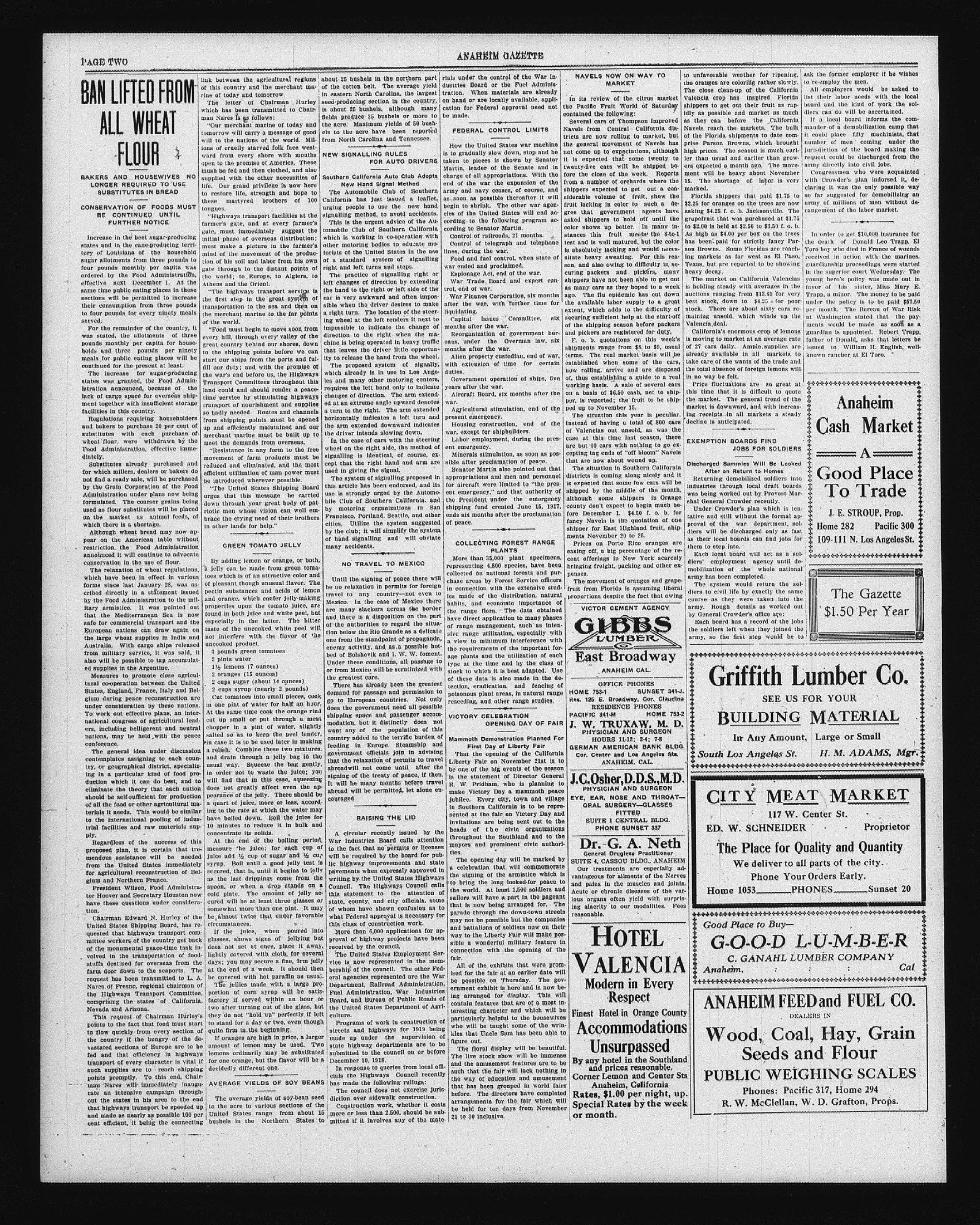
Searchable text
BAN LIFTED FROM
ALL WHEAT
FLOUR
BAKERS AND HOUSEWIVES NO
LONGER REQUIRED TO USE
SUBSTITUTES IN BREAD
CONSERVATION OF FOODS MUST
BE CONTINUED UNTIL
FURTHER NOTICE
Increase in the beet sugar-producing states and in the cane-producing territory of Louisiana of the household sugar allotments from three pounds to four pounds monthly per capita was ordered by the Food Administration, effective next December 1. At the same time public eating places in these sections will be permitted to increase their consumption from three pounds to four pounds for every ninety meals served.
For the remainder of the country, it was stated, the allotments of three pounds monthly per capita for households and three pounds per ninety meals for public eating places will be continued for the present at least.
The increase for sugar-producing states was granted, the Food Administration announced, because of the lack of cargo space for overseas shipment together with insufficient storage facilities in this country.
Regulations requiring householders and bakers to purchase 20 per cent of substitutes with each purchase of wheat flour were withdrawn by the Food Administration, effective immediately.
Link between the agricultural regions of this country and the merchant marine of today and tomorrow.
The letter of Chairman Hurley which has been transmitted to Chairman Nares is as follows:
"Our merchant marine of today and tomorrow will carry a message of goodwill to the nations of the world. Millions of cruelly starved folk face westward from every shore with mouths open to the promise of America. These mush be fed and then clothed, and also supplied with the other necessities of life. Our grand privilege is now here to restore life, strength and hope to these martyred brothers of 100 tongues.
Highways transport facilities at the farmer's gate, and at every farmer's gate, must immediately suggest the initial phase of overseas distribution; must make a picture in the farmer's mind of the movement of the production of his soil and labor from his own gate through to the distant points of the world; to Europe, to Algiers, to Athens and the Orient.
The highways transport service is the first step in the great system of transportation to the sea and then on the merchant marine to the far points of the world.
Food must begin to move soon from every hill, through every valley of the great country behind our shores, down to the shipping points before we can start our ships from the ports and fulfill our duty; and with the promise of the war's end before us, the Highways Transport Committees throughout this land could and should render a peace-time service by stimulating highways transport of nourishment and supplies so badly needed. Routes and channels from shipping points must be opened up and efficiently maintained and our merchant marine must be built up to meet the demands from overseas."
Resistance in any form to the free movement of farm products must be about 25 bushels of the cotton bale in eastern North Carolina seed-producing fields produce acre; Max els to the acre from North Carolina.
NEW SIGNALS
Southern California
New Hampshire
The Automobile California has urging people signalling met.
This is the tomobile Club which is working other motorizing tourists of the borough of a standard right and left.
The practice left changes on the hand to the car is very awful when they a right turn. The ing wheel at the impossible to direction to chine is being that leaves thity to release t.
The proposed which already les and many requires the less changes of dir ed at an extrem e a turn to the n horizontally in the arm extent the driver intends.
In the case wheel on the signalling is
The increase for sugar-producing states was granted, the Food Administration announced, because of the lack of cargo space for overseas shipment together with insufficient storage facilities in this country.
Regulations requiring householders and bakers to purchase 20 per cent of substitutes with each purchase of wheat flour were withdrawn by the Food Administration, effective immediately.
Substitutes already purchased and for which millers, dealers or bakers do not find a ready sale, will be purchased by the Grain Corporation of the Food Administration under plans now being formulated. The coarser grains being used as flour substitutes will be placed on the market as animal feeds, of which there is a shortage.
Although wheat bread may now appear on the American table without restriction, the Food Administration announced it will continue to advocate conservation in the use of flour.
The relaxation of wheat regulations, which have been in effect in various forms since last January 28, was ascribed directly in a statement issued by the Food Administration to the military armistice. It was pointed out that the Mediterranean Sea is now safe for commercial transport and the European nations can draw again on the large wheat supplies in India and Australia. With cargo ships released from military service, it was said, it also will be possible to tap accumulated supplies in the Argentine.
Measures to promote close agricultural co-operation between the United States, England, France, Italy and Belgium during peace reconstruction are under consideration by these nations. To work out effective plans, an international congress of agricultural leaders, including belligerent and neutral nations, may be held with the peace conference.
The general idea under discussion contemplates assigning to each country, or geographical district, specializing in a particular kind of food production which it can do best, and to eliminate the theory that each nation should be self-sufficient for production of all the food or other agricultural materials it needs. This would be similar to the international pooling of industrial facilities and raw materials supply.
Regardless of the success of this proposed plan, it is certain that tremendous assistance will be needed from the United States immediately start our ships from the ports and fill our duty; and with the promise of the war's end before us, the Highways Transport Committees throughout this land could and should render a peace-time service by stimulating highways transport of nourishment and supplies so badly needed. Routes and channels from shipping points must be opened up and efficiently maintained and our merchant marine must be built up to meet the demands from overseas.
"Resistance in any form to the free movement of farm products must be reduced and eliminated, and the most efficient utilization of man power must be introduced wherever possible.
"The United States Shipping Board urges that this message be carried down through your great body of patriotic men whose vision can well embrace the crying need of their brothers in other lands for help."
GREEN TOMATO JELLY
By adding lemon or orange, or both, a jelly can be made from green tomatoes which is of an attractive color and of pleasant though unusual flavor. The pectin substances and acids of lemon and orange, which confer jelly-making properties upon the tomato juice, are found in both juice and white peel, but especially in the latter. The bitter taste of the uncooked white peel will not interfere with the flavor of the uncooked product.
3 pounds green tomatoes
2 pints water
1½ lemons (7 ounces)
2 oranges (15 ounces)
2 cups sugar (about 14 ounces)
2 cups syrup (nearly 2 pounds)
Cut tomatoes into small pieces, cook in one pint of water for half an hour. At the same time cook the orange rind cut up small or put through a meat chopper in a pint of water, slightly salted so as to keep the peel tender, in case it is to be used later in making a relish. Combine these two mixtures, and drain through a jelly bag in the usual way. Squeeze the bag gently, in order not to waste the juice; you will find that in this case, squeezing does not greatly affect even the appearance of the jelly. There should be a quart of juice, more or less, according to the rate at which the water may have boiled down. Boil the juice for 10 minutes to reduce it in bulk and concentrate its solids.
At the end of the boiling period, measure the juice; for each cup of juice add ½ cup of sugar and ½ cup syrup. Boil until a good jelly test is
ing in a particular kind of food production which it can do best, and to eliminate the theory that each nation should be self-sufficient for production of all the food or other agricultural materials it needs. This would be similar to the international pooling of industrial facilities and raw materials supply.
Regardless of the success of this proposed plan, it is certain that tremendous assistance will be needed from the United States immediately for agricultural reconstruction of Belgium and Northern France.
President Wilson, Food Administrator Hoover and Secretary Houston now have these questions under consideration.
Chairman Edward N. Hurley of the United States Shipping Board, has requested that highways transport committee workers of the country get back of the monumental peace-time task involved in the transportation of foodstuffs destined for overseas from the farm door down to the seaports. The request has been transmitted to L. A. Nares of Fresno, regional chairman of the Highways Transport Committee, comprising the states of California, Nevada and Arizona.
This request of Chairman Hurley's points to the fact that food must start to flow quickly from every section of the country if the hungry of the devastated sections of Europe are to be fed and that efficiency in highways transport of every character is vital if such supplies are to reach shipping points promptly. To this end, Chairman Nares will immediately inaugurate an intensive campaign throughout the states in his area to the end that highways transport be speeded up and made as nearly as possible 100 per cent efficient, it being the connecting in order not to waste the juice; you will find that in this case, squeezing does not greatly affect even the appearance of the jelly. There should be a quart of juice, more or less, according to the rate at which the water may have boiled down. Boil the juice for 10 minutes to reduce it in bulk and concentrate its solids.
At the end of the boiling period, measure the juice; for each cup of juice add $\frac{1}{2}$ cup of sugar and $\frac{1}{2}$ cup syrup. Boil until a good jelly test is secured, that is, until it begins to jelly as the last drippings come from the spoon, or when a drop stands on a cold plate. The amount of jelly secured will be at least three glasses or somewhat more than one pint. It may be almost twice that under favorable circumstances.
If the juice, when poured into glasses, shows signs of jellying but does not set at once, place it away, lightly covered with cloth, for several days; you may secure a fine, firm jelly at the end of a week. It should then be covered with hot paraffin as usual.
The jellies made with a large proportion of corn syrup will be satisfactory if served within an hour or two after turning out of the glass, but they do not "hold up" perfectly if left to stand for a day or two, even though quite firm in the beginning.
If oranges are high in price, a larger amount of lemon may be used. Two lemons ordinarily may be substituted for one orange, but the flavor will be a decidedly different one.
AVERAGE YIELDS OF SOY BEANS
The average yields of soy-bean seed to the acre in various sections of the United States range from about 15 bushels in the Northern States to
ANAHEIM GAZETTE
about 25 bushels in the northern part of the cotton belt. The average yield in eastern North Carolina, the largest seed-producing section in the country, is about 25 bushels, although many fields produce 35 bushels or more to the acre. Maximum yields of 50 bushels to the acre have been reported from North Carolina and Tennessee.
NEW SIGNALLING RULES FOR AUTO DRIVERS
Southern California Auto Club Adopts New Hand Signal Method
The Automobile Club of Southern California has just issued a leaflet, urging people to use the new hand signalling method, to avoid accidents.
This is the urgent advice of the Automobile Club of Southern California which is working in co-operation with other motoring bodies to educate motorists of the United States in the use of a standard system of signalling right and left turns and stops.
The practice of signalling right or left changes of direction by extending the hand to the right or left side of the car is very awkward and often impossible when the driver desires to make a right turn. The location of the steering wheel at the left renders it next to impossible to indicate the change of direction to the right when the machine is being operated in heavy traffic that leaves the driver little opportunity to release the hand from the wheel.
The proposed system of signally, which already is in use in Los Angeles and many other motoring centers, requires the left hand only to indicate changes of direction. The arm extended at an extreme angle upward denotes a turn to the right. The arm extended horizontally indicates a left turn and the arm extended downward indicates the driver intends slowing down.
In the case of cars with the steering wheel on the right side, the method of signalling is identical, of course, ex-
The proposed system of signally, which already is in use in Los Angeles and many other motoring centers, requires the left hand only to indicate changes of direction. The arm extended at an extreme angle upward denotes a turn to the right. The arm extended horizontally indicates a left turn and the arm extended downward indicates the driver intends slowing down.
In the case of cars with the steering wheel on the right side, the method of signalling is identical, of course, except that the right hand and arm are used in giving the signal.
The system of signalling proposed in this article has been endorsed, and its use is strongly urged by the Automobile Club of Southern California, and by motoring organizations in San Francisco, Portland, Seattle, and other cities. Utilize the system suggested by the club; it will simplify the system of hand signalling and will obviate many accidents.
NO TRAVEL TO MEXICO
Until the signing of peace there will be no relaxation in permits for foreign travel to any country—not even to Mexico. In the case of Mexico there are many slackers across the border and there is a disposition on the part of the authorities to regard the situation below the Rio Grande as a delicate one from the standpoint of propaganda, enemy activity, and as a possible hotbed of Bolshevik and I. W. W. foment. Under these conditions, all passage to or from Mexico will be scrutinized with the greatest care.
There has already been the greatest demand for passage and permission to go to European countries. Not only does the government need all possible shipping space and passenger accommodation, but it distinctly does not want any of the population of this country added to the terrific burden of feeding in Europe. Steamship and government officials join in advising that the relaxation of permits to travel abroad will not come until after the signing of the treaty of peace, if then. It will be many months before travel abroad will be permitted, let alone encouraged.
RAISING THE LID
A circular recently issued by the War Industries Board calls attention to the fact that no permits or licenses will be required by the board for public highway improvements and state with extension of time for certain duties.
Government operation of ships, five years after the war.
Aircraft Board, six months after the war.
Agricultural stimulation, end of the present emergency.
Housing construction, end of the war, except for shipbuilders.
Labor employment, during the present emergency.
Minerals stimulation, as soon as possible after proclamation of peace.
Senator Martin also pointed out that appropriations and men and personnel for aircraft were limited to "the present emergency," and that authority of the President under the emergency shipping fund created June 15, 1917, ends six months after the proclamation of peace.
COLLECTING FOREST RANGE PLANTS
More than 35,000 plant specimens, representing 4,800 species, have been collected on national forests and purchase areas by Forest Service officers in connection with the extensive studies made of the distribution, natural habits, and economic importance of the range flora. The data obtained have direct application to many phases of range management, such as intensive range utilization, especially with a view to minimum interference with the requirements of the important forage plants and the utilization of each type at the time and by the class of stock to which it is best adapted. Use of these data is also made in the detection, eradication, and fencing of poisonous plant areas, in natural range reseeding, and other range studies.
VICTORY CELEBRATION OPENING DAY OF FAIR
Mammoth Demonstration Planned For First Day of Liberty Fair
That the opening of the California Liberty Fair on November 21st is to be one of the big events of the season is the statement of Director General R. W. Pridham, who is planning to make Victory Day a mammoth peace jubilee. Every city, town and village in Southern California is to be represented at the fair on Victory Day and invitations are being sent out to the heads of the civic organizations throughout Southland and to the mayors and prominent civic authorities.
The opening day will be marked by
RAISING THE LID
A circular recently issued by the War Industries Board calls attention to the fact that no permits or licenses will be required by the board for public highway improvements and state pavements when expressly approved in writing by the United States Highways Council. The Highways Council calls this statement to the attention of state, county, and city officials, some of whom have shown confusion as to what Federal approval is necessary for this class of construction work.
More than 6,000 applications for approval of highway projects have been received by the council.
The United States Employment Service is now represented in the membership of the council. The other Federal agencies represented are the War Department, Railroad Administration, Fuel Administration, War Industries Board, and Bureau of Public Roads of the United States Department of Agriculture.
Programs of work in construction of streets and highways for 1919 being made up under the supervision of state highway departments are to be submitted to the council on or before December 10, 1918.
In response to queries from local officials the Highways Council recently has made the following rulings:
The council does not exercise jurisdiction over sidewalk construction.
Construction work, whether it costs more or less than 2,500, should be submitted if it involves any of the mate-
be one of the big events of the season is the statement of Director General R. W. Pridham, who is planning to make Victory Day a mammoth peace jubilee. Every city, town and village in Southern California is to be represented at the fair on Victory Day and invitations are being sent out to the heads of the civic organizations throughout the Southland and to the mayors and prominent civic authorities.
The opening day will be marked by a celebration that will commemorate the signing of the armistice which is to bring the long looked-for peace to the world. At least 1,500 soldiers and sailors will have a part in the pageant that is now being arranged for. The parade through the down-town streets may not be possible but the companies and battalions of soldiers now on their way to the Liberty Fair will make possible a wonderful military feature in connection with the opening of the fair.
All of the exhibits that were promised for the fair at an earlier date will be possible on Thursday. The government exhibit is here and is now being arranged for display. This will contain features that are of a most interesting character and which will be particularly helpful to the housewives who will be taught some of the wrinkles that Uncle Sam has been able to figure out.
The floral display will be beautiful. The live stock show will be immense and the amusement features are to be such that the fair will lack nothing in the way of education and amusement that has been grouped in world fairs before. The directors have completed arrangements for the fair which will be held for ten days from November 21 to 30 inclusive.
HOTEL VALENCIA Modern in Every Respect
Finest Hotel in Orange County Accommodations Unsurpassed
By any hotel in the Southland and prices reasonable.
Corner Lemon and Center Sts Anaheim, California
Rates, $1.00 per night, up.
Special Rates by the week or month.
HOW ON WAY TO MARKET
of the citrus market
World of Saturday following:
Thompson Improved Central California disclosing to market, butement of Navels has expectations, although that some twenty to will be shipped before the week. Reports of orchards where the need to get out a cone of fruit, show the color to such a department agents have to hold off until the better. In many inquilt meets the 8-to-1 matured, but the color mixing and would necessitate. For this reading to difficulty in seeding and pickers, manny been able to get out they hoped to a week epidemic has cut down poor supply to a great deal to the difficulty of not help at the start-off season before packers registered for duty.
rations on this week's sale from $8 to $9, usual market basis will be on some of the cars, alive and are disposed of a guide to a real A sale of several cars $2.50 cash, net to ship the fruit to be shipment 15.
This year is peculiar, having a total of 800 cars unsold, as was the same last season, there with nothing to go ex- of "off bloom" Navels to unfavorable weather for ripening, the oranges are coloring rather slowly. The close clean-up of the California Valencia crop has inspired Florida shippers to get out their fruit as rapidly as possible and market as much as they can before the California Navels reach the markets. The bulk of the Florida shipments to date comprise Parson Browns, which brought high prices. The season is much earlier than usual and earlier than growers expected a month ago. The movement will be heavy about November 15. The shortage of labor is very marked.
Florida shippers that paid $1.75 to $2.25 for oranges on the trees are now asking $4.25 f. o. b. Jacksonville. The grapefruit that was purchased at $1.75 to $2.00 is held at $2.50 to $3.50 f. o. b. As high as $4.00 per box on the trees has been paid for strictly fancy Parson Browns. Some Floridas are reaching markets as far west as El Paso, Texas, but are reported to be showing heavy decay.
The market on California Valencias is holding steady with averages in the auctions ranging from $13.65 for very best stock, down to $4.25 for poor stock. There are about sixty cars remaining unsold, which winds up the Valencia deal.
California's enormous crop of lemons is moving to market at an average rate of 27 cars daily. Ample supplies are already available in all markets to take care of the wants of the trade and the total absence of foreign lemons will in no way be felt.
Price fluctuations are so great at this time that it is difficult to quote the market. The general trend of the market is downward, and with increasing receipts in all markets a steady decline is anticipated.
EXEMPTION BOARDS FIND JOBS FOR SOLDIERS
ask the former employer if he wishes to re-employ the men.
All employers would be asked to list their labor needs with the local board and the kind of work the soldiers can do will be ascertained.
If a local board informs the commander of a demobilization camp that it could place fifty machinists, that number of men coming under the jurisdiction of the board making the request could be discharged from the army directly into civil jobs.
Congressmen who were acquainted with Crowder's plan indorsed it, declaring it was the only possible way so far suggested for demobilizing an army of millions of men without derangement of the labor market.
In order to get $10,000 insurance for the death of Donald Leo Trapp, El Toro boy who died in France of wounds received in action with the marines, guardianship proceedings were started in the superior court Wednesday. The young hero's policy was made out in favor of his sister, Miss Mary E. Trapp, a minor. The money to be paid under the policy is to be paid $57.50 per month. The Bureau of War Risk at Washington stated that the payments would be made as soon as a guardian is appointed. Robert Trapp, father of Donald, asks that letters be issued to William H. English, well-known rancher at El Toro.
EXEMPTION BOARDS FIND JOBS FOR SOLDIERS
Discharged Sammies Will Be Looked After on Return to Homes
Returning demobilized soldiers into industries through local draft boards was being worked out by Provost Marshal General Crowder recently.
Under Crowder's plan which is tentative and still without the formal approval of the war department, soldiers will be discharged only as fast as their local boards can find jobs for them to step into.
Each local board will act as a soldiers' employment agency until demobilization of the whole national army has been completed.
The system would return the soldiers to civil life by exactly the same course as they were taken into the army. Rough details as worked out by General Crowder's office are:
Each board has a record of the jobs the soldiers left when they joined the army, so the first step would be to
Anaheim Cash Market
A Good Place To Trade
J. E. STROUP, Prop.
Home 282 Pacific 300
109-111 N. Los Angeles St.
The Gazette
$1.50 Per Year
Griffith Lumber Co.
SEE US FOR YOUR BUILDING MATERIAL
In Any Amount, Large or Small
South Los Angeles St. H. M. ADAMS, Mgr.
CITY MEAT MARKET
117 W. Center St.
ED. W. SCHNEIDER Proprietor
The Place for Quality and Quantity
We deliver to all parts of the city.
CITY MEAT MARKET
117 W. Center St.
ED. W. SCHNEIDER Proprietor
The Place for Quality and Quantity
We deliver to all parts of the city.
Phone Your Orders Early.
Home 1053 PHONES Sunset 20
Good Place to Buy—
G-O-O-D L-U-M-B-E-R
C. GANAHL LUMBER COMPANY
Anaheim. Cal
ANAHEIM FEED and FUEL CO.
DEALERS IN
Wood, Coal, Hay, Grain Seeds and Flour
PUBLIC WEIGHING SCALES
Phones: Pacific 317, Home 294
R. W. McClellan, W. D. Grafton, Props.