anaheim-gazette 1918-11-07
Scanned page
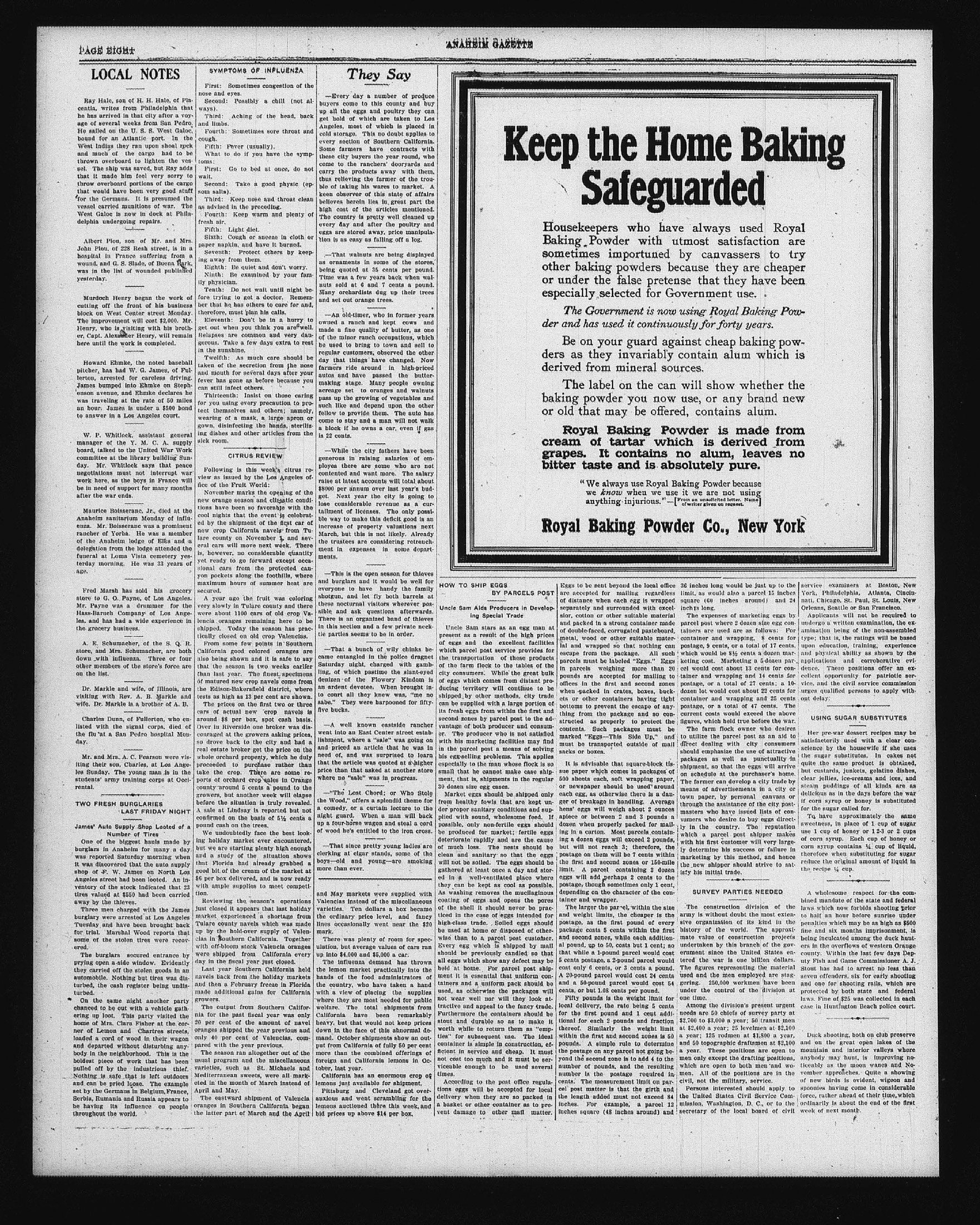
Searchable text
LOCAL NOTES
Ray Hale, son of H. H. Hale, of Placentia, writes from Philadelphia that he has arrived in that city after a voyage of several weeks from San Pedro. He sailed on the U. S. S. West Galoc, bound for an Atlantic port. In the West Indias they ran upon shoal rock and much of the cargo had to be thrown overboard to lighten the vessel. The ship was saved, but Ray adds that it made him feel very sorry to throw overboard portions of the cargo that would have been very good stuff for the Germans. It is presumed the vessel carried munitions of war. The West Galoc is now in dock at Philadelphia undergoing repairs.
Albert Plou, son of Mr. and Mrs. John Plou, of 228 Resh street, is in a hospital in France suffering from a wound, and G. S. Slade, of Buena Park, was in the list of wounded published yesterday.
Murdoch Henry began the work of cutting off the front of his business block on West Center street Monday. The improvement will cost $2,000. Mr. Henry, who is visiting with his brother, Capt. Alexander Henry, will remain here until the work is completed.
Howard Ehmke, the noted baseball pitcher, has had W. G. James, of Fullerton, arrested for careless driving. James bumped into Ehmke on Stephenson avenue, and Ehmke declares he was traveling at the rate of 50 miles an hour. James is under a $500 bond to answer in a Los Angeles court.
W. P. Whitlock, assistant general manager of the Y. M. C. A. supply board, talked to the United War Work committee at the library building Sun.
SYMPTOMS OF INFLUENZA
First: Sometimes congestion of the nose and eyes.
Second: Possibly a chill (not always).
Third: Aching of the head, back and limbs.
Fourth: Sometimes sore throat and cough.
Fifth: Fever (usually).
What to do if you have symptoms:
First: Go to bed at once, do not wait.
Second: Take a good physic (epsom salts).
Third: Keep nose and throat clean as advised in the preceding.
Fourth: Keep warm and plenty of fresh air.
Fifth: Light diet.
Sixth: Cough or sneeze in cloth or paper napkin, and have it burned.
Seventh: Protect others by keeping away from them.
Eighth: Be quiet and don't worry.
Ninth: Be examined by your family physician.
Tenth: Do not wait until night before trying to get a doctor. Remember that he has others to care for and, therefore, must plan his calls.
Eleventh: Don't be in a hurry to get out when you think you are well. Relapses are common and very dangerous. Take a few days extra to rest in the sunshine.
Twelfth: As much care should be taken of the secretion from the nose and mouth for several days after your fever has gone as before because you can still infect others.
Thirteenth: Insist on those caring for you using every precaution to protect themselves and others; namely, wearing a mask, a large apron or gown, disinfecting the hands, sterilizing dishes and other articles from the sick room.
CITRUS REVIEW
Every day buyers come to up all the eggs get hold of where Angeles, most cold storage. Every section of these city buyers come to the rail carry the product thus relieving the table of taking his keen observer believes herein high cost of this country is every day and eggs are stored tion is as easy as that walnut as ornaments being quoted at Time was a few nuts sold at 6 Many orchards and set out oran An old-time owned a ranch made a fine quail of the minor rank he used to bring regular customer day that things farmers ride and autos and have making stage acreage set to pass up the growth such like and fellow to provide come to stay and a block if he ow is 22 cents.
While the o
Howard Ehmke, the noted baseball pitcher, has had W. G. James, of Fullerton, arrested for careless driving. James bumped into Ehmke on Stephenson avenue, and Ehmke declares he was travelling at the rate of 50 miles an hour. James is under a $500 bond to answer in a Los Angeles court.
W. P. Whitlock, assistant general manager of the Y. M. C. A. supply board, talked to the United War Work committee at the library building Sunday. Mr. Whitlock says that peace negotiations must not interrupt war work here, as the boys in France will be in need of support for many months after the war ends.
Maurice Boisseranc, Jr., died at the Anaheim sanitarium Monday of influenza. Mr. Boisseranc was a prominent rancher of Yorba. He was a member of the Anaheim lodge of Elks and a delegation from the lodge attended the funeral at Loma Vista cemetery yesterday morning. He was 33 years of age.
Fred Marsh has sold his grocery store to G. O. Payne, of Los Angeles. Mr. Payne was a drummer for the Hass-Baruch Company of Los Angeles, and has had a wide experience in the grocery business.
A. E. Schumacher, of the S. Q. R. store, and Mrs. Schumacher, are both down with influenza. Three or four other members of the store's force are on the list.
Dr. Markle and wife, of Illinois, are visiting with Rev. A. B. Markle and wife. Dr. Markle is a brother of A. B.
Charles Dunn, of Fullerton, who enlisted with the signal corps, died of the flu at a San Pedro hospital Monday.
Mr. and Mrs. A. C. Pearson were visiting their son, Charles, at Los Angeles Sunday. The young man is in the students' army training corps at Occi-rental.
TWO FRESH BURGLARIES LAST FRIDAY NIGHT
James' Auto Supply Shop Looted of a Number of Tires
One of the biggest hauls made by burglars in Anaheim for many a day was reported Saturday morning when it was discovered that the auto supply taken of the secretion from the nose and mouth for several days after your fever has gone as before because you can still infect others.
Thirteenth: Insist on those caring for you using every precaution to protect themselves and others; namely, wearing of a mask, a large apron or gown, disinfecting the hands, sterilizing dishes and other articles from the sick room.
CITRUS REVIEW
Following is this week's citrus review as issued by the Los Angeles office of the Fruit World:
November marks the opening of the new orange season and climatic conditions have been so favorable with the cool nights that the event is celebrated by the shipment of the first car of new crop California navels from Tulare county on November 1, and several cars will move next week. There is, however, no considerable quantity yet ready to go forward except occasional cars from the protected canyon pockets along the foothills, where maximum hours of summer heat are secured.
A year ago the fruit was coloring very slowly in Tulare county and there were about 1100 cars of old crop Valencia oranges remaining here to be shipped. Today the season has practically closed on old crop Valencias.
From some few points in Southern California good colored oranges are also being shown and it is safe to say that the season is two weeks earlier than last year. The finest specimens of matured new crop navels come from the Edison-Bakersfield district, where tests as high as 13 per cent are shown.
The prices on the first two or three cars of actual new crop navels is around $8 per box, spot cash basis. Over in Riverside one broker was discouraged at the growers asking prices, so drove back to the city and had a real estate broker get the price on the whole orchard property, which he duly proceeded to purchase rather than take the crop. There are some reports of orchard crop sales in Orange county around 5 cents a pound to the growers, but another week will elapse before the situation is truly revealed.
A sale at Lindsay is reported but not confirmed on the basis of 5½ cents a pound cash on the trees.
We undoubtedly face the best looking holiday market ever encountered, but we are starting plenty high enough and a study of the situation shows that Florida had already grabbed a
TWO FRESH BURGLARIES
LAST FRIDAY NIGHT
James' Auto Supply Shop Looted of a Number of Tires
One of the biggest hauls made by burglars in Anaheim for many a day was reported Saturday morning when it was discovered that the auto supply shop of F. W. James on North Los Angeles street had been looted. An inventory of the stock indicated that 23 tires valued at $550 had been carried away by the thieves.
Three men charged with the James burglary were arrested at Los Angeles Tuesday and have been brought back for trial. Marshal Wood reports that some of the stolen tires were recovered.
The burglars secured entrance by prying open a side window. Evidently they carried off the stolen goods in an automobile. Nothing but tires was disturbed, the cash register being undisturbed.
On the same night another party chanced to be out with a vehicle gathering up loot. This party visited the home of Mrs. Clara Fisher at the corner of Lemon and Chartres streets, loaded a cord of wood in their wagon and departed without disturbing anybody in the neighborhood. This is the boldest piece of work that has been pulled off by the industrious thief. Nothing is safe that is left outdoors and can be pried loose. The example set by the Germans in Belgium, France, Serbia, Rumania and Russia appears to be having its influence on people throughout the world.
We undoubtedly face the best looking holiday market ever encountered, but we are starting plenty high enough and a study of the situation shows that Florida had already grabbed a good bit of the cream of the market at $6 per box delivered, and is now ready with ample supplies to meet competition.
Reviewing the season's operations just closed it appears that last holiday market experienced a shortage from Tulare county navels which was made up by the hold-over supply of Valencias in Southern California. Together with off-bloom stock Valencia oranges were shipped from California every day in the fiscal year just closed.
Last year Southern California held navels back from the holiday markets and then a February freeze in Florida made additional gains for California growers.
The output from Southern California for the past fiscal year was only 20 per cent of the amount of navel oranges shipped the year previous and only 40 per cent of Valencias, compared with the year previous.
The season ran altogether out of the usual program and the miscellaneous varieties, such as St. Michaels and Mediterranean sweets, were all marketed in the month of March instead of April and May.
The eastward shipment of Valencia oranges in Southern California began the latter part of March and the April take the crop. There are some reports of orchard crop sales in Orange county around 5 cents a pound to the growers, but another week will elapse before the situation is truly revealed. A sale at Lindsay is reported but not confirmed on the basis of 5½ cents a pound cash on the trees.
The influenza has heavy, but that down in the face mand. October shut out from California more than the other foreign and Cali tober, last year.
California has lemons just available. Pittsburg and anxious and well lemons auctioned bid prices up abo-
They Say
Every day a number of produce buyers come to this county and buy up all the eggs and poultry they can get hold of which are taken to Los Angeles, most of which is placed in cold storage. This no doubt applies to every section of Southern California. Some farmers have contracts with these city buyers the year round, who come to the ranchers' dooryards and carry the products away with them, thus relieving the farmer of the trouble of taking his wares to market. A keen observer of this state of affairs believes herein lies in great part the high cost of the articles mentioned. The country is pretty well cleaned up every day and after the poultry and eggs are stored away, price manipulation is as easy as falling off a log.
That walnuts are being displayed as ornaments in some of the stores, being quoted at 35 cents per pound. Time was a few years back when walnuts sold at 6 and 7 cents a pound. Many orchardists dug up their trees and set out orange trees.
An old-timer, who in former years owned a ranch and kept cows and made a fine quality of butter, as one of the minor ranch occupations, which he used to bring to town and sell to regular customers, observed the other day that things have changed. Now farmers ride around in high-priced autos and have passed the butter-making stage. Many people owning acreage set to oranges and walnuts pass up the growing of vegetables and such like and depend upon the other fellow to provide them. The auto has come to stay and a man will not walk a block if he owns a car, even if gas is 22 cents.
While the city fathers have been
HOW TO SHIP EGGS BY PARCELS POST
Uncle Sam Aids Producers in Developing Special Trade
Uncle Sam stars as an egg man at present as a result of the high prices of eggs and the excellent facilities which parcel post service provides for the transportation of these products of the farm flock to the tables of the city consumers. While the great bulk of eggs which comes from distant producing territory will continue to be shipped by other methods, city trade can be supplied with a large portion of its fresh eggs from within the first and second zones by parcel post to the advantage of both producer and consumer. The producer who is not satisfied with his marketing facilities may find in the parcel post a means of solving his egg-selling problems. This applies especially to the man whose flock is so small that he cannot make case shipment, that is, shipments in the regular 30 dozen size egg cases.
Market eggs should be shipped only from healthy fowls that are kept under proper sanitary conditions and supplied with sound, wholesome feed. If possible, only non-fertile eggs should be produced for market; fertile eggs deteriorate rapidly and are the cause of much loss. The nests should be clean and sanitary so that the eggs will not be solled. The eggs should be
Eggs to be sent beyond the local office are accepted for mailing regardless of distance when each egg is wrapped separately and surrounded with excelsior, cotton or other suitable material and packed in a strong container made of double-faced, corrugated pasteboard, metal, wood or other suitable material and wrapped so that nothing can escape from the package. All such parcels must be labeled "Eggs." Eggs in parcels weighing more than 20 pounds are accepted for mailing to offices in the first and second zones when packed in crates, boxes, buckets or other containers having tight bottoms to prevent the escape of anything from the package and so constructed as properly to protect the contents. Such packages must be marked "Eggs—This Side Up," and must be transported outside of mail sacks or boxes.
It is advisable that square-block tissue paper which comes in packages of 500 sheets each, soft wrapping paper, or newspaper should be used around each egg, as otherwise there is a danger of breakage in handling. Average hens' eggs will weigh about 2 ounces apiece or between 2 and 3 pounds a dozen when properly packed for mailing in a carton. Most parcels containing a dozen eggs will exceed 2 pounds, but will not reach 3; therefore, the postage on them will be 7 cents within the first and second zones or 150-mile
price than that asked at another store where no "sale" was in progress.
"The Lost Chord; or Who Stole the Wood," offers a splendid theme for a comedy, or a curtain lecture to the night guard. When a man will back up a four-horse wagon and steal a cord of wood he's entitled to the iron cross.
That since pretty young ladies are clerking at cigar stands, some of the boys—old and young—are smoking more than ever.
and May markets were supplied with Valencias instead of the miscellaneous varieties. Ten dollars a box became the ordinary price level, and fancy lines occasionally went near the $20 mark.
There was plenty of room for speculation, but average values of cars ran up into $4,000 and $5,000 a car.
The influenza demand has thrown the lemon market practically into the hands of the food administrators of the country, who have taken a hand with a view of placing the supplies where they are most needed for public welfare. The total shipments from California have been remarkably heavy, but that would not keep prices down in the face of this abnormal demand. October shipments show an output from California of fully 50 per cent more than the combined offerings of foreign and California lemons in October, last year.
California has an enormous crop of lemons just available for shipment.
Pittsburg and Cleveland got over-anxious and went scrambling for the lemons auctioned there this week, and bid prices up above $14 per box.
Market eggs should be shipped only from healthy fowls that are kept under proper sanitary conditions and supplied with sound, wholesome feed. If possible, only non-fertile eggs should be produced for market; fertile eggs deteriorate rapidly and are the cause of much loss. The nests should be clean and sanitary so that the eggs will not be soiled. The eggs should be gathered at least once a day and stored in a well-ventilated place where they can be kept as cool as possible.
As washing removes the mucilaginous coating of eggs and opens the pores of the shell it should never be practiced in the case of eggs intended for high-class trade. Soiled eggs should be used at home or disposed of otherwise than to a parcel post customer. Every egg which is shipped by mail should be previously candled so that all eggs which show any defect may be held at home. For parcel post shipment it is essential that uniform containers and a uniform pack should be used, as otherwise the packages will not wear well nor will they look attractive and appeal to the fancy trade.
Furthermore the containers should be stout and durable so as to make it worth while to return them as "empties" for subsequent use. The ideal container is simple in construction, efficient in service and cheap. It must not cost too much and it must be serviceable enough to be used several times.
According to the post office regulations eggs will be accepted for local delivery when they are so packed in a basket or other container as to prevent damage to other mails matter.
small that he cannot make case shipment, that is, shipments in the regular 30 dozen size egg cases.
Market eggs should be shipped only from healthy fowls that are kept under proper sanitary conditions and supplied with sound, wholesome feed. If possible, only non-fertile eggs should be produced for market; fertile eggs deteriorate rapidly and are the cause of much loss. The nests should be clean and sanitary so that the eggs will not be soiled. The eggs should be gathered at least once a day and storied in a well-ventilated place where they can be kept as cool as possible.
As washing removes the mucilaginous coating of eggs and opens the pores of the shell it should never be practiced in the case of eggs intended for high-class trade. Soiled eggs should be used at home or disposed of otherwise than to a parcel post customer. Every egg which is shipped by mail should be previously candled so that all eggs which show any defect may be held at home. For parcel post shipment it is essential that uniform containers and a uniform pack should be used, as otherwise the packages will not wear well nor will they look attractive and appeal to the fancy trade.
Furthermore the containers should be stout and durable so as to make it worth while to return them as "empties" for subsequent use. The ideal container is simple in construction, efficient in service and cheap. It must not cost too much and it must be serviceable enough to be used several times.
According to the post office regulations eggs will be accepted for local delivery when they are so packed in a basket or other container as to prevent damage to other mails matter.
The larger the parcel, within the size and weight limits, the cheaper is the postage, as the first pound of every package costs 5 cents within the first and second zones, while each additional pound, up to 50, costs but 1 cent; so that while a 1-pound parcel would cost 5 cents postage, a 2-pound parcel would cost only 6 cents, or 3 cents a pound. A 20-pound parcel would cost 24 cents and a 50-pound parcel would cost 54 cents, or but 1.08 cents per pound.
Fifty pounds is the weight limit for local delivery, the rate being 5 cents for the first pound and 1 cent additional for each 2 pounds and fraction thereof. Similarly the weight limit within the first and second zones is 50 pounds. A simple rule to determine the postage on any parcel not going beyond the second zone is to add 4 to the number of pounds, and the resulting number is the postage required in cents. The measurement limit on parcel post matter is that the girth and the length added must not exceed 84 inches. For example, a parcel 12 inches square (48 inches around) and
Home Baking
confirmed
who have always used Royal
der with utmost satisfaction are
importuned by canvassers to try
powders because they are cheaper
false pretense that they have been
ected for Government use.
Comment is now using Royal Baking Powded it continuously for forty years.
our guard against cheap baking powinvariably contain alum which is
mineral sources.
on the can will show whether the
er you now use, or any brand new
may be offered, contains alum.
Baking Powder is made from
artar which is derived from
contains no alum. leaves no
Baking Powder is made from salt which is derived from contains no alum, leaves no and is absolutely pure.
Always use Royal Baking Powder because when we use it we are not using injurious."
Baking Powder Co., New York
beyond the local office in mailing regardless of each egg is wrapped arounded with excellent suitable material strong container made corrugated pasteboard, other suitable materi so that nothing can package. All such labeled "Eggs." Eggs noted more than 20 for mailing to and second zones crates, boxes, buckleins having tight at the escape of any package and so con-arly to protect the packages must be this Side Up," and rated outside of mail that square-block tis-omes in packages of soft wrapping paper, would be used around wise there is a dan-handling. Average high about 2 ounces 2 and 3 pounds a early packed for mail-post parcels contain will exceed 2 pounds 3; therefore, the will be 7 cents within and zones or 150-mile 36 inches long would be just up to the limit, as would also a parcel 15 inches square (60 inches around) and 24 inch is long.
The expenses of marketing eggs by parcel post where 2 dozen size egg containers are used are as follows: For container and wrapping, 8 cents for postage, 9 cents, or a total of 17 cents, which would be 8½ cents a dozen marketing cost. Marketing a 5-dozen parcel would cost about 13 cents for container and wrapping and 14 cents for postage, or a total of 27 cents; a 10-dozen lot would cost about 22 cents for container and wrapping and 25 cents postage, or a total of 47 cents. The current costs would exceed the above figures, which held true before the war.
The farm flock owner who desires to utilize the parcel post as an aid to direct dealing with city consumers should emphasize the use of attractive packages as well as punctuality in shipment, so that the eggs will arrive on schedule at the purchaser's home. The farmer can develop a city trade by means of advertisements in a city or town paper, by personal canvass or through the assistance of the city postmasters who have issued lists of consumers who desire to buy eggs directly in the country. The reputation which a parcel post shipper makes with his first customer will very largely determine his success or failure in marketing by this method, and hence the new shipper should strive to sat-service examiners at Boston, New York, Philadelphia, Atlanta, Cincinnati, Chicago, St. Paul, St. Louis, New Orleans, Seattle or San Francisco.
Applicants will not be required to undergo a written examination, the examination being of the non-assembled type; that is, the ratings will be based upon education, training, experience and physical ability as shown by the applications and corroborative evidence. These positions offer an excellent opportunity for patriotic service, and the civil service commission urges qualified persons to apply without delay:
USING SUGAR SUBSTITUTES
Her pre-war dessert recipes may be satisfactorily used with a clear conscience by the housewife if she uses the sugar substitutes. In cakes not quite the same product is obtained, but custards, junkets, gelatine dishes, clear jellies, ice-creams and ices, and steam puddings of all kinds are as delicious as in the days before the war if corn syrup or honey is substituted for the sugar called for.
To have approximately the same sweetness, in place of 1 cup of sugar use 1 cup of honey or 1 2-3 or 2 cups of corn syrup. Each cup of honey or corn syrup contains¼ cup of liquid, therefore when substituting for sugar reduce the original amount of liquid in
on schedule at the purchaser's home. The farmer can develop a city trade by means of advertisements in a city or town paper, by personal canvass or through the assistance of the city postmasters who have issued lists of consumers who desire to buy eggs directly in the country. The reputation which a parcel post shipper makes with his first customer will very largely determine his success or failure in marketing by this method, and hence the new shipper should strive to satisfy his initial trade.
SURVEY PARTIES NEEDED
The construction division of the army is without doubt the most extensive organization of its kind in the history of the world. The approximate value of construction projects undertaken by this branch of the government since the United States entered the war is one billion dollars. The figures representing the material used and the men employed are staggering. 250,000 workmen have been under the control of the division at one time.
Among the division's present urgent needs are 50 chiefs of survey party at $2,700 to $3,000 a year; 50 transit men at $2,400 a year; 25 levelmen at $2,100 a year; 125 rodmen at $1,800 a year, and 50 topographic draftsmen at $2,100 a year. These positions are open to men only except the drafting positions, which are open to both men and women. All of the positions are in the civil, not the military, service.
Persons interested should apply to the United States Civil Service Commission, Washington, D. C., or to the secretary of the local board of civil but custards, junkets, gelatine dishes, clear jellies, ice-creams and ice, and steam puddings of all kinds are as delicious as in the days before the war if corn syrup or honey is substituted for the sugar called for.
To have approximately the same sweetness, in place of 1 cup of sugar use 1 cup of honey or 1 2-3 or 2 cups of corn syrup. Each cup of honey or corn syrup contains ¼ cup of liquid, therefore when substituting for sugar reduce the original amount of liquid in the recipe ¼ cup.
A wholesome respect for the combined mandate of the state and federal laws which now forbids shooting prior to half an hour before sunrise under penalties which may be as high as $500 fine and six months imprisonment, is being inculcated among the duck hunters in the overflows of western Orange county. Within the last few days Deputy Fish and Game Commissioner A. J. Stout has had to arrest no less than seven offenders, six for early shooting and one for shooting rails, which are protected by both state and federal laws. Fine of $25 was collected in each case in Huntington Beach police court.
Duck shooting, both on club preserve and on the great open lakes of the mountain and interior valleys where anybody may hunt, is improving noticeably as the moon wanes and November approaches. Quite a showing of new birds is evident, wigeon and spoonies having come in considerable force, rather ahead of their time, which ordinarily is about the end of the first week of next month.