anaheim-gazette 1918-11-07
Scanned page
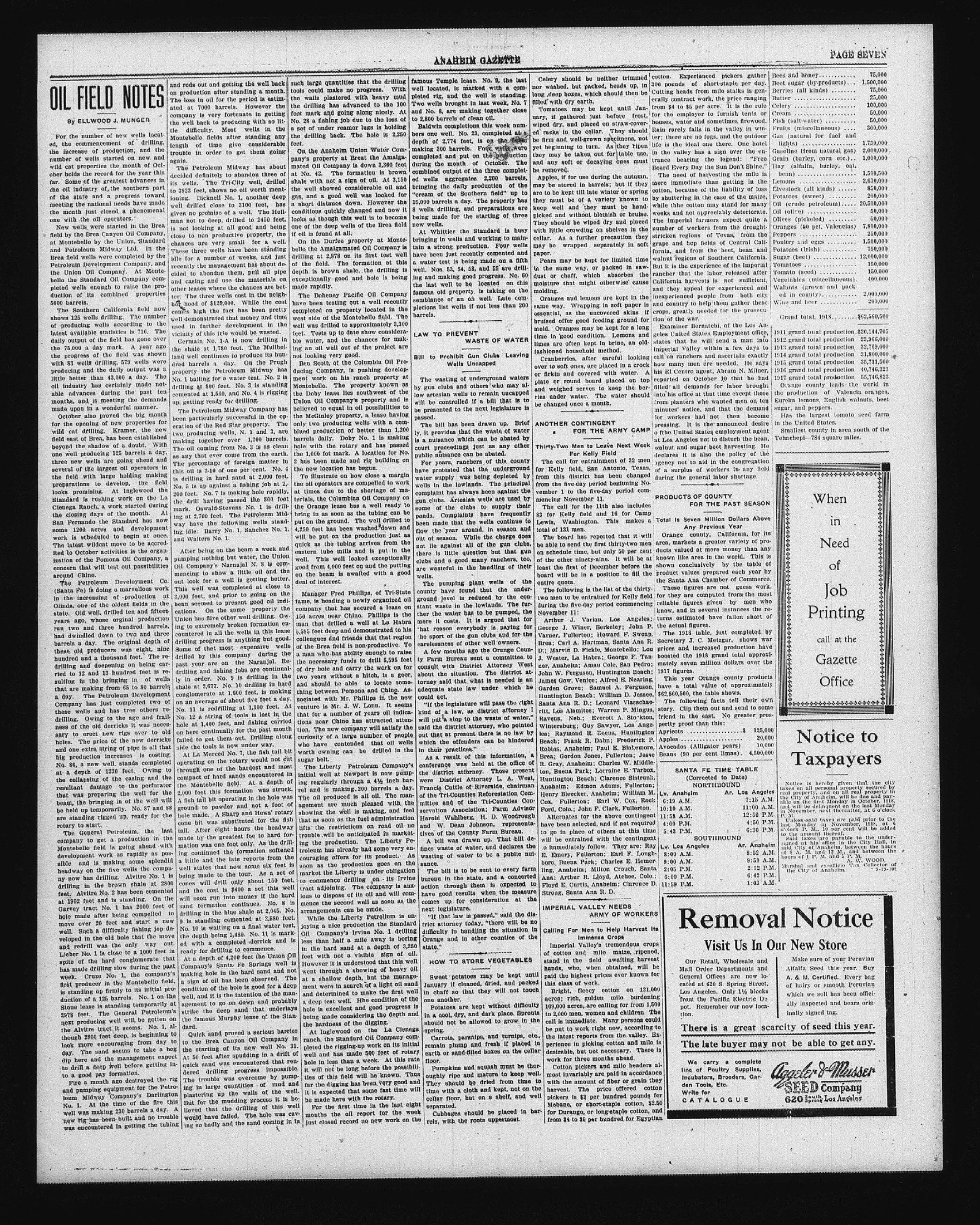
Searchable text
OIL FIELD NOTES
BY ELLWOOD J. MUNGER
For the number of new wells located, the commencement of drilling, the increase of production, and the number of wells started on new and wild cat properties the month of October holds the record for the year this far. Some of the greatest advances in the oil industry of the southern part of the state and a progress toward meeting the national needs have made the month just closed a phenomenal one with the oil operators.
New wells were started in the Brea field by the Brea Canyon Oil Company, at Montebello by the Union, Standard and Petroleum Midway Ltd. In the Brea field wells were completed by the Petroleum Development Company, and the Union Oil Company. At Montebello the Standard Oil Company completed wells enough to raise the production of its combined properties 5000 barrels.
The Southern California field now shows 125 wells drilling. The number of producing wells according to the latest available statistics is 716. The daily output of the field has gone over the 75,000 a day mark. A year ago the progress of the field was shown with 83 wells drilling, 579 wells were producing and the daily output was a little better than 43,000 a day. The oil industry has certainly made notable advances during the past ten months, and is meeting the demands made upon in a wonderful manner.
October also proved the big month for the opening of new properties for wild cat drilling. Kramer, the new field east of Brea, has been established beyond the shadow of a doubt. With one well producing 125 barrels a day, and rods out and getting the well back on production after standing a month. The loss in oil for the period is estimated at 7000 barrels. However the company is very fortunate in getting the well back to producing with so little difficulty. Most wells in the Montebello fields after standing any length of time give considerable trouble in order to get them going again.
The Petroleum Midway has about decided definitely to abandon three of its wells. The Tri-City well, drilled to 3923 feet, shows no oil worth mentioning. Bicknell No. 1, another deep well drilled close to 3100 feet, has given no promise of a well. The Hellman not to deep, drilled to 2450 feet, is not looking at all good and being close to non productive property, the chances are very small for a well. These three wells have been standing idle for a number of weeks, and just recently the management has about decided to abandon them, pull all pipe and casing and use the materials on other leases where the chances are better. The three wells cost in the neighborhood of $125,000. While the cost comes high the fact has been pretty well demonstrated that money and time used in further development in the vicinity of this trio would be wasted.
Germain No. 1-A is now drilling in the shale at 1,780 feet. The Mullholland well continues to produce its hundred barrels a day. On the Prugh property the Petroleum Midway has No. 1 bailing for a water test. No. 2 is drilling at 800 feet. No. 3 is standing cemented at 1,560, and No. 4 is rigging up, getting ready for drilling.
The Petroleum Midway Company has been particularly successful in the operation of the Red Star property. The two producing wells, N. 1 and 3, are making together over 1,200 barrels. The oil coming from No. 3 is as clean as any that ever come from the earth.
such large quantities that tools could make no profit; the walls plastered with the drilling has advanced foot mark and going along No. 28 a fishing job due to a set of under reamor lurking in the drilling back. The feet.
On the Anaheim Union pany's property at Breasted Oil Company is done at No. 42. The format shale with not a sign off of the well showed considera gas, and a good well was a short distance down, conditions quickly change looks as though this well one of the deep wells of if oil is found at all.
On the Durfee proper bello the Amalgamated Oil drilling at 2,878 on its side of the field. The form depth is brown shale, this exceptionally good and made rapidly.
The Doheney Pacific have been testing out a completed on property west side of the Montebello well was drilled to approximate Tests up to date shale water, and the changing an oil well out of not looking very good.
Ben Scott, of the Coluducing Company, is pursuing work on his ranch Montebello. The property the Doby lease lies south Union Oil Company's prairie believed to equal in oil pany the McGinley property, only two producing well blended production of both barrels daily. Doby No hole with the rotary and the 1,000 ft mark. A lo
with 83 wells drilling, 579 wells were producing and the daily output was a little better than 43,000 a day. The oil industry has certainly made notable advances during the past ten months, and is meeting the demands made upon in a wonderful manner.
October also proved the big month for the opening of new properties for wild cat drilling. Kramer, the new field east of Brea, has been established beyond the shadow of a doubt. With one well producing 125 barrels a day, three new wells are going ahead and several of the largest oil operators in the field with large holding making preparations to develop, the field looks promising. At Inglewood the Standard is rushing work on the La Clenega Ranch, a work started during the closing days of the month. At San Fernando the Standard has now some 1200 acres and development work is scheduled to begin at once. The latest wildcat move to be accredited to October activities is the organization of the Pomona Oil Company, a concern that will test out possibilities around Chino.
The Petroleum Development Co. (Santa Fe) is doing a marvellous work in the increasing of production at Olinda, one of the oldest fields in the state. Old well, drilled ten and fifteen years ago, whose original production ran two and three hundred barrels, had dwindled down to two and three barrels a day. The original depth of these old producers was eight, nine hundred and a thousand feet. The redrilling and deepening on being carried to 12 and 13 hundred feet is resulting in the bringing in of wells that are making from 65 to 80 barrels a day. The Petroleum Development Company has just completed two of these wells and has tree others redrilling. Owing to the age and frailness of the old derricks it was necessary to erect new rigs over to old holes. The price of the new derricks and one extra string of pipe is all that big production increases is costing No. 86, a new well, stands completed at a depth of 1230 feet. Owing to the collapsing of the casing and the resultant damage to the perforator that was preparing the well for the beam, the bringing in of the well will be held up temporarily. No. 87 and 88 are standing rigged up, ready for the rotary to start.
The General Petroleum, the last company to get a production in the Montebello field is going ahead with development work as rapidly as possible and is making some splendid dred barrels a day. On the Prugh property the Petroleum Midway has No. 1 bailing for a water test. No. 2 is drilling at 800 feet. No. 3 is standing cemented at 1,560, and No. 4 is rigging up, getting ready for drilling.
The Petroleum Midway Company has been particularly successful in the operation of the Red Star property. The two producing wells, N. 1 and 3, are making together over 1,200 barrels. The oil coming from No. 3 is as clean as any that ever come from the earth. The percentage of foreign matter in this oil is 3-10 of one per cent. No. 4 is drilling in hard sand at 2,000 feet. No. 5 is up against a fishing job at 2,200 feet. No. 7 is making hole rapidly, the drill having passed the 800 foot mark. Oswald-Stevens No. 1 is drilling at 2,700 feet. The Petroleum Midway have the following wells standing idle: Barry No. 1, Sanchez No. 1, and Walters No. 1.
After being on the beam a week and pumping nothing but water, the Union Oil Company's Narnajal N. 8 is commencing to show a little oil and the out look for a well is getting better. This well was completed at close to 3,000 feet, and prior to going on the bean seemed to present good oil indications. On the same property the Union has flive other well drilling. Owing to extremely broken formation encountered in all the wells in this lease drilling progress is anything but good. Some of the most expensive wells drilled by this company during the past year are on the Naranjal. Redrilling and fishing jobs are continually in order. No. 9 is drilling in the shale at 2,677. No. 10 drilling in hard conglomerate at 1,600 feet, is making on an average of about five feet a day. No. 11 is redrilling at 1,100 feet. At No. 12 a string of tools is lost in the hole at 1,400 feet, and fishing carried on here continually for the past month failed to get them out. Drilling along side the tools is now under way.
At La Merced No. 7, the fish tail bit operating on the rotary would not cut through one of the hardest and most compact of hard sands encountered in the Montebello field. At a depth of 2,000 feet this formation was struck. A fish tail bit operating in the hole was ground to powder and not a foot of hole made. A Sharp and Hews' rotary cone bit was substituted for the fish tail. After eight hours the headway made by the greatest foe to hard formation was one foot only. As the drilling continued the formation softened a little and the late reports from the new location has been believed to equal in oil pumps only two producing wells bined production of both barrels daily. Doby No. hole with the rotary and the 1,000 ft mark. A loot has been made and run on the new location has been put on the product quick as the tubing array eastern tube mills and well. This well looked good from 4,000 feet on or on the beam is awafer deal of interest.
Manager Fred Phillips fame, is heading a new company that has secured 150 acres near Chino. Man that drilled a well 5,595 feet deep and demolished colleagues and friends of the Brea field is none man who has ability to necessary funds to dry hole and carry two years without a hood and should be able thing between Pomona associated with Mr. Phillips venture is Mr.J.W.D that for a number of ytions near Chino has a relation.The new company curiosity of a large nu who have contended worth owning can be sugar belt.
The Liberty Petroleum initial well at Newport ing regularly through rel and is making,200 The oil produced is allagement are much pho showing the well is more that as soon as the fuel lifts the restrictions trouble will be anticipating the production.Troileum has already had couraging offers for for soon as the produc
at a depth of 1230 feet. Owing to the collapsing of the casing and the resultant damage to the perforator that was preparing the well for the beam, the bringing in of the well will be held up temporarily. No. 87 and 88 are standing rigged up, ready for the rotary to start.
The General Petroleum, the last company to get a production in the Montebello field is going ahead with development work as rapidly as possible and is making some splendid headway on the five wells the company now has drilling. Alvitre No. 1 is drilling in the brown shale at 2800 feet. Alvitre No. 2 has been cemented at 1902 feet and is standing. On the Garvey tract No. 1 has 2000 feet of hole made after being compelled to move over 20 feet and start a new well. Such a difficulty fishing jop developed in the old hole that the move and redrill was the only way out. Lieber No. 1 is close to a 1000 feet in spite of the hard conglomerate that has made drilling slow during the past week. Cruze No. 1, the company's first producer in the Montebello field, is standing up firmly to its initial production of a 125 barrels. No. 1 on the Stone lease is standing temporarily at 2978 feet. The General Petroleum's next producing well will be gotten on the Alvitre tract it seems. No. 1, although 2800 feet deep, is beginning to look more encouraging from day to day. The sand seems to take a bog dip here and the management expect to drill a deep well before getting into a good pay formation.
Fire a month ago destroyed the rig and pumping equipment for the Petroleum Midway Company's Darlington No. 1. At the time of the fire this well was making 230 barrels a day. A new rig has been built and no trouble was encountered in getting the tubing through one of the hardest and most compact of hard sands encountered in the Montebello field. At a depth of 2,000 feet this formation was struck. A fish tail bit operating in the hole was ground to powder and not a foot of hole made. A Sharp and Hews' rotary cone bit was substituted for the fish tail. After eight hours the headway made by the greatest foe to hard formation was one foot only. As the drilling continued the formation softened a little and the late reports from the well states that now some six feet is being made to the tour. As a set of cones will drill only about 150 feet, and the cost is $400 a set this well will soon run into money if the hard sand formation continues. No. 8 is drilling in the blue shale at 2,045. No. 9 is standing cemented at 2,580 feet. No. 10 is waiting on a final water test, the depth being 2,480. No. 11 is marked with a completed derrick and is ready for drilling to commence.
At a depth of 4,200 feet the Union Oil Company's Santa Fe Springs well is making hole in the hard sand and not a sign of oil has been observed. The condition of the hole is good for a deep well, and it is the intention of the management to go on down and probably strike the deep sand that underlays the famous Murphy lease of the Standard.
Quick sand proved a serious barrier to the Brea Canyon Oil Company in the starting of its new well No. 31. At 50 feet after spudding in a drift of quick sand was encountered that rendered drilling progress impossible. The trouble was overcome by pumping in large quantities of mud and plastering up the walls of the well. But for the mudding process it is believed that the drilling of this well would have failed. The hole was cav ing so badly and the sand coming in in
Initial well at Newport ing regularly through rel and is making.200 The oil produced is all agement are much phishing showing the well is m that as soon as the fuel lifts the restrictions trouble will be anticipating the production. The troleum has already had couraging offers for it soon as the produc t market the Liberty is to commence drilling tract adjoining. The lo ous to dispose of its mence the second well arrangements can be While the Liberty joying a nice product Oil Company's Irving less than half a mile in the hard sand at feet with not a visit However it is underst stent through a show at a shallow depth ment were in search and determined to make a deep test well. Hole hole is excellent and being made consideri der hardness of the o
At Inglewood on ranch, the Standard did pleted the rigging-up well and has made hole in less than a w it will not be long be ties of this field will far the digging has b e it is expected that se be made here with th For the first time months the oil reps just closed record no
such large quantities that the drilling tools could make no progress. With the walls plastered with heavy mud the drilling has advanced to the 100 foot mark and going along nicely. At No. 28 a fishing job due to the loss of a set of under reamor lugs is holding the drilling back. The hole is 2,250 feet.
On the Anaheim Union Water Company's property at Breat the Amalgamated Oil Company is down 3,360 feet at No. 42. The formation is brown shale with not a sign of oil. At 3,150 the well showed considerable oil and gas, and a good well was looked for a short distance down. However the conditions quickly changed and now it looks as though this well is to become one of the deep wells of the Brea field if oil is found at all.
On the Durfee property at Montebello the Amalgamated Oil Company is drilling at 2,878 on its first test well of the field. The formation at this depth is brown shale, the drilling is exceptionally good and hole is being made rapidly.
The Doheney Pacific Oil Company have been testing out a well recently completed on property located in the west side of the Montebello field. The well was drilled to approximately 3,300 feet. Tests up to date show considerable water, and the chances for making an oil well out of the project are not looking very good.
Ben Scott, of the Columbia Oil Producing Company, is pushing development work on his ranch property at Montebello. The property known as the Doby lease lies southwest of the Union Oil Company's property and is believed to equal in oil possibilities to the McGinley property, a lease having only two producing wells with a combined production of better than 1,200 barrels daily. Doby No. 1 is making hole with the rotary and has passed the 1,000 ft mark. A location for No.
famous Temple lease. No. 9, the last well located, is marked with a completed rig, and the well is standing. Two wells brought in last week, No. 7 and No. 8, are making together close to 2,800 barrels of clean oil.
Baldwin completions this week numbers one well. No. 23, completed at a depth of 2,774 feet, is on the same making 300 barrels. Four wells were completed and put on the production during the month of October. The combined output of the three completed wells aggregates 2,200 barrels, bringing the daily production of the "cream of the Southern field" up to 15,000 barrels a day. The property has 8 wells drilling, and preparations are being made for the starting of three new wells.
At Whittier the Standard is busy bringing in wells and working to maintain a strong production. Four wells have been just recently cemented and a water test is being made on a fifth well. Nos. 53, 54, 58, and 59 are drilling and making good progress. No. 60 the last well to be located on this famous old property is taking on the semblance of an oil well. Late completions list wells if not less than 200 barrels.
LAW TO PREVENT WASTE OF WATER
Bill to Prohibit Gun Clubs Leaving Wells Uncapped
The wasting of underground waters by gun clubs and others who may allow artesian wells to remain uncapped will be controlled if a bill that is to be presented to the next legislature is passed.
The bill has been drawn up. Briefly, it provides that the waste of water is a nuisance which can be abated by court proceedings just as any other public nuisance can be abated.
Celery should be neither trimmed nor washed, but packed, heads up, in long deep boxes, which should then be filled with dry earth.
Tomatoes may be kept until January, if gathered just before frost, wiped dry, and placed on straw-covered racks in the cellar. They should be firm and well-grown specimens, not yet beginning to turn. As they ripen they may be taken out for table use, and any soft or decaying ones must be removed.
Apples, if for use during the autumn, may be stored in barrels; but if they are to be kept till late winter or spring they must be of a variety known to keep well and they must be hand-picked and without blemish or bruise. They should be wiped dry and placed with little crowding on shelves in the cellar. As a further precaution they may be wrapped separately in soft paper.
Pears may be kept for limited time in the same way, or packed in sawdust or chaff, which absorbes the moisture that might otherwise cause molding.
Oranges and lemons are kept in the same way. Wrapping in soft paper is essential, as the uncovered skins if bruised offer good feeding ground for mold. Oranges may be kept for a long time in good condition. Lemons and limes are often kept in brine, an old-fashioned household method.
Cranberries, after careful looking over to soft ones, are placed in a crock or firkin and covered with water. A plate or round board placed on top and weighed serves to keep the berries under water. The water should be changed once a month.
ANOTHER CONTINGENT FOR THE ARMY CAMP
Thirty-Two Men to Leave Next Week For Kelly Field
Expert 300 pounds of Cutting heads erally contract from $4 to $5 for the emple houses, water Rain rarely farther; there are life is the idea in the valley trance bearing Board Every I
The need of more immediate cotton, because by shattering while the coo weeks and no! The Imperial number of wo stricken region grape and ho formia, and f walnut regions But it is the e rancher that Californiahand they app inexperienced and country t crops,greatly tion of the w
Examiner Lgeles United states that h Imperial Vail call on ranch how many im his El Centro reported on all filled al derv into his office from planters minutes' nott for workers pressing. It offfthe United at Los Angeles walnut and s declares it
Ben Scott, of the Columbia Oil Producing Company, is pushing development work on his ranch property at Montebello. The property known as the Doby lease lies southwest of the Union Oil Company's property and is believed to equal in oil possibilities to the McGinley property, a lease having only two producing wells with a combined production of better than 1,200 barrels daily. Doby No. 1 is making hole with the rotary and has passed the 1,000 ft mark. A location for No. 2 has been made and rig building on the new location has begun.
To illustrate on how close a margin the oil operators are compelled to work at times due to the shortage of materials, the Columbia Oil Company on the Orange lease has a well ready to bring in as soon as the tubing can be put on the ground. The well drilled to 4,250 feet has been washed down and will be put on the production just as quick as the tubing arrives from the eastern tube mills and is put in the well. This well looked exceptionally good from 4,000 feet op and the putting on the beam is awaited with a good deal of interest.
Manager Fred Phillips, of Tri-State fame, is heading a newly organized oil company that has secured a lease on 150 acres near Chino. Phillips is the man that drilled a well at La Habra 5,595 feet deep and demonstrated to his colleagues and friends that that region of the Brea field is non-productive. To a man who has ability enough to raise the necessary funds to drill 5,595 feet of dry hole and carry the work on for two years without a hitch, is a goer, and should be able to locate something between Pomona and Ching. Associated with Mr. Phillips in the new venture is Mr. J. W. Lonn. It seems that for a number of years oil indications near Chino has attracted attention. The new company will satisfy the curiosity of a large number of people who have contended that oil wells worth owning can be drilled in the sugar belt.
The Liberty Petroleum Company's initial well at Newport is now pumping regularly through a 4½ inch barrel and is making 200 barrels a day. The oil produced is all oil. The management are much pleased with the showing the well is making, and feel that as soon as the fuel administration lifts the restrictions on road oil no trouble will be anticipated in marketing the production. The Liberty Petroleum has already had some very encouraging offers for its product. As soon as the production goes on the Wells Uncapped
The wasting of underground waters by gun clubs and others (who may allow artesian wells to remain uncapped will be controlled if a bill that is to be presented to the next legislature is passed.
The bill has been drawn up. Briefly, it provides that the waste of water is a nuisance which can be abated by court proceedings just as any other public nuisance can be abated.
For years, ranchers of this county have protested that the underground water supply was being depleted by wells in the lowlands. The principal complaint has always been against the gun clubs. Artesian wells are used by some of the clubs to supply their ponds. Complaints have frequently been made that the wells continue to flow the year around, in season and out of season. While the charge does not lie against all of the gun clubs, there is little question but that gun clubs and a good many ranchers, too, are wasteful in the handling of their wells.
The pumping plant wells of the county have found that the underground level is reduced by the constant waste in the lowlands. The further the water has to be pumped, the more it costs. It is argued that for that reason everybody is paying for the sport of the gun clubs and for the carelessness of other well owners.
A few months ago the Orange County Farm Bureau sent a committee to consult with District Attorney West about the situation. The district attorney said that what is needed is an adequate state law under which he could act.
"If the legislature will pass the right kind of a law, as district attorney I will put a stop to the waste of water," said the district attorney, who pointed out that at present there is no law by which the offenders can be hindered in their practices."
As a result of this information, a conference was held at the office of the district attorney. Those present were District Attorney L. A. West, Francis Cuttle of Riverside, chairman of the Tri-Counties Reforestation Committee and of the Tri-Counties Conservation Association; Farm Advisor Harold Wahlberg, H. D. Woodrough and W. Dean Johnson, representatives of the County Farm Bureau.
A bill was drawn up. That bill defines waste of water, and declares the wasting of water to be a public nuisance.
ANOTHER CONTINGENT FOR THE ARMY CAMP
Thirty-Two Men to Leave Next Week For Kelly Field
The call for entrainment of 32 men for Kelly field, San Antonio, Texas, from this district has been changed from the five-day period beginning November 1 to the five-day period commencing November 11.
The call for the 11th also includes 83 for Kelly field and 16 for Camp Lewis, Washington. This makes a total of 131 men.
The board has reported that it will be able to send the first thirty-two men on schedule time, but only 50 per cent of the other ninety-nine. It will be at least the first of December before the board will be in a position to fill the entire quota.
The following is the list of the thirty-two men to be entrained for Kelly field during the five-day period commencing November 11:
Arthur J. Varian, Los Angeles; George J. Winer, Berkeley; John P. Varner, Fullerton; Howard F. Swoap, Brea; Carl A. Hartman, Santa Ana R. D.; Marvin D. Fickle, Montebello; Lou J. Wester, La Habra; George F. Tanner, Anaheim; Aman Cole, San Pedro; John W. Ferguson, Huntington Beach; James Gow, Venice; Alfred E. Nearing, Garden Grove; Samuel A. Ferguson, Huntington Beach; William D. Jessee, Santa Ana R. D.; Leonard Vlasschaeritt, Los Alamitos; Warren P. Mingus, Ravens, Neb.; Everett A. Sto-kton, Wintersburg; Guy Sawyer, Los Angeles; Raymond E. Zeena, Huntington Beach; Frank R. Dahn; Frederick P. Robins, Anaheim; Paul E. Blakemore, Brea; Gordon Jones, Fullerton; Jesse R. Gray, Anaheim; Charles W. Middleton, Buena Park; Lorraine E. Tarbox, Huntington Beach; Clarence Sistrunk, Anaheim; Edmon Adams, Fullerton; Henry Bleecker, Anaheim; William M. Cox, Fullerton; Earl W. Cox, Rock Ford, Colo.; John F. Clark, Fullerton.
Alternates for the above contingent have been selected, and if not required to go in place of others at this time will be entrained with the contingent immediately follow. They are: Ray E. Emery, Fullerton; Earl F. Loughboro, Buena Park; Charles E. Hemer...
initial well at Newport is now pumping regularly through a 4½ inch barrel and is making 200 barrels a day. The oil produced is all oil. The management are much pleased with the showing the well is making, and feel that as soon as the fuel administration lifts the restrictions on road oil no trouble will be anticipated in marketing the production. The Liberty Petroleum has already had some very encouraging offers for its product. As soon as the production goes on the market the Liberty is under obligation to commence drilling on its Irvine tract adjoining. The company is anxious to dispose of its oil and will commence the second well as soon as the arrangements can be amde.
While the Liberty Petroleum is enjoying a nice production the Standard Oil Company's Irvine No. 1 drilling less than half a mile away is boring in the hard sand at a depth of 3,250 feet with not a visible sign of oil. However it is understood that this well went through a showing of heavy oil at a shallow depth, but the management were in search of a light oil sand and determined to make the first well a deep test well. The condition of the hole is excellent and good progress is being made considering the depth and the hardness of the digging.
At Inglewood on the La Cienega ranch, the Standard Oil Company completed the rigging-up work on its initial well and has made 500 feet of rotary hole in less than a week. At this rate it will not be long before the possibilities of this field will be known. Thus far the digging has been very good and it is expected that some fast time will be made here with the rotary.
For the first time in the last eight months the oil report for the week just closed record no new work on the district attorney. Those present were District Attorney L. A. West, Francis Cuttle of Riverside, chairman of the Tri-Counties Reforestation Committee and of the Tri-Counties Conservation Association; Farm Advisor Harold Wahlberg, H. D. Woodrough and W. Dean Johnson, representatives of the County Farm Bureau.
A bill was drawn up. That bill defines waste of water, and declares the wasting of water to be a public nuisance.
The bill is to be sent to every farm bureau in the state, and a concerted action through them is expected to have good results when the measure comes up for consideration at the next legislature.
"If that law is passed," said the district attorney today, "there will be no difficulty in handling the situation in Orange and in other counties of the state."
HOW TO STORE VEGETABLES
Sweet potatoes may be kept until January if cleaned, dried, and packed in chaff so that they will not touch one another.
Potatoes are kept without difficulty in a cool, dry, and dark place. Sprouts should not be allowed to grow in the spring.
Carrots, parsnips, and turnips, etc., remain plump and fresh if placed in earth or sand-filled boxes on the cellar floor.
Pumpkins and squash must be thoroughly ripe and mature to keep well. They should be dried from time to time with a cloth and kept, not on the cellar floor, but on a shelf, and well separated.
Cabbages should be placed in barrels, with the roots uppermost.
Cotton pickers and milo headers almost invariably are paid in accordance with the amount of fiber or grain they harvest. The price offered cotton pickers is $2 per hundred pounds for Mebane, or short-staple cotton, $2.50 for Durango, or long-staple cotton, and from $4 to $5 per hundred for Egyptian
for trimmed heads up, in should then be until Jan. before frost, straw-cover they should specimens, not they ripen table use, bones must the autumn, but if they or spring known to be hand-in or bruise. and placed selves in the caution they likely in soft limited time used in saw-sorbes the wise cause kept in the soft paper is used skins if ground for not for a long Lemons and lime, an old-bod. useful looking in a crock in water. A faced on top keep the berberater should
Army Camp Next Week
cotton. Experienced pickers gather 300 pounds of short-staple per day. Cutting heads from milo stalks is generally contract work, the price ranging from $4 to $5 per acre. It is the rule for the employer to furnish tents or houses, water and sometimes firewood. Rain rarely falls in the valley in winter; there are no fogs, and the outdoor life is the ideal one there. One hotel in the valley has a sign over the entrance bearing the legend: "Free Board Every Day the Sun Don't Shine."
The need of harvesting the milo is more immediate than getting in the cotton, because of the liability of loss by shattering in the case of the maize, while the cotton may stand for many weeks and not appreciably deteriorate. The Imperial farmers expect quite a number of workers from the drought-stricken regions of Tevas, from the grape and hop fields of Central California, and from the beet, bean and walnut regions of Southern California. But it is the experience of the Imperial rancher that the labor released after California harvests is not sufficient, and they appeal for experienced and inexperienced people from both city and country to help them gather these crops, greatly needed for the prosecution of the war.
Examiner Bernatchi, of the Los Angeles United States Employment office, states that he will send a man into Imperial Valley within a few days to call on ranchers and ascertain exactly how many men are needed. He says his El Centro agent, Abram N. Milner, reported on October 10 that he had filled all demands for labor brought into his office at that time except those from planters who wanted men on ten minutes' notice, and that the demand for workers had not then become pressing. It is the announced desire of the United States employment agent at Los Angeles not to disturb the bean, walnut and sugar beet harvesting. He declares it is also the policy of the
Bees and honey... 75,000
Beet sugar (by-products)... 1,500,000
Berrles (all kinds)... 75,000
Butter... 25,000
Celery... 100,000
Cream... 50,000
Fish (salt-water)... 50,000
Fruits (miscellaneous)... 300,000
Gas (natural for fuel and lights)... 1,750,000
Gasoline (from natural gas)... 2,000,000
Grain (barley, corn etc.)... 1,000,000
Hay (alfalfa, barley, oat, bean)... 1,500,500
Lemons... 2,630,000
Livestock (all kinds)... 850,000
Potatoes (sweet)... 200,000
Oil (crude petroleum)... 20,500,000
Oil (olive)... 50,000
Olives (pickled)... 50,000
Oranges ($0 pet. Valencias)... 7,800,000
Peppers... 250,000
Poultry and eggs... 1,500,000
Potatoes (irish)... 750,000
Sugar (beet)... 12,000,000
Tomatoes... 150,000
Tomato (seed)... 150,000
Vegetables (miscellaneous). 400,000
Walnuts (grown and pack-ed in county)... 2,000,000
Wine and beer... 200,000
Grand total, 1918.....$62,560,500
1911 grand total production.$20,144,705
1912 grand total production 23,966,000
1913 grand total production 32,769,000
1914 grand total production 31,800,000
1915 grand total production 35,711,500
1916 grand total production 40,746,323
1917 grand total production 55,746,823
Orange county leads the world in the production of Valencia oranges,
Eureka lemons, English walnuts, beet sugar,and peppers.
Has the largest tomato seed farm in the United States.
Smallest county in area south of the Tehachepi—784 square miles.
PRODUCTS OF COUNTY
FOR THE PAST SEASON
Total is Seven Million Dollars Above Any Previous Year
Orange county, California, for its area, markets a greater variety of products valued at more money than any known like area in the world. This is shown conclusively by the table of product values prepared each year by the Santa Ana Chamber of Commerce.
These figures are not guess work, for they are computed from the most reliable figures given by men who know, and in several instances the returns estimated have fallen short of the actual figures.
The 1918 table, just completed by Secretary J. C. Metzgar, shows war prices and increased production have boosted the 1918 grand total approximately seven million dollars over the 1917 figures.
This year Orange county products have a total value of approximately $62,560,500, the table shows.
The following facts tell their own story. Clip them out and send to some friend in the east. No greater prosperity proof than this:
Apricots ... $ 125,000
Apples ... 20,000
Avocados (Alligator pears) ... 10,000
Beans (90 per cent limas) ... 4,500,000
NOTICE TO TAXPAYERS
Notice is hereby given that the city taxes on all personal property secured by real property, and on all real property in the City of Anaheim, will be due and payable on the first Monday in October, 1918, and will be delinquent on the last Monday in November, next thereafter, at 6 o'clock P.M.
Unless said taxes are paid prior to the last Monday in November, 1918, at 6 o'clock P.M., 10 per cent will be added to the amount thereof.
Said taxes are payable to the under-signed at his office in the City Hall, in said City of Anaheim, between the hours of 8 A.M. and 12 M., and between the hours of I P.M. and 5 P.M.
Marsal and ex-officio Tax Collector of
SANTA FE TIME TABLE
(Corrected to Date)
NORTHBOUND
Lv. Anaheim Ar. Los Angeles
6:19 A.M. 7:15 A.M.
10:10 A.M. 11:00 A.M.
11:58 A.M. 12:50 P.M.
4:00 P.M. 4:50 P.M.
5:43 P.M. 6:30 P.M.
SOUTHBOUND
Lv. Los Angeles Ar. Anaheim
8:00 A.M. 8:52 A.M.
9:00 A.M. 9:50 A.M.
2:05 P.M. 2:52 P.M.
6:00 P.M. 6:42 P.M.
11:59 P.M. 1:03 A.M.
Notice is hereby given that the city taxes on all personal property secured by real property, and on all real property in the City of Anaheim, will be due and payable on the first Monday in October, 1918, and will be delinquent on the last Monday in November, next thereafter, at 6 o'clock P.M.
Unless said taxes are paid prior to the last Monday in November, 1918, at 6 o'clock P.M., 10 per cent will be added to the amount thereof.
Said taxes are payable to the under-signed at his office in the City Hall, in said City of Anaheim, between the hours of 8 A.M. and 12 M., and between the hours of 1 P.M. and 5 P.M.
A. W. WOOD,
Marshal and ex-officio Tax Collector of the City of Anaheim.
Removal Notice
Visit Us In Our New Store
Our Retail, Wholesale and Mail Order Departments and General Offices are now located at 620 S. Spring Street, Los Angeles. Only 1½ blocks from the Pacific Electric Depot. Remember our new location.
Make sure of your Peruvian Alfalfa Seed this year. Buy A. & M. Certified. Every bag of hairy or smooth Peruvian which we sell has been officially inspected and bears originally signed tag.
There is a great scarcity of seed this year.
The late buyer may not be able to get any.
We carry a complete line of Poultry Supplies, Incubators, Brooders, Garden Tools, Etc.
Write for
CATALOGUE
Aggeler & Musser
SEED Company
620 South Spring Los Angeles