anaheim-gazette 1918-08-08
Scanned page
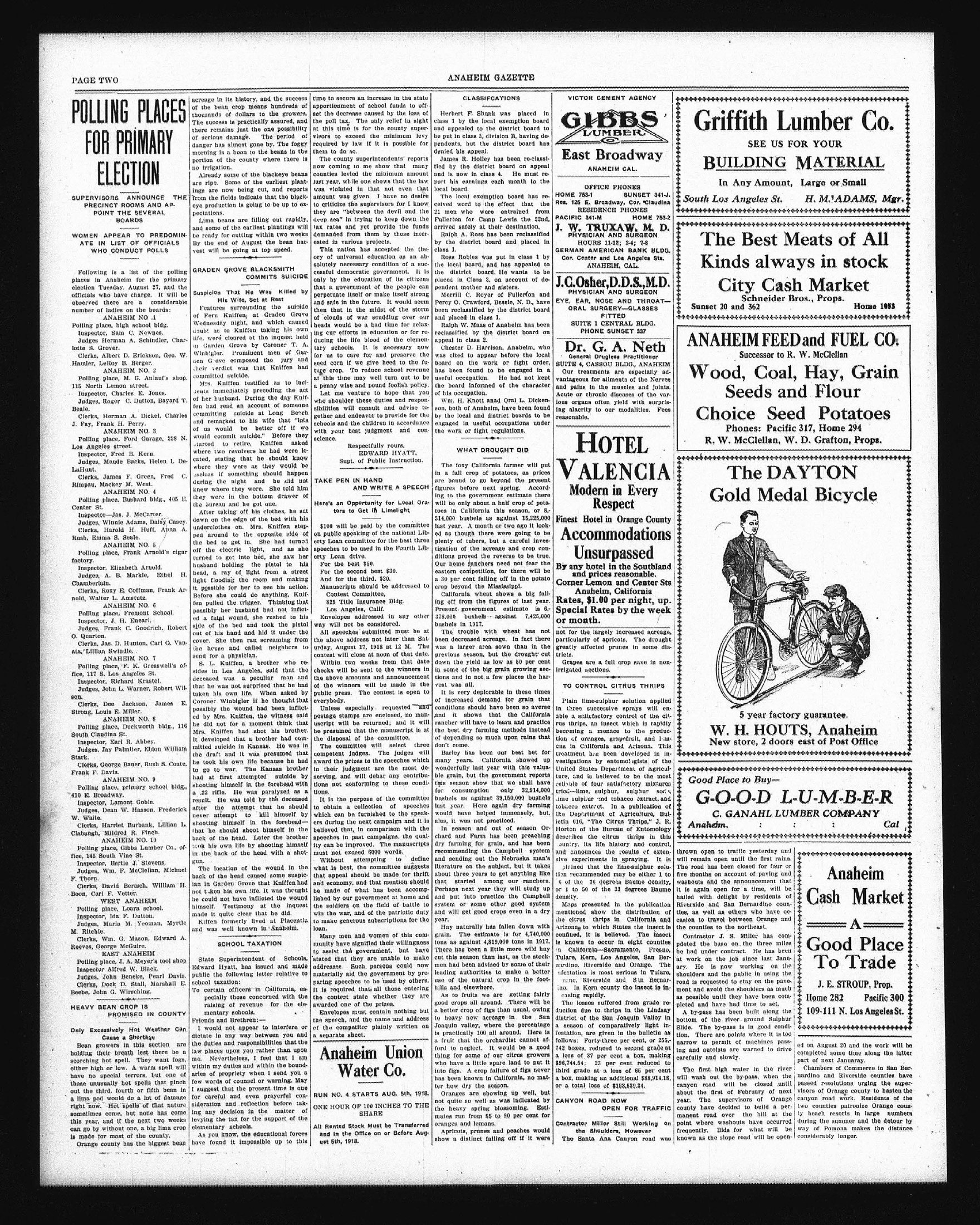
Searchable text
POLLING PLACES
FOR PRIMARY ELECTION
SUPERVISORS ANNOUNCE THE PRECINCT ROOMS AND APPOINT THE SEVERAL BOARDS
WOMEN APPEAR TO PREDOMINATE IN LIST OF OFFICIALS WHO CONDUCT POLLS
Following is a list of the polling places in Anaheim for the primary election Tuesday, August 27, and the officials who have charge. It will be observed there are a considerable number of ladies on the boards:
ANAHEIM NO. 1
Polling place, high school bldg.
Inspector, Sam C. Newnes.
Judges Herman A. Schindler, Charlotte S. Grover.
Clerks, Albert D. Erickson, Geo. W. Hamler, LeRoy B. Berger.
ANAHEIM NO. 2
Polling place, M. G. Anlauf's shop, 115 North Lemon street.
Inspector, Charles E. Jones.
Judges, Roger C. Dutton, Bayard T. Beale.
Clerks, Herman A. Dickel, Charles J. Fay, Frank H. Perry.
ANAHEIM NO. 3
Polling place, Ford Garage, 228 N. Los Angeles street.
Inspector, Fred B. Kern.
acreage in its history, and the success of the bean crop means hundreds of thousands of dollars to the growers. The success is practically assured, and there remains just the one possibility of serious damage. The period of danger has almost gone by. The foggy morning is a boon to the beans in the portion of the county where there is no irrigation.
Already some of the blackeye beans are ripe. Some of the earliest plantings are now being cut, and reports from the fields indicate that the blackeye production is going to be up to expectations.
Lima beans are filling out rapidly, and some of the earliest plantings will be ready for cutting within two weeks. By the end of August the bean harvest will be going at top speed.
GRADEN GROVE BLACKSMITH COMMITTS SUICIDE
Suspicion That He Was Killed by His Wife, Set at Rest
Features surrounding the suicide of Fern Kniffen at Graden Grove Wednesday night, and which caused doubt as to Kniffen taking his own life, were cleared at the inquest held on Garden Grove by Coroner T. A. Winbigler. Prominent men of Garden Grove composed the jury and their verdict was that Kniffen had committed suicide.
Mrs. Kniffen testified as to incidents immediately preceding the act of her husband. During the day Kniffen had read an account of someone committing suicide at Long Beach and remarked to his wife that "lots of us would be better off if we would commit suicide." Before they started to retire, Kniffen asked where two revolvers he had were located to secure an apportionment of the poll tax. They at this time is for visors to exceed required by law them to do so.
The county superintendent coming to my counties levied the last year, while one was violated in an amount was given to criticize the suicides they are "between deep sea" in trying tax rates and yet demanded from them ested in various ways.
This nation harsory of universal solutely necessary successful democracy only by the educator that a government perpetuate itself and safe in the future then that in the clouds of war heads would be acting cur efforts inducing the life to tary schools. I for us to care for seed corn if we ture crop. To reat at this time may a penny wise and let me venture who shoulder these abilities will come together and endeavor schools and the city with your best j science.
Respect ED
Hamler, LeRoy B. Berger.
ANAHEIM NO. 2
Polling place, M. G. Anlauf's shop, 115 North Lemon street.
Inspector, Charles E. Jones.
Judges, Roger C. Dutton, Bayard T. Beale.
Clerks, Herman A. Dickel, Charles J. Fay, Frank H. Perry.
ANAHEIM NO. 3
Polling place, Ford Garage, 228 N. Los Angeles street.
Inspector, Fred B. Kern.
Judges, Maude Backs, Helen I. DeLaHunt.
Clerks, James F. Green, Fred C. Rimpau, Mackey M. West.
ANAHEIM NO. 4
Polling place, Bushard bldg., 405 E. Center St.
Inspector—Jas. J. McCarter.
Judges, Winnie Adams, Daisy Casey.
Clerks, Harold H. Huff, Anna A. Rush, Emma S. Seale.
ANAHEIM NO. 5
Polling place, Frank Arnold's cigar factory.
Inspector, Elizabeth Arnold.
Judges, A. B. Markle, Ethel H. Chamberlain.
Clerks, Roxy E. Coffman, Frank Arnold, Walter L. Amstutz.
ANAHEIM NO. 6
Polling place, Fremont School.
Inspector, J. H. Enearl.
Judges, Frank C. Goodrich, Robert O. Quarton.
Clerks, Jas. D. Hunton, Carl O. Vanata, 'Lillian Swindle.
ANAHEIM NO. 7
Polling place, F. K. Gresswell's office, 117 S. Los Angeles St.
Inspector, Richard Krastel.
Judges, John L. Warner, Robert Wilson.
Clerks, Dee Jackson, James E. Strong, Louis E. Miller.
ANAHEIM NO. 8
Polling place, Duckworth bldg., 116 South Claudina St.
Inspector, Earl R. Abbey.
Judges, Jay Palmiter, Eldon William Stark.
Clerks, George Bauer, Rush S. Coate, Frank F. Davis.
ANAHEIM NO. 9
Polling place, primary school bldg., 410 E. Broadway.
Inspector, Lamont Goble.
Judges, Dean W. Hasson, Frederick W. Walte.
Clerks, Harriet Burbank, Lillian L. Clabangh, Mildred R. Finch.
ANAHEIM NO. 10
Polling place, Gibbs Lumber Co., office, 145 South Vine St.
Inspector, Bertle J. Stevens.
Mrs. Kniffen testified as to incidents immediately preceding the act of her husband. During the day Kniffen had read an account of someone committing suicide at Long Beach and remarked to his wife that "lots of us would be better off if we would commit suicide." Before they started to retire, Kniffen asked where two revolvers he had were located, stating that he should know where they were as they would be useless if something should happen during the night and he did not knew where they were. She told him they were in the bottom drawer of the bureau and he got one.
After taking off his clothes, he sat down on the edge of the bed with his underclothes on. Mrs. Kniffen stepped around to the opposite side of the bed to get in. She had turned off the electric light, and as she turned to get into bed, she saw her husband holding the pistol to his head, a ray of light from a street light flooding the room and making it possible for her to see his action. Before she could do anything, Kniffen pulled the trigger. Thinking that possibly her husband had not inflicted a fatal wound, she rushed to his side of the bed and took the pistol out of his hand and hid it under the cover. She then ran screaming from the house and called neighbors to send for a physician.
S. L. Kniffen, a brother who resides in Los Angeles, said that the deceased was a peculiar man and that he was not surprised that he had taken his own life. When asked by Coroner Winbigler if he thought that possibly the wound had been inflicted by Mrs. Kniffen, the witness said he did not for a moment think that Mrs. Kniffen had shot his brother. It developed that a brother had committed suicide in Kansas. He was in the draft and it was presumed that he took his own life because he had to go to war. The Kansas brother had at first attempted suicide by shooting himself in the forehead with a .22 rifle. He was paralyzed as a result. He was told by the deceased after the attempt that he should never attempt to kill himself by shooting himself in the forehead—that he should shoot himself in the back of the head. Later the brother took his own life by shooting himself in the back of the head with a shotgun.
Glen Gove composed the jury and their verdict was that Kniffen had committed suicide.
Mrs. Kniffen asked where two revolvers he had were located, stating that he should know where they were as they would be useless if something should happen during the night and he did not knew where they were. She told him they were in the bottom drawer of the bureau and he got one.
After taking off his clothes, he sat down on the edge of the bed with his underclothes on. Mrs. Kniffen stepped around to the opposite side of the bed to get in. She had turned off the electric light, and as she turned to get into bed, she saw her husband holding the pistol to his head, a ray of light from a street light flooding the room and making it possible for her to see his action. Before she could do anything, Kniffen pulled the trigger. Thinking that possibly her husband had not inflicted by Mrs. Kniffen, the witness said he did not for a moment think that Mrs. Kniffen had shot his brother. It developed that a brother had committed suicide in Kansas. He was in the draft and it was presumed that he took his own life because he had to go to war. The Kansas brother had at first attempted suicide by shooting himself in the forehead with a .22 rifle. He was paralyzed as a result.
He was told by the deceased after the attempt that he should never attempt to kill himself by shooting himself in the forehead—that he should shoot himself in the back of the head. Later the brother took his own life by shooting himself in the back of the head with a shotgun.
TAKE PEN IN HAND
Here's an Opportunity to Get
$100 will be paid on public speaking;erty Loan committee speeches to be used;tery Loan drive.
For the best $ For the second And for the third Manuscripts show Contest Committee
825 Title Institute Los Angeles Envelopes address way will not be All speeches suited above address urday; August 17 contest will close Within two weeks checks will be seen above amount of the winners w public press.The everybody.
Unless especial postage stamps are uscript will be presumed that the disposal of t The committee competent judges award the prizes t in their judgmen serving,and will tions not conformitions.
It is the purpose to obtain a collec which can be furious during the next believed that, in speeches in past it can be improvem must not exceed Without attent
Frank F. Davis.
ANAHEIM NO. 9
Polling place, primary school bldg., 410 E. Broadway.
Inspector, Lamont Goble.
Judges, Dean W. Hasson, Frederick W. Waite.
Clerks, Harriet Burbank, Lillian L. Clabaugh, Mildred R. Finch.
ANAHEIM NO. 10
Polling place, Gibbs Lumber Co., office, 145 South Vine St.
Inspector, Bertie J. Stevens.
Judges, Wm. F. McClellan, Michael F. Thorn.
Clerks, David Bertsch, William H. Boon, Carl F. Vetter.
WEST ANAHEIM
Polling place, Loara school.
Inspector, Ida F. Dutton.
Judges, Maria M. Yeoman, Myrtle M. Ritchie.
Clerks, Wm. G. Mason, Edward A. Reeves, George McGuire.
EAST ANAHEIM
Polling place, J. A. Meyer's tool shop
Inspector Alfred W. Black.
Judges, John Beneke, Pearl Davis.
Clerks, Dock D. Stall, Marshall E. Beebe, John G. Wirsching.
HEAVY BEAN CROP IS PROMISED IN COUNTY
Only Excessively Hot Weather Can Cause a Shortage
Bean growers in this section are holding their breath lest there be a scorching hot spell. They want fogs, either high or low. A warm spell will have no special terrors, but one of those unusually hot spells that pinch out the third, fourth or fifth bean in a lima pod would do a lot of damage right now. Hot spells of that nature sometimes come, but none has come this year, and if the next two weeks can go by without one, a big lima crop is made for most of the county.
Orange county has the biggest bean to go to war. The Kansas brother had at first attempted suicide by shooting himself in the forehead with a .22 rifle. He was paralyzed as a result. He was told by the deceased after the attempt that he should never attempt to kill himself by shooting himself in the forehead—that he should shoot himself in the back of the head. Later the brother took his own life by shooting himself in the back of the head with a shotgun.
The location of the wound in the back of the head caused some suspicion in Garden Grove that Kniffen had not taken his own life. It was thought he could not have inflicted the wound himself. Testimony at the inquest made it quite clear that he did.
Kiffen formerly lived at Placentia and was well known in Anaheim.
SCHOOL TAXATION
State Superintendent of Schools, Edward Hyatt, has issued and made public the following letter relative to school taxation:
To certain officers in California, especially those concerned with the raising of revenue for the elementary schools.
Friends and Brethren:—
I would not appear to interfere or dictate in any way between you and the duties and responsibilities that the law places upon you rather than upon me. Nevertheless, I feel that I am within my duties and within the boundaries of propriety when I send you a few words of counsel or warning. May I suggest that the present time is one for careful and even prayerful consideration and reflection before taking any decision in the matter of levying the tax for the support of the elementary schools.
As you know, the educational forces have found it impossible up to this
ANAHEIM GAZETTE
time to secure an increase in the state apportionment of school funds to offset the decrease caused by the loss of the poll tax. The only relief in sight at this time is for the county supervisors to exceed the minimum levy required by law if it is possible for them to do so.
The county superintendents' reports now coming to me show that many counties levied the minimum amount last year, while one shows that the law was violated in that not even that amount was given. I have no desire to criticize the supervisors for I know they are "between the devil and the deep sea" in trying to keep down the tax rates and yet provide the funds demanded from them by those interested in various projects.
This nation has accepted the theory of universal education as an absolutely necessary condition of a successful democratic government. It is only by the education of its citizens that a government of the people can perpetuate itself or make itself strong and safe in the future. It would seem then that in the midst of the storm of clouds of war scudding over our heads would be a bad time for relaxing cur efforts in education or for reducing the life blood of the elementary schools. It is necessary now for us to care for and preserve the seed corn if we give heed to the future crop. To reduce school revenue at this time may well turn out to be a penny wise and pound foolish policy.
Let me venture to hope that you who shoulder these duties and responsibilities will consult and advise together and endeavor to provide for the schools and the children in accordance with your best judgment and conscience.
Respectfully yours,
EDWARD HYATT,
CLASSIFICATIONS
Herbert F. Shunk was placed in class 1 by the local exemption board and appealed to the district board to be put in class 3, division B, having dependents, but the district board has denied his appeal.
James R. Holley has been re-classified by the district board on appeal and is now in class 4. He must report his earnings each month to the local board.
The local exemption board has received word to the effect that the 21 men who were entrained from Fullerton for Camp Lewis the 22nd, arrived safely at their destination.
Ralph A. Ross has been reclassified by the district board and placed in class 1.
Ross Robles was put in class 1 by the local board, and has appealed to the district board. He wants to be placed in Class 3, on account of dependent mother and sisters.
Merrill C. Royer of Fullerton and Percy O. Crawford, Bessie, N. D., have been reclassified by the district board and placed in class 1.
Ralph W. Maas of Anaheim has been reclassified by the district board on appeal in class 2.
Chester D. Harrison, Anaheim, who was cited to appear before the local board on the work or fight order, has been found to be engaged in a useful occupation. He had not kept the board informed of the character of his occupation.
Wm. H. Knott anad Oral L. Dickenson, both of Anaheim, have been found by the local and district boards to be engaged in useful occupations under the work or fight regulations.
VICTOR CEMENT AGENCY
GIBBS LUMBER
East Broadway
ANAHEIM CAL.
OFFICE PHONES
HOME 753-1
RESIDENCE PHONES
PACIFIC 341-M
HOME 753-2
J. W. TRUXAW, M.D.
PHYSICIAN AND SURGEON
HOURS 11-12; 2-4; 7-8
GERMAN AMERICAN BANK BLDG.
Cor. Center and Los Angeles Sts.
ANAHEIM, CAL.
J.C.Osher,D.D.S.,M.D.
PHYSICIAN AND SURGEON
EYE, EAR, NOSE AND THROAT—ORAL SURGERY—GLASSES
FITTED
SUITE 1 CENTRAL BLDG.
PHONE SUNSET 337
Dr. G. A. Neth
General Drugless Practitioner
SUITE 4, CASSOU BLDG., ANAHEIM
Our treatments are especially advantageous for alliments of the Nerves and pains in the muscles and joints. Acute or chronic diseases of the various organs often yield with surprising alacrity to our modalities. Fees reasonable.
seed corn if we give heed to the future crop. To reduce school revenue at this time may well turn out to be a penny wise and pound foolish policy.
Let me venture to hope that you shoulder these duties and responsibilities will consult and advise together and endeavor to provide for the schools and the children in accordance with your best judgment and conscience.
Respectfully yours,
EDWARD HYATT,
Supt. of Public Instruction.
TAKE PEN IN HAND
AND WRITE A SPEECH
Here's an Opportunity for Local Orators to Get in Limelight
$100 will be paid by the committee on public speaking of the national Liberty Loan committee for the best three speeches to be used in the Fourth Liberty Loan drive.
For the best $50.
For the second best $30.
And for the third, $20.
Manuscripts should be addressed to Contest Committee,
825 Title Insurance Bldg.
Los Angeles, Calif.
Envelopes addressed in any other way will not be considered.
All speeches submitted must be at the above address not later than Saturday, August 17, 1918 at 12 M. The contest will close at noon of that date.
Within two weeks from that date checks will be sent to the winners in the above amounts and announcement of the winners will be made in the public press. The contest is open to everybody.
Unless especially requested and postage stamps are enclosed, no manuscript will be returned; and it will be presumed that the manuscript is at the disposal of the committee.
The committee will select three competent judges. The judges will award the prizes to the speeches which in their judgment are the most deserving, and will debar any contributions not conforming to these conditions.
It is the purpose of the committee to obtain a collection of speeches which can be furnished to the speakers during the next campaign and it is believed that, in comparison with the speeches in past campaigns, the quality can be improved. The manuscripts must not exceed 6000 words.
Without attempting to define board on the work or fight order, has been found to be engaged in a useful occupation. He had not kept the board informed of the character of his occupation.
Wm. H. Knott anad Oral L. Dickenson, both of Anaheim, have been found by the local and district boards to be engaged in useful occupations under the work or fight regulations.
WHAT DROUGHT DID
The foxy California farmer will put in a fall crop of potatoes, as prices are bound to go beyond the present figures before next spring. According to the government estimate there will be only about a half crop of potatoes in California this season, or 8,314,000 bushels as against 15,225,000 last year. A month or two ago it looked as though there were going to be plenty of tubers, but a careful investigation of the acreage and crop conditions proved the reverse to be true. Our home ganchers need not fear the eastern competition, for there will be a 30 per cent falling off in the potato crop beyond the Mississippi.
California wheat shows a big falling off from the figures of last year. Present-government estimate is 6,378,000 bushels against 7,425,000 bushels in 1917.
The trouble with wheat has not been decreased acreage. In fact there was a larger area sown than in the previous season, but the drought cut down the yield as low as 50 per cent in some of the big grain growing sections and in not a few places the harvest was nil.
It is very deplorable in these times of increased demand for grain that conditions should have been so averse and it shows that the California rancher will have to learn and practice the best dry farming methods instead of depending so much upon rains that don't come.
Barley has been our best bet for many years. California showed up wonderfully last year with this valuable grain, but the government reports this season show that we shall have for consumption only 32,914,000 bushels as against 39,150,000 bushels last year. Here again dry farming would have helped immensely, but, alas, it was not practiced.
In season and out of season Orchard and Farm has been preaching dry farming for grain, and has been recommending the Campbell system and sending out the Nebraska man's literature on the subject but it takes
In their judgment are the most deserving, and will debar any contributions not conforming to these conditions.
It is the purpose of the committee to obtain a collection of speeches which can be furnished to the speakers during the next campaign and it is believed that, in comparison with the speeches in past campaigns, the quality can be improved. The manuscripts must not exceed 6000 words.
Without attempting to define what is best, the committee suggests that appeal should be made for thrift and economy, and that mention should be made of what has been accomplished by our government at home and the soldiers on the field of battle to win the war, and of the patriotic duty to make generous subscriptions for the loan.
Many men and women of this community have signified their willingness to assist the government, but have stated that they are unable to make addresses. Such persons could now materially aid the government by preparing speeches to be used by others. It is required that all those entering the contest state whether they are awarded one of the prizes.
Envelopes must contain nothing but the speech, and the name and address of the competitor plainly written on a separate sheet.
Anaheim Union Water Co.
RUN NO. 4 STARTS AUG. 5th, 1918.
ONE HOUR OF 100 INCHES TO THE SHARE
All Rented Stock Must be Transferred and in the Office on or Before August 5th, 1918.
The estimate is for 4,740,000 tons as against 4,819,000 tons in 1917. There has been a little more wild hay cut this season than last, as the stockmen had been advised by some of their leading authorities to make a better use of the natural crop in the foothills and elsewhere.
As to fruits we are getting fairly good crops all around. There will be a better crop of figs than usual, owing to heavy new acreage in the San Joaquin valley, where the percentage is practically 100 all around. Here is a fruit that the orchardist cannot afford to neglect. It would be a good thing for some of our citrus growers who have a little spare land to put it into figs. A crop failure of figs never has been known in California, no matter how dry the season.
Oranges are showing up well, but not quite so well as was indicated by the heavy spring blossoming. Estimates run from 85 to 90 per cent for oranges and lemons.
Apricots, prunes and peaches would show a distinct falling off if it were wonderfully last year with this valuable grain, but the government reports this season show that we shall have for consumption only 32,914,000 bushels as against 39,150,000 bushels last year. Here again dry farming would have helped immensely, but, alas, it was not practiced.
In season and out of season Orchard and Farm has been preaching dry farming for grain, and has been recommending the Campbell system and sending out the Nebraska man's literature on the subject, but it takes about three years to get anything like that started among our ranchers. Perhaps next year they will study up and put into practice the Campbell system or some other good system and will get good crops even in a dry year.
Hay naturally has fallen down with grain. The estimate is for 4,740,000 tons as against 4,819,000 tons in 1917. There has been a little more wild hay cut this season than last, as the stockmen had been advised by some of their leading authorities to make a better use of the natural crop in the foothills and elsewhere.
As to fruits we are getting fairly good crops all around. There will be a better crop of figs than usual, owing to heavy new acreage in the San Joaquin valley, where the percentage is practically 100 all around. Here is a fruit that the orchardist cannot afford to neglect. It would be a good thing for some of our citrus growers who have a little spare land to put it into figs. A crop failure of figs never has been known in California, no matter how dry the season.
Oranges are showing up well, but not quite so well as was indicated by the heavy spring blossoming. Estimates run from 85 to 90 per cent for oranges and lemons.
Apricots, prunes and peaches would show a distinct falling off if it were wonderfully last year with this valuable grain, but the government reports this season show that we shall have for consumption only 32,914,000 bushels as against 39,150,000 bushels last year. Here again dry farming would have helped immensely, but, alas, it was not practiced.
In season and out of season Orchard and Farm has been preaching dry farming for grain, and has been recommending the Campbell system and sending out the Nebraska man's literature on the subject, but it takes about three years to get anything like that started among our ranchers. Perhaps next year they will study up and put into practice the Campbell system or some other good system and will get good crops even in a dry year.
Hay naturally has fallen down with grain. The estimate is for 4,740,000 tons as against 4,819,000 tons in 1917. There has been a little more wild hay cut this season than last, as the stockmen had been advised by some of their leading authorities to make a better use of the natural crop in the foothills and elsewhere.
As to fruits we are getting fairly good crops all around. There will be a better crop of figs than usual, owing to heavy new acreage in the San Joaquin valley, where the percentage is practically 100 all around. Here is a fruit that the orchardist cannot afford to neglect. It would be a good thing for some of our citrus growers who have a little spare land to put it into figs. A crop failure of figs never has been known in California, no matter how dry the season.
Oranges are showing up well, but not quite so well as was indicated by the heavy spring blossoming. Estimates run from 85 to 90 per cent for oranges and lemons.
Apricots, prunes and peaches would show a distinct falling off if it were wonderfully last year with this valuable grain, but the government reports this season show that we shall have for consumption only 32,914,000 bushels as against 39,150,000 bushels last year. Here again dry farming would have helped immensely, but, alas, it was not practiced.
In season and out of season Orchard and Farm has been preaching dry farming for grain, and has been recommending the Campbell system and sending out the Nebraska man's literature on the subject, but it takes about three years to get anything like that started among our ranchers. Perhaps next year they will study up and put into practice the Campbell system or some other good system and will get good crops even in a dry year.
Hay naturally has fallen down with grain. The estimate is for 4,740,000 tons as against 4,819,000 tons in 1917. There has been a little more wild hay cut this season than last, as the stockmen had been advised by some of their leading authorities to make a better use of the natural crop in the foothills and elsewhere.
As to fruits we are getting fairly good crops all around. There will be a better crop of figs than usual, owing to heavy new acreage in the San Joaquin valley, where the percentage is practically 100 all around. Here is a fruit that the orchardist cannot afford to neglect. It would be a good thing for some of our citrus growers who have a little spare land to put it into figs. A crop failure of figs never has been known in California, no matter how dry the season.
Oranges are showing up well, but not quite so well as was indicated by the heavy spring blossoming. Estimates run from 85 to 90 per cent for oranges and lemons.
Apricots, prunes and peaches would show a distinct falling off if it were wonderfully last year with this valuable grain, but the government reports this season show that we shall have for consumption only 32,914,000 bushels as against 39,150,000 bushels last year. Here again dry farming would have helped immensely, but, alas, it was not practiced.
In season and out of season Orchard and Farm has been preaching dry farming for grain, and has been recommending the Campbell system and sending out the Nebraska man's literature on the subject, but it takes about three years to get anything like that started among our ranchers. Perhaps next year they will study up and put into practice the Campbell system or some other good system and will get good crops even in a dry year.
Hay naturally has fallen down with grain. The estimate is for 4,740,000 tons as against 4,819,000 tons in 1917. There has been a little more wild hay cut this season than last, as the stockmen had been advised by some of their leading authorities to make a better use of the natural crop in the foothills and elsewhere.
As to fruits we are getting fairly good crops all around. There will be a better crop of figs than usual, owing to heavy new acreage in the San Joaquin valley, where the percentage is practically 100 all around. Here is a fruit that the orchardist cannot afford to neglect. It would be a good thing for some of our citrus growers who have a little spare land to put it into figs. A crop failure of figs never has been known in California, no matter how dry the season.
Oranges are showing up well, but not quite so well as was indicated by the heavy spring blossoming. Estimates run from 85 to 90 per cent for oranges and lemons.
Apricots, prunes and peaches would show a distinct falling off if it were wonderfully last year with this valuable grain, but the government reports this season show that we shall have for consumption only 32,914,000 bushels as against 39,150,000 bushels last year. Here again dry farming would have helped immensely, but, alas, it was not practiced.
In season and out of season Orchard and Farm has been preaching dry farming for grain, and has been recommending the Campbell system and sending out the Nebraska man's literature on the subject, but it takes about three years to get anything like that started among our ranchers. Perhaps next year they will study up and put into practice the Campbell system or some other good system and will get good crops even in a dry year.
Hay naturally has fallen down with grain. The estimate is for 4,740,000 tons as against 4,819,000 tons in 1917. There has been a little more wild hay cut this season than last, as the stockmen had been advised by some of their leading authorities to make a better use of the natural crop in the foothills and elsewhere.
As to fruits we are getting fairly good crops all around. There will be a better crop of figs than usual, owing to heavy new acreage in the San Joaquin valley, where the percentage is practically 100 all around. Here is a fruit that the orchardist cannot afford to neglect. It would be a good thing for some of our citrus growers who have a little spare land to put it into figs. A crop failure of figs never has been known in California, no matter how dry the season.
Oranges are showing up well, but not quite so well as was indicated by the heavy spring blossoming. Estimates run from 85 to 90 per cent for oranges and lemons.
Apricots, prunes and peaches would show a distinct falling off if it were wonderfully last year with this valuable grain, but the government reports this season show that we shall have for consumption only 32,914,000 bushels as against 39,150,000 bushels last year. Here again dry farming would have helped immensely,but,alas,it was not practiced.
In season and out of season Orchard and Farm has been preaching dry farming for grain,and has been recommending the Campbell system and sending out the Nebraska man's literature on the subject,but it takes about three years to get anything like that started among our ranchers. Perhaps next year they will study up and put into practice the Campbell system or some other good system and will get good crops even in a dry year.
Hay naturally has fallen down with grain. The estimate is for 4,740,000 tons as against 4,819,000 tons in 1917. There has been a little more wild hay cut this season than last,as the stockmen had been advised by some of their leading authorities to make a better use of the natural crop in the foothills and elsewhere.
As to fruits we are getting fairly good crops all around. There will be a better crop of figs than usual,owing to heavy new acreage in the San Joaquin valley,where the percentage is practically 100 all around. Here is a fruit that the orchardist cannot afford to neglect. It would be a good thing for some of our citrus growers who have a little spare land to put it into figs. A crop failure of figs never has been known in California,no matter how dry the season.
Oranges are showing up well,but not quite so well as was indicated by the heavy spring blossoming. Estimates run from 85 to 90 per cent for oranges and lemons.
Apricots,prunes和peaches would show a distinct falling off if it were wonderfully last year with this valuable grain,but the government reports this season show that we shall have for consumption only 32,914,000 bushels as against 39,150,000 bushels last year. Here again dry farming would have helped immensely,but,alas,it was not practiced.
In season and out of season Orchard and Farm has been preaching dry farming for grain,and has been recommending the Campbell system and sending out the Nebraska man's literature on the subject,but it takes about three years to get anything like that started among our ranchers. Perhaps next year they will study up and put into practice the Campbell system or some other good system and will get good crops even in a dry year.
Hay naturally has fallen down with grain. The estimate is for 4,740,000 tons as against 4,819,000 tons in 1917. There has been a little more wild hay cut this season than last,as the stockmen had been advised by some of their leading authorities to make a better use of the natural crop in the foothills和 elsewhere.
As to fruits we are getting fairly good crops all around. There will be a better crop of figs than usual,owing to heavy new acreage in the San Joaquin valley,where the percentage is practically 100 all around. Here is a fruit that the orchardist cannot afford to neglect. It would be a good thing for some of our citrus growers who have a little spare land to put it into figs. A crop failure of figs never has been known in California,no matter how dry the season.
Oranges are showing up well,but not quite so well as was indicated by the heavy spring blossoming. Estimates run from 85 to 90 per cent for oranges和lemons.
Apricots,prunes和peaches would show a distinct falling off if it were wonderfully last year with this valuable grain,but the government reports this season show that we shall have for consumption only 32,914,000 bushels as against 39,150,000 bushels last year. Here again dry farming would have helped immensely,but,alas,it was not practiced.
In season and out of season Orchard and Farm has been preaching dry farming for grain,and has been recommending the Campbell system and sending out the Nebraska man's literature on the subject,but it takes about three years to get anything like that started among our ranchers. Perhaps next year they will study up and put into practice the Campbell system or some other good system and will get good crops even in a dry year.
Hay naturally has fallen down with grain. The estimate is for 4,740,000 tons as against 4,819,OOO tons in 1917. There has been a little more wild hay cut this season than last,as the stockmen had been advised by some of their leading authorities to make a better use of the natural crop in the foothills和 elsewhere.
As to fruits we are getting fairly good crops all around. There will be a better crop of figs than usual,owing to heavy new acreage in the San Joaquin valley,where the percentage is practically 1OO all around. Here is a fruit that the orchardist cannot afford to neglect. It would be a good thing for some of our citrus growers who have a little spare land to put it into figs. A crop failure of figs never has been known in California,no matter how drytheseason.ItsdistributionoftheSanJoaquinValleyinacounselofcomparativelylightinfestation,a giveninthebulletinasfollows:Forty-threepercentor255,-742boxes,-reducedtosecondgradeatlossof37percentorbox-making$96,$744.$;23percent reducedtothirdgradeatlossof65percentorbox-making$88,$914.$;ortotallossof$183,$539.$;34.CANYONROADNOWOPENFORTRAFFICContractorMillerStillWorkingontheShouldersHoweverTheSantaAnnaCanyonroadwas
CANYON ROAD NOWOPEN FOR TRAFFICContractor Miller Still Working onthe Shoulders HoweverTheSantaAnnaCanyonroadwas
CANYON ROAD NOWOPEN FOR TRAFFICContractor Miller Still Working onthe Shoulders HoweverTheSantaAnnaCanyonroadwas
CANYON ROAD NOWOPEN FOR TRAFFICContractor Miller Still Working onthe Shoulders HoweverTheSantaAnnaCanyonroadwas
CANYON ROAD NOWOPEN FOR TRAFFICContractor Miller Still Working onthe Shoulders HoweverTheSantaAnnaCanyonroadwas
CANYON ROAD NOWOPEN FOR TRAFFICContractor Miller Still Working onthe Shoulders HoweverTheSantaAnnaCanyonroadwas
CANYON ROAD NOWOPEN FOR TRAFFICContractor Miller Still Working onthe Shoulders HoweverTheSantaAnnaCanyonroadwas
CANYON ROAD NOWOPEN FOR TRAFFICContractor Miller Still Working onthe Shoulders HoweverTheSantaAnnaCanyonroadwas
CANYON ROAD NOWOPEN FOR TRAFFICContractor Miller Still Working onthe Shoulders HoweverTheSantaAnnaCanyonroadwas
CANYON ROAD NOWOPEN FOR TRAFFICContractor Miller Still Working onthe Shoulders HoweverTheSantaAnnaCanyonroadwas
CANYON ROAD NOWOPEN FOR TRAFFICContractor Miller Still Working onthe Shoulders HoweverTheSantaAnnaCanyonroadwas
CANYON ROAD NOWOPEN FOR TRAFFICContractor Miller Still Working onthe Shoulders HoweverTheSantaAnnaCanyonroadwas
CANYON ROAD NOWOPEN FOR TRAFFICContractor Miller Still Working onthe Shoulders HoweverTheSantaAnnaCanyonroadwas
CANYON ROAD NOWOPEN FOR TRAFFICContractor Miller Still Working onthe Shoulders HoweverTheSantaAnnaCanyonroadwas
CANYON ROAD NOWOPEN FOR TRAFFICContractor Miller Still Working onthe Shoulders HoweverTheSantaAnnaCanyonroadwas
CANYON ROAD NOWOPEN FOR TRAFFICContractor Miller Still Working onthe Shoulders HoweverTheSantaAnnaCanyonroadwas
CANYON ROAD NOWOPEN FOR TRAFFICContractor Miller Still Working onthe Shoulders HoweverTheSantaAnnaCanyonroadwas
CANYON ROAD NOWOPEN FOR TRAFFICContractor Miller Still Working onthe Shoulders HoweverTheSantaAnnaCanyonroadwas
CANYON ROAD NOWOPEN FOR TRAFFICContractor Miller Still Working onthe Shoulders HoweverTheSantaAnnaCanyonroadwas
CANYON ROAD NOWOPEN FOR TRAFFICContractor Miller Still Working onthe Shoulders HoweverTheSantaAnnaCanyonroadwas
CANYON ROAD NOWOPEN FOR TRAFFICContractor Miller Still Working onthe Shoulders HoweverTheSantaAnnaCanyonroadwas
CANYON ROAD NOWOPEN FOR TRAFFICContractor Miller Still Working onthe Shoulders HoweverTheSantaAnnaCanyonroadwas
CANYON ROAD NOWOPEN FOR TRAFFICContractor Miller Still Working onthe Shoulders HoweverTheSantaAnnaCanyonroadwas
CANYON ROAD NOWOPEN FOR TRAFFICContractor Miller Still Working onthe ShouldersHoweverTheSantaAnnaCanyonroadwas
CANYON ROAD NOWOPEN FOR TRAFFIC Contractor Miller Still Working onthe Shoulders HoweverTheSantaAnnaCanyonroadwas
CANYON ROAD NOWOPEN FOR TRAFFIC Contractor Miller Still Working onthe Shoulders howeverTheSantaAnnaCanyonroadwas
CANYON ROAD NOWOPEN FOR TRAFFIC Contractor Miller Still Working onthe Shoulders howeverTheS SantaAnnaCanyonroadwas
CANYON ROAD NOWOPEN FOR TRAFFIC Contractor Miller Still Working onthe Shoulders howeverTheS SantaAnnaCanyonroadwas
CANYON ROAD NOWOPEN FOR TRAFFIC Contractor Miller Still Working onthe Shoulders howeverTheS SantaAnnaCanyonroadwas
CANYON ROAD NOWOPEN FOR TRAFFIC Contractor Miller Still Working onthe Shoulders howeverTheS SantaAnnaCanyonroadwas
CANYON ROAD NOWOPEN FOR TRAFFIC Contractor Miller Still Working onthe Shoulders howeverTheS SantaAnnaCanyonroadwas
CANYON ROAD NOWOPEN FOR TRAFFIC Contractor Miller Still Working onthe Shoulders howeverTheS SantaAnnaCanyonroadwas
CANYON ROAD NOWOPEN FOR TRAFFIC Contractor Miller Still Working onthe Shoulders howeverTheS SantaAnnaCanyonroadwas
CANYON ROAD NOWOPEN FOR TRAFFIC Contractor Miller Still Working onthe Shoulders howeverTheS SantaAnnaCanyonroadwas
CANYON ROAD NOWOPEN FOR TRAFFIC Contractor Miller Still Working onthe Shoulders howeverTheS SantaAnnaCanyonroadwas
CANYON ROAD NOWOPEN FOR TRAFFIC Contractor Miller Still Working onthe Shoulders howeverTheS SantaAnnaCanyonroadwas
CANYON ROAD NOWOPEN FOR TRAFFIC Contractor Miller Still Working onthe Shoulders howeverTheS SantaAnnaCanyonroadwas
CANYON ROAD NOWOPEN FOR TRAFFIC Contractor Miller Still Working onthe Shoulders howeverTheS SantaAnnaCanyonroadwas
CANYON ROAD NOWOPEN FOR TRAFFIC Contractor Miller Still Working onthe Shoulders howeverTheS SantaAnnaCanyonroadwas
C ANYON ROAD NOWOPEN FOR TRAFFIC Contractor Miller Still Working onthe Shoulders howeverTheS SantaAnnaCanyonroadwas
C ANYON ROAD NOWOPEN FOR TRAFFIC Contractor Miller Still Working onthe Shoulders howeverTheS SantaAnnaCanyonroadwas
C ANYON ROAD NOWOPEN FOR TRAFFIC Contractor Miller Still Working onthe Shoulders howeverTheS SantaAnnaCanyonroadwas
C ANYON ROAD NOWOPEN FOR TRAFFIC Contractor Miller Still Working onthe Shoulders howeverTheS SantaAnnaCanyonroadwas
C ANYON ROAD NOWOPEN FOR TRAFFIC Contractor Miller Still Working ontheShoulders howeverTheS SantaAnnaCanyonroadwas
C ANYON ROAD NOWOPEN FOR TRAFFIC Contractor Miller Still Working ontheShoulders howeverTheS SantaAnnaCanyonroadwas
C ANYON ROAD NOWOPEN FOR TRAFFIC Contractor Miller Still Working ontheShoulders howeverTheS SantaAnnaCanyonroadwas
C ANYON ROAD NOWOPEN FOR TRAFFIC Contractor Miller Still Working ontheShoulders howeverTheS SantaAnnaCanyon roadwas
C ANYON ROAD NOWOPEN FOR TRAFFIC Contractor Miller Still Working ontheShoulders howeverTheS SantaAnnaCanyon roadwas
C ANYON ROAD NOWOPEN FOR TRAFFIC Contractor Miller Still Working ontheShoulders howeverTheS SantaAnna Canyon roadwas
C ANYON ROAD NOWOPEN FOR TRAFFIC Contractor Miller Still Working ontheShoulders howeverTheS SantaAnna Canyon roadwas
C ANYON ROAD NOWOPEN FOR TRAffic Contractor Miller Still Working ontheShoulders howeverTheS SantaAnna Canyon roadwas
C ANYON ROAD NOWOPEN ForT raffic Contractor Miller still working ontheShoulders howeverTheS SantaAnna Canyon roadwas
c AnyOn RoAd nOwOpenForT raffic Contractor Miller still working ontheShoulders howeverTheS SantaAnna Canyon roadwas
c AnyOn RoAd nOwOpenForT raffic Contractor Miller still working ontheShoulders howeverTheS SantaAnna Canyon roadws
c AnyOn RoAd nOwOpenForT raffic Contractor Miller still working ontheShoulders howeverTheS SantaAnna Canyon roadws
c AnyOn RoAd nOwOpenForT raffic Contractor Miller still working ontheShoulders howeverTheS SantaAnNA Canyon roadws
c AnyOn RoAd nOwOpenForT raffic Contractor Miller still working ontheShoulders howeverTheS SantaAnNA Canyon roadws
c AnyOn RoAd nOwOpenForT raffic Contractor Miller still working ontheShoulders howeverTheS SantaAnNA Canyon roadws
c AnyOn RoAd nOwOpenForT raffic Contractor Miller still working ontheShoulder sws
c AnyOn RoAd nOwOpenForT raffic Contractor Miller still working ontheShoulder sws
c AnyOn RoAd nOwOpenForT raffic Contractor Miller still working ontheShoulder sws
c AnyOn RoAd nOwOpenForT raffic Contract
Griffith Lumber Co.
SEE US FOR YOUR
BUILDING MATERIAL
In Any Amount, Large or Small
South Los Angeles St. H. M.!ADAMS, Mgr.
The Best Meats of All
Kinds always in stock
City Cash Market
Schneider Bros., Props.
Sunset 20 and 362 Home 1053
ANAHEIM FEEDand FUEL CO.
Successor to R. W. McClellan
Wood, Coal, Hay, Grain
Seeds and Flour
Choice Seed Potatoes
Phones: Pacific 317, Home 294
R. W. McClellan, W. D. Grafton, Props.
Wood, Coal, Hay, Grain
Seeds and Flour
Choice Seed Potatoes
Phones: Pacific 317, Home 294
R. W. McClellan, W. D. Grafton, Props.
The DAYTON
Gold Medal Bicycle
5 year factory guarantee.
W. H. HOUTS, Anaheim
New store, 2 doors east of Post Office
Good Place to Buy—
G-O-O-D L-U-M-B-E-R
C. GANAHL LUMBER COMPANY
Anaheim, Cal
Good Place to Buy—
G-O-O-D L-U-M-B-E-R
C. GANAHL LUMBER COMPANY
Anaheim, Cal.
Anaheim Cash Market
A Good Place To Trade
J. E. STROUP, Prop.
Home 282 Pacific 300
109-111 N. Los Angeles St.
thrown open to traffic yesterday and will remain open until the first rains. The road has been closed for four or five months on account of paving and washouts and the announcement that it is again open for a time, will be hailed with delight by residents of Riverside and San Bernardino counties, as well as others who have occasion to travel between Orange and the counties to the northeast.
Contractor J. S. Miller has completed the base on the three miles he had under contract. He has been at work on the job since last January. He is now working on the shoulders and the public in using the road is requested to stay on the pavement and avoid the shoulders as much as possible until they have been completed and have had time to set.
A by-pass has been built along the bottom of the river around Sulphur Slide. The by-pass is in good condition. There are points where it is too narrow to permit of machines passing and autoists are warned to drive carefully and slowly.
The first high water in the river will wash out the by-pass, when the canyon road will be closed until about the first of February of next year. The supervisors of Orange county have decided to build a permanent road over the hill at the point where washouts have occurred frequently. Bids for what will be known as the slope road will be opened on August 20 and the work will be completed some time along the latter part of next Januaray.
Chambers of Commerce in San Bernardino and Riverside counties have passed resolutions urging the supervisors of Orange county to hasten the canyon road work. Residents of the two counties patronize Orange county beach resorts in large numbers during the summer and the detour by way of Pomona makes the distance considerably longer.