anaheim-gazette 1918-07-25
Scanned page
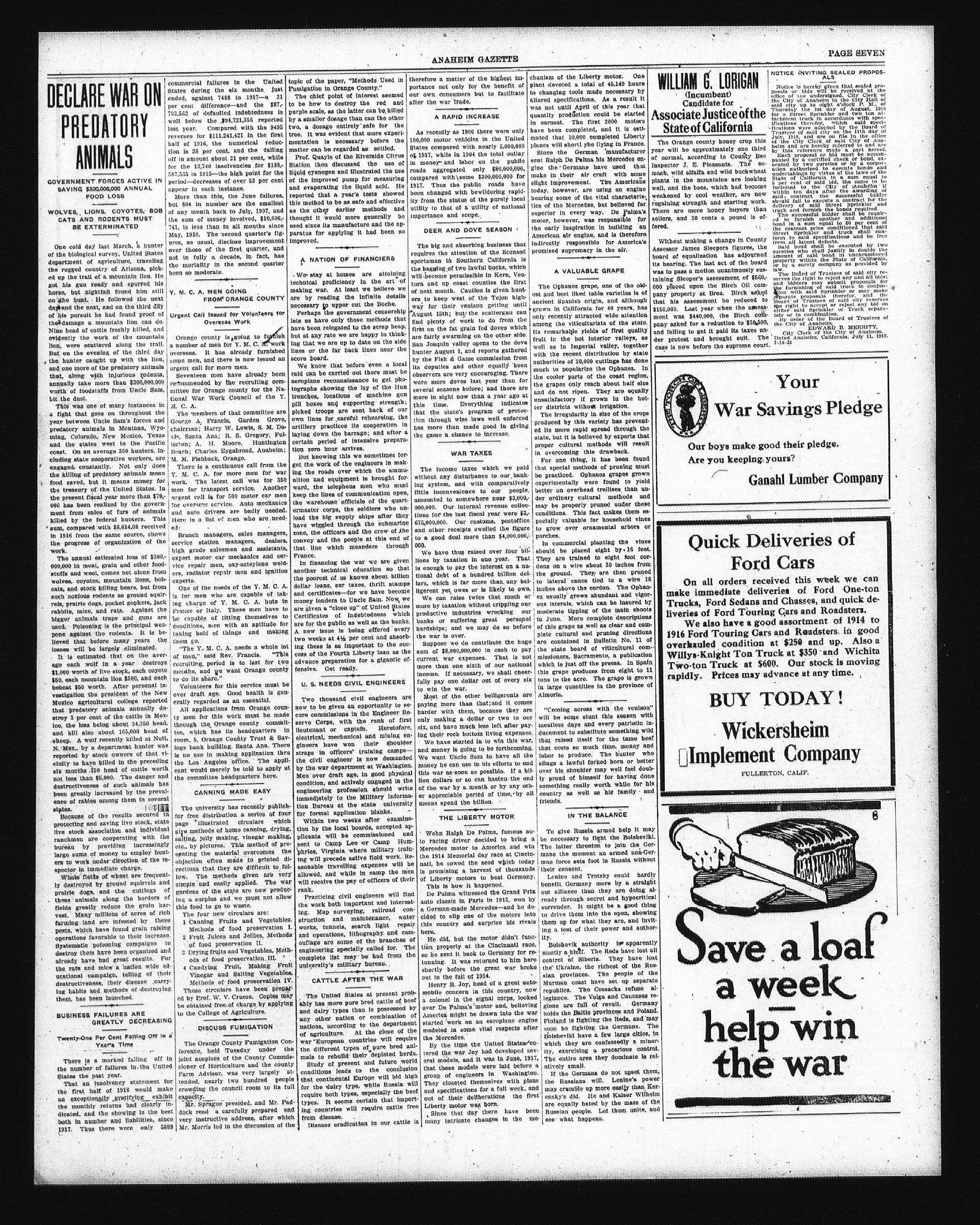
Searchable text
DECLARE WAR ON PREDATORY ANIMALS
GOVERNMENT FORCES ACTIVE IN SAVING $300,000,000 ANNUAL FOOD LOSS
WOLVES, LIONS, COYOTES, BOB CATS AND RODENTS MUST BE EXTERMINATED
One cold day last March, a hunter of the biological survey, United States department of agriculture, travelling the rugged country of Arizona, picked up the trail of a mountain lion. He got his gun ready and spurred his horse, but nightfall found him still on the hunt. He followed the next day and the next, and on the third day of his pursuit he had found proof of the damage a mountain lion can do. Nine head of cattle freshly killed, and evidently the work of the mountain lion, were scattered along the trail. But on the evening of the third day the hunter caught up with the lion, and one more of the predatory animals that, along with injurious rodents, annually take more than $300,000,000 worth of foodstuffs from Uncle Sam, lit the dust.
This was one of many instances in a fight that goes on throughout the year between Uncle Sam's forces and predatory animals in Montana, Wyoming, Colorado, New Mexico, Texas and the states west to the Pacific coast. On an average 300 hunters, commercial failures in the United States during the six months just ended, against 7488 in 1917—a 21 per cent difference—and the $87,-793,562 of defaulted indebtedness is well below the $94,721,356 reported last year. Compared with the 9495 reverses for $111,241,421 in the first half of 1916, the numerical reduction is 38 per cent, and the falling off in amount about 21 per cent, while for the 12,740 insolvencies for $188,-587,535 in 1915—the high point for the period—decreases of over 53 per cent appear in each instance.
More than this, the June failures, but 804 in number are the smallest of any month back to July, 1907, and the sum of money involved, $10,606,-741, is less than in all months since May, 1910. The second quarter's figures, as usual, disclose improvement over those of the first quarter, and not in fully a decade, in fact, has the mortality in the second quarter been so moderate.
Y. M. C. A. MEN GOING FROM ORANGE COUNTY
Urgent Call Issued for Volunteers for Overseas Work
Orange county is going to furnish a number of men for Y. M. C. A. work overseas. It has already furnished some men, and there is now issued an urgent call for more men.
Seventeen men have already been recommended by the recruiting committee for Orange county for the National War Work Council of the Y. M. C. A.
The members of that committee are George A. Francis, Garden Grove, chairman; Harry W. Lewis, S. M. Davis, Santa Ana; R. S. Gregory, Fullerton; A. H. Moore, Huntington Beach; Charles Eygabroad, Anaheim; topic of the paper, "Methane Fumigation in Orange County."
The chief point of interest to be how to destroy the purple scale, as the latter by a smaller dosage than one two, a dosage entirely safe tree. It was evident that management is necessary matter can be regarded as Prof. Quayle of the River Station then discussed liquid cyanogen and illustrations of the improved pump for evaporating the liquor reported that a year's time this method to be as safe as the other earlier thought it would more used since its manufacture paratus for applying it improved.
A NATION OF FINANCE
We stay at homes and technical proficiency in making war. At least we are by reading the instructions necessary to upper cut trees.
Perhaps the government lets us have only those we have relegated to ther but at any rate we are having that we are up to date lines or the far back life score board.
We know that before raid can be carried out the aeroplane reconnaissance photographs showing the last trenches, locations of pill boxes and support pickled troops are sent own lines for careful artillery practices its laying down the barrage certain period of intension zero hour arrives.
But knowing this we
the hunter caught up with the nonand one more of the predatory animals
that, along with injurious rodents,
annually take more than $300,000,000
worth of foodstuffs from Uncle Sam,
bit the dust.
This was one of many instances in
a fight that goes on throughout the
year between Uncle Sam's forces and
predatory animals in Montana, Wyoming,
Colorado, New Mexico, Texas
and the states west to the Pacific coast.
On an average 300 hunters, including state cooperative workers, are engaged, constantly. Not only does the killing of predatory animals mean food saved, but it means money for the treasury of the United States. In the present fiscal year more than $79,000 has been realized by the government from sales of furs of animals killed by the federal hunters. This sum, compared with $8,614,08 received in 1916 from the same source, shows the progress of organization of the work.
The annual estimated loss of $300,000,000 in meat, grain and other foodstuffs and wool, comes not alone from wolves, coyotes, mountain lions, bobcats, and stock killing bears, but from such noxious rodents as ground squirrels, prairie dogs, pocket gophers, jack rabbits, mice, and rats. Against the bigger animals traps and guns are used. Poisoning is the principal weapon against the rodents. It is believed that before many years the losses will be largely eliminated.
It is estimated that on the average each wolf in a year destroys $1,000 worth of live stock, each coyote $50, each mountain lion $500, and each bobcat $50 worth. After personal investigation the president of the New Mexico agricultural college reported that predatory animals annually destroy 3 per cent of the cattle in Mexico, the loss being about 34,350 head, and kill also about 165,000 head of sheep. A wolf recently killed at Nutt, N. Mex., by a department hunter was reported by stock owners of that vicinity to have killed in the preceding six months 150 head of cattle worth not less than $5,000. The danger and destructiveness of such animals has been greatly increased by the prevalence of rabies among them in several states.
Because of the results secured in protecting and saving live stock, state live stock association and individual ranchmen are cooperating with the bureau by providing increasingly large sums of money to employ hunters to work under direction of the in-
Seventeen men have already been recommended by the recruiting committee for Orange county for the National War Work Council of the Y. M. C. A.
The members of that committee are George A. Francis, Garden Grove, chairman; Harry W. Lewis, S. M. Davis, Santa Ana; R. S. Gregory, Fulerton; A. H. Moore, Huntington Beach; Charles Eygabroad, Anaheim; M. M. Flashback, Orange.
There is a continuous call from the Y. M. C. A. for more men for war work. The latest call was for 350 men for transport service. Another urgent call is for 500 motor car men for overseas service. Auto mechanics and auto drivers are badly needed. Here is a list of men who are needed:
Branch managers, sales managers, service station managers, dealers, high grade salesmen and assistants, expert motor car mechanics and service repair men, oxy-actylene welders, radiator repair men and ignition experts.
One of the needs of the Y. M. C. A. is for men who are capable of taking charge of Y. M. C. A. huts in France or Italy. These men have to be capable of titting themselves to conditions, men with an aptitude for taking hold of things and making them go.
"The Y. M. C. A. needs a whole lot of men," said Rev. Francis. "This recruiting period is to last for two months, and we want Orange county to do its share."
Volunteers for this service must be over draft age. Good health is generally regarded as an essential.
All applications from Orange county men for this work must be made through the Orange county committee, which has its headquarters in room 5, Orange County Trust & Savings bank building. Santa Ana. There is no use in making application thru the Los Angeles office. The applicant would merely be told to apply at the committee headquarters here.
CANNING MADE EASY
The university has recently published for free distribution a series of four page illustrated circulars which give methods of home canning, drying, salting, jelly making, vinegar making, etc., by pictures. This method of presenting the material overcomes the objection often made to printed di-
We know that beforeraid can be carried outthe aeroplane reconnaissancetographs showing the lasttrenches, locations of pill boxes and supportpiticked troops are sentown lines for careful reartillery practices its co-laying down the barrage certain period of intention zero hour arrives.
But knowing this we get the work of the engin ing the roads over which nittion and equipment is ward,the telephons may keep the lines of communihe warehouse officialsermaster corps,the solld load the big supply shifhave wiggled through therzone,the officers and therconvoy and the people that line which meansFrance.
In financing the waranother technical educatiesthe poorest of us knowndollar loans,sur taxes,and certificates—for we money lenders to Uncle are given a “close up” offCertificates of Indebteare for the public as wellA new issue is beingtwo weeks at 4½ per ceing these is as importantcess of the Fourth Liberade advance preparation forfensive.Get ready.
U.S.NEEDS CIVIL
Two thousand civil now to be given an oppure commissions in therserve Corps,with therileutenant or captainelectrical mechanical engineers have won ther straps in officers’ traithe civil engineer isby the war departmentMen over draft age,in condition,and activelyengineering professionimmediately to theMilton Bureau at the storformal application.
Within two weeks a tion by the local boardplicants will be comsent to Camp Lee ovphries,Virginia whereing will precede activem
Because of the results secured in protecting and saving live stock, state live stock association and individual ranchmen are cooperating with the bureau by providing increasingly large sums of money to employ hunters to work under direction of the inspector in immediate charge.
Whole fields of wheat are frequently destroyed by ground squirrels and prairie dogs, and the cuttings of these animals along the borders of fields greatly reduce the grain harvest. Many millions of acres of rich farming land are infested by these pests, which have found grain raising operations favorable to their increase. Systematic poisoning campaigns to destroy them have been organized and already have had great results. For the rats and mice a nation wide educational campaign, telling of their destructiveness, their disease carrying habits and methods of destroying them, has been launched.
BUSINESS FAILURES ARE GREATLY DECREASING
Twenty-One Per Cent Falling Off in a Year's Time
There is a marked falling off in the number of failures in the United States the past year.
That an insolvency statement for the first half of 1918 would make an exceptionally gratifying exhibit the monthly returns had clearly indicated, and the showing is the best both in number and liabilities, since 1917. Thus there were only 5889 cant would merely be told to apply at the committee headquarters here.
CANNING MADE EASY
The university has recently published for free distribution a series of four page illustrated circulars which give methods of home canning, drying, salting, jelly making, vinegar making, etc., by pictures. This method of presenting the material overcomes the objection often made to printed directions that they are difficult to follow. The methods given are very simple and easily applied. The war gardens of the state are now producing a surplus and we must not allow this food to go to waste.
The four new circulars are:
1. Canning Fruits and Vegetables. Methods of food preservation I.
2. Fruit Juices and Jellies, Methods of food preservation II.
3. Drying fruits and Vegetables, Methods of food preservation III.
4. Candying Fruit, Making Fruit Vinegar and Salting Vegetables, Methods of food preservation IV.
These circulars have been prepared by Prof. W. V. Cruess. Copies may be obtained free of charge by applying to the College of Agriculture.
DISCUSS FUMIGATION
The Orange County Fumigation Conference, held Tuesday under the joint auspices of the County Commissioner of Horticulture and the county Farm Advisor, was very largely attended, nearly two hundred people crowding the council room to its full capacity.
Mr. Sprague presided, and Mr. Paddock read a carefully prepared and very instructive address, after which Mr. Morris led in the discussion of the
The United States ably has more pure bran and dairy types than any other nation or nations, according to agriculture. At war European countries the different types o mals to rebuild their Study of present a conditions leads to that continental Europe for the dairy type, we require both types, en types. It seems caring countries will re from disease.
Disease eradication
topic of the paper, "Methods Used in Fumigation in Orange County."
The chief point of interest seemed to be how to destroy the red and purple scale, as the latter can be killed by a smaller dosage than can the other two, a dosage entirely safe for the tree. It was evident that more experimentation is necessary before the matter can be regarded as settled.
Prof. Quayle of the Riverside Citrus Station then discussed the use of liquid cyanogen and illustrated the use of the improved pump for measuring and evaporating the liquid acid. He reported that a year's tests showed this method to be as safe and effective as the other earlier methods and thought it would more generally be used since its manufacture and the apparatus for applying it had been so improved.
A NATION OF FINANCIERS
We stay at homes are attaining technical proficiency in the art of making war. At least we believe we are by reading the infinite details necessary to upper cut the Boche.
Perhaps the government censorship lets us have only those methods that have been relegated to the scrap heap, but at any rate we are happy in thinking that we are up to date on the side lines or the far back lines near the score board.
We know that before even a local raid can be carried out there must be aeroplane reconnaissance to get photographs showing the lay of the Hun trenches, locations of machine gun pill boxes and supporting strength; picked troops are sent back of our own lines for careful rehearsing, the artillery practices its cooperation in laying down the barrage; and after a certain period of intensive preparation zero hour arrives.
But knowing this we sometimes therefore a matter of the highest importance not only for the benefit of our own consumers but to facilitate after the war trade.
A RAPID INCREASE
As recently as 1906 there were only 100,000 motor vehicles in the United States compared with nearly 5,000,000 of 1917, while in 1904 the total outlay in money and labor on the public roads aggregated only $80,000,000, compared with some $300,000,000 for 1917. Thus the public roads have been changed with bewildering rapidity from the status of the purely local utility to that of a utility of national importance and scope.
DEER AND DOVE SEASON
The big and absorbing business that requires the attention of the licensed sportsman in Southern California is the bagging of two lawful bucks, which will become permissible in Kern, Ventura and up coast counties the first of next month. Caution is given hunters to keep west of the Tejon highway for their venison getting until August 15th; but the scattergun can find plenty of work to do from the first on the fat grain fed doves which are fairly swarming on the other side. San Joaquin valley opens to the dove hunter August 1, and reports gathered by the Fish & Game commission from its deputies and other equally keen observers are very encouraging. There were more doves last year than for several seasons before; and there are more in sight now than a year ago at this time. Everything indicates that the state's program of protection through wise laws well enforced has more than made good in giving the game a chance to increase.
WAR TAXES
chanism of the Liberty motor. One plant devoted a total of 45,149 hours to changing tools made necessary by altered specifications. As a result it was not until April of this year that quantity production could be started in earnest. The first 2000 motors have been completed, and it is estimated that 10,000 completed Liberty planes will shortlye flying in France.
Since the German manufacturer sent Ralph De Palma his Mercedes engine the Germans have used that make in their air craft with some slight improvement. The Americans today, however, are using an engine bearing some of the vital characteristics of the Mercedes, but believed far superior in every way. De Palma's motor, however, was responsible for the early inspiration in building an American air engine, and is therefore indirectly responsible for America's promised supremacy in the air.
A VALUABLE GRAPE
The Ophanez grape, one of the oldest and best liked table varieties is of ancient Spanish origin, and although grown in California for 40 years, has only recently attracted wide attention among the viticulturists of the state. Its remarkable yields of first quality fruit is the hot interior valleys, as well as in Imperial valley, together with the recent distribution by state authorities of 20,000 cuttings has done much to popularize the Ophanez. In the cooler parts of the coast region, the grapes only reach about half size and do not ripen. They are equally unsatisfactory if grown in the hotter districts without irrigation.
The irregularity in size of the crops produced by this variety has prevented its more rapid spread through the state, but it is believed by experts that proper cultural methods will result in overcoming this drawback.
We know that before even a local raid can be carried out there must be aeroplane reconnaissance to get photographs showing the lay of the Hun trenches, locations of machine gun pill boxes and supporting strength; picked troops are sent back of our own lines for careful rehearsing, the artillery practices its cooperation in laying down the barrage; and after a certain period of intensive preparation zero hour arrives.
But knowing this we sometimes forget the work of the engineers in making the roads over which the ammunition and equipment is brought forward, the telephons men who must keep the lines of communication open, the warehouse officials of the quartermaster corps, the soldiers who unload the big supply ships after they have wiggled through the submarine zone, the officers and the crew of the convoy and the people at this end of that line which meanders through France.
In financing the war we are given another technical education so that the poorest of us knows about billion dollar loans, sur taxes, thrift stamps and certificates—for we have become money lenders to Uncle Sam. Now we are given a "close up" of United States Certificates of Indebtedness which are for the public as well as the banks. A new issue is being offered every two weeks at 4½ per cent and absorbing these is as important to the success of the Fourth Liberty loan as the advance preparation for a gigantic offensive. Get ready.
U. S. NEEDS CIVIL ENGINEERS
Two thousand civil engineers are now to be given an opportunity to secure commissions in the Engineer Reserve Corps, with the rank of first lieutenant or captain. Heretofore, electrical, mechanical and mining engineers have won their shoulder straps in officers' training camps—the civil engineer is now demanded by the war department at Washington. Men over draft age, in good physical condition, and actively engaged in the engineering profession should write immediately to the Military Information Bureau at the state university for formal application blanks.
Within two weeks after examination by the local boards, accepted applicants will be commissioned and sent to Camp Lee or Camp Humphries, Virginia where military training will precede active field work. Reasonable selling expenses will be by the Fish & Game Commission its deputies and other equally keen observers are very encouraging. There were more doves last year than for several seasons before; and there are more in sight now than a year ago at this time. Everything indicates that the state's program of protection through wise laws well enforced has more than made good in giving the game a chance to increase.
WAR TAXES
The income taxes which we paid without any disturbance to our banking system, and with comparatively little inconvenience to our people, amounted to somewhere near $3,000,000. Our internal revenue collections for the last fiscal year were $3,675,000,000. Our customs, postoffice and other receipts swelled the figure to a good deal more than $4,000,000,000.
We have thus raised over four billions by taxation in one year. That is enough to pay the interest on a national debt of a hundred billion dollars, which is far more than any belligerent yet owes or is likely to owe.
We can raise twice that much or by taxation without crippling our productive industries wrecking our banks or suffering great personal hardships; and we may do so before the war is over.
Suppose we do contribute the huge sum of $8,000,000,000 in cash to pay current war expenses. That is not more than one sixth of our national income. If necessary, we shall cheerfully pay one dollar out of every six to win the war.
Most of the other belligerents are paying more than that; and it comes harder with them, because they are only making a dollar or two to our six, and have much less left after paying their rock bottom living expenses.
We have started in to win this war, and money is going to be forthcoming. We want Uncle Sam to have all the money he can use in his efforts to end this war as soon as possible. If a billion dollars or so can hasten the end of the war by a month or by any other appreciable period of time, by all means spend the billion.
THE LIBERTY MOTOR
Wehn Ralph De Palma, famous auto racing driver decided to bring a Mercedes motor to America and win the 1914 Memorial day race at Cincinnati, he sowed the seed which today authorities of 20,000 cuttings has done much to popularize the Ophanez. In the cooler parts of the coast region, the grapes only reach about half size and do not ripen. They are equally unsatisfactory if grown in the hotter districts without irrigation.
The irregularity in size of the crops produced by this variety has prevented its more rapid spread through the state, but it is believed by experts that proper cultural methods will result in overcoming this drawback.
For one thing, it has been found that special methods of pruning must be practiced. Ophanez grapes grown experimentally were found to yield better on overhead trellises than under ordinary cultural methods and may be properly pruned under these conditions. This fact makes them especially valuable for household vines to grow over ornamental arbors or porches.
In commercial planting the vines should be placed eight by 16 feet. They are trained to eight foot cordons on a wire about 30 inches from the ground. They are then pruned to lateral canes tied to a wire 18 inches above the cordon. The Ophanez usually grows abundant and vigorous laterals, which can be insured by moderate tipping of the main shoots in June. More complete descriptions of this grape as well as clear and complete cultural and pruning directions are contained in Bulletin No. 11 of the state board of viticultural commissioners, Sacramento, a publication which is just off the press. In Spain this grape produces from eight to 11 tons to the acre. The grape is grown in large quantities in the province of Almeria.
"Coming across with the venison" will be some stunt this season with meatless days and every patriotic inducement to substitute something wild that raised itself for the tame beef that costs so much time, money and labor to produce. The hunter who silings a lawful forked horn or better over his shoulder may well feel doubly proud of himself for having done something really worth while for his country as well as his family and friends.
IN THE BALANCE
To give Russia armed help it may be necessary to fight the Bolsheviks. The latter threaten to join the Germans the moment an armed non-German force sets foot in Russia without
Men over draft age, in good physical condition, and actively engaged in the engineering profession should write immediately to the Military Information Bureau at the state university for formal application blanks.
Within two weeks after examination by the local boards, accepted applicants will be commissioned and sent to Camp Lee or Camp Humphries, Virginia where military training will precede active field work. Reasonable travelling expenses will be allowed, and while in camp the men will receive the pay of officers of their rank.
Practicing civil engineers will find the work both important and interesting. Map surveying, railroad construction and maintenance, water works, tunnels, search light repair and operations, lithography and camouflage are some of the branches of engineering specially called for. The complete list may be had from the university's military bureau.
CATTLE AFTER THE WAR
The United States at present probably has more pure bred cattle of beef and dairy types than is possessed by any other nation or combination of nations, according to the department of agriculture. At the close of the war European countries will require the different types of pure bred animals to rebuild their depleted herds.
Study of present and future world conditions leads to the conclusion that continental Europe will bid high for the dairy type, while Russia will require both types, especially the beef types. It seems certain that importing countries will require cattle free from disease.
Disease eradication in our cattle is this war as soon as possible. If a billion dollars or so can hasten the end of the war by a month or by any other appreciable period of time, by all means spend the billion.
THE LIBERTY MOTOR
Wehn Ralph De Palma, famous auto racing driver decided to bring a Mercedes motor to America and win the 1914 Memorial day race at Cincinnati, he sowed the seed which today is promising a harvest of thousands of Liberty motors to beat Germany.
This is how it happened.
De Palma witnessed the Grand Prix auto classic in Paris in 1913, won by a German-made Mercedes—and he decided to slip one of the motors into this country and surprise his rivals here.
He did, but the motor didn't function properly at the Cincinnati race, so he sent it back to Germany for retunning. It was returned to him here shortly before the great war broke out in the fall of 1914.
Henry B. Joy, head of a great automobile concern in this country, now a colonel in the signal corps, looked over De Palma's motor and, believing America might be drawn into the war started work on an earoplane engine modeled in some vital respects after the Mercedes.
By the time the United States entered the war Joy had developed several models, and it was in June, 1917, that these models were laid before a group of engineers in Washington. They closed themselves with plans and specifications for a full week, and out of their deliberations the first Liberty motor was born.
Since that day there have been many intricate changes in the me-
IN THE BALANCE
To give Russia armed help it may be necessary to fight the Bolsheviks. The latter threaten to join the Germans the moment an armed non-German force sets foot in Russia without their consent.
Lenine and Trotzky could hardly benefit Germany more by a straight out alliance than they are doing already through secret and hypocritical surrender. It might be a good thing to drive them into the open, showing them up for what they are, and inviting a test of their power and authority.
Bolshevik authority is apparently mostly a bluff. The Reds have lost all control of Siberia. They have lost the Ukrainne, the richest of the Russian provinces. The people of the Murman coast have set up separate republics. The Cossacks refuse allegiance. The Volga and Caucasus regions are full of revolt. Germany holds the Baltic provinces and Poland. Finland is fighting the Reds, and may soon be fighting the Germans. The Bolsheviks have a few large cities, in which they are confessedly a minority, exercising a precarious control. The entire area they dominate is relatively small.
If the Germans do not upset them, the Russians will. Lenine's power may crumble up more easily than Kersensky's did. He and Kaiser Wilhelm are equally hated by the mass of the Russian people. Let them unite, and see what happens.
WILLIAM G. LORIGAN
(Incumbent)
Candidate for Associate Justice of the State of California
The Orange county honey crop this year will be approximately one third of normal, according to County Bee Inspector J. E. Pleasants. The such, wild alfalfa and wild buckwheat plants in the mountains are looking well, and the bees, which had become weakened by cool weather, are now regaining strength and starting work. There are more honey buyers than sellers, and 20 cents a pound is offered.
Without making a change in County Assessor James Sleepers figures, the board of equalization has adjourned its hearing. The last act of the board was to pass a motion unanimously sustaining Sleeper's assessment of $560,000 placed upon the Birch Oil company property at Brea. Birch asked that his assessment be reduced to $150,000. Last year when the assessment was $440,000, the Birch company asked for a reduction to $30,500, and failing to get it paid its taxes under protest and brought suit. The case is now before the supreme court.
NOTICE (INVITING SEALED PROPOSALS)
Notice is hereby given that sealed proposals or bids will be received at the office of the undersigned, City Clerk of the City of Anaheim in the City Hall of said city up to eight o'clock P.M., of Thursday the 1st day of August, 1918 for a Street Sprinkler and two ton attachment truck in accordance with specifications thereof, which said specimens were adopted by the Board of Trustees of said city on the 11th day of July, 1918, and are on file in the office of the City Clerk of said City of Anaheim and are hereby referred to and are by this reference made a part hereof.
Each proposal or bid must be accompanied by a certified check or bond, executed by two sureties or by a corporation authorized to execute bonds and undertakings by virtue of the laws of the State of California in a sum equal to 5 per cent of said bid, the same to be forfeited to the City of Anaheim if within ten days after the awarding of said contract the successful bidder should fail to execute a contract for the delivery of said Street Sprinkler and truck and furnish the bonds required.
The successful bidder shall be required to furnish another and additional bond in a sum equal to 50 per cent of the contract price conditioned that said Street Sprinkler and truck shall conform to said specifications and be free from all latent defects.
Said bond shall be executed by two sureties who shall justify in double the amount of said bond in unencumbered property within the State of California, or by a surety company as provided by law.
The Board of Trustees of said city reserves the right to reject any and all bids; and bidders may submit proposals for the furnishing of said truck in conjunction with said Sprinkler or may make separate proposals therefor, and the Board of Trustees of said city reserves the right to accept or reject any bid on either said Sprinkler or Truck separately or in combination.
By order of the Board of Trustees of the City of Anaheim.
EDWARD B. MERRITT,
City Clerk of the City of Anaheim,
Dated Anaheim, California, July 11, 1918.
Your War Savings Pledge
Our boys make good their pledge.
Your War Savings Pledge
Our boys make good their pledge.
Are you keeping yours?
Ganahl Lumber Company
Quick Deliveries of Ford Cars
On all orders received this week we can make immediate deliveries of Ford One-ton Trucks, Ford Sedans and Chasses, and quick deliveries of Ford Touring Cars and Roadsters.
We also have a good assortment of 1914 to 1916 Ford Touring Cars and Roadsters in good overhauled condition at $250 and up. Also a Willys-Knight Ton Truck at $350 and Wichita Two-ton Truck at $600. Our stock is moving rapidly. Prices may advance at any time.
BUY TODAY!
Wickersheim Implement Company
FULLERTON, CALIF.
Save a loaf
a week
help win
the war