anaheim-gazette 1918-03-21
Scanned page
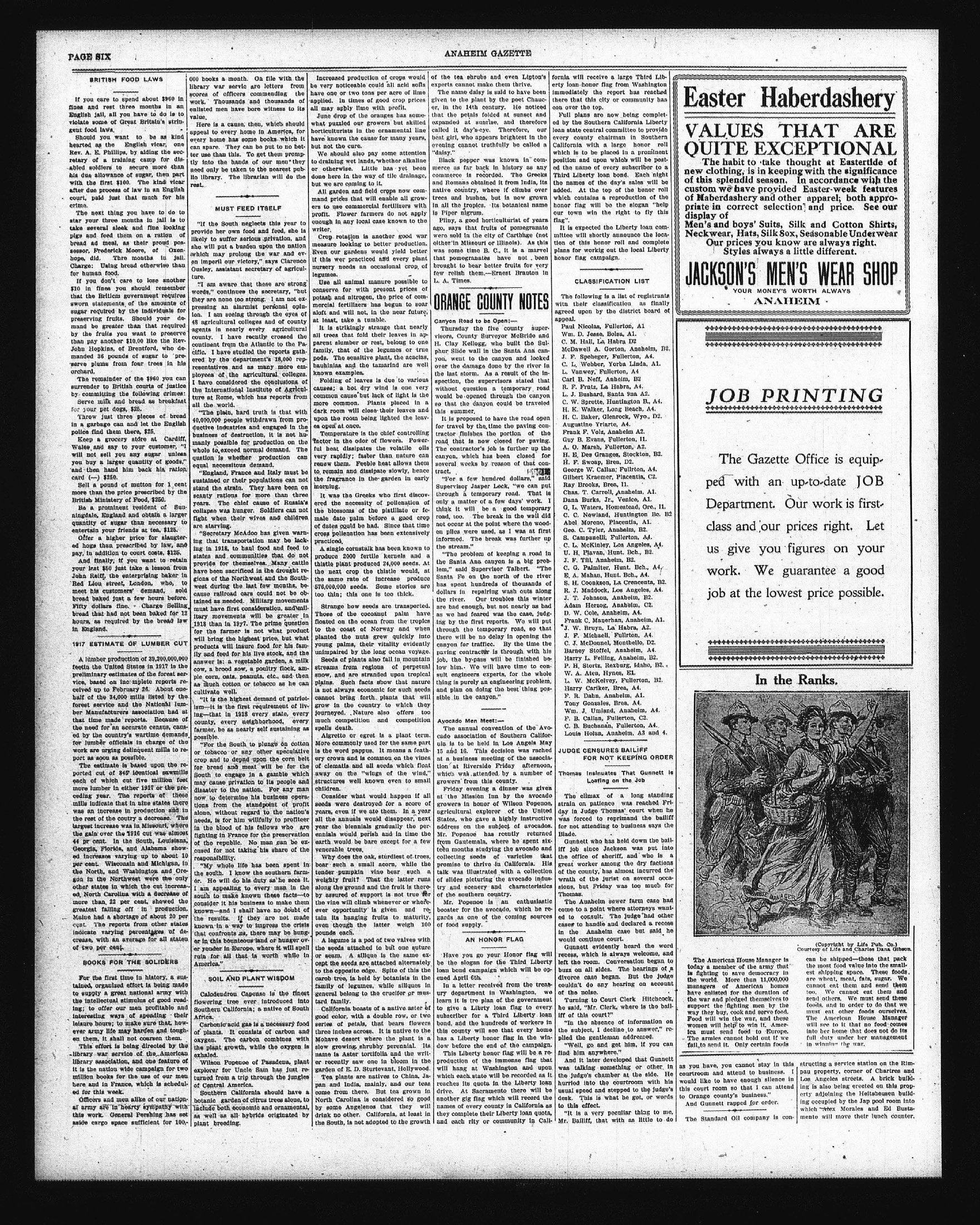
Searchable text
BRITISH FOOD LAWS
If you care to spend about $960 in fines and rest three months in an English jail, all you have to do is to violate some of Great Britain's stringent food laws.
Should you want to be as kind hearted as the English vicar, one Rev. A. E. Phillips, by alding the secretary of a training camp for disabled soldiers to secure more than his due allowance of sugar, then part with the first $100. The kind vicar after due process of law in an English court, paid just that much for his crime.
The next thing you have to do to star your three months in jail is to take several sleek and fine looking pigs and feed them on a ration of bread ad meal, as their proud possessor, Frederick Moore, of Oxonhope, did. Thre months in jail. Charge: Using bread otherwise than for human food.
If you don't care to lose another $10 in fines you should remember that the British government requires sworn statements of the amounts of sugar required by the individuals for preserving fruits. Should your demand be greater than that required by the fruits you want to preserve than pay another $10,00 like the Rev. John Hopkins, of Brentford, who demanded 36 pounds of sugar to preserve plums from four trees in his orchard.
The remainder of the $960 you can surrender to British courts of justice by committing the following crimes:
Serve milk and bread as breakfast for your pet dogs, $25.
Throw just three pieces of bread in a garbage can and let the English police find them there, $25.
Keep a grocery store at Cardiff, Wales and say to your customer, "I will not sell you any sugar unless 000 books a month. On file with the library war service are letters from scores of officers commending the work. Thousands and thousands of enlisted men have bore witness to its value.
Here is a cause, then, which should appeal to every home in America, for every home has some books which it can spare. They can be put to no better use than this. To get them promptly into the hands of our men they need only be taken to the nearest public library. The librarian will do the rest.
MUST FEED ITSELF
"If the South neglects this year to provide her own food and feed, she is likely to suffer serious privation, and she will put a burden upon the nation which may prolong the war and even imperil our victory," says Clarence Ousley, assistant secretary of agriculture.
"I am aware that these are strong words," continues the secretary, "but they are none too strong. I am not expressing an alarmist personal opinion. I am seeing through the eyes of 48 agricultural colleges and of county agents in nearly every agricultural county. I have recently crossed the continent from the Atlantic to the Pacific. I have studied the reports gathered by the department's 18,000 representatives and as many more employees of the agricultural colleges. I have considered the conclusions of the International Institute of Agriculture at Rome, which has reports from all the world."
"The plain, hard truth is that with 40,000,000 people withdrawn from productive industries and engaged in the business of destruction, it is not humanly possible for production on the whole to exceed normal demand. The question is whether production can increased produce be very noticeable; have one or two to applied. In times all may apply limits.
June drop of the what puzzled our horticulturists in that have known the case but not the cure.
We should also to drain wet land or otherwise. L done here in the w but we are coming.
All garden and mand prices that workers to use commercial profit. Flower far enough in any local writer.
Crop rotation is measure looking to Even our gardens if this wer practical nursery needs and legumes.
Use all animal conserve for with potash and nitrogen mercial fertilizers aloft and will not at least, take a t It is strikingly all trees that fold parent slumber on family, that of t pods. The sensitii bauhinias and th known examples.
Folding of leaves causes; a hot dry common cause but more common dark room will cl up upon the room be es open at once.
Temperature is factor in the odor ful heat dissipat very rapidly; fa
The remainder of the $960 you can surrender to British courts of justice by committing the following crimes:
Serve milk and bread as breakfast for your pet dogs, $25.
Throw just three pieces of bread in a garbage can and let the English police find them there, $25.
Keep a grocery store at Cardiff, Wales and say to your customer, "I will not sell you any sugar unless you buy a larger quantity of goods," and then hand him back his ration card (—) $250.
Sell a pound of mutton for 1 cent more than the price prescribed by the British Ministry of Food, $250.
Be a prominent resident of Sunningdale, England and obtain a larger quantity of sugar than necessary to entertain your friends at tea, $125.
Offer a higher price for slaughtered hogs than prescribed by law, and pay, in addition to court costs, $125.
And finally, if you want to retain your last $50 just take a lesson from John Reiff, the enterprising baker in Red Lion street, London, who, to meet his customers' demand, sold bread baked just a few hours before. Fifty dollars fine. Charge Selling, bread that had not been baked for 12 hours, as required by the bread law in England.
1917 ESTIMATE OF LUMBER CUT
A lumber production of 39,200,000,000 feet in the United States in 1917 is the preliminary estimates of the forest service, based on incomplete reports received up to February 26. About one-half of the 34,000 mills listed by the forest service and the National Lumber Manufacturers association had at that time made reports. Because of the need for an accurate census, caused by the country's wartime demands, for lumber officials in charge of the work are urging delinquent mills to report as soon as possible.
The estimate is based upon the reported cut of 845 identical sawmills each of which cut five million feet more lumber in either 1917 or the preceding year. The reports of these mills indicate that in nine states there was an increase in production and in the rest of the country a decrease. The largest increase was in Missouri, where the gain over the 1916 cut was almost 44 per cent. In the South, Louisiana, Georgia, Florida, and Alabama showed increases varying up to about 10 per cent. Wisconsin and Michigan, in
"The plain, hard truth is that with 40,000,000 people withdrawn from productive industries and engaged in the business of destruction, it is not humanly possible for production on the whole to exceed normal demand. The question is whether production can equal necessitous demand.
"England, France and Italy must be sustained or their populations can not stand the strain. They have been on scanty rations for more than three years. The chief cause of Russia's collapse was hunger. Soldiers can not fight when their wives and children are starving.
"Secretary McAdoo has given warning that transportation may be lacking in 1918, to haul food and feed to states and communities that do not provide for themselves. Many cattle have been sacrificed in the drought regions of the Northwest and the Southwest during the last few months, because railroad cars could not be obtained as needed. Military movements must have first consideration, and military movements will be greater in 1918 than in 19y7. The prime question for the farmer is not what product will bring the highest price, but what products will insure food for his family and feed for his live stock, and the answer is: a vegetable garden, a milk cow, a brood sow, a poultry flock, ample corn, oats, peanuts, etc., and then as much cotton or tobacco as he can cultivate well.
"It is the highest demand of patriotism—it is the first requirement of living—that in 1918 every state, every county, every neighborhood, every farmer, be as nearly self sustaining as possible.
"For the South to plunge on cotton or tobacco or any other speculative crop and to depnd upon the corn belt for bread and meat will be for the South to engage in a gamble which may cause privation to its people and disaster to the nation. For any man now to determine his business operations from the standpoint of profit alone, without regard to the nation's needs, is for him willfully to profiteer in the blood of his fellows who are fighting in France for the preservation of the republic. No man can be excused for not taking his share of the responsibility."
My whole life has been spent in representing by the department's 18,000 representatives and as many more employees of the agricultural colleges. I have considered the conclusions of the International Institute of Agriculture at Rome, which has reports from all the world.
"The plain, hard truth is that with 40,000,000 people withdrawn from productive industries and engaged in the business of destruction, it is not humanly possible for production on the whole to exceed normal demand. The question is whether production can equal necessitous demand.
"England, France and Italy must be sustained or their populations can not stand the strain. They have been on scanty rations for more than three years. The chief cause of Russia's collapse was hunger. Soldiers can not fight when their wives and children are starving.
"Secretary McAdoo has given warning that transportation may be lacking in 1918, to haul food and feed to states and communities that do not provide for themselves. Many cattle have been sacrificed in the drought regions of the Northwest and the Southwest during the last few months, because railroad cars could not be obtained as needed. Military movements must have first consideration,and military movements will be greater in 1918 than in 19y7. The prime question for the farmer is not what product will insure food for his family and feed for his live stock, and the answer is: a vegetable garden, a milk cow, a brood sow, a poultry flock, ample corn, oats, peanuts, etc., and then as much cotton or tobacco as he can cultivate well.
"It is the highest demand of patriotism—it is the first requirement of living—that in 1918 every state, every county, every neighborhood, every farmer, be as nearly self sustaining as possible.
"For the South to plunge on cotton or tobacco or any other speculative crop and to depnd upon the corn belt for bread and meat will be for the South to engage in a gamble which may cause privation to its people and disaster to the nation. For any man now to determine his business operations from the standpoint of profit alone, without regard to the nation's needs, is for him willfully to profiteer in the blood of his fellows who are fighting in France for the preservation of the republic. No man can be excused for not taking his share of the responsibility."
ported cut of 845 identical sawmills each of which cut five million feet more lumber in either 1917 or the preceding year. The reports of these mills indicate that in nine states there was an increase in production and in the rest of the country a decrease. The largest increase was in Missouri, where the gain over the 1916 cut was almost 44 per cent. In the South, Louisiana, Georgia, Florida, and Alabama showed increases varying up to about 10 per cent. Wisconsin and Michigan, in the North, and Washington and Oregon in the Northwest were the only other states in which the cut increased. North Carolina with a decrease of more than 22 per cent, showed the greatest falling off in production. Maine had a shortage of about 20 per cent. The reports from other states indicate varying percentages of decrease, with an average for all states of two per cent.
BOOKS FOR THE SOLIDERS
For the first time in history, a sustained, organized effort is being made to supply a great national army with the intellectual stimulus of good reading; to offer our men profitable and interesting ways of spending their leisure hours; to make sure that, however army life may harden and toughen them, it shall not coarsen them.
This effort is being directed by the library war service of the American library association, and one feature of it is the nation wide campaign for two million books for the use of our men here and in France, which is scheduled for this week.
Officers and men alike of our national army are in hearty sympathy with this work. General Pershing has set aside cargo space sufficient for 100,-
SOIL AND PLANT WISDOM
Calodendron Capense is the finest flowering tree ever introduced into Southern California; a native of South Africa.
Carbonic acid gas is a necessary food of plants. It consists of carbon and oxygen. The carbon combines with the plant growth, while the oxygen is exhaled.
Wilson Popenoe of Pasadena, plant explorer for Uncle Sam has just returned from a trip through the jungles of Central America.
Southern California should have a botanic garden of citrus trees alone, to include both economic and ornamental, as well as all hybrids originated by plant breeding.
Why does the oak bear such a small tender pumpkin weighty fruit? along the ground by assured of suction the vine will climb ever opportunity tain its hanging even though the pounds each.
A legume is a plant the seeds attach or seam. A stillcept the seeds are to the opposite carob tree, is held family of legumes general belong to tard family.
California boasts good color, with series of petals, three inches across Mohave desert w slow growing, sh name is Aster to er recently saw garden of E. D. S.
Tea plants are pan and India, come from there North Carolina by some Angelen drink no other. the South, is not
ANAHEIM GAZETTE
Increased production of crops would be very noticeable could all acid soils have one or two tons per acre of lime applied. In times of good crop prices all may apply lime with profit.
June drop of the oranges has somewhat puzzled our growers but skilled horticulturists in the ornamental line have known the cause for many years, but not the cure.
We should also pay some attention to draining wet lands, whether alkaline or otherwise. Little has yet been done here in the way of tile drainage, but we are coming to it.
All garden and field crops now command prices that will enable all growers to use commercial fertilizers with profit. Flower farmers do not apply enough in any local case known to the writer.
Crop rotation is another good war measure looking to better production. Even our gardens would yield better if this was practiced and every plant nursery needs an occasional crop of legumes.
Use all animal manure possible to conserve for with present prices of potash and nitrogen, the price of commercial fertilizers has begun to soar aloft and will not, in the near future, at least, take a tumble.
It is strikingly strange that nearly all trees that fold their leaves in apparent slumber or rest, belong to one family, that of the legumes or true pods. The sensitive plant, the acacia, bauhinias and the tamarind are well known examples.
Folding of leaves is due to various causes; a hot dry wind is one very common cause but lack of light is the more common. Plants placed in a dark room will close their leaves and upon the room being lighted the leaves open at once.
Temperature is the chief controlling factor in the odor of flowers. Powerful heat dissipates the volatile oils very rapidly; faster than nature can of the tea shrubs and even Lipton's experts cannot make them thrive.
The name daisy is said to have been given to the plant by the poet Chaucer, in the 14th century. He noticed that the petals folded at sunset and expanded at sunrise, and therefore called it day's eye. Therefore, our best girl, who appears brightest in the evening cannot truthfully be called a "daisy."
Black pepper was known in commerce as far back in history as any commerce is recorded. The Greeks and Romans obtained it from India, its native country, where it climbs over trees and bushes, but is now grown in all the tropics. Its botanical name is Piper nigrum.
Pliny, a good horticulturist of years ago, says that fruits of pomegranate were sold in the city of Carthage (not either in Missouri or Illinois). As this was some time B. C., it is a marvel that pomegranates have not been brought to bear better fruits for very few relish them.—Ernest Brauton in L. A. Times.
ORANGE COUNTY NOTES
Canyon Road to be Open:
Thursday the five county supervisors, County Surveyor McBride and H. Clay Kellogg, who built the Sulphur Slide wall in the Santa Ana canyon, went to the canyon and looked over the damage done by the river in the last storm. As a result of the inspection, the supervisors stated that without question a temporary road would be opened through the canyon so that the canyon could be traveled this summer.
It is proposed to have the road open for travel by the time the paving contractor finishes the portion of the road that is now closed for paving. The contractor's job is further up the canyon, which has been closed for
fornia will receive a large Third Liberty loan-honor flag from Washington immediately the report has reached there that this city or community has con over the top.
Full plans are now being completed by the Southern California Liberty loan state central committee to provide every county chairman in Southern California with a large honor roll which is to be placed in a prominent position and upon which will be posted the name of every subscriber to a Third Liberty loan bond. Each night the names of the day's sales will be added. At the top of the honor roll which contains a reproduction of the honor flag will be the slogan "help our town win the right to fly this flag".
It is expected the Liberty loan committee will shortly announce the location of this honor roll and complete plans for worklg out the local Liberty honor flag campaign.
CLASSIFICATION LIST
The following is a list of registrants with their classification as finally agreed upon by the district board of appeal.
Paul Nicolas, Fullerton, A1
Wm. D. Jesse, Bolsa, A1.
C. M. Hall, La Habra D2
McDawell A. Gorton, Anaheim, B2.
J. F. Speheger, Fullerton, A4.
C. L. Webber, Yorba Linda, A1.
L. Vaney, Fullerton, A4
Carl B. Neff, Anheim, B2
R. F. Frntz, La Habra, A4.
L. J. Bushard, Santa 9na A2.
C. W. Sprotte, Huntington B., A4.
H. K. Walker, Long Beach, A4.
H. C. Baker, Glenrock, Wyo., D2.
Augustine Yrlarte, A4.
Frank F. Volz, Anaheim A2.
Guy B. Evans, Fullerton, I1.
A. O. Marsh, Fullerton, A2.
H. E. Des Granges, Stockton, B2.
bauhinlas and the tamarind are well known examples.
Folding of leaves is due to various causes; a hot dry wind is one very common cause but lack of light is the more common. Plants placed in a dark room will close their leaves and upon the room being lighted the leaves open at once.
Temperature is the chief controlling factor in the odor of flowers. Powerful heat dissipates the volatile oils very rapidly; faster than nature can renew them. Feeble heat allows them to remain and dissipate slowly, hence the fragrance in the garden in early morning.
It was the Greeks who first discovered the necessity of pollination of the blossoms of the pistillate or female date palm before a good crop of dates could be had. Since that time cross pollination has been extensively practiced.
A single cornstalk has been known to produce 2000 fertile kernels and a thistle plant produced 24,000 seeds. At the next crop the thistle would, at the same rate of increase produce 576,000,000 seeds. Some stories are too thin; this one is too thick.
Strange how seeds are transported. Those of the coconut palm have floated on the ocean from the tropics to the coast of Norway and when planted the nuts grew quickly into young palms, their vitality evidently unimpaired by the long ocean voyage.
Seeds of plants also fall in mountain streams from regions of perpetual snow, and are stranded upon tropical plains. Such facts show that nature is not always economic for such seeds cannot bring forth plants that will grow in the country to which they journeyed. Nature also offers too much competition and competition spells death.
Algrette or egret is a plant term. More commonly used for the same part is the word pappus. It means a feathery crown and is common on the vines of clematis and all seeds which float away on the "wings of the wind," structures well known even to small children.
Consider what would happen if all seeds were destroyed for a score of years, even if we ate them. In a year all the annuals would disappear, next year the biennials gradually the perennials would perish and in time the earth would be bare except for a few venerable trees.
Why does the oak, sturdiest of trees, bear such a small acorn, while the bauhinlas and the tamarind are well known examples.
Folding of leaves is due to various causes; a hot dry wind is one very common cause but lack of light is the more common. Plants placed in a dark room will close their leaves and upon the room being lighted the leaves open at once.
Temperature is the chief controlling factor in the odor of flowers. Powerful heat dissipates the volatile oils very rapidly; faster than nature can renew them. Feeble heat allows them to remain and dissipate slowly, hence the fragrance in the garden in early morning.
It was the Greeks who first discovered the necessity of pollination of the blossoms of the pistillate or female date palm before a good crop of dates could be had. Since that time cross pollination has been extensively practiced.
A single cornstalk has been known to produce 2000 fertile kernels and a thistle plant produced 24,000 seeds. At the next crop the thistle would, at the same rate of increase produce 576,000,000 seeds. Some stories are too thin; this one is too thick.
Strange how seeds are transported. Those of the coconut palm have floated on the ocean from the tropics to the coast of Norway and when planted the nuts grew quickly into young palms, their vitality evidently unimpaired by the long ocean voyage.
Seeds of plants also fall in mountain streams from regions of perpetual snow, and are stranded upon tropical plains. Such facts show that nature is not always economic for such seeds cannot bring forth plants that will grow in the country to which they journeyed. Nature also offers too much competition and competition spells death.
Algrette or egret is a plant term. More commonly used for the same part is the word pappus. It means a feathery crown and is common on the vines of clematis and all seeds which float away on the "wings of the wind," structures well known even to small children.
Consider what would happen if all seeds were destroyed for a score of years, even if we ate them. In a year all the annuals would disappear, next year the biennials gradually the perennials would perish and in time the earth would be bare except for a few venerable trees.
Why does the oak, sturdiest of trees, bear such a small acorn, while the bauhin las and the tamarind are well known examples.
Folding of leaves is due to various causes; a hot dry wind is one very common cause but lack of light is the more common. Plants placed in a dark room will close their leaves and upon the room being lighted the leaves open at once.
Temperature is the chief controlling factor in the odor of flowers. Powerful heat dissipates the volatile oils very rapidly; faster than nature can renew them. Feeble heat allows them to remain and dissipate slowly, hence the fragrance in the garden in early morning.
It was the Greeks who first discovered the necessity of pollination of the blossoms of the pistillate or female date palm before a good crop of dates could be had. Since that time cross pollination has been extensively practiced.
A single cornstalk has been known to produce 2000 fertile kernels and a thistle plant produced 24,000 seeds. At the next crop the thistle would, at the same rate of increase produce 576,000,000 seeds. Some stories are too thin; this one is too thick.
Strange how seeds are transported. Those of the coconut palm have floated on the ocean from the tropics to the coast of Norway and when planted the nuts grew quickly into young palms, their vitality evidently unimpaired by the long ocean voyage.
Seeds of plants also fall in mountain streams from regions of perpetual snow, and are stranded upon tropical plains. Such facts show that nature is not always economic for such seeds cannot bring forth plants that will grow in the country to which they journeyed. Nature also offers too much competition and competition spells death.
Algrette or egret is a plant term. More commonly used for the same part is the word pappus. It means a feathery crown and is common on the vines of clematis and all seeds which float away on the "wings of the wind," structures well known even to small children.
Consider what would happen if all seeds were destroyed for a score of years, even if we ate them. In a year all the annuals would disappear, next year the biennials gradually the perennials would perish and in time the earth would be bare except for a few venerable trees.
Why does the oak, sturdiest of trees, bear such a small acorn, while the bauhin las and the tamarind are well known examples.
Folding of leaves is due to various causes; a hot dry wind is one very common cause but lack of light is the more common. Plants placed in a dark room will close their leaves and upon the room being lighted the leaves open at once.
Temperature is the chief controlling factor in the odor of flowers. Powerful heat dissipates the volatile oils very rapidly; faster than nature can renew them. Feeble heat allows them to remain and dissipate slowly, hence the fragrance in the garden in early morning.
It was the Greeks who first discovered the necessity of pollination of the blossoms of the pistillate or female date palm before a good crop of dates could be had. Since that time cross pollination has been extensively practiced.
A single cornstalk has been known to produce 2000 fertile kernels and a thistle plant produced 24,000 seeds. At the next crop the thistle would, at the same rate of increase produce 576,000,000 seeds. Some stories are too thin; this one is too thick.
Strange how seeds are transported. Those of the coconut palm have floated on the ocean from the tropics to the coast of Norway and when planted the nuts grew quickly into young palms, their vitality evidently unimpaired by the long ocean voyage.
Seeds of plants also fall in mountain streams from regions of perpetual snow, and are stranded upon tropical plains. Such facts show that nature is not always economic for such seeds cannot bring forth plants that will grow in the country to which they journeyed. Nature also offers too much competition and competition spells death.
Algrette or egret is a plant term. More commonly used for the same part is the word pappus. It means a feathery crown and is common on the vines of clematis and all seeds which float away on the "wings of the wind," structures well known even to small children.
Consider what would happen if all seeds were destroyed for a score of years, even if we ate them. In a year all the annuals would disappear, next year the biennials gradually the perennials would perish and in time the earth would be bare except for a few venerable trees.
Why does the oak, sturdiest of trees, bear such a small acorn, while the bauhin las and the tamarind are well known examples.
Folding of leaves is due to various causes; a hot dry wind is one very common cause but lack of light is the more common. Plants placed in a dark room will close their leaves and upon the room being lightedthe leaves open at once.
Temperature is the chief controlling factor in the odor of flowers. Powerful heat dissipates the volatile oils very rapidly; faster than nature can renew them. Feeble heat allows them to remain and dissipate slowly, hence the fragrance in the garden in last storm. As a result ofthe inspection,the supervisors stated that without question a temporary road would be opened throughthe canyon so thatthe canyon could be traveled this summer.
It is proposed to havethe road openfor travel bythe timethe paving contractor finishesthe portionofthe road thatis now closed for paving.The contractor's jobis further upthe canyonwhichhas beenclosedforseveral weeksbyreasonofthatcontract."
"Fora few hundred dollars," said Supervisor Jasper Leck,"we can putthrougha temporary road. Thatisonlya matterofa few days'work.Ithinkitwillbeagoodtemporaryroad,touo.Thebreakintherowdidnotoccuratethepointwherethewoodenplieswereused,andIwasatfirstinformed.Thebreakwasfurtherupthestream."
"TheproblemofkeepingaroadintheSanta Anacanyondisabeworkingthetropicalroad.Isonlya matterofa fewdays'work.Ithinkitwillbeagoodtemporaryroad,sothattherewillbenodelayinopeningthecanyonfortraffice.BYthetimethepavingcontracteristhroughwithhisjob,thebypasswillbefinishedbelowhim..Wewillhavetimetoconsultengineersexperts,forgothewholethingis purelyanengineeringproblem,andplanondoingthebestthingpossibleinthecanyon."
Avocado Men Meet:
The annual conventionoftheAvocadoassociationofSouthernCaliforniaistobeheldinLosAngelesMay15and16.ThisdecisionwasrachedatabusinessmeetingoftheassociationatRiversideFridayafternoon,battonedhowbestthingpossibleinthecanyon."
Thomas Insinuates That GunnettisLoafingontheJob
The climaxofa longstanding strainonpatiencewasreachedFridayinJudgeThomas'courtwhenhewasforcedtoreprimandtheballifffornotattendingtobusinesssaystheBlade.
GunnettwhohashelddowntheballiffjobsinceJacksonwasputintoofficeofsherrif,andwhoisagreatworkeramongthedryfactions
which people and may man opera-profit nation's proffiteer who are invocation be ex- of the
agent ov-ill spell while in
the acts—to them doubt of made the crisis hungger over all spell while in
the finest bed into of South
ary food on and with oxygen is
plant just re-jungles
have a alone, to mental, stated by
away on the "wings of the wind," structures well known even to small children.
Consider what would happen if all seeds were destroyed for a score of years, even if we ate them. In a year all the annuals would disappear, next year the biennials gradually the perennials would perish and in time the earth would be bare except for a few venerable trees.
Why does the oak, sturdiest of trees, bear such a small acorn, while the tender pumpkin vine bear such a weighty fruit? That the latter runs along the ground and the fruit is thereby assured of support is not true for the vine will climb whenever or wherever opportunity is given and retain its hanging fruits to maturity, even though the latter weigh 100 pounds each.
A legume is a pod of two valves with the seeds attached to but one suture or seam. A silique is the same except the seeds are attached alternately to the opposite edge. Spite of this the carob tree, is held by botanists in the family of legumes, while siliques in general belong to the crucifer or mustard family.
California boasts of a native aster of good color, with a double row, or two series of petals, that bears flowers three inches across. It is native to the Mohave desert where the plant is a slow growing, shrubby perennial. Its name is Aster tortifolia and the writer recently saw one in bloom in the garden of E. D. Sturtevant, Hollywood.
Tea plants are natives to China, Japan and India, mainly, and our teas come from there. But tea grown in North Carolina is considered so good by some Angelenos that they will drink no other. California, at least in the South, is not adopted to the growth which was attended by a number of growers from this county.
Friday evening a dinner was given at the Mission Inn by the avocado growers in honor of Wilson Popenoe, agricultural explorer of the United States, who gave a highly instructive address on the subject of avocados. Mr. Popenoe has recently returned from Gautemala, where he spent sixteen months studying the avocado and collecting seeds of varieties that promise to thrive in California. His talk was illustrated with a collection of slides picturing the avocado industry and scenery and characteristics of the southern country.
Mr. Popenoe is an enthusiastic booster for the avocado, which he regards as one of the coming sources of food supply.
AN HONOR FLAG
Have you go your Honor flag will be the slogan for the Third Liberty loan bond campaign which will be opened April 6th.
In a letter received from the treasury department in Washington, we learn it is tre plan of the government to give a Liberty loan flag to every subscriber for a Third Liberty loan bond, and the hundreds of workers in this county will see that every home has a Liberty honor flag in the window before the end of the campaign.
This Liberty honor flag will be a reproduction of the immense flag that will hang at Washington and upon which each state will be recorded as it reaches its quota in the Liberty loan drive. At Sacramento there will be another gig flag which will record the names of every county in California as they complete their Liberty loan quota, and each rity or community in Call-
Thomas Insinuates That Gunnett is Loafing on the Job
The climax of a long standing strain on patience was reached Friday in Judge Thomas' court when he was forced to reprimand the bailiff for not attending to business says the Blade.
Gunnett who has held down the bailiff job since Jackson was put into the office of sheriff, and who is a great worker among the dry factions of the county, has almost incurred the wrath of the jurist on several occasions, but Friday was too much for Thomas.
The Anaheim sewer farm case had come to a point where attorneys wanted to consult. The judge had other cases to handle and declared a recess in the Anaheim case but said he would continue court.
Gunnett evidently heard the word recess, which is always welcome, and left the room. Conversation began to buzz on all sides. The hearings of a divorce case began. But the judge couldn't do any hearing on account of the noise.
Turning to Court Clerk Hitchcock, he said, "Mr. Clerk, where is the bailiff of this court?"
"In the absence of information on the subject, I decline to answer," replied the gentleman addressed.
"Well, go and get him, if you can find him anywhere."
And it later developed that Gunnett was talking something or other in the judge's chamber at the side. He hurried into the courtroom with his usual speed and stepped to the judge's desk. This is what he got, or words to this effect.
"It is a very peculiar thing to me, Mr. Balliff, that with as little to do
Easter Haberdashery
VALUES THAT ARE QUITE EXCEPTIONAL
The habit to take thought at Eastertime of new clothing, is in keeping with the significance of this splendid season. In accordance with the custom we have provided Easter-week features of Haberdashery and other apparel; both appropriate in correct selection and price. See our display of Men's and boys' Suits, Silk and Cotton Shirts, Neckwear, Hats, Silk 8ox, Seasonable Underwear. Our prices you know are always right. Styles always a little different.
JACKSON'S MEN'S WEAR SHOP
YOUR MONEY'S WORTH ALWAYS
ANAHEIM
JOB PRINTING
JOB PRINTING
The Gazette Office is equipped with an up-to-date JOB Department. Our work is first-class and our prices right. Let us give you figures on your work. We guarantee a good job at the lowest price possible.
In the Ranks.
The American House Manager is today a member of the army that is fighting to save democracy in the world. More than 11,000,000 managers of American homes have enlisted for the duration of the war and pledged themselves to support the fighting men by the way they buy, cook and serve food. Food will win the war, and these women will help to win it. America must send food to Europe. The armies cannot hold out if we fail to send it. Only certain foods can be shipped—those that pack the most food value into the smallest shipping space. These foods are wheat, meat, fats, sugar. We cannot eat them and send them too. We cannot eat them and send others. We must send these foods, and in order to do that we must eat other foods ourselves. The American House Manager will see to it that no food comes into her home that does not do its full duty under her management in winning the war.
as you have, you cannot stay in this courtroom and attend to business. I would like to have enough silence in this court room so that I can attend to Orange county's business."
And Gunnett rapped for order.
The Standard Oil company is constructing a service station on the Rimpau property, corner of Chartres and Los Angeles streets. A brick building is also being erected on this property adjoining the Heitsheusen building occupied by the Jap pool room into which Alex Morales and Ed Bustamente will move their lunch counter.