anaheim-gazette 1918-01-31
Scanned page
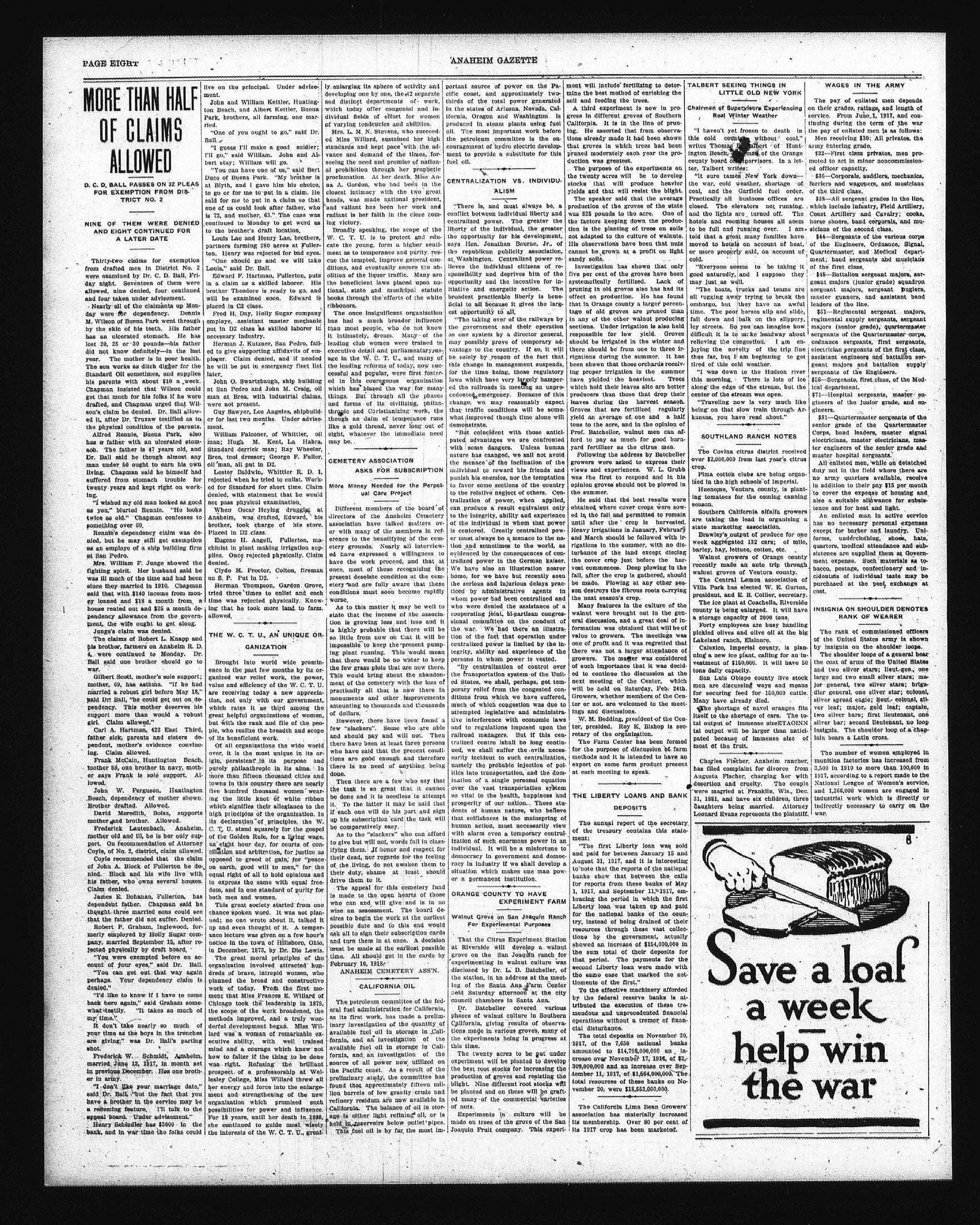
Searchable text
MORE THAN HALF OF CLAIMS ALLOWED
D. C. D. BALL PASSES ON 32 PLEAS FOR EXEMPTION FROM DISTRICT NO. 2
NINE OF THEM WERE DENIED AND EIGHT CONTINUED FOR A LATER DATE
Thirty-two claims for exemption from drafted men in District No. 2 were examined by Dr. C. D. Ball, Friday night. Seventeen of them were allowed, nine denied, four continued and four taken under advisement.
Nearly all of the claimants up Monday were for dependency. Dennis M. Wilson of Buena Park went through by the skin of his teeth. His father has an ulcerated stomach. He has lost 20, 25 or 30 pounds—his father did not know definitely—in the last year. The mother is in poor health. The son works as ditch digger for the Standard Oil sometimes, and supplies his parents with about $10 a week. Chapman insisted that Wilson could get that much for his folks if he were drafted, and Chapman urged that Wilson's claim be denied. Dr. Ball allowed it, after Dr. Truxaw testified as to the physical condition of the parents.
Alfred Rennie, Buena Park, also has a father with an ulcerated stomach. The father is 47 years old, and Dr. Ball said he though almost any live on the principal. Under advise-ment.
John and William Kettler, Huntington Beach, and Albert Kettler, Buena Park, brothers, all farming, one married.
"One of you ought to go," said Dr. Ball.
"I guess I'll make a good soldier; I'll go," said William. John and Albert stay; William will go.
"You can have one of us," said Bert Duce of Buena Park. "My brother is at Blyth, and I gave him his choice, to go or for me to put in a claim. He said for me to put in a claim so that one of us could look after father, who is 73, and mother, 63." The case was continued to Monday to get word as to the brother's draft location.
Louis Lae and Henry Lae, brothers, partners farming 280 acres at Fullerton. Henry was rejected for bad eyes.
"One should go and we will take Louis," said Dr. Ball.
Edward F. Hartman, Fullerton, puts in a claim as a skilled laborer. His brother Theodore is ready to go, and will be examined soon. Edward is placed in C2 class.
Fred H. Day, Holly Sugar company employe, assistant master mechanic put in D2 class as skilled laborer in necessary industry.
Herman J. Kutzner, San Pedro, failed to give supporting affidavits of employer. Claim denied, if needed he will be put in emergency fleet list later.
John O. Swartzbaugh, ship building at San Pedro and John M. Craig, oil man at Brea, with industrial claims, were not present.
Guy Sawyer, Los Angeles, shipbuilder for last two months. Under advise-ment.
William Falconer, of Whittier, oil man; Hugh M. Kent, La Habra, Standard derrick man; Ray Wheeler, Brea tool dresser; George F. Fuller,
Mrs. L. M., ed Miss Will standards and vance and de seeing the need al prohibition proclamation.
na A. Gordon closest intim heads, was r and valiant l radiant is her ing victory.
Broadly spat W. C. T. U., cate the you ment as to te cue the tempi ditions, and o olition of the beneficien tional books through ribboners.
The once has had a than most p it intimately leading club executive det age in the W the leading recessful and p ed in this which has b things. But and forms thropic and though an d like a gold t sight, whatte may be.
The son works in ditch digger for the Standard Oil sometimes, and supplies his parents with about $10 a week. Chapman insisted that Wilson could get that much for his folks if he were drafted, and Chapman urged that Wilson's claim be denied. Dr. Ball allowed it, after Dr. Truxaw testified as to the physical condition of the parents.
Alfred Rennie, Buena Park, also has a father with an ulcerated stomach. The father is 47 years old, and Dr. Ball said he though almost any man under 50 ought to earn his own living. Chapman said he himself had suffered from stomach trouble for twenty years and kept right on working.
"I wished my old man looked as good as you," blurted Rennie. "He looks twice as old." Chapman confesses to something over 60.
Rennie's dependency claim was denied, but he may still get exemption as an employee of a ship building firm at San Pedro.
Mrs. William F. Junge showed the fighting spirit. Her husband said he was ill much of the time and had been since they married in 1910. Chapman said that with $140 income from money loaned and $18 a month from a house rented out and $25 a month dependency allowance from the government, the wife ought to get along.
Junge's claim was denied.
The claims of Robert L. Knapp and his brother, farmers on Anaheim R. D. 4, were continued to Monday. Dr. Ball said one brother should go to war.
Gilbert Scott, mother's sole support; mother, 69, has asthma. "If he had married a robust girl before May 18," said Dr. Ball, "he could get out on dependency. This mother deserves his support more than would a robust girl. Claim allowed."
Carl A. Hartman, 422 East Third, father sick, parents and sisters dependent, mother's evidence convincing. Claim allowed.
Frank McCain, Huntington Beach, mother 59, one brother in navy, mother says Frank is sole support. Allowed.
John W. Ferguson, Huntington Beach, dependency of mother shown. Brother drafted. Allowed.
David Meredith, Bolsa, supports mother and brother. Allowed.
Frederick Lautenbach, Anaheim, mother old and ill, he is her only support. On recommendation of Attorney Coyle, of No. 2, district, claim allowed.
Coyle recommended that the claim of John A. Block of Fullerton he de
THE W. C. T. U., AN UNIQUE ORGANIZATION
Brought into world wide prominence in the past few months by its organized war relief work, the power, value and efficiency of the W. C. T. U. are receiving today a new appreciation, not only with our government, which rates it as third among the great helpful organizations of women, but with the rank and file of the people, who realize the breadth and scope of its beneficial work.
Of all organizations the wide world over, it is the most unique in its origin, persistent in its purpose and purely philanthropic in its aims. In more than fifteen thousand cities and towns in this country there are nearly five hundred thousand women wearing the little knot of white ribbon which signifies their allegiance to the high principles of the organization. In its declaration of principles, the W. C. T. U. stand squarely for the gospel of the Golden Rule, for a lying wage, an eight hour day, for courts of conciliation and arbitration, for justice as opposed to greed of gain, for "peace."
John W. Ferguson, Huntington Beach, dependency of mother shown. Brother drafted. Allowed.
David Meredith, Bolsa, supports mother and brother. Allowed.
Frederick Lautenbach, Anaheim, mother old and ill, he is her only support. On recommendation of Attorney Coyle, of No. 2, district, claim allowed.
Coyle recommended that the claim of John A. Block of Fullerton be denied. Block and his wife live with his father, who owns several houses. Claim denied.
James E. Bohanan, Fullerton, has dependent father. Chapman said he thought three married sons could see that the father did not suffer. Denied.
Robert P. Graham, Inglewood, formerly employed by Holly Sugar company, married September 15, after rejected physically by draft board.
"You were exempted before on account of your eyes," said Dr. Ball.
"You can get out that way again perhaps. Your dependency claim is denied."
"I'd like to know if I have to come back here again," said Graham somewhat testily. "It takes so much of my time."
It don't take nearly so much of your time as the boys in the trenches are giving," was Dr. Ball's parting shot.
Frederick W. Schmidt, Anaheim, married June 12, 1917, in month set in previous December. Has one brother in army.
"I don't like your marriage date," said Dr. Ball, "but the fact that you have a brother in the service may be a redeming feature. I'll talk to the appeal board. Under advisement."
Henry Schindler has $3000 in the bank, and in war time the folks could purely philanthropic in its aims. In more than fifteen thousand cities and towns in this country there are nearly five hundred thousand women wearing the little knot of white ribbon which signifies their allegiance to the high principles of the organization. In its declaration of principles, the W.C.T.U. stand squarely for the gospel of the Golden Rule, for a living wage, an eight hour day, for courts of conciliation and arbitration, for justice as opposed to greed of gain; for "peace on earth, good will to men," for the equal right of all to hold opinions and to express the same with equal freedom, and in one standard of purity for both men and women.
This great society started from one chance spoken word. It was not planned; no one wrote about it, talked it up and even thought of it. A temperance lecture was given on a few hour's notice in the town of Hillsboro, Ohio, in December, 1873, by Dr. Dio Lewis.
The great moral principles of the organization involved attracted hundreds of brave, intrepid women, who planned the broad and constructive work of today. From the first moment that Miss Frances E. Willard of Chicago took the leadership in 1879, the scope of the work broadened, the methods improved, and a truly wonderful development began. Miss Willard was a woman of remarkable executive ability, with well trained mind and a courage which knew not how to falter if the thing to be done was right. Refusing the brilliant prospect of a professorship at Wellesley College, Miss Willard threw all her energy and force into the enlargement and strengthening of the new organization which promised such possibilities for power and influence. For 18 years, until her death in 1898, she continued to guide most wisely the interests of the W.C.T.U., great-
ANAHEIM GAZETTE
ly enlarging its sphere of activity and developing one by one, the 42 separate and distinct departments of work, which today offer congenial and individual fields of effort for women of varying tendencies and abilities.
Mrs. L. M. N. Stevens, who succeeded Miss Willard, sustained her high standards and kept pace with the advance and demand of the times, forseeing the need and promise of national prohibition through her prophetic proclamation. At her death, Miss Anna A. Gordon, who had been in the closest intimacy with the two great heads, was made national president, and valiant has been her work and radiant is her faith in the close coming victory.
Broadly speaking, the scope of the W. C. T. U. is to protect and educate the young, form a higher sentiment as to temperance and purity, rescue the tempted, improve general conditions, and eventually secure the abolition of the liquor traffic. Many are the beneficient laws placed upon national, state and municipal statute books through the efforts of the white ribboners.
The once insignificant organization has had a much broader influence than most people, who do not know it intimately, dream. Many of the leading club women were trained in executive detail and parliamentary usage in the W. C. T. U., and many of the leading reforms of today, now successful and popular, were first fostered in this courageous organization which has blazed the way for many things. But through all the phases and forms of its civilizing, philanthropic and Christianizing work, though an aim of temperance runs like a gold thread, never long out of sight, whatever the immediate need may be.
important source of power on the Pacific coast, and approximately two-thirds of the total power generated in the states of Arizona, Nevada, California, Oregon and Washington is produced in steam plants using fuel oil. The most important work before the petroleum committee is the encouragement of hydro electric development to provide a substitute for this fuel oil.
CENTRALIZATION VS. INDIVIDUALISM
"There is, and must always be, a conflict between individual liberty and centralized power. The greater the liberty of the individual, the greater the opportunity for his development, says Hon. Jonathan Bourne, Jr., of the republican publicity association, at Washington. Centralized power relieves the individual citizens of responsibility and deprives him of the opportunity and the incentive for initiative and energetic action. The broadest practicable liberty is beneficial to all because it gives the largest opportunity to all.
"The taking over of the railways by the government and their operation as one system by a director general, may possibly prove of temporary advantage to the country. If so, it will be solely by reason of the fact that this change in management suspends, for the time being, those regulatory laws which have very largely hampered the railroads in meeting an unprecedented emergency. Because of this change, we may reasonably expect that traffic conditions will be somewhat improved though time alone will demonstrate.
"But coincident with those anticipated advantages we are confronted with some dangers. Unless human nature has canned, we sall not avoid ment will include fertilizing to determine the best method of enriching the soil and feeding the trees.
A third experiment is now in progress in different groves of Southern California. It is in the line of pruning. He asserted that from observations already made it had been shown that groves in which trees had been pruned moderately each year the production was greatest.
The purpose of the experiments on the twenty acres will be to develop stocks that will produce heavier yields and that will resist the blight.
The speaker said that the average production of the groves of the state was 825 pounds to the acre. One of the factors keeping down the production is the planting of trees on soils not adapted to the culture of walnuts. His observations have been that nuts cannot be grown at a profit on light sandy soils.
Investigation has shown that only five per cent of the groves have been systematically fertilized. Lack of pruning in old groves also has had its effect on production. He has found that in Orange county a larger percentage of old groves are pruned than in any of the other walnut producing sections. Under irrigation is also held responsible for low yield. Groves should be irrigated in the winter and there should be from one to three irrigations during the summer. It has been shown that those orchards receiving proper irrigation in the summer have yielded the heaviest. Trees which hold their leaves alte are better producers than those that drop their leaves during the harvest season. Groves that are fertilized regularly yield an average of one and a half tons to the acre, and in the opinion of Prof. Batcheller, walnut men can afford to pay as much for good barnyard fertilizer as the citrus men.
Following the address by Batcheller
CEMETERY ASSOCIATION
ASKS FOR SUBSCRIPTION
More Money Needed for the Perpetual Care Project
Different members of the board of directors of the Anaheim Cemetery association have talked matters over with many of the members in reference to the beautifying of the cemetery grounds. Nearly all interviewed have expressed a willingness to have the work proceed, and that at once, most of these recognizing the present desolate condition at the cemetery and are fully aware that these conditions must soon become rapidly worse.
As to this matter it may be well to state that the income of the association is growing less and less and it is highly probable that there will be so little from now on that it will be impossible to keep the present pumping plant running. This would mean that there would be no water to keep the few grass plots that are now there. This would bring about the abandonment of the cemetery with the loss of practically all that is now there in monuments and other improvements amounting to thousands and thousands of dollars.
However, there have been found a few "slackers". Some who are able and should pay and will not. Then there have been at least three persons who have said that the present conditions are good enough and therefore there is no need of anything being done.
Then there are a few who say that the task is so great that it cannot be done and it is needless to attempt it. To the latter it may be said that if each one will do his part and sign up his subscription card the task will be comparatively easy.
As to the "slackers" who can afford to give but will not, words fall in classifying them. If honor and respect for their dead, nor regards for the feeling of the living, do not awaken them to this change in management suspends, for the time being, those regulatory laws which have very largely hampered the railroads in meeting an unprecedented emergency. Because of this change, we may reasonably expect that traffic conditions will be somewhat improved though time alone will demonstrate.
"But coincident with those anticipated advantages we are confronted with some dangers. Unless human nature has canned, we shall not avoid the menace of the inclination of the individual to reward his friends and punish his enemies, nor the temptation to favor some sections of the country to the relative neglect of others. Centralization of power, when applied, can produce a result equivalent only to the integrity, ability and experience of the individual in whom that power is centered. Greatly centralized power must always be a menace to the nation and sometimes to the world, as evidenced by the consequences of centralized power in the German kaiser. We have also an illustration nearer home, for we have but recently seen the serious and injurious delays practiced by administrative agents in whom power had been centralized and who were denied the assistance of a cooperating joint, bi-partisan congressional committee on the conduct of the war. We had there an illustration of the fact that operation under centralized power is limited by the integrity, ability and experience of the persons in whom power is vested.
"By centralization of control over the transportation system of the United States, we shall, perhaps, get temporary relief from the congested conditions from which we have suffered, much of which congestion was due to attempted legislative and administrative interference with economic laws and to regulations imposed upon the railroad managers. But if this centralized control lshall be long continued, we shall suffer the evils necessarily incident to such centralization, namely the probable injection of politics into transportation, and the domination of a single personal equation over the vast transportation system so vital to the health, happiness and prosperity of our nation. Those students of human nature, who believe that selfishness is the mainspring of human action, must necessarily view with alarm even a temporary centralization of such enormous power in an individual. It will be a misfortune to democracy in government and democracy in industry if we shall develop a been shown that those orchards receiving proper irrigation in the summer have yielded the heaviest. Trees which hold their leaves alte are better producers than those that drop their leaves during the harvest season. Groves that are fertilized regularly yield an average of one and a half tons to the acre, and in the opinion of Prof. Batcheller, walnut men can afford to pay as much for good barnyard fertilizer as the citrus men.
Following the address by Batcheller growers were asked to express their views and experiences. W. L. Grubb was the first to respond and in his opinion groves should not be plowed in the summer.
He said that the best results were obtained where cover crops were sowed in the fall and permitted to remain until after the crop is harvested. Heavy irrigations in January, February and March should be followed with irrigations in the summer, with no disturbance of the land except disclosing the cover crop just before the harvest commences. Deep plowing in the fall, after the crop is gathered, should be made. Plowing at any other season destroys the fibrous roots carrying the next season's crop.
Many features in the culture of the walnut were brought out in the general discussion, and a great deal of information was obtained that will be of value to growers. The meetings was one of profit and it was regretted that there was not a larger attendance of growers. The master was considered of such importance that it was decided to continue the discussion at the next meeting of the Center, which will be held on Saturday, Feb. 24th. Growers, whether members of the Center or not, are welcomed to the meetings and discussions.
W. M. Bedding, president of the Center, presided. Roy K. Bishop is secretary of the organization.
The Farm Center has been formed for the purpose of discussion of farm methods and it is intended to have an export on some farm product present at each meeting to speak.
THE LIBERTY LOANS AND BANK DEPOSITS
The annual report of the secretary of the treasury contains this statement:
"The first Liberty loan was sold and paid for between January 15 and August 31, 1917, and it is interesting
Then there are a few who say that the task is so great that it cannot be done and it is needless to attempt it. To the latter it may be said that if each one will do his part and sign up his subscription card the task will be comparatively easy.
As to the "slackers" who can afford to give but will not, words fall in classifying them. If honor and respect for their dead, nor regards for the feeling of the living, do not awaken them to their duty, shame at least should drive them to it.
The appeal for this cemetery fund is made to the open hearts of those who can and will give and is in no wise an assessment. The board desires to begin the work at the earliest possible date and to this end would ask all to sign their subscription cards and turn them in at once. A decision must be made at the earliest possible time. All should get in the cards by February 10, 1918.
ANAHEIM CEMETERY ASS'N.
CALIFORNIA OIL
The petroleum committee of the federal fuel administration for California, as its first work, has made a preliminary investigation of the quantity of available fuel oil in storage in California, and an investigation of the available fuel oil in storage in California, and an investigation of the source of all power now utilized on the Pacific coast. As a result of the preliminary study, the committee has found that approximately fifteen million barrels of low gravity crude and refinery residuum are now available in California. The balance of oil in storage is either light refining oil, or is held in reservoirs below outlet pipes.
This fuel oil is by far the most im-
at each meeting to speak.
THE LIBERTY LOANS AND BANK DEPOSITS
The annual report of the secretary of the treasury contains this statement:
"The first Liberty loan was sold and paid for between January 15 and August 31, 1917, and it is interesting to note that the reports of the national banks show that between the calls for reports from these banks of May 1, 1917, and September 11, 1917, embracing the period in which the first Liberty loan was taken up and paid for the national banks of the country, instead of being drained of their resources through these vast collections by the government, actually showed an increase of $154,000,000 in the sum total of their deposits for that period. The payments for the second Liberty loan were made with the same ease that marked the settlements of the first."
To the effective machinery afforded by the federal reserve banks is attributed the execution of these tremendous and unprecedented financial operations without a tremor of financial disturbance.
The total deposits on November 20, 1917, of the 7,650 national banks amounted to $14,798,000,000 an increase over November 17, 1916, of $2,309,000,000 and an increase over September 11, 1917, of $1,564,000,000. The total resources of these banks on November 20, were $18,553,000,000.
The California Lima Bean Growers' association has materially increased its membership. Over 80 per cent of its 1917 crop has been marketed.
TALBERT SEEING THINGS IN LITTLE OLD NEW YORK
Chairman of Supervisors Experiencing Real Winter Weather
"I haven't yet frozen to death in this cold county without coal," writes Thomas R. Albert of Huntington Beach, man of the Orange county board of supervisors. In a letter, Talbert writes:
"It sure tames New York down—the war, cold weather, shortage of coal, and the Garfield fuel order. Practically all business offices are closed. The elevators not running and the lights are turned off. The hotels and rooming houses all seem to be full and running over. I am told that a great many families have moved to hotels on account of heat, or more properly said, on account of cold.
"Everyone seems to be taking it good naturedly, and I suppose they may just as well.
"The boats, trucks and teams are all tugging away trying to break the embargo, but they have an awful time. The poor horses slip and slide, fall down and balk on the slippery ice streets. So you can imagine how difficult it is to make headway about relieving the congestion. I am enjoying the novelty of the trip fine thus far, but I am beginning to get tired of this cold weather.
"I was down to the Hudson river this morning. There is lots of ice along the edge of the stream, but the center of the stream was open.
"Traveling now is very much like being on that slow train through Arkansas, you have read about."
SOUTHLAND RANCH NOTES
The Covina citrus district received
WAGES IN THE ARMY
The pay of enlisted men depends on their grades, ratings, and length of service. From June 1, 1917, and continuing during the term of the war the pay of enlisted men is as follows:
Men receiving $30: All privates, the army entering grade.
$33—First class privates, men promoted to act in minor noncommissioned officer capacity.
$36—Corporals, saddlers, mechanics, farriers and wagoners, and musicians of the third class.
$38—All sergeant grades in the line, which include Infantry, Field Artillery, Coast Artillery and Cavalry; cooks, horse shoers, band corporals, and musicians of the second class.
$44—Sergeants of the various corps of the Engineers, Ordnance, Signal, Quartermaster, and Medical department; band sergeants and musicians of the first class.
$48—Battalion sergeant majors, sergeant majors (junior grade) squadron sergeant majors, sergeant buglers, master gunners, and assistant band leaders of the line.
$51—Regimental sergeant majors, regimental supply sergeants, sergeant majors (senior grade), quartermaster sergeants of the Quartermaster corps, ordnance sergeants, first sergeants, electrician sergeants of the first class, assistant engineers and battalion sergeant majors and battalion supply sergeants of the Engineers.
$56—Sergeants, first class, of the Medical department.
$71—Hospital sergeants, master engineers of the junior grade, and engineers.
$81—Quartermaster sergeants of the senior grade of the Quartermaster Corps, band leaders, master signal electricians, master electricians, master engineers of the senior grade and master hospital sergeants.
at those orchards receiv-
gation in the summer
of the heaviest. Trees
are their leaves alte are better
than those that drop their
in the harvest season.
There are fertilized regularly
age of one and a half
time, and in the opinion of
the farmer, walnut men can affarm much for good barning as the citrus men.
The address by Batcheller
asked to express their
interferences. W. L. Grubb
to respond and in his
should not be plowed in
At the best results were
the cover crops were sowand permitted to remain
the crop is harvested.
Onts in January, February
should be followed with irtle summer, with no disthe land except discing
up just before the harries. Deep plowing in the
crop is gathered, should
allow at any other seaname fibrous roots carrying
on's crop.
In the culture of the
brought out in the general, and a great deal of intainment obtained that will be of
others. The meetings was
and it was regretted that
a larger attendance of the mager was considered
attence that it was decide the discussion at the
of the Center, which
on Saturday, Feb. 24th.
Other members of the Cenre welcomed to the meetcussions.
Being president of the CenRoy K. Bishop is secorganization.
Center has been formed
use of discussion of farm
it is intended to have an
the farm product present
to speak.
SOUTHLAND RANCH NOTES
The Covina citrus district received over $2,000,000 from last year's citrus crop.
Pima cotton clubs are being organiz-
ized in the high schools of Imperial.
Hueneeme, Ventura county, is plant-
ing tomatoes for the coming canning season.
Southern California alfalfa growers
are taking the lead in organizing a state marketing association.
Brawley's output of produce for one week aggregated 132 cars; of milo,
barley, hay, lettuce, cotton, etc.
Walnut growers of Orange county recently made an auto trip through
walnut groves of Ventura county.
The Central Lemon association of Villa Park has elected W. E. Gurton,
president, and E. B. Collier, secretary.
The ice plant at Coachella, Riverside county is being enlarged. It will have a storage capacity of 2000 tons.
Forty employees are busy handling pickled olives and olive oil at the big Lakeland ranch, Elsinore.
Calexico, Imperial county, is plan-
ning a new ice plant, calling for an investment of $150,000. It will have 50 tons daily capacity.
San Luis Obispo county live stock men are discussing ways and means for securing feed for 150,000 cattle. Many have already died.
The shortage of navel oranges fits itself to the shortage of cars. The total output of immense sizeETAOINN output will be larger than anticipated because of immense size of most of the fruit.
Charles Fischer, Anaheim rancher,
has filed complaint for divorce from Augusta Fischer, charging her with desertion and cruelty. The couple were married at Franklin, Wis., Dec.
31, 1881, and have six children, three daughters being married. Attorney Leonard Evans represents the plaintiff.
The rank of commissioned officers
of the United States army is shown by insignia on the shoulder loops.
The shoulder loops of a general bear
the coat of arms of the United States and two silver stars; lieut.-gen., one large and two small silver stars; major general, two silver stars; brigadier general, one silver star; colonel, silver spread eagle; lieut.-colonel, silver leaf; major, gold leaf; captain, two silver bars; first lieutenant, one silver bar; second lieutenant, no loop insignia. The shoulder loop of a chap-
lain bears a Latin cross.
The number of women employed in munition factories has increased from 3,500 in 1910 to more than 100,000 in 1917, according to a report made to the National League of Women's service,
and 1,266,000 women are engaged in industrial work which is directly or indirectly necessary to carry on the war.
Save a loaf
a week
help win
the war