anaheim-gazette 1918-01-03
Scanned page
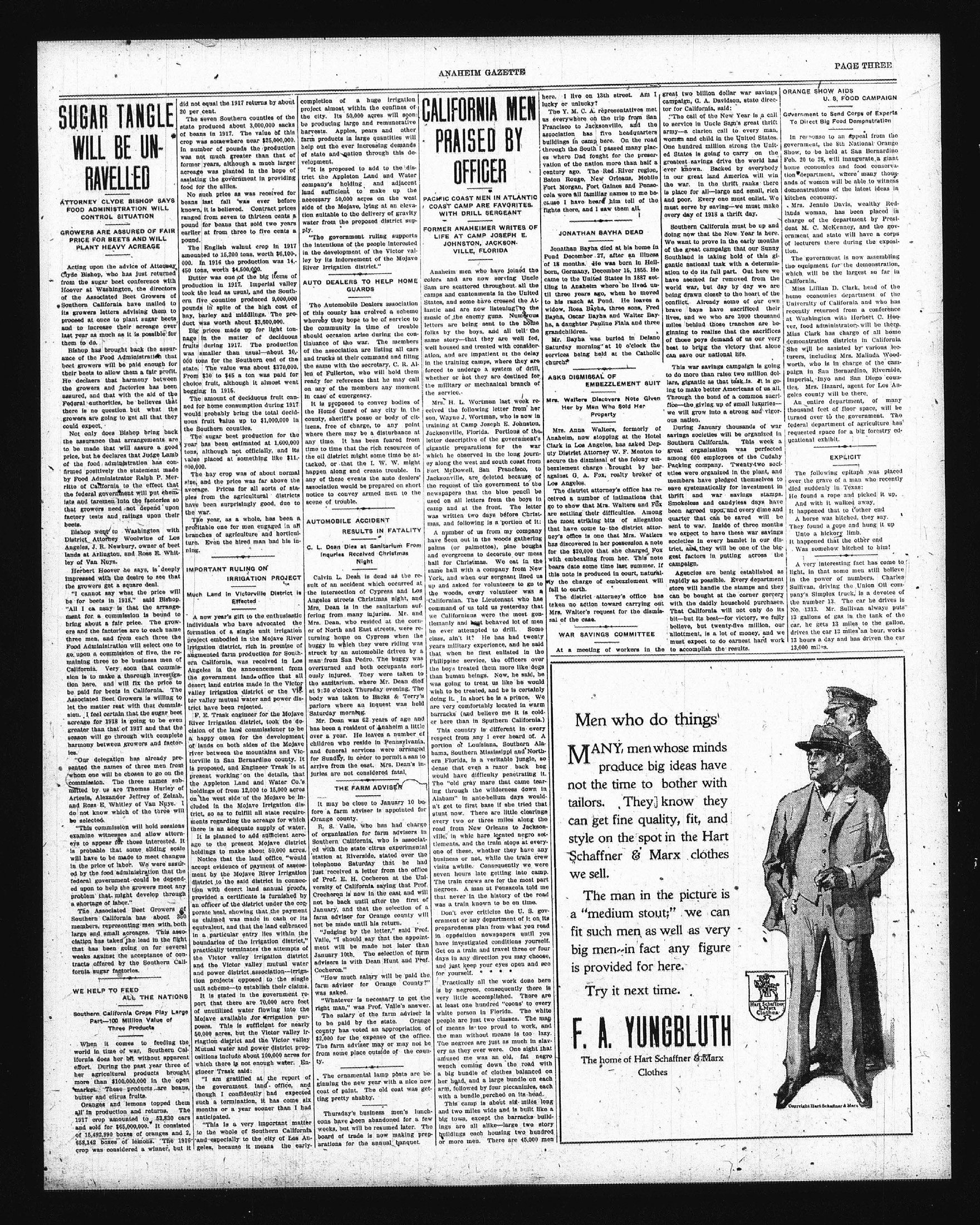
Searchable text
SUGAR TANGLE
WILL BE UN-RAVELLED
ATTORNEY CLYDE BISHOP SAYS
FOOD ADMINISTRATION WILL CONTROL SITUATION
GROWERS ARE ASSURED OF FAIR PRICE FOR BEETS AND WILL PLANT HEAVY ACREAGE
Acting upon the advice of Attorney Clyde Bishop, who has just returned from the sugar beet conference with Hoover at Washington, the directors of the Associated Beet Growers of Southern California have mailed to its growers letters advising them to proceed at once to plant sugar beets and to increase their acreage over last year as much as it is possible for them to do.
Bishop has brought back the assurance of the Food Administration that beet growers will be paid enough for their beets to allow them a fair profit. He declares that harmony between the growers and factories has been assured, and that with the aid of the Federal authorities, he believes that there is no question but what the growers are going to get all that they could expect.
Not only does Bishop bring back the assurance that arrangements are to be made that will assure a good price, but he declares that Judge Lamb did not equal the 1917 returns by about 20 per cent.
The seven Southern counties of the state produced about 3,000,000 sacks of beans in 1917. The value of this crop was somewhere near $25,000,000. In number of pounds the production was not much greater than that of former years, although a much larger acreage was planted in the hope of assisting the government in providing food for the allies.
No such price as was received for beans last fall was ever before known, it is believed. Contract prices ranged from seven to thirteen cents a pound for beans that sold two years earlier at from three to five cents a pound.
The English walnut crop in 1917 amounted to 15,200 tons, worth $6,100,-000. In 1916 the production was 14,-450 tons, worth $4,500,000.
Butter was one of the big items of production in 1917. Imperial valley took the lead as usual, and the Southern five counties produced 9,000,000 pounds in spite of the high cost of hay, barley and middlings. The product was worth about $3,600,000.
Big prices made up for light tonnage in the matter of deciduous fruits during 1917. The production was smaller than usual—about 10,-000 tons for the Southern end of the state. The value was about $370,000. From $30 to $45 a ton was paid for choice fruit, although it almost went begging in 1915.
The amount of deciduous fruit canned for home consumption during 1917 would probably bring the total deciduous fruit value up to $1,000,000 in the Southern counties.
The sugar beet production for the year has been estimated at 1,600,000 tons, although not officially, and its completion of a project almost within the city. Its 50,000 acres produce large harvests. Apples, peanuts farm products in large help out the ever increasing state and nation development.
"It is proposed to district the Appleton L company's holding land sufficient to necessary 50,000 acres side of the Mojave, location suitable to the dewater from the property."
"The government intends to the intentions of the county by its Indorsement River Irrigation district."
AUTO DEALERS TO GUARD
The Automobile Department of this county has enlisted whereby they hope to maintain the community in should occasion arise tenuance of the war of the association and and trucks at their coats the same with the seals of Fullerton, which ready for reference on any of the members in case of emergency.
It is proposed to hire the Home Guard of this county, sheriff's positsizens, free of charge where there may be any time. It has little time to time that the oil district might
beet growers will be paid enough for their beets to allow them a fair profit. He declares that harmony between the growers and factories has been assured, and that with the aid of the Federal authorities, he believes that there is no question but what the growers are going to get all that they could expect.
Not only does Bishop bring back the assurance that arrangements are to be made that will assure a good price, but he declares that Judge Lamb of the food administration has confirmed positively the statement made by Food Administrator Ralph P. Merritte of California to the effect that the federal government will put chemists and taremen into the factories so that growers need not depend upon factory tests and ratings upon their beets.
Bishop went to Washington with District Attorney Woolwine of Los Angeles, J. R. Newbury, owner of beet lands at Arlington, and Ross E. Whitley of Van Nuys.
Herbert Hoover he says, is deeply impressed with the desire to see that the growers get a square deal.
"I cannot say what the price will be for beets in 1918," said Bishop. "All I can say is that the arrangement for a commission is bound to bring about a fair price. The growers and the factories are to each name three men, and from each three the Food Administration will select one to go, upon a commission of five, the remaining three to be business men of California. Very soon that commission is to make a thorough investigation here, and will fix the price to be paid for beets in California. The Associated Beet Growers is willing to let the matter rest with that commission. I feel certain that the sugar beet acreage for 1918 is going to be even greater than that of 1917 and that the season will go through with complete harmony between growers and factories."
"Our delegation has already presented the names of three men from whom one will be chosen to go on the commission. The three names submitted by us are Thomas Hurley of Artesia, Alexander Jeffrey of Zeilzah, and Ross E. Whitley of Van Nuys. I do not know which of the three will be selected."
"This commission will hold sessions examine witnesses and allow attorneys to appear for those interested. It is probable that some sliding scale will have to be made to meet changes in the price of labor. We were assur-
IMPORTANT RULING ON IRRIGATION PROJECT
Much Land In Victorville District is Effected
A new year's gift to the enthusiastic individuals who have advocated the formation of a single unit irrigation project embodied in the Mojave River Irrigation district, rich in promise of augmented farm production for Southern California, was received in Los Angeles in the announcement from the government land office that all desert land entries made in the Victor valley irrigation district or the Victor valley mutual water and power district have been rejected.
F. E. Trask engineer for the Mojave River Irrigation district, took the decision of the land commissioner to be a happy omen for the development of lands on both sides of the Mojave river between the mountains and Victorville in San Bernardino county. It is proposed, and Engineer Trask is at present working on the details, that the Appleton Land and Water Co.'s holdings of from 12,000 to 15,000 acres on the west side of the Mojave be included in the Mojave Irrigation district, so as to fulfill all state requirements regarding the acreage for which there is an adequate supply of water.
It is planned to add sufficient acreage to the present Mojave district holdings to make about 50,000 acres.
Notice that the land office "would accept evidence of payment of assess-
CALVIN L. DEAH is sult of an accident at the intersection of Angeles streets Ch Mrs. Dean is in thering from many Mrs. Dean, who reefer of North and East turning home on buggy in which ther struck by an automan from San Ped overturned and bousily injured. Ther sanitarium. wht at 9:30 o'clock Thu body was taken to parlors where an Saturday morning.
Mr. Dean was 62 has been a resident over a year. He children who reside and funeral service for Sunday, in order arrive from the east juries are not com-
THE FAR
It may be close fore a farm adviser Orange county.
R. S. Valle, ww of organization for Southern Californied with the state station at Riversi telephone Satur
The three names submitted by us are Thomas Hurley of Artesia, Alexander Jeffrey of Zelzah, and Ross E. Whitley of Van Nuys. I do not know which of the three will be selected.
"This commission will hold sessions examine witnesses and allow attorneys to appear for those interested. It is probable that some sliding scale will have to be made to meet changes in the price of labor. We were assured by the food administration that the federal government could be dependent upon to help the growers meet any problem that might develop through a shortage of labor."
The Associated Beet Growers of Southern California has about 350 members, representing men with both large and small acreages. This association has taken the lead in the fight that has been going on for several weeks against the acceptance of contracts offered by the Southern California sugar factories.
WE HELP TO FEED
ALL THE NATIONS
Southern California Crops Play Large Part—100 Million Value of Three Products
When it comes to feeding the world in time of war, Southern California does her bit without apparent effort. During the past year three of her agricultural products brought more than $100,000,000 in the open market. These products are beans, butter and citrus fruits.
Oranges and lemons topped them all in production and returns. The 1917 crop amounted to 63,830 cars and sold for $65,000,000. It consisted of 15,492,990 boxes of oranges and 2,658,142 boxes of lemons. The 1916 crop was considered a winner, but it is proposed, and engineer Tom is present working on the details, that the Appleton Land and Water Co.'s holdings of from 12,000 to 15,000 acres on the west side of the Mojave be included in the Mojave Irrigation district, so as to fulfill all state requirements regarding the acreage for which there is an adequate supply of water.
It is planned to add sufficient acreage to the present Mojave district holdings to make about 50,000 acres.
Notice that the land office "would accept evidence of payment of assessment by the Mojave River Irrigation district to the said district in connection with desert land annual proofs, provided a certificate is furnished by an officer of the district under the corporate seal, showing that the payment as claimed was made in cash or its equivalent, and that the land embraced in a particular entry lies within the boundaries of the irrigation district," practically terminates the attempts of the Victor valley irrigation district and the Victor valley mutual water and power district association—irrigation projects opposed to the single unit scheme—to establish their claims.
It is stated in the government report that there are 70,000 acre feet of unutilized water flowing into the Mojave available for irrigation purposes. This is sufficient for nearly 50,000 acres, but the Victor valley irrigation district and the Victor valley Mutual water and power district propositions include about 100,000 acres for which there is not enough water. Engineer Trask said:
"I am gratified at the report of the government land office, and though I confidently had expected such a termination, it has come six months or a year sooner than I had anticipated.
"This is a very important matter to the whole of Southern California and especially to the city of Los Angeles, because it means the early-juries are not complete."
It may be closed fore a farm adviser Orange county.
R. S. Valle, who of organization for Southern California ed with the state station at Riverside telephone Saturday just received a letter of Prof. E. H. C. university of California Crocheron is now not back until January, and that farm adviser for not be made until "Judging by the Valle, "I should ment will be m January 10th. T advisers is with Cocheron."
"How much sa farm adviser for was asked.
"Whatever is right man," was The salary of to be paid by county has voted $2,000 for the e The farm adviser from some place ty.
The ornamental ginning the new coat of paint. T ting pretty shabby Thursday's bu reeons have been weeks, but will b board of trade arations for th
ANAHEIM GAZETTE
completion of a huge irrigation project almost within the confines of the city. Its 50,000 acres will soon be producing large and remunerative harvests. Apples, pears and other farm products in large quantities will help out the ever increasing demands of state and nation through this development.
"It is proposed to add to the district the Appleton Land and Water company's holding and adjacent land sufficient to make up the necessary 50,000 acres on the west side of the Mojave, lying at an elevation suitable to the delivery of gravity water from the proposed district supply.
"The government ruling supports the intentions of the people interested in the development of the Victor valley by its indorsement of the Mojave River Irrigation district."
AUTO DEALERS TO HELP HOME GUARDS
The Automobile Dealers association of this county has evolved a scheme whereby they hope to be of service to the community in time of trouble should occasion arise during the continuance of the war. The members of the association are listing all cars and trucks at their command and filling the same with the secretary, C. R. Allen of Fullerton, who will hold them ready for reference that he may call on any of the members any moment in case of emergency.
It is proposed to convey bodies of the Home Guard of any city in the county, sheriff's posse or body of citizens, free of charge, to any point where there may be a disturbance at any time. It has been feared from time to time that the rich resources of the oil district might some time be at
CALIFORNIA MEN PRAISED BY OFFICER
PACIFIC COAST MEN IN ATLANTIC COAST CAMP ARE FAVORITES WITH DRILL SERGEANT
FORMER ANAHEIMER WRITES OF LIFE AT CAMP JOSEPH E. JOHNSTON, JACKSON-VILLE, FLORIDA
Anaheim men who have joined the colors and are now serving Uncle Sam are scattered throughout all the camps and cantonments in the United States, and some have crossed the Atlantic and are now listening to the music of the enemy guns. Numerous letters are being sent to the home folks by the boys, and all tell the same story—that they are well fed, well housed and treated with consideration, and are impatient at the delay in the training camps, where they are forced to undergo a system of drill, whether or not they are destined for the military or mechanical branch of the service.
Mrs. H. L. Wortman last week received the following letter from her son, Wayne J. Wortman, who is now in training at Camp Joseph E. Johnston, Jacksonville, Florida. Portions of the letter descriptive of the government's gigantic preparations for the war which he observed in the long journere.
I live on 13th street. Am I lucky or unlucky?
The Y. M. C. A. representatives met us everywhere on the trip from San Francisco to Jacksonville, and the association has five headquarters buildings in camp here. On the road through the South I passed many places where Dad fought for the preservation of the nation more than half a century ago. The Red River region, Baton Rouge, New Orleans, Mobile Fort Morgan, Fort Gaines and Penscola were all familiar names to me because I have heard him tell of the fights there, and I saw them all.
JONATHAN BAYHA DEAD
Jonathan Bayha died at his home in Pond December 27, after an illness of 18 months. He was born in Hellborn, Germany, December 15, 1855. He came to the United States in 1887 settling in Anaheim where he lived until three years ago, when he moved to his ranch at Pond. He leaves a widow, Rosa Bayha, three sons, Fred Bayha, Oscar Bayha and Walter Bayha, a daughter Pauline Flala and three grandchildren.
Mr. Bayha was buried in Delano Saturday morning at 10 o'clock the services being held at the Catholic church.
ASKS DISMISSAL OF EMBEZZLEMENT SUIT
Mrs. Walters Discovers Note Given Her by Man Who Sold Her Property
Mrs. Anna Walters, formerly of Anaheim, now stopping at the Hotel Clark in Los Angeles, has asked Deputy District Attorney W. F. Menton to great two campaign toror for California.
The canto service army—a women and One hundred States greatest sage ever known in our grief war. It is place for fear and poor must serve every day.
Southern doing now We want to of the great Southland gantic nation to do have seen world being conflict brave lives, and miles being gaining of those beat to beat can save.
During savings Southern great c
AUTOMOBILE ACCIDENT
RESULTS IN FATALITY
C. L. Dean Dies at Sanitarium From Inquiries Received Christmas Night
Calvin L. Deah is dead as the result of an accident which occurred at the intersection of Cypress and Los Angeles streets Christmas night, and Mrs. Dean is in the sanitarium suffering from many injuries. Mr. and Mrs. Dean, who resided at the corner of North and East streets, were returning home on Cypress when the buggy in which they were riding was struck by an automobile driven by a man from San Pedro. The buggy was overturned and both occupants seriously injured. They were taken to the sanitarium where Mr. Dean died at 9:30 o'clock Thursday evening. The body was taken to Backs & Terry's parlors where an inquest was held Saturday morning.
Mr. Dean was 62 years of age and has been a resident of Anaheim a little over a year. He leaves a number of children who reside in Pennsylvania, and funeral services were arranged for Sunday, in order to permit a san to arrive from the east. Mrs. Dean's injuries are not considered fatal.
THE FARM ADVISER
It may be close to January 10 before a farm adviser is appointed for Orange county.
R. S. Valle, who has had charge of organization for farm advisers in Southern California, who is associated with the state citrus experimental station at Riverside, stated over the telephone Saturday that he had
in the training camps, where they are forced to undergo a system of drill, whether or not they are destined for the military or mechanical branch of the service.
Mrs. H. L. Wortman last week received the following letter from her son, Wayne J. Wortman, who is now in training at Camp Joseph E. Johnston, Jacksonville, Florida. Portions of the letter descriptive of the government's gigantic preparations for the war which he observed in the long journey along the west and south coast from Fort McDowell, San Francisco, to Jacksonville, are deleted because of the request of the government to the newspapers that the blue pencil be used on all letters from the boys in camp and at the front. The letter was written two days before Christmas, and following is a portion of it:
A number of us from my company have been out in the woods gathering palms (or palmettos), pine boughs and evergreens to decorate our mess hall for Christmas. We eat in the same hall with a company from New York, and when our sergeant lined us up and asked for volunteers to go to the woods, every volunteer was a Californian. The Lieutenant who has command of us told us yesterday that we Californians were the most gentlemenly and most behaved lot of men he ever attempted to drill. Some class, ain't it? He has had twenty years military experience, and he said that when he first enlisted in the Philippine service, the officers over the boys treated them more like dogs than human beings. Now, he said, he was going to treat us like he would wish to be treated, and he is certainly doing it. In short he is a prince. We are very comfortably located in warm barracks (and believe me it is colder here than in Southern California.) This country is different in every respect from any I ever heard of. A portion of Louisiana, Southern Alabama, Southern Mississippi and Northern Florida, is a veritable jungle, so dense that even a razor back hog would have difficulty penetrating it. The "old gray mare that came tearing through the wilderness down in Alabama" in ante-bellum days wouldn't get to first base if she tried that stunt now. There are little clearings every two or three miles along the road from New Orleans to Jacksonville, in whichear located negro settlements, and the train stops at everyone of these, whether they have any business or not, while the train crew visits while Consequently we were
Men who do this
MANY men whose produce big ideas not the time to bother tailors. They know can get fine quality, fine style on the spot in the Schaffner & Marx office
During savings among Packing eties were members save system thrift Smokeeleven been aggrieved sent to we expect societies trict, and gest face campaign
Agency rapidly store which can be be with That Cabbit—but believe, allotment must ex-
IT may be close to January 10 before a farm adviser is appointed for Orange county.
R. S. Valle, who has had charge of organization for farm advisers in Southern California, who is associated with the state citrus experimental station at Riverside, stated over the telephone Saturday that he had just received a letter from the office of Prof. E. H. Cocheron at the University of California saying that Prof. Crocheron is now in the east and will not be back until after the first of January, and that the selection of a farm adviser for Orange county will not be made until his return.
"Judging by the letter," said Prof. Valle, "I should say that the appointment will be made not later than January 10th. The selection of farm advisers is with Dean Hunt and Prof. Crocheron."
"How much salary will be paid the farm adviser for Orange County?" was asked.
"Whatever is necessary to get the right man," was Prof. Valle's answer.
The salary of the farm adviser is to be paid by the state. Orange county has voted an appropriation of $2,000 for the expense of the office. The farm adviser may or may not be from some place outside of the county.
The ornamental lamp posts are beginning the new year with a nice new coat of paint. The old coat was getting pretty shabby.
Thursday's business men's luncheons have been abandoned for a few weeks, but will be resumed later. The board of trade is now making preparations for the annual banquet.
The "old gray mare that came tearing through the wilderness down in Alabama" in ante-bellum days wouldn't get to first base if she tried that stunt now. There are little clearings every two or three miles along the road from New Orleans to Jacksonville, in whiche hare located negro settlements, and the train stops at everyone of these, whether they have any business or not, while the train crew visits awhile. Consequently we were seven hours late getting into camp. The train crews are for the most part negroes. A man at Pensacola told me that never in the history of the road was a train known to be on time.
Don't ever criticize the U.S. government or any department of it on its preparedness plan from what you read in opposition newspapers until you have investigated conditions yourself. Get on a train and travel three or four days in any direction you may choose, and just keep your eyes open and see for yourself.
Practically all the work done here is by negroes, consequently there is very little accomplished. There are at least one hundred "coons' to every white person in Florida. The white people are just two classes. The map of means is too proud to work, and the man without means is too lazy. The negroes are just as much in slavery as they ever were. One sight that amused me was an old, fat negro wench coming down the road with a big bundle of clothes balanced on her head, and a large bundle on each arm, followed by four piccaninies, each with a bundle perched on its head.
This camp is about six miles long and two miles wide and is built like a big town, except the barracks buildings are all alike—large two story buildings each housing two hundred or more men. There are 45,000 men
PAGE THREE
ORANGE SHOW AIDS
U. S. FOOD CAMPAIGN
Government to Send Corps of Experts To Direct Big Food Demonstration
In response to an appeal from the government, the 8th National Orange Show, to be held at San Bernardino Feb. 20 to 28, will inaugurate a giant home economies and food conservation department, where many thousands of women will be able to witness demonstrations of the latest ideas in kitchen economy.
Mrs. Jennie Davis, wealthy Redlands woman, has been placed in charge of the department by President M. C. McKenney, and the government and state will have a corps of lecturers there during the exposition.
The government is now assembling the equipment for the demonstration, which will be the largest so far in California.
Miss Lillian D. Clark, head of the home economics department of the University of California and who has recently returned from a conference at Washington with Herbert C. Hoover, food administrator, will be there. Miss Clark has charge of all home demonstration districts in California. She will be assisted by various lecturers, including Mrs. Malinda Woodworth, who is in charge of the campaign in San Bernardino, Riverside, Imperial, Inyo and San Diego counties. Mrs. Hazard, agent for Los Angeles county will be there.
An entire department, of many thousand feet of floor space, will be turned over to the government. The federal department of agriculture has requested space for a big forestry educational exhibit.
This war savings campaign is going to do more than raise two million dollars, gigantic as that task is. It is going to make better Americans of us all. Through the bond of a common sacrifice—the giving up of small luxuries—we will grow into a strong and vigorous nation.
During January thousands of war savings societies will be organized in Southern California. This week a great organization was perfected among 600 employees of the Cudahy great two billion dollar war savings campaign, G. A. Davidson, state director for California, said:
"The call of the New Year is a call to service in Uncle Sam's great thrift army—a clarion call to every man, woman and child in the United States. One hundred million strong the United States is going to carry on the greatest savings drive the world has ever known. Backed by everybody in our great land America will win the war. In the thrift ranks there is place for all—large and small, rich and poor. Every one must enlist. We must serve by saving—we must make every day of 1918 a thrift day."
Southern California must be up and doing now that the New Year is here. We want to prove in the early months of the great campaign that our Sunny Southland is taking hold of this gigantic national task with a determination to do its full part. Out here we have seemed far removed from the world war, but day by day we are being drawn closer to the heart of the conflict. Already some of our own brave bays have sacrificed their lives, and we who are 3000 thousand miles behind those tranches are beginning to realize that the sacrifices of those poys demand of us our very beat to bring the victory that alone can save our national life.
Explicit
This war savings campaign is going to do more than raise two million dollars, gigantic as that task is. It is going to make better Americans of us all. Through the bond of a common sacrifice—the giving up of small luxuries—we will grow into a strong and vigorous nation.
During January thousands of war savings societies will be organized in Southern California. This week a great organization was perfected among 600 employees of the Cudahy Packing company. Twenty-two societies were organized in the plant, and members have pledged themselves to save systematically for investment in thrift and war savings stamps. Smokeless and candyless days have been agreed upon, and every dime and quarter that can be saved will be sent to war. Inside of three months we expect to have these war savings societies in every hamlet in our district, and they will be one of the biggest factors in putting across the campaign.
Agencies are benig established as rapidly as possible. Every department store will handle the stamps and they can be bought at the corner gorcery with the daidly household purchases. That California will not only do its bit—but its best—for victory, we fully believe, but twenty-five million, our allotment, is a lot of money, and we must expect to do earnest hard work to accomplish the results.
An entire department, of many thousand feet of floor space, will be turned over to the government. The federal department of agriculture has requested space for a big forestry educational exhibit.
EXPLICIT
The following epitaph was placed over the grave of a man who recently died suddenly in Texas:
He found a rope and picked it up,
And with it walked away.
It happened that to other end
A horse was hitched, they say.
They found a rope and hung it up
Unto a hickory limb.
It happened that the other end
Was somehow hitched to him!
A very interesting fact has come to light, in that some men still believe in the power of numbers. Charles Sullivan, driving the Union Oil company's Simplex truck, is a devotee of the number 13. The car he drives is No. 1313. Mr. Sullivan always puts 13 gallons of gas in the tank of the car, he gets 13 miles to the gallon, drives the car 13 miles an hour, works 13 hours a day and has driven the car 13,000 miles.
time to bother with
They] know they
fine quality, fit, and
the spot in the Hart
er & Marx clothes
man in the picture is
um stout;" we can
men as well as very
in fact any figure
ded for here.
it next time.
YUNGBLUTH
name of Hart Schaffner & Marx
Clothes
Copyright Hart Schaffner & Marx