anaheim-gazette 1918-01-03
Scanned page
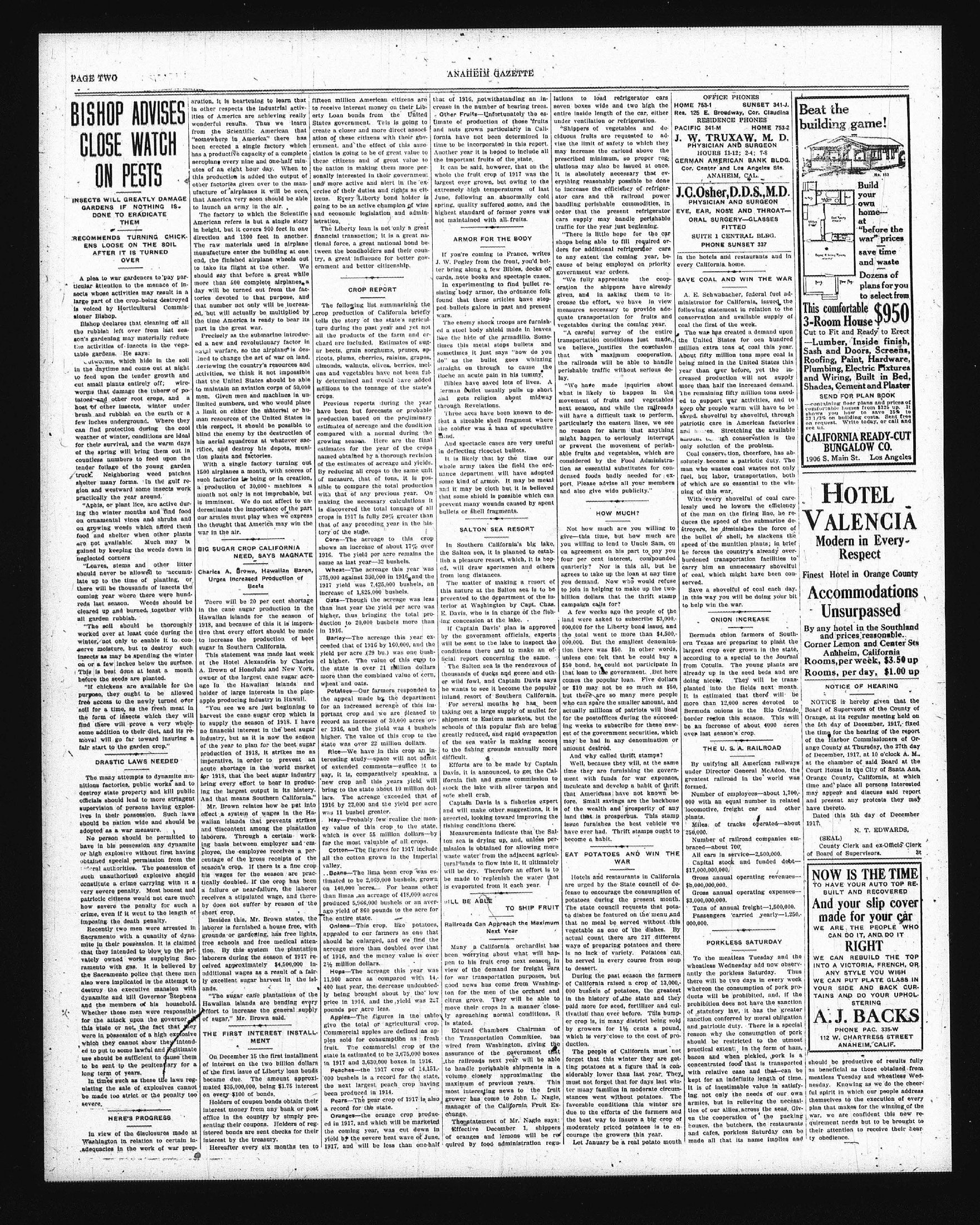
Searchable text
BISHOP ADVISES
CLOSE WATCH
ON PESTS
INSECTS WILL GREATLY DAMAGE
GARDENS IF NOTHING IS
DONE TO ERADICATE
THEM
RECOMMENDS TURNING CHICKENS LOOSE ON THE SOIL AFTER IT IS TURNED OVER
A plea to war gardeners to pay particular attention to the menace of insects whose activities may result in a large part of the crop-being destroyed is voiced by Horticultural Commissioner Bishop.
Bishop declares that cleaning off all the rubbish left over from last season's gardening may materially reduce the activities of insects in the vegetable gardens. He says:
Cutworms, which hide in the soil in the daytime and come out at night to feed upon the tender growth and cut small plants entirely off; wireworms that damage the tubers of potatoes and other root crops, and a host of other insects, winter under brush and rubbish on the earth or a few inches underground. Where they can find protection during the cool weather of winter, conditions are ideal for their survival, and the warm days of the spring will bring them out in arboration, it is heartening to learn that in other respects the industrial activities of America are achieving really wonderful results. Thus we learn from the Scientific American that "somewhere in America" there has been erected a single factory which has a productive capacity of a complete aeroplane every nine and one-half minutes of an eight hour day. When to this production is added the output of other factories given over to the manufacture of airplanes it will be seen that America very soon should be able to launch an army in the air.
The factory to which the Scientific American refers is but a single story in height, but it covers 900 feet in one direction and 1300 feet in another. The raw materials used in airplane manufacture enter the building at one end, the finished airplane wheels out to take its flight at the other. We should say that before a great while more than 500 complete airplanes a day will be turned out from the factories devoted to that purpose, and that number not only will be increased, but will actually be multiplied by the time America is ready to bear its part in the great war.
Precisely as the submarine introduced a new and revolutionary factor in naval warfare, so the airplane is designed to change the art of war on land. Reviewing the country's resources and activities, we think it not impossible that the United States should be able to maintain an aviation corps of 50,000 men. Given men and machines in unlimited numbers, and who would place a limit on either the material or human resources of the United States in this respect, it should be possible to blind the enemy by the destruction of his aerial squadrons at whatever sacrifice, and destroy his depots, munition plants and factories.
fifteen million Arms to receive interest Loan bonds States government create a closer association of these citizens and the nation in making sonally interested and more active exercise of their duties. Every Liberty going to be an act and economic legislation.
The Liberty loan financial transactionional force, a great tween the bondho try, a great influenment and bett
Outworms, which hide in the soil in the daytime and come out at night to feed upon the tender growth and cut small plants entirely off; wireworms that damage the tubers of potatoes and other root crops, and a host of other insects, winter under brush and rubbish on the earth or a few inches underground. Where they can find protection during the cool weather of winter, conditions are ideal for their survival, and the warm days of the spring will bring them out in countless numbers to feed upon the tender foliage of the young garden truck. Neighboring weed patches shelter many forms. In the gulf region and westward some insects work practically the year around.
"Aphis, or plant lice, are active during the winter months and find food on ornamental vines and shrubs and on growing weeds which afford them food and shelter when other plants are not available. Much may be gained by keeping the weeds down in neglected corners.
"Leaves, stems and other litter should never be allowed to accumulate up to the time of planting, or there will be thousands of insects the coming year where there were hundreds last season. Weeds should be cleared up and burned, together with all garden rubbish.
"The soil should be thoroughly worked over at least once during the winter, not only to enable it to conserve moisture, but to destroy such insects as may be spending the winter on or a few inches below the surface. This is best done at least a month before the seeds are planted.
"If chickens are available for the purpose, they ought to be allowed free access to the newly turned over soil for a time, as the fresh meat in the form of insects which they will find there will prove a very wholesome addition to their diet, and its removal will go far toward insuring a fair start to the garden crop."
DRASTIC LAWS NEEDED
The many attempts to dynamite munitions factories, public works and to destroy state property and kill public officials should lead to more stringent supervision of persons having explosives in their possession. Such laws should be nation wide and should be adopted as a war measure.
No person should be permitted to have in his possession any dynamite or high explosive without first having obtained special permission from the BIG SUGAR CROP CALIFORNIA NEED, SAYS MAGNATE
Charles A. Brown, Hawaiian Baron, Urges Increased Production of Beets
There will be 20 per cent shortage in the cane sugar production in the Hawaiian islands for the season of 1918, and because of this it is imperative that every effort should be made to increase the production of beet sugar in Southern California.
This statement was made last week at the Hotel Alexandria by Charles A. Brown of Hondululu and New York, owner of the largest cane sugar acreage in the Hawaiian islands and holder of large interests in the pineapple producing industry in Hawaii.
"You see we are just beginning to harvest the cane sugar crop which is to supply the season of 1918. I have no financial interest in the beet sugar industry, but as it is now the season of the year to plan for the beet sugar production of 1918, it strikes me as imperative, in order to prevent an acute shortage in the world market for 1918, that the beet sugar industry bring every effort to bear in producing the largest output in its history. And that means Southern California."
Mr. Brown relates how he put into effect a system of wages in the Hawaiian islands that prevents strikes and discontent among the plantation laborers. Through a certain working basis between employer and employee, the employee receives a percentage of the gross receipts of the company.
Previous reports have been but production based estimates of acres compared with growing seasons. Estimates for named obtained of the estimates. By reducing all of measure, this able to compare with that of any making the need is discovered that crops in 1917 is that of any precursor of the stage.
Corn—The acetyl shows an increase 1916. The yield same as last year.
Wheat—The 375,000 against 1917 yield was increase of 1,832.
Oats—Though than last year higher, thus buildup to 20,000 in 1916.
Barley—Theceeded that of 1917 yield per acre el higher. The state is one more than the o wheat and oats.
Potatoes—Our appeal may for an increase portant crop and record an increase 1916, and the higher. The var state was over.
Rice—We have interesting study of extended say, it is, common new crop and bring to the staars. The acer 1916 by 22,000 was 11 bushels.
Hay—Probably value of which is over far the most w cotton—The all the cotton valley.
The many attempts to dynamite munitions factories, public works and to destroy state property and kill public officials should lead to more stringent supervision of persons having explosives in their possession. Such laws should be nation wide and should be adopted as a war measure.
No person should be permitted to have in his possession any dynamite or high explosive without first having obtained special permission from the federal authorities. The possession of such unauthorized explosive should constitute a crime carrying with it a very severe penalty. Most honest and patriotic citizens would not care much how severe the penalty for such a crime, even if it went to the length of imposing the death penalty.
Recently two men were arrested in Sacramento with a quantity of dynamite in their possession. It is claimed that they intended to blow up the privately owned works supplying Sacramento with gas. It is believed by the Sacramento police that these men also were implicated in the attempt to destroy the executive mansion with dynamite and kill Governor Stephens and the members of his household. Whether these men were responsible for the attack upon the governor or this state or not, the fact that they were in possession of a high explosive which they cannot show they intended to put to some lawful and legitimate use should be sufficient to cause them to be sent to the penitentiary for a long term of years.
In times such as these the laws regulating the sale of explosives cannot be made too strict or the penalty too severe.
HERE'S PROGRESS
In view of the disclosures made at Washington in relation to certain inadequacies in the work of war preparation, Mr. Brown relates how he put into effect a system of wages in the Hawaiian islands that prevents strikes and discontent among the plantation laborers. Through a certain working basis between employer and employee, the employee receives a percentage of the gross receipts of the season's crop. If there is a fine crop his wages for the season are practically doubled. If the crop has been a failure or near-failure, the laborer receives a stipulated wage, and thereby does not suffer by reason of the short crop.
Besides this, Mr. Brown states, the laborer is furnished a house free, with grounds or gardening, has free lights, free schools and free medical attention. By this system the plantation laborers during the season of 1917 received approximately $4,500,000 additional wages as a result of a fairly excellent sugar harvest in the islands.
"The sugar cane plantations of the Hawaiian islands are bending every effort to increase the general supply of sugar," Mr. Brown said.
THE FIRST INTEREST INSTALLMENT
On December 15 the first installment of interest on the two billion dollars of the first issue of Liberty loan bonds became due. The amount approximated $35,000,000, being $1.75 interest on every $100 of bonds.
Holders of coupon bonds obtain their interest money from any bank or post office in the country by simply presenting their coupons. Holders of registered bonds are sent checks for their interest by the treasury.
Hereafter every six months ten to
ANAHÉIM GAZETTE
fifteen million American citizens are to receive interest money on their Liberty Loan bonds from the United States government. This is going to create a closer and more direct association of these citizens with their gov'ternment, and the effect of this association is going to be of great value to these citizens and of great value to the nation in making them more personally interested in their government and more active and alert in the exercise of their duties and rights as citizens. Every Liberty bond holder is going to be an active champion of wise and economic legislation and administration.
The Liberty loan is not only a great financial transaction; it is a great national force, a great national bond between the bondholders and their country, a great influence for better government and better citizenship.
CROP REPORT
The following list summarizing the crop production of California briefly tells the story of the state's agriculture during the past year and yet not all the products of the farm and orchard are included. Estimates of sugar beets, grain sorghums, prunes, apricots, plums, cherries, raisins, grapes, almonds, walnuts, olives, berries, melons and vegetables have not been fairly determined and would save added millions to the tonnage of the state's crops.
Previous reports during the year have been but forecasts or probable production based on the preliminary estimates of acreage and the condition compared with a normal during the growing season. Here are the final estimates for the year of the crops named obtained by a thorough revision that of 1916, notwithstanding an increase in the number of bearing trees. Other Fruits—Unfortunately the estimate of production of those fruits and nuts grown particularly in California have not been determined in time to be incorporated in this report. Another year it is hoped to include all the important fruits of the state.
It can be said, however, that on the whole the fruit crop of 1917 was the largest ever grown, but owing to the extremely high temperatures of last June, following an abnormally cold spring, quality suffered some, and the highest standard of former years was not maintained with all fruits.
ARMOR FOR THE BODY
If you're coming to France, writes J. W. Pegley from the front, you'd better bring along a few Bibles, decks of cards, note books and spectacle cases.
In experimenting to find bullet resisting body armor, the ordinance folk found that these articles have stopped bullets galore in past and present wars.
The enemy shock troops are furnished a steel body shield made in leaves like the hide of the armadillo. Sometimes this metal stops bullets and sometimes it just says "how do you do" as the bullet goes whizzing straight on through to cause the bloche an acute pain in his tummy.
Bibles have saved lots of lives. A German Bullet usually pulls up short and gets religion about midway through Revelations.
Three aces have been known to defeat a sizeable shell fragment where the soldier was a man of speculative mind.
And spectacle cases are very useful in deflecting ricochet bullets.
lations to load refrigerator cars seven boxes wide and two high the entire inside length of the car, either under ventilation or refrigeration.
"Shippers of vegetables and deciduous fruits are requested to advise the limit of safety to which they may increase the carload above the prescribed minimum, so proper regulations may also be issued at once. It is absolutely necessary that everything reasonably possible be done to increase the efficiency of refrigerator cars and the railroad power handling perishable commodities, in order that the present refrigerator cars supply may handle perishable traffic for the year just beginning.
"There is little hope for the car shops being able to fill required orders for additional refrigerator cars to any extent the coming year, because of being employed on priority government war orders.
"We fully appreciate the cooperation the shippers have already given, and in asking them to increase the effort, we have in view measures necessary to provide adequate transportation for fruits and vegetables during the coming year.
"A careful survey of the entire transportation conditions just made, we believe, justifies the conclusion that with maximum cooperation, the railroads will be able to handle perishable traffic without serious delay.
"We have made inquiries about what is likely to happen in the movement of fruits and vegetables next season, and while the railroads will have a difficult task to perform, particularly the eastern lines, we see no reason for alarm that anything might happen to seriously interrupt or prevent the movement of perishable fruits and vegetables, which are..."
The acreage to this crop shows an increase of about 17% over 1916. The yield per acre remains the same as last year—32 bushels.
Wheat—The acreage this year was 375,000 against 350,000 in 1916 and the 1917 yield was 7,425,000 bushels, an increase of 1,825,000 bushels.
Oats—Though the acreage was less than last year the yield per acre was higher, thus bringing the total production to 20,000 bushels more than in 1916.
Barley—The acreage this year exceeded that of 1916 by 160,000, and the yield per acre (29 bu.) was one bushel higher. The value of this crop to the state is over 21 million dollars more than the combined value of corn, wheat and oats.
Potatoes—Our farmers responded to the appeal made by the department for an increased acreage of this important crop and we are pleased to record an increase of 30,000 acres over 1916, and the yield was 4 bushels higher. The value of this crop to the state was over 22 million dollars.
Rice—We have in this crop an interesting study—space will not admit of extended comments—suffice it to say, it is, comparatively speaking, a new crop and this years yield will bring to the state about 10 million dollars. The acreage exceeded that of 1916 by 22,000 and the yield per acre was 11 bushel greater.
Hay—Probably few realize the money value of this crop to the state, which is over 55 million dollars—by far the most valuable of all crops.
Cotton—The figures for 1917 include all the cotton grown in the Imperial valley.
SALTON SEA RESORT
In Southern California's big lake, the Salton sea, it is planned to establish a pleasure resort, which, it is hoped, will draw sportsmen and others from long distances.
The matter of making a resort of this nature at the Salton sea is to be presented to the department of the interior at Washington by Capt. Chas. E. Davis, who is in charge of the fishing concession at the lake.
If Captain Davis' plan is approved by the government officials, experts will be sent to the lake to inspect the conditions there and to make an official report concerning the same.
The Salton sea is the rendezvous of thousands of ducks and geese and other wild fowl, and Captain Davis says he wants to see it become the popular inland resort of Southern California.
For several months he has been taking out a large supply of mullet for shipment to Eastern markets, but the schools of this popular fish are being greatly reduced, and rapid evaporation of the sea water is making access to the fishing grounds annually more difficult.
Efforts are to be made by Captain Davis, it is announced, to get the California fish and game commission to stock the lake with silver tarp and sofe shell crab.
Captain Davis is a fisheries expert and will make other suggestions, it is asserted, looking toward improving the fishing conditions there.
Measurements indicate that the Salton sea is drying up, and, unless permission is obtained for allowing more waste water from the adjacent agricultural lands to flow into it, it ultimately do as the bullet goes whizzing straight on through to cause the boche an acute pain in his tummy.
Bibles have saved lots of lives. A German Dullet usually pulls up short and gets religion about midway through Revelations.
Three aces have been known to defeat a sizeable shell fragment where the soldier was a man of speculative mind.
And spectacle cases are very useful in deflecting ricochet bullets.
It is likely that by the time our whole army takes the field or ordnance department will have adopted some kind of armor. It may be metal and it may be cloth but it is believed that some shield is possible which can prevent many wounds caused by spent bullets or shell fragments.
HOW MUCH?
Not how much are you willing to give—this time, but how much are you willing to lend to Uncle Sam, on agreement on his part to pay you four per cent interest, compounded quarterly? Nor is this all, but he agrees to take up the loan at any time you demand. Now who would refuse to join in helping to make up the two-billion dollars that the thrift stamp campaign calls for?
A few weeks ago the people of the land were asked to subscribe $3,000,000 for the Liberty bond issue, and the total went to more than $4,500,000. But the smallest denomination there was $50. In other words, unless one felt that he could buy a $50 bond, he could not participate in that loan to the government. But here comes the popular loan. Five dollars or $10 may not be so much as $50, but there are so many more people who can spare the smaller amount, and actually millions of patriots will head for the postoffices during the succeeding weeks to subscribe for these newest of the government securities, which may be had in any denomination or amount desired.
And why called thrift stamps?
Well, because they will, at the same time they are furnishing the government with funds for war expenses, inculcate and develop a habit of thrift that Americans have not known before. Small savings are the backbone of the wealth and prosperity of any land that is prosperous. This stamp issue furnishes the best vehicle we have ever had. Thrift stamps ought to become a habit.
industry on producs history. california."
put into the Hast strikes plantation in workand empasses a perform has been the laborer and thereon of the states, the free, with free lights, local attenuated plantation of 1917 remains of the being every rural supply
INSTALLMENT on dollars loan bonds at approxitate 75 interest
obtain their bank or post simply precesses for their ths ten to
Oranges—the orange crop produced in 1917, and which will be marketed the coming year, was cut down in yield by the severe heat wave of June, 1917, and will be less than one-half say, it is, comparatively speaking, a new crop and this years yield will bring to the state about 10 million dollars. The acreage exceeded that of 1916 by 22,000 and the yield per acre was 11 bushel greater.
Hay—Probably few realize the money value of this crop to the state, which is over 55 million dollars—by far the most valuable of all crops.
Cotton—The figures for 1917 include all the cotton grown in the Imperial valley.
Beans—The lima bean crop was estimated to be 2,069,000 bushels, grown on 140,000 acres. For beans other than limas, an acreage of 418,000 acres produced 5,966,000 bushels or an average yield of 860 pounds to the acre for the entire state.
Onions—This crop, like potatoes, appealed to our farmers as one that should be enlarged, and we find the acreage more than doubled over that of 1916, and the money value is over 2½ million dollars.
Hops—The acreage this year was 11,900 acres as compared with 14,400 last year, the decrease undoubtedly being brought about by the low price in 1916, and the yield was 227 pounds per acre less.
Apples—The figures in the table give the total or agricultural crop. Commercial apples are defined as apples sold for consumption as fresh fruit. The commercial crop of the state is estimated to be 3,675,000 boxes in 1917 and 3,630,000 boxes in 1916.
Peaches—the 1917 crop of 14,151,000 bushels is a record for the state, the next largest peach crop having been produced in 1914.
Pears—The pear crop of 1917 is also a record for the state.
Oranges—the orange crop produced in 1917, and which will be marketed the coming year, was cut down in yield by the severe heat wave of June, 1917, and will be less than one-half Davis, it is announced, to get the California fish and game commission to stock the lake with silver tarpon and sofe shell crab.
Captain Davis is a fisheries expert and will make other suggestions. It is asserted, looking toward improving the fishing conditions there.
Measurements indicate that the Salton sea is drying up, and unless permission is obtained for allowing more waste water from the adjacent agricultural lands to flow into it, it ultimately will be dry. Therefore an effort is to be made to replenish the water that is evaporated from it each year.
WILL BE ABLE TO SHIP FRUIT
Railroads Can Approach the Maximum Next Year
Many a California orchardist has been worrying about what will happen to his fruit crop next season in view of the demand for freight ears for war transportation purposes, but good news has come from Washington for the men of the orchard and citrus grove. They will be able to move their crops in a manner closely approaching normal conditions, it is stated.
Edward Chambers Chairman of the Transportation Committee, has wired from Washington, giving the assurance of the government that the railroads next year will be able to handle perishable shipments in a volume closely approximating the maximum of previous years. This most interesting news to the fruit grower has come to John L. Nagle, manager of the California Fruit Exchange.
The statement of Mr. Nagle says:
Effective December 1, shippers of oranges and lemons will be required by food administration regu-
Hotels and restaurants in California are urged by the State council of defense to encourage the consumption of potatoes during the present month. The state council requests that potato dishes be featured on the menu and that no meal be served without this vegetable as one of the dishes. By actual count there are 217 different ways of preparing potatoes and there is no lack of variety. Potatoes can be served in every course from soup to dessert.
During the past season the farmers of California raised a crop of 13,000,-000 bushels of potatoes, the greatest in the history of the state and they paid more for seed, fertilizer and cultivation than ever before. This bumper crop is, in many district being sold by growers for ½ cents a pound, which is very close to the cost of production.
The people of California must not forget that this winter they are getting potatoes at a figure that is considerably lower than last year. They must not forget that for days last winter many families in moderate circumstances went without potatoes. The favorable conditions this winter are due to the efforts of the farmers and the best way to insure a big crop of moderately priced potatoes is to encourage the growers this year.
Let January be a real potato month
OFFICE PHONES
HOME 753-1 SUNSET 341-J.
Res. 125 E. Broadway, Cor. Claudina
RESIDENCE PHONES
PACIFIC 341-M HOME 753-2
J. W. TRUXAW, M. D.
PHYSICIAN AND SURGEON
HOURS 11-12; 2-4; 7-8
GERMAN AMERICAN BANK BLDG.
Cor. Center and Los Angeles Sts.
ANAHEIM, CAL.
J.C.Osher, D.D.S., M.D.
PHYSICIAN AND SURGEON
EYE, EAR, NOSE AND THROAT—ORAL SURGERY—GLASSES FITTED
SUITE 1 CENTRAL BLDG.
PHONE SUNSET 337
in the hotels and restaurants and in every California home.
SAVE COAL AND WIN THE WAR
A. E. Schwabacher, federal fuel administrator for California, issued the following statement in relation to the conservation and available supply of coal the first of the week.
The war has created a demand upon the United States for oen hundred million extra tons of coal this year. About fifty million tons more coal is being mined in the United States this year than ever before, yet the increased production will not supply more than half the increased demand. The remaining fifty million tons needed to support war activities, and to keep our people warm will have to be saved. shovelful by shovelful, through patriotic care in American factories and houses. Stretching the available amount through conservation is the only solution of the problem.
Coal conservation, theerfore, has abBeat the building game!
Build your own home—at "before the war" prices save time and waste Dozens of plans for you to select from
This comfortable $950
3-Room House Cut to Fit and Ready to Erect —Lumber, Inside finish, Sash and Doors, Screens, Roofing, Paint, Hardware, Plumbing, Electric Fixtures and Wiring, Built in Bed, Shades, Cement and Plaster
SEND FOR PLAN BOOK —containing floor plans and prices of comfortable homes from $325 up. It shows you how to save 25% to 33 1/3% on building costs. Sent free on request. Write today, or call and see us.
CALIFORNIA READY-CUT BUNGALOW CO.
being mined in the United States this year than ever before, yet the increased production will not supply more than half the increased demand. The remaining fifty million tons needed to support war activities, and to keep our people warm will have to be saved, shovelful by shovelful, through patriotic care in American factories and houses. Stretching the available amount through conservation is the only solution of the problem.
Coal conservation, therefore, has absolutely become a patriotic duty. The man who wastes coal wastes not only fuel, but labor, transportation, both of which are so essential to the winning of this war.
With every shovelful of coal carefully used he lowers the efficiency of the man on the firing line, he reduces the speed of the submarine destroyers, he diminishes the force of the bullet or shell, he slackens the speed of the munition plants; in brief he forces the country's already overburdened transportation facilities to carry him an unnecessary shovelful of coal, which might have been conserved.
Save a shovelful of coal each day. In this way you will be doing your bit to help win the war.
ONION INCREASE
Bermuda onion farmers of Southern Texas are preparing to plant the largest crop ever grown in the state, according to a special to the Journal from Cotulla. The young plants are already up in the seed beds and are doing nicely. They will be transplanted into the fields next month. It is estimated that there will be more than 12,000 acres devoted to Bermuda onions in the Rio Grande border region this season. This will be an increase of about 4000 acres over last season's crop.
THE U. S. A. RAILROAD
By unifying all American railways under Director General McAdoo, the greatest railroad in the world was formed.
Number of employees—about 1,700,000 with an equal number in related locomotive, freight car and other plants.
Miles of tracks operated—about 250,000.
Number of railroad companies embraced—about 700.
All cars in service—2,500,000.
Capital stock and funded debt—
HOTEL VALENCIÁ
Modern in Every-Respect
Finest Hotel in Orange County
Accommodations Unsurpassed
By any hotel in the Southland and prices reasonable.
Corner Lemon and Center Sts Anaheim, California
Rooms, per week, $3.50 up
Rooms, per day, $1.00 up
NOTICE OF HEARING
NOTICE is hereby given that the Board of Supervsors of the County of Orange, at its regular meeting held on the 5th day of December, 1917, fixed the time for the hearing of the report of the Harbor Commissioners of Orange County at Thursday, the 27th day of December, 1917, at 10 o'clock A.M., at the chamber of said Board at the Court House in the City of Santa Ana, Orange County, California, at which time and place all persons interested may appear and discuss said report and present any protests they may have thereto.
Dated this 5th day of December 1917.
N. T. EDWARDS,
(SEAL)
County Clerk and ex-Officio Clerk of Board of Supervisors.
NOW IS THE TIME TO HAVE YOUR AUTO TOP REBUILT AND RECOVERED
And your slip cover made for your car
WE ARE THE PEOPLE WHO CAN DO IT, AND DO IT RIGHT
WE CAN REBUILD THE TOP INTO A VICTORIA, FRENCH, OR ANY STYLE YOU WISH
WE CAN PUT PLATE GLASS IN YOUR SIDE AND BACK CURTAINS AND DO YOUR UPHOLSTERING
A.J. BACKS
PHONE PAC. 335-W
112 W. CHARTRESS STREET
ANAHEIM, CALIF.
should be productive of results fully as beneficial as those obtained from meatless Tuesday and wheatless Wednesday. Knowing as we do the cheerful spirit in which our people address themselves to the execution of every plan that makes for the winning of the war, we are confident this new requirement needs but to be brought to their attention to receive their hearty obedience.