anaheim-gazette 1917-10-04
Scanned page
Searchable text
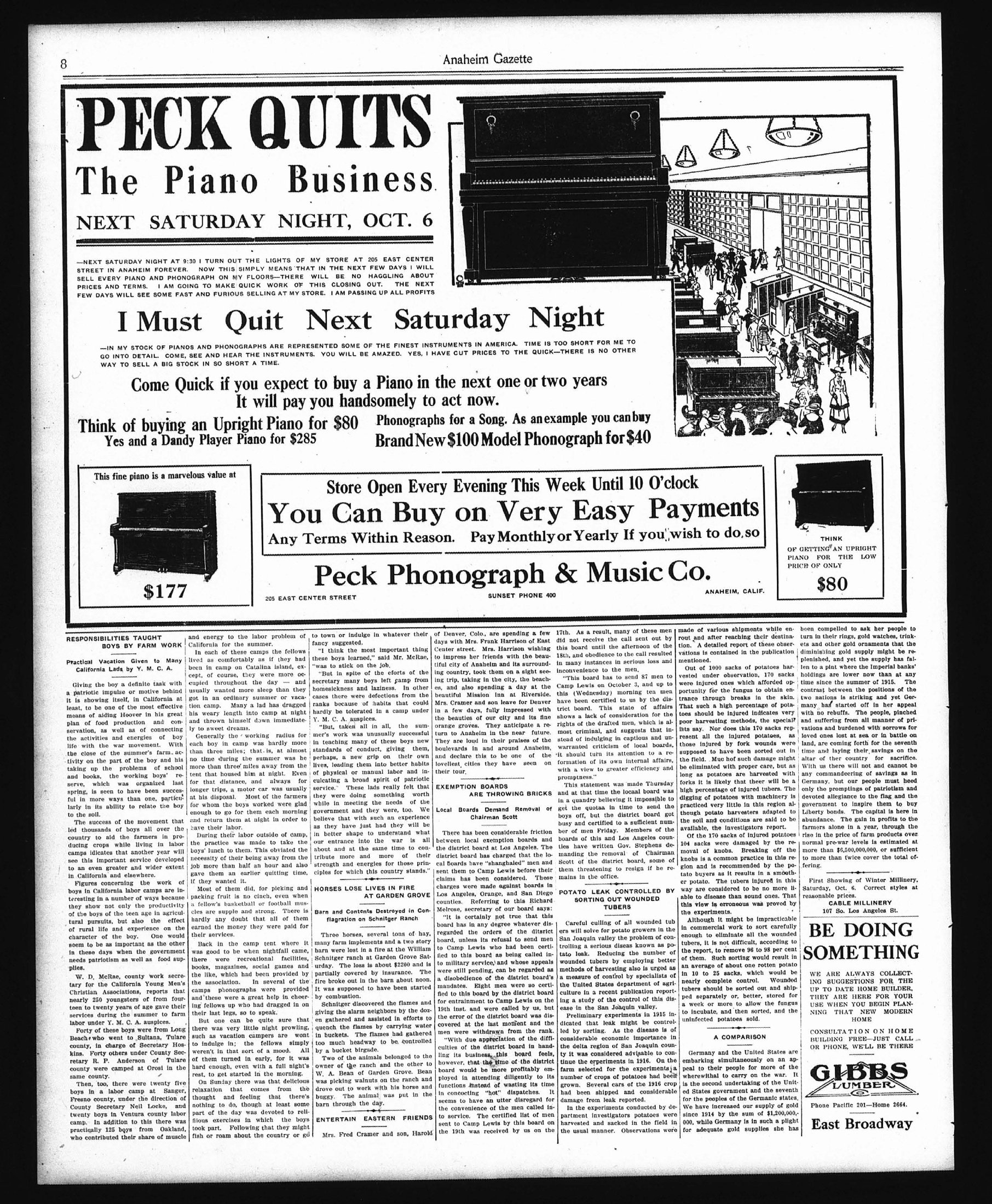
PECK QUIT
The Piano Business
NEXT SATURDAY NIGHT,
—NEXT SATURDAY NIGHT AT 9:30 I TURN OUT THE LIGHTS OF MY STORE AT 2
STREET IN ANAHEIM FOREVER. NOW THIS SIMPLY MEANS THAT IN THE NEXT
SELL EVERY PIANO AND PHONOGRAPH ON MY FLOORS—THERE WILL BE NO
PRICES AND TERMS. I AM GOING TO MAKE QUICK WORK OF THIS CLOSING O
FEW DAYS WILL SEE SOME FAST AND FURIOUS SELLING AT MY STORE. I AM PASSIN
I Must Quit Next
—IN MY STOCK OF PIANOS AND PHONOGRAPHS ARE REPRESENTED SOME OR
GO INTO DETAIL. COME, SEE AND HEAR THE INSTRUMENTS. YOU WILL BE
WAY TO SELL A BIG STOCK IN SO SHORT A TIME.
Come Quick if you expect to buy a
It will pay you hand
Think of buying an Upright Piano for $80
Yes and a Dandy Player Piano for $285
Come Quick if you expect to buy an Upright Piano for $80
Yes and a Dandy Player Piano for $285
This fine piano is a marvelous value at
$177
RESPONSIBILITIES TAUGHT BOYS BY FARM WORK
Practical Vacation Given to Many California Lads by Y. M. C. A.
Giving the boy a definite task with a patriotic impulse or motive behind it is showing itself, in California at least, to be one of the most effective means of aiding Hoover in his great plan of food production and conservation, as well as of connecting the activities and energies of boy life with the war movement. With the close of the summer's farm activity on the part of the boy and his taking up the problems of school and books, the working boys' reserve, which was organized last spring, is seen to have been successful in more ways than one, particularly in its ability to relate the boy to the soil.
The success of the movement that led thousands of boys all over the country to aid the farmers in producing crops while living in labor and energy to the labor problem of California for the summer.
In each of these camps the fellows lived as comfortably as if they had been in camp on Catalina island, except, of course, they were more occupied throughout the day — and usually wanted more sleep than they got in an ordinary summer or vacation camp. Many a lad has dragged his weary length into camp at night and thrown himself down immediately to sweet dreams.
Generally the working radius for each boy in camp was hardly more than three miles; that is, at almost no time during the summer was he more than three miles away from the tent that housed him at night. Even for that distance, and always for longer trips, a motor car was usually at his disposal. Most of the farmers for whom the boys worked were glad enough to go for them each morning and return them at night in order to have their labor.
During their labor outside of camp, the practice was made to take the boys' lunch to them. This obviated the town or indulgent fancy suggested.
"I think the most these boys learned," was to stick on this point.
"But in spite of secretary many boys homesickness and cases there were ranks because of hardly be tolerated." Y. M. C. A. auspice.
"But, taken all mer's work was used in teaching many standards of conduct perhaps, a new lives, leading them of physical or mental calcating a broad service." These latter they were doing while in meeting government and they believe that with as they have just in better shape to our entrance into about and at the
The success of the movement that led thousands of boys all over the country to aid the farmers in producing crops while living in labor camps indicates that another year will see this important service developed to an even greater and wider extent in California and elsewhere.
Figures concerning the work of boys in California labor camps are interesting in a number of ways because they show not only the productivity of the boys of the teen age in agricultural pursuits, but also the effect of rural life and experience on the character of the boy. One would seem to be as important as the other in these days when the government needs patriotism as well as food supplies.
W. D. McRae, county work secretary for the California Young Men's Christian Associations, reports that nearly 250 youngsters of fourteen to twenty years of age gave their services during the summer to farm labor under Y. M. C. A. auspices.
Forty of these boys were from Long Beach who went to Sultana, Tulare county, in charge of Secretary Hoskins. Forty others under County Secretary R. P. Anderson of Tulare county were camped at Orosi in the same county.
Then, too, there were twenty five boys in a labor camp at Sanger, Fresno county, under the direction of County Secretary Neil Locke, and twenty boys in Ventura county labor camp. In addition to this there was practically 125 boys from Oakland, who contributed their share of muscle no time during the summer was he more than three miles away from the tent that housed him at night. Even for that distance, and always for longer trips, a motor car was usually at his disposal. Most of the farmers for whom the boys worked were glad enough to go for them each morning and return them at night in order to have their labor.
During their labor outside of camp, the practice was made to take the boys' lunch to them. This obviated the necessity of their being away from the job more than half an hour and also gave them an earlier quitting time, if they wanted it.
Most of them did, for picking and packing fruit is no cinch, even when a fellow's basketball or football muscles are supple and strong. There is hardly any doubt that all of them earned the money they were paid for their services.
Back in the camp tent where it was good to be when nightfall came, there were recreational facilities, books, magazines, social games and the like, which had been provided by the association. In several of the camps phonographs were provided and these were a great help in cheering fellows up who had dragged in on their last legs, so to speak.
But one can be quite sure that there was very little night prowling, such as vacation campers are wont to indulge in; the fellows simply weren't in that sort of a mood. All of them turned in early, for it was hard enough, even with a full night's rest, to get started in the morning.
On Sunday there was that delicious relaxation that comes from the thought and feeling that there's nothing to do, though at least some part of the day was devoted to religious exercises in which the boys took part. Following that they might fish or roam about the country or go perhaps, a new lives, leading them of physical or mental calcating a broad service. These lay they were doing while in meeting government and they believe that with as they have just in better shape they our entrance into about and at the tribute more and strength and energy ciples for which th
HORSES LOSE LOVE
Barn and Contention flagration on $
Three horses, so many farm implement barn were lost in Schnitger ranch and urday. The loss is partially covered fire broke out in It was supposed to by combustion.
Schnitger discover giving the alarm men gathered and a quench the flames in buckets. The fire too much headway by a bucket birgata.
Two of the animal owner of the range W. A. Bean of O was picking walnut drove out to work buggy. The animal barn through the ENTERTAIN EA
Mrs. Fred Cram
AUITS
Business.
NIGHT, OCT. 6
OF MY STORE AT 205 EAST CENTER
THAT IN THE NEXT FEW DAYS I WILL
ERE WILL BE NO HAGGLING ABOUT
OF THIS CLOSING OUT. THE NEXT
MY STORE. I AM PASSING UP ALL PROFITS
Next Saturday Night
REPRESENTED SOME OF THE FINEST INSTRUMENTS IN AMERICA. TIME IS TOO SHORT FOR ME TO
MENTS. YOU WILL BE AMAZED. YES, I HAVE CUT PRICES TO THE QUICK—THERE IS NO OTHER
ect to buy a Piano in the next one or two years
ay you handsomely to act now.
no for $80 Phonographs for a Song. As an example you can buy
$285
Brand New $100 Model Phonograph for $40
Select to buy a Piano in the next one or two years
may you handsomely to act now.
No for $80
Phonographs for a Song. As an example you can buy
$285
Brand New $100 Model Phonograph for $40
Store Open Every Evening This Week Until 10 O’clock
You Can Buy on Very Easy Payments
by Terms Within Reason. Pay Monthly or Yearly If you wish.
Peck Phonograph & Music Co.
CENTER STREET
SUNSET PHONE 400
to town or indulge in whatever their fancy suggested.
“I think the most important thing these boys learned,” said Mr. McRae,
“was to stick on the job.
“But in spite of the efforts of the secretary many boys left camp from homesickness and laziness. In other cases there were defections from the ranks because of habits that could hardly be tolerated in a camp under Y. M. C. A. auspices.
“But, taken all in all, the summer’s work was unusually successful in teaching many of these boys new standards of conduct, giving them, perhaps, a new grip on their own lives, leading them into better habits of physical or manual labor and incubating a broad spirit of patriotic service.” These lads really felt that they were doing something worth while in meeting the needs of the government and they were, too. We believe that with such an experience as they have just had they will be in better shape to understand what our entrance into the war is all about and at the same time to con-
of Denver, Colo., are spending a few days with Mrs. Frank Harrison of East Center street. Mrs. Harrison wishing to impress her friends with the beautiful city of Anaheim and its surrounding country, took them on a sightseeing trip, taking in the city, the beaches, and also spending a day at the beautiful Mission Inn at Riverside. Mrs. Cramer and son leave for Denver in a few days, fully impressed with the beauties of our city and its fine orange groves. They anticipate a return to Anaheim in the near future. They are loud in their praises of the boulevards in and around Anaheim, and declare this to be one of the loveliest cities they have seen on their tour.
EXEMPTION BOARDS
ARE THROWING BRICKS
Local Boards Demand Removal of Chairman Scott
There has been considerable friction between local exemption boards and the district board at Los Angeles. The
17th. As a result, many of these men did not receive the call sent out by this board until the afternoon of the 18th, and obedience to the call resulted in many instances in serious loss and inconvenience to the men.
“This board has to send 87 men to Camp Lewis on October 3, and up to this (Wednesday) morning ten men have been certified to us by the district board. This state of affairs shows a lack of consideration for the rights of the drafted men, which is almost criminal, and suggests that instead of indulging in captious and unwarranted criticism of local boards, it should turn its attention to a reformation of its own internal affairs, with a view to greater efficiency and promptness.”
This statement was made Thursday and at that time the locala board was in a quandry believing it impossible to get the quotaa in time to send the boys off, but the district board got busy and certified to a sufficient number of men Friday. Members of the boards of this and Los Angeles counties have written Gov. Stephens de-
HORSES LOSE LIVES IN FIRE AT GARDEN GROVE
Barn and Contents Destroyed in Conflagration on Schnitger Ranch
Three horses, several tons of hay, many farm implements and a two story barn were lost in a fire at the William Schnitger ranch at Garden Grove Saturday. The loss is about $2200 and is partially covered by insurance. The fire broke out in the barn about noon. It was supposed to have been started by combustion.
Schnitger discovered the flames and giving the alarm neighbors by the dozen gathered and assisted in efforts to quench the flames by carrying water in buckets. The flames had gathered too much headway to be controlled by a bucket birgade.
Two of the animals belonged to the owner of the ranch and the other to W. A. Bean of Garden Grove. Bean was picking walnuts on the ranch and drove out to work with his horse and buggy. The animal was put in the barn through the day.
ENTERTAIN EASTERN FRIENDS
Mrs. Fred Cramer and son, Harold
EXEMPTION BOARDS ARE THROWING BRICKS
Local Boards Demand Removal of Chairman Scott
There has been considerable friction between local exemption boards and the district board at Los Angeles. The district board has charged that the local boards have "shanghailed" men and sent them to Camp Lewis before their claims has been considered. These charges were made against boards in Los Angeles, Orange, and San Diego counties. Referring to this Richard Melrose, secretary of our board says:
"It is certainly not true that this board has in any degree whatever disregarded the orders of the district board, unless its refusal to send men to Camp Lewis who had been certified to this board as being called into military service, and whose appeals were still pending, can be regarded as a disobedience of the district board's mandates. Eight men were so certified to this board by the district board for entrainment to Camp Lewis on the 19th inst. and were called by us, but the error of the district board was discovered at the last moment and the men were withdrawn from the rank.
"With due appreciation of the difficulties of the district board in handling its business, this board feels, however, that the time of the district board would be more profitably employed in attending diligently to its functions instead of wasting its time in concocting "hot" dispatches. It seems to have an utter disregard for the convenience of the men called into service. The certified list of men sent to Camp Lewis by this board on the 19th was received by us on the"
POTATO LEAK CONTROLLED BY SORTING OUT WOUNDED TUBERS
Careful culling of all wounded tubers will solve for potato growers in the San Joaquin valley the problem of controlling a serious disease known as potato leak. Reducing the number of wounded tubers by employing better methods of harvesting also is urged as a measure of control by specialists of the United States department of agriculture in a recent publication reporting a study of the control of this disease in the San Joaquin valley.
Preliminary experiments in 1915 indicated that leak might be controlled by sorting. As the disease is of considerable economic importance in the delta region of San Joaquin county it was considered advisable to continue the experiments in 1916. On the farm selected for the experiments a number of crops of potatoes had been grown. Several cars of the 1916 crop had been shipped and considerable damage from leak reported.
In the experiments conducted by department investigators potatoes were harvested and sacked in the field in the usual manner. Observations were
anbuy
r$40
many of these men call sent out by afternoon of the call resulted in serious loss and men.
send 87 men to October 3, and up to morning ten men so us by the district of affairs deliberation for the men, which is al-suggests that incapious and un- of local boards, attention to a re-internal affairs, over efficiency and made Thursday locaal board was giving it impossible to time to send the district board got a sufficient number Members of the Los Angeles coun-ov. Stephens de-made of various shipments while en-rout and after reaching their destination. A detailed report of these observations is contained in the publication mentioned.
Out of 1000 sacks of potatoes harvested under observation, 170 sacks were injured ones which afforded opportunity for the fungus to obtain entrance through breaks in the skin. That such a high percentage of potatoes should be injured indicates very poor harvesting methods, the speciall- hits say. Nor does this 170 sacks represent all the injured potatoes, as those injured by fork wounds were supposed to have been sorted out in the field. Muc hof such damage might be eliminated with proper care, but as long as potatoes are harvested with forks it is likely that theer will be a high percentage of injured tubers. The digging of potatoes with machinery is practiced very little in this region although potato harvesters adapted to the soil and conditions are said to be available, the investigators report.
Of the 170 sacks of injured potatoes 104 sacks were damaged by the removal of knobs. Breaking off the been compelled to ask her people to turn in their rings, gold watches, trinkets and other gold ornaments that the diminishing gold supply might be replenished, and yet the supply has fallen to a pint where the Imperial banks' holdings are lower now than at any time since the summer of 1915. The contrast between the positions of the two nations is striking and yet Germany had started off in her appeal with no rebuffs. The people, pinched and suffering from all manner of privations and burdened with sorrows for loved ones lost at sea or in battle on land, are coming forth for the seventh time and laying their savings on the altar of ther country for sacrifice. With us there will not and cannot be any commandeering of savings as in Germany, but our people must heed only the promptings of patriotism and devoted allegiance to the flag and the government to inspire them to buy Liberty bonds. The capital is here in abundance. The gain in profits to the farmers alone in a year, through the rise in the price of farm products over normal pre-war levels is estimated at more than $6,500,000,000, or sufficient
CONTROLLED BY THE WOUNDED TUBERS
all wounded tuber growers in the one problem of connecuses known as poing the number of employing better tubers also is urged as well by specialists of department of agri-publication report-control of this disquin valley.
iments in 1915 insight be control the disease is of public importance in San Joaquin coun- advisable to con- in 1916. On the other experiments a potatoes had been used of the 1916 crop and considerable reported.
is conducted by deors potatoes were used in the field in Observations were the field. Muc hof such damage might be eliminated with proper care, but as long as potatoes are harvested with forks it is likely that they will be a high percentage of injured tubers. The digging of potatoes with machinery is practiced very little in this region although potato harvesters adapted to the soil and conditions are said to be available, the investigators report.
Of the 170 sacks of injured potatoes 104 sacks were damaged by the removal of knobs. Breaking off the knobs is a common practice in this region and is recommended by the potato buyers as it results in a smoother potato. The tubers injured in this way are considered to be no more liable to disease than sound ones. That this view is erroneous was proved by the experiments.
Although it might be impracticable in commercial work to sort carefully enough to eliminate all the wounded tubers, it is not difficult, according to the report, to remove 96 to 98 per cent of them. Such sorting would result in an average of about one rotten potato in 10 to 25 sacks, which would be nearly complete control. Wounded tubers should be sorted out and shipped separately or, better, stored for a week or more to allow the fungus to incubate, and then sorted, and the uninfected potatoes sold.
A COMPARISON
Germany and the United States are embarking simultaneously on an appeal to their people for more of the wherewithal to carry on the war. It is the second undertaking of the United States government and the seventh for the peoples of the Germanic states. We have increased our supply of gold since 1914 by the sum of $1,200,000,000, while Germany is in such a plight for adequate gold supplies she has
altar of ther country for sacrifice. With us there will not and cannot be any commandeering of savings as in Germany, but our people must heed only the promptings of patriotism and devoted allegiance to the flag and the government to inspire them to buy Liberty bonds. The capital is here in abundance. The gain in profits to the farmers alone in a year, through the rise in the price of farm products over normal pre-war levels is estimated at more than $6,500,000,000, or sufficient to more than twice cover the total offering.
First Showing of Winter Millinery, Saturday, Oct. 6. Correct styles at reasonable prices.
CABLE MILLINERY
107 So. Los Angeles St.
BE DOING SOMETHING
WE ARE ALWAYS COLLECTING SUGGESTIONS FOR THE UP TO DATE HOME BUILDER, THEY ARE HERE FOR YOUR USE WHEN YOU BEGIN PLANNING THAT NEW MODERN HOME
CONSULTATION ON HOME BUILDING FREE—JUST CALL OR PHONE, WE'LL BE THERE
GIBBS LUMBER
Phone Pacific 201—Home 2664.
East Broadway