anaheim-gazette 1917-08-16
Scanned page
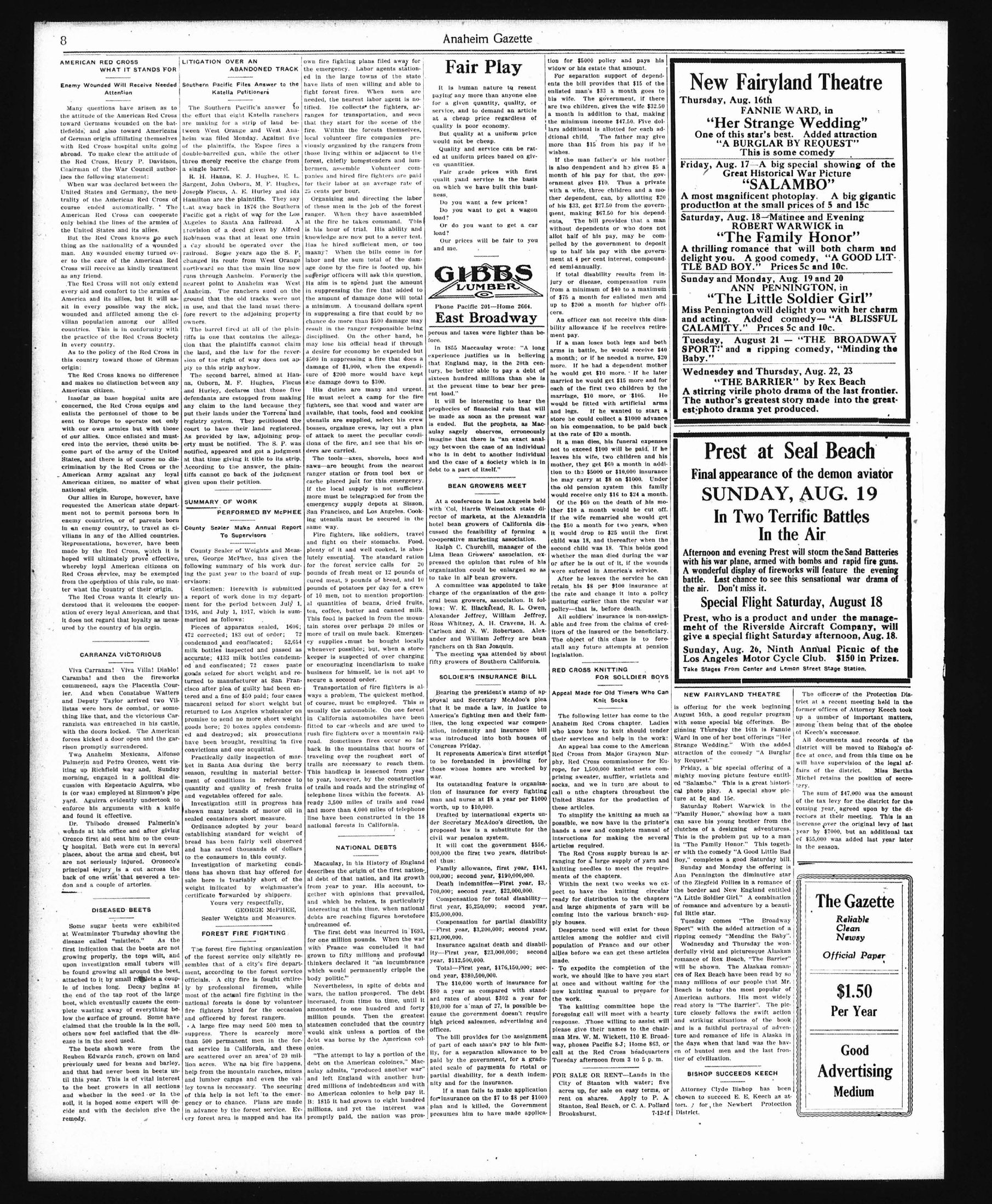
Searchable text
AMERICAN RED CROSS
WHAT IT STANDS FOR
Enemy Wounded Will Receive Needed Attention
Many questions have arisen as to the attitude of the American Red Cross toward Germans wounded on the battlefields, and also toward Americans of German origin affiliating themselves with Red Cross hospital units going abroad. To make clear the attitude of the Red Cross, Henry P. Davidson, Chairman of the War Council authorizes the following statement:
When war was declared between the United States and Germany, the neutrality of the American Red Cross of course ended automatically. The American Red Cross can cooperate only behind the lines of the armies of the United States and its allies.
But the Red Cross knows no such thing as the nationality of a wounded man. Any wounded enemy turned over to the care of the American Red Cross will receive as kindly treatment as any friend.
The Red Cross will not only extend every aid and comfort to the armies of America and its allies, but it will assist in every possible way the sick, wounded and afflicted among the civilian population among our allied countries. This is in conformity with the practice of the Red Cross Society in every country.
As to the policy of the Red Cross in this country toward those of German origin:
The Red Cross knows no difference and makes no distinction between any American citizen.
Insofar as base hospital units are concerned, the Red Cross equips and enlists the personnel of those to be sent to Europe to operate not only with our own armies but with those of our allies. Once enlisted and mustered into the service, these units be
LITIGATION OVER AN ABANDONED TRACK
Southern Pacific Files Answer to the Katella Petitioners
The Southern Pacific's answer to the effort that eight Katella ranchers are making for a strip of land between West Orange and West Anaheim was filed Monday. Against five of the plaintiffs, the Espee fires a double-barreled gun, while the other three merely receive the charge from a single barrel.
R. H. Hanna, E. J. Hughes, E. L. Sargent, John Osborn, M. F. Hughes, Joseph Fiscus, A. E. Hurley and ida Hamilton are the plaintiffs. They say that away back in 1876 the Southern Pacific got a right of way for the Los Angeles to Santa Ana railroad. A provision of a deed given by Alfred Robinson was that at least one train a day should be operated over the railroad. Some years ago the S. P. changed its route from West Orange northward so that the main line now runs through Anheim. Formerly the nearest point to Anaheim was West Anaheim. The ranchers sued on the ground that the old tracks were not in use, and that the land must therefore revert to the adjoining property owners.
The barrel fired at all of the plaintiffs is one that contains the allegation that the plaintiffs cannot claim the land, and the law for the reversion of the right of way does not apply to this strip anyhow.
The second barrel, aimed at Hanna, Osborn, M. F. Hughes, Fiscus and Hurley, declares that those five defendants are estopped from making any claim to the land because they put their lands under the Torrens land registry system. They petitioned the court to have their land registered. As provided by law, adjoining property must be notified. The S. P. was owned fire fighting plant in the emergency. Labor ed in the large town have lists of men will fight forest fires. We needed, the nearest lattified. He collects ranges for transport that they start for the fire. Within the former local volunteer fireviously organized by those living within or forest, chiefly homestead bermen, assemble companies and hired fire for their labor at an 25 cents per hour.
Organizing and directing of these men is the ranger. When they arrive at the fire he takes his hour of trial. Knowledge are now put Has he hired sufficient maany? When the labor and the sum tage done by the fire superior officers will His aim is to spend in suppressing the fire the amount of damage a minimum. A thousand in suppressing a fire chance do more than result in the ranger disciplined. On this may lose his official a desire for economy $500 in suppressing a damage of $1,000, without a damage down to His duties are many He must select a co fighters, see that work available, that tools, utensils are supplied bosses, organize crew of attack to meet tions of the fire, and
The Red Cross knows no difference and makes no distinction between any American citizen.
Insofar as base hospital units are concerned, the Red Cross equips and enlists the personnel of those to be sent to Europe to operate not only with our own armies but with those of our allies. Once enlisted and mustered into the service, these units become part of the army of the United States, and there is of course no discrimination by the Red Cross or the American Army against any loyal American citizen, no matter of what national origin.
Our allies in Europe, however, have requested the American state department not to permit persons born in enemy countries, or of parents born in an enemy country, to travel as civilians in any of the Allied countries. Representations, however, have been made by the Red Cross, which it is hoped will ultimately prove effective, whereby loyal American citizens on Red Cross service, may be exempted from the operation of this rule, no matter what the country of their origin.
The Red Cross wants it clearly understood that it welcomes the cooperation of every loyal American, and that it does not regard that loyalty as measured by the country of his orgin.
CARRANZA VICTORIOUS
Viva Carranza! Viva Villa! Diablo! Caramba! and then the fireworks commenced, says the Placentia Courier. And when Constabue Watters and Deputy Taylor arrived two Villistas were hors de combat, or something like that, and the victorious Carranzista was entrenched in his castle, with the doors locked. The American forces kicked a door open and the garrison promptly surrendered.
Two Anaheim Mexicans, Alfonso Palmerin and Pedro Orozco, went visiting up Richfield way and, Sunday morning, engaged in a political discussion with Espestacio Aguirra, who is (or was) employed at Simmon's pipe yard. Aguirra evidently undertook to enforce his arguments with a knife and found it effective.
Dr. Thibodo dressed Palmerin's wounds at his office and after giving Orozco first aid sent him to the county hospital. Both were cut in several
SUMMARY OF WORK
PERFORMED BY McPHEE
County Sealer Make Annual Report To Supervisors
County Sealer of Weights and Measures, George McPhee, has given the following summary of his work during the past year to the board of supervisors:
Gentlemen: Herewith is submitted a report of work done in my department for the period between July 1, 1916, and July 1, 1917, which is summarized as follows:
Pieces of apparatus sealed, 1606; 472 corrected; 183 out of order; 72 condemned and confiscated; 52,654 milk bottles inspected and passed as accurate; 4133 milk bottles condemned and confiscated; 72 cases paste goods seized for short weight and returned to manufacturer at San Francisco after plea of guilty had been entered and a fine of $50 paid; four cases macaroni seized for short weight but returned to Los Angeles wholesaler on promise to send no more short weight goods here; 20 boxes apples condemned and destroyed; six prosecutions have been brought, resulting in five convictions and one acquittal.
Practically daily inspection of market in Santa Ana during the berry season, resulting in material betterment of conditions in reference to quantity and quality of fresh fruits and vegetables offered for sale.
Investigation still in progress has shown many brands of motor oil in sealed containers short measure.
Ordinance adopted by your board establishing standard for weight of bread has been fairly well observed and has saved thousands of dollars.
His duties are many. He must select a captain fighters, see that work available, that tools, utensils are supplied, bosses, organize crew of attack to meet tions of the fire, andders are carried.
The tools—axes, saws—are brought for ranger station or fre cache placed just for if the local supply more must be telegram emergency supply due San Francisco, and L ing utensils must be same way.
Fire fighters, like and fight on their plenty of it and well lately essential. They for the forest service pounds of fresh meats cured meat, 9 pounds pounds of potatoes pail of 10 men, not to ma al quantities of bea tea, coffee, butter a This food is packed in tain stores over per more of trail on mulley supplies must be whenever possible; he keeper is suspected or encouraging incen business for himself secure a second order.
Transportation of ways a problem. The of course, must be usually the automobile in California automobiles fitted to car wheels rush fire fighters over road. Sometimes fi back in the mountain traveling over the ra trails are necessary. This handicap is lear to year, however, by of trails and roads an telephone lines within ready 3,500 miles o and more than 4,000 line have been cons national forests in C
DISEASED BEETS
Some sugar beets were exhibited at Westminster Thursday showing the disease called "mistleto." As the first indication that the beets are not growing properly, the tops wilt, and upon investigation small tubers will be found growing all around the beet, attached to it by small roots a couple of inches long. Decay begins at the end of the tap root of the large beet, which eventually causes the complete wasting away of everything below the surface of ground. Some have claimed that the trouble is in the soil, others now feel satisfied that the disease is in the seed used.
The beets shown were from the Reuben Edwards ranch, grown on land previously used for beans and barley, and that had never been in beets until this year. This is of vital interest to the beet growers in all sections and whether in the seed or in the soil, it is hoped some expert will decide and with the decision give the remedy.
Practically daily inspection of market in Santa Ana during the berry season, resulting in material betterment of conditions in reference to quantity and quality of fresh fruits and vegetables offered for sale.
Investigation still in progress has shown many brands of motor oil in sealed containers short measure.
Ordinance adopted by your board establishing standard for weight of bread has been fairly well observed and has saved thousands of dollars to the consumers in this county.
Investigation of marketing conditions has shown that hay offered for sale here is variably short of the weight indicated by weighmaster's certificate forwarded by shippers.
Yours very respectfully,
GEORGE McPHEE,
Sealer Weights and Measures.
FOREST FIRE FIGHTING
The forest fire fighting organization of the forest service only slightly resembles that of a city's fire department, according to the forest service officials. A city fire is fought entirely by professional firemen, while most of the actual fire fighting in the national forests is done by volunteer fire fighters hired for the occasion and officered by forest rangers.
A large fire may need 500 men to suppress. There is scarcely more than 500 permanent men in the forest service in California, and these are scattered over an area of 20 million acres. When big fire happens, help from the mountain ranches, mines and lumber camps and even the valley towns is necessary. The securing of this help is not left to the emergency or to chance. Plans are made in advance by the forest service. Every forest area is mapped and has its travel over the trails are necessary. This handicap is leased to year, however, by trails and roads and telephone lines within ready 3,500 miles or more than 4,000 line have been consigned national forests in C.
NATIONAL
Macaulay, in his description the origin of debt of that nation from year to year, together with opinions and which he related interesting at this time debts are reaching undreamed of.
The first debt was for one million pounds with France was grown to fifty million thinkers declared it which would permanently body politic."
Nevertheless, in wars, the nation proincerased, from time amounted to one hundred million pounds. The statesmen concluded would sink unless debt was borne by them.
"The attempt to launder debt on the American aulay admits," "produce and left England with dred millions of indebted no American colonies B: 1815 it had grown millions, and yet they promptly paid, the
own fire fighting plans filed away for the emergency. Labor agents stationed in the large towns of the state have lists of men willing and able to fight forest fires. When men are needed, the nearest labor agent is notified. He collects the fighters, arranges for transportation, and sees that they start for the scene of the fire. Within the forests themselves, local volunteer fire companies previously organized by the rangers from those living within or adjacent to the forest, chiefly hompsteaders and lumbermen, assemble Volunteer companies and hired fire fighters are paid for their labor at an average rate of 25 cents per hour.
Organizing and directing the labor of these men is the job of the forest ranger. When they have assembled at the fire he takes command. This is his hour of trial. His ability and knowledge are now put to a sever test. Has he hired sufficient men, or too many? When the bills come in for labor and the sum total of the damage done by the fire is footed up, his superior officers will ask this question. His aim is to spend just the amount in suppressing the fire that added to the amount of damage done will total a minimum. A thousand dollars spent in suppressing a fire that could by no chance do more than $500 damage may result in the ranger responsible being disciplined. On the other hand, he may lose his official head if through a desire for economy he expended but $500 in suppressing a fire that does a damage of $1,000, when the expenditure of $200 more would have kept the damage down to $300.
His duties are many and urgent. He must select a camp for the fire fighters, see that wood and water are available, that tools, food and cooking utensils are supplied, select his crew bosses, organize crews, lay out a plan of attack to meet the peculiar conditions of the fire, and see that his ordinance and taxes were lighter than before.
In 1855 Maccaulay wrote: "A long experience justifies us in believing that England may, in the 20th century, be better able to pay a debt of sixteen hundred millions than she is at the present time to bear her present load."
It will be interesting to hear the prophecies of financial ruin that will be made as soon as the present war is ended. But the prophets, as Macaulay sagely observes, erroneously imagine that there is "an exact analogy between the case of an individual for $5000 policy and pays his widow or his estate that amount.
For separation support of dependents the bill provides that $15 of the enlisted man's $33 a month goes to his wife. The government, if there are two children, gives the wife $32.50 a month in addition to that, making the minimum income $47.50. Five dollars additional is allotted for each additional child. The father may give more than $15 from his pay if he wishes.
If the man father’s or his mother is also dependent and he gives $5 a month of his pay for that, the government gives $10. Thus a private with a wife, three children and a mother dependent, can, by allotting $20 of his $33, get $27.50 from the government, making $67.50 for his dependents. The bill provides that a man without dependents or who does not allot half of his pay, may be compelled by the government to deposit up to half his pay with the government at 4 per cent interest, compounded semi-annually.
If total disability results from injury or disease, compensation runs from a minimum of $40 to a maximum of $75 a month for enlisted men and up to $200 a month for higher officers.
An officer cannot receive this disability allowance if he receives retirement pay.
If a man loses both legs and both arms in battle, he would receive $40 a month; or if he needed a nurse, $20 more. If he had a dependent mother he would get $10 more. If he later married he would get $15 more and for each of the first two children by the marriage, $10 more, or $105. He would be fitted with artificial arms and legs. If he wanted to start a store he could collect a $100 advance on his compensation, to be paid back at the rate of $20 a month.
It a man dies, his funeral expenses not exceed $100 will be paid. If he
$500 in suppressing a fire that does a damage of $1,000, when the expenditure of $200 more would have kept the damage down to $300.
His duties are many and urgent. He must select a camp for the fire fighters, see that wood and water are available, that tools, food and cooking utensils are supplied, select his crew bosses, orgainze crews, lay out a plan of attack to meet the peculiar conditions of the fire, and see that his orders are carried.
The tools—axes, shovels, hoes and saws—are brought from the nearest ranger station or from tool box or cache placed just for this emergency. If the local supply is not sufficient more must be telegraphed for from the emergency supply depots at Sisson, San Francisco, and Los Angeles. Cooking utensils must be secured in the same way.
Fire fighters, like soldiers, travel and fight on their stomachs. Food, plenty of it and well cooked, is absolutely essential. The standard ration for the forest service calls for 20 pounds of fresh meat or 12 pounds of cured meat, 9 pounds of bread, and 10 pounds of potatoes per day for a crew of 10 men, not to mention proportional quantities of beans, dried fruits, tea, coffee, butter and canned milk. This food is packed in from the mountain stores over perhaps 20 miles or more of trail on mule back. Emergency supplies must be bought locally whenever possible; but, when a store keeper is suspected of over charging or encouraging incendiaryism to make business for himself, he is not apt to secure a second order.
Transportation of fire fighters is always a problem. The quickest method, of course, must be employed. This is usually the automobile. On one forest in California automobiles have been fitted to car wheels and are used to rush fire fighters over a mountain railroad. Sometimes fires occur so far back in the mountains that hours of traveling over the roughest sort of trails are necessary to reach them. This handicap is lessened from year to year, however, by the construction of trails and roads and the stringing of telephone lines within the forests. Already 3,500 miles of trails and road and more than 4,000 miles of telephone line have been constructed in the 18 national forests in California.
BEAN GROWERS MEET
At a conference in Los Angeels held with Col. Harris Weinstock state director of markets, at the Alexandria hotel bean growers of California discussed the feasibility of forming a co-operative marketing association.
Ralph C. Churchill, manager of the Lima Bean Growers' association, expressed the opinion that rules of his organization could be enlarged so as to take in alP bean growers.
A committee was appointed to take charge of the organization of the general bean growers, association. It follows: W. E. Blackstead, R. L. Owen, Alexander Jeffrey, William Jeffrey, Ross Whitney, A. H. Cravens, H. A. Carlson and N. W. Robertson. Alexander and William Jeffrey are bean ranchers on th San Joaquin.
The meeting was attended by about fifty growers of Southern California.
SOLDIER'S INSURANCE BILL
Bearing the president's stamp of approval and Secretary McAdoo's plea that it be made a law, in justice to America's fighting men and their families, the long expected war compensation, indemnity and insurance bill was introduced into both houses of Congress Friday.
It represents America's first attempt to be forehanded in providing for those whose homes are wrecked by war.
Its outstanding feature is organization of insurance for every fighting man and nurse at $8 a year per $1000 worth, up to $10,000.
Drafted by international experts under Secretary McAdoo's direction, the proposed law is a substitute for the civil war pension system.
It will cost the government $556.
A month; or if he needed a nurse, $20 more. If he had a dependent mother he would get $10 more. If he later married he would get $15 more and for each of the first two children by the marriage, $10 more, or $105. He would be fitted with artificial arms and legs. If he wanted to start a store he could collect a $1000 advance on his compensation, to be paid back at the rate of $20 a month.
It a man dies, his funeral expenses not to exceed $100 will be paid. If he leaves his wife, two children and his mother, they get $60 a month in addition to the $5000 or $10,000 insurance he may carry at $8 on $1000. Under the old pension system this family would receive only $16 to $24 a month.
Of the $60 on the death of his mother $10 a month would be cut off. If the wife remarried she would get the $50 a month for two years, when it would drop to $25 until the first child was 18. This holds good whether the man died during the war or after he is out of it, if the wounds were suffered in America's service.
After he leaves the service he can retain his $8 per $100 insurance at the rate and change it into a policy maturing earlier than the regular war policy—that is, before death.
All soldiers' insurance is non-assignable and free from the claims of creditors of the insured or the beneficiary. The object of this claus is to forestall any future attempts at pension legislation.
RED CROSS KNITTING FOR SOLLDIER BOYS
Appeal Made for Old Timers Who Can Knit Socks
The following letter has come to the Anaheim Red Cross chapter. Ladies who know how to knit should tender their services and help in the work:
An appeal has come to the American Red Cross from Major Grayson Murphy, Red Cross commissioner for Europe, for 1,500,000 knitted sets comprising sweater, muffler, wristlets and socks, and we in turn are about to call on the chapters throughout the United States for the production of these articles.
To simplify the knitting as much as possible, we now have in the printer's hands a new and complete manual of instructions for making several articles required.
NATIONAL DEBTS
Macaulay, in his History of England describes the origin of the first national debt of that nation, and its growth from year to year. His account, together with opinions that prevailed, and which he relates, is particularly interesting at this time, when national debts are reaching figures heretofore undreamed of.
The first debt was incurred in 1693, for one million pounds. When the war with France was concluded it had grown to fifty millions and profound thinkers declared it "an incumbance which would permanently cripple the body politic."
Nevertheless, in spite of debts and wars, the nation prospered. The debt incerased, from time to time, until it amounted to one hundred and forty million pounds. Then the greatest statesmen concluded that the country would sink unless a portion of the debt was borne by the American colonies.
"The attempt to lay a portion of the debt on the American colonies," Macaulay admits, "produced another war" and left England with another hundred millions of indebtedness and with no American colonies to help pay it. B: 1815 it had grown to eight hundred millions, and yet the interest was promptly paid, the nation was pros-
It will cost the government $556,000,000 the first two years, distributed thus:
Family allowance, first year, $141,000,000; second year, $190,000,000.
Death indemnities—First year, $3,700,000; second year, $22,000,000.
Compensation for total disability—first year, $5,250,000; second year, $35,000,000.
Compensation for partial disability—First year, $3,200,000; second year, $21,000,000.
Insurance against death and disability—First year, $23,000,000; second year, $112,500,000.
Total—First year, $176,150,000; second year, $380,500,000.
The $10,000 worth of insurance for $80 a year as compared with standard rates of about $302 a year for $10,000 for a man of 27, is possible because the government doesn't require high priced salesmen, advertising and offices.
The bill provides for the assignment of part of each man's pay to his family, for a separation allowance to be paid by the government, for a graduated scale of payments for rtotal or partial disability, for a death indemnity and for the insurance.
If a man fails to make application for insurance on the $7 to $8 per $1000 plan and is killed, the Government presumes him to have made application to be forehanded in providing for those whose homes are wrecked by war.
Its outstanding feature is organization of insurance for every fighting man and nurse at $8 a year per $1000 worth, up to $10,000.
Drafted by international experts under Secretary McAdoo's direction, the proposed law is a substitute for the civil war pension system.
It will cost the government $556,000,000 the first two years, distributed thus:
Family allowance, first year, $141,000,000; second year, $190,000,000.
Death indemnities—First year, $3,700,000; second year, $22,000,000.
Compensation for total disability—first year, $5,250,000; second year, $35,000,000.
Compensation for partial disability—First year, $3,200,
New Fairyland Theatre
Thursday, Aug. 16th
FANNIE WARD, in
“Her Strange Wedding”
One of this star’s best. Added attraction
“A BURGLAR BY REQUEST”
This is some comedy
Friday, Aug. 17—A big special showing of the Great Historical War Picture
“SALAMBO”
A most magnificent photoplay. A big gigantic production at the small prices of 5 and 15c
Saturday, Aug. 18—Matinee and Evening
ROBERT WARWICK in
“The Family Honor”
A thrilling romance that will both charm and delight you. A good comedy, “A GOOD LITTLE BAD BOY.” Prices 5c and 10c.
Sunday and Monday, Aug. 19 and 20
ANN PENNINGTON, in
“The Little Soldier Girl”
Miss Pennington will delight you with her charm and acting. Added comedy—“A BLISSFUL CALAMITY.” Prices 5c and 10c.
Tuesday, August 21 — “THE BROADWAY SPORT” and a ripping comedy, “Minding the Baby.”
Wednesday and Thursday, Aug. 22, 23
“THE BARRIER” by Rex Beach
A stirring virile photo drama of the last frontier. The author’s greatest story made into the greatest photo drama yet produced.
Wednesday and Thursday, Aug. 22, 23
“THE BARRIER” by Rex Beach
A stirring virile photo drama of the last frontier.
The author’s greatest story made into the greatest photo drama yet produced.
Prest at Seal Beach
Final appearance of the demon aviator
SUNDAY, AUG. 19
In Two Terrific Battles
In the Air
Afternoon and evening Prest will storm the Sand Batteries with his war plane, armed with bombs and rapid fire guns. A wonderful display of fireworks will feature the evening battle. Last chance to see this sensational war drama of the air. Don’t miss it.
Special Flight Saturday, August 18
Prest, who is a product and under the management of the Riverside Aircraft Company, will give a special flight Saturday afternoon, Aug. 18.
Sunday, Aug. 26, Ninth Annual Picnic of the Los Angeles Motor Cycle Club. $150 in Prizes.
Take Stages From Center and Lemon Street Stage Station.
NEW FAIRYLAND THEATRE
is offering for the week beginning August 16th, a good regular program with some special big offerings. Beginning Thursday the 16th is Fannie Ward in one of her best offerings "Her Strange Wedding." With the added attraction of the comedy "A Burglar by Request."
Friday, a big special offering of a mighty moving picture feature entitled "Salambo." This is a great historical photo play. A special show picture at $c and 15c.
Saturday Robert Warwick in the "Family Honor," showing how a man can save his young brother from the clutches of a designing adventurer. This is the problem put up to a man in "The Family Honor." This together with the promise of a Good Little Bad Baby."
The officers of the Protection District at a recent meeting held in the former offices of Attorney Keech took up a number of important matters, among them being that of the choice of Keech's successor.
All documents and records of the district will be moved to Bishop's office at once, and from this time on he will have supervision of the legal affairs of the district. Miss Bertha Michel retains the position of secretary.
The sum of $47,000 was the amount of the tax levy for the district for the coming year, agreed upon by the directors at their meeting. This is an increase over the original levy of last year by $7000, but an additional tax of $55,000 was added last year later in the season.
Friday, a big special offering of a mighty moving picture feature entitled "Salambo." This is a great historical photo play. A special show picture at $c and 15c.
Saturday Robert Warwick in the "Family Honor," showing how a man can save his young brother from the clutches of a designing adventurer. This is the problem put up to a man in "The Family Honor." This together with the comedy "A Good Little Bad Boy," completes a good Saturday bill.
Sunday and Monday the offering is Ann Pennington the diminutive star of the Ziegfeld Follies in a romance of the border and New England entitled "A Little Soldier Girl." A combination of romance and adventure by a beautiful little star.
Tuesday comes "The Broadway Sport" with the added attraction of a ripping comedy "Mending the Baby."
Wednesday and Thursday the wonderfully vivid and picturesque Alaskan romance of Rex Beach, "The Barrier" will be shown. The Alaskan romances of Rex Beach have been read by so many millions of our people that Mr. Beach is today the most popular of American authors. His most widely read story is "The Barrier". The picture closely follows the swift action and striking situations of the book and is a faithful portrayal of adventure and romance of life in Alaska in the days when that land was the haven of hunted men and the last frontier of civilization.
BISHOP SUCCEEDS KEECH
Attorney Clyde Bishop has been chosen to succeed E. E. Keech as attorn. for the Newbert Protection District.