anaheim-gazette 1917-08-16
Scanned page
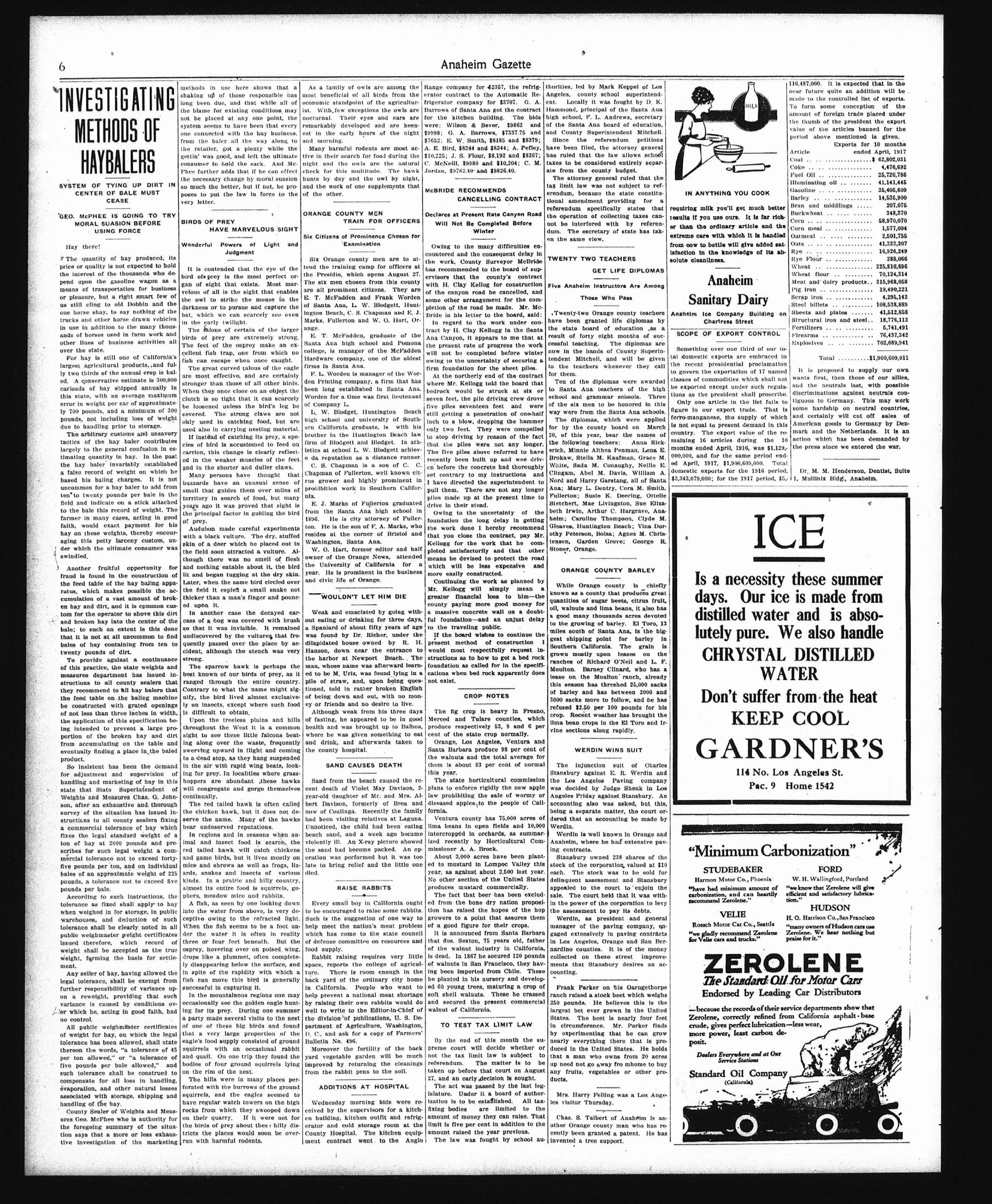
Searchable text
INVESTIGATING METHODS OF HAYBALERS
SYSTEM OF TYING UP DIRT IN CENTER OF BALE MUST CEASE
GEO. McPHEE IS GOING TO TRY MORAL SUASION BEFORE USING FORCE
Hay there!
The quantity of hay produced, its price or quality is not expected to hold the interest of the thousands who depend upon the gasoline wagon as a means of transportation for business or pleasure, but a right smart few of us still cling to old Dobbin and the one horse shay, to say nothing of the trucks and other horse drawn vehicles in use in addition to the many thousands of horses used in farm work and other lines of business activities all over the state.
For hay is still one of California's largest agricultural products, and fully two thirds of the annual crop is baled. A conservative estimate is 300,000 carloads of hay shipped annually in this state, with an average maximum error in weight per car of approximately 700 pounds, and a minimum of 300 pounds, not including loss of weight due to handling prior to storage.
The arbitrary customs and unsavory tactics of the hay baler contributes largely to the general confusion in use here shows that a shaking up of those responsible has long been due, and that while all of the blame for existing conditions may not be placed at any one point, the system seems to have been that every one connected with the hay business, from the baler all the way along to the retailer, got a plenty while the gettin' was good, and left the ultimate consumer to hold the sack. And McPhee further adds that if he can effect the necessary change by moral suasion so much the better, but if not, he proposes to put the law in force to the very letter.
BIRDS OF PREY HAVE MARVELOUS SIGHT
Wonderful Powers of Light and Judgment
It is contended that the eye of the bird of prey is the most perfect organ of sight that exists. Most marvelous of all is the sight that enables the owl to strike the mouse in the darkness or to pursue and capture the bat, which we can scarcely see even in the early twilight.
The talons of certain of the larger birds of prey are extremely strong. The feet of the osprey make an excellent fish trap, one from which no fish can escape when once caught.
The great curved talons of the eagle are most effective, and are certainly stronger than those of all other birds. When they once close on an object the clutch is so tight that it can scarcely be loosened unless the bird's leg be severed. The strong claws are not only used in catching food, but are used also in carrying nesting material.
If instead of catching its prey, a species of bird is accustomed to feed on methods in use here shows that a shaking up of those responsible has long been due, and that while all of the blame for existing conditions may not be placed at any one point, the system seems to have been that every one connected with the hay business, from the baler all the way along to the retailer, got a plenty while the gettin' was good, and left the ultimate consumer to hold the sack. And McPhee further adds that if he can effect the necessary change by moral suasion so much the better, but if not, he proposes to put the law in force to the very letter.
ORANGE COUNTY TRAIN
Six Citizens of Prominent Examinat
Six Orange county tend the training camp at Presidio, which owe The six men chosen are all prominent citi E. T. McFadden and of Santa Ana, L. W.ington Beach, C. S. Ch Marks, Fullerton and range.
E. T. McFadden, Santa Ana high school college, is manager of Hardware company, o firms in Santa Ana.
F. L. Worden is man den Printing company been long established Worden for a time wa of Company L.
L. W. Blodget, Hu high school and univern California graduate brother in the Hunting firm of Blodgett and
For hay is still one of California's largest agricultural products, and fully two thirds of the annual crop is baled. A conservative estimate is 300,000 carloads of hay shipped annually in this state, with an average maximum error in weight per car of approximately 700 pounds, and a minimum of 300 pounds, not including loss of weight due to handling prior to storage.
The arbitrary customs and unsavory tactics of the hay baler contributes largely to the general confusion in estimating quantity in hay. In the past the hay baler invariably established a false record of weight on which he based his baling charges. It is not uncommon for a hay baler to add from ten to twenty pounds per bale in the field and indicate on a stick attached to the bale this record of weight. The farmer in many cases, acting in good faith, would exact payment for his hay on these weights, thereby encouraging this petty larceny custom, under which the ultimate consumer was swindled.
Another fruitful opportunity for fraud is found in the construction of the feed table of the hay baling apparatus, which makes possible the accumulation of a vast amount of broken hay and dirt, and it is common custom for the operator to shove this dirt and broken hay into the center of the bale; to such an extent is this done that it is not at all uncommon to find bales of hay containing from ten to twenty pounds of dirt.
To provide against a continuance of this practice, the state weights and measures department has issued instructions to all county sealers that they recommend to all hay balers that the feed table on the baling machine be constructed with grated openings of not less than three inches in width, the application of this specification being intended to prevent a large proportion of the broken hay and dirt from accumulating on the table and eventually finding a place in the baled product.
So insistent has been the demand for adjustment and supervision of handling and marketing of hay in this state that State Superintendent of Weights and Measures Chas. G. Johnson, after an exhaustive and thorough survey of the situation has issued instructions to all county sealers fixing a commercial tolerance of hay which fixes the legal standard weight of a ton of hay at 2000 pounds and precludes for such legal weight a com-
The great curved talons of the eagle are most effective, and are certainly stronger than those of all other birds. When they once close on an object the clutch is so tight that it can scarcely be loosened unless the bird's leg be severed. The strong claws are not only used in catching food, but are used also in carrying nesting material.
If instead of catching its prey, a species of bird is accustomed to feed on carrion, this change is clearly reflected in the weaker muscles of the feet and in the shorter and duller claws.
Many persons have thought that buzzards have an unusual sense of smell that guides them over miles of territory in search of food, but many years ago it was proved that sight is the principal factor in guiding the bird of prey.
Audubon made careful experiments with a black vulture. The dry, stuffed skin of a deer which be placed out in the field soon attracted a vulture. Although there was no smell of flesh and nothing eatable about it, the bird lit and began tugging at the dry skin. Later, when the same bird circled over the field it espied a small snake not thicker than a man's finger and pounced upon it.
In another case the decayed carcass of a dog was covered with brush so that it was invisible. It remained undiscovered by the vultures that frequently passed over the place by accident, although the stench was very strong.
The sparrow hawk is perhaps the best known of our birds of prey, as it ranged through the entire country. Contrary to what the name might signify, the bird lived almost exclusively on insects, except where such food is difficult to obtain.
Upon the treeless plains and hills throughout the West it is a common sight to see these little falcons beating along over the waste, frequently swerving upward in flight and coming to a dead stop, as they hang suspended in the air with rapid wing beats, looking for prey. In localities where grasshoppers are abundant, these hawks will congregate and gorge themselves continually.
The red tailed hawk is often called the chicken hawk, but it does not deserve the name. Many of the hawks bear undeserved reputations.
In regions and in seasons when animal and insect food is scarce, the red tailed hawk will catch chickens fish can escape when once caught.
The great curved talons of the eagle are most effective, and are certainly stronger than those of all other birds. When they once close on an object the clutch is so tight that it can scarcely be loosened unless the bird's leg be severed. The strong claws are not only used in catching food, but are used also in carrying nesting material.
If instead of catching its prey, a species of bird is accustomed to feed on carrion, this change is clearly reflected in the weaker muscles of the feet and in the shorter and duller claws.
Many persons have thought that buzzards have an unusual sense of smell that guides them over miles of territory in search of food, but many years ago it was proved that sight is the principal factor in guiding the bird of prey.
Audubon made careful experiments with a black vulture. The dry, stuffed skin of a deer which be placed out in the field soon attracted a vulture. Although there was no smell of flesh and nothing eatable about it, the bird lit and began tugging at the dry skin. Later, when the same bird circled over the field it espied a small snake not thicker than a man's finger and pounced upon it.
In another case the decayed carcass of a dog was covered with brush so that it was invisible. It remained undiscovered by the vultures that frequently passed over the place by accident, although the stench was very strong.
The sparrow hawk is perhaps the best known of our birds of prey, as it ranged through the entire country. Contrary to what the name might signify, the bird lived almost exclusively on insects, except where such food is difficult to obtain.
Upon the treeless plains and hills throughout the West it is a common sight to see these little falcons beating along over the waste, frequently swerving upward in flight and coming to a dead stop, as they hang suspended in the air with rapid wing beats, looking for prey. In localities where grasshoppers are abundant, these hawks will congregate and gorge themselves continually.
The red tailed hawk is often called the chicken hawk, but it does not deserve the name. Many of the hawks bear undeserved reputations.
In regions and in seasons when animal and insect food is scarce, the red tailed hawk will catch chickens fish can escape when once caught.
The great curved talons of the eagle are most effective, and are certainly stronger than those of all other birds. When they once close on an object the clutch is so tight that it can scarcely be loosened unless the bird's leg be severed. The strong claws are not only used in catching food, but are used also in carrying nesting material.
If instead of catching its prey, a species of bird is accustomed to feed on carrion, this change is clearly reflected in the weaker muscles of the feet and in the shorter and duller claws.
Many persons have thought that buzzards have an unusual sense of smell that guides them over miles of territory in search of food, but many years ago it was proved that sight is the principal factor in guiding the bird of prey.
Audubon made careful experiments with a black vulture. The dry, stuffed skin of a deer which be placed out in the field soon attracted a vulture. Although there was no smell of flesh and nothing eatable about it, the bird lit and began tugging at the dry skin. Later, when the same bird circled over the field it espied a small snake not thicker than a man's finger and pounced upon it.
In another case the decayed carcass of a dog was covered with brush so that it was invisible. It remained undiscovered by the vultures that frequently passed over the place by accident, although the stench was very strong.
The sparrow hawk is perhaps the best known of our birds of prey, as it ranged through the entire country. Contrary to what the name might signify, the bird lived almost exclusively on insects, except where such food is difficult to obtain.
Upon the treeless plains and hills throughout the West it is a common sight to see these little falcons beating along over the waste, frequently swerving upward in flight and coming to a dead stop, as they hang suspended in the air with rapid wing beats, looking for prey. In localities where grasshoppers are abundant, these hawks will congregate and gorge themselves continually.
The red tailed hawk is often called the chicken hawk, but it does not deserve the name. Many of the hawks bear undeserved reputations.
In regions and in seasons when animal and insect food is scarce, the red tailed hawk will catch chickens fish can escape when once caught.
F. L. Worden is main丹 den Printing company been long established Worden for a time wan Company L.
L. W. Blodget, Hugh high school and university California graduate brother in the Hunting firm of Blodgett and letters at school L.W.e da reputation as a C. S. Chapman is main Chapman of Fullerton rus grower and high prohibition work in Santa Ana.
E. J. Marks of Ful from the Santa Ana 1896. He is city attendant. He is the son of resides at the corner Washington, Santa A W.O. Hart, former owner of the Orange University of Cali year. Hs is prominent and civic life of Oran
WOULDN'T LEAVE
Weak and emaciate out eating or drinking A Spaniard of about five was found by Dr.R.Dilapidated house own Hanson, down near harbor at Newport man, whose name wasted to be M.Uriz, was pile of straw,and ,tioned,told in ratherof being down and oey or friends and no Although weak from fasting,hhe appear health and was broughtwhere he was givenand drink,and afterthe county hospital.
SAND CAUSE
Sand fromthe beach cent deathof Violet year-old daughterofbert Davisonformer nowof Coalinga.Re had been visiting relUnnoticed,the childbeach sand,andawviolently ill.An X-rayillandthe sandhad become
So insistent has been the demand for adjustment and supervision of handling and marketing of hay in this state that State Superintendent of Weights and Measures Chas. G. Johnson, after an exhaustive and thorough survey of the situation has issued instructions to all county sealers fixing a commercial tolerance of hay which fixes the legal standard weight of a ton of hay at 2000 pounds and prescribes for such legal weight a commercial tolerance not to exceed forty-five pounds per ton, and on individual bales of an approximate weight of 225 pounds, a tolerance not to exceed five pounds per bale.
According to such instructions, the tolerance as fixed shall apply to hay when weighed in for storage, in public warehouses, and deduction of such tolerance shall be clearly noted in all public weighmaster weight certificates issued therefore, which record of weight shall be accepted as the true weight, forming the basis for settlement.
Any seller of hay, having allowed the legal tolerance, shall be exempt from further responsibility of variance upon a reweight, providing that such variance is caused by conditions over which he, acting in good faith, had no control.
All public weighmaster certificates of weight for hay, on which the legal tolerance has been allowed, shall state thereon the words, "a tolerance of 45 per ton allowed," or "a tolerance of five pounds per bale allowed," and such tolerance shall be construed to compensate for all loss in handling, evaporation, and other natural losses associated with storage, shipping and handling of the hay.
County Sealer of Weights and Measures Geo. McPhee who is authority for the foregoing summary of the situation says that a more or less exhaustive investigation of the marketing to a dead stop, as they hang suspended in the air with rapid wing beats, looking for prey. In localities where grasshoppers are abundant, these hawks will congregate and gorge themselves continually.
The red tailed hawk is often called the chicken hawk, but it does not deserve the name. Many of the hawks bear undeserved reputations.
In regions and in seasons when animal and insect food is scarce, the red tailed hawk will catch chickens and game birds, but it lives mostly on mice and shrews as well as frogs, lizards, snakes and insects of various kinds. In a prairie and hilly country, almost its entire food is squirrels, gophers, meadow mice and rabbits.
A fish, as seen by one looking down into the water from above, is very deceptive owing to the refracted light. When the fish seems to be a foot under the water it is often in reality three or four feet beneath. But the osprey, hovering over on poised wing, drops like a plummet, often completely disappearing below the surface, and in spite of the rapidity with which a fish can move this bird is generally successful in capturing it.
In the mountainous regions one may occasionally see the golden eagle hunting for its prey. During one summer a party made several visits to the nest of one of these big birds and found that a very large proportion of the eagle's food supply consisted of ground squirrels with an occasional rabbit and quail. On one trip they found the bodies of four ground squirrels lying on the rim of the nest.
The hills were in many places perforated with the burrows of the ground squirrels, and the eagles seemed to have regular watch towers on the high rocks from which they swooped down on their quarry. If it were not for the birds of prey about these hilly districts the places would soon be overrun with harmful rodents.
SAND CAUSES
Sand from the beach cent death of Violet year-old daughter of Robert Davison, former now of Coalinga. Re had been visiting relative Unnoticed, the child beach sand, and a w violently ill. An X-ray the sand had become eration was performed late to bring relief ad died.
RAISE RAIS
Every small boy in to be encouraged to rai Such is the suggestion help meet the nation which has come to use of defense committee food supply.
Rabbit raising req space, reports the cature. There is room back yard of the order in California. People help prevent a nation by raising their own well to write to the division of public department of Agriculture D. C., and ask for a Bulletin No. 496.
Moreover the fertile yard vegetable garden improved by returning from the rabbit pens.
ADDITIONS AT
Wednesday morning received by the superv en building, kitchen emerator and cold store County Hospital. Th ment contract wen
Anaheim Gazette
As a family of owls are among the most beneficial of all birds from the economic standpoint of the agriculturist. With few exceptions the owls are nocturnal. Their eyes and ears are remarkably developed and are keenest in the early hours of the night and morning.
Many harmful rodents are most active in their search for food during the night and the owls are the natural check for this multitude. The hawk hunts by day and the owl by night, and the work of one supplements that of the other.
ORANGE COUNTY MEN TRAIN FOR OFFICERS
Six Citizens of Prominence Chosen for Examination
Six Orange county men are to attend the training camp for officers at the Presidio, which opens August 27. The six men chosen from this county are all prominent citizens. They are E. T. McFadden and Frank Worden of Santa Ana, L. W. Blodgett, Huntington Beach, C. S. Chapman and E. J. Marks, Fullerton and W. O. Hart, Orange.
E. T. McFadden, graduate of the Santa Ana high school and Pomona college, is manager of the McFadden Hardware company, one of the oldest firms in Santa Ana.
F. L. Worden is manager of the Worden Printing company, a firm that has been long established in Santa Ana. Worden for a time was first lieutenant of Company L.
L. W. Blodgett, Huntington Beach high school and university of Southern California graduate, is with his brother in the Huntington Beach law firm of Blodgett and Blodgett. In athletics at school L. W. Blodgett schliege
Range company for $2357, the refrigerator contract to the Automatic Refrigerator company for $3707. G. A. Barrows of Santa Ana got the contract for the kitchen building. The bids were: Wilson & Bever, $9862 and $9998; G. A. Barrows, $7337.75 and $7652; E. W. Smith, $8185 and $8379; A. E. Bird, $8244 and $8344; A. Pefley, $10,225; J. S. Flour, $8,192 and $8367; C. McNeill, $9980 and $10,204; C. M. Jordan, $9782.40 and $9826.40.
McBRIDE RECOMMENDS CANCELLING CONTRACT
Declares at Present Rate Canyon Road Will Not Be Completed Before Winter
Owing to the many difficulties encountered and consequent delay in the work, County Surveyor McBride has recommended to the board of supervisors that the county's contract with H. Clay Kellog for construction of the canyon road be cancelled, and some other arrangement for the completion of the road be made. Mr. McBride in his letter to the board, said:
In regard to the work under contract by H. Clay Kellog in the Santa Ana Canyon, it appears to me that at the present rate of progress the work will not be completed before winter owing to the uncertainty of securing a firm foundation for the sheet piles.
At the northerly end of the contract where Mr. Kellogg told the board that bedrock would be struck at six or seven feet, the pile driving crew drove five piles seventeen feet and were still getting a penetration of one-half inch to a blow, dropping the hammer only two feet. They were compelled to stop driving by reason of the fact that the piles were not any longer.
thorities, led by Mark Keppel of Los Angeles, county school superintendent. Locally it was fought by D. K. Hammond, principal of the Santa Ana high school, F. L. Andrews, secretary of the Santa Ana board of education, and County Superintendent Mitchell.
Since the referendum petitions have been filed, the attorney general has ruled that the law allows school taxes to be considered entirely separate from the county budget.
The attorney general ruled that the tax limit law was not subject to referendum, because the state constitutional amendment providing for a referendum specifically states that the operation of collecting taxes cannot be interfered with by referendum. The secretary of state has taken the same view.
TWENTY TWO TEACHERS GET LIFE DIPLOMAS
Five Anaheim Instructors Are Among Those Who Pass
Twenty-two Orange county teachers have been granted life diplomas by the state board of education as a result of forty eight months of successful teaching. The diplomas are now in the hands of County Superintendent Mitchell, and will be given to the teachers whenever they call for them.
Ten of the diplomas were awarded to Santa Ana teachers of the high school and grammar schools. Three of the six men to be honored in this way were from the Santa Ana schools.
The diplomas, which were applied for by the county board on March 20, of this year, bear the names of the following teachers: Anna Rickrishikh Mingle Berman Long
Hardware company, one of the oldest firms in Santa Ana.
F. L. Worden is manager of the Worden Printing company, a firm that has been long established in Santa Ana. Worden for a time was first lieutenant of Company L.
L. W. Blodget, Huntington Beach high school and university of Southern California graduate, is with his brother in the Huntington Beach law firm of Blodgett and Blodget. In athletics at school L. W. Blodgett achieve da reputation as a distance runner.
C. S. Chapman is a son of C. C. Chapman of Fullerton, well known citrus grower and highly prominent in prohibition work in Southern California.
E. J. Marks of Fullerton graduated from the Santa Ana high school in 1896. He is city attorney of Fullerton. He is the son of F. A. Marks, who resides at the corner of Bristol and Washington, Santa Ana.
W. O. Hart, former editor and half owner of the Orange News, attended the University of California for a year. His is prominent in the business and civic life of Orange.
WOULDN'T LET HIM DIE
Weak and emaciated by going without eating or drinking for three days, a Spaniard of about fifty years of age was found by Dr. Richer, under the dilapidated house owned by R. H. Hanson, down near the entrance to the harbor at Newport Beach. The man, whose name was afterward learned to be M. Uriz, was found lying in a pile of straw, and, upon being questioned, told in rather broken English of being down and out, with no money or friends and no desire to live.
Although weak from his three days of fasting, he appeared to be in good health and was brought up to Balboa, where he was given something to eat and drink, and afterwards taken to the county hospital.
SAND CAUSES DEATH
Sand from the beach caused the recent death of Violet May Davison, 2-year-old daughter of Mr. and Mrs. Albert Davison, formerly of Brea and now of Coalinga. Recently the family had been visiting relatives at Laguna. Unnoticed, the child had been eating beach sand, and a week ago became violently ill. An X-ray picture showed the sand had become packed. An op-
At the northerly end of the contract where Mr. Kellogg told the board that bedrock would be struck at six or seven feet, the pile driving crew drove five piles seventeen feet and were still getting a penetration of one-half inch to a blow, dropping the hammer only two feet. They were compelled to stop driving by reason of the fact that the piles were not any longer. The five piles above referred to have recently been built up and wee driven before the concrete had thoroughly set contrary to my instructions and I have directed the superintendent to pull them. There are not any longer piles made up at the present time to drive in their stead.
Owing to the uncertainty of the foundation the long delay in getting the work done I hereby recommend that you close the contract, pay Mr. Kellogg for the work that he completed satisfactorily and that other means be devised to protect the road which will be less expensive and more easily constructed.
Continuing the work as planned by Mr. Kellogg will simply mean a greater financial loss to him—the county paying more good money for a massive concrete wall on a doubtful foundation—and an unjust delay to the traveling public.
If the board wishes to continue the present method of construction I would most respectfully request instructions as to how to get a bed rock foundation as called for in the specifications when bed rock apparently does not exist.
CROP NOTES
The fig crop is heavy in Fresno, Merced and Tulare counties, which produce respectively 53, 9 and 6 per cent of the state crop normally.
Orange, Los Angeles, Ventura and Santa Barbara produce 98 per cent of the walnuts and the total average for them is about 83 per cent of normal this year.
The state horticultural commission plans to enforce rigidly the new apple law prohibiting the sale of wormy or diseased apples to the people of California.
Ventura county has 75,000 acres of lima beans in open fields and 10,000 intercropped in orchards, as summarized recently by Horticultural Commissioner A. A. Brock.
Tendent Mitchell, and will be given to the teachers whenever they call for them.
Ten of the diplomas were awarded to Santa Ana teachers of the high school and grammar schools. Three of the six men to be honored in this way were from the Santa Ana schools.
The diplomas, which were applied for by the county board on March 20, of this year, bear the names of the following teachers: Anna Rickierich, Minnie Althea Penman, Lena E. Brokaw, Stella M. Kaufman, Grace M. White, Sada M. Conaugby, Neill E. Clingam, Abel M. Davis, William A. Nord and Harry Garstang, all of Santa Ana; Mary L. Dentry, Cora M. Smith, Fullerton; Susle K. Deering, Ottelle Stetchert, Mae Livingston, Sue Elizabeth Irwin, Arthur C. Hargrave, Anaheim; Caroline Thompson, Clyde M. Gleaves, Huntington Beach; Vina Dorothy Peterson, Bolsa; Agnes M. Christensen, Garden Grove; George R. Stoner, Orange.
ORANGE COUNTY BARLEY
While Orange county is chiefly known as a county that produces great quantities of sugar beets, citrus fruit, oil, walnuts and lima beans, it also has a good many thousands acres devoted to the growing of barley. El Toro, 13 miles south of Santa Ana, is the biggest shipping point for barley in Southern California. The grain is grown mostly upon leases on the ranches of Richard O'Neil and L. F. Moulton. Barney Clinhard, who has a lease on the Moulton ranch, already this season has threshed 25,000 sacks of barley and has between 2000 and 3000 sacks more to follow, and he has refused $2.50 per 100 pounds for his crop. Recent weather has brought the lima bean crops in the El Toro and Irvine sections along rapidly.
WERDIN WINS SUIT
The injunction suit of Charles Stansbury against E. R. Werdin and the Los Angeles Paving company was decided by Judge Shenk in Los Angeles Friday against Stansbury. An accounting also was asked, but this, being a separate matter, the court ordered that an accounting be made by Werdin is well known in Orange and Anaheim, where he had extensive paving contracts.
SAND CAUSES DEATH
Sand from the beach caused the recent death of Violet May Davison, 2-year-old daughter of Mr. and Mrs. Albert Davison, formerly of Brea and now of Coalinga. Recently the family had been visiting relatives at Laguna. Unnoticed, the child had been eating beach sand, and a week ago became violently ill. An X-ray picture showed the sand had become packed. An operation was performed but it was too late to bring relief and the little one died.
RAISE RABBITS
Every small boy in California ought to be encouraged to raise some rabbits. Such is the suggestion of one way to help meet the nation's meat problem which has come to the state council of defense committee on resources and food supply.
Rabbit raising requires very little space, reports the college of agriculture. There is room enough in the back yard of the ordinary city home in California. People who want to help prevent a national meat shortage by raising their own rabbits would do well to write to the Editor-in-Chief of the division of publications, U. S. Department of Agriculture, Washington, D. C., and ask for a copy of Farmers' Bulletin No. 496.
Moreover the fertility of the backyard vegetable garden will be much improved by returning the cleanings from the rabbit pens to the soil.
ADDITIONS AT HOSPITAL
Wednesday morning bids were received by the supervisors for a kitchen building, kitchen outfit and refrigerator and cold storage room at the County Hospital. The kitchen equipment contract went to the Anglo
the walnuts and the total average for them is about 83 per cent of normal this year.
The state horticultural commission plans to enforce rigidly the new apple law prohibiting the sale of wormy or diseased apples to the people of California.
Ventura county has 75,000 acres of lima beans in open fields and 10,000 intercropped in orchards, as summarized recently by Horticultural Commissioner A. A. Brock.
About 3,000 acres have been planted to mustard in Lompoc Valley this year, as against about 2,500 last year. No other section of the United States produces mustard commercially.
The fact that beer has been excluded from the bone dry nation proposition has raised the hopes of the hop growers to a point that assures them of a good figure for their crops.
It is announced from Santa Barbara that dos. Sexton, 75 years old, father of the walnut industry in California, is dead. In 1867 he secured 120 pounds of walnuts in San Francisco, they having been imported from Chile. These he planted in his nursery and developed 60 young trees, maturing a crop of soft shell walnuts. These he crassed and secured the present commercial walnut of California.
TO TEST TAX LIMIT LAW
By the end of this month the supreme court will decide whether or not the tax limit law is subject to referendum. The matter is to be taken up before that court on August 27, and an early decision is sought.
The act was passed by the last legislature. Under it a board of authorization is to be established. All tax-fixing bodies are limited to the amount of money they can raise. That limit is five per cent in addition to the amount raised the year previous.
The law was fought by school au-
The injunction suit of Charles Stansbury against E. R. Werdin and the Los Angeles Paving company was decided by Judge Shenk in Los Angeles Friday against Stansbury. An accounting also was asked, but this, being a separate matter, the court ordered that an accounting be made by Werdin.
Werdin is well known in Orange and Anaheim, where he had extensive paving contracts.
Stansbury owned 238 shares of the stock of the corporation valued at $10 each. The stock was to be sold for delinquent assessment and Stansbury appealed to the court to enjoin the sale. The court held that it was within the power of the corporation to levy the assessment to pay its debts.
Werdin, as president and general manager of the paving company, engaged extensively in paving contracts in Los Angeles, Orange and San Bernardino counties. It is of the money collected on these street improvements that Stansbury desires an accounting.
Frank Parker on his Oarngethorpe ranch raised a stock beet which weighs 250 pounds. He believes this is the largest bet ever grown in the United States. The beet is nearly four feet in circumference. Mr. Parker finds by experimenting that he can grow nearly everything there that is produced in the United States. He holds that a man who owns from 20 acres up need not go away fro mhome to buy any fruits, vegetables or other products.
Mrs. Harry Felling was a Los Angeles visitor Thursday.
Chas. S. Talbert of Anaheim is another Orange county man who has recently been granted a patent. He has invented a tree support.
IN ANYTHING YOU COOK
requiring milk you'll get much better results if you use ours. It is far richer than the ordinary article and the extreme care with which it is handled from cow to bottle will give added satisfaction in the knowledge of its absolute cleanliness.
Anaheim Sanitary Dairy
Anaheim Ice Company Building on Chartress Street
SCOPE OF EXPORT CONTROL
Something over one third of our total domestic exports are embraced in the recent presidential proclamation to govern the exportation of 17 named classes of commodities which shall not be exported except under such regulations as the president shall proscribe.
Only one article in the list fails to figure in our export trade. That is ferro-manganese, the supply of which is not equal to present demand in this country. The export value of the remaining 16 articles during the 10 months ended April, 1916, was $1,129,000. It is expected that in the near future quite an addition will be made to the controlled list of exports. To form some conception of the amount of foreign trade placed under the thumb of the president the export value of the articles banned for the period above mentioned is given.
Exports for 10 months
Article ended April, 1917
Coal ... $62,802,031
Coke ... 4,476,692
Fuel Oil ... 25,720,786
Illuminating oil ... 41,141,445
Gasoline ... 35,405,609
Barley ... 14,535,900
Bran and middlings ... 207,075
Buckwheat ... 348,370
Corn ... 58,970,070
Corn meal ... 1,577,004
Oatmeal ... 2,501,755
Oats ... 41,323,207
Rye ... 16,926,249
Rye Flour ... 288,066
Wheat ... 225,810,896
Wheat flour ... 70,124,314
Meat and dairy products... 315,968,058
Pig iron ... 19,490,221
Scrap iron ... 4,295,143
Steel billets ... 108,538,889
Sheets and plates ... 41,512,858
Structural iron and steel... 18,776,112
Fortillizers ... 5,741,491
Firearms ... 76,437,342
Explosives ... 702,689,941
Total ... $1,900,609,011
It is proposed to supply our own wants first, then those of our allies, and the neutrals last, with possible discriminations against neutrals contiguous to Germany. This may work some hardship on neutral countries, and certainly will cut off sales of American goods to Germany by Denmark and the Netherlands. It is an action which has been demanded by the press since we entered war.
ICE
Is a necessity these summer days. Our ice is made from distilled water and is absolutely pure. We also handle CHRYSTAL DISTILLED WATER
Don't suffer from the heat KEEP COOL GARDNER'S
114 No. Los Angeles St.
Pac. 9 Home 1542
Minimum Carbonization
"Minimum Carbonization"
STUDEBAKER
Harmon Motor Co., Phoenix
"have had minimum amount of carbonization, and can heartily recommend Zerolene."
FORD
W. H. Wallingford, Portland
"We know that Zerolene will give efficient and satisfactory lubrication."
VELIE
Roesch Motor Car Co., Seattle
"We gladly recommend Zerolene for Velie cars and trucks."
HUDSON
H. O. Harrison Co., San Francisco
"many owners of Hudson cars use Zerolene. We hear nothing but praise for it."
ZEROLENE
The Standard Oil for Motor Cars
Endorsed by Leading Car Distributors
—because the records of their service departments show that Zerolene, correctly refined from California asphalt-base crude, gives perfect lubrication—less wear, more power, least carbon deposit.
Dealers Everywhere and at Our Service Stations
Standard Oil Company
(California).