anaheim-gazette 1917-07-05
Scanned page
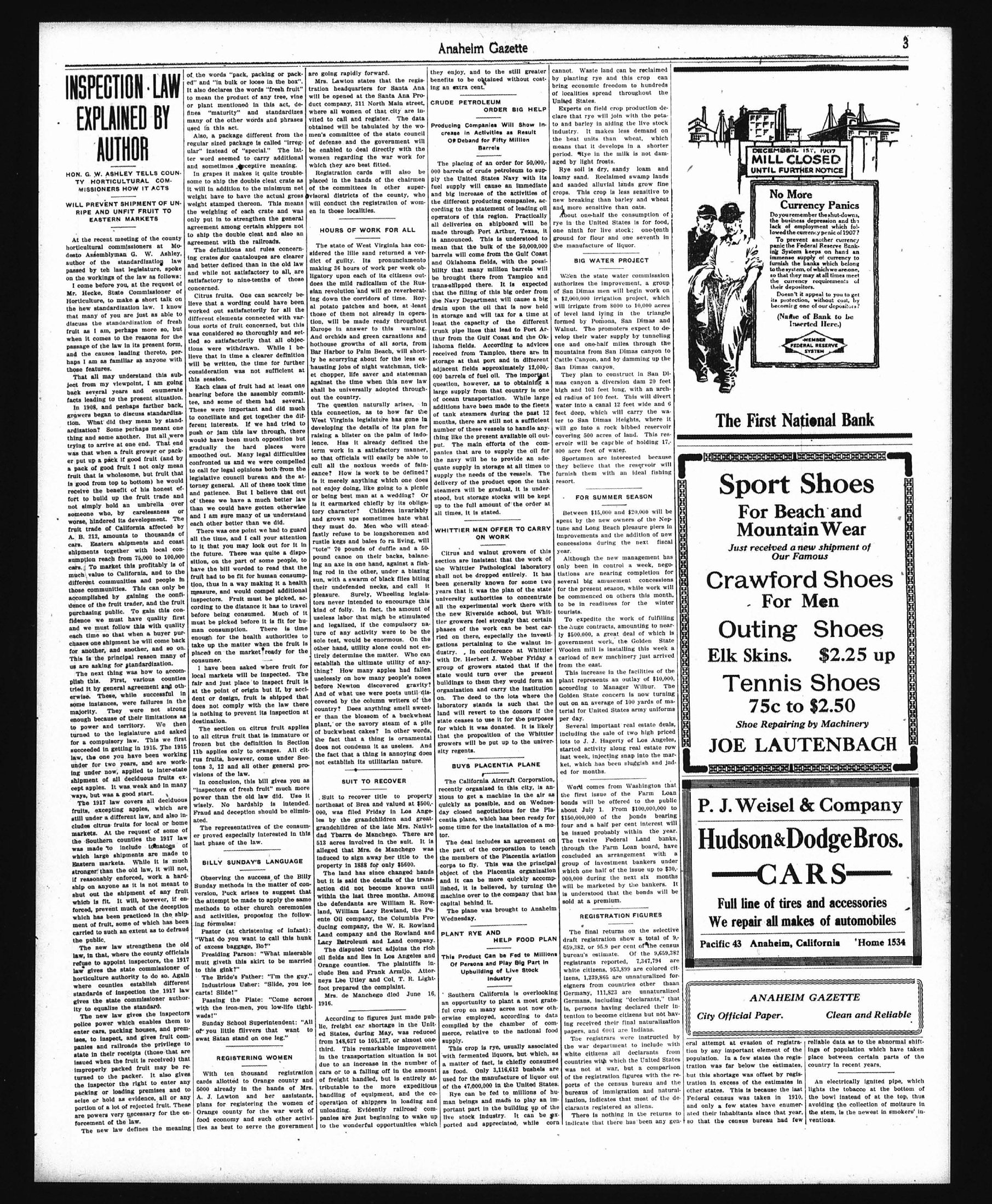
Searchable text
INSPECTION · LAW
EXPLAINED BY AUTHOR
HON. G. W. ASHLEY TELLS COUNTY HORTICULTURAL COMMISSIONERS HOW IT ACTS
WILL PREVENT SHIPMENT OF UNRIPE AND UNFIT FRUIT TO
EASTERN MARKETS
At the recent meeting of the county horticultural commissioners at Modesto Assemblyman G. W. Ashley, author of the standardization law passed by teh last legislature, spoke on the workings of the law as follows:
I come before you, at the request of Mr. Hecke, State Commissioner of Horticulture, to make a short talk on the new standardization law. I know that many of you are just as able to discuss the standardization of fresh fruit as I am, perhaps more so, but when it comes to the reasons for the passage of the law in its present form, and the causes leading thereto, perhaps I am as familiar as anyone with those features.
That all may understand this subject from my viewpoint, I am going back several years and enumerate facts leading to the present situation.
In 1908, and perhaps farther back, growers began to discuss standardization. What did they mean by standardization? Some perhaps meant one thing and some another. But all were trying to arrive at one end. That end of the words "pack, packing or packed" and "in bulk or loose in the box". It also declares the words "fresh fruit" to mean the product of any tree, vine or plant mentioned in this act, defines "maturity" and standardizes many of the other words and phrases used in this act.
Also, a package different from the regular sized package is called "irregular" instead of "special." The latter word seemed to carry additional and sometimes receptive meaning.
In grapes it makes it quite troublesome to ship the double cleat crate as it will in addition to the minimum net weight have to have the actual gross weight stamped thereon. This means the weighing of each crate and was only put in to strengthen the general agreement among certain shippers not to ship the double cleat and also an agreement with the railroads.
The definitions and rules concerning crates for cantaloupes are clearer and better defined than in the old law and while not satisfactory to all, are satisfactory to nine-tenths of those concerned.
Citrus fruits. One can scarcely believe that a wording could have been worked out satisfactorily for all the different elements connected with various sorts of fruit concerned, but this was considered so thoroughly and settled so satisfactorily that all objections were withdrawn. While I believe that in time a clearer definition will be written, the time for further consideration was not sufficient at this session.
Each class of fruit had at least one hearing before the assembly committee, and some of them had several. These were important and did much to conciliate and get together the different interests. If we had tried to push or jam this law through, there would have been much opposition but gradually the hard places were going rapidly for Mrs. Lawton statetration headquarters will be opened at the duct company, 311 N where all women of vited to call and reobtain will be tablenen's committee of of defense and they be enabled to deal women regarding which they are best.
Registration cards placed in the hands of the committees divisional districts of will conduct the regien in those localities.
HOURS OF WORK
The state of West sidered the lille san dict of guilty. Its making 36 hours ofiligatory upon each does the mild radian revolution and ing down the corridor al potato patches those of them not tion, will be made Europe in answer And orchids and greothouse growths o Bar Harbor to Palm ly be scurrying about hausting jobs of nig et chopper, life save against the time w shall be universally out the country.
The question na this connection, as West Virginia legislation developing a blister on lence. Has it al
That all may understand this subject from my viewpoint, I am going back several years and enumerate facts leading to the present situation.
In 1908, and perhaps farther back, growers began to discuss standardization. What did they mean by standardization? Some perhaps meant one thing and some another. But all were trying to arrive at one end. That end was that when a fruit grower or packer put up a pack if good fruit (and by a pack of good fruit I not only mean fruit that is wholesome, but fruit that is good from top to bottom) he would receive the benefit of his honest effort to build up the fruit trade and not simply hold an umbrella over someone who, by carelessness or worse, hindered its development. The fruit trade of California affected by A. B. 212, amounts to thousands of cars. Eastern shipments and coastal shipments together with local consumption reach from 75,000 to 100,000 cars. To market this profitably is of much value to California, and to the different communities and people in those communities. This can only be accomplished by gaining the confidence of the fruit trader, and the fruit purchasing public. To gain this confidence we must have quality first and we must follow this with quality each time so that when a buyer purchases one shipment he will come back for another, and another, and so on. This is the principal reason many of us are asking for standardization.
The next thing was how to accomplish this. First, various counties tried it by general agreement and otherwise. These, while successful in some instances, were failures in the majority. They were not strong enough because of their limitations as to power and territory. We then turned to the legislature and asked for a compulsory law. This we first succeeded in getting in 1915. The 1915 law, the one you have been working under for two years, and are working under now, applied to inter-state shipment of all deciduous fruits except apples. It was weak and in many ways, but was a good start.
The 1917 law covers all deciduous fruits, excepting apples, which are still under a different law, and also includes citrus fruits for local or home markets. At the request of some of the Southern counties the 1917 law was made to include tomatoes of
Each class of fruit had at least one hearing before the assembly committee, and some of them had several. These were important and did much to conciliate and get together the different interests. If we had tried to push or jam this law through, there would have been much opposition but gradually the hard places were smoothed out. Many legal difficulties confronted us and we were compelled to call for legal opinions both from the legislative council bureau and the attorney general. All of these took time and patience. But I believe that out of these we have a much better law than we could have gotten otherwise and I am sure many of us understand each other better than we did.
There was one point we had to guard all the time, and I call your attention to it that you may look out for it in the future. There was quite a disposition, on the part of some people, to have the bill worded to read that the fruit had to be fit for human consumption, thus in a way making it a health measure, and would compel additional inspectors. Fruit must be picked, according to the distance it has to travel before being consumed. Much of it must be picked before it is fit for human consumption. There is time enough for the health authorities to take up the matter when the fruit is placed on the market ready for the consumer.
I have been asked where fruit for local markets will be inspected. The fair and just place to inspect fruit is at the point of origin but if, accident or design, fruit is shipped that does not comply with the law there is nothing to prevent its inspection at destination.
The section on citrus fruit applies to all citrus fruit that is immature or frozen but the definition in Section 11b applies only to oranges. All citrus fruits, however, come under Sections 3, 12 and all other general provisions of the law.
In conclusion, this bill gives you as "inspectors of fresh fruit" much more power than the old law did. Use it wisely. No hardship is intended. Fraud and deception should be eliminated.
The representatives of the consumer proved especially interested in this last phase of the law.
The question now this connection, as West Virginia legislation developing the detail raising a blister on lence. Has it all term work in a sae so that officials will cull all the noxious eance? How is we is it merely anything not enjoy doing, like or being best man is it earmarked chary character? Or and grown ups some they must do. Me fastly refuse to be rustle kegs and ball "tote" 70 pounds o pound canoe on t ing an axe in one b ing rod in the other sun, with a swarm their undefended in pleasure. Surely tors never intended kind of folly. In useless labor that t and legalized, if t nature of any activi sole test, would be other hand, utility tirely determine tha establish the ultimeth thing? How many uselessly on how n before Newton d And of what use w covered by the co country? Dees an er than the blossom plant, or the save of buckwheat cake the fact that a t does not condemn the fact that a th not establish its u
law, the one you have been working under for two years, and are working under now, applied to inter-state shipment of all deciduous fruits except apples. It was weak and in many ways, but was a good start.
The 1917 law covers all deciduous fruits, except apples, which are still under a different law, and also includes citrus fruits for local or home markets. At the request of some of the Southern counties the 1917 law was made to include tomatoes of which large shipments are made to Eastern markets. While it is much stronger than the old law, it will not, if reasonably enforced, work a hardship on anyone as it is not meant to shut out the shipment of any fruit which is fit. It will, however, if enforced, prevent much of the deception which has been practiced in the shipment of fruit, some of which has been carried to such an extent as to defraud the public.
The new law strengthens the old law, in that, where the county officials refuse to appoint inspectors, the 1917 law gives the state commissioner of horticulture authority to do so. Again where counties establish different standards of inspection the 1917 law gives the state commissioner authority to equalize the standard.
The new law gives the inspectors police power which enables them to enter cars, packing houses, and premises, to inspect, and gives fruit companies and railroads the privilege to state in their receipts (those that are issued when the fruit is received) that improperly packed fruit may be returned to the packer. It also gives the inspector the right to enter any packing or loading premises and to seize or hold as evidence, all or any portion of a lot of rejected fruit. These are powers very necessary for the enforcement of the law.
The new law defines the meaning
Observing the success of the Billy Sunday methods in the matter of conversion, Puck arises to suggest that the attempt be made to apply the same methods to other church ceremonies and activities, proposing the following formulas:
Pastor (at christening of infant): "What do you want to call this hunk of excess baggage, Bo?"
Presiding Parson: "What miserable mutt giveth this skirt to be married to this gink?"
The Bride's Father: "I'm the guy."
Industrious Usher: "Slide, you ice-carts! Slide!"
Passing the Plate: "Come across with the iron-men, you low-life tightwads!"
Sunday School Superintendent: "All of you little flivvers that want to swat Satan stand on one leg."
REGISTERING WOMEN
With ten thousand registration cards allotted to Orange county and 5000 already in the hands of Mrs. A. J. Lawton and her assistants, plans for registering the women of Orange county for the war work of food economy and such other activities as best to serve the government
Anaheim Gazette
are going rapidly forward.
Mrs. Lawton states that the registration headquarters for Santa Ana will be opened at the Santa Ana Product company, 311 North Main street, where all women of that city are invited to call and register. The data obtained will be tabulated by the women's committee of the state council of defense and the government will be enabled to deal directly with the women regarding the war work for which they are best fitted.
Registration cards will also be placed in the hands of the chairmen of the committees in other supervisors districts of the county, who will conduct the registration of women in those localities.
HOURS OF WORK FOR ALL
The state of West Virginia has considered the lilie sand returned a verdict of guilty. Its pronunciation making 36 hours of work per week obligatory upon each of its citizens outdoes the mild radicalism of the Russian revolution and will go reverberating down the corridors of time. Royal potato patches and hoes, at least those of them not already in operation, will be made ready throughout Europe in answer to this warning. And orchids and green carnations and hothouse growths of all sorts, from Bar Harbor to Palm Beach, will shortly be scurrying about for the less exhausting jobs of night watchman, ticket chopper, life saver and statesman against the time when this new law shall be universally adopted throughout the country.
The question naturally arises, in this connection, as to how far the West Virginia legislature has gone in developing the details of its plan for raising a blister on the palm of indolence. Has it already defined the
they enjoy, and to the still greater benefits to be obtained without costing an extra cent.
CRUDE PETROLEUM ORDER BIG HELP
Producing Companies Will Show Increase in Activities as Result Of Deband for Fifty Million Barrels
The placing of an order for 50,000,000 barrels of crude petroleum to supply the United States Navy with its fuel supply will cause an immediate and big increase of the activities of the different producing companies, according to the statement of leading oil operators of this region. Practically all deliveries on shipboard will be made through Port Arthur, Texas, it is announced. This is understood to mean that the bulk of the 50,000,000 barrels will come from the Gulf Coast and Oklahoma fields, with the possibility that many million barrels will be brought there from Tampico and trans-shipped there. It is expected that the filling of this big order from the Navy Department will cause a big drain upon the oil that is now held in storage and will tax for a time at least the capacity of the different trunk pipe lines that lead to Port Arthur from the Gulf Coast and the Oklahoma fields. According to advices received from Tampico, there are in storage at that port and in different adjacent fields approximately 12,000,000 barrels of fuel oil. The important question, however, as to obtaining a large supply from that country is one of ocean transportation. While large additions have been made to the fleets of tank steamers during the past 12 months, there are still not a sufficient number of these vessels to handle anything like the present available oil output. The main efforts of the cannot. Waste land can be reclaimed by planting rye and this crop can bring economic freedom to hundreds of localities spread throughout the United States.
Experts on field crop production declare that rye will join with the potato and barley in aiding the live stock industry. It makes less demand on the heat units than wheat, which means that it develops in a shorter period. Rye in the milk is not damaged by light frosts.
Rye soil is dry, sandy loam and loamy sand. Reclaimed swamp lands and sanded alluvial lands grow fine crops. This crop is less sensitive to new breaking than barley and wheat and more sensitive than oats.
About one-half the consumption of rye in the United States is for food, one ninth for live stock; one-tenth ground for flour and one seventh in the manufacture of liquor.
BIG WATER PROJECT
When the state water commission authorizes the improvement, a group of San Dimas men will begin work on a $2,000,000 irrigation project, which will irrigate from 8000 to 10,000 acres of level land lying in the triangle formed by Pomona, San Dimas and Walnut. The promoters expect to develop their water supply by tunneling one and one-half miles through the mountains from San Dimas canyon to Cattle Canyon, and by damming up the San Dimas canyon.
They plan to construct in San Dimas canyon a diversion dam 20 feet high and 103 feet long, with an arched radius of 100 feet. This will divert water into a canal 12 feet wide and 6 feet deep, which will carry the water to San Dimas Heights, where it will go into a rock bibbed reservoir covering 500 acres of land. This reservoir will be capable of holding 17-
by be scurrying about for the less exhausting jobs of night watchman, ticket chopper, life saver and statesman against the time when this new law shall be universally adopted throughout the country.
The question naturally arises, in this connection, as to how far the West Virginia legislature has gone in developing the details of its plan for raising a blister on the palm of indolence. Has it already defined the term work in a satisfactory manner, so that officials will easily be able to cull all the noxious weeds of fainance? How is work to be defined? Is it merely anything which one does not enjoy doing, like going to a picnic or being best man at a wedding? Or is it earmarked chiefly by its obligatory character? Children invariably and grown ups sometimes hate what they must do. Men who will steadfastly refuse to be longshoremen and rustle kegs and bales fo ra living, will "tote" 70 pounds of duffle and a 50-pound canoe on their backs, balancing an axe in one hand, against a fishing rod in the other, under a blazing sun, with a swarm of black flies biting their undefended necks, and call it pleasure. Surely, Wheeling legislators never intended to encourage this kind of folly. In fact, the amount of useless labor that might be stimulated and legalized, if the compulsory nature of any activity were to be the sole test, would be enormous. On the other hand, utility alone could not entirely determine the matter. Who can establish the ultimate utility of anything? How many apples had fallen uselessly on how many people's noses before Newton discovered gravity? And of what use were poets until discovered by the column writers of the country? Dees anything smell sweeter than the blossom of a buckwheat plant, or the savory steam of a pile of buckwheat cakes? In other words, the fact that a thing is ornamental does not condemn it as useless. And the fact that a thing is annoying does not establish its utilitarian nature.
SUIT TO RECOVER
Suit to recover title to property northeast of Brea and valued at $600,000, was filed Friday in Los Angeles by the grandchildren and great-grandchildren of the late Mrs. Natividad Ybarra de Manchego. There are 513 acres involved in the suit. It is alleged that Mrs. de Manchego was received from Pampas, there are in storage at that port and in different adjacent fields approximately 12,000-000 barrels of fuel oil. The important question, however, as to obtaining a large supply from that country is one of ocean transportation. While large additions have been made to the fleets of tank steamers during the past 12 months, there are still not a sufficient number of these vessels to handle anything like the present available oil output. The main efforts of the companies that are to supply the oil for the navy will be to provide an adequate supply in storage at all times to supply the needs of the vessels. The delivery of the product upon the tank steamers will be gradual, it is understood, but storage stocks will be kept up to the full amount of the order at all times, it is stated.
WHITTIER MEN OFFER TO CARRY ON WORK
Citrus and walnut growers of this section are insistent that the work of the Whittier Pathological laboratory shall not be dropped entirely. It has generally known for some two years that it was the plan of the state university authorities to concentrate all the experimental work there with the new Riverside school, but Whittler growers feel strongly that certain phases of the work can be best carried on there, especially the investigations pertaining to the walnut industry. In conference at Whittier with Dr. Herbert J. Webber Friday a group of growers stated that if the state would turn over the present buildings to them they would form an organization and carry the institution on. The deed to the lots where the laboratory stands is such that the land will revert to the donors if the state ceases to use it for the purposes for which it was donated. It is likely that the proposition of the Whittler growers will be put up to the university regents.
BUYS PLACENTIA PLANE
The California Aircraft Corporation, recently organized in this city, is anxious to get a machine in the air as quickly as possible, and on Wednesday closed negotiations for the Placentia plane, which has been ready for some time for the installation of a motor.
The deal includes an agreement on the part of the corporation to teach Cattle Canyon, and by damming up the San Dimas canyon.
They plan to construct in San Dimas canyon a diversion dam 20 feet high and 103 feet long, with an arched radius of 100 feet. This will divert water into a canal 12 feet wide and 6 feet deep, which will carry the water to San Dimas Heights, where it will go into a rock bibbed reservoir covering 500 acres of land. This reservoir will be capable of holding 17,000 acre feet of water.
Sportsmen are interested because they believe that the reservoir will furnish them with an ideal fishing resort.
FOR SUMMER SEASON
Between $15,000 and $20,000 will be spent by the new owners of the Neptune and Long Beach pleasure piers in improvements and the addition of new concessions during the next fiscal year.
Although the new management has only been in control a week, negotiations are nearing completion for several big amusement concessions for the present season, while work will be commenced on others this month, to be in readiness for the winter tourists.
To expedite the work of fulfilling the huge contracts, amounting to nearly $500,000, a great deal of which is government work, the Golden State Woolen mill is installing this week a carload of new machinery just arrived from the east.
This increase in the facilities of the plant represents an outlay of $10,000, according to Manager Wilbur. The Golden State concern is now turning out on an average of 100 yards of material for United States army uniforms per day.
Several important real estate deals, including the sale of two high priced lots to J. J. Hagerty of Los Angeles, started activity along real estate row last week, injecting snap into the market, which has been sluggish and jaded for months.
Word comes from Washington that the first issue of the Farm Loan bonds will be offered to the public about July 1. From $100,000,000 to $150,000,000 of the bonds bearing four and a half per cent interest will be issued probably within the year. The twelve Federal Land banks, through the Farm Loan board, have
SUIT TO RECOVER
Suit to recover title to property northeast of Brea and valued at $500,000, was filed Friday in Los Angeles by the grandchildren and great-grandchildren of the late Mrs. Natividad Ybarra de Manchego. There are 513 acres involved in the suit. It is alleged that Mrs. de Manchego was induced to sign away her title to the property in 1888 for only $5600.
The land has since changed hands but it is said the details of the transaction did not become known until within the last three months. Among the defendants are William R. Rowland, William Lacy Rowland, the Puente Oil company, the Columbia Producing company, the W. R. Rowland Land company and the Rowland and Lacy Betroleum Land company.
The disputed tract adjoints the rich oil fields and lies in Los Angeles and Orange counties. The plaintiffs include Ben and Frank Armijo. Attorneys Lee Utley and Col. T. R. Lightfoot prepared the complaint.
Mrs. de Manchego died June 16, 1916.
According to figures just made public, freight car shortage in the United States, during May, was reduced from 148,627 to 105,127, or almost one-third. This remarkable improvement in the transportation situation is not due to an increase in the number of cars or to a falling off in the amount of freight handled, but is entirely attributable to the more expeditious handling of equipment, and the cooperation of shippers in loading and unloading. Evidently railroad companies are just beginning to wake up to the wonderful opportunities which BUYS PLACENTIA PLANE
The California Aircraft Corporation, recently organized in this city, is anxious to get a machine in the air as quickly as possible, and on Wednesday closed negotiations for the Placentia plane, which has been ready for some time for the installation of a motor.
The deal includes an agreement on the part of the corporation to teach the members of the Placentia aviation corps to fly. This was the principal object of the Placentia organization and it can be more quickly accomplished, it is believed, by turning the machine over to the company that has capital behind it.
The plane was brought to Anaheim Wednesday.
PLANT RYE AND HELP FOOD PLAN
This Product Can be Fed to Millions Of Persons and Play Big Part In Upbuilding of Live Stock Industry
Southern California is overlooking an opportunity to plant a most grateful crop on many acres not now otherwise employed, according to data compiled by the chamber of commerce, relative to the national food supply.
This crop is rye, usually associated with fermented liquors, but which, as a matter of fact, is chiefly consumed as food. Only 3,116,612 bushels are used for the manufacture of liquor out of the 47,000,000 in the United States.
Rye can be fed to millions of human beings and made to play an important part in the building up of the live stock industry. It can be exported and appreciated, while corn
The final returns on the selective draft registration show a total of 9,659,382, or 95.9 per cent of the census bureau's estimate. Of the 9,659,382 registrants reported, 7,347,794 are white citizens, 953,899 are colored citizens, 1,239,865 are unnaturalized foreigners from countries other than Germany, 111,823 are unnaturalized Germans, including "declarants," that is, persons having declared their intention to become citizens but not having received their final naturalization papers, and 6001 are Indians.
The registrars were instructed by the war department to include with white citizens all declarants from countries with which the United States was not at war, but a comparison of the registration figures with the reports of the census bureau and the bureaus of immigration and naturalization indicates that most of the declarants registered as aliens.
There is nothing in the returns to indicate that there has been any gen-
DECEMBER 15TH, 1907
MILL CLOSED
UNTIL FURTHER NOTICE
No More
Currency Panics
Do you remember the shut-downs,
the business depression and the
lack of employment which followed the currency panic of 1907?
To prevent another currency panic the Federal Reserve Banking System keeps on hand an immense supply of currency to furnish the banks which belong to the system, of which we are one,
so that they may at all times meet the currency requirements of their depositors.
Doesn't it appeal to you to get its protection, without cost, by becoming one of our depositors?
(Name of Bank to be Inserted Here.)
MEMBER
FEDERAL RESERVE
SYSTEM
The First National Bank
The First National Bank
Sport Shoes
For Beach and Mountain Wear
Just received a new shipment of Our Famous
Crawford Shoes
For Men
Outing Shoes
Elk Skins. $2.25 up
Tennis Shoes
75c to $2.50
Shoe Repairing by Machinery
JOE LAUTENBACH
P. J. Weisel & Company
Hudson&DodgeBros.
P. J. Weisel & Company
Hudson&DodgeBros.
CARS
Full line of tires and accessories
We repair all makes of automobiles
Pacific 43 Anaheim, California 'Home 1534
ANAHEIM GAZETTE
City Official Paper. Clean and Reliable
eral attempt at evasion of registration by any important element of the population. In a few states the registration was far below the estimates, but this shortage was offset by registration in excess of the estimates in other states. This is because the last Federal census was taken in 1910, and only a few states have enumerated their inhabitants since that year, so that the census bureau had few reliable data as to the abnormal shifts of population which have taken place between certain parts of the country in recent years.
An electrically ignited pipe, which lights the tobacco at the bottom of the bowl instead of at the top, thus avoiding the collection of moltsure in the stem, is the newest in smokers' inventions.