anaheim-gazette 1917-02-22
Scanned page
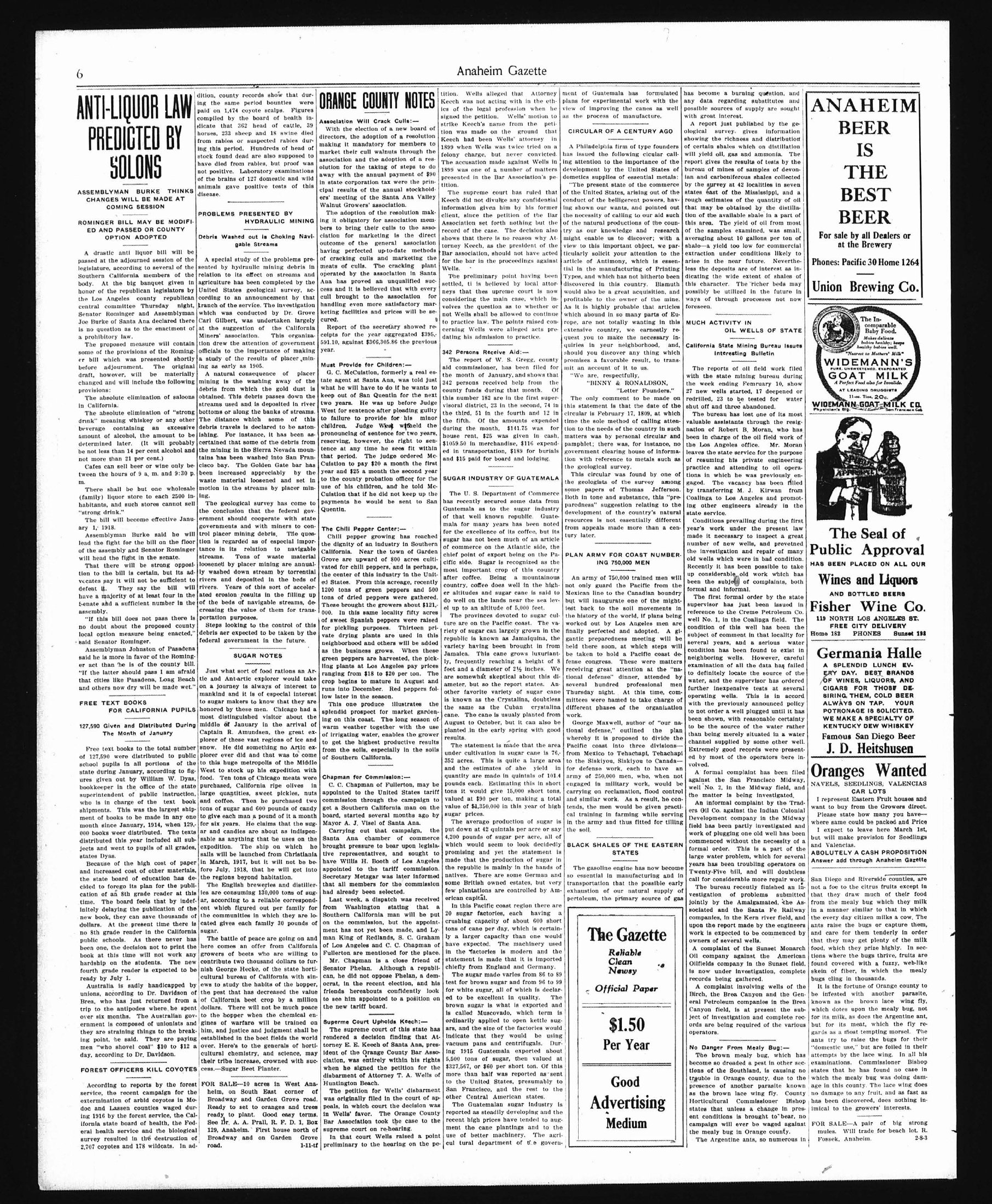
Searchable text
ANTI-LIQUOR LAW
PREDICTED BY
SOLONS
ASSEMBLYMAN BURKE THINKS
CHANGES WILL BE MADE AT
COMING SESSION
ROMINGER BILL MAY BE MODIFIED AND PASSED OR COUNTY OPTION ADOPTED
A drastic anti liquor bill will be passed at the adjourned session of the legislature, according to several of the Southern California members of the body. At the big banquet given in honor of the republican legislators by the Los Angeles county republican central committee Thursday night, Senator Rominger and Assemblyman Joe Burke of Santa Ana declared there is no question as to the enactment of a prohibitory law.
The proposed measure will contain some of the provisions of the Rominger bill which was presented shortly before adjournment. The original draft, however, will be materially changed and will include the following provisions:
The absolute elimination of saloons in California.
The absolute elimination of "strong drink" meaning whiskey or any other beverage containing an excessive amount of alcohol, the amount to be determined later. (It will probably edition, county records show that during the same period bounties were paid on 1,474 coyote scalps. Figures compiled by the board of health indicate that 362 head of cattle, 39 horses, 233 sheep and 18 swine died from rabies or suspected rabies during this period. Hundreds of head of stock found dead are also supposed to have died from rabies, but proof was not positive. Laboratory examinations of the brains of 127 domestic and wild animals gave positive tests of this disease.
PROBLEMS PRESENTED BY HYDRAULIC MINING
Debris Washed out is Choking Navigable Streams
A special study of the problems presented by hydraulic mining debris in relation to its effect on streams and agriculture has been completed by the United States geological survey, according to an announcement by that branch of the service. The investigation which was conducted by Dr. Grove Carl Gilbert, was undertaken largely at the suggestion of the California Miners' association. This organization drew the attention of government officials to the importance of making a study of the results of placer mining as early as 1905.
A natural consequence of placer mining is the washing away of the debris from which the gold dust is obtained. This debris passes down the streams used and is deposited in river bottoms or along the banks of streams. The distance which some of this debris travels is declared to be astonishing. For instance, it has been ascertained that some of the debris from the mining in the Sierra Nevada moun...
some of the provisions before adjournment. The original draft, however, will be materially changed and will include the following provisions:
The absolute elimination of saloons in California.
The absolute elimination of "strong drink" meaning whiskey or any other beverage containing an excessive amount of alcohol, the amount to be determined later. (It will probably be not less than 14 per cent alcohol and not more than 21 per cent.)
Cafes can sell beer or wine only between the hours of 9 a.m. and 9:30 p.m.
There shall be but one wholesale (family) liquor store to each 2500 inhabitants, and such stores cannot sell "strong drink."
The bill will become effective January 1, 1918.
Assemblyman Burke said he will lead the fight for the bill on the floor of the assembly and Senator Rominger will head the fight in the senate.
That there will be strong opposition to the bill is certain, but its advocates say it will not be sufficient to defeat it. They say the bill will have a majority of at least four in the Senate and a sufficient number in the assembly.
"If this bill does not pass there is no doubt about the proposed county local option measure being enacted," said Senator Rominger.
Assemblyman Johnston of Pasadena said he is more in favor of the Rominger act than he is of the county bill. "If the latter should pass I am afraid that cities like Pasadena, Long Beach and others now dry will be made wet."
FREE TEXT BOOKS FOR CALIFORNIA PUPILS
127,590 Given and Distributed During The Month of January
Free text books to the total number of 127,590 were distributed to public school pupils in all portions of the state during January, according to figures given out by William W. Dyas, bookkeeper in the office of the state superintendent of public instruction, who is in charge of the text book shipments. This was the largest shipment of books to be made in any one month since January, 1914, when 129,000 books weer distributed. The texts distributed this year included all subjects and went to pupils of all grades,
a study of the results of placer mining as early as 1905.
A natural consequence of placer mining is the washing away of the debris from which the gold dust is obtained. This debris passes down the streams used and is deposited in river bottoms or along the banks of streams.
The distance which some of this debris travels is declared to be astonishing. For instance, it has been ascertained that some of the debris from the mining in the Sierra Nevada mountains has been washed into San Francisco bay. The Golden Gate bar has been increased appreciably by the waste material loosened and set in motion in the streams by placer mining.
The geological survey has come to the conclusion that the federal government should cooperate with state governments and with miners to control placer mining debris. The question is regarded as of especial importance in its relation to navigable streams. Tons of waste material loosened by placer mining are annually washed down stream by torrential rivers and deposited in the beds of rivers. Years of this sort of accelerated erosion results in the filling up of the beds of navigable streams, decreasing the value of them for transportation purposes.
Steps looking to the control of this debris aer expected to be taken by the federal government in the future.
SUGAR NOTES
Just what sort of food rations an Artic and Ant-artic explorer would take on a journey is always of interest to mankind and it is of especial interest to sugar makers to know that they are honored by these men. Chicago had a most distinguished visitor about the middle of January in the arrival of Captain R. Amundsen, the great explorer of these vast regions of ice and snow. He did something no Artic explorer ever did and that was to come to this huge metropolis of the Middle West to stock up his expedition with food. Ten tons of Chicago meats were purchased, California ripe olives in large quantities, sweet pickles, nuts and coffee. Then he purchased two tons of sugar and 600 pounds of candy to give each man a pound of it a month for six years. He claims that the sugar and candies are about as indispensable as anything that he uses on the expedition. The ship on which he
Must Provide for:
G. C. McCulisty tate agent at San Francisco what he will have keep out of San Francisco two years. He West for sentence to failure to pro children. Judge pronouncing s reserved, however at any time that period. The Culstion to pay year and $25 a month to the county pro use of his child Culstion that if he payments he w Quentin.
The Chill Pepper
Chill pepper for the dignity of an California. Nearest Grove are upwavivated for chill peppers at center of third States. From 1200 tons of grit tons of dried peas These brought thou 000. In this case of sweet Spanish for pickling pure drying plants neighborhood and as the business green peppers al ling plants at L ranging from $1 crop begins to runs into December low later in the
This one provides splendid prospering on this coastal warm weather off irrigating water to get the high from the soils, of Southern Californi
Chapman for Co
C. C. Chapman appointed to this commission three get a Southern board, started s Mayor A. J. Visi Carrying out Santa Ana ch brought pressure
of 127,590 were distributed to public school pupils in all portions of the state during January, according to figures given out by William W. Dyas, bookkeeper in the office of the state superintendent of public instruction, who is in charge of the text book shipments. This was the largest shipment of books to be made in any one month since January, 1914, when 129,000 books weeer distributed. The texts distributed this year included all subjects and went to pupils of all grades, states Dyas.
Because of the high cost of paper and increased cost of other materials, the state board of education has decided to forego its plan for the publication of an 8th grade reader at this time. The board feels that by indefinitely delaying the publication of the new book, they can asse thousands of dollars. At the present time there is no 8th grade reader in the California public schools. As there never has been one, the decision not to print the book at this time will not work any hardship on the students. The new fourth grade reader is expected to be ready by July 1.
Australia is sadly handicapped by unions, according to Dr. Davidson of Brea, who has just returned from a trip to the antipodes where he spent over six months. The Australian government is composed of unionists and they are straining things to the breaking point, he said. They are paying men "who shovel coal" $10 to $12 a day, according to Dr. Davidson.
FOREST OFFICERS KILL COYOTES
According to reports by the forest service, the recent campaign for the extermination of arbid coyotes in Modoc and Lassen counties waged during 1916 by the forest service, the California state board of health, the Federal health service and the biological survey resulted in the destruction of 2,707 coyotes and 178 wildcats. In ad-
FOR SALE—10 acres in West Anaheim, on South East corner of Broadway and Garden Grove road. Ready to set to oranges and trees ready to plant. Good easy terms. See Dr. A. A. Prall, R. F. D. 1, Box 129, Anaheim. First house north of Broadway and on Garden Grove road.
Chapman for CoC. C. Chapman appointed to the commission three get a Southern board, started s Mayor A. J. Visi Carrying out Santa Ana ch brought pressure representa have Willis H. appointed to the Secretary Metz that all members had already beed Last week, a from Washington Southern California on the commiss ment has not yet man King of R of Los Angeles Fullerton are m Mr. Chapman Senator Phelan can, he did not ocrat, in the re friends hereabe to see him appe na new tariff b
Superme Court
The supreme rendered a decree torney E. E. Ke ident of the Org elation, was en when he signed disbarment of A Huntington BeaThe petition was originally f peals, in which in Wells' favor Bar Association supreme court u In that court preliminary to
Anaheim Gazette
ORANGE COUNTY NOTES
Association Will Crack Culls:
With the election of a new board of directors, the adoption of a resolution making it mandatory for members to market their cull walnuts through the association and the adoption of a resolution for the taking of steps to do away with the annual payment of $90 in state corporation tax were the principal results of the annual stockholders' meeting of the Santa Ana Valley Walnut Growers' association.
The adoption of the resolution making it obligatory for association members to bring their culls to the association for marketing is the direct outcome of the general association having perfected up-to-date methods of cracking culls and marketing the meats of culls. The cracking plant operated by the association in Santa Ana has proved an unqualified success and it is believed that with every brought to the association for handling even more satisfactory marketing facilities and prices will be secured.
Report of the secretary showed receipts for the year aggregated $395,591.10, against $366,305.86 the previous year.
Must Provide for Children:
G. C. McCulston, formerly a real estate agent at Santa Ana, was told just what he will have to do if he wants to keep out of San Quentin for the next two years. He was up before Judge West for sentence after pleading guilty to failure to provide for his minor children. Judge West withheld the pronouncing of sentence for two years, reserving, however, the right to sentence at any time he sees fit within titition. Wells alleged that Attorney Keech was not acting with in the ethics of the legal profession when he signed the petition. Wells' motion to strike Keech's name from the petition was made on the ground that Keech had been Wells' attorney in 1899 when Wells was twice tried on a felony charge, but never convicted. The accusation made against Wells in 1899 was one of a number of matters presented in the Bar Association's petition.
The supreme court has ruled that Keech did not divulge any confidential information given him by his former client, since the petition of the Bar Association set forth nothing but the record of the case. The decision also shows that there is no reason why Attorney Keech, as the president of the Bar association, should not have acted for the bar in the proceedings against Wells.
The preliminary point having been settled, ti is believed by local attorneys that these supreme court is now considering the main case, which involves the question as to whether or not Wells shall be allowed to continue to practice law. The points raised concerning Wells were alleged acts pre-dating his admission to practice.
342 Persons Receive Aid:
The report of W. S. Gregg, county aid commissioner, has been filed for the month of January, and shows that 342 persons received help from the county funds during that month. Of this number 182 are in the first supervisorial district, 23 in the second, 74 in the third, 51 in the fourth and 12 in the fifth. Of the amounts expended during the month, $141.75 was for house rent, $25 was given in cash, $1059.50 in merchandise, $116 expenditure of Guatemala has formulated plans for experimental work with the view of improving the canes as well as the process of manufacture.
CIRCULAR OF A CENTURY AGO
A Philadelphia firm of type founders has issued the following circular calling attention to the importance of the development by the United States of domestics supplies of essential metals:
"The present state of the commerce of the United States, arising out of the conduct of the belligerent powers, having shown our wants, and pointed out the necessity of calling to our aid such of the natural productions of the country as our knowledge and research might enable us to discover; with a view to this important object, we particularly solicit your attention to the article of Antimony, which is essential in the manufacturing of Printing Types, and which has not hitherto been discovered in this country. Bismuth would also be a great acquisition, and profitable to the owner of the mine. As it is highly probable that articles which abound in so many parts of Europe, are not totally wanting in this extensive country, we earnestly request you to make the necessary inquiries in your neighborhood, and, should you discover anything which promises a favorable result, to transmit an account of it to us.
"We are, respectfully,
"BINNY & RONALDSON,
"Letter Founders."
The only comment to be made on this statement is that the date of the circular is February 17, 1809, at which time the sole method of calling attention to the needs of the country in such matters was by personal circular and pamphlet; there was, for instance, no
Must Provide for Children:—
G. C. McCuliston, formerly a real estate agent at Santa Ana, was told just what he will have to do if he wants to keep out of San Quentin for the next two years. He was up before Judge West withheld the pronouncing of sentence for two years, reserving, however, the right to sentence at any time he sees fit within that period. The judge ordered McCuliston to pay $20 a month the first year and $25 a month the second year to the county probation officer for the use of his children, and he told McCuliston that if he did not keep up the payments he would be sent to San Quentin.
The Chili Pepper Center:—
Chili pepper growing has reached the dignity of an industry in Southern California. Near the town of Garden Grove are upward of 800 acres cultivated for chili peppers, and is perhaps, the center of this industry in the United States. From this acreage, recently 1200 tons of green peppers and 500 tons of dried peppers were gathered. These brought the growers about $121,000. In this same locality fifty acres of sweet Spanish peppers were raised for pickling purposes. Thirteen private drying plants are used in this neighborhood and others will be added as the business grows. When these green peppers are harvested, the pickling plants at Los Angeles pay prices ranging from $18 to $20 per ton. The crop begins to mature in August and runs into December. Red peppers follow later in the season.
This one produce illustrates the splendid prospect for market gardening on this coast. The long season of warm weather together with the use of irrigating water, enables the grower to get the highest productive results from the soils, especially in the soils of Southern California.
Chapman for Commission:—
C. C. Chapman of Fullerton, may be appointed to the United States tariff commission through the campaign to get a Southern California man on the board, started several months ago by Mayor A. J. Visel of Santa Ana.
Carrying out that campaign, the Santa Ana chamber of commerce brought pressure to bear upon legislature.
The report of W. S. Gregg, county aid commissioner, has been filed for the month of January, and shows that 342 persons received help from the county funds during that month. Of this number 182 are in the first supervisorial district, 23 in the second, 74 in the third, 51 in the fourth and 12 in the fifth. Of the amounts expended during the month, $141.75 was for house rent, $25 was given in cash, $1059.50 in merchandise, $116 expenditure in transportation, $189 for burials and $15 paid for board and lodging.
SUGAR INDUSTRY OF GUATEMALA
The U. S. Department of Commerce has recently secured some data from Guatemala as to the sugar industry of that well known republic. Guatemala for many years has been noted for the excellence of its coffee, but its sugar has not been much of an article of commerce on the Atlantic side, the chief point of export being on the Pacific side. Sugar is recognized as the most important crop of this country after coffee. Being a mountainous country, coffee does well in the higher altitudes and sugar cane is said to do well on the lands near the sea level up to an altitude of 5,000 feet.
The provinces devoted to sugar culture are on the Pacific coast. The variety of sugar can largely grown in the republic is known as Jamaliquina, the variety having been brought in from Jamaica. This cane grows luxuriantly, frequently reaching a height of 8 feet and a diameter of 2½ inches. We are somewhat skeptical about this diameter, but so the report states. Another favorite variety of sugar cane is known as the Crystalina, doubtless the same as the Cuban crystallina cane. The cane is usually planted from August to October, but it can also be planted in the early spring with good results.
The statement is made that the area under cultivation in sugar cane is 76.352 acres. This is quite a large area and the estimates of ahe yield in quantity are made in quintals of 101.4 pounds each. Estimating this in short tons it would give 15,000 short tons, valued at $90 per ton, making a total value of $1,350,000 in this year of high sugar prices.
The average production of sugar is put down at 42 quintals per acre or say 4,200 pounds of sugar per acre, all of which would seem to look decidedly promising.
"We are, respectfully,
"BINNY & RONALDSON,
"Letter Founders."
The only comment to be made on this statement is that the date of the circular is February 17, 1809, at which time the sole method of calling attention to the needs of the country in such matters was by personal circular and pamphlet; there was, for instance, no government clearing house of information with reference to metals such as the geological survey.
This circular was found by one of the geologists of the survey among some papers of Thomas Jefferson. Both in tone and substance, this "preparedness" suggestion relating to the development of the country's natural resources is not essentially different from appeals made more than a century later.
PLAN ARMY FOR COAST NUMBERING 750,000 MEN
An army of 750,000 trained men will not only guard the Pacific from the Mexican line to the Canadian boundry but will inaugurate one of the mightiest back to the soil movements in the history of the world, if plans being worked out by Los Angeles men are finally perfected and adopted. A gigantic preparedness meeting will be held there soon, at which steps will be taken to hold a Pacific coast defense congress. These were matters receiving great attention at the "national defense" dinner, attended by several hundred professional men Thursday night. At this time, committees were hamed to take charge of different phases of the organization work.
George Maxwell, author of "our national defense," outlined the plan whereby it is proposed to divide the Pacific coast into three divisions—from Mexico to Tehachapi, Tehachapi to the Siskiyou, Siskiyou to Canada—for defense work, each to have an army of 250,000 men, who, when not engaged in military work, would be carrying on reclamation, flood control and similar work. As a result, he contends, the men would be given practical training in farming while serving in the army and thus fitted for tilling the soil.
BLACK SHALES OF THE EASTERN
Chapman for Commission:—
C. C. Chapman of Fullerton, may be appointed to the United States tariff commission through the campaign to get a Southern California man on the board, started several months ago by Mayor A. J. Visel of Santa Ana.
Carrying out that campaign, the Santa Ana chamber of commerce brought pressure to bear upon legislative representatives, and sought to have Willis H. Booth of Los Angeles appointed to the tariff commission. Secretary Metzgar was later informed that all members for the commission had already been selected.
Last week, a dispatch was received from Washington stating that a Southern California man will be put on the commission, but the appointment has not yet been made, and Lyman King of Redlands, S. C. Graham of Los Angeles and C. C. Chapman of Fullerton are mentioned for the place.
Mr. Chapman is a close friend of Senator Phelan. Although a republican, he did not oppose Phelan, a democrat, in the recent election, and his friends hereabouts confidently look to see him appointed to a position on the new tariff board.
Superme Court Upholds Keech:—
The supreme court of this state has rendered a decision finding that Attorney E. E. Keech of Santa Ana, president of the Orange County Bar Association, was entirely within his rights when he signed the petition for the disbarment of Attorney T. A. Wells of Huntington Beach.
The petition for Wells' disbarment was originally filed in the court of appeals, in which court the decision was in Wells' favor. The Orange County Bar Association took the case to the supreme court on re-hearing.
In that court Wells raised a point preliminary to the hearing on the pe-
352 acres. This is quite a large area and the estimates of ahe yield in quantity are made in quintals of 101.4 pounds each. Estimating this in short tons it would give 15,000 short tons, valued at $90 per ton, making a total value of $1,350,000 in this year of high sugar prices.
The average production of sugar is put down at 42 quintals per acre or say 4,200 pounds of sugar per acre, all of which would seem to look decidedly promising and yet the statement is made that the production of sugar in the republic is mainly in the hands of natives. There are some German and some British owned estates, but very few plantations are controlled by American capital.
In this Pacific coast region there are 20 sugar factories, each having a crushing capacity of about 600 short tons of cane per day, which is certainly a larger capacity than one would have expected. The machinery used in the factories is modern and the statement is made that it is imported chiefly from England and Germany.
The sugar made varies from 86 to 89 test for brown sugar and from 96 to 99 for white sugar, all of which is declared to be excellent in quality. The brown sugar is what is exported and is called Muscovado, which term is ordinarily applied to open kettle sugars, and the size of the factories would indicate that they would be using vacuum pans and centrifugals. During 1915 Guatemala exported about 5,500 tons of sugar, then valued at $327,567, or $60 per short ton. Of this more than half was reported as sent to the United States, presumably to San Francisco, and the rest to the other Central American states.
The Guatemalan sugar industry is reported as steadily developing and the recent high prices have tended to augment the cane plantings and to the use of better machinery. The agricultural department of the govern-
has become a burning question, and any data regarding substitutes and possible sources of supply are sought with great interest.
A report just published by the geological survey gives information showing the richness and distribution of certain shales which on distillation will yield oil, gas and ammonia. The report gives the results of tests by the bureau of mines of samples of devonian and carboniferous shales collected by the survey at 42 localities in seven states east of the Mississippi, and a rough estimates of the quantity of oil that may be obtained by the distillation of the available shale in a part of this area. The yield of oil from most of the samples examined, was small, averaging about 10 gallons per ton of shale—a yield too low for commercial extraction under conditions likely to arise in the near future. Nevertheless the deposits are of interest as indicating the wide extent of shales of this character. The richer beds may possibly be utilized in the future in ways of through processes not now foreseen.
MUCH ACTIVITY IN OIL WELLS OF STATE
California State Mining Bureau Issues Interesting Bulletin
The reports of oil field work filed with the state mining bureau during the week ending February 10, show 27 new wells started, 17 deepened or redrilled, 23 to be tested for water shut off and three abandoned.
The bureau has lost one of its most valuable assistants through the resignation of Robert B. Moran, who has been in charge of the oil field work of the Los Angeles office. Mr. Moran
The reports of oil field work filed with the state mining bureau during the week ending February 10, show 27 new wells started, 17 deepened or redrilled, 23 to be tested for water shut off and three abandoned.
The bureau has lost one of its most valuable assistants through the resignation of Robert B. Moran, who has been in charge of the oil field work of the Los Angeles office. Mr. Moran leaves the state service for the purpose of resuming his private engineering practice and attending to oil operations in which he was previously engaged. The vacancy has been filled by transferring M. J. Kirwan from Coalinga to Los Angeles and promoting other engineers already in the state service.
Conditions prevailing during the first year's work under the present law made it necessary to inspect a great number of new wells, and prevented the investigation and repair of many old wells which were in bad condition. Recently it has been possible to take up considerable old work which has been the subject of complaints, both formal and informal.
The first formal order by the state supervisor has just been issued in reference to the Creme Petroleum Co. well No. 1, in the Coalinga field. The condition of this well has been the subject of comment in that locality for several years, and a serious water condition has been found to exist in neighboring wells. However, careful examination of all the data has failed to definitely locate the source of the water, and the supervisor has ordered further inexpensive tests at several operating wells. This is in accord with the previously announced policy to not order a well plugged until it has been shown, with reasonable certainty to be the source of the water rather than being merely situated in a water channel supplied by some other well. Extremely good records were presented by most of the operators here involved.
A formal complaint has been filed against the San Francisco Midway, well No. 2, in the Midway field, and the matter is being investigated.
An informal complaint by the Traders Oil Co. against the Indian Colonial Development company in the Midway field has been partly investigated and work of plugging one old well has been commenced without the necessity of a formal order. This is a part of the
Oranges Wanted
NAVELS, SEEDLINGS; VALENCIAS CAR LOTS
I represent Eastern Fruit houses and want to buy from the Growers direct.
Please state how many you have—where same could be packed and Price
I expect to leave here March 1st, but will make provision for Seedlings and Valencias.
OF THE EASTERN
ATES
engine has now become manufacturing and in
that the possible early
natural supply of
primary source of gas
Gazette
Available
an
newy
al Paper
1.50 Year
food
ertising
dium
A formal complaint has been filed against the San Francisco Midway,
well No. 2, in the Midway field, and
the matter is being investigated.
An informal complaint by the Traders Oil Co. against the Indian Colonial Development company in the Midway field has been partly investigated and work of plugging one old well has been commenced without the necessity of a formal order. This is a part of the large water problem, which for several years has been troubling operators on Twenty-Five hill, and will doubtless call for considerable more repair work.
The bureau recently finished an investigation of problems submitted jointly by the Amalgamated, the Associated and the Santa Fe Railway companies, in the Kern river field, and upon the report made by the engineers work is expected to be commenced by owners of several wells.
A complaint of the Sunset Monarch Oil company against the American Oilfields company in the Sunset field, is now under investigation, complete records being gathered.
A complaint involving wells of the Birch, the Brea Canyon and the General Petroleum companies in the Brea Canyon field, is at present the subject of investigation and complete records are being required of the various operators.
No Danger From Mealy Bug:—
The brown mealy bug, which has become so dreaded a pest in other sections of the Southland, is causing no trouble in Orange county, due to the presence of another parasite known as the brown lace wing fly. County Horticultural Commissioner Bishop states that unless a change in present conditions is brought to bear, no campaign will ever be waged against the mealy bug in Orange county.
The Argentine ants, so numerous in
Oranges Wanted
NAVELS, SEEDLINGS, VALENCIAS CAR LOTS
I represent Eastern Fruit houses and want to buy from the Growers direct.
Please state how many you have—where same could be packed and Price I expect to leave here March 1st, but will make provision for Seedlings and Valencias.
ABOLUTELY A CASH PROPOSITION Answer add through Anaheim Gazette
San Diego and Riverside counties, are not a foe to the citrus fruits except in that they draw much of their food from the mealy bug which they milk in a manner similar to that in which the every day citizen milks a cow. The ants raise the bugs or capture them, and care for them tenderly in order that they may get plenty of the milk food, which they prize highly. In sections where the bugs thrive, fruits are found covered with a fuzzy, web-like skein of fiber, in which the mealy bugs cling in thousands.
It is the fortune of Orange county to be infested with another parasite, known as the brown lace wing fly, which dotes upon the mealy bug, not for its milk, as does the Argentine ant, but for its meat, which the fly regards as a most tempting morsel. The ants try to raise the bugs for their "domestic use," but are foiled in their attempts by the lace wing. In all his examinations. Commissioner Bishop states that he has found no case in which the mealy bug was doing damage in this county. The lace wing does no damage to any fruit, and as fast as has been discovered, does nothing imical to the growers' interests.
FOR SALE—A pair of big strong mules. Will trade for beach lot. R. Fossek, Anaheim. 2-8-3