anaheim-gazette 1917-02-08
Scanned page
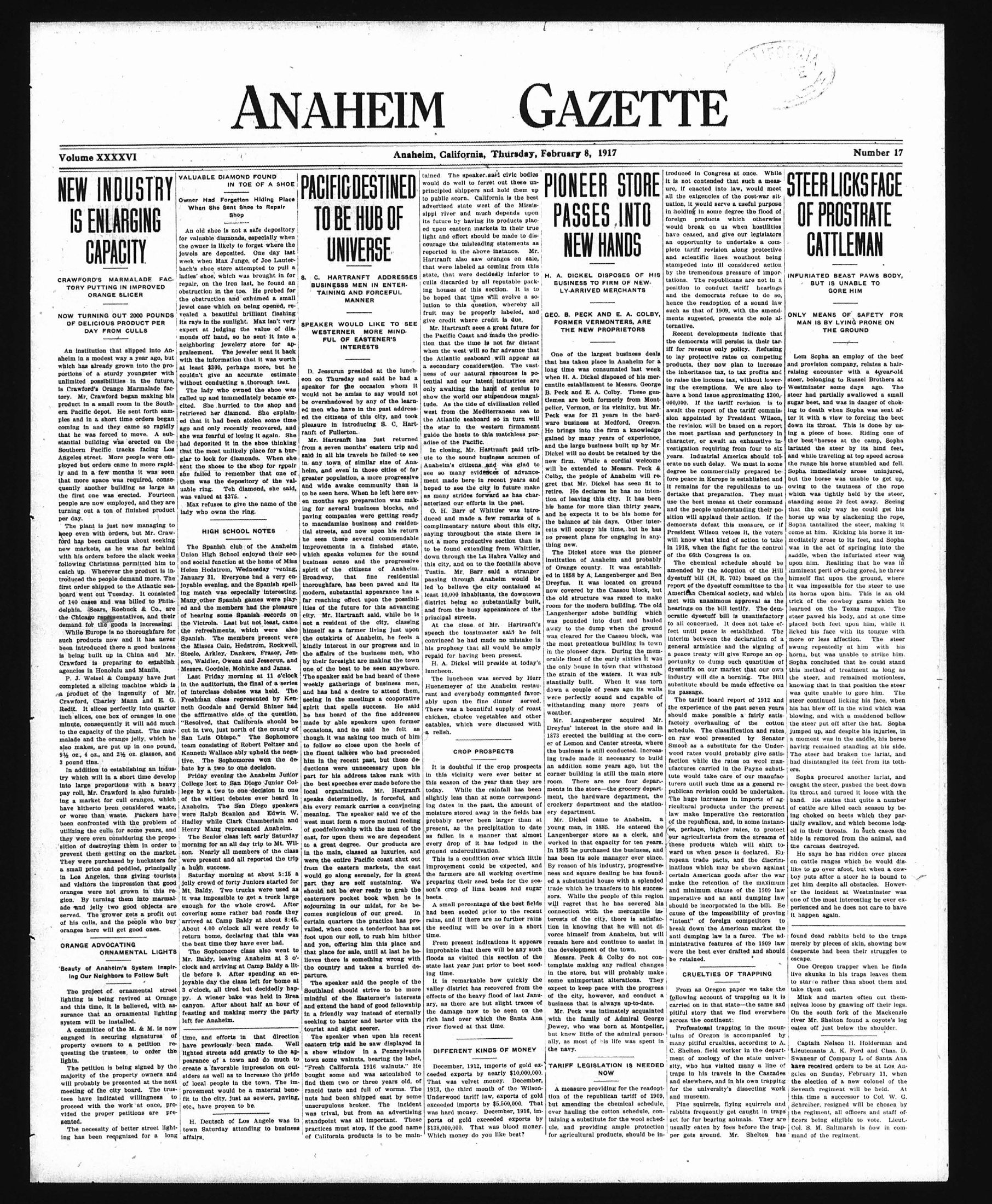
Searchable text
NEW INDUSTRY IS ENLARGING CAPACITY.
CRAWFORD'S MARMALADE FACTORY PUTTING IN IMPROVED ORANGE SLICER
NOW TURNING OUT 2000 POUNDS OF DELICIOUS PRODUCT PER DAY FROM CULLS
An institution that slipped into Anaheim in a modest way a year ago, but which has already grown into the proportions of a sturdy youngster with unlimited possibilities in the future, is Crawford's Orange Marmalade factory. Mr. Crawford began making his product in a small room in the Southern Pacific depot. He sent forth samples and in a short time orders began coming in and they came so rapidly that he was forced to move. A substantial building was erected on the Southern Pacific tracks facing Los Valuable Diamond Found In Toe Of A Shoe
Owner Had Forgetten Hiding Place When She Sent Shoe to Repair Shop
An old shoe is not a safe depository for valuable diamonds, especially when the owner is likely to forget where the jewels are deposited. One day last week when Max Junge, of Joe Lauterbach's shoe store attempted to pull a ladies' shoe, which was brought in for repair, on the iron last, he found an obstruction in the toe. He probed for the obstruction and exhumed a small jewel case which on being opened, revealed a beautiful brilliant flashing its rays in the sunlight. Max isn't very expert at judging the value of diamonds off hand, so he sent it into a neighboring jewelry store for appraisement. The Jeweler sent it back with the information that it was worth at least $300, perhaps more, but he couldn't give an accurate estimate without conducting a thorough test.
The lady who owned the shoe was called up and immediately became excited. She hurried to the shop and retrieved her diamond. She explained that it had been stolen some time ago and only recently recovered, and she was fearful of losing it again. She had deposited it in the shoe thinking
PACIFIC DESIGN TO BE HU UNIVERS
S. C. HARTRANFT BUSINESS MEN TAINING AND MANNE
SPEAKER WOULD WESTERNER MO FUL OF EAST INTERES
D. Jessurun presided eon on Thursday and speaker for the occasion would not be amiss to be overshadowed by an ed men who have in th ed the citizens of this pleasure in introducing ranft of Fullerton.
Mr. Hartranft has from a seven months'
aheim in a modest way a year ago, but which has already grown into the proportions of a sturdy youngster with unlimited possibilities in the future, is Crawford's Orange Marmalade factory. Mr. Crawford began making his product in a small room in the Southern Pacific depot. He sent forth samples and in a short time orders began coming in and they came so rapidly that he was forced to move. A substantial building was erected on the Southern Pacific tracks facing Los Angeles street. More people were employed but orders came in more rapidly and in a few months it was seen that more space was required, consequently another building as large as the first one was erected. Fourteen people are now employed, and they are turning out a ton of finished product per day.
The plant is just now managing to keep even with orders, but Mr. Crawford has been cautious about seeking new markets, as he was far behind with his orders before the slack weeks following Christmas permitted him to catch up. Wherever the product is introduced the people demand more. The first order shipped to the Atlantic seaboard went out Tuesday. It consisted of 140 cases and was billed to Philadelphia. Sears, Roebuck & Co., are the Chicago representatives, and their demand for the goods is increasing.
While Europe is no thoroughfare for such products now and it has never been introduced there a good business is being built up in China and Mr. Crawford is preparing to establish agencies in Honolulu and Manila.
P. J. Weisel & Company have just completed a slicing machine which is a product of the ingenuity of Mr. Crawford, Charley Mann and E. G. Redit. It slices perfectly into quarter inch slices, one box of oranges in one minute, consequently it will add much to the capacity of the plant. The marmalade and the orange jelly, which he also makes, are put up in one pound, 9½ oz., 4 oz., and 2½ oz. glasses, and 3 pound tins.
In addition to establishing an industry which will in a short time develop into large proportions with a heavy pay roll, Mr. Crawford is also furnishing a market for cull oranges, which have hitherto been considered waste, or worse than waste. Packers have been confronted with the problem of utilizing the culls for some years, and they were even considering the proposition of destroying them in order to
HIGH SCHOOL NOTES
The Spanish club of the Anaheim Union High School enjoyed their second social function at the home of Miss Helen Hedstrom, Wednesday evening, January 31. Everyone had a very enjoyable evening, and the Spanish spelling match was especially interesting. Many other Spanish games were played and the members had the pleasure of hearing some Spanish records on the Victrola. Last but not least, came the refreshments, which were also Spanish. The members present were the Misses Cain, Hedstrom, Rockwell, Steele, Arkley, Dankers, Fraser, Jensen, Waldler, Owens and Jesserun, and Messrs. Goodale, Mohinke and Janss.
Last Friday morning at 11 o'clock in the auditorium, the final of a series of interclass debates was held. The Freshman class represented by Kenneth Goodale and Gerald Shiner had the affirmative side of the question, "Resolved, that California should be cut in two, just north of the county of San Luis Obispo." The Sophomore team consisting of Robert Peltzer and Kenneth Wallace ably upheld the negative. The Sophomores won the debate by a two to one decision.
Friday evening the Anaheim Junior College lost to San Diego Junior College by a two to one decision in one of the wittiest debates ever heard in Anaheim. The San Diego speakers were Ralph Scanlon and Edwin W. Hadley while Clark Chamberlain and Henry Mang represented Anaheim.
The Senior class left early Saturday morning for an all day trip to Mt. WilDEN with the information that it was worth at least $300, perhaps more, but he couldn't give an accurate estimate without conducting a thorough test.
The lady who owned the shoe was called up and immediately became excited. She hurried to the shop and retrieved her diamond. She explained that it had been stolen some time ago and only recently recovered, and she was fearful of losing it again. She had deposited it in the shoe thinking that the most unlikely place for a burglar to look for diamonds. When she sent the shoes to the shop for repair she failed to remember that one of them was the depository of the valuable ring. Teh diamond, she said, was valued at $375.
Max refuses to give the name of the lady who owns the ring.
D. Jessurun presided over on Thursday and gave a speaker for the occasion would not be amiss to be overshadowed by an ed men who have in this pleasure in introducing ranft of Fullerton.
Mr. Hartranft has from a seven months' sale said in all his travels in any town of similar helm, and even in those greater population, a man and wide awake come to be seen here. When he sees these several improvements in a city which speaks volumes business sense and spirit of the citizens Broadway, that flourishfare, has been modern, substantial apart far reaching effect upon titles of the future for city. Mr. Hartranft does not a resident of the himself as a farmer like outskirts of Anaheim kindly interest in our affairs of the business by their foresight are none of the best to be The speaker said he has weekly gatherings of and has had a desire seeing in the meeting spirit that spells such he has heard of them made by able speakers occasions, and he said though it was asking to follow so close up the fluent talkers when him in the recent part for his address best speeches ever local organization speaks determinedly, his every remark carries meaning. The speaker west must form a more good fellowship with east, for upon them wipe to a great degree.
In addition to establishing an industry which will in a short time develop into large proportions with a heavy pay roll, Mr. Crawford is also furnishing a market for cull oranges, which have hitherto been considered waste, or worse than waste. Packers have been confronted with the problem of utilizing the culls for some years, and they were even considering the proposition of destroying them in order to prevent them getting on the market. They were purchased by hucksters for a small price and peddled, principally in Los Angeles, thus giving tourists and visitors the impression that good oranges were not grown in this region. By turning them into marmalade and jelly two good objects are served. The grower gets a profit out of his culls, and the people who buy oranges here will get good ones.
ORANGE ADVOCATING ORNAMENTAL LIGHTS
Beauty of Anaheim's System Inspiring Our Neighbors to Follow Sult
The project of ornamental street lighting is being revived at Orange and this time, it is believed, with assurance that an ornamental lighting system will be installed.
A committee of the M. & M. is now engaged in securing signatures of property owners to a petition requesting the trustees to order the lights.
The petition is being signed by the majority of the property owners and will probably be presented at the next meeting of the city board. The trustees have indicated willingness to proceed with the work at once, provided the proper petitions are presented.
The necessity of better street lighting has been recognized for a long time, and efforts in that direction have previously been made. Well lighted streets add greatly to the appearance of a town and do much to create a favorable impression on outsiders as well as to increase the pride of local people in the town. The improvement would be a material benefit to the city, just as sewers, paving, etc., have proven to be.
H. Deutsch of Los Angele was in town Saturday attending to business affairs.
Friday evening the Anaheim Junior College lost to San Diego Junior College by a two to one decision in one of the wittiest debates ever heard in Anaheim. The San Diego speakers were Ralph Scanlon and Edwin W. Hadley while Clark Chamberlain and Henry Mang represented Anaheim.
The Senior class left early Saturday morning for an all day trip to Mt. Wilson. Nearly all members of the class were present and all reported the trip a hugh success.
Saturday morning at about 5:15 a jolly crowd of forty Juniors started for Mt. Baldy. Two trucks were used as it was impossible to get a truck large enough for the whole crowd. After covering some rather bad roads they arrived at Camp Baldy at about 8:45. About 4.00 o'clock all were ready to return home, declaring that this was the best time they have ever had.
The Sophomore class also went to Mr. Baldy, leaving Anaheim at 3 o'clock and arriving at Camp Baldy a little before 9. After spending an enjoyable day the class left for home at 3 o'clock, all tired but decidedly happy. AWiener bake was held in Brea canyon. After about half an hour of feasting and making merry the party left for Anaheim.
Time, and efforts in that direction have previously been made. Well lighted streets add greatly to the appearance of a town and do much to create a favorable impression on outsiders as well as to increase the pride of local people in the town. The improvement would be a material benefit to the city, just as sewers, paving, etc., have proven to be.
H. Deutsch of Los Angele was in town Saturday attending to business affairs.
The speaker when he saw eastern trip said he saw a show window in town some walnuts, but "Fresh California 1992 bought some and we find them two or three rancid taste and full nuts had been shipped unscrupulous broker." was trivial, but from standpoint was all in practices must stop, of California products...
NAHEIM GAZETTE
Anaheim, California, Thursday, February 8, 1917
PACIFIC DESTINED TO BE HUB OF UNIVERSE
S. C. HARTRANFT ADDRESSES BUSINESS MEN IN ENTERTAINING AND FORCEFUL MANNER
SPEAKER WOULD LIKE TO SEE WESTERNER MORE MINDFUL OF EASTENER'S INTERESTS
D. Jessurun presided at the luncheon on Thursday and said he had a speaker for the occasion whom it would not be amiss to say would not be overshadowed by any of the learned men who have in the past addressed the citizens of this city, and took pleasure in introducing S. C. Hartranft of Fullerton.
Mr. Hartranft has just returned from a seven months' eastern trip andtained. The speaker said civic bodies would do well to ferret out these unprincipled shippers and hold them up to public scorn. California is the best advertised state west of the Mississippi river and much depends upon its future by having its products placed upon eastern markets in their true light and effort should be made to discourage the misleading statements as reported in the above instance. Mr. Hartranft also saw oranges on sale, that were labeled as coming from this state, that were decidedly inferior to culls discarded by all reputable packing houses of this section. It is to be hoped that time will evolve a solution to this question, whereby all fruit may be properly labeled, and give credit where credit is due.
Mr. Hartranft sees a great future for the Pacific Coast and made the prediction that the time is not far distant when the west will so far advance that the Atlantic seaboard will appear as a secondary consideration. The vastness of our natural resources is potential and our latent industries are only awaiting the hand of genius to show the world our stupendous magnitude. As the tide of civilization rolled west from the Mediterranean sea to the Atlantic seaboard so in turn will the star in the western firmament guide the hosts to this matchless paradise of the Pacific.
PIONEER STORE PASSES INTO NEW HANDS
H. A. DICKEL DISPOSES OF HIS BUSINESS TO FIRM OF NEWLY-ARRIVED MERCHANTS
GEO. B. PECK AND E. A. COLBY, FORMER VERMONTERS, ARE THE NEW PROPRIETORS
One of the largest business deals that has taken place in Anaheim for a long time was consumed last week when H. A. Dickel disposed of his mercantile establishment to Messrs. George B. Peck and E. A. Colby. These gentlemen are both formerly from Montpelier, Vermon, or its vicinity, but Mr. Peck was for 21 years in the hardware business at Medford, Oregon. He brings into the firm a knowledge gained by many years of experience, and the large business built up by Mr.
Recent dthe democracy iff for reveal to lay proft products, ththe inheritance to raise the exegetive have a bond of 000,000. If await the reapplication the revision the most p character, o
D. Jessurun presided at the luncheon on Thursday and said he had a speaker for the occasion whom it would not be amiss to say would not be overshadowed by any of the learned men who have in the past addressed the citizens of this city, and took pleasure in introducing S. C. Hartranft of Fullerton.
Mr. Hartranft has just returned from a seven months' eastern trip and said in all his travels he failed to see in any town of similar size of Anaheim, and even in those cities of far greater population, a more progressive and wide awake community than is to be seen here. When he left here seven months ago preparation was making for several business blocks, and paving companies were getting ready to macadamize business and residential streets, and now upon his return he sees these several commendable improvements in a finished state, which speaks volumes for the sound business sense and the progressive spirit of the citizens of Anaheim. Broadway, that fine residential thoroughfare, has been paved and its modern, substantial appearance has a far reaching effect upon the possibilities of the future for this advancing city. Mr. Hartranft said, while he is not a resident of the city, classing himself as a farmer living just upon the outskirts of Anaheim, he feels a kindly interest in our progress and in the affairs of the business men, who by their foresight are making the town one of the best to be seen anywhere. The speaker said he had heard of these weekly gatherings of business men, and has had a desire to attend them, seeing in the meetings a cooperative spirit that spells success. He said he has heard of the fine addresses made by able speakers upon former occasions, and he said he felt though it was asking too much of him to follow so close upon the heels of the fluent talkers who had preceded him in the recent past, but these deductions were unnecessary upon his part for his address takes rank with the best speeches ever made before the local organization. Mr. Hartranft speaks determinedly, is forceful, and his every remark carries a convincing meaning. The speaker said we of the west must form a more mutual feeling of good fellowship with the men of the east, for upon them we are dependent to a great degree. Our products are
CROP PROSPECTS
It is doubtful if the crop prospects in this vicinity were ever better at this season of the year than they are today. While the rainfall has been slightly less than at some corresponding dates in the past, the amount of moisture stored away in the fields has probably never been larger than at present, as the precipitation to date as fallen in a manner that almost every drop of it has lodged in the Atlantic seaboard will appear as a secondary consideration. The vastness of our natural resources is potential and our latent industries are only awaiting the hand of genius to show the world our stupendous magnitude. As the tide of civilization rolled west from the Mediterranean sea to the Atlantic seaboard so in turn will the star in the western firmament guide the hosts to this matchless paradise of the Pacific.
In closing, Mr. Hartranft paid tribute to the sound business acumen of Anaheim's citizens and was glad to see so many evidences of advancement made here in recent years and hoped to see the city in future make as many strides forward as has characterized our efforts in the past.
O. H. Barr of Whittler was introduced and made a few remarks of a complimentary nature about this city, saying throughout the state there is not a more productive section than is to be found extending from Whittler, down through the La Habra Valley and this city, and on to the foothills above Tustin. Mr. Barr said a stranger passing through Anaheim would be led to believe the city contained at least 10,000 inhabitants, the downtown district being so substantially built, and from the busy appearances of the principal streets.
At the close of Mr. Hartranft's speech the toastmaster said he felt convinced he had made no mistake in his prophesy that all would be amply repaid for having been present.
H. A. Dickel will preside at today's luncheon.
The luncheon was served by Herr Huenemeyer of the Anaheim restaurant and everybody commented favorably upon the fine dinner served. There was a bountiful supply of roast chicken, choice vegetables and other eatables, which were discussed with a relish.
Mr. Langenberger acquired Mr. Dreyfus' interest in the store and in 1873 erected the building at the corner of Lemon and Center streets, where the business is still conducted. Increasing trade made it necessary to build an addition some years ago, but the corner building is still the main store room. There are now four departments in the store—the grocery department, the hardware department, the crockery department and the stationery department.
Mr. Dickel came to Anaheim, a young man, in 1885. He entered the Langenberger store as a clerk, and worked in that capacity for ten years. In 1895 he purchased the business, and one of the largest business deals that has taken place in Anaheim for a long time was consumed last week when H. A. Dickel disposed of his mercantile establishment to Messrs. George B. Peck and E. A. Colby. These gentlemen are both formerly from Montpelier, Vermon, or its vicinity, but Mr. Peck was for 21 years in the hardware business at Medford, Oregon. He brings into the firm a knowledge gained by many years of experience, and the large business built up by Mr. Dickel will no doubt be retained by the new firm. While a cordial welcome will extended to Messrs. Peck & Colby, the people of Anaheim will regret that Mr. Dickel has seen fit to retire. He declares he has no intention of leaving this city. It has been his home for more than thirty years, and he expects it to be his home for the balance of his days. Other interests will occupy his time, but he has no present plans for engaging in anything new.
The Dickel store was the pioneer institution of Anaheim and probably of Orange county. It was established in 1858 by A. Langenberger and Ben Dreyfus. It was located on ground now covered by the Cassou block, but the old structure was razed to make room for the modern building. The old Langenberger adobe building which was pounded into dust and hauled away to the dump when the ground was cleared for the Cassou block, was the most pretentious building in town in the pioneer days. During the memorable flood of the early sixties it was only house in town that withstood the strain of the waters. It was substantially built. When it was torn down a couple of years ago its walls were perfectly sound and capable of withstanding many more years of weather.
Mr. Langenberger acquired Mr. Dreyfus' interest in the store and in 1873 erected the building at the corner of Lemon and Center streets, where the business is still conducted. Increasing trade made it necessary to build an addition some years ago, but the corner building is still the main store room. There are now four departments in the store—the grocery department, the hardware department, the crockery department and the stationery department.
Mr. Dickel came to Anaheim, a young man, in 1885. He entered the Langenberger store as a clerk, and worked in that capacity for ten years. In 1895 he purchased the business, and
him in the recent past, but these deductions were unnecessary upon his part for his address takes rank with the best speeches ever made before the local organization. Mr. Hartranft speaks determinedly, is forceful, and his every remark carries a convincing meaning. The speaker said we of the west must form a more mutual feeling of good fellowship with the men of the east, for upon them we are dependent to a great degree. Our products are in the main, classed as luxuries, and were the entire Pacific coast shut out from the eastern markets, the east would go along serenely, for in great part they are self sustaining. We should not be ever ready to grab the easterners pocket book when he is sojourning in our midst, for he becomes suspicious of our greed. In certain quarters the practice has prevailed, when once a tenderfoot has set foot upon our soil, to rush him hither and yon, offering him this place and that place for sale, until at last he believes there is something wrong with the country and takes a hurried departure.
The speaker said the people of the Southland should strive to be more mindful of the Easterner's interests and extend the hand of good fellowship in a friendly way instead of eternally seeking to banter and barter with the tourist and sight seer.
The speaker when upon his recent eastern trip said he saw displayed in a show window in a Pennsylvania town some walnuts, bearing the label, "Fresh California 1916 walnuts." He bought some and was astonished to find them two or three years old, of rancid taste and full of worms. The nuts had been shipped east by some unscrupulous broker. The incident was trivial, but from an advertising standpoint was all important. These practices must stop, if the good name of California products is to be main-
It is doubtful if the crop prospects in this vicinity were ever better at this season of the year than they are today. While the rainfall has been slightly less than at some corresponding dates in the past, the amount of moisture stored away in the fields has probably never been larger than at present, as the precipitation to date as fallen in a manner that almost every drop of it has lodged in the ground undercultivation.
This is a condition over which little improvement could be expected, and the farmers are all working overtime preparing their seed beds for the season's crop of lima beans and sugar beets.
A small percentage of the beet fields had been seeded prior to the recent rains, and if there are no further rains the seeding will be over in a short time.
From present indications it appears improbable that there will be any such floods as visited this section of the state last year just prior to beet seeding time.
It is remarkable how quickly the valley district has recovered from the effects of the heavy flood of last January, as there are but slight traces of the damage now to be seen on the rich land over which the Santa Ana river flowed at that time.
DIFFERENT KINDS OF MONEY
December, 1912, imports of gold exceeded exports by nearly $10,000,000. That was velvet money. December, 1913, the third month of the Wilson-Underwood tariff law, exports of gold exceeded imports by $5,500,000. That was hard money. December, 1916, imports of gold exceeded exports by $138,000,000. That was blood money. Which money do you like best?
Mr. Dickel came to Anaheim, a young man, in 1885. He entered the Langenberger store as a clerk, and worked in that capacity for ten years. In 1895 he purchased the business, and has been its sole manager ever since. By reason of his industry, progressiveness and square dealing he has founded a substantial house with a splended trade which he transfers to his successors. While the people of this region will regret that he has severed his connection with the mercantile interests of the city, there is satisfaction in knowing that he will not divorce himself from Anaheim, but will remain here and continue to assist in the development of the town.
Messrs. Peck & Colby do not contemplate making any radical changes in the store, but will probably make some unimportant alterations. They expect to keep pace with the progress of the city, however, and conduct a business that is always up-to-date.
Mr. Peck was intimately acquainted with the family of Admiral George Dewey, who was born at Montpellier, but knew little of the admiral personally, as most of his life was spent in the navy.
TARIFF LEGISLATION IS NEEDED NOW
A measure providing for the readoption of the republican tariff of 1909, but amending the chemical schedule, over hauling the cotton schedule, containing a substitute for the wool schedule, and providing ample protection for agricultural products, should be in-
STORE INTO BIDS
ES OF HIS OF NEW-HANTS
A. COLBY,
ERS, ARE RETORS
business deals nahelm for a used last week and of his mer-essrs. George These gen-ly from Montnity, but Mr. in the hard-ord, Oregon. a knowledge of experience, built up by Mr.
produced in Congress at once. While it is not contended that such a measure, if enacted into law, would meet all the exigencies of the post-war situ-ation, it would serve a useful purpose in holding in some degree the flood of foreign products which otherwise would break on us when hostilities have ceased, and give our legislators an opportunity to undertake a complete tariff revision along protective and scientific lines without being stampeded into ill considered action by the tremendous pressure of importations. The republicans are not in a position to conduct tariff hearings and the democrats refuse to do so, hence the readoption of a sound law such as that of 1909, with the amendments suggested, presents the sole alternative.
Recent developments indicate that the democrats will persist in their tariff for revenue only policy. Refusing to lay protective rates on competing products, they now plan to increase the inheritance tax, to tax profits and to raise the income tax, without lowering the exemptions. We are also to have a bond issue approximating $300,000,000. If the tariff revision is to await the report of the tariff commission appointed by President Wilson, the revision will be based on a report the most partisan and perfunctory in character, or await an exhaustive investigation requiring from four to six
STEER LICKS FACE OF PROSTRATE CATTLEMAN
INFURIATED BEAST PAWS BODY, BUT IS UNABLE TO GORE HIM
ONLY MEANS OF SAFETY FOR MAN IS BY LYING PRONE ON THE GROUND
Lem Sopha an employ of the beef and provision company, relates a hair-raising encounter with a 4-year-old steer, belonging to Russel Brothers at Westminster some days ago. The steer had partially swallowed a small sugar beet, and was in danger of choking to death when Sopha was sent after it with a view to forcing the beet down its throat. This is done by using a piece of hose. Riding one of the best horses at the camp, Sopha larriated the steer by its hind feet.
to lay protective rates on competing products, they now plan to increase the inheritance tax, to tax profits and to raise the income tax, without lowering the exemptions. We are also to have a bond issue approximating $300,000,000. If the tariff revision is to await the report of the tariff commission appointed by President Wilson, the revision will be based on a report the most partisan and perfunctory in character, or await an exhaustive investigation requiring from four to six years. Industrial America should tolerate no such delay. We must in some degree be commercially prepared before peace in Europe is established and it remains for the republicans to undertake that preparation. They must use the best means at their command and the people understanding their position will applaud their action. If the democrats defeat this measure, or if President Wilson vetoes it, the voters will know what kind of action to take in 1918, when the fight for the control of the 66th Congress is on.
The chemical schedule should be amended by the adoption of the Hill dyestuff bill (H.R.702) based on the report of the dyestuff committee to the American Chemical society, and which met with unanimous approval as the hearings on the bill testify. The democratic dyestuff bill is unsatisfactory to all concerned. It does not take effect until peace is established. The interim between the declaration of a general armistice and the signing of a peace treaty will give Europe an opportunity to dump such quantities of dyestuffs on our market that our own industry will die a borning. The Hill substitute should be made effective on its passage.
The tariff board report of 1912 and the experience of the past seven years should make possible a fairly satisfactory overhauling of the cotton schedule. The classification and rates on raw wool presented by Senator Smoot as a substitute for the Underwood rates would probably give satisfaction while the rates on wool manufactures carried in the Payne substitute would take care of our manufacturers until such time as a general republican revision could be undertaken. The huge increases in imports of agricultural products under the present law make imperative the restoration of the republican, and, in some instances, perhaps, higher rates, to protect our agriculturists from the streams of these products which will shift toward protective rates on competing products, they now plan to increase the inheritance tax, to tax profits and to raise the income tax, without lowering the exemptions. We are also to have a bond issue approximating $300,000,000. If the tariff revision is to await the report of the tariff commission appointed by President Wilson, the revision will be based on a report the most partisan and perfunctory in character, or await an exhaustive investigation requiring from four to six years. Industrial America should tolerate no such delay. We must in some degree be commercially prepared before peace in Europe is established and it remains for the republicans to undertake that preparation. They must use the best means at their command and the people understanding their position will applaud their action. If the democrats defeat this measure, or if President Wilson vetoes it, the voters will know what kind of action to take in 1918, when the fight for the control of the 66th Congress is on.
The chemical schedule should be amended by the adoption of the Hill dyestuff bill (H.R.702) based on the report of the dyestuff committee to the American Chemical society, and which met with unanimous approval as the hearings on the bill testify. The democratic dyestuff bill is unsatisfactory to all concerned. It does not take effect until peace is established. The interim between the declaration of a general armistice and the signing of a peace treaty will give Europe an opportunity to dump such quantities of dyestuffs on our market that our own industry will die a borning. The Hill substitute should be made effective on its passage.
The tariff board report of 1912 and the experience of the past seven years should make possible a fairly satisfactory overhauling of the cotton schedule. The classification and rates on raw wool presented by Senator Smoot as a substitute for the Underwood rates would probably give satisfaction while the rates on wool manufactures carried in the Payne substitute would take care of our manufacturers until such time as a general republican revision could be undertaken. The huge increases in imports of agricultural products under the present law make imperative the restoration of the republican, and, in some instances, perhaps, higher rates, to protect our agriculturists from the streams of these products which will shift toward protective rates on competing products, they now plan to increase the inheritance tax, to tax profits and to raise the income tax, without lowering the exemptions. We are also to have a bond issue approximating $300,000,000. If the tariff revision is to await the report of the tariff commission appointed by President Wilson, the revision will be based on a report the most partisan and perfunctory in character, or await an exhaustive investigation requiring from four to six years. Industrial America should tolerate no such delay. We must in some degree be commercially prepared before peace in Europe is established and it remains for the republicans to undertake that preparation. They must use the best means at their command and the people understanding their position will applaud their action. If the democrats defeat this measure, or if President Wilson vetoes it, the voters will know what kind of action to take in 1918, when the fight for the control of the 66th Congress is on.
The chemical schedule should be amended by the adoption of the Hill dyestuff bill (H.R.702) based on the report of the dyestuff committee to the American Chemical society, and which met with unanimous approval as the hearings on the bill testify. The democratic dyestuff bill is unsatisfactory to all concerned. It does not take effect until peace is established. The interim between the declaration of a general armistice and the signing of a peace treaty will give Europe an opportunity to dump such quantities of dyestuffs on our market that our own industry will die a borning. The Hill substitute should be made effective on its passage.
The tariff board report of 1912 and the experience of the past seven years should make possible a fairly satisfactory overhauling of the cotton schedule. The classification and rates on raw wool presented by Senator Smoot as a substitute for the Underwood rates would probably give satisfaction while the rates on wool manufactures carried in the Payne substitute would take care of our manufacturers until such time as a general republican revision could be undertaken. The huge increases in imports of agricultural products under the present law make imperative the restoration of the republican, and, in some instances, perhaps, higher rates, to protect our agriculturists from the streams of these products which will shift toward protective rates on competing products, they now plan to increase the inheritance tax, to tax profits and to raise the income tax, without lowering the exemptions. We are also to have a bond issue approximating $300,000,000. If the tariff revision is to await the report of the tariff commission appointed by President Wilson, the revision will be based on a report the most partisan and perfunctory in character, or await an exhaustive investigation requiring from four to six years. Industrial America should tolerate no such delay. We must in some degree be commercially prepared before peace in Europe is established and it remains for the republicans to undertake that preparation. They must use the best means at their command and the people understanding their position will applaud their action. If the democrats defeat this measure, or if President Wilson vetoes it, the voters will know what kind of action to take in 1918, when the fight for the control of the 66th Congress is on.
Lem Sopha an employ of the beef and provision company, relates a hair-raising encounter with a 4-year-old steer, belonging to Russel Brothers at Westminster some days ago. The steer had partially swallowed a small sugar beet, and was in danger of choking to death when Sopha was sent after it with a view to forcing the beet down its throat. This is done by using a piece of hose. Riding one of the best horses at the camp, Sopha lariatedthe steer by its hind feet,and while traveling at top speed across range his horse stumbled and fell. Sopha immediately arose uninjured, but the horse was unable to get up, owing to tautness of the rope which was tightly held by the steer, standing some 20 feet away. Seeing that only way he could get his horse up was by slackeningthe rope,Sopha tantalizedthe steer,making it come at him. Kicking his horse it immediately arose to its feet,and Sopha was in the act of springing intothe saddle,whenthe infuriated steer was upon him. Realizing that he was imminent perilof being gored,the threw himself flat uponthe ground,where it was impossible forthe steerto use its horns upon him. This is an old trick ofthe cowboy gamewhich he learned onthe Texas ranges.The steer pawed his body,and at one time placed both feet uponhim;whileit lickedhis face withits tonguewith moreor less affection.The steer swung repeatedlyat him with his horns,但was unableto strikehim.Sopha concludedthathe could standthis methodof treatmentaslongasthe steer,and remainedmotionless,knowingthatinthatpositionthe steerwas quiteunabletogorehim.Thesteercontinuedlickinghisface,whenhishatblewoffinthewindwhichwasblowing,andwitha maddenedbellowthesteerputoffafterthehat.Sophajumpedup,anddespitehisinjuries,在a momentwasinthesaddle,hishorsehavingremainedstandingathisside.Thesteerhadbrakenthelariat,andhaddisintangleditsfeetfromitstethers.
Sopha procured another lariat,and caughtthe steer,pushedthebeetdownits throatandturneditloosewiththeband.He states thatquitea numberof cattlearekilledeach seasonbybeingchokedonbeetswhichtheypartiallyswallow,andwhichbecome lodgedin their throats.Insuchcasesthehideisremovedfromthe animal,andthecarcassdestroyed.
Anaheim, a state entered the clerk, and for ten years business, and ever since progressive he has found with a splended to his success of this region is severed his mercantile interest is satisfacie will not die him, but will be to assist in town.
Do not conducional changes probably make institutions. They in the progress and conduct a up-to-date acquainted Admiral George at Montpeller, Admiral person was spent in
IS NEEDED for the readopt-stariff of 1909, logical schedule, schedule, con- the wool schedule protection should be in-
CRUELTIES OF TRAPPING
From an Oregon paper we take the following account of trapping as it is carried on in that state—the same sad pitiful story that we find everywhere across the continent:
Professional trapping in the mountains of Oregon is accompanied by many pitiful cruelties, according to A. C. Shelton, field worker in the department of zoology of the state university, who has visited many a line of traps in his travels in the Cascades and elsewhere, and in his own trapping for the university's dissecting work and museum.
Pine squirrels, flying squirrels and rabbits frequently get caught in traps set for fur bearing animals. They are usually eaten by foes before the trapper gets around. Mr. Shelton has
found dead rabbits held to the traps merely by pieces of skin, showing how desperate had been their struggles to escape.
One Oregon trapper when he finds live skunks in his traps leaves them to starve rather than shoot them and take them out.
Mink and marten often cut themselves loose by gnawing off their legs. On the south fork of the Mackenzie river Mr. Shelton found a coyote's leg eaten off just below the shoulder.
Captain Nelson H. Holderman and Lieutenants A. K. Ford and Chas. D. Swanenr of Company L of Santa Ana have received orders to be at Los Angeles on Sunday, February 11, when the election of a new colonel of the Seventh regiment will be held. At this time a successor to Col. W. G. Schreiber, resigned will be chosen by the regiment, all officers and staff officers being eligible to vote. Lieut.-Col. S. M. Saltmarsh is now in command of the regiment.