anaheim-gazette 1916-11-09
Scanned page
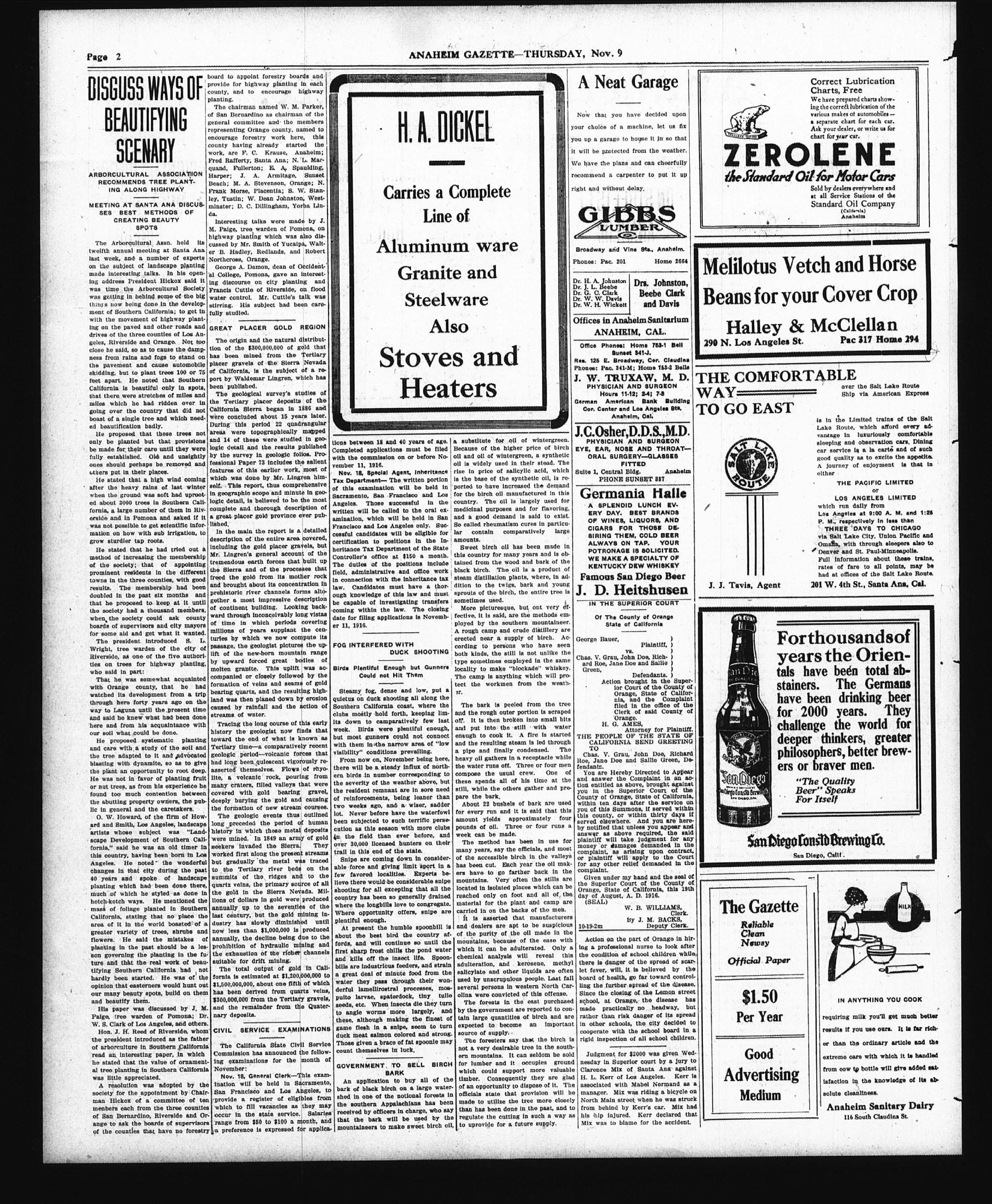
Searchable text
DISGUSS WAYS OF BEAUTIFYING SCENARY
ARBORCULTURAL ASSOCIATION RECOMMENDS TREE PLANTING ALONG HIGHWAY
MEETING AT SANTA ANA DISCUSSES BEST METHODS OF CREATING BEAUTY SPOTS
The Arborcultural Assn. held its twelfth annual meeting at Santa Ana last week, and a number of experts on the subject of landscape planting made interesting talks. In his opening address President Hickox said it was time the Arborcultural Society was getting in behind some of the big things now being done in the development of Southern California; to get in with the movement of highway planting on the paved and other roads and drives of the three counties of Los Angeles, Riverside and Orange. Not too close he said, so as to cause the dampness from rains and fogs to stand on the pavement and cause automobile skidding, but to plant trees 100 or 75 feet apart. He noted that Southern California is beautiful only in spots, that there were stretches of miles and miles which he had ridden over in going over the country that did not boast of a single tree and which needed beautification badly.
He proposed that these trees not only be planted but that provisions be made for their care until they were board to appoint forestry boards and provide for highway planting in each county, and to encourage highway planting.
The chairman named W. M. Parker, of San Bernardino as chairman of the general committee and the members representing Orange county, named to encourage forestry work here, this county having already started the work, are F. C. Krause, Anaheim; Fred Rafferty, Santa Ana; N. L. Marquand, Fullerton; E. A. Spaulding, Harper; J. A. Armitage, Sunset Beach; M. A. Stevenson, Orange; N. Frank Morse, Placentia; S. W. Stanley, Tustin; W. Dean Johnston, Westminster; D. C. Dillingham, Yorba Linda.
Interesting talks were made by J. M. Paige, tree warden of Pomona, on highway planting which was also discussed by Mr. Smith of Yucaipa, Walter B. Hadley, Redlands, and Robert Northcross, Orange.
George A. Damon, dean of Occidental College, Pomona, gave an interesting discourse on city planting and Francis Cuttle of Riverside, on flood water control. Mr. Cuttle's talk was stirring. His subject had been carefully studied.
GREAT PLACER GOLD REGION
The origin and the natural distribution of the $300,000,000 of gold that has been mined from the Tertiary placer gravels of the Sierra Nevada of California, is the subject of a report by Waldemar Lingren, which has been published.
The geological survey's studies of the Tertiary placer deposits of the California Sierra began in 1886 and were concluded about 15 years later. During this period 22 quadrangular areas were topographically mapped and 14 of these were studied in geologic detail and the results published.
ness from rains and fogs to stand on the pavement and cause automobile skidding, but to plant trees 100 or 75 feet apart. He noted that Southern California is beautiful only in spots, that there were stretches of miles and miles which he had ridden over in going over the country that did not boast of a single tree and which needed beautification badly.
He proposed that these trees not only be planted but that provisions be made for their care until they were fully established. Old and unsightly ones should perhaps be removed and others put in their places.
He stated that a high wind coming after the heavy rains of last winter when the ground was soft had uprooted about 3000 trees in Southern California, a large number of them in Riverside and in Pomona and asked if it was not possible to get scientific information on how with sub irrigation, to grow sturdier tap roots.
He stated that he had tried out a method of increasing the membership of the society; that of appointing prominent residents in the different towns in the three counties, with good results. The membership had been doubled in the past six months and that he proposed to keep at it until the society had a thousand members, when the society could ask county boards of supervisors and city mayors for some aid and get what it wanted.
The president introduced S. L. Wright, tree warden of the city of Riverside, as one of the five authorities on trees for highway planting, who said in part:
That he was somewhat acquainted with Orange county, that he had watched its development from a trip through here forty years ago on the way to Laguna until the present time and said he knew what had been done here and from his acquaintance with our soil what could be done.
He proposed systematic planting and care with a study of the soil and the tree adapted to it and advocated blasting with dynamite, so as to give the plant an opportunity to root deep. He was not in favor of planting fruit or nut trees, as from his experience he found too much contention between the abutting property owners, the public in general and the caretakers.
O. W. Howard, of the firm of Howard and Smith, Los Angeles, landscape artists whose subject was "Landscape Development of Southern California," said he was an old timer in
The geological survey's studies of the Tertiary placer deposits of the California Sierra began in 1886 and were concluded about 15 years later. During this period 22 quadrangular areas were topographically mapped and 14 of these were studied in geologic detail and the results published by the survey in geologic folios. Professional Paper 73 includes the salient features of this earlier work, most of which was done by Mr. Lingren himself. This report, thus comprehensive in geographic scope and minute in geologic detail, is believed to be the most complete and thorough description of a great placer gold province ever published.
In the main the report is a detailed description of the entire area covered, including the gold placer gravels, but Mr. Lingren's general account of the tremendous earth forces that built up the Sierra and of the processes that freed the gold from its mother rock and brought about its concentration in prehistoric river channels forms altogether a most impressive description of continent building. Looking backward through inconceivably long vistas of time in which periods covering millions of years supplant the centuries by which we now compute its passage, the geologist pictures the uplift of the new-born mountain range by upward forced great bodies of molten granite. This uplift was accompanied or closely followed by the formation of veins and seams of gold bearing quartz, and the resulting highland was then planed down by erosion caused by rainfall and the action of streams of water.
Tracing the long course of this early history the geologist now finds that toward the end of what is known as Tertiary time—a comparatively recent geologic period—volcanic forces that had long been quiescent vigorously reasserted themselves. Flows of ryolite, a volcanic rock, pouring from many craters, filled valleys that were covered with gold bearing gravel, deeply burying the gold and causing the formation of new stream courses.
The geologic events thus outlined long preceded the period of human history in which these metal deposits were mined. In 1849 an army of gold seekers invaded the Sierra. They has been mined from the Tertiary placer gravels of the Sierra Nevada of California, is the subject of a report by Waldemar Lingren, which has been published.
The geological survey's studies of the Tertiary placer deposits of the California Sierra began in 1886 and were concluded about 15 years later. During this period 22 quadrangular areas were topographically mapped and 14 of these were studied in geologic detail and the results published by the survey in geologic folios. Professional Paper 73 includes the salient features of this earlier work, most of which was done by Mr. Lingren himself. This report, thus comprehensive in geographic scope and minute in geologic detail, is believed to be the most complete and thorough description of a great placer gold province ever published.
In the main the report is a detailed description of the entire area covered, including the gold placer gravels, but Mr. Lingren's general account of the tremendous earth forces that built up the Sierra and of the processes that freed the gold from its mother rock and brought about its concentration in prehistoric river channels forms altogether a most impressive description of continent building. Looking backward through inconceivably long vistas of time in which periods covering millions of years supplant the centuries by which we now compute its passage, the geologist pictures the uplift of the new-born mountain range by upward forced great bodies of molten granite. This uplift was accompanied or closely followed by the formation of veins and seams of gold bearing quartz, and the resulting highland was then planed down by erosion caused by rainfall and the action of streams of water.
Tracing the long course of this early history the geologist now finds that toward the end of what is known as Tertiary time—a comparatively recent geologic period—volcanic forces that had long been quiescent vigorously reasserted themselves. Flows of ryolite, a volcanic rock, pouring from many craters, filled valleys that were covered with gold bearing gravel, deeply burying the gold and causing the formation of new stream courses.
The geologic events thus outlined long preceded the period of human history in which these metal deposits were mined. In 1849 an army of gold seekers invaded the Sierra. They have been mined from the Tertiary placer gravels of the Sierra Nevada of California, is the subject of a report by Waldemar Lingren, which has been published.
The geological survey's studies of the Tertiary placer deposits of the California Sierra began in 1886 and were concluded about 15 years later. During this period 22 quadrangular areas were topographically mapped and 14 of these were studied in geologic detail and the results published by the survey in geologic folios. Professional Paper 73 includes the salient features of this earlier work, most of which was done by Mr. Lingren himself. This report, thus comprehensive in geographic scope and minute in geologic detail, is believed to be the most complete and thorough description of a great placer gold province ever published.
In the main the report is a detailed description of the entire area covered, including the gold placer gravels, but Mr. Lingren's general account of the tremendous earth forces that built up the Sierra and of the processes that freed the gold from its mother rock and brought about its concentration in prehistoric river channels forms altogether a most impressive description of continent building. Looking backward through inconceivably long vistas of time in which periods covering millions of years supplant the centuries by which we now compute its passage, the geologist pictures the uplift of the new-born mountain range by upward forced great bodies of molten granite. This uplift was accompanied or closely followed by the formation of veins and seams of gold bearing quartz, and the resulting highland was then planed down by erosion caused by rainfall and the action of streams of water.
Tracing the long course of this early history the geologist now finds that toward the end of what is known as Tertiary time—a comparatively recent geologic period—volcanic forces that had long been quiescent vigorously reasserted themselves. Flows of ryolite, a volcanic rock, pouring from many craters, filled valleys that were covered with gold bearing gravel, deeply burying the gold and causing the formation of new stream courses.
The geologic events thus outlined long preceded the period of human history in which these metal deposits were mined. In 1849 an army of gold seekers invaded the Sierra. They have been mined from the Tertiary placer gravels of the Sierra Nevada of California, is the subject of a report by Waldemar Lingren, which has been published.
The geological survey's studies of the Tertiary placer deposits of the California Sierra began in 1886 and were concluded about 15 years later. During this period 22 quadrangular areas were topographically mapped and 14 of these were studied in geologic detail and the results published by the survey in geologic folios. Professional Paper 73 includes the salient features of this earlier work, most of which was done by Mr. Lingren himself. This report, thus comprehensive in geographic scope and minute in geologic detail, is believed to be the most complete and thorough description of a great placer gold province ever published.
In the main the report is a detailed description of the entire area covered, including the gold placer gravels, but Mr. Lingren's general account of the tremendous earth forces that built up the Sierra and of the processes that freed the gold from its mother rock and brought about its concentration in prehistoric river channels forms altogether a most impressive description of continent building. Looking backward through inconceivably long vistas of time in which periods covering millions of years supplant the centuries by which we now compute its passage, the geologist pictures the uplift of the new-born mountain range by upward forced great bodies of molten granite. This uplift was accompanied or closely followed by the formation of veins and seams of gold bearing quartz, and the resulting highland was then planed down by erosion caused by rainfall and the action of streams of water.
Tracing the long course of this early history the geologist now finds that toward the end of what is known as Tertiary time—a comparatively recent geologic period—volcanic forces that had long been quiescent vigorously reasserted themselves. Flows of ryolite, a volcanic rock, pouring from many craters, filled valleys that were covered with gold bearing gravel, deeply buryingthe gold and causingthe formationofnewstreamcourses.
The geologic events thus outlined long precededtheperiodofhumanhistoryinwhichthemetaldepositionswereminuted.In1849anarmyofgoldseekersinvadedtheSierra.Thetheyhavebeensubmittedwiththecommencementasthatthefieldover300000
the tree adapted to it and advocated blasting with dynamite, so as to give the plant an opportunity to root deep. He was not in favor of planting fruit or nut trees, as from his experience he found too much contention between the abutting property owners, the public in general and the caretakers.
O. W. Howard, of the firm of Howard and Smith, Los Angeles, landscape artists whose subject was "Landscape Development of Southern California," said he was an old timer in this country, having been born in Los Angeles. He noted the wonderful changes in that city during the past 40 years and spoke of landscape planting which had been done there, much of which he styled as done in hotch-kotch ways. He mentioned the mass of foliage planted in Southern California, stating that no place the area of it in the world boasted of a greater variety of trees, shrubs and flowers. He said the mistakes of planting in the past should be a lesson governing the planting in the future and that the real work of beautifying Southern California had not hardly been started. He was of the opinion that easterners would hunt out our many beauty spots, build on them and beautify them.
His paper was discussed by J. M. Paige, tree warden of Pomona; Dr. W. S. Clark of Los Angeles, and others.
Hon. J. H. Reed of Riverside, whom the president introduced as the father of arborculture in Southern California read an interesting paper, in which he stated that the value of ornamental tree planting in Southern California was little appreciated.
A resolution was adopted by the society for the appointment by Chairman Hickox of a committee of ten members each from the three counties of San Bernardino, Riverside and Orange to ask the boards of supervisors of the counties that have no forestry
CIVIL SERVICE EXAMINATIONS
The California State Civil Service Commission has announced the following examinations for the month of November:
Nov. 18, General Clerk—This examination will be held in Sacramento, San Francisco and Los Angeles, to provide a register of eligibles from which to fill vacancies as they may occur in the state service. Salaries range from $50 to $100 a month, and a preference is expressed for applica-
ANAHEIM GAZETTE—THURSDAY, Nov. 9
H. A. DICKEL
Carries a Complete Line of
Aluminum ware
Granite and
Steelware
Also
Stoves and
Heaters
A Neat Garage
Now that you have decided upon your choice of a machine, let us fix you up a garage to house it in so that it will be protected from the weather. We have the plans and can cheerfully recommend a carpenter to put it up right and without delay.
GIBBS LUMBER
Broadway and Vine Sts., Anaheim.
Phones: Pac. 201 Home 2664
Dr. H. A. Johnston
Dr. J. L. Beebe
Dr. G. C. Clark
Dr. W. W. Davis
Dr. W. H. Wickett
Drs. Johnston,
Beebe Clark
and Davis
Offices in Anaheim Sanitarium
ANAHEIM, CAL.
Office Phones: Home 753-1 Bell Sunset 341-J.
Res. 125 E. Broadway, Cor. Claudina
Phones: Pac. 341-M; Home 753-2 Bells
J. W. TRUXAW, M. D.
PHYSICIAN AND SURGEON
Hours 11-12; 2-4; 7-8
German Amerloan Bank Building
Cor. Center and Los Angeles Sts.
Anaheim, Cal.
J.C.Osher, D.D.S., M.D.
PHYSICIAN AND SURGEON
a substitute for oil of wintergreen.
Because of the higher price of birch
tions between 18 and 40 years of age. Completed applications must be filed with the commission on or before November 11, 1916.
Nov. 18, Special Agent, Inheritance Tax Department—The written portion of this examination will be held in Sacramento, San Francisco and Los Angeles. Those successful in the written will be called to the oral examination, which will be held in San Francisco and Los Angeles only. Successful candidates will be eligible for certification to positions in the Inheritance Tax Department of the State Controller's office at $150 a month. The duties of the positions include field, administrative and office work in connection with the inheritance tax law. Candidates must have a thorough knowledge of this law and must be capable of investigating transfers coming within the law. The closing date for filing applications is November 11, 1916.
FOG INTERFERED WITH DUCK SHOOTING
Birds Plentiful Enough but Gunners Could not Hit Them
Steamy fog, dense and low, put a quietus on duck shooting all along the Southern California coast, where the clubs mostly hold forth, keeping limits down to camparatively few last week. Birds were plentiful enough, but most gunners could not connect with them in the narrow area of "low visibility" conditions prevailing.
From now on, November being here, there will be a steady influx of northern birds in number corresponding to the severity of the weather above, but the resident remnant are in sore need of reinforcements, being leaner than two weeks ago, and a wiser, sadder lot. Never before have the waterfowl been subjected to such terrific persecution as this season with more clubs in the field than ever before, and over 30,000 licensed hunters on their trail in end of the state.
a substitute for oil of wintergreen. Because of the higher price of birch oil and oil of wintergreen, a synthetic oil is widely used in their stead. The rise in price of salicylic acid, which is the base of the synthetic oil, is reported to have increased the demand for the birch oil manufactured in this country. The oil is largely used for medicinal purposes and for flavoring, and a good demand is said to exist. So called rheumatism cures in particular contain comparatively large amounts.
Sweet birch oil has been made in this country for many years and is obtained from the wood and bark of the black birch. The oil is a product of steam distillation plants, where, in addition to the twigs, bark and young sprouts of the birch, the entire tree is sometimes used.
More picturesque, but ont very effective, it is said, are the methods employed by the southern mountaineer. A rough camp and crude diatllery are erected near a supply of birch. According to persons who have seen both kinds, the still is not unlike the type sometimes employed in the same locality to make "blockade" whiskey. The camp is anything which will protect the workmen from the weather.
The bark is peeled from the tree and the rough outer portion is scraped off. It is then broken into small bits and put into the still with water enough to cook it. A fire is started and the resulting steam is led through a pipe and finally condensed. The heavy oil gathers in a receptacle while the water runs off. Three or four men compose the usual crew. One of these spends all of his time at the still, while the others gather and prepare the bark.
About 22 bushels of bark are used for every run and it is said that this amount yields approximately four pounds of oil. Three or four runs a week can be made.
The method has been in use for many years, say the officials, and most Res. 125 E. Broadway, Cer. Claudina Phones: Pac. 341-M; Home 753-2 Bells J. W. TRUXAW, M.D. PHYSICIAN AND SURGEON Hours 11-12; 2-4; 7-8 German American Bank Building Cor. Center and Los Angeles Sts. Anaheim, Cal.
J.C.Osher,D.D.S.,M.D. PHYSICIAN AND SURGEON EYE, EAR, NOSE AND THROAT—ORAL SURGERY—GLASSES FITTED Suite 1, Central Bldg. Anaheim PHONE SUNSET 887
Germania Halle
A SPLENDID LUNCH EVERY DAY. BEST BRANDS OF WINES, LIQUORS, AND CIGARS FOR THOSE DESIRING THEM, COLD BEER ALWAYS ON TAP. YOUR POTRONAGE IS SOLICITED. WE MAKE A SPECIALTY OF KENTUCKY DEW WHISKEY
Famous San Diego Beer
J. D. Heitshusen
IN THE SUPERIOR COURT
Of The County of Orange State of California
George Bauer,
Plaintiff,
vs.
Chas. V. Grau, John Doe, Richard Roe, Jane Doe and Sallie Green,
Defendants.
Action brought in the Superior Court of the County of Orange, State of California, and the Complaint filed in the office of the Clerk of said County of Orange.
H. G. AMES,
Attorney for Plaintiff.
THE PEOPLE OF THE STATE OF CALIFORNIA SEND GREETING TO
Chas. V. Grau, John Doe, Richard Roe, Jane Doe and Sallie Green, Defendants.
You are Hereby Directed to Appear and answer the Complaint in an action entitled as above, brought against you in the Superior Court of the County of Orange, State of California, within ten days after the service on you of this Summons, if served within this county, or within thirty days if served elsewhere. And you are hereby notified that unless you appear and answer as above required, the said plaintiff will take judgment for any money or damages demanded in the courtroom upon contract...
From now on, November being here, there will be a steady influx of northern birds in number corresponding to the severity of the weather above, but the resident remnant are in sore need of reinforcements, being leaner than two weeks ago, and a wiser, sadder lot. Never before have the waterfowl been subjected to such terrific persecution as this season with more clubs in the field than ever before, and over 30,000 licensed hunters on their trail in this end of the state.
Snipe are coming down in considerable force and giving limit sport in a few favored localities. Experts believe there would be considerable snipe shooting for all excepting that all the country has been so generally drained where the longbills love to congregate. Where opportunity offers, snipe are plentiful enough.
At present the humble spoonbill is about the best bird the country affords, and will continue so until the first sharp frost chills the pond water and kills off the insect life. Spoonbills are industrious feeders, and strain a great deal of minute food from the water they pass through their wonderful lamellirostral processes, mosquito larvae, spaterdock, tiny tulle seeds, etc. When insects die they turn to angle worms more largely, and these, although making the finest of game flesh in a snipe, seem to turn duck meat salmon colored and strong. Those given a brace of fat spoonle may count themselves in luck.
GOVERNMENT TO SELL BIRCH BARK
An application to buy all of the bark of black birch on a large watershed in one of the notional forests in the southern Appalachians has been received by officers in charge, who say that the bark will be used by the mountaineers to make sweet birch oil,
heavy oil gathers in a receptacle while the water runs off. Three or four men compose the usual crew. One of these spends all of his time at the still, while the others gather and prepare the bark.
About 22 bushels of bark are used for every run and it is said that this amount yields approximately four pounds of oil. Three or four runs a week can be made.
The method has been in use for many years, say the officials, and most of the accessible birch in the valleys has been cut. Each year the oil makers have to go farther back in the mountains. Very often the stills are located in isolated places which can be reached only on foot and all of the material for the plant and camp are carried in on the backs of the men.
It is asserted that manufacturers and dealers are apt to be suspicious of the purity of the oil made in the mountains, because of the ease with which it can be adulterated. Only a chemical analysis will reveal this adulteration, and kerosene, methyl salicylate and other liquids are often used by unscrupulous people. Last fall several persons in western North Carolina were convicted of this offense.
The forests in the east purchased by the government are reported to contain large quantities of birch and are expected to become an important source of supply.
The foresters say that the birch is not a very desirable tree in the southern mountains. It can seldom be sold for lumber and it occupies ground which could support more valuable timber. Consequently they are glad of an opportunity to dispose of it. The officials state that provision will be made to utilize the tree more closely than has been done in the past, and to regulate the cutting in such a way as to uprovide for a future supply.
Action on the part of Orange in hiring a professional nurse to look after the condition of school children while there is danger of the spread of scarlet fever, will, it is believed by the board of health, go far toward controlling the further spread of the disease. Since the closing of the Lemon street school, at Orange, the disease has made practically no headway, but rather than risk danger of its spread in other schools, the city decided to cooperate with the school board in a rigid inspection of all school children.
Judgment for $2000 was given Wednesday in Superior court by a jury to Clarence Mix of Santa Ana against H. L. Kerr of Los Angeles. Kerr is associated with Mabel Normand as a manager. Mix was riding a bicycle on North Main street when he was struck from behind by Kerr's car. Mix had his hip injured. Kerr declared that Mix was to blame for the accident.
Correct Lubrication Charts, Free
We have prepared charts showing the correct lubrication of the various makes of automobiles—a separate chart for each car.
Ask your dealer, or write us for chart for your car.
ZEROLENE
the Standard Oil for Motor Cars
Sold by dealers everywhere and at all Service Stations of the Standard Oil Company
(California)
Anaheim
Melilotus Vetch and Horse Beans for your Cover Crop
Halley & McClellan
290 N. Los Angeles St. Pac 317 Home 294
THE COMFORTABLE WAY TO GO EAST
over the Salt Lake Route
Ship via American Express
is in the Limited trains of the Salt Lake Route, which afford every advantage in luxuriously comfortable sleeping and observation cars. Dining
THE COMFORTABLE WAY TO GO EAST
over the Salt Lake Route
Ship via American Express
is in the Limited trains of the Salt Lake Route, which afford every advantage in luxuriously comfortable sleeping and observation cars. Dining car service is a la carte and of such good quality as to excite the appetite. A journey of enjoyment is that in either.
THE PACIFIC LIMITED
or
LOS ANGELES LIMITED
which run daily from Los Angeles at 9:00 A.M. and 1:25 P.M., respectively in less than THREE DAYS TO CHICAGO
via Salt Lake City, Union Pacific and Omaha, with through sleepers also to Denver and St. Paul-Minneapolis.
Full information about these trains, rates of fare to all points, may be had at offices of the Salt Lake Route.
J. J. Tavis, Agent
201 W. 4th St., Santa Ana, Cal.
Forthousandsof years the Orientals have been total abstainers. The Germans have been drinking beer for 2000 years. They challenge the world for deeper thinkers, greater philosophers, better brewers or braver men.
"The Quality Beer" Speaks For Itself
San Diego Consid Brewing Co.
The Gazette
Reliable
Clean
Newsy
Official Paper
$1.50
Per Year
Good
Advertising
Medium
IN ANYTHING YOU COOK
requiring milk you'll get much better results if you use ours. It is far richer than the ordinary article and the extreme care with which it is handled from cow to bottle will give added satisfaction in the knowledge of its absolute cleanliness.
Anaheim Sanitary Dairy
116 South Claudina St.