anaheim-gazette 1916-11-09
Scanned page
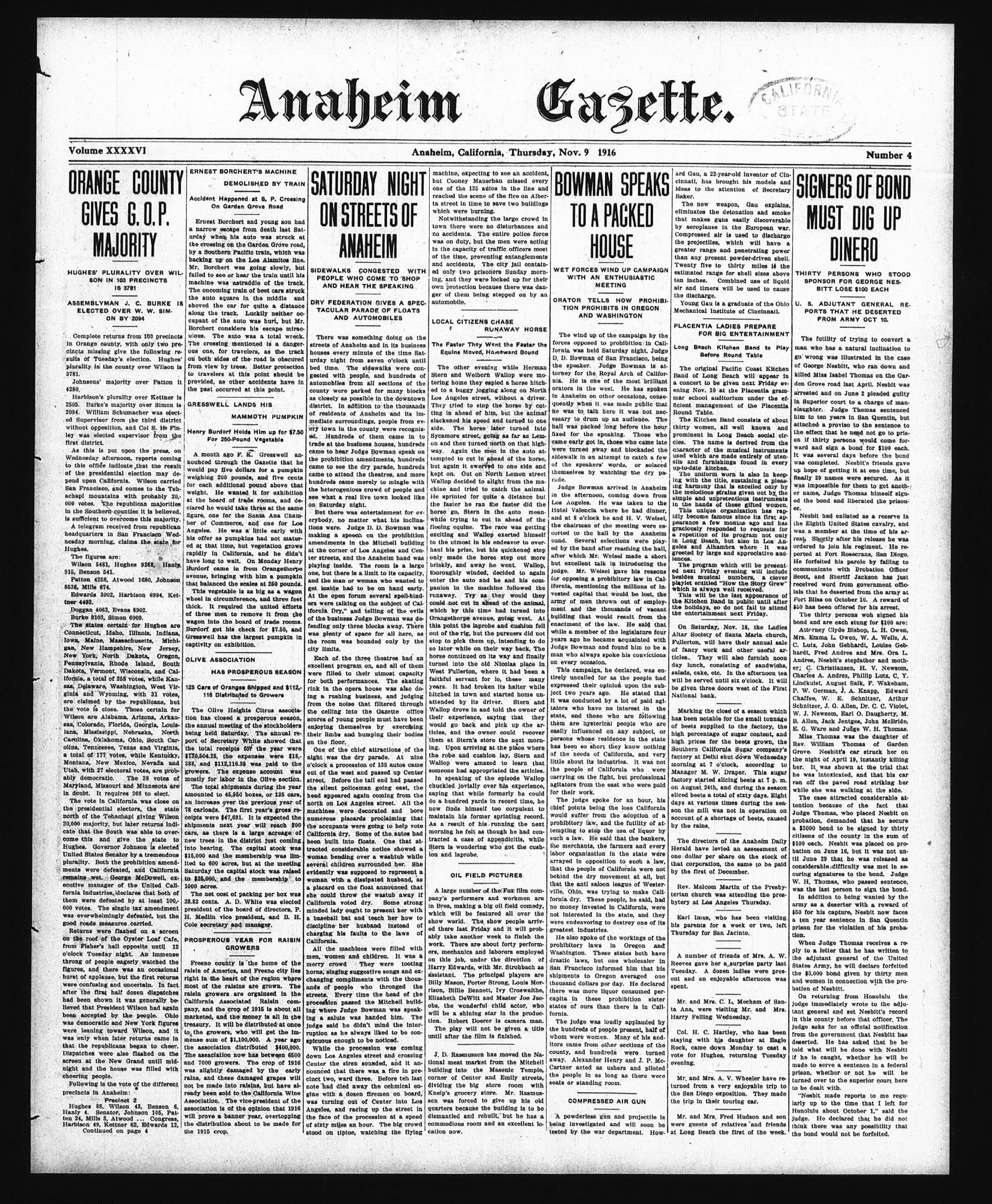
Searchable text
ORANGE COUNTY GIVES G.O.P. MAJORITY
HUGHES' PLURALITY OVER WILSON IN 103 PRECINCTS IS 3781
ASSEMBLYMAN J. C. BURKE IS ELECTED OVER W. W. SIMON BY 2094
Complete returns from 103 precincts in Orange county, with only two precincts missing give the following results of Tuesday's election. Hughes' plurality in the county over Wilson is 3781.
Johnson's majority over Patton it 4280.
Harbison's plurality over Kettner is 2505. Burke's majority over Simon is 2094. William Schumacher was elected Supervisor from the third district without opposition, and Col S. H. Finley was elected supervisor from the first district.
ERNEST BORCHERT'S MACHINE DEMOLISHED BY TRAIN
Accident Happened at S. P. Crossing On Garden Grove Road
Ernest Borchert and young son had a narrow escape from death last Saturday when his auto was struck at the crossing on the Garden Grove road, by a Southern Pacific train, which was backing up on the Los Alamitos line. Mr. Borchert was going slowly, but failed to see or hear the train until his machine was astraddle of the track. The oncoming train of beet cars struck the auto square in the middle and shoved the car for quite a distance along the track. Luckily neither occupant of the auto was hurt, but Mr. Borchert considers his escape miraculous. The auto was a total wreck. The crossing mentioned is a dangerous one, for travelers, as the track on both sides of the road is obscured from view by trees. Better protection to travelers at this point should be provided, as other accidents have in the past occurred at this point.
GRESSWELL LANDS HIS MAMMOTH PUMPKIN
Henry Burdorf Holds Him up for $7.50 For 250-Pound Vegetable
results of Tuesday's election. Hughes' plurality in the county over Wilson is 3781.
Johnson's majority over Patton it 4280.
Harbison's plurality over Kettner is 2505. Burke's majority over Simon is 2094. William Schumacher was elected Supervisor from the third district without opposition, and Col S. H. Finley was elected supervisor from the first district.
As this is put upon the press, on Wednesday afternoon, reports coming to this office indicate that the result of the presidential election may depend upon California. Wilson carried San Francisco, and comes to the Tehachapi mountains with probably 20,000 votes. The republican majorities in the Southern counties it is believed, is sufficient to overcome this majority.
A telegram received from republican headquarters in San Francisco Wednesday morning, claims the state for Hughes.
The figures are:
Wilson 5481, Hughes 9262, Hanly 915, Benson 541.
Patton 4258, Atwood 1680, Johnson 8538, Mills 674.
Edwards 3002, Harbison 6994, Kettner 4493.
Duggan 4063, Evans 8902.
Burke 8103, Simon 6009.
The states certain for Hughes are Connecticut, Idaho, Illinois, Indiana, Iowa, Maine, Massachusetts, Michigan, New Hampshire, New Jersey, New York, North Dakota, Oregon, Pennsylvania, Rhode Island, South Dakota, Vermont, Wisconsin, and California, a total of 258 votes, while Kansas, Delaware, Washington, West Virginia and Wyoming, with 31 votes, are claimed by the republicans, but the vote is close. Those certain for Wilson are Alabama, Arizona, Arkansas, Colorado, Florida, Georgia, Louisiana, Mississippi, Nebraska, North Carolina, Oklahoma, Ohio, South Carolina, Tennessee, Texas and Virginia, a total of 177 votes, while Kentucky, Montana, New Mexico, Nevada and Utah, with 27 electoral votes, are probably democratic. The 38 votes of Maryland, Missouri and Minnesota are in doubt. It requires 266 to elect.
The vote in California was close on the presidential electors, the state north of the Tehachapi giving Wilson 20,000 majority, but later returns indicate that the South was able to overcome this and give the state to Hughes. Governor Johnson is elected on both sides of the road is obscured from view by trees. Better protection to travelers at this point should be provided, as other accidents have in the past occurred at this point.
GRESSWELL LANDS HIS
MAMMOTH PUMPKIN
Henry Burdorf Holds Him up for $7.50 For 250-Pound Vegetable
A month ago F. K. Gresswell announced through the Gazette that he would pay five dollars for a pumpkin weighing 200 pounds, and five cents for each additional pound above that weight. He wanted it for exhibition at the board of trade rooms, and declared he would take three at the same figure, one for the Santa Ana Chamber of Commerce, and one for Los Angeles. He was a little early with his offer as pumpkins had not matured at that time, but vegetation grows rapidly in California, and he didn't have long to wait. On Monday Henry Burdorf came in from Orangethorpe avenue, bringing with him a pumpkin that balanced the scales at 250 pounds.
This vegetable is as big as a wagon wheel in circumference, and three feet thick. It required the united efforts of three men to remove it from the wagon into the board of trade rooms. Burdorf got his check for $7.50, and Gresswell has the largest pumpkin in captivity on exhibition.
OLIVE ASSOCIATION
HAS PROSPEROUS SEASON
125 Cars of Oranges Shipped and $112,-116 Distributed to Growers
The Olive Heights Citrus association has closed a prosperous season, the annual meeting of the stockholders being held Saturday. The annual report of Secretary White showed that the total receipts for the year were $130,504.25, the expenses were $18,-388, and $112,116.25 was paid to the growers. The expense account was mostly for labor in the Olive section.
The total shipments during the year amounted to 45,950 boxes, or 125 cars, an increase over the previous year of 78 carloads. The first year's gross receipts were $47,691. It is expected the shipments next year will reach 200 cars, as there is a large acreage of new trees in the district just coming into bearing. The capital stock was
Each of the three excellent programs once filled to their fullest for both performance rink in the opera house a rushing business from the noise that the ceiling into the scores of young people enjoying themselves their limbs and bums on the floor.
One of the chief night was the dry p o'clock a procession out of the west and street. Before the taunt the silent policeman head appeared again north on Los Angeles machines were decorated numerous placards the occupants were given California dry. Some been built into float traced considerable
a total of 177 votes, while Kentucky, Montana, New Mexico, Nevada and Utah, with 27 electoral votes, are probably democratic. The 38 votes of Maryland, Missouri and Minnesota are in doubt. It requires 266 to elect.
The vote in California was close on the presidential electors, the state north of the Tehachapi giving Wilson 20,000 majority, but later returns indicate that the South was able to overcome this and give the state to Hughes. Governor Johnson is elected United States Senator by a tremendous plurality. Both the prohibition amendments were defeated, and California remains wet. George McDowell, executive manager of the United California Industries, declares that both of them were defeated by at least 100,000 votes. The single tax amendment was overwhelmingly defeated, but the good roads measures carried.
Returns were flashed on a screen on the roof of the Oyster Loaf Cafe, from Fisher's hall opposite until 12 o'clock Tuesday night. An immense throng of people eagerly watched the figures, and there was an occasional burst of applause, but the first returns were confusing and uncertain. In fact after the first half dozen dispatches had been shown it was generally believed that President Wilson had again been accepted by the people. Ohio was democratic and New York figures were leaning toward Wilson, and it was only when later returns came in that the republicans began to cheer. Dispatches were also flashed on the screen at the New Grand until midnight and the house was filled with cheering people.
Following is the vote of the different precincts in Anaheim:
Precinct 2
Hughes 88, Wilson 43, Benson 6,
Hanly 4. Senator, Johnson 105, Patten 24, Mills 3, Atwood ... Congress,
Harbison 49, Kettner 62, Edwards 12,
Continued on page 4
PROSPEROUS YEAR FOR RAISIN GROWERS
Fresno county is the home of the raisin of America, and Fresno city lies right in the heart of the region where most of the raisins are grown. The raisin growers are organized in the California Associated Raisin company, and the crop of 1915 is about all marketed, and the money is all in the treasury. It will be distributed at once to the growers, who will get the immense sum of $1,100,000. A year ago the association distributed $400,000. The association now has between 6500 and 7000 growers. The crop of 1916 was slightly damaged by the early rains, and these damaged grapes will not be made into raisins, but have already been sold to the California Wine Association. The vice-president of the association is of the opinion that 1916 will prove a banner year, overtopping the distribution about to be made for the 1915 crop.
Anaheim Gazette
Anaheim, California, Thursday, Nov. 9 1916
SATURDAY NIGHT ON STREETS OF ANAHEIM
SIDEWALKS CONGESTED WITH PEOPLE WHO COME TO SHOP AND HEAR THE SPEAKING
DRY FEDERATION GIVES A SPEC-TACULAR PARADE OF FLOATS AND AUTOMOBILES
There was something doing on the streets of Anaheim and in its business houses every minute of the time Saturday night from seven o'clock until bed time. The sidewalks were congested with people, and hundreds of automobiles from all sections of the county were parked for many blocks as closely as possible in the downtown district. In addition to the thousands of residents of Anaheim and its immediate surroundings, people from every town in the county were recognized. Hundreds of them came in to trade at the business houses, hundreds
machine, expecting to see an accident, but Cooney Mauerhan missed every one of the 135 autos in the line and reached the scene of the fire on Alberta street in time to save two buildings which were burning.
Notwithstanding the large crowd in town there were no disturbances and no accidents. The entire police force was on duty, but the men were acting in the capacity of traffic officers most of the time, preventing entanglements and accidents. The city jail contained only two prisoners Sunday morning, and they were locked up for their own protection because there was danger of them being stepped on by an automobile.
LOCAL CITIZENS CHASE RUNAWAY HORSE
The Faster They Went the Faster the Equine Moved, Homeward Bound
The other evening while Herman Stern and Welborn Wallop were motoring home they escaped a horse hitched to a buggy jogging along on North Los Angeles street, without a driver. They tried to stop the horse by cutting in ahead of him, but the animal slackened his speed and turned to one side. The horse later turned into Sycamore street, going as far as Lemon and then turned north on that high-
BOWMAN SPEAKS TO A PACKED HOUSE
WET FORCES WIND UP CAMPAIGN WITH AN ENTHUSIASTIC MEETING
ORATOR TELLS HOW PROHIBITION PROHIBITS IN OREGON AND WASHINGTON
The wind up of the campaign by the forces opposed to prohibition in California was held Saturday night, Judge D. D. Bowman of San Francisco, being the speaker. Judge Bowman is attorney for the Royal Arch of California. He is one of the most brilliant orators in the west. He has spoken in Anaheim on other occasions, consequently when it was made public that he was to talk here it was not necessary to drum up an audience. The hall was packed long before the hour fixed for the speaking. Those who came early got in, those who came late were turned away and blocked the road.
ard Gau,
cinnati,
ideas to
Baker.
The new eliminated that man by aeropress Compressor the project greater than any Twenty estimated ten inches air and the dischair Young Mechanic PLACENE
Long Bee
The order Band of a concert ening No mar schooficient m Round To The Kii thirty wom prominent cles. Thi
houses every minute of the time Saturday
urday night from seven o'clock until
bed time. The sidewalks were congested with people, and hundreds of
automobiles from all sections of the
county were parked for many blocks
as closely as possible in the downtown
district. In addition to the thousands
of residents of Anaheim and its immediate surroundings, people from every
town in the county were recognized. Hundreds of them came in to
trade at the business houses, hundreds
came to hear Judge Bowman speak on
the prohibition amendments, hundreds
came to see the dry parade, hundreds
came to attend the theatres, and more
hundreds came merely to mingle with
the heterogenious crowd of people and
see what a real live town looked like
on Saturday night.
But there was entertainment for everybody, no matter what his inclinations were. Judge D. D. Bowman was making a speech on the prohibition amendments in the Mitchell building at the corner of Los Angeles and Center streets, and the Anaheim band was playing inside. The room is a large one, but there is a limit to its capacity, and the man or woman who wanted to get inside had to be on hand early. At the open forum several spell-binders were talking on the subject of California Dry," and telling of the evils of the business Judge Bowman was defending only three blocks away. There was plenty of space for all here, as the room was bounded only by the city limits.
Each of the three theatres had an excellent program on, and all of them were filled to their utmost capacity for both performances. The skating rink in the opera house was also doing a rushing business, and judging from the noise that filtered through the ceiling into the Gazette office scores of young people must have been enjoying themselves by exercising their limbs and bumping their bodies on the floor.
One of the chief attractions of the night was the dry parade. At nine o'clock a procession of 135 autos came out of the west and passed up Center street. Before the tail end had passed the silent policeman going east, the head appeared again coming from the north on Los Angeles street. All the machines were decorated and bore numerous placards proclaiming that the occupants were going to help vote California dry. Some of the autos had been built into floats. One that attracted considerable notice showed a
The other evening while Herman Stern and Welborn Wallop were motoring home they espied a horse hitched to a buggy jogging along on North Los Angeles street, without a driver. They tried to stop the horse by cutting in ahead of him, but the animal slackened his speed and turned to one side. The horse later turned into Sycamore street, going as far as Lemon and then turned north on that highway. Again the men in the auto attempted to cut in ahead of the horse, but again it swerved to one side and kept on. Out on North Lemon street Wallop decided to alight from the machine and tried to catch the animal. He sprinted for quite a distance but the faster he ran the faster did the horse go, Stern in the auto meanwhile trying to cut in ahead of the fleeing equine. The race was getting exciting and Wallop exerted himself to the utmost in his endeavor to overhaul his prize, but his quickened step only made the horse step out more briskly, and away he went. Wallop, thoroughly winded, decided to again enter the auto and he and his companion in the machine followed the runaway. Try as they would they could not cut in ahead of the animal, which by this time had turned into Orangethorpe avenue, going west. At this point the laprobe and cushion fell out of the rig, but the pursuers did not stop to pick them up, intending to do so later while on their way back. The horse continued on its way and finally turned into the old Nicolas place in West Fullerton, where it had been a faithful servant for lo, these many years. It had broken its halter while bitched in town and started home unattended by its driver. Stern and Wallop drove in and told the owner of their experience, saying that they would go back and pick up the articles, and the owner could recover them at Stern's store next morning. Upon arriving at the place where the robe and cushion lay, Stern and Wallop were amazed to learn that someone had appropriated the articles.
In speaking of the episode Wallop chuckled jovially over his experience, saying that while formerly he could do a hundred yards in record time, he now finds himself too corpulent to maintain his former sprinting record. As a result of his running the next morning he felt as though he had contracted a case of appendicitis, while Stern is wondering who got the cushion.
D. D. Bowman of San Francisco, being the speaker. Judge Bowman is attorney for the Royal Arch of California. He is one of the most brilliant orators in the west. He has spoken in Anaheim on other occasions, consequently when it was made public that he was to talk here it was not necessary to drum up an audience. The hall was packed long before the hour fixed for the speaking. Those who came early got in, those who came late were turned away and blocked the sidewalk in an attempt to catch a few of the speakers' words, or solaced themselves by watching the dry parade.
Judge Bowman arrived in Anaheim in the afternoon, coming down from Los Angeles. He was taken to the Hotel Valencia where he had dinner, and at 8 o'clock he and H. V. Weisel, the chairman of the meeting were escorted to the hall by the Anaheim band. Several selections were played by the band after reaching the hall, after which Mr. Weisel made a short but excellent talk in introducing the judge. Mr. Weisel gave his reasons for opposing a prohibitory law in California, mentioning the millions of invested capital that would be lost, the army of men thrown out of employment and the thousands of vacant building that would result from the enactment of the law. He said that while a member of the legislature four years ago he became acquainted with Judge Bowman and found him to be a man who always spoke his convictions on every occasion.
This campaign, he declared, was entirely uncalled for as the people had expressed their opinion upon the subject two years ago. He stated that it was conducted by a lot of paid agitators who have no interest in the state, and those who are following them are hysterical people who are easily influenced on any subject, or persons whose residence in the state has been so short they know nothing of the needs of California, and very little about its industries. It was not the people of California who were carrying on the fight, but professional agitators from the east who were paid for their work.
The judge spoke for an hour, his chief points being the loss California would suffer from the adoption of a prohibitory law, and the futility of attempting to step use of liquor by such a law. He said that the bankers, merchants, farmers and every
night was the dry parade. At nine o'clock a procession of 135 autos came out of the west and passed up Center street. Before the tall end had passed the silent policeman going east, the head appeared again coming from the north on Los Angeles street. All the machines were decorated and bore numerous placards proclaiming that the occupants were going to help vote California dry. Some of the autos had been built into floats. One that attracted considerable notice showed a woman bending over a washtub while several children surrounded her. She evidently was supposed to represent a woman with a dissipated husband, as a placard on the float announced that she could throw the wastub away if California voted dry. Some strong minded lady ought to present her with a baseball bat and teach her how to discipline her husband instead of charging his faults to the laws of California.
All the machines were filled with men, women and children. It was a merry crowd. They were tooting horns, singing suggestive songs and exchanging compliments with the thousands of people who thronged the streets. Every time the head of the procession passed the Mitchell building where Judge Bowman was speaking a salute was handed him. The judge said he didn't mind the interruption as he always liked to be conspicuous enough to be noticed.
While the procession was coming down Los Angeles street and crossing Center the siren sounded, and it announced that there was a fire in precinct two, ward three. Before ten last note had died away the cehmical engine with a dozen firemen on board, was turning out of Center into Los Angeles, and racing up the street in the face of the procession at a speed of sixty miles an hour. The big crowd stood on tiptoe, watching the flying
OIL FIELD PICTURES
A large number of the Fox film company’s performers and workmen are in Brea, making a big oil field comedy, which will be featured all over the show world. The show people arrived there last Friday and it will probably take another week to finish the work. There are about forty performers, mechanics and laborers employed on this job, under the direction of Harry Edwards, with Mr. Strohbach as assistant. The principal players are Billy Mason, Porter Strong, Louis Morrison, Billie Bennett, Ivy Croswalthe, Elizabeth DeWitt and Master Joe Jacobs, the wonderful child actor, who will be a shining star in the production. Robert Doerer is camera man.
The play will not be given a title until after the film is finished.
J. D. Rasmussen has moved the National meat market from the Mitchell building into the Masonic Temple, corner of Center and Emily streets, dividing the big store room with Knelp's grocery store. Mr. Rasmussen was forced to give up his old quarters because the building is to be dismantled and rebuilt, but he has a commodious room and an excellent location now.
COMPRESSED AIR GUN
A powderless gun and projectile is being investigated and will soon be tested by the war department. How-
SPEAKS
CKED
GE
UP CAMPAIGN
USIASTIC
OW PROHIBIN OREGON
NGTON
campaign by the abiltion in Caliday night, Judge Francisco, being Bowman is at Arch of Califormost brilliant He has spoken occasions, consesade public that it was not necaudience. The before the hour Those who who came late hardened Gau, a 22-year-old inventor of Cincinnati, has brought his models and ideas to the attention of Secretary Baker.
The new weapon, Gau explains, eliminates the detonation and smoke that makes guns easily discoverable by aeroplanes in the European war. Compressed air is used to discharge the projectiles, which will have a greater range and penetrating power than any present powder-driven shell. Twenty five to thirty miles is the estimated range for shell sizes above ten inches. Combined use of liquid air and timers will be used to cause the discharge.
Young Gau is a graduate of the Ohio Mechanical Institute of Cincinnati.
PLACENTIA LADIES PREPARE FOR BIG ENTERTAINMENT
Long Beach Kitchen Band to Play Before Round Table
The original Pacific Coast Kitchen Band of Long Beach will appear in a concert to be given next Friday evening Nov. 10 at the Placentia grammar school auditorium under the efficient management of the Placentia Round Table.
The Kitchen Band consists of about thirty women, all well known and prominent in Long Beach social circles. The name is derived from the character of the musical instrument.
SIGNERS OF BOND MUST DIG UP DINERO
THIRTY PERSONS WHO STOOD SPONSOR FOR GEORGE NESBITT LOSE $100 EACH
U. S. ADJUTANT GENERAL REPORTS THAT HE DESERTED FROM ARMY OCT 10.
The futility of trying to convert a man who has a natural inclination to go wrong was illustrated in the case of George Nesbitt, who ran down and killed Miss Isabel Thomas on the Garden Grove road last April. Nesbit was arrested and on June 2 pleaded guilty in Superior court to a charge of manslaughter. Judge Thomas sentenced him to ten years in San Quentin, but attached a proviso to the sentence to the effect that he need not go to prison if thirty persons would come forward and sign a bond for $100 each.
The original Pacific Coast Kitchen Band of Long Beach will appear in a concert to be given next Friday evening Nov. 10 at the Placentia grammar school auditorium under the efficient management of the Placentia Round Table.
The Kitchen Band consists of about thirty women, all well known and prominent in Long Beach social circles. The name is derived from the character of the musical instruments used which are made entirely of utensils and furnishings found in every up-to-date kitchen.
The uniform worn is also in keeping with the title, sustaining a pleasing harmony that is excelled only by the melodious strains given out by the simple and unpretentious instruments in the hands of these gifted women.
This unique organization has rapidly become famous since its first appearance a few months ago and has graciously responded to requests for a repetition of its program not only in Long Beach, but also in Los Angeles and Alhambra where it was greeted by large and appreciative audiences.
The program which will be presented next Friday evening will include besides musical numbers, a clever playlet entitled "How the Story Grew" which is always well received.
This will be the last appearance of the Kitchen Band in public until after the holidays, so do not fail to attend the entertainment next Friday.
On Saturday, Nov. 18, the Ladies Altar Society of Santa Maria church, Fullerton, will have their annual sale of fancy work and other useful articles... They will also furnish noon day lunch, consisting of sandwiches, salads, cake, etc. In the afternoon tea will be served until six o'clock. It will be given three doors west of the First National bank.
Marking the close of a season which has been notable for the small tonnage of beets supplied to the factory, the high percentage of sugar content, and high prices for the beets grown, the Southern California Sugar company's factory at Delhi shut down Wednesday morning at 7 o'clock, according to Manager M. W. Draper. This sugar factory started slicing beets at 7 p.m. on August 24th, and during the season sliced beets a total of sixty days. Eight days at various times during the season the mill was not in operation on account of a shortage of beets, caused by the rains.
The directors of the Anaheim Daily Herald have levied an assessment of go wrong was illustrated in the case of George Nesbitt, who ran down and killed Miss Isabel Thomas on the Garden Grove road last April. Nesbit was arrested and on June 2 pleaded guilty in Superior court to a charge of manslaughter. Judge Thomas sentenced him to ten years in San Quentin, but attached a proviso to the sentence to the effect that he need not go to prison if thirty persons would come forward and sign a bond for $100 each. It was several days before the bond was completed. Nesbit's friends gave up hope of getting it at one time, but finally 29 names were secured. As it was impossible for them to get another name, Judge Thomas himself signed the bond and liberated the prisoner.
Nesbit had enlisted as a reserve in the Elighth United States cavalry, and was a member at the time of his arrest. Shortly after his release he was ordered to join his regiment. He reported at Fort Rosecrans, San Diego. He forfeited his parole by falling to communicate with Probation Officer Scott, and Sheriff Jackson has just received word from government officials that he deserted from the army at Fort Bliss on October 10. A reward of $50 has been offered for his arrest.
The thirty persons who signed his bond and are each stung for $100 are:
Attorney Clyde Bishop, L. H. Owen, Mrs. Emma L. Owen, W. A. Wells, A. C. Lutz, John Gebhardt, Louise Gebhardt, Fred Andres and Mrs. Ora L. Andree, Nesbit's stepfather and mother; C. Christiansen, H. V. Newsom, Charles A. Andres, Phillip Lutz, C. Y. Lindkulst, August Salk, F. Wakeham, P. W. German, J. A. Knapp, Edward Chaffee, W. E. Schnitzer, Arthur Schnitzer, J. G. Allen, Dr. C. C. Violet, W. J. Newsom, Earl O. Daugherty, M. B. Allen, Jack Jentges, John McBride, E. G. Ware and Judge W. H. Thomas.
Miss Thomas was the daughter of Rev. William Thomas of Garden Grove. Nesbit's car struck her on the night of April 19, instantly killing her. It was shown at the trial that he was intoxicated, and that his car ran off the paved road striking her while she was walking at the side.
The case attracted considerable attention because of the fact that Judge Thomas, who placed Nesbit on probation, demanded that he secure a $3000 bond to be signed by thirty citizens of the county in the sum of $100 each. Nesbit was placed on probation on June 16 but it was not
It was not professional who were paid at the bankers, and every state were so such a law, California were not present at all, butague of Westereto make Callie, he said, had California, were state, and they destroy one of its workings of the Oregon and states both have wholesaler in him that his averaged one. He declared consumed peribition sister there is in Callia applauded by present, half of many of his and sections of the were turned and J. P. Mcrs and piloted as there were
The directors of the Anaheim Daily Herald have levied an assessment of one dollar per share on the stock of that corporation, the same to be paid by the first of December.
Rev. Malcom Martin of the Presbyterian church was attending the presbytery at Los Angeles Thursday.
Earl Imus, who has been visiting his parents for a week or two, left Thursday for San Jacinto.
A number of friends of Mrs. A. W. Reeves gave her a surprise party last Tuesday. A dozen ladies were present and an enjoyable afternoon was spent.
Mr. and Mrs. C. L. Mecham of Santa Ana, were visiting Mr. and Mrs. Harry Felling Wednesday.
Col. H. C. Hartley, who has been staying with his daughter at Eagle Rock, came down Monday to cast a vote for Hughes, returning Tuesday evening.
Mr. and Mrs. A. V. Wheeler have returned from a very enjoyable trip to the San Diego exposition. They made the trip in their touring car.
Mr. and Mrs. Fred Hudson and son were guests of relatives and friends at Long Beach the first of the week.
the night of April 19, instantly killing her. It was shown at the trial that he was intoxicated, and that his car ran off the paved road striking her while she was walking at the side.
The case attracted considerable attention because of the fact that Judge Thomas, who placed Nesbit on probation, demanded that he secure a $3000 bond to be signed by thirty citizens of the county in the sum of $100 each. Nesbit was placed on probation on June 16, but it was not until June 29 that he was released as considerable difficulty was met in securing signatures to the bond. Judge W. H. Thomas, who passed sentence, was the last person to sign the bond.
In addition to being wanted by the army as a deserter with a reward of $50 for his capture, Nesbit now faces a ten year sentence in San Quentin prison for the violation of his probation.
When Judge Thomas receives a reply to a letter that he has written to the adjutant general of the United States Army, he will declare forfeited the $3,000 bond given by thirty men and women in connection with the probation of Nesbitt.
On returning from Honolulu the judge immediately wrote to the adjutant general and set Nesbitt's record in this county before that officer. The judge asks for an official notification from the government that Nesbitt has deserted. He has asked that he be told what will be done with Nesbitt if he is caught, whether he will be made to serve a sentence in a federal prison, whether or not he will be turned over to the superior court here to be dealt with.
"Nesbit made reports to me regularly up to the time that I left for Honolulu about October 1," said the judge. He declared that he did not think there was any possibility that the bond would not be forfeited.