anaheim-gazette 1916-09-07
Scanned page
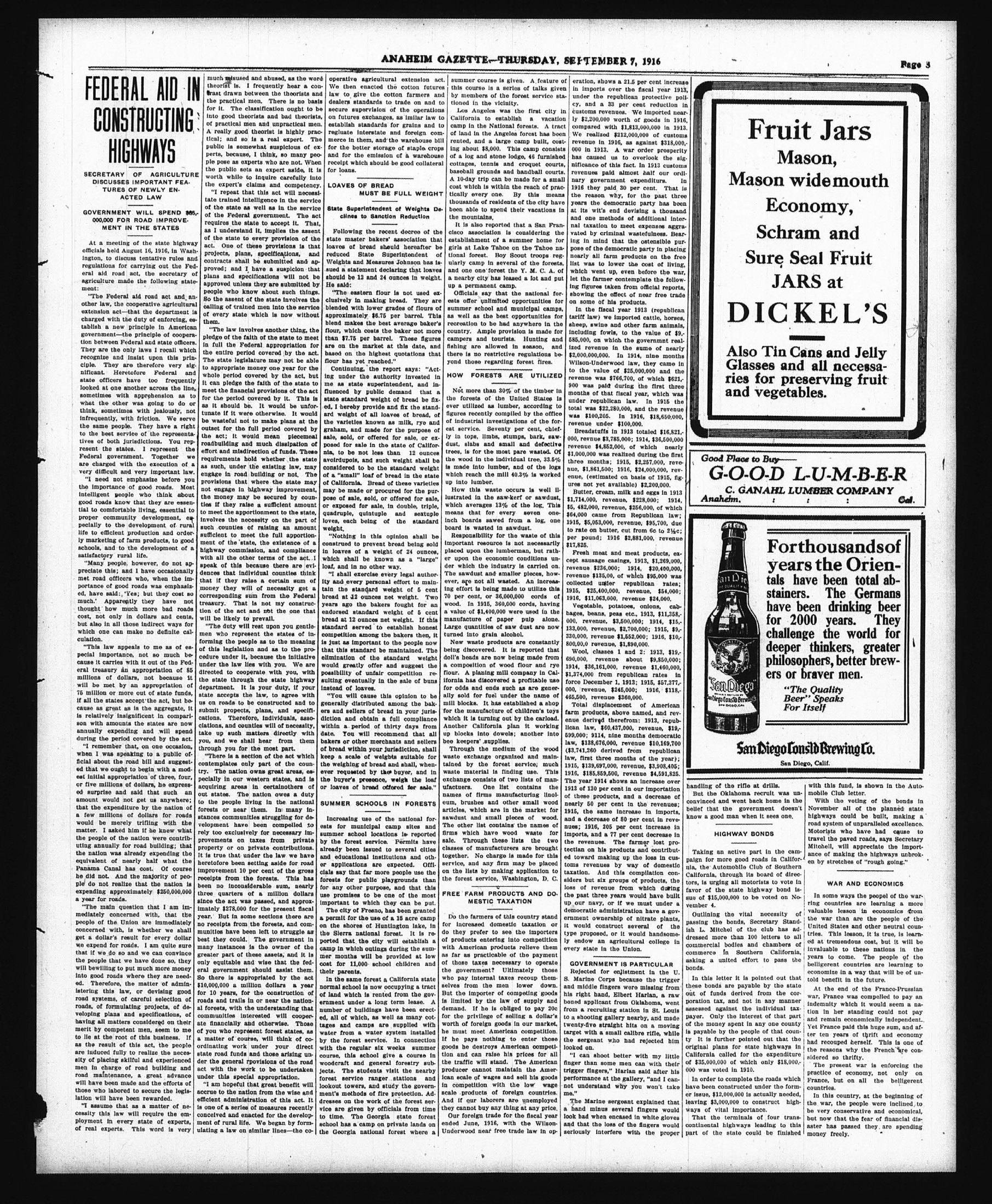
Searchable text
FEDERAL AID IN CONSTRUCTING HIGHWAYS
SECRETARY OF AGRICULTURE DISCUSSES IMPORTANT FEATURES OF NEWLY ENACTED LAW
GOVERNMENT WILL SPEND $65,000,000 FOR ROAD IMPROVEMENT IN THE STATES
At a meeting of the state highway officials held August 16, 1916, in Washington, to discuss tentative rules and regulations for carrying out the Federal aid road act, the secretary of agriculture made the following statement:
"The Federal aid road act and another law, the cooperative agricultural extension act—that the department is charged with the duty of enforcing, establish a new principle in American government—the principle of cooperation between Federal and state officers. They are the only laws I recall which recognize and insist upon this principle. They are therefore very significant. Heretofore Federal and state officers have too frequently looked at one another across the line, sometimes with apprehension as to what the other was going to do or think, sometimes with jealousy, not infrequently, with friction. We serve the same people. They have a right to the best service of the representatives of both jurisdictions. You represent the much misused and abused, as the word theorist is. I frequently hear a contrast drawn between the theorists and the practical men. There is no basis for it. The classification ought to be into good theorists and bad theorists, of practical men and unpractical men. A really good theorist is highly practical; and so is a real expert. The public is somewhat suspicious of experts, because, I think, so many people pose as experts who are not. When the public sets an expert aside, it is worth while to inquire carefully into the expert's claims and competency.
"I repeat that this act will necessitate trained intelligence in the service of the state as well as in the service of the Federal government. The act requires the state to accept it. That, as I understand it, implies the assent of the state to every provision of the act. One of these provisions is that projects, plans, specifications, and contracts shall be submitted and approved; and I have a suspicion that plans and specifications will not be approved unless they are submitted by people who know about such things. So the assent of the state involves the calling of trained men into the service of every state which is now without them.
"The law involves another thing, the pledge of the faith of the state to meet in full the Federal appropriation for the entire period covered by the act. The state legislature may not be able to appropriate money one year for the whole period covered by the act, but it can pledge the faith of the state to meet the financial provisions of the act for the period covered by it. This is as it should be. It would be unfortunate if it were otherwise. It would be wasteful not to make plans at the outset for the full period covered by the act; it would mean piecemeal roadbuilding and much dissipation of operative agreements."
Following this state master level loaves of bread reduced State Weights and Mines sued a statement should be 12 acres.
"The easterly clusively in many blended with low approximately blend makes flour, which costs than $7.75 per pound on the maize based on the flour has yet ripe.
Continuing, there me as state staff fluenced by state standard ed, I hereby prodd weight of varieties kgraham, and milsale, sold, or opossed for sale."
recognize and insist upon this principle. They are therefore very significant. Heretofore Federal and state officers have too frequently looked at one another across the line, sometimes with apprehension as to what the other was going to do or think, sometimes with jealously, not infrequently, with friction. We serve the same people. They have a right to the best service of the representatives of both jurisdictions. You represent the states. I represent the Federal government. Together we are charged with the execution of a very difficult and very important law.
"I need not emphasize before you the importance of good roads. Most intelligent people who think about good roads know that they are essential to comfortable living, essential to proper community development, especially to the development of rural life to efficient production and orderly marketing of farm products, to good schools, and to the development of a satisfactory rural life.
"Many people, however, do not appreciate this; and I have occasionally met road officers who, when the importance of good roads was emphasized, have said: 'Yes; but they cost so much.' Apparently they have not thought how much more bad roads cost, not only in dollars and cents, but also in all those indirect ways for which one can make no definite calculation.
"This law appeals to me as of especial importance, not so much because it carries with it out of the Federal treasury an appropriation of 85 millions of dollars, not because it will be met by an appropriation of 75 million or more out of state funds, if all the states accept the act, but because as great as is the aggregate, it is relatively insignificant in comparison with amounts the states are now annually expending and will spend during the period covered by the act.
"I remember that, on one occasion, when I was speaking to a public official about the road bill and suggested that we ought to begin with a modest initial appropriation of three, four, or five millions of dollars, he expressed surprise and said that such an amount would not get us anywhere; that the expenditure by the nation of a few millions of dollars for roads would be merely trifling with the matter. I asked him if he knew what the people of the nation were contributing annually for road building; that
The state legislature may not be able to appropriate money one year for the whole period covered by the act, but it can pledge the faith of the state to meet the financial provisions of the act for the period covered by it. This is as it should be. It would be unfortunate if it were otherwise. It would be wasteful not to make plans at the outset for the full period covered by the act; it would mean piecemeal roadbuilding and much dissipation of effort and misdirection of funds. These requirements hold whether the state as such, under the existing law, may engage in road building or not. The provisions that where the state may not engage in highway improvement, the money may be secured by counties if they raise a sufficient amount to meet the apportionment to the state, involves the necessity on the part of such counties of raising an amount sufficient to meet the full apportionment of the state, the existence of a highway commission, and compliance with all the other terms of the act. I speak of this because there are evidences that individual counties think that if they raise a certain sum of money they will of necessity get a corresponding sum from the Federal treasury. That is not my construction of the act and not the one that will be likely to prevail.
"The duty will rest upon you gentlemen who represent the states of informing the people as to the meaning of this legislation and as to the procedure under it, because the initiative under the law lies with you. We are directed to cooperate with you, with the state through the state highway department. It is your duty, if your state accepts the law, to agree with us on roads to be constructed and to submit projections, plans, and specifications. Therefore, individuals, associations, and counties will of necessity take up such matters directly with you, and we shall hear from them through you for the most part.
"There is a section of the act which contemplates only part of the country. The nation owns great areas, especially in our western states, and is acquiring areas in certain others of out states. The nation owes a duty to the people living in the national forests or near them. In many instances communities struggling for development have been compelled to rely too exclusively for necessary improvements on taxes from private property or on private contributions."
Continuing, ing under the me as state standard ed, I hereby provide weight of f varieties known graham, and m sale, sold, or o posed for sale niia, to be not avoirdupois, and considered to be of a "small" loa California. B may be made on pose of sale, so or exposed for quadruple, quin love, each being weight.
"Nothing in construed to pre- which shall be loaf, and in no date.
"I shall exercise and every per- tain the standard bread at 12 ounces years ago the endorsed standards bread at 12 ounces standard served competition amd is just as important that this standard elimination of would greatly o possibility of un suiting eventually instead of loave.
"You will cause generally distribut ers and sellers o diction and obtai within a period date. You will bakers or other o f bread within y keep a scale off he weighing of ever requested by the buyer's pre- or loaves of brew."
SUMMER SCHOOL
Increasing use ests for municipal summer school by the forest se already been less
which I was speaking to a public official about the road bill and suggested that we ought to begin with a modest initial appropriation of three, four, or five millions of dollars, he expressed surprise and said that such an amount would not get us anywhere; that the expenditure by the nation of a few millions of dollars for roads would be merely trifling with the matter. I asked him if he knew what the people of the nation were contributing annually for road building; that the nation was already expending the equivalent of nearly half what the Panama Canal has cost. Of course he did not. And the majority of people do not realize that the nation is expending approximately $250,000,000 a year for roads.
"The main question that I am immediately concerned with, that the people of the Union are immediately concerned with, is whether we shall get a dollar's result for every dollar we expend for roads. I am quite sure that if we do so and we can convince the people that we have done so, they will be willing to put much more money into good roads where they are needed. Therefore, the matter of administering this law, or devising good road systems, of careful selection of roads, of formulating projects, of developing plans and specifications, of having all matters considered on their merit by competent men, seem to me to lie at the root of this business. If as the result of this act, the people are induced fully to realize the necessity of placing skillful and experienced men in charge of road building and road maintenance, a great advance will have been made and the efforts of those who labored to secure the legislation will have been rewarded.
"I assume that as a matter of necessity this law will require the employment in every state of experts, of real experts. This word is very
There is a section of the act which contemplates only part of the country. The nation owns great areas, especially in our western states, and is acquiring areas in certain others out states. The nation owes a duty to the people living in the national forests or near them. In many instances communities struggling for development have been compelled to rely too exclusively for necessary improvements on taxes from private property or on private contributions. It is true that under the law we have heretofore been setting aside for road improvement 10 per cent of the gross receipts from the forests. This has been no inconsiderable sum, nearly three quarters of a million dollars since the act was passed, and approximately $278,000 for the present fiscal year. But in some sections there are no receipts from the forests, and communities have left to struggle as best they could. The government in many instances is the owner of the greater part of these assets, and it is only equitable and wise that the federal government should assist them. So there is appropriated by the act $10,000,000 a million dollars a year for 10 years, for the construction of roads and trails in or near the national forests, with the understanding that communities interested will cooperate financially and otherwise. Those of you who represent forest states, as a matter of course, will think of coordinating work under your direct state road funds and those arising under the general provisions of the road act with the work to be undertaken under this special appropriation.
"I am hopeful that great benefit will accrue to the nation from the wise and efficient administration of this act. It is one of a series of measures recently conceived and enacted for the development of rural life. We began by formulating a law on similar lines—the co-
ANAHEIM GAZETTE—THURSDAY, SEPTEMBER 7, 1916
is the word dear a contorists and is no basis ought to be theorists,
optical men, highly prapert. The ous of exmany peo- not. When aside, it is
faultily into competency.
will necessithe service one service
The act it. That,
the assent of the us is that ans, and and apcition that will not be permitted by such things.
vokes the one service without thing, the one meetation for the act, but the state to of the act
This is one unforIt would was at the covered by decemealation of
operative agricultural extension act.
We then enacted the cotton futures law to give the cotton farmers and dealers standards to trade on and to secure supervision of the operations on futures exchanges, as similar law to establish standards for grains and to regulate interstate and foreign commerce in them, and the warehouse bill for the better storage of staple crops and for the emission of a warehouse receipt which should be good collateral for loans.
LOAVES OF BREAD
MUST BE FULL WEIGHT
State Superintendent of Weights Declines to Sanction Reduction
Following the recent decree of the state master bakers' association that loaves of bread should hereafter be reduced State Superintendent of Weights and Measures Johnson has issued a statement declaring that loaves should be 12 and 24 ounces in weight. He said:
"The eastern flour is not used exclusively in making bread. They are blended with lower grades of flours of approximately $6.75 per barrel. This blend makes the best average baker's flour, which costs the baker not more than $7.75 per barrel. These figures are on the market at this date, and based on the highest quotations that flour has yet reached."
Continuing, the report says: "Acting under the authority invested in me as state superintendent, and influenced by public demand that a state standard weight of bread be fixed, I hereby provide and fix the standard weight of all loaves of bread, of the varieties known as milk, rye and graham, and made for the purpose of sale, sold, or offered for sale, or exposed for sale in the state of Califor-
summer course is given. A feature of this course is a series of talks given by members of the forest service stationed in the vicinity.
Los Angeles was the first city in California to establish a vacation camp in the National forests. A tract of land in the Angeles forest has been rented, and a large camp built, costing about $8,000. This camp consists of a log and stone lodge, 46 furnished cottages, tennis and croquet courts, baseball grounds and handball courts. A 10-day trip can be made for a small cost which is within the reach of practically every one. By this means thousands of residents of the city have been able to spend their vacations in the mountains.
It is also reported that a San Francisco association is considering the establishment of a summer home for girls at Lake Tahoe on the Tahoe national forest. Boy Scout troops regularly camp in several of the forests, and one one forest the Y. M. C. A. of a nearby city has leased a lot and put up a permanent camp.
Officials say that the national forests offer unlimited opportunities for summer school and municipal camps, as well as the best opportunities for recreation to be had anywhere in the country. Ample provision is made for campers and tourists. Hunting and fishing are allowed in season, and there is no restrictive regulations beyond those regarding forest fires.
HOW FORESTS ARE UTILIZED
Not more than 30% of the timber in the forests of the United States is ever utilized as lumber, according to figures recently compiled by the office of industrial investigations of the forest service. Seventy per cent, chiefly in tops, limbs, stumps, bark, sawdust, slabs and small and defective eration, shows a 21.5 per cent increase in imports over the fiscal year 1913, under the republican protective policy, and a 33 per cent reduction in customs revenues. We imported nearly $2,200,000 worth of goods in 1916, compared with $1,813,000,000 in 1913. We realized $212,000,000 of customs revenue in 1916, as against $318,000,-000 in 1913. A war order prosperity has caused us to overlook the significance of this fact. In 1913 customs revenues paid almost half our ordinary government expenditures. In 1916 they paid 30 per cent. That is the reason why, for the past three years the democratic party has been at its wit's end devising a thousand and one methods of additional internal taxation to meet expenses aggravated by criminal wastefulness. Bearin mind that the ostensible purpose of the democratic party in placing nearly all farm products on the free list was to lower the cost of living, which went up, even before the war, let the farmer contemplate the following figures taken from official reports, showing the effect of near free trade on some of his products.
In the fiscal year 1913 (republican tariff law) we imported cattle, horses, sheep, swine and other farm animals, including fowls, to the value of $9,-585,000, on which the government realized revenue in the sum of nearly $2,000,000,000. In 1914, nine months Wilson-Underwood law, they came in to the value of $25,000,000 and the revenue was $766,700, of which $621,-900 was paid during the first three months of that fiscal year, which was under republican law. In 1915 the total was $22,280,000, and the revenue was $100,205. In 1916, $18,650,000 revenue under $100,000.
Breadstuffs in 1913 totaled $16,821,-000; revnue $3,785,000; 1914, $36,500,000 revenue $4,852,000; of which nearly
Continuing, the report says: "Acting under the authority invested in me as state superintendent, and influenced by public demand that a state standard weight of bread be fixed, I hereby provide and fix the standard weight of all loaves of bread, of the varieties known as milk, rye and graham, and made for the purpose of sale, sold, or offered for sale, or exposed for sale in the state of California, to be not less than 12 ounces avoiroduois, and such weight shall be considered to be the standard weight of a "small" loaf of bread in the state of California. Bread of these varieties may be made or procured for the purpose of sale, sold, or offered for sale, or exposed for sale, in double, triple, quadruple, quintuple and sextuple loves, each being of the standard weight.
"Nothing in this opinion shall be construed to prevent bread being sold in loaves of a weight of 24 ounces, which shall be known as a "large" loaf, and in no other way.
"I shall exercise every legal authority and every personal effort to maintain the standard weight of 5 cent bread at 12 ounces net weight. Two years ago the bakers fought for an endorsed standard weight of 5 cent bread at 12 ounces net weight. If this standard served to establish honest competition among the bakers then, it is just as important to the people now that this standard be maintained. The elimination of the standard weight would greatly offer and suggest the possibility of unfair competition resulting eventually in the sale of buns instead of loaves.
"You will cause this opinion to be generally distributed among the bakers and sellers of bread in your jurisdiction and obtain a full compliance within a period of thirty days from date. You will recommend that all bakers or other merchants and sellers of bread within your jurisdiction, shall keep a scale of weights suitable for the weighing of bread and shall, whenever requested by the buyer, and in the buyer's presence, weigh the loaf or loaves of bread offered for sale."
SUMMER SCHOOLS IN FORESTS
Increasing use of the national forests for municipal camp sites and summer school locations is reported by the forest service. Permits have already been issued to several cities
HOW FORESTS ARE UTILIZED
Not more than 30% of the timber in the forests of the United States is ever utilized as lumber, according to figures recently compiled by the office of industrial investigations of the forest service. Seventy per cent, chiefly in tops, limbs, stumps, bark, sawdust, slabs and small and defective trees, is for the most pare wasted. Of the wood in the individual tree, 33.5% is made into lumber, and of the logs which reach the mill 40.3% is worked up into lumber.
How this waste occurs is well illustrated in the saw-kerf or sawdust, which averages 13% of the log. This means that for every seven one-inch boards sawed from a log, one board is wasted in sawdust.
Responsibility for the waste of this important resource is not necessarily placed upon the lumberman, but rather upon the economic conditions under which the industry is carried on. The sawdust and smaller pieces, however, are not all wasted. An increasing effort is being made to utilize this 70 per cent, or 36,000,000 cords of wood. In 1915, 360,000 cords, having a value of $1,400,000 were used in the manufacture of paper pulp alone. Large quantities of saw dust are now turned into grain alcohol.
New waste products are constantly being discovered. It is reported that doll's heads are now being made from a composition of wood flour and rye flour. A planing mill company in California has discovered a profitable use for odds and ends such as are generally sold for fuel under the name of mill blocks. It has established a shop for the manufacture of children's toys which it is turning out by the carload. Another California plan it working up blocks into dowels; another into bee keepers' supplies.
Through the medium of the wood waste exchange organized and maintained by the forest service; much waste material is finding use. This exchange consists of two lists of manufacturers. One list contains the names of firms manufacturing linoleum, brushes and other small wood articles, which are in the market for sawdust and small pieces of wood. The other list contains the names of firms which have wood waste for sale. Through these lists the two classes of manufacturers are brought there is no restrictive regulations beyond those regarding forest fires.
Wilson-Underwood law, they came in to the value of $25,000,000 and the revenue was $766,700, of which $621,-900 was paid during the first three months of that fiscal year, which was under republican law. In 1915 the total was $22,280,000, and the revenue was $100,205. In 1916, $18,650,000, revenue under $100,000.
Breadstuffs in 1913 totaled $16,821,-000, revenue $3,785,000; 1914, $36,500,000 revenue $4,852,000, of which nearly $1,000,000 was realized during the first three months; 1915, $2,257,000, revenue $1,861,500; 1916, $24,000,000, revenue (estimated on basis of 1915 figures not yet available) $2,200,000.
Butter, cream, milk and eggs in 1913 $1,714,000, revenue $228,000; 1914,$5,482,000, revenue $256,000, of which $64,000 came from Republican law; 1915,$5,053,000, revenue $95,700 due to rate on butter; cut from cto 2½c; per pound; 1916 $2,881,000, revenue $17,825.
Fresh meat and meat products except sausage casings, 1913,$1,269,000 Revenue $236,000; 1914,$20,400,000 revenue $135,oof which $95,ooo was collected under republican rates; 1915,$25,400,ooo revenue $54,ooo; 1916,$11,063,ooo revenue $24,ooo.
Vegetable potatoes onions cabbages beans peas etc., 1913,$11,358,-ooo revenue $3,500,ooo; 1914,$15,-133,ooo revenue $2,700,ooo; 1915,$9,-330,ooo revenue $1,552,ooo; 1916,$10,-800,ooo revenue $1,890,ooo.
Wool classes 1 and 2: 1913,$19,-690,ooo revenue about $9,858,ooo; 1914,$36,161,ooo revenue $1,46O,OOO; 1,374,OOO from republican rates in force December 1,1913; 1915,$57,377,-ooo revenue $245,ooo; 1916,$118,-465,ooo revenue $36O,OOO.
Total displacement of American farm products above named,and revenue derived therefrom: 1913,republican law,$6O,437,OOO revenue,$I-599,OOO; 9IlI4,nine months democratic law,$I38,G76,OOO revenue$I-6I9,OOO($3,74I,26O derived from republican law,first three months ofthe year); 19I5,$139,697,OOO revenue,$3,9O8,4O5; 19I6,$185,859,OOO revenue,$4,SVI,825.The year 19I4 shows an increase over 19I3of 13O per cent in our importation of these products,and a decrease of nearly 5O per cent in the revenues; 19I5,the same increase in imports,and a decrease of 8O per cent in revenues; 19I6 ,2O5per cent increase in imports,and a 77 per cent decrease in the revenues.The farmer lost protection on his products and contributi-
SUMMER SCHOOLS IN FORESTS
Increasing use of the national forests for municipal camp sites and summer school locations is reported by the forest service. Permits have already been issued to several cities and educational institutions and other applications are expected. Officials say that far more people use the forests for public playgrounds than for any other purpose, and that this use promises to be one of the most important to which they can be put.
The city of Fresno, has been granted a permit for the use of a 15 acre camp on the shores of Huntington lake, in the Sierra national forest. It is reported that the city will establish a camp in which outings during the summer months will be provided at low cost for 11,000 school children and their parents.
In the same forest a California state normal school is now occupying a tract of land which is rented from the government under a long term lease. A number of buildings have been erected, all of which, as well as many cottages and camps are supplied with water from a water system installed by the forest service. In connection with the regular six weeks summer course, this school give a course in woodcraft and general forestry subjects. The students visit the nearby forest service ranger stations and lookout towers, and study the government's methods of fire protection. Addresses on the work of the forest service are given by officials from time to time. The Georgia state forest school has a camp on private lands on the Georgia national forest where a waste exchange organized and maintained by the forest service; much waste material is finding use. This exchange consists of two lists of manufacturers. One list contains the names of firms manufacturing linoleum, brushes and other small wood articles, which are in the market for sawdust and small pieces of wood. The other list contains the names of firms which have wood waste for sale. Through these lists the two classes of manufacturers are brought together. No charge is made for this service, and any firm may be placed on the lists by making application to the forest service, Washington, D.C.
FREE FARM PRODUCTS AND DOMESTIC TAXATION
Do the farmers of this country stand for increased domestic taxation or do they prefer to see the importers of products entering into competition with American products relieve them as far as practicable of the payment of those taxes necessary to operate the government? Ultimately those who pay internal taxes recoup themselves from the men lower down. But the importer of competing goods is limited by the law of supply and demand. If he is obliged to pay 20c for the privilege of selling a dollar's worth of foreign goods in our market, he must meet American competition. If he pays nothing to enter those goods he destroys American competition and can raise his prices for all the traffic will stand. The American producer cannot maintain the American scale of wages and sell his goods in competition with the low wage scale products of foreign countries. And if our laborers are unemployed they cannot buy any thing at any price.
Our foreign trade for the fiscal year ended June, 1916, with the Wilson-Underwood near free trade law in op-
GOVERNMENT IS PARTICULAR
Rejected for enlistment in the U.S. Marine Corps because the trigger and middle fingers were missing from his right hand, Elbert Harlan, a raw boned applicant from Oklahoma, went from a recruiting station in St. Louis to a shooting gallery nearby, and made twenty-five straight hits on a moving target with a small callibre rifle, while the sergeant who had rejected him looked on.
"I can shoot better with my little finger than some men can with their trigger fingers," Harlan said after his performance at the gallery, "and I cannot understand why you won't take me."
The Marine sergeant explained that a hand minus several fingers would look bad when encased in white gloves and that the loss of the fingers would seriously interfere with the proper law, first three months of the year); 1915, $139,697,000, revenue, $3,908,405; 1916, $185,859,500, revenue $4,591,825. The year 1914 shows an increase over 1913 of 130 per cent in our importation of these products, and a decrease of nearly 50 per cent in the revenues; 1915, the same increase in imports, and a decrease of 80 per cent in revenues; 1916, 205 per cent increase in imports, and a 77 per cent decrease in the revenues. The farmer lost protection on his products and contributed toward making up the loss in customs revenues by way of domestic taxation. And this compilation considers but six groups of products, the loss of revenue from which during the past three years would have built up our navy, or if we must under a democratic administration have a government ownership of nitrate plants, it would construct several of the type proposed, or it would handsomely endow an agricultural college in every state in the Union.
GOVERNMENT IS PARTICULAR
Rejected for enlistment in the U.S. Marine Corps because the trigger and middle fingers were missing from his right hand, Elbert Harlan, a raw boned applicant from Oklahoma, went from a recruiting station in St. Louis to a shooting gallery nearby, and made twenty-five straight hits on a moving target with a small callibre rifle, while the sergeant who had rejected him looked on.
"I can shoot better with my little finger than some men can with their trigger fingers," Harlan said after his performance at the gallery, "and I cannot understand why you won't take me."
The Marine sergeant explained that a hand minus several fingers would look bad when encased in white gloves and that the loss of the fingers would seriously interfere with the proper law, first three months of the year); 1915, $139,697,000, revenue, $3,908,405; 1916, $185,859,500, revenue $4,591,825. The year 1914 shows an increase over 1913 of 130 per cent in our importation of these products, and a decrease of nearly 50 per cent in the revenues; 1915, the same increase in imports, and a decrease of 80 per cent in revenues; 1916, 205 per cent increase in imports, and a 77 per cent decrease in the revenues. The farmer lost protection on his products and contributed toward making up the loss in customs revenues by way of domestic taxation. And this compilation considers but six groups of products, the loss of revenue from which during the past three years would have built up our navy, or if we must under a democratic administration have a government ownership of nitrate plants, it would construct several of the type proposed, or it would handsomely endow an agricultural college in every state in the Union."
Fruit Jars
Mason,
Mason widemouth
Economy,
Schram and
Sure Seal Fruit
JARS at
DICKEL'S
Also Tin Cans and Jelly
Glasses and all necessaries for preserving fruit
and vegetables.
Good Place to Buy—
G-O-O-D L-U-M-B-E-R
C. GANAHL LUMBER COMPANY
Anaheim, Cal.
Forthousands of years the Orientals have been total abstainers. The Germans have been drinking beer for 2000 years. They challenge the world for deeper thinkers, greater philosophers, better brewers or braver men.
"The Quality Beer" Speaks For Itself
San Diego Consld Brewing Co.
San Diego, Calif.
handling of the rifle at drills.
But the Oklahoma recruit was unconvinced and went back home in the belief that the government doesn't know a good man when it sees one.
HIGHWAY BONDS
with this fund, is shown in the Automobile Club letter.
With the voting of the bonds in November all of the planned state highways could be built, making a road system of unparalleled excellence. Motorists who have had cause to travel the paved roads, says Secretary Mitchell, will appreciate the import-
handling of the rifle at drills.
But the Oklahoma recruit was unconvinced and went back home in the belief that the government doesn't know a good man when it sees one.
HIGHWAY BONDS
Taking an active part in the campaign for more good roads in California, the Automobile Club of Southern California, through its board of directors, is urging all motorists to vote in favor of the state highway bond issue of $15,000,000 to be voted on November 4.
Outlining the vital necessity of passing the bonds, Secretary Standish L. Mitchel of the club has addressed more than 100 letters to all commercial bodies and chambers of commerce in Southern California, asking a united effort to pass the bonds.
In this letter it is pointed out that these bonds are payable by the state out of funds derived from the corporation tax, and not in any manner assessed against the individual taxpayer. Only the interest of that part of the money spent in any one county is payable by the people of that county. It is further pointed out that the original plans for state highways in California called for the expenditure of $35,000,000 of which only $18,000,000 was voted in 1910.
In order to complete the roads which have been constructed under the former issue, $12,000,000 is actually needed, leaving $3,000,000 to construct highways of vital importance.
That the terminals of four transcontinental highways leading to this part of the state could be finished with this fund, is shown in the Automobile Club letter.
With the voting of the bonds in November all of the planned state highways could be built, making a road system of unparalleled excellence. Motorists who have had cause to travel the paved roads, says Secretary Mitchell, will appreciate the importance of making the highways unbroken by stretches of "rough going."
WAR AND ECONOMICS
In some ways the peopel of the warring countries are learning a more valuable lesson in economics from the war than are the people of the United States and other neutral countries. This lesson, it is true, is learned at tremendous cost, but it will be invaluable to these nations in the years to come. The people of the belligerent countries are learning to economize in a way that will be of untold benefit in the future.
At the end of the Franco-Prussian war, France was compelled to pay an indemnity which it would seem a nation in her standing could not pay and remain economically independent. Yet France paid this huge sum, and after ten years of thrift and economy had recouped herself. This is one of the reasons why the French are considered so thrifty.
The present war is enforcing the practice of economy, not only on France, but on all the belligerent countries.
In this country, at the beginning of the war, the people were inclined to be very conservative and economical, but now that the fear of financial disaster has passed they are spending money freely.