anaheim-gazette 1916-09-07
Scanned page
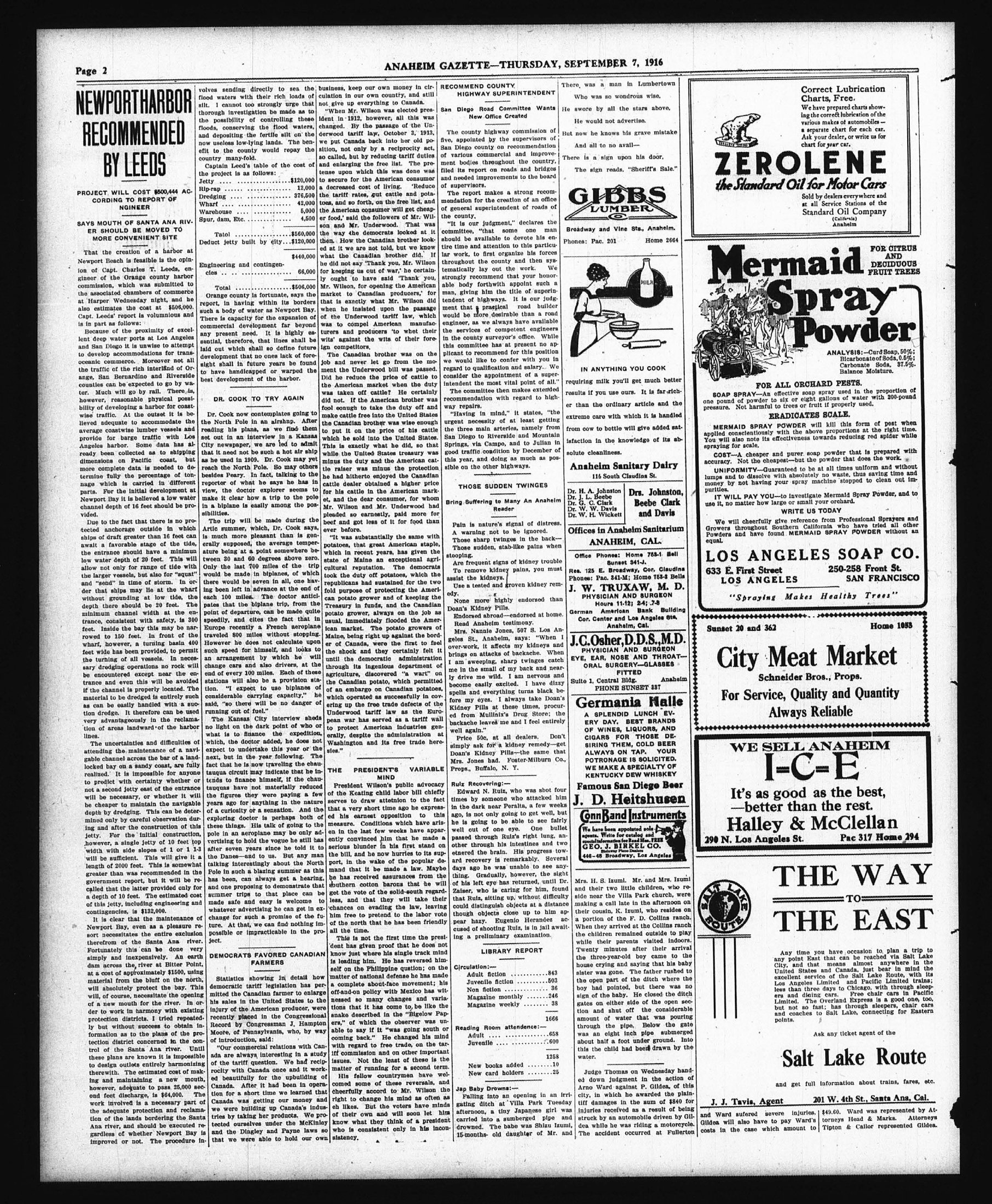
Searchable text
NEWPORTHARBOR RECOMMENDED BY LEEDS
PROJECT WILL COST $500,444 ACCORDING TO REPORT OF ENGINEER
SAYS MOUTH OF SANTA ANA RIVER SHOULD BE MOVED TO MORE CONVENIENT SITE
That the creation of a harbor at Newport Beach is feasible is the opinion of Capt. Charles T. Leeds, engineer of the Orange county harbor commission, which was submitted to the associated chambers of commerce at Harper Wednesday night, and he also estimates the cost at $506,000. Capt. Leeds' report is volumnious and is in part as follows:
Because of the proximity of excellent deep water ports at Los Angeles and San Diego it is unwise to attempt to develop accommodations for trans-oceanic commerce. Moreover not all the traffic of the rich interland of Orange, San Bernardino and Riverside counties can be expected to go by water. Much will go by rail. There is, however, reasonable physical possibility of developing a harbor for coast-wise traffic. At the outset it is believed adequate to accommodate the average coastwise lumber vessels and provide for barge traffic with Los Angeles harbor. Some data has al-volves sending directly to sea the flood waters with their rich loads of silt. I cannot too strongly urge that thorough investigation be made as to the possibility of controlling these floods, conserving the flood waters, and depositing the fertile silt on the now useless low-lying lands. The benefit to the county would repay the country many-fold.
Captain Leed's table of the cost of the project is as follows:
Jetty ... $120,000
Rip-rap ... 12,000
Dredging ... 376,500
Wharf ... 42,000
Warehouse ... 5,000
Spur, dam, Etc. ... 4,500
Tatol ... $560,000
Deduct jetty built by city...$120,000
$440,000
Engineering and contingencies ... 66,000
Total ... $506,000
Orange county is fortunate, says the report, in having within its borders such a body of water as Newport Bay. There is capacity for the expansion of commercial development far beyond any present need. It is highly essential, therefore, that lines shall be laid out which shall so define future development that no ones lack of fore-sight shall in future years be found to have handicapped or warped the best development of the harbor.
DR. COOK TO TRY AGAIN
Dr. Cook now contemplates going to the North Pole in an airship. After reading his plans, as we find them set out in an interview in a Kansas City newspaper, we are led to admit business, keep our calculation in our own not give up every "When Mr. Wilson ident in 1912, he changed. By the derwood tariff law we put Canada basition, not only so called, but by and enlarging the tense upon which to secure for the decreased cost the tariff rates, toes, and so forth the American cargo food," said the son and Mr. Ursula the way the deter then. How the Ced at it we are re what the Canada he did not say "for keeping us oily ought to harm Mr. Wilson, for our market to Canada that is exactly when he insisted of the Underwater was to compel tuturers and producers wits' against the ign competitors.
The Canadian job and never ment the Underwater Did he reduce the American m was taken off did not. If the fool enough to make cattle free the Canadian broth to put it on which he sold This is exactly
to develop accommodations for transoceanic commerce. Moreover not all the traffic of the rich interland of Orange, San Bernardino and Riverside counties can be expected to go by water. Much will go by rail. There is, however, reasonable physical possibility of developing a harbor for coastwise traffic. At the outset it is believed adequate to accommodate the average coastwise lumber vessels and provide for barge traffic with Los Angeles harbor. Some data has already been collected as to shipping dimensions on Pacific coast, but more complete data is needed to determine fully the percentage of tonnage which is carried in different parts. For the initial development at Newport Bay it is believed a low water channel depth of 16 feet should be provided.
Due to the fact that there is no protected anchorage outside in which ships of draft greater than 16 feet can await a favorable stage of the tide, the entrance should have a minimum low water depth of 20 feet. This will allow not only for range of tide with the larger vessels, but also for "squat" and "send" in time of storm. In order that ships may lie at the wharf without grounding at low tide, the depth there should be 20 feet. The minimum channel width at the entrance, consistent with safety, is 300 feet. Inside the bay this may be narrowed to 150 feet. In front of the wharf, however, a turning basin 400 feet wide has been provided, to permit the turning of all vessels. In necessary dredging operations no rock will be encountered except near the entrance and even this will be avoided if the channel is properly located. The material to be dredged is entirely such as can be easily handled with a suction dredge. It therefore can be used very advantageously in the reclamation of areas landward of the harbor lines.
The uncertainties and difficulties of attending the maintenance of a navigable channel across the bar of a landlocked bay on a sandy coast, are fully realized. It is impossible for anyone to predict with certainty whether or not a second jetty east of the entrance will be necessary, or whether it will be cheaper to maintain the navigable depth by dredging. This can be determined only by careful observation during and after the construction of this jetty. For the initial construction, however, a single jetty of 10 feet top width with side slopes of 1 or 1 1/3
DR. COOK TO TRY AGAIN
Dr. Cook now contemplates going to the North Pole in an airshnp. After reading his plans, as we find them set out in an interview in a Kansas City newspaper, we are led to admit that it need not be such a hot air ship as he used in 1909. Dr. Cook may yet reach the North Pole. So may others besides Peary. In fact, talking to the reporter of what he says he has in view, the doctor explorer seems to make it clear how a trip to the pole in a biplane is easily among the possibilities.
The trip will be made during the Artic summer, which, Dr. Cook says, is much more pleasant than is generally supposed, the average temperature being at a point somewhere between 30 and 60 degrees above zero. Only the last 700 miles of the trip would be made in biplanes, of which there would be seven in all, one having been left in advance at the end of each 100 miles. The doctor anticipates that the biplane trip, from the point of departure, can be made quite speedily, and cites the fact that in Europe recently a French aeroplane traveled 800 miles without stopping. However he does not calculate upon such speed for himself, and looks to an arrangement by which he will change cars and also drivers, at the end of every 100 miles. Each of these stations will also be a provision station. "I expect to use biplanes of considerable carrying capacity," he said, "so there will be no danger of running out of fuel."
The Kansas City interview sheds no light on the dark point of who or what is to finance the expedition, which, the doctor added, he does not expect to undertake this year or the next, but in the year following. The fact that he is now traveling the chauqua circuit may indicate that he intends to finance himself, if the chauquas have not materially reduced the figures they were paying a few years ago for anything in the nature of a curiosity or a sensation. And the exploring doctor is perhaps both of these things. His talk of going to the pole in an aeroplane may be only advertising to hold the vogue he still has after seven years since he told it to
The Canadian job and never ment the Underwater Did he reduce to make cattle free; the Canadian breed to put it on which he sold it. This is exactly while the United States minus the duty rate raiser was he had hitherto cattle dealer obey for his cattle in et, and the dearest Mr. Wilson and pleaded so earn beef and got lee ever before.
"It was substitutable potatoes, that which in recent state of Maine cultural reputation took the duty of republicans had fold purpose of can potato grower usual, immediate Ican market. Maine, being ruler of Canada, the shock and until the demons through its agriculture, did the Canadian part of an embargo which operated ering up the first Underwood tar pean war has to protect America, despite Washington siles."
gable channel across the bar of a land-locked bay on a sandy coast, are fully realized. It is impossible for anyone to predict with certainty whether or not a second jetty east of the entrance will be necessary, or whether it will be cheaper to maintain the navigable depth by dredging. This can be determined only by careful observation during and after the construction of this jetty. For the initial construction, however, a single jetty of 10 feet top width with side slopes of 1 or 1 1/3 will be sufficient. This will give it a length of 2000 feet. This is somewhat greater than was recommended in the government report, but it will be recalled that the latter provided only for a depth of 10 feet. The estimated cost of this jetty, including engineering and contingencies, is $132,000.
It is clear that the maintenance of Newport Bay, even as a pleasure resort necessitates the entire exclusion therefrom of the Santa Ana river. Fortunately this can be done very simply and inexpensively. An earth dam across the river at Bitter Point, at a cost of approximately $1500, using material from the bluff on the north, will absolutely protect the bay. This will, of course, necessitate the opening of a new mouth for the river. In order to work in harmony with existing protection districts, I tried repeatedly but without success to obtain information as to the plans of the protection district concerned in the control of the Santa Ana river. Until these plans are known it is impossible to design outlets entirely harmonizing therewith. The estimated cost of making and maintaining a new mouth, however, adequate to pass 25,000 second feet discharge, is $64,000. The work involved is a necessary part of the adequate protection and reclamation of the lands bordering the Santa Ana river, and should be executed regardless of whether Newport Bay is improved or not. The procedure in-
next, but in the year following. The fact that he is now traveling the chauqua circuit may indicate that he intends to finance himself, if the chauquas have not materially reduced the figures they were paying a few years ago for anything in the nature of a curiosity or a sensation. And the exploring doctor is perhaps both of these things. His talk of going to the pole in an aeroplane may be only advertising to hold the vogue he still has after seven years since he told it to the Danes—and to us. But any man talking interestingly about the North Pole in such a blazing summer as this has been, can always get a hearing, and one proposing to demonstrate that summer trips to that place can be made safe and easy is welcome to whatever advertising he can get in exchange for such a promise of the future. At that, we can find nothing impossible or impracticable in the project.
DEMOCRATS FAVORED CANADIAN FARMERS
Statistics showing in detail how democratic tariff legislation has permitted the Canadian farmer to enlarge his sales in the United States to the injury of the American producer, were recently placed in the Congressional Record by Congressman J. Hampton Moore, of Pennsylvania, who, by way of introduction, said:
"Our commercial relations with Canada are always interesting in a study of the tariff question. We had reciprocity with Canada once and it worked beautifully for the upbuilding of Canada. After it had been in operation for a short time we learned that Canada was getting our money and we were building up Canada's industries by taking her products. We protected ourselves under the McKinley and the Dingley and Payne laws so that we were able to hold our own matter of natl.
a complete off-and-on position so mations that it snake descriptrs," of which able to say he coming back with regard to commission issues. Not matter of ruin.
His fellow comed some cheerfully and right to change eh likes. Bof their own know what who is consisstency.
ANAHEIM GAZETTE—THURSDAY, SEPTEMBER 7, 1916
business, keep our own money in circulation in our own country, and still not give up everything to Canada.
"When Mr. Wilson was elected president in 1912, however, all this was changed. By the passage of the Underwood tariff law, October 3, 1913, we put Canada back into her old position, not only by a reciprocity act, so called, but by reducing tariff duties and enlarging the free list. The pretense upon which this was done was to secure for the American consumer a decreased cost of living. 'Reduce the tariff rates, put cattle and potatoes, and so forth, on the free list, and the American consumer will get cheaper food,' said the followers of Mr. Wilson and Mr. Underwood. That was the way the democrats looked at it then. How the Canadian brother looked at it we are not told, but we know what the Canadian brother did. If he did not say 'Thank you, Mr. Wilson for keeping us out of war,' he certainly ought to have said 'Thank you, Mr. Wilson, for opening the American market to Canadian producers,' for that is exactly what Mr. Wilson did when he insisted upon the passage of the Underwood tariff law, which was to compel American manufacturers and producers 'to whet their wits' against the wits of their foreign competitors.
The Canadian brother was on the job and never let go from the moment the Underwood bill was passed. Did he reduce the price of cattle to the American market when the duty was taken off cattle? He certainly did not. If the American brother was fool enough to take the duty off and make cattle free into the United States the Canadian brother was wise enough to put it on the price of his cattle which he sold into the United States. This is exactly what he did, so that business, keep our own money in circulation in our own country, and still not give up everything to Canada.
"When Mr. Wilson was elected president in 1912, however, all this was changed. By the passage of the Underwood tariff law, October 3, 1913, we put Canada back into her old position, not only by a reciprocity act, so called, but by reducing tariff duties and enlarging the free list. The pretense upon which this was done was to secure for the American consumer a decreased cost of living. 'Reduce the tariff rates, put cattle and potatoes, and so forth, on the free list, and the American consumer will get cheaper food,' said the followers of Mr. Wilson and Mr. Underwood. That was the way the democrats looked at it then. How the Canadian brother looked at it we are not told, but we know what the Canadian brother did. If he did not say 'Thank you, Mr. Wilson for keeping us out of war,' he certainly ought to have said 'Thank you, Mr. Wilson, for opening the American market to Canadian producers,' for that is exactly what Mr. Wilson did when he insisted upon the passage of the Underwood tariff law, which was to compel American manufacturers and producers 'to whet their wits' against the wits of their foreign competitors.
The Canadian brother was on the job and never let go from the moment the Underwood bill was passed. Did he reduce the price of cattle to the American market when the duty was taken off cattle? He certainly did not. If the American brother was fool enough to take the duty off and make cattle free into the United States the Canadian brother was wise enough to put it on the price of his cattle which he sold into the United States. This is exactly what he did, so that business, keep our own money in circulation in our own country, and still not give up everything to Canada.
"When Mr. Wilson was elected president in 1912, however, all this was changed. By the passage of the Underwood tariff law, October 3, 1913, we put Canada back into her old position, not only by a reciprocity act, so called, but by reducing tariff duties and enlarging the free list. The pretense upon which this was done was to secure for the American consumer a decreased cost of living. 'Reduce the tariff rates, put cattle and potatoes, and so forth, on the free list, and the American consumer will get cheaper food,' said the followers of Mr. Wilson and Mr. Underwood. That was the way the democrats looked at it then. How the Canadian brother looked at it we are not told, but we know what the Canadian brother did. If he did not say 'Thank you, Mr. Wilson for keeping us out of war,' he certainly ought to have said 'Thank you, Mr. Wilson, for opening the American market to Canadian producers,' for that is exactly what Mr. Wilson did when he insisted upon the passage of the Underwood tariff law, which was to compel American manufacturers and producers 'to whet their wits' against the wits of their foreign competitors.
The Canadian brother was on the job and never let go from the moment the Underwood bill was passed. Did he reduce the price of cattle to the American market when the duty was taken off cattle? He certainly did not. If the American brother was fool enough to take the duty off and make cattle free into the United States the Canadian brother was wise enough to put it on the price of his cattle which he sold into the United States. This is exactly what he did, so that business, keep our own money in circulation in our own country, and still not give up everything to Canada.
"When Mr. Wilson was elected president in 1912, however, all this was changed. By the passage of the Underwood tariff law, October 3, 1913, we put Canada back into her old position, not only by a reciprocity act, so called, but by reducing tariff duties and enlarging the free list. The pretense upon which this was done was to secure for the American consumer a decreased cost of living. 'Reduce the tariff rates, put cattle and potatoes, and so forth, on the free list, and the American consumer will get cheaper food,' said the followers of Mr. Wilson and Mr. Underwood. That was the way the democrats looked at it then. How the Canadian brother looked at it we are not told, but we know what the Canadian brother did. If he did not say 'Thank you, Mr. Wilson for keeping us out of war,' he certainly ought to have said 'Thank you, Mr. Wilson, for opening the American market to Canadian producers,' for that is exactly what Mr. Wilson did when he insisted upon the passage of the Underwood tariff law, which was to compel American manufacturers and producers 'to whet their wits' against the wits of their foreign competitors.
The Canadian brother was on the job and never let go from the moment the Underwood bill was passed. Did he reduce the price of cattle to the American market when the duty was taken off cattle? He certainly did not. If the American brother was fool enough to take the duty off and make cattle free into the United States the Canadian brother was wise enough to put it on the price of his cattle which he sold into the United States. This is exactly what he did, so that business, keep our own money in circulation in our own country, and still not give up everything to Canada.
"When Mr. Wilson was elected president in 1912, however, all this was changed. By the passage of the Underwood tariff law, October 3, 1913, we put Canada back into her old position, not only by a reciprocity act, so called, but by reducing tariff duties and enlarging the free list. The pretense upon which this was done was to secure for the American consumer a decreased cost of living. 'Reduce the tariff rates, put cattle and potatoes, and so forth, on the free list, and the American consumer will get cheaper food,' said the followers of Mr. Wilson and Mr. Underwood. That was the way the democrats looked at it then. How the Canadian brother looked at it we are not told, but we know what the Canadian brother did. If he did not say 'Thank you, Mr. Wilson for keeping us out of war,' he certainly ought to have said 'Thank you, Mr. Wilson, for opening the American market to Canadian producers,' for that is exactly what Mr. Wilson did when he insisted upon the passage of the Underwood tariff law, which was to compel American manufacturers and producers 'to whet their wits' against the wits of their foreign competitors.
The Canadian brother was on the job and never let go from the moment the Underwood bill was passed. Did he reduce the price of cattle to the American market when the duty was taken off cattle? He certainly did not. If the American brother was fool enough to take the duty off and make cattle free into the United States the Canadian brother was wise enough to put it on the price of his cattle which he sold into the United States. This is exactly what he did, so that business, keep our own money in circulation in our own country, and still not give up everything to Canada.
"When Mr. Wilson was elected president in 1912,however,all this was changed.bythepassionofvariouscommercialandimprovementbodies throughoutthecountry,fileditsreportonroadsandbridgesandneededimprovementstotheboardofsupervisors.
The report makes a strong recommendation forthecreationofanofficeofgeneralsuperintendentofroadsofthecounty.
"Itisourjudgment," declaresthecommittee,"thatsomeonemanshouldbeavailabletodevotehisentiretimeandattentiontothisparticularwork,tostirstorganizehisc forces throughoutthecountyandthensystematicallylayoutthework.Westronglyrecommendthatapracticalroadbuilderwouldbemoredesirablethanaroadengineer,aswealwayshaveavailabletheservicesofcompetentengineersinthecountysurveyor'soffice."Whilethiscommitteehasatpresentnoapplicantto recommendforthispositionwewouldliketo conferwithyouinregardtoqualificationandsalary..Weconsidertheappointmentofasuperintendentthemostvitalpointofall."
The committee then makes extended recommendation with regard to highway repairs.
"Havinginmind,"itstates,"theurgent necessityofatleastgettingthethreemainarteries,namelyfromSanDiegotoRiversideandMountainSprings,viaCampo,andtoJulianin"
IN ANYTHING YOU COOK
requiring milk you'll get much better results if you use ours. It is far richer thantheordinaryarticleandtheextremecarewithwhichitishandledfromcowtobottlewillgiveaddedsatisfactionintheknowledgeofitsab-
The Canadian brother was on the job and never let go from the moment the Underwood bill was passed. Did he reduce the price of cattle to the American market when the duty was taken off cattle? He certainly did not. If the American brother was fool enough to take the duty off and make cattle free into the United States the Canadian brother was wise enough to put it on the price of his cattle which he sold into the United States. This is exactly what he did, so that while the United States treasury was minus the duty and the American cattle raiser was minus the protection he had hitherto enjoyed the Canadian cattle dealer obtained a higher price for his cattle in the American market, and the dear consumer, for whom Mr. Wilson and Mr. Underwood had pleaded so earnestly, paid more for beef and got less of it for food than ever before.
"It was substantially the same with potatoes, that great American staple, which in recent years, has given the state of Maine an exceptional agricultural reputation. The democrats took the duty off potatoes, which the republicans had sustained for the two fold purpose of protecting the American potato grower and of keeping the Treasury in funds, and the Canadian potato grower, always on the job as usual, immediately flooded the American market. The potato growers of Maine, being right up against the border of Canada, were the first to feel the shock and they certainly felt it until the democratic administration through its ingenious department of agriculture, discovered "a wart" on the Canadian potato, which permitted of an embargo on Canadian potatoes, which operated as successfully in covering up the free trade defects of the Underwood tariff law as the European war has served as a tariff wall to protect American industries generally, despite the administration at Washington and its free trade here-sies."
THE PRESIDENT'S VARIABLE MIND
President Wilson's public advocacy of the Keating child labor bill chiefly serves to draw attention to the fact that a very short time ago he expressed his earnest opposition to this measure. Conditions which have arisen in the last few weeks have apparently convinced him that he made a serious blunder in his first stand on
IN ANYTHING YOU COOK requiring milk you'll get much better results if you use ours. It is far richer than the ordinary article and the extreme care with which it is handled from cow to bottle will give added satisfaction in the knowledge of its absolute cleanliness.
Anaheim Sanitary Dairy
116 South Claudina St.
Dr. H. A. Johnston
Dr. J. L. Beebe
Dr. G. C. Clark
Dr. W. W. Davis
Dr. W. H. Wickett
Offices in Anaheim Sanitarium ANAHEIM, CAL.
Office Phones: Home 753-1 Bell Sunset 341-J.
Res. 125 E. Broadway, Cor. Claudina Phones: Pac. 341-M; Home 753-2 Bells
J. W. TRUXAW, M. D.
PHYSICIAN AND SURGEON
Hours 11-12; 2-4; 7-8
German American Bank Building
Cor. Center and Los Angeles Sta.
Anaheim, Cal.
J.C.Osher,D.D.S.,M.D.
PHYSICIAN AND SURGEON
EYE, EAR, NOSE AND THROAT—ORAL SURGERY—GLASSES FITTED
Suite 1, Central Bldg.
Anaheim PHONE SUNSET 387
Germania Halle
A SPLENDID LUNCH EVERY DAY. BEST BRANDS OF WINES, LIQUORS, AND CIGARS FOR THOSE DESIRED THEM, COLD BEER ALWAYS ON TAP. YOUR POTRONAGE IS SOLICITED. WE MAKE A SPECIALTY OF KENTUCKY DEW WHISKEY
Famous San Diego Beer
J. D. Heitshusen
Conn Band Instruments
We have been appointed sole agents. Write for catalog and special information for Brand Mem., FREE GEO. J. BIRKEL GO.
THE PRESIDENT'S VARIABLE MIND
President Wilson's public advocacy of the Keating child labor bill chiefly serves to draw attention to the fact that a very short time ago he expressed his earnest opposition to this measure. Conditions which have arisen in the last few weeks have apparently convinced him that he made a serious blunder in his first stand on the bill, and he now hurries to its support, in the wake of the popular demand that it be made a law. Maybe he has received assurances from the southern cotton barons that he will get the vote of the solid-south regardless, and that they will take their chances on evading the law, leaving him free to pretend to the labor vote of the north that he has been friendly all the time.
This is not the first time the president has given proof that he does not know just where his single track mind is leading him. He has reversed himself on the Philippine question; on the matter of national defense he has made a complete about-face movement; his off-and-on policy with Mexico has witnessed so many changes and variations that it has come to be like the snake described in the "Bigelow Papers," of which the observer was unable to say if it "was going south or coming back." He changed his mind with regard to free trade, on the tariff commission and on other important issues. Not the least of these is the matter of running for a second term.
His fellow countrymen have welcomed some of these reversals, and cheerfully accord to Mr. Wilson the right to change his mind as often as he likes. But the voters have minds of their own and will soon let him know what they think of a president who is consistent only in his inconsistency.
Rulz Recovering:—
Edward N. Rulz, who was shot four times by someone who attacked him in the dark near Peralta, a few weeks ago, is not only going to get well, but he is going to be able to see fairly well out of one eye. One bullet passed through Rulz's right lung, another through his intestines and two etereded the brain. His progress toward recovery is remarkably. Several days ago he was unable to see anything. Gradually, however, the sight of his left eye has returned, until Dr. Zaiser, who is caring for him, found that Rulz, sitting up, without difficulty could distinguish objects at a distance though objects close up to him appear hazy. Eugenio Herandez accused of shooting Rulz, is in jail awaiting a preliminary examination.
LIBRARY REPORT
Circulation:—
Adult fiction ... 843
Juvenile fiction ... 503
Non fiction ... 36
Magazine monthly ... 246
Magazine weekly ... 38
1666
Reading Room attendance:—
Adult ... 658
Juvenile ... 600
1258
New books added ... 10
New card holders ... 25
Jap Baby Drowns:—
Falling into an opening in an irritating ditch at Villa Park Tuesday afternoon, a tiny Japanese girl was carried into a sumberged pipe and drowned. The babe was Shizu Izumi, 15-months-old daughter of Mr. and Mrs. H. S. Izumi. Mr. and Mrs. Izumi and their two little children, who reside near the Villa Park church, were making a call late in the afternoon on their cousin, K. Izumi, who resides on a portion of the F. D. Collins ranch. When they arrived at the Collins ranch the children remained outside to play while their parents visited indoors. Twenty minutes after their arrival the three-year-old boy came to the house crying and saying that his baby sister was gone. The father rushed to the open part of the ditch where the boy had pointed, but there was no sign of the baby. He closed the ditch gates on either side of the open section and shut off the considerable amount of water that was pouring through the pipe. Below the gate was an eight inch pipe submerged about half a foot under ground. Into this the child had been drawn by the water.
Judge Thomas on Wednesday handed down judgment in the action of Arno Ward against P. Glidea, of this city, in which he awarded the plaintiff damages in the sum of $840 for injuries received as a result of being struck by an automobile driven by Glidea while he was riding a motorcycle. The accident occurred at Fullerton
Correct Lubrication Charts, Free.
We have prepared charts showing the correct lubrication of the various makes of automobiles—a separate chart for each car.
Ask your dealer, or write us for chart for your car.
ZEROLENE
the Standard Oil for Motor Cars
Sold by dealers everywhere and at all Service Stations of the Standard Oil Company
(California)
Anaheim
Mermaid Spray Powder
ANALYSIS:—Curd Soap, 50%; Bicarbonate of Soda, 0.5%; Carbonate Soda, 37.5%. Balance Moisture.
FOR ALL ORCHARD PESTS.
SOAP SPRAY—An effective soap spray used in the proportion of one pound of powder to six or eight gallons of water with 200-pound pressure. Not harmful to trees or fruit if properly used.
ERADICATES SCALE.
MERMAID SPRAY POWDER will kill this form of pest when applied consciently with the above proportions at the right time. You will also note its effectiveness towards reducing red spider while spraying for scale.
FOR ALL ORCHARD PESTS.
SOAP SPRAY—An effective soap spray used in the proportion of one pound of powder to six or eight gallons of water with 200-pound pressure. Not harmful to trees or fruit if properly used.
ERADICATES SCALE.
MERMAID SPRAY POWDER will kill this form of pest when applied conscientiously with the above proportions at the right time. You will also note its effectiveness towards reducing red spider while spraying for scale.
COST—A cheaper and purer soap powder that is prepared with accuracy. Not the cheapest—but the powder that does the work.
UNIFORMITY—Guaranteed to be at all times uniform and without lumps and to dissolve with absolutely no waste, thus saving time and money by not having your spray machine stopped to clean out impurities.
IT WILL PAY YOU—to investigate Mermaid Spray Powder, and to use it, no matter how large or small your orchard.
WRITE US TODAY
We will cheerfully give reference from Professional Sprayers and Growers throughout Southern California who have tried all other Powders and have found MERMAID SPRAY POWDER without an equal.
LOS ANGELES SOAP CO.
633 E. First Street
LOS ANGELES
SAN FRANCISCO
"Spraying Makes Healthy Trees"
Sunset 20 and 362 Home 1053
City Meat Market
Schneider Bros., Props.
For Service, Quality and Quantity
Always Reliable
WE SELL ANAHEIM
I=C=E
It's as good as the best,
—better than the rest.
Halley & McClellan
290 N. Los Angeles St. Pac 317 Home 294
I=C=E
It’s as good as the best,
—better than the rest.
Halley & McClellan
290 N. Los Angeles St. Pac 317 Home 294
THE WAY TO THE EAST
Any time you have occasion to plan a trip to any point East that can be reached via Salt Lake City, and that means almost anywhere in the United States and Canada, just bear in mind the excellent service of the Salt Lake Route, with its Los Angeles Limited and Pacific Limited trains; less than three days to Chicago, with through sleepers and dining cars. Free chair cars in Pacific Limited. The Overland Express is a good one, too, but not so fast; has through sleepers, chair cars and coaches to Salt Lake, connecting for Eastern points.
Ask any ticket agent of the Salt Lake Route
and get full information about trains, fares, etc.
J. J. Tavis, Agent 201 W. 4th St., Santa Ana, Cal.
and Ward suffered severe injuries. Gildea will also have to pay Ward's costs in the case which amount to $49.60. Ward was represented by Attorneys Head & Marks. Attorneys Tipton & Callor represented Gildea.