anaheim-gazette 1916-07-06
Scanned page
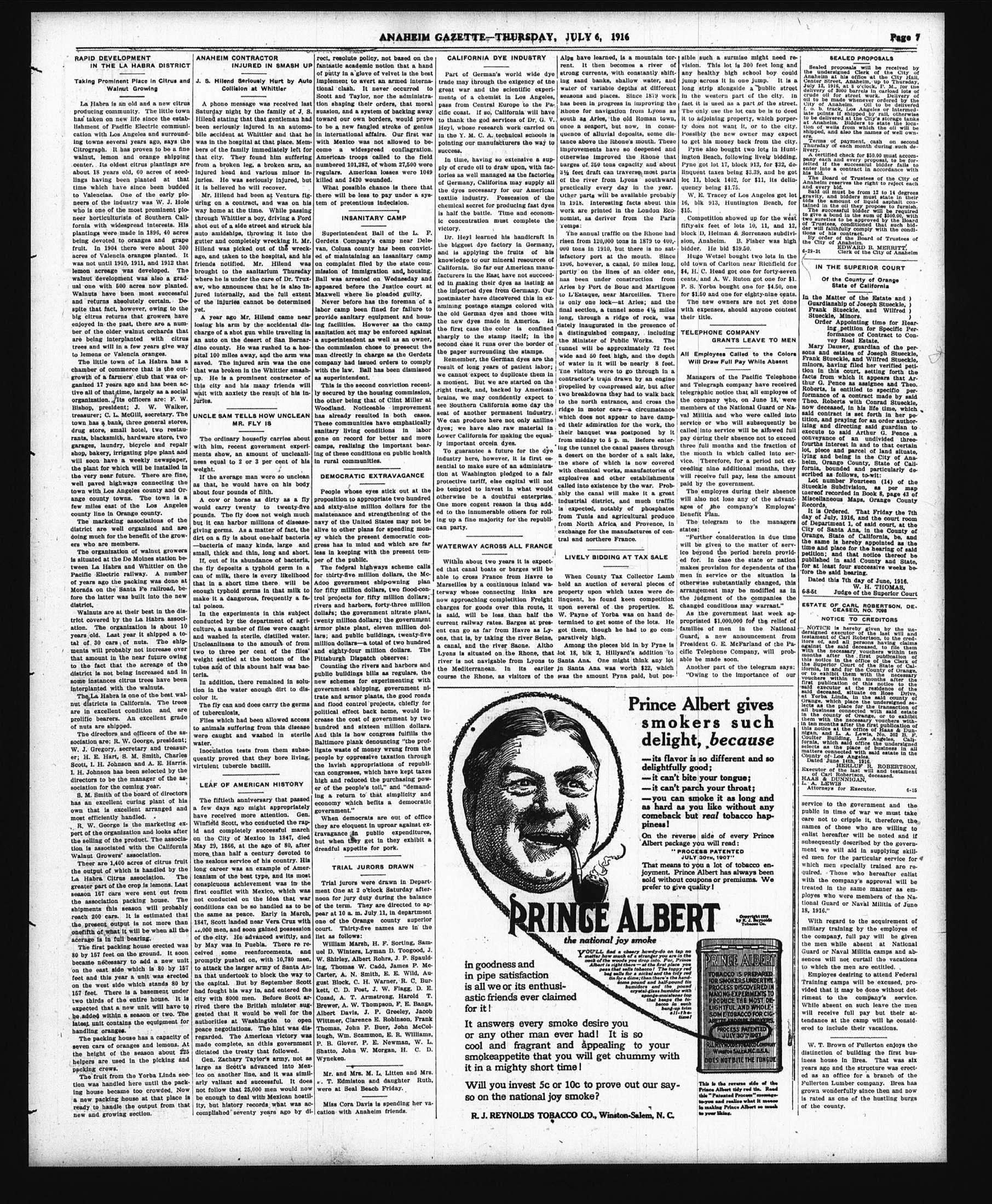
Searchable text
RAPID DEVELOPMENT
IN THE LA HABRA DISTRICT
Taking Prominent Place in Citrus and Walnut Growing
La Habra is an old and a new citrus producing community. The little town has taken on new life since the establishment of Pacific Electric communication with Los Angeles and surrounding towns several years ago, says the Citrograph. It has proven to be a fine walnut, lemon and orange shipping center. Its oldest citrus plantings are about 18 years old, 60 acres of seedlings having been planted at that time which have since been budded to Valencias. One of the early pioneers of the industry was W. J. Hole who is one of the most prominent pioneer horticulturists of Southern California with widespread interests. His plantings were made in 1896, 40 acres being devoted to oranges and grape fruit. In 1904 there were about 300 acres of Valencia oranges planted. It was not until 1910, 1911, and 1912 that lemon acreage was developed. The walnut development was also a gradual one with 500 acres now planted. Walnuts have been most successful and returns absolutely certain. Despite that fact, however, owing to the big citrus returns that growers have enjoyed in the past, there are a number of the older walnut orchards that are being interplanted with citrus trees and will in a few years give way to lemons or Valencia oranges.
The little town of La Habra has a chamber of commerce that is the outgrowth of a farmers' club that was organized 17 years ago and has been active all of that time, largely as a social organization. Its officers are: F. W. Bishop, president; J. W. Walker, treasurer; C. L. McGill, secretary. The town has a bank, three general stores, drug store, small hotel, two restaurants, blacksmith, hardware store, two garages, laundry, bicycle and repair.
ANAHEIM CONTRACTOR
INJURED IN SMASH UP
J. S. Hilend Seriously Hurt by Auto Collision at Whittler
A phone message was received last Saturday night by the family of J. S. Hilend stating that gentleman had been seriously injured in an automobile accident at Whittier and that he was in the hospital at that place. Members of the family immediately left for that city. They found him suffering from a broken leg, a broken arm, an injured head and various minor injuries. He was seriously injured, but it is believed he will recover.
Mr. Hilend had been at Ventura figuring on a contract, and was on his way home at the time. While passing through Whittier a boy, driving a Ford shot out of a side street and struck his auto amidships, throwing it into the gutter and completely wrecking it. Mr. Hilend was picked out of the wreckage, and taken to the hospital, and his friends notified. Mr. Hilend was brought to the sanitarium Thursday where he is under the care of Dr. Truxaw, who announces that he is also injured internally, and the full extent of the injuries cannot be determined yet.
A year ago Mr. Hilend came near losing his arm by the accidental discharge of a shot gun while traveling in an auto on the desert of San Bernardino county. He was rushed to a hospital 100 miles away, and the arm was saved. The injured arm was the one that was broken in the Whittier smash-up. He is a prominent contractor of this city and his many friends will wait with anxiety the result of his injuries.
UNCLE SAM TELLS HOW UNCLEAN MR. FLY IS
The ordinary housefly carries about with him, recent government experl-
rect, resolute police fantastic academies of putty in a gloved implement to avail national clash. It Scott and Taylor, tion shaping their suasion, and a system toward our own b to be a new fang in international aff with Mexico was come a widest American troops numbered 101,282, regulars. America killed and 3420 w What possible o there will be less tem of pretentious
INSANITA
Superintendent Gerdetz Company van, Colusa county ed of maintaining on complaint filed mission of immig Ball was arrested appeared before Maxwell where he Never before had labor camp been provide sanitary en ing facilities. Ho sanitation act may superintendent she commission ch man directly in ch company had issued with the law. Ball as superintendent.
This is the secondly secured by the other being th Woodland. Notice has already resulted These communities sanitary living co gone on record for camps, realizing t
The little town of La Habra has a chamber of commerce that is the outgrowth of a farmers' club that was organized 17 years ago and has been active all of that time, largely as a social organization. Its officers are: F. W. Bishop, president; J. W. Walker, treasurer; C. L. McGill, secretary. The town has a bank, three general stores, drug store, small hotel, two restaurants, blacksmith, hardware store, two garages, laundry, bicycle and repair shop, bakery, irrigating pipe plant and will soon have a weekly newspaper, the plant for which will be installed in the very near future. There are fine, well paved highways connecting the town with Los Angeles county and Orange county towns. The town is a few miles east of the Los Angeles county line in Orange county.
The marketing associations of the district are well organized and are doing much for the benefit of the growers who are members.
The organization of walnut growers is situated at the De Moines station between La Habra and Whittier on the Pacific Electric railway. A number of years ago the packing was done at Morada on the Santa Fe railroad, before the latter was built into the new district.
Walnuts are at their best in the district covered by the La Habra association. The organization is about 10 years old. Last year it shipped a total of 30 cars of nuts. The shipments will probably not increase over that amount in the near future owing to the fact that the acreage of the district is not being increased and in some instances citrus trees have been interplanted with the walnuts.
The La Habra is one of the best walnut districts in California. The trees are in excellent condition and are prolific bearers. An excellent grade of nuts are shipped.
The directors and officers of the association are: R. W. George, president; W. J. Gregory, secretary and treasurer; H. E. Hart, S. M. Smith, Charles Scott, I. H. Johnson and A. E. Harris. I. H. Johnson has been selected by the directors to be the manager of the association for the coming year.
S. M. Smith of the board of directors has an excellent curing plant of his own that is excellent arranged and most efficiently handled.
R. W. George is the marketing expert of the organization and looks after the selling of the product. The association is associated with the California pitfall 100 miles away, and the arm was saved. The injured arm was the one that was broken in the Whittier smash-up. He is a prominent contractor of this city and his many friends will wait with anxiety the result of his injuries.
UNCLE SAM TELLS HOW UNCLEAN MR. FLY IS
The ordinary housefly carries about with him, recent government experiments show, an amount of uncleanliness equal to 2 or 3 per cent of his weight.
If the average man were so unclean as that, he would have on his body about four pounds of filth.
A cow or horse as dirty as a fly would carry twenty to twenty-five pounds. The fly does not weigh much but it can harbor millions of disease-giving germs. As a matter of fact, the dirt on a fly is about one-half bacteria—bacteria of many kinds, large and small, thick and thin, long and short.
If, out of its abundance of bacteria, the fly deposits a typhoid germ in a can of milk, there is every likelihood that in a short time there will be enough typhoid germs in that milk to make it a dangerous, frequently a fatal poison.
In the experiments in this subject conducted by the department of agriculture, a number of flies were caught and washed in sterile, distilled water. Uncleanliness to the amount of from two to three per cent of the flies' weight settled at the bottom of the tubes and of this abount half was bacteria.
In addition, there remained in solution in the water enough dirt to discolor it.
The fly can and does carry the germs of tuberculosis.
Flies which had been allowed access to animals suffering from this disease were caught and washed in sterile water.
Inoculation tests from them subsequently proved that they bore living, virtulent tubercle bacilli.
LEAF OF AMERICAN HISTORY
The fiftieth anniversary that passed a few days ago might appropriately have received more attention. Gen. Winfield Scott, who conducted the rapid and completely successful march on the City of Mexico in 1847, died May 29, 1866, at the age of 80, after man directly in company had issued with the law. Ballard as superintendent.
This is the secondly secured by the law other being Woodland. Notice has already resulted These communities sanitary living co-gone on record for camps, realizing ting of these conditions in rural community.
DEMOCRATIC I
People whose eye proposition to appraise sixty-nine milliliter maintenance and s navy of the United alive to other plants which the press greens has in mind less in keeping with per of the public.
The federal high for thirty-five million Adoo government for fifty million doctor projects for five rivers and harbors dollars; the govern twenty million dollar arm plate plant, lars; and public billion dollars—a ta and eighty-four m Pittsburgh Dispatche Counting the river public buildings by new schemes for government shipping trade and armor pla and flood control political effect base crease the cost of hundred and sixte And this is how Baltimore plank de ligate waste of more people by oppressing lavish appropi can congresses, whigh high and reduced er of the people's ing a return to economy which bu government."
When democrat they are eloquent for travagance in pr but when they get dreadful appetite
H. E. Hart, S. M. Smith, Charles Scott, I. H. Johnson and A. E. Harris.
I. H. Johnson has been selected by the directors to be the manager of the association for the coming year.
S. M. Smith of the board of directors has an excellent curing plant of his own that is excellent arranged and most efficiently handled.
R. W. George is the marketing expert of the organization and looks after the selling of the product. The association is associated with the California Walnut Growers' association.
Theer are 1,400 acres of citrus fruit the output of which is handled by the La Habra Citrus association. The greater part of the crop is lemons. Last season 167 cars were sent out from the association packing house. The shipments this season will probably reach 200 cars. It is estimated that the present output is not more than one-fifth of what it will be when all the acerage is in full bearing.
The first packing house erected was 80 by 157 feet on the ground. It became necessary to add a new unit on the east side which is 80 by 157 feet and this year a unit was erected on the west side which stands 80 by 157 feet. There is a basement under two thirds of the entire house. It is expected that a new unit will have to be added within a season or two. The latest unit contains the equipment for handling oranges.
The packing house has a capacity of seven cars of oranges and lemons. At the height of the season about 225 helpers are used in the picking and packing crews.
The fruit from the Yorba Linda section was handled here until the packing house became too crowded. Now a new packing house at that place is ready to handle the output from that new and growing section.
LEAF OF AMERICAN HISTORY
The fiftieth anniversary that passed a few days ago might appropriately have received more attention. Gen. Winfield Scott, who conducted the rapid and completely successful march on the City of Mexico in 1847, died May 29, 1866, at the age of 80, after more than half a century devoted to the zealous service of his country. His long career was an example of Americanism of the best type, and its most conspicuous achievement was in the first conflict with Mexico, which was not conducted on the idea that war conditions can be so handled as to be the same as peace. Early in March, 1847, Scott landed near Vera Cruz with 2,000 men, and soon gained possession of the city. He advanced swiftly, and by May was in Puebla. There received some reinforcements, and promptly pushed on, with 10,780 men, to attack the larger army of Santa Anna that undertook to block the way to the capital. But by September Scott had fought his way in, and entered the city with 8000 men. Before Scott arrived there the British minister suggested that it would be well for the authorities at Washington to open peace negotiations. The hint was disregarded. The American victory was made complete, an dthis government dictated the treaty that followed.
Gen. Zachary Taylor's army, not as large as Scott's advanced into Mexico on another line, and it was similarly valiant and successful. It does not follow that 25,000 men would now be enough to deal with Mexican hostility, but history records what was accomplished seventy years ago by di-
ANAHEIM GAZETTE—THURSDAY, JULY 6, 1916
SH UP
By Auto
ed last of J. S. Han had automobiles that he. Mem left for offering firm, an minor in, butura fig on his passing a Ford truck his into the fit. Mr. Wreck and his was Thursday. Trux also in extent termined
the near real disclining in Bernarah a hosm was one one smashtor of will this in
LEAN about experimental policy, not based on the fantastic academic notion that a hand of putty in a glove of velvet is the best implement to avert an armed international clash. It never occurred to Scott and Taylor, nor the administration shaping their orders, that moral suasion, and a system of backing away toward our own borders, would prove to be a new fangled stroke of genius in international affairs. Our first war with Mexico was not allowed to become a widespread conflagration. American troops called to the field numbered 101,282, of whom 27,500 were regulars. American losses were 1049 killed and 3420 wounded.
What possible chance is there that there will be less to pay under a system of pretentious indecision.
INSANITARY CAMP
Superintendent Ball of the L. F. Gerdetz Company's camp near Delevan, Colusa county has been convicted of maintaining an insanitary camp on complaint filed by the state commission of immigration and housing. Ball was arrested on Wednesday and appeared before the Justice court at Maxwell where he pleaded guilty.
Never before has the foreman of a labor camp been fined for failure to provide sanitary equipment and housing facilities. However as the camp sanitation act may be enforced against a superintendent as well as an owner, the commission chose to presecut the man directly in charge as the Gerdetz company had issued orders to comply with the law. Ball has been dismissed as superintendent.
This is the second conviction recently secured by the housing commission, the other being that of Clint Miller at Woodland. Noticeable improvement has already resulted in both cases. These communities have emphatically sanitary living conditions in labor gone on record for better and more camps, realizing the important bear-rect, resolute policy, not based on the fantastic academic notion that a hand of putty in a glove of velvet is the best implement to avert an armed international clash. It never occurred to Scott and Taylor, nor the administration shaping their orders, that moral suasion, and a system of backing away toward our own borders, would prove to be a new fangled stroke of genius in international affairs. Our first war with Mexico was not allowed to become a widespread conflagration. American troops called to the field numbered 101,282, of whom 27,500 were regulars. American losses were 1049 killed and 3420 wounded.
What possible chance is there that there will be less to pay under a system of pretentious indecision.
CALIFORNIA DYE INDUSTRY
Part of German's world wide dye trade may through the exigency of the great war and the scientific experiments of a chemist in Los Angeles, pass from Central Europe to the Pacific coast. If so, California will have to thank the god services of Dr. G. V. Heyl, whose research work carried on in the Y. M. C. A. technical schools is pointing our manufacturers the way to success.
In time, having so extensive a supply of crude oil to draw upon, with factories as well managed as the factories of Germany, California may supply all the dyes necessary for our American textile industry. Possession of the chemical secret for producing fast dyes is half the battle. Time and economic concentration must complete the victory.
Dr. Heyl learned his handicraft in the biggest dye factory in Germany, and is applying the fruits of his knowledge to our mineral resources of California. So far our American manufacturers in the East have not succeeded in making their dyes as lasting as the imported dyes from Germany. Our postmaster have discovered this in examining postage stamps colored with the old German dyes and those with the new dyes made in America. In the first case the color is confined sharply to the stamp itself; in the second case it runs over the border of the paper surrounding the stamps.
Remember, the German dyes are the result of long years of patient labor; we cannot expect to duplicate them in a moment. But we are started on the right track, and, backed by American brains, we may confidently expect to see Southern California some day the seat of another permanent industry. We can produce here not only aniline dyes; we have also raw material in Lower California for making the equally important orcin dyes.
Alps have learned, is a mountain torrent. It then becomes a river of strong currents, with constantly shifting sand banks, shallow water, and water of variable depths at different seasons and places. Since 1879 work has been in progress in improving the khone for navigation from Lyons as south as Arles, the old Roman town, once a seaport, but now, in consequence of alluvial deposits, some distance above the Rhone's mouth. These improvements have so deepened and otherwise improved the Rhone that barges of 350 tons capacity and about 3½ feet draft can traverse most parts of the river from Lyons southward practically every day in the year. Other parts will be available probably in 1918. Interesting facts about this work are printed in the London Economist, as deriver from the Paris Temps:
The annual traffic on the Rhone had risen from 120,000 tons in 1879 to 400,000 tons in 1910, but there is no satisfactory port at the mouth. Since 1906, however, a canal, 50 miles long, partly on the lines of an older one, has been under construction from Arles by Port de Bouc and Martigues to L'Estaque, near Marceilles. There is only one lock—at Arles; and the final section, a tunnel some 4½ miles long, through a ridge of rock, was datedly inaugurated in the presence of a distinguished company, including Minister of Public Works. The tunnel will be approximately 72 feet wide and 50 feet high, and the depth of water in it will be nearly 8 feet. The visitors were to go through in a contractor's train drawn by an engine propelled by compressed air, but after two breakdowns they had to walk back to the north entrance, and cross the ridge in motor cars—a circumstance which does not appear to have damped their admiration for the work, tho their banquet was postponed by it from midday to 5 p.m. Before entering the tunnel the canal passes through
man directly in charge as the Gerdetz company had issued orders to comply with the law. Ball has been dismissed as superintendent.
This is the second conviction recently secured by the housing commission, the other being that of Clint Miller at Woodland. Noticeable improvement has already resulted in both cases. These communities have emphatically sanitary living conditions in labor gone on record for better and more camps, realizing the important bearing of these conditions on public health in rural communities.
DEMOCRATIC EXTRAVAGANCE
People whose eyes stick out at the proposition to appropriate two hundred and sixty-nine million dollars for the maintenance and strengthening of the navy of the United States may not be alive to other plans for spending money which the present democratic congress has in mind and which are far less in keeping with the present temper of the public.
The federal highways scheme calls for thirty-five million dollars, the McAdoo government ship-owning plan for fifty million dollars, two flood-control projects for fifty million dollars; rivers and harbors, forty-three million dollars; the government nitrate plant, twenty million dollars; the government armor plate plant, eleven million dollars; and public buildings, twenty-five million dollars—a total of two hundred and eighty-four million dollars. The Pittsburgh Dispatch observes:
Counting the rivers and harbors and public buildings bills as regulars, the new schemes for experimenting with government shipping, government nitrate and armor plants, the good roads and flood control projects, chiefly for political effect back home, would increase the cost of government by two hundred and sixteen million dollars. And this is how congress fulfills the Baltimore plank denouncing "the profligate waste of money wrung from the people by oppressive taxation through the lavish appropriations of republican congresses, which have kept taxes high and reduced the purchasing power of the people's toll," and "demanding a return to that simplicity and economy which befits a democratic government."
When democrats are out of office they are eloquent in uproar against extravagance in public expenditures, but when they get in they exhibit a dreadful appetite for pork.
Remember, the German dyes are the result of long years of patient labor; we cannot expect to duplicate them in a moment. But we are started on the right track, and, backed by American brains, we may confidently expect to see Southern California some day the seat of another permanent industry. We can produce here not only aniline dyes; we have also raw material in Lower California for making the equally important orcein dyes.
To guarantee a future for the dye industry here, however, it is first essential to make sure of an administration at Washington pledged to a fair protective tariff, else capital will not be tempted to invest in what would otherwise be a doubtful enterprise. One more cogent reason is thus added to the innumerable others for rolling up a fine majority for the republican party.
WATERWAY ACROSS ALL FRANCE
Within about two years it is expected that canal boats or barges will be able to cross France from Havre to Marseilles by a continuous inland waterway whose connecting links are now approaching completion Freight charges for goods over this route, it is said, will be less than half the current railway rates. Barges at present can go as far from Havre as Lyons, that is, by taking the river Seine, a canal, and the river Saone. Altho Lyons is situated on the Rhone, that river is not navigable from Lyons to the Mediterranean. In its earlier course the Rhone, as visitors of the wide and 50 feet high, and the depth of water in it will be nearly 8 feet. The visitors were to go through in a contractor's train drawn by an engine propelled by compressed air, but after two breakdowns they had to walk back to the north entrance, and cross the ridge in motor cars—a circumstance which does not appear to have damped their admiration for the work, the their banquet was postponed by it from midday to 5 p.m. Before entering the tunnel the canal passes through a desert on the border of a salt lake, the shore of which is now covered with chemical works, manufactories of explosives and other establishments called into existence by the war. Probably the canal will make it a great industrial district, and much traffic is expected, notably of phosphates from Tunis and agricultural produce from North Africa and Provence, in exchange for the manufactures of central and northern France.
LIVELY BIDDING AT TAX SALE
When County Tax Collector Lamb held an auction of several pieces of property upon which taxes were delinquent, he found keen competition upon several of the properties. E.Wayne of Yorba was on hand determined to get some of the lots. He got them, though he had to go comparatively high.
Among the pieces bid in by Pyne is lot 18, blk 2, Hillyard's addition to Santa Ana. One might think any lot in Santa Ana was worth $22, which was the amount Pyna paid, but pos-
TRIAL JURORS DRAWN
Trial jurors were drawn in Department One at 2 o'clock Saturday afternoon for jury duty during the balance of the term. They are directed to appear at 10 a.m. July 11, in department one of the Orange county superior court. Thirty-five names are in the list as follows:
William Marsh, H. F. Sorting, Samuel D. Winters, Lyman D. Toogood, J. W. Shirley, Albert Rohrs, J. P. Spaulding, Thomas W. Cadd, James P. McCarter, A. N. Smith, E. E. Wild, August Block, C. H. Warner, R. C. Burkett, C. D. Post, J. W. Flagg, D. E. Cozad, A. T. Armstrong, Harold T. Brewer, A. W. Thompson, F. E. Bangs, Albert Davis, J. P. Greeley, Jacob Wittmer, Clarence E. Robinson, Frank Thomas, John F. Buer, John McColough, Wm. Scammon, E. R. Williams, P. B. Glover, P. E. Newman, W. L. Shatto, John W. Morgan, H. C. D. Wyneken.
Mr. and Mrs. M. L. Litten and Mrs.
R. T. Edmiston and daughter Ruth,
were at Seal Beach Friday.
Miss Cora Davis is spending her vacation with Anaheim friends.
PRINCE ALBERT
the national joy smoke
in goodness and in pipe satisfaction
is all we or its enthusiastic friends ever claimed for it!
It answers every smoke desire you or any other man ever had! It is so cool and fragrant and appealing to your smokeappetite that you will get chummy with it in a mighty short time!
Will you invest 5c or 10c to prove out our say-so on the national joy smoke?
R.J.REYNOLDS TOBACCO CO., Winston-Salem, N.C.
is a mountain torrises a river of which constantly shiftallow water, and depths at different Since 1879 work in improving the town from Lyons as old Roman town, now, in conse- deposits, some dis- one’s mouth. These also deepened and the Rhone that capacity and about渡者 most parts Lyons southward day in the year. Available probably facts about this the London Eco- from the Paris on the Rhone had runs in 1879 to 400, there is no sat- one mouth. Since final, 50 miles long, of an older one, construction from Lucc and Martigues Marceilles. There Arles; and the feel some 4½ miles edge of rock, was in the presence of company, including public Works. The approximately 72 feet high, and the depth nearly 8 feet. Go through in a dawn by an engine passed air, but after had to walk back once, and cross the circumstance near to have damp for the work, tho postponed by it him. Before enteral passes throughsible such a surmise might need revision. This lot is 300 feet long and any healthy high school boy could jump across it in one jump. It is a long strip alongside a public street in the western part of the city. In fact it is used as a part of the street. The only use the lot can be is to deed it to adjoining property, which porpery does not want it, or to the city. Possibly the new owner may expect to get his money back from the city. Pyne also bought two lots in Huntington Beach, following lively bidding. Pyne got lot 17, block 913, for $32, delinquent taxes being $3.39, and he got lot 11, block 1402, for $11, its delinquency being $1.75.
W. E. Tracey of Los Angeles got lot 16, blk 913, Huntington Beach, for $15.
Competition showed up for the west fifty-six feet of lots 10, 11, and 12, block D, Helman & Sorenson subdivision, Anaheim. B. Fisher was high bidder. He bid $39.50.
Hugo Wetzel bought two lots in the old town of Carlton near Richfield for $4, H. C. Head got one for forty-seven cents, and A. W. Ruton got one for $1. P. S. Yorba bought one for $4.50, one for $1.50 and one for eighty-nine cents.
The new owners are not yet done with expenses, should anyone contest their title.
TELEPHONE COMPANY
GRANTS LEAVE TO MEN
All Employees Called to the Colors
Will Draw Full Pay While Absent
Managers of the Pacific Telephone and Telegraph company have received telegraphic notice that all employees of the company who, on June 18, were members of the National Guard or Naval Militia and who were called into service or who will subsequently be called into service will be allowed full pay during their absence not to exceed three full months and the fraction of
SEALED PROPOSALS
Sealed proposals will be received by the undersigned Clerk of the City of Anaheim at his office at the City Hall, Center Street, Anaheim, up to Thursday, July 13, 1918, at 8 o’clock, P. M., for the delivery of 3000 barrels in carload lots of crude oil for street work. Delivery of oil to be made whenever ordered by the City of Anaheim. Oil to be delivered f.o.b.track, Los Angeles or intermediate points if shipped by rail, otherwise to be delivered at the City’s storage tanks at Anaheim. Bidders state the location of wells from which the oil will be shipped, and also the names of well owners.
Terms of payment, cash on second Thursday of each month during such delivery.
Certified check for $50.00 must accompany each and every proposal to be forfeited if the successful bidder fails to enter into a contract in accordance with his bid.
The Board of Trustees of the City of Anaheim reserves the right to reject each and every bid.
Said oil must be from 12 to 14 degrees gravity, and bidders must state in their bids the amount of liquid asphalt contained in the oil they propose to furnish.
The successful bidder will be required to give bond in the sum of $500.00, with two sureties to be approved by the Board of Trustees, conditioned that such bidder will faithfully comply with the conditions of his contract.
By order of the Board of Trustees of the City of Anaheim.
EDWARD B. MERRITT,
Clerk of the City of Anaheim
IN THE SUPERIOR COURT
Of the County of Orange
State of California
In the Matter of the Estate and
Guardianship of Joseph Stueckle,
Frank Stueckle, and Wilfred Stueckle,
Minors, having filed her verified petition in this court, setting forth the facts from which it appears that Arthur G. Pence as assignee and Theo. Roberts, is entitled to specific performance of a contract made by said Theo. Roberts with Conrad Stueckle, now deceased, in his life time, which said contract is set forth in her petition, and praying for an order authorizing and directing said guardian to execute to said Arthur G. Pence a conveyance of an undivided three-fourths interest in and to that certain lot
Prince Albert gives smokers such delight, because
—its flavor is so different and so delightfully good;
—it can't bite your tongue;
—it can't parch your throat;
—you can smoke it as long and as hard as you like without any comeback but real tobacco happiness!
On the reverse side of every Prince Albert package you will read:
Managers of the Pacific Telephone and Telegraph company have received telegraphic notice that all employees of the company who, on June 18, were members of the National Guard or Naval Militia and who were called into service or who will subsequently be called into service will be allowed full pay during their absence not to exceed three full months and the fraction of the month in which called into service. Therefore, for a period not exceeding nine additional months, they will receive full pay, less the amount paid by the government.
The employees during their absence will also not lose any of the advantages of the company's Employes' Benefit Plan.
The telegram to the managers states:
"Further consideration in due time will be given to the matter of service beyond the period herein provided for. In case the state or nation makes provision for dependents of the men in service or the situation is otherwise substantially changed, this arrangement may be modified as in the judgment of the companies the changed conditions may warrant."
As the government last week appropriated $1,000,000 for the relief of families of men in the National Guard, a new announcement from President G. E. McFarland of the Pacific Telephone Company, will probable be made soon.
Another part of the telegram says:
"Owing to the importance of our
NOTICE is hereby given by the undersigned executor of the last will and testament of Carl Robertson, to the creditors of, and all persons having claims against the said deceased, to file them with the necessary vouchers within ten months after the first publication of this notice at the office of Haas & Dunigan, and L. A. Lewis, No. 302 B. F. Coulter Building, Los Angeles, California, which said office the undersigned selects as the place of business in all matters connected with said estate in the County of Los Angeles.
Dated June 14th, 1916.
HERLUF R. ROBERTSON,
Executor of the last will and testament of Carl Robertson, deceased.
HAAS & DUNNIGAN,
L. A. LEWIS
Attorneys for Executor.
service to the government and the public in time of war we must take care not to cripple it, therefore, the names of those who are willing to enlist hereafter will be noted and if subsequently described by the government we will aid in supplying skill."
—its flavor is so different and so delightfully good;
—it can't bite your tongue;
—it can't parch your throat;
—you can smoke it as long and as hard as you like without any comeback but real tobacco happiness!
On the reverse side of every Prince Albert package you will read:
"PROCESS PATENTED JULY 30TH, 1907"
That means to you a lot of tobacco enjoyment. Prince Albert has always been sold without coupons or premiums. We prefer to give quality!
ALBERT
Copyright 1918 by R. J. Reynolds Tobacco Co.
PRISE ALBERT
TOBACCO IS PREPARED FOR SMOKERS UNDER THE PROCESS DISCOVERED IN MAKING EXPERIMENTS TO PRODUCE THE MOST DELIGHTFUL AND WHOLE-SOME TOBACCO FOR CIGARETTES AND WINNIE'S CREAMS.
PROCESS PATENTED JULY 30TH, 1907
R.J. REYNOLDS LTD. LONDON
WINSTON SALEM N.C. USA
DOES NOT BITE THE TONGUE
This is the reverse side of the Prince Albert tidy red tin. Read this "Patented Process" message-to-you and realize what it means in making Prince Albert so much to your liking.
service to the government and the public in time of war we must take care not to cripple it, therefore, the names of those who are willing to enlist hereafter will be noted and if subsequently described by the government we will aid in supplying skilled men for the particular service for which men specially trained are required. Those who hereafter enlist with the company's approval will be treated in the same manner as employees who were members of the National Guard or Naval Militia of June 18, 1916."
With regard to the acquirement of military training by the employes of the company, full pay will be given the men while absent at National Guard or Naval Militia camps and absences will not curtail the vacations to which the men are entitled.
Employees desiring to attend Federal Training camps will be excused, provided that it may be done without detriment to the company's service. While absent on such leave the men will receive full pay but their attendance at the camp will be considered to include their vacations.
W. T. Brown of Fullerton enjoys the distinction of building the first business house in Brea. That was six years ago and the structure was erected as an office for a branch of the Fullerton Lumber company. Brea has grown wonderfully since then and now is rated as one of the hustling burgs of the county.