anaheim-gazette 1916-06-08
Scanned page
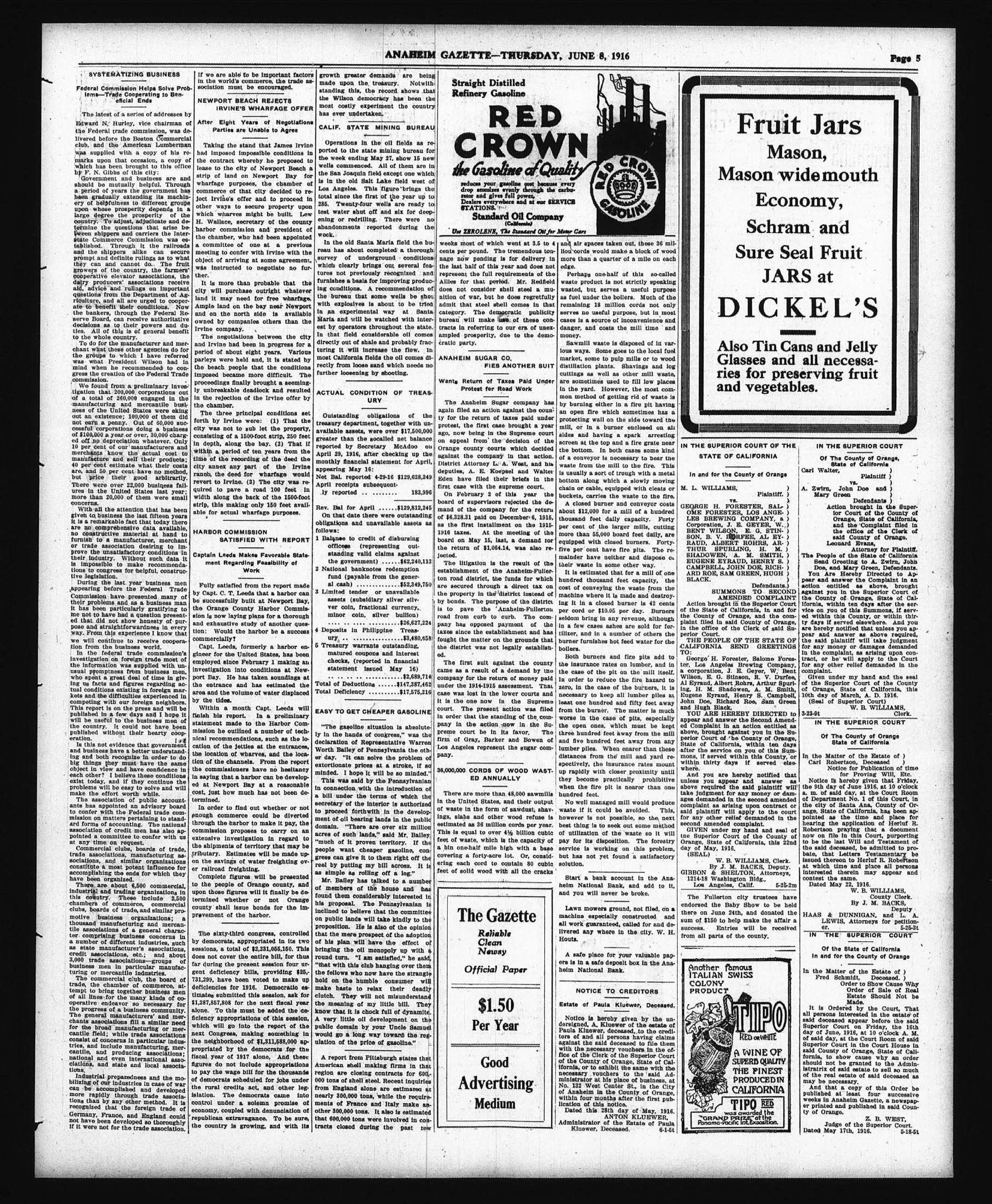
Searchable text
SYSTEMATIZING BUSINESS
Federal Commission Helps Solve Problems—Trade Cooperating to Beneficial Ends
The latest of a series of addresses by Edward N. Hurley, vice chairman of the Federal trade commission, was delivered before the Boston Commercial club, and the American Lumberman was supplied with a copy of his remarks upon that occasion, a copy of which has been brought to this office by F. N. Gibbs of this city:
Government and business are and should be mutually helpful. Through a period of years the government has been gradually extending its machinery of helpfulness to different groups upon whose prosperity depends in a large degree the prosperity of the country. To adjust, adjudicate and determine the questions that arise between shipers and carriers the Interstate Commerce Commission was established. Through it the railroads and the shippers alike can secure prompt and definite rulings as to what they can and cannot do. The fruit growers of the country, the farmers' cooperative elevator associations, the dairy producers' associations receive aid, advice and rulings on important questions from the Department of Agriculture, and all are urged to cooperate to benefit their conditions. Now the bankers, through the Federal Reserve Board, can receive authoritative decisions as to their powers and duties. All of this is of general benefit to the whole country.
To do for the manufacturer and merchant what these other agencies do for the groups to which I have referred was what President Wilson had in mind when he recommended to congress the creation of the Federal Trade commission.
We found from a preliminary investigation that 200,000 corporations out of a total of 260,000 engaged in the manufacturing and mercantile business of the United States were eking out an existence; 100,000 of them did not earn a penny. Out of 60,000 successful corporations doing a business of $100,000 a year or over, 30,000 charged off no depreciation whatever. Only 10 per cent of our manufacturers and
If we are able to be important factors in the world's commerce, the trade association must be encouraged.
NEWPORT BEACH REJECTS IRVINE'S WHARFAGE OFFER
After Eight Years of Negotiations Parties are Unable to Agree
Taking the stand that James Irvine had imposed impossible conditions in the contract whereby he proposed to lease to the city of Newport Beach a strip of land on Newport Bay for wharfage purposes, the chamber of commerce of that city decided to reject Irvine's offer and to proceed in other ways to secure property upon which wharves might be built. Lew H. Wallace, secretary of the county harbor commission and president of the chamber, who had been appointed a committee of one at a previous meeting to confer with Irvine with the object of arriving at some agreement, was instructed to negotiate no further.
It is more than probable that the city will purchase outright whatever land it may need for free wharfage. Ample land on the bay near Newport and on the north side is available owned by companies others than the Irvine company.
The negotiations between the city and Irvine had been in progress for a period of about eight years. Various parleys were held and, it is stated by the beach people that the conditions imposed became more difficult. The proceedings finally brought a seemingly unbreakable deadlock and resulted in the rejection of the Irvine offer by the chamber.
The three principal conditions set forth by Irvine were: (1) That the city was not to sub let the property, consisting of a 1500-foot strip, 250 feet in depth, along the bay. (2) That if growth greater or made upon the standing this, the Wilson demand most costly expo has ever undertaken.
CALIF. STATE
Operations in ported to the state the week ending well commenced; the San Joaquin fills is in the old Salem Los Angeles. The total since the first 285. Twenty-four test water shut off ening or redrilling abandonments re week.
In the old Santa reau has about co survey of under which clearly bright furnishes a basis ing conditions. A bureau that with explosives in an experiment Maria and will be best by operators t In that field con directly out of sh aturing it will inc most California fi rectly from loose further loosening.
ACTUAL COND
Outstanding o treasury department available assets, w greater than the reported by Secre
the groups to which I have referred was what President Wilson had in mind when he recommended to congress the creation of the Federal Trade commission.
We found from a preliminary investigation that 200,000 corporations out of a total of 260,000 engaged in the manufacturing and mercantile business of the United States wereeking out an existence; 100,000 of them did not earn a penny. Out of 60,000 successful corporations doing a business of $100,000 a year or over, 30,000 charged off no depreciation whatever. Only 10 per cent of our manufacturers and merchants know the actual cost to manufacture and sell their products; 40 per cent estimate what their costs are, and 50 per cent have no method, but price their good arbitrarily.
There were over 22,000 business failures in the United States last year; more than 20,000 of them were small concerns.
With all the attention that has been given to business the last fifteen years it is a remarkable fact that today there are no comprehensive data available, no constructive material at hand to furnish to a manufacturer, merchant or trade association desiring to improve the unsatisfactory conditions in their industry. Without such data it is impossible to make recommendations to congress for helpful, constructive legislation.
During the last year business men appearing before the Federal Trade Commission have presented many of their problems and as a business man it has been particularly gratifying to me not to have had a question presented that did not show honesty of purpose and straightforwardness in every way. From this experience I know that we will continue to receive cooperation from the business world.
In the federal trade commission's investigation on foreign trade most of the information was supplied with unusual promptness from business men, who spent a great deal of time in giving us facts and figures regarding actual conditions existing in foreign markets and the difficulties experienced in competing with our foreign neighbors. This report is on the press and will be published in a few days and I hope it will be useful to the business men of the country. It could not have been published without their hearty cooperation.
Is this not evidence that government and business have a better understanding and both recognize in order to do big things they must have the same object in view and have confidence in each other? I believe these conditions exist today, and if they continue the problems will be easy to solve and will make the effort worth while.
The association of public accountants has appointed an advisory board to confer with the Federal trade commission on matters pertaining to standard forms of accounting. The national association of credit men has also appointed a committee to confer with us at any time on request.
Commercial clubs, boards of trade
parls were held and, it is stated by the beach people that the conditions imposed became more difficult. The proceedings finally brought a seemingly unbreakable deadlock and resulted in the rejection of the Irvine offer by the chamber.
The three principal conditions set forth by Irvine were: (1) That the city was not to sub let the property, consisting of a 1500-foot strip, 250 feet in depth, along the bay. (2) That if within a period of ten years from the time of the recording of the deed the city annex any part of the Irvine ranch, the deed for wharfage would revert to Irvine. (3) The city was required to pave a road 100 feet in width along the back of the 1500-foot strip, this making only 150 feet available for actual wharfage purposes.
HARBOR COMMISSION SATISFIED WITH REPORT
Captain Leeds Makes Favorable Statement Regarding Feasibility of Work
Fully satisfied from the report made by Capt. C. T. Leeds that a harbor can be successfully built at Newport Bay, the Orange County Harbor Commission is now laying plans for a thorough and exhaustive study of another question: Would the harbor be a success commercially?
Capt. Leeds, formerly a harbor engineer for the United States, has been employed since February 1 making an investigation into conditions at Newport Bay. He has taken soundings at the entrance and has estimated the area and the volume of water displaced by the tides.
Within a month Capt. Leeds will finish his report. In a preliminary statement made to the Harbor Commission he outlined a number of technical recommendations, such as the location of the jetties at the entrances, the location of wharves, and the location of the channels. From the report the commissioners have no hesitancy in saying that a harbor can be developed at Newport Bay at a reasonable cost, just how much has not been determined.
In order to find out whether or not enough commerce could be diverted through the harbor to make it pay, the commission proposes to carry on an extensive investigation in regard to the shipments of territory that may be
and both recognize in order to do big things they must have the same object in view and have confidence in each other? I believe these conditions exist today, and if they continue the problems will be easy to solve and will make the effort worth while.
The association of public accountants has appointed an advisory board to confer with the Federal trade commission on matters pertaining to standard forms of accounting. The national association of credit men has also appointed a committee to confer with us at any time on request.
Commercial clubs, boards of trade, trade associations, manufacturing associations, and similar organizations constitute a most potent influence for accomplishing the ends for which they have been organized.
There are about 6,500 commercial, industrial and trading organizations in this country. These include 2,500 chambers of commerce, commercial clubs, boards of trade, and similar promotive business organizations; a thousand manufacturing and mercantile associations of a general character comprising business concerns in a number of different industries, such as state manufacturer's associations, credit associations, etc.; and about 3,000 trade associations—groups of business men in particular manufacturing or mercantile industries.
The commercial club, the board of trade, the chamber of commerce, attempt to bring together business men of all lines for the many kinds of cooperative endeavor so necessary for the progress of a business community. The general manufacturers' and merchants' associations fill a similar need for the broad manufacturing or mercantile field; while trade associations consist of concerns in particular industries, and include manufacturing, mercantile, and producing associations; national and even international associations, and state and local associations.
Industrial preparedness and the mobilizing of our industries in case of war can be accomplished and developed more rapidly through trade associations than by any other method. It is recognized that the foreign trade of Germany, France, and England could not have been developed so thoroughly if it were not for the trade association.
The sixty-third congress, controlled by democrats, appropriated in its two sessions, a total of $2,231,055,150. This does not cover the entire bill, for thus far during the present session four urgent deficiency bills, providing $25,-731,299, have been voted to make up deficiencies for 1916. Democratic estimates submitted this session, ask for $1,287,857,808 for the next fiscal year alone. To this must be added the deficiency appropriations of this session, which will go into the report of the next Congress, making something in the neighborhood of $1,311,588,000 appropriated by the democrats for the fiscal year of 1917 alone. And these figures do not include appropriations to pay the wage bill for the thousands of democrats scheduled for jobs under the rural credits act, and other legislation. The democrats came into control under a solemn promise of economy, coupled with denunciation of republican extravagance. To be sure, the country is growing, and with its location of windows, and the location of windows, and the location of windows,
This was said by in connection with a bill under the secretary of the interior to proceed forthwithment of oil bearing domain. "There are acres of such land," much of it proves people want cheeses can give it reel by putting milk as simple as rolls.
Mr. Bailey has 4 members of the found them consider his proposal. He inclined to believe on public lands will proposition. He is that the mere prosess of his plan will bring the oil round turn. "I am that with this clutch the fellows who now hold on the humble make haste to run clutch. They will the meaning of me know that it is chosen A very little oil public domain by would go a long vulation of the price.
A report from Permanent American shell mills region are closing 000 tons of shell stems from England along nearly 300,000 tons of France other 300,000 tons that 600,000 tons w tracts closed duri-
ANAHEIM GAZETTE—THURSDAY, JUNE 8, 1916
growth greater demands are being made upon the treasury. Notwithstanding this, the record shows that the Wilson democracy has been the most costly experiment the country has ever undertaken.
CALIF. STATE MINING BUREAU
Operations in the oil fields as reported to the state mining bureau for the week ending May 27, show 15 new wells commenced. All of them are in the San Joaquin field except one which is in the old Salt Lake field west of Los Angeles. This figure brings the total since the first of the year up to 285. Twenty-four wells are ready to test water shut off and six for deepening or redrilling. There were no abandonments reported during the week.
In the old Santa Maria field the bureau has about completed a thorough survey of underground conditions which clearly brings out several features not previously recognized and furnishes a basis for improving producing conditions. A recommendation of the bureau that some wells be shot with explosives is about to be tried in an experimental way at Santa Maria and will be watched with interest by operators throughout the state. In that field considerable oil comes directly out of shale and probably fracturing it will increase the flow. In most California fields the oil comes directly from loose sand which needs no further loosening by shooting.
ACTUAL CONDITION OF TREASURY
Outstanding obligations of the treasury department, together with unavailable assets, were over $17,500,000 greater than the socalled net balance reported by Secretary McAdoo on weeks most of which went at 3.5 to 4 cents per pound. The tremendous tonnage now pending is for delivery in the last half of this year and does not represent the full requirements of the Allies for that period. Mr. Redfield does not consider shell steel a munition of war, but he does regretfully admit that steel shell comes in that category. The democratic publicity bureau will make use of these contracts in referring to our era of unexamined prosperity, due to the democratic party.
ANAHEIM SUGAR CO.
FIES ANOTHER SUIT
Want's Return of Taxes Paid Under Protest for Road Work
The Anaheim Sugar company has again filed an action against the county for the return of taxes paid under protest, the first case brought a year ago, now being in the Supreme court on appeal from the decision of the Orange county courts which decided and air spaces taken out, these 36 million cords would make a block of wood more than a quarter of a mile on each edge.
Perhaps one-half of this so-called waste product is not strictly speaking wasted, but serves a useful purpose as fuel under the boilers. Much of the remaining 18 million cords not only serves no useful purpose, but in most cases is a source of inconvenience and danger, and costs the mill time and money.
Sawmill waste is disposed of in various ways. Some goes to the local fuel market, some to pulp mills or to wood distillation plants. Shavings and log cuttings as well as other mill waste, are sometimes used to fill low places in the yard. However, the most common method of getting rid of waste is by burning either in a fire pit having an open fire which sometimes has a protecting wall on the side toward the mill, or in a burner enclosed on all sides and having a spark arresting screen at the top and a fire grate near
ACTUAL CONDITION OF TREASURY
Outstanding obligations of the treasury department, together with unavailable assets, were over $17,500,000 greater than the socalled net balance reported by Secretary McAdoo on April 29, 1916, after checking up the monthly financial statement for April, appearing May 16:
Net Bal. reported 4-29-16 $129,628,249 April receipts subsequently reported ... 183,996
Rev. Bal for April ... $129,812,245
On that date there were outstanding obligations and unavailable assets as follows:
1 Balance to credit of disbursing offices (representing outstanding valid claims against the government) ... $62,240,113
2 National banknotes redemption fund (payable from the general cash) ... $52,349,750
3 Limited tender or unavailable assets (subsidiary silver silver coin, fractional currency, minor coin, silver bullion) ... $26,627,224
4 Deposits in Philippine Treasury ... $3,480,658
5 Treasury warrants outstanding, matured coupons and interest checks, (reported in financial statement issued May 16)
... $2,689,714
Total of Deductions ... $147,387,462
Total Deficiency ... $17,575,216
EASY TO GET CHEAPER GASOLINE
"The gasoline situation is absolutely in the hands of congress," was the declaration of Representative Warren Worth Bailey of Pennsylvania the other day. "It can solve the problem of extortionate prices at a stroke, if so minded. I hope it will be so minded."
This was said by the Pennsylvanian in connection with the introduction of a bill under the terms of which the secretary of the interior is authorized to proceed forthwith in the development of oil bearing lands in the public domain. "There are over six million acres of such lands," said Mr. Bailey. "much of it proven territory. If the people want cheaper gasoline con-
ANAHEIM SUGAR CO.
FIES ANOTHER SUIT
Want's Return of Taxes Paid Under Protest for Road Work
The Anaheim Sugar company has again filed an action against the county for the return of taxes paid under protest, the first case brought a year ago, now being in the Supreme court on appeal from the decision of the Orange county courts which decided against the company in that action. District Attorney L. A. West, and his deputies, A. E. Koepsel and Walter Eden have filed their briefs in the first case with the supreme court.
On February 2 of this year the board of supervisors rejected the demand of the company for the return of $6,328.31 paid on December 6, 1915, as the first installment on the 1915-1916 taxes. At the meeting of the board on May 15, last, a demand tor the return of $1,064.14, was also rejected.
The litigation is the result of the establishment of the Anaheim-Fullerton road district, the funds for which are secured through a direct tax on the property in the district instead of by bonds. The purpose of the district is to pave the Anaheim-Fullerton road from curb to curb. The company has opposed payment of the taxes since the establishment and has fought the matter on the grounds that the district was not legally established.
The first suit against the county came as a result of a demand by the company for the return of money paid under the 1914-1915 assessment. That case was lost in the lower courts and it is the one now in the Supreme court. The present action was filed in order that the standing of the company in the action now in the Supreme court be in its favor. The firm of Gray, Barker and Bowen of Los Angeles represent the sugar company.
36,000,000 CORDS OF WOOD WASTED ANNUALLY
There are more than 48,000 sawmills in the United States, and their output of waste in the form of sawdust, shavings, slabs and other wood refuse is estimated as 36 million cords per year. This is equal to over 4½ billion cubic feet of waste, which is the capacity of a bin one-half mile high with a base market, some to pulp mills or to wood distillation plants. Shavings and log cuttings as well as other mill waste, are sometimes used to fill low places in the yard. However, the most common method of getting rid of waste is by burning either in a fire pit having an open fire which sometimes has a protecting wall on the side toward the mill, or in a burner enclosed on all sides and having a spark arresting screen at the top and a fire grate near the bottom. In both cases some kind of a conveyor is necessary to bear the waste from the mill to the fire. This is usually a sort of trough with a metal bottom along which a slowly moving chain or cable, equipped with cleats or buckets, carries the waste to the fire.
A closed burner and conveyor costs about $12,000 for a mill of a hundred thousand feet daily capacity. Forty per cent of the larger mills, cutting more than 55,000 board feet daily, are equipped with closed burners. Forty-five per cent have fire pits. The remainder have neither and dispose of their waste in some other way.
It is estimated that for a mill of one hundred thousand feet capacity, the cost of conveying the waste from the machine where it is made and destroying it in a closed burner is 42 cents per cord or $10.05 per day. Burners seldom bring in any revenue although in a few cases ashes are sold for fertilizer, and in a number of others the burner furnishes hot feed water for the boilers.
Both burners and fire pits add to the insurance rates on lumber, and in the case of the pit on the mill itself. In order to reduce the fire hazard to zero, in the case of the burners, it is necessary to keep all lumber piles at least one hundred and fifty feet away from the burner. The matter is much worse in the case of pits, especially the open ones, which must be kept three hundred feet away from the mill and five hundred feet away from any lumber piles. When enarer than these distances from the mill and yard respectively, the insurance rates mount up rapidly with closer proximity until they become practically prohibitive when the fire pit is nearer than one hundred feet.
No well managed mill would produce waste if it could be avoided. This however is not possible, so the next best thing is to seek out some method of utilization of the waste so it will pay for its disposition. The forestry service is working on this problem.
36,000,000 CORDS OF WOOD WASTED ANNUALLY
There are more than 48,000 sawmills in the United States, and their output of waste in the form of sawdust, shavings, slabs and other wood refuse is estimated as 36 million cords per year. This is equal to over 4½ billion cubic feet of waste, which is the capacity of a bin one-half mile high with a base covering a forty-acre lot. Or, considering each cord to contain 80 cubic feet of solid wood with all the cracks
Mr. Bailey has talked to a number of members of the house and has found them considerably interested in his proposal. The Pennsylvanian is inclined to believe that the committee on public lands will take kindly to the proposition. He is also of the opinion that the mere prospect of the adoption of his plan will have the effect of bringing the oil monopoly up with a round turn. "I am satisfied," he said, "that with this club hanging over them the fellows who now have the strangle hold on the humble consumer will make haste to relax their deadly clutch. They will not misunderstand the meaning of my little bill. They know that it is chock full of dynamite. A very little oil development on the public domain by your Uncle Samuel would go a long way toward the regulation of the price of gasoline."
A report from Pittsburgh states that American shell making firms in that region are closing contracts for 600,000 tons of shell steel. Recent inquiries from England alone are estimated at nearly 300,000 tons, while the requirements of France and Italy make another 300,000 tons. It also is estimated that 600,000 tons were involved in contracts closed during the past few days.
The Gazette
Reliable Clean Newsy
Official Paper
$1.50
Per Year
Good Advertising Medium
NOTICE TO CREDITORS
Estate of Paula Kluewer, Deceased.
Notice is hereby given by the undersigned, A. Kluewer of the estate of Paula Kluewer, deceased, to the creditors of and all persons having claims against the said deceased to file them with the necessary vouchers in the office of the Clerk of the Superior Court of the County of Orange, State of California, or to exhibit the same with the necessary vouchers to the said Administrator at his place of business, at No. 132 West Center St., in the City of Anaheim in the County of Orange, within four months after the first publication of this notice.
Dated this 28th day of May, 1916.
ANTON KLUEWER,
Administrator of the Estate of Paula Kluewer, Deceased.
Fruit Jars
Mason,
Mason widemouth
Economy,
Schram and
Sure Seal Fruit
JARS at
DICKEL'S
Also Tin Cans and Jelly
Glasses and all necessaries for preserving fruit
and vegetables.
IN THE SUPERIOR COURT OF THE STATE OF CALIFORNIA
In and for the County of Orange
M. L. WILLIAMS,
Plaintiff.
vs.
GEORGE H. FORESTER, SALOME FORESTER, LOS ANGELES BREWING COMPANY, a Corporation, J. E. GEYER, W.
BENT WILSON, E. G. STINSON, B. V. IORFEE, AL EYRAUD, ALBERT ROHRS, ARTHUR SPURLING, H. M.
SHADOWEN, A. M. SMITH, EUGENE EYRAUD, HENRY S.
CAMPBELL, JOHN DOE, RICHARD ROE, SAM GREEN, HUGH BLACK.
Defendants.
SUMMONS TO SECOND AMENDED COMPLAINT
Action brought in the Superior Court of the State of California, in and for the County of Orange, and the complaint filed in said County of Orange, in the office of the Clerk of said Superior Court.
THE PEOPLE OF THE STATE OF CALIFORNIA SEND GREETINGS TO:
George H. Forester, Salome Forester, Los Angeles Brewing Company, a corporation, J. E. Geyer, W. Bent Wilson, E. G. Stinson, R. V. Durfee, Al Eyraud, Albert Rohrs, Arthur Spurling, H. M. Shadowen, A. M. Smith, Eugene Eyraud, Henry S. Campbell, John Doe, Richard Roe, Sam Green and Hugh Black.
YOU ARE HEREBY DIRECTED to appear and answer the Second Amended Complaint in an action entitled as above, brought against you in the Superior Court of the County of Orange, State of California, within ten days after the service on you of this summons, if served within this County, or within thirty days if served elsewhere.
And you are hereby notified that unless you appear and answer as above required the said plaintiff will take judgment for any money or damages demanded in the second amended complaint as arising upon contract or said plaintiff will apply to the court for any other relief demanded in the second amended complaint.
GIVEN under my hand and seal of the Superior Court of the County of Orange, State of California, this 22nd day of May, 1916.
IN THE SUPERIOR COURT
Of The County of Orange,
State of California
Carl Walter,
Plaintiff
vs.
A. Zwirn, John Doe and Mary Green
Defendants
Action brought in the Superior Court of the County of Orange, State of California, and the Complaint filed in the office of the Clerk of said County of Orange.
Leonard Evans,
Attorney for Plaintiff.
The People of the State of California Send Greeting to A. Zwirn, John Doe, and Mary Green Defendants.
You Are Hereby Directed to Appear and answer the Complaint in an action entitled as above, brought against you in the Superior Court of the County of Orange, State of California, within ten days after the service on you of this summons, if served within this County, or within thirty days if served elsewhere.
And you are hereby notified that unless you appear and answer as above required the said plaintiff will take judgment for any money or damages demanded in the complaint, as arising upon contract, or he will apply to the Court for any other relief demanded in the complaint.
Given under my hand and the seal of the Superior Court of the County of Orange, State of California, this 10th day of March, A.D. 1916.
(Seal of Superior Court)
W. B. WILLIAMS,
3-23-9t
Clerk.
IN THE SUPERIOR COURT
Of The County of Orange
State of California
In the Matter of the Estate of )
Carl Robertson, Deceased
Notice for Publication of time for Proving Will, Etc.
Notice is hereby given that Friday, the 9th day of June 1916, at 10 o'clock a.m., of said day, at the Court Room of Department No. 1 of this Court, in the city of Santa Ana, County of Orange, State of California, has been appointed as the time and place for hearing the application of Herluf R. Robertson praying that a document now on file in this Court, purporting to be the last Will and Testament of the said deceased, be admitted to pro-
And you are hereby notified that unless you appear and answer as above required the said plaintiff will take judgment for any money or damages demanded in the second amended complaint as arising upon contract or said plaintiff will apply to the court for any other relief demanded in the second amended complaint.
GIVEN under my hand and seal of the Superior Court of the County of Orange, State of California, this 22nd day of May, 1916.
(SEAL)
W. B. WILLIAMS, Clerk.
By J. M. BACKS, Deputy.
GIBBON & SHELTON, Attorneys,
1214-18 Washington Bldg., Los Angeles, Calif.
The Fullerton city trustees have endorsed the Baby Show to be held there on June 24th, and donated the sum of $150 to help make the affair a success. Entries will be received from all parts of the county.
In the Matter of the Estate of )
Fred Schmidt, Deceased.)
Order to Show Cause Why
Order of Sale of Real Estate Should Not be Made.
It is Ordered by the Court, That all persons interested in the estate of said deceased appear before the said Superior Court on Friday, the 16th day of June, 1916, at 10 o'clock A.M. of said day, at the Court Room of said Superior Court in the Court House in said County of Orange, State of California, to show cause why an order should not be granted to the Administratrix of said estate to sell so much of the real estate of said deceased as may be necessary.
And that a copy of this Order be published at least four successive weeks in Anaheim Gazette, a newspaper printed and published in said County of Orange.
Z. B. WEST,
Judge of the Superior Court.
Dated May 17th, 1916.