anaheim-gazette 1916-05-25
Scanned page
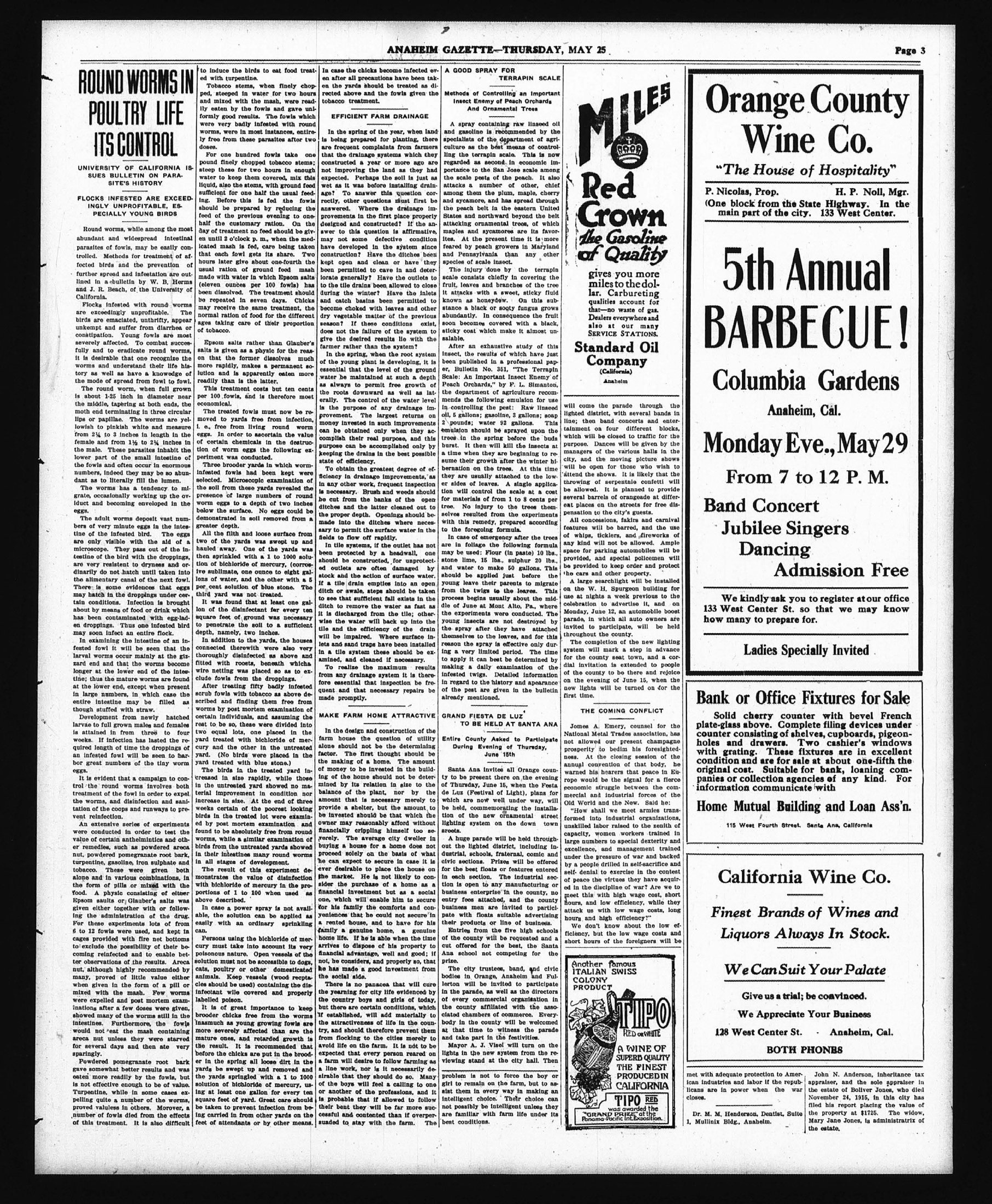
Searchable text
ROUND WORMS IN POULTRY LIFE ITS CONTROL
UNIVERSITY OF CALIFORNIA ISSUES BULLETIN ON PARASITE'S HISTORY
FLOCKS INFESTED ARE EXCEEDINGLY UNPROFITABLE, ESPECIALLY YOUNG BIRDS
Round worms, while among the most abundant and widespread intestinal parasites of fowls, may be easily controlled. Methods for treatment of affected birds and the prevention of further spread and infestation are outlined in a bulletin by W. B. Herms and J. R. Beach, of the University of California.
Flocks infested with round worms are exceedingly unprofitable. The birds are emaciated, unthrifty, appear unkempt and suffer from diarrhea or constipation. Young fowls are most severely affected. To combat successfully and to eradicate round worms, it is desirable that one recognize the worms and understand their life history as well as have a knowledge of the mode of spread from fowl to fowl.
The round worm, when full grown is about 1-25 inch in diameter near the middle, tapering at both ends, the moth end terminating in three circular lips or papillae. The worms are yellowish to pinkish white and measure from 2½ to 3 inches in length in the female and from 1½ to 2¼ inches in the male. These insects inhabit the to induce the birds to eat food treated with turpentine.
Tobacco stems, when finely chopped, steeped in water for two hours and mixed with the mash, were readily eaten by the fowls and gave uniformly good results. The fowls which were very badly infested with round worms, were in most instances, entirely free from these parasites after two doses.
For one hundred fowls take one pound finely chopped tobacco stems; steep these for two hours in enough water to keep them covered, mix this liquid, also the stems, with ground feed sufficient for one half the usual feeding. Before this is fed the fowls should be prepared by reducing the feed of the previous evening to one-half the customary ration. On the day of treatment no feed should be given until 2 o'clock p.m., when the medicated mash is fed, care being taken that each fowl gets its share. Two hours later give about one-fourth the usual ration of ground feed mash made with water in which Epsom salts (eleven ounces per 100 fowls) has been dissolved. The treatment should be repeated in seven days. Chicks may receive the same treatment, the normal ration of food for the different ages taking care of their proportion of tobacco.
Epsom salts rather than Glauber's salts is given as a physic for the reason that the former dissolves much more rapidly, makes a permanent solution and is apparently eaten more readily than is the latter.
This treatment costs but ten cents per 100 fowls, and is therefore most economical.
The treated fowls must now be removed to yards free from infection, i.e., free from living round worm eggs. In order to ascertain the value of certain chemicals in the destruction of worm eggs, follow these steps:
In case the chick en after all preen on the yards she directed above and tobacco treatment.
EFFICIENT
In the spring is being prepared are frequent concern that the drainage constructed a year not improving the expected. Perhaps wet as it was b age? To answer rectly, other qu an answered. When provements in th designed and coo answer to this qu may not some have developed construction? He kept open and been permitted to elaborate generally? To the tile drains during the winter and catch basin become choked v dry vegetable m season? If they does not the fall give the desired farmer rather than.
In the spring, of the young pla essential that th water be maintained as always to pe rethe roots down erally. The cont is the purpose of provement. The money invested can be obtained compilish their re purpose can be
it is desirable that one recognize the worms and understand their life history as well as have a knowledge of the mode of spread from fowl to fowl.
The round worm, when full grown is about 1-25 inch in diameter near the middle, tapering at both ends, the moth end terminating in three circular lips or papillae. The worms are yellowish to pinkish white and measure from 2½ to 3 inches in length in the female and from 1½ to 2¼ inches in the male. These parasites inhabit the lower part of the small intestine of the fowls and often occur in enormous numbers, indeed they may be so abundant as to literally fill the lumen.
The worms has a tendency to migrate, occasionally working up the oviduct and becoming enveloped in the eggs.
The adult worms deposit vast numbers of very minute eggs in the intestine of the infested bird. The eggs are only visible with the aid of a microscope. They pass out of the intestine of the bird with the droppings, are very resistant to dryness and ordinarily do not hatch until taken into the alimentary canal of the next fowl. There is some evidences that eggs may hatch in the droppings under certain conditions. Infection is brought about by means of food or drink which has been contaminated with egg-laden droppings. Thus one infested bird may soon infect an entire flock.
In examining the intestine of an infested fowl it will be seen that the larval worms occur mainly at the gizzard end and that the worms become longer at the lower end of the intestine; thus the mature worms are found at the lower end, except when present in large numbers, in which case the entire intestine may be filled as though stuffed with straw.
Development from newly hatched larvae to full grown males and females is attained in from three to four weeks. If infection has lasted the required length of time the droppings of an infested fowl will be seen to harbor great numbers of the tiny worm eggs.
It is evident that a campaign to control the round worms involves both treatment of the fowl in order to expel the worms, and disinfection and sanitation of the coops and runways to prevent reinfection.
An extensive series of experiments were conducted in order to test the value of certain anthelmintics and other remedies, such as powdered areca on that the former dissolves much more rapidly, makes a permanent solution and is apparently eaten more readily than is the latter.
This treatment costs but ten cents per 100 fowls, and is therefore most economical.
The treated fowls must now be removed to yards free from infection, i.e., free from living round worm eggs. In order to ascertain the value of certain chemicals in the destruction of worm eggs the following experiment was conducted.
Three brooder yards in which worm-infested fowls had been kept were selected. Microscopic examination of the soil from these yards revealed the presence of large numbers of round worm eggs to a depth of two inches below the surface. No eggs could be demonstrated in soil removed from a greater depth.
All the filth and loose surface from two of the yards was swept up and hauled away. One of the yards was then sprinkled with a 1 to 1000 solution of bichloride of mercury, (corrosive sublimate, one ounce to eight gallons of water, and the other with a 5 per cent solution of blue stone). The third yard was not treated.
It was found that at least one gallon of the disinfectant for every ten square feet of ground was necessary to penetrate the soil to a sufficient depth, namely, two inches.
In addition to the yards, the houses connected therewith were also very thoroughly disinfected as above and fitted with roosts, beneath which wire netting was placed so as to exclude fowls from the droppings.
After treating fifty badly infested scrub fowls with tobacco as above described and finding them free from worms by post mortem examination of certain individuals, and assuming the rest to be so, these were divided into two equal lots, one placed in the yard treated with bichloride of mercury and the other in the untreated yard. (No birds were placed in the yard treated with blue stone.)
The birds in the treated yard increased in size rapidly, while those in the untreated yard showed no material improvement in condition nor increase in size. At the end of three weeks certain of the poorest looking birds in the treated lot were examined by post mortem examination and found to be absolutely free from round worms, while a similar examination of birds from the untreated yards showed
In this spring, of the young plants essential that water be maintained as always to keep the roots downwardly. The content is the purpose of provement. The money invested in can be obtained by compilish their purpose can be kept keeping the drainage state of efficiency.
To obtain the efficiency in draining any other work is necessary. Briefly cut from there ditches and then proper depth made into the cisary to permit the fields to flow off.
In tile systems, been protected should be constructed outlets are stock and the act If a tile drain ditch or awale, so to see that sufficient ditch to remove it is discharged wise the water will tile and the effluent will be impaired lets and sand traps in a tile system amined, and clean.
To realize these from any drainage fore essential that quent and that made promptly.
MAKE FARM HOME
In the design and farm house these alone should not factor. The first making of a money to be ing of the home mined by its reliance on its amount that is provide a shelter be invested should owner may reason financially cripple severely. The average buying a house
It is evident that a campaign to control the round worms involves both treatment of the fowl in order to expel the worms, and disinfection and sanitation of the coops and runways to prevent reinfection.
An extensive series of experiments were conducted in order to test the value of certain anthelmintics and other remedies, such as powdered areca nut, powdered pomegranate root bark, turpentine, gasoline, iron sulphate and tobacco. These were given both alone and in various combinations, in the form of pills or mixed with the food. A physic consisting of either Epsom salts or Glauber's salts was given either together with or following the administration of the drug. For these experiments lots of from 6 to 12 fowls were used, and kept in cages provided with fire net bottoms to exclude the possibility of their becoming reinfected and to enable better observations of the results. Areca nut, although highly recommended by many, proved of little value either when given in the form of a pill or mixed with the mash. Few worms were expelled and post mortem examinations after a few doses were given, showed many of the worms still in the intestines. Furthermore, the fowls would not eat the mash containing areca nut unless they were starved for several days and then ate very sparingly.
Powdered pomegranate root bark gave somewhat better results and was eaten more readily by the fowls, but is not effective enough to be of value. Turpentine, while in some cases ex-pelling quite a number of the worms, proved valueless in others. Moreover, a number of fowls died from the effects of this treatment. It is also difficult
The birds in the treated yard increased in size rapidly, while those in the untreated yard showed no material improvement in condition nor increase in size. At the end of three weeks certain of the poorest looking birds in the treated lot were examined by post mortem examination and found to be absolutely free from round worms, while a similar examination of birds from the untreated yards showed in their intestines many round worms in all stages of development.
The result of this experiment demonstrates the value of disinfection with dichloride of mercury in the proportions of 1 to 100 when used as above described.
In case a power spray is not available, the solution can be applied easily with an ordinary sprinkling can.
Persons using the dichloride of mercury must take into account its very poisonous nature. Open vessels of the solution must not be accessible to dogs, cats, poultry or other domesticated animals. Keep vessels (wood receptacles should be used) containing the disinfectant will covered and properly labelled poison.
It is of great importance to keep brooder chicks free from the worms inasmuch as young growing fowls are more severely affected than are the mature ones, and retarded growth is the result. It is recommended that before the chicks are put in the brooder in the spring all loose dirt in the yards be swept up and removed and the yards springled with a 1 to 1000 solution of dichloride of mercury, using at least one gallon for every ten square feet of yard. Great care should be taken to prevent infection from being carried in from other yards on the feet of attendants or by other means.
The birds in the treated yard increased in size rapidly, while those in the untreated yard showed no material improvement in condition nor increase in size. At the end of three weeks certain of the poorest looking birds in the treated lot were examined by post mortem examination and found to be absolutely free from round worms, while a similar examination of birds from the untreated yards showed in their intestines many round worms in all stages of development.
The result of this experiment demonstrates the value of disinfection with dichloride of mercury in the proportions of 1 to 100 when used as above described.
In case a power spray is not available, the solution can be applied as easily with an ordinary sprinkling can.
Persons using the dichloride of mercury must take into account its very poisonous nature. Open vessels of the solution must not be accessible to dogs, cats, poultry or other domesticated animals. Keep vessels (wood receptacles should be used) containing the disinfectant will covered and properly labelled poison.
It is of great importance to keep brooder chicks free from the worms inasmuch as young growing fowls are more severely affected than are the mature ones, and retarded growth is the result. It is recommended that before the chicks are put in the brooder in the spring all loose dirt in the yards be swept up and removed and the yards springled with a 1 to 1000 solution of dichloride of mercury, using at least one gallon for every ten square feet of yard. Great care should be taken to prevent infection from being carried in from other yards on the feet of attendants or by other means.
The birds in the treated yard increased in size rapidly, while those in the untreated yard showed no material improvement in condition nor increase in size. At the end of three weeks certain of the poorest looking birds in the treated lot were examined by post mortem examination and found to be absolutely free from round worms, while a similar examination of birds from the untreated yards showed in their intestines many round worms in all stages of development.
The result of this experiment demonstrates the value of disinfection with dichloride of mercury in the proportions of 1 to 100 when used as above described.
In case a power spray is not available, the solution can be applied as easily with an ordinary sprinkling can.
Persons using the dichloride of mercury must take into account its very poisonous nature. Open vessels of the solution must not be accessible to dogs, cats, poultry or other domesticated animals. Keep vessels (wood receptacles should be used) containing the disinfectant will covered and properly labelled poison.
It is of great importance to keep brooder chicks free from the worms inasmuch as young growing fowls are more severely affected than are the mature ones, and retarded growth is the result. It is recommended that before the chicks are put in the brooder in the spring all loose dirt in the yards be swept up and removed and the yards springled with a 1 to 1000 solution of dichloride of mercury, using at least one gallon for every ten square feet of yard. Great care should be taken to prevent infection from being carried in from other yards on the feet of attendants or by other means.
The birds in the treated yard increased in size rapidly, while those in the untreated yard showed no material improvement in condition nor increase in size. At the end of three weeks certain of the poorest looking birds in the treated lot were examined by post mortem examination and found to be absolutely free from round worms, while a similar examination of birds from the untreated yards showed in their intestines many round worms in all stages of development.
The result of this experiment demonstrates the value of disinfection with dichloride of mercury in the proportions of 1 to 100 when used as above described.
In case a power spray is not available, the solution can be applied as easily with an ordinary sprinkling can.
Persons using the dichloride of mercury must take into account its very poisonous nature. Open vessels of the solution must not be accessible to dogs, cats, poultry or other domesticated animals. Keep vessels (wood receptacles should be used) containing the disinfectant will covered and properly labelled poison.
It is of great importance to keep brooder chicks free from the worms inasmuch as young growing fowls are more severely affected than are the mature ones, and retarded growth is the result. It is recommended that before the chicks are put in the brooder in the spring all loose dirt in the yards be swept up and removed and the yards springled with a 1 to 1000 solution of dichloride of mercury, using at least one gallon for every ten square feet of yard. Great care should be taken to prevent infection from being carried in from other yards on the feet of attendants or by other means.
The birds in the treated yard increased in size rapidly, while those in the untreated yard showed no material improvement in condition nor increase in size. At the end of three weeks certain of the poorest looking birds in the treated lot were examined by post mortem examination and found to be absolutely free from round worms, while a similar examination of birds from the untreated yards showed in their intestines many round worms in all stages of development.
The result of this experiment demonstrates the value of disinfection with dichloride of mercury in the proportions of 1 to 100 when used as above described.
In case a power spray is not available, the solution can be applied as easily with an ordinary sprinkling can.
Persons using the dichloride of mercury must take into account its very poisonous nature. Open vessels of the solution must not be accessible to dogs, cats, poultry or other domesticated animals. Keep vessels (wood receptacles should be used) containing the disinfectant will covered and properly labelled poison.
It is of great importance to keep brooder chicks free from the worms inasmuch as young growing fowls are more severely affected than are the mature ones, and retarded growth is the result. It is recommended that before the chicks are put in the brooder in the spring all loose dirt in the yards be swept up and removed and the yards springled with a 1 to 1000 solution of dichloride of mercury, using at least one gallon for every ten square feet of yard. Great care should be taken to prevent infection from being carried in from other yards on the feet of attendants or by other means.
The birds in the treated yard increased in size rapidly, while those in the untreated yard showed no material improvement in condition nor increase in size. At the end of three weeks certain of the poorest looking birds in the treated lot were examined by post mortem examination and found to be absolutely free from round worms, while a similar examination of birds from the untreated yards showed in their intestines many round worms in all stages of development.
The result of this experiment demonstrates the value of disinfection with dichloride of mercury in the proportions of 1 to 100 when used as above described.
In case a power spray is not available, the solution can be applied as easily with an ordinary sprinkling can.
Persons using the dichloride of mercury must take into account its very poisonous nature. Open vessels of the solution must not be accessible to dogs, cats, poultry or other domesticated animals. Keep vessels (wood receptacles should be used) containing the disinfectant will covered and properly labelled poison.
It is of great importance to keep brooder chicks free from the worms inasmuch as young growing fowls are more severely affected than are the mature ones, and retarded growth is the result. It is recommended that before the chicks are put in the brooder in the spring all loose dirt in the yards be swept up and removed and the yards springled with a 1 to 1000 solution of dichloride of mercury, using at least one gallon for every ten square feet of yard. Great care should be taken to prevent infection from being carried in from other yards onthe feet of attendants or by other means.
The birds in the treated yard increased in size rapidly, while those in the untreated yard showed no material improvement in condition nor increase in size. At the end of three weeks certain of poorest looking birds in treated lot were examined by post mortem examination and found to be absolutely free from round worms, while a similar examination of birds from untreated yards showed in their intestines many round worms in all stages of development.
The result of this experiment demonstrates the value of disinfection with dichloride of mercury in proportionisof 1to100whenusedasabovedescribed.Incaseapowersprayisnotavailable,thesolutioncanbeappliedaseasilywithanordinarysprinklingcan.Personsusingthebichlorideofmercurymusttakeintoaccountitsverypoisonousnature.Openvesselsofthesolutionmustnotbeaccessibletodogs,cats,poultryorotherdomesticatedanimals.Keepvessels(woodreceptaclesshouldbeused)containingthedisinfectantwilerecoveredandproperlylabelledpoison.Thebirdsintheretreatyardincreasedinsizerapidlywhilenoseintheuntreatedyardshowednomaterialimprovementinconditionnorincreaseinsize.Absolutelyfreefromroundwormswhileasimilarexaminationofbirdsfromuntreatedyardsshowedintheintestinesmanyroundwormsinallstagesofdevelopment.Theaverbuyingahousewillproceedsolelyoftenhecanexpecttoreverdesirabletothemarket.Hesiderthepurchasingfinancialinvestmentonewhichwillcillerversiencesthathacarerentedhouse,afamilyagenuinehomelife.Ifhearrivestodisposethefinancialadvantagenotheheconsideredhehasmadeageneralsocialside.TherereisnopaytheyearningforthecountryboysbuttherearecertainIfestablished.whetherattractivenesstry,andshouldthattromflockingtotheavoidlifeontheexpectedthateverya farmwilldesirea linework,norrablethattheyoffetheboyswillprovideanotheroftheirbenttheywecessfulandcontentuadedtostayv
ANAHEIM GAZETTE—THURSDAY, MAY 25
In case the chicks become infected even after all precautions have been taken the yards should be treated as directed above and the fowls given the tobacco treatment.
EFFICIENT FARM DRAINAGE
In the spring of the year, when land is being prepared for planting, there are frequent complaints from farmers that the drainage systems which they constructed a year or more ago are not improving the land as they had expected. Perhaps the soil is just as wet as it was before installing drainage? To answer this question correctly, other questions must first be answered. Where the drainage improvements in the first place properly designed and constructed? If the answer to this question is affirmative, may not some defective condition have developed in the system since construction? Have the ditches been kept open and clean or have they been permitted to cave in and deteriorate generally? Have the outlets to the tile drains been allowed to close during the winter? Have the inlets and catch basins been permitted to become choked with leaves and other dry vegetable matter of the previous season? If these conditions exist, does not the failure of the system to give the desired results lie with the farmer rather than the system?
In the spring, when the root system of the young plant is developing, it is essential that the level of the ground water be maintained at such a depth as always to permit free growth of the roots downward as well as laterally. The control of the water level is the purpose of any drainage improvement. The largest returns on money invested in such improvements can be obtained only when they accomplish their real purpose, and this purpose can be accomplished only by
A GOOD SPRAY FOR TERRAPIN SCALE
Methods of Controlling an Important Insect Enemy of Peach Orchards And Ornamental Trees
A spray containing raw linseed oil and gasoline is recommended by the specialists of the department of agriculture as the best means of controlling the terrapin scale. This is now regarded as second in economic importance to the San Jose scale among the scale pests of the peach. It also attacks a number of other chief among them the plum, maple, cherry and sycamore, and has spread through the peach belt in the eastern United States and northward beyond the belt attacking ornamental trees, of which maples and sycamores are its favorites. At the present time it is more feared by peach growers in Maryland and Pennsylvania than any other species of scale insect.
The injury done by the terrapin scale consists chiefly in covering the fruit, leaves and branches of the tree it attacks with a sweet, sticky fluid known as honeydew. On this substance a black or sooty fungus grows abundantly. In consequence the fruit soon becomes covered with a black, sticky coat which make it almost unsalable.
After an exhaustive study of this insect, the results of which have just been published in a professional paper, Bulletin No. 351, "The Terrapin Scale: An Important Insect Enemy of Peach Orchards," by F. L. Simanton, the department of agriculture recommends the following emulsion for use in controlling the pest: Raw linseed oil, 5 gallons; gasoline, 3 gallons; soap 2 pounds; water 92 gallons. This emulsion should be sprayed upon the trees in the spring before the buds burst. It then will kill the insects at will come the parade through the lighted district, with several bands in line; then band concerts and entertainment on four different blocks, which will be closed to traffic for the purpose. Dances will be given by the
In the spring, when the root system of the young plant is developing, it is essential that the level of the ground water be maintained at such a depth as always to permit free growth of the roots downward as well as laterally. The control of the water level is the purpose of any drainage improvement. The largest returns on money invested in such improvements can be obtained only when they accomplish their real purpose, and this purpose can be accomplished only by keeping the drains in the best possible state of efficiency.
To obtain the greatest degree of efficiency in drainage improvements, as in any other work, frequent inspection is necessary. Brush and weeds should be cut from the banks of the open ditches and the latter cleaned out to the proper depth. Openings should be made into the ditches where necessary to permit the surface water in the fields to flow off rapidly.
In tile systems, if the outlet has not been protected by a headwall, one should be constructed, for unprotected outlets are often damaged by stock and the action of surface water. If a tile drain empties into an open ditch or swale, steps should be taken to see that sufficient fall exists in the ditch to remove the water as fast as it is discharged from the tile; otherwise the water will back up into the tile and the efficiency of the drain will be impaired. Where surface inlets and sand traps have been installed in a tile system these should be examined, and cleaned if necessary.
To realize the maximum results from any drainage system it is therefore essential that inspection be frequent and that necessary repairs be made promptly.
MAKE FARM HOME ATTRACTIVE
In the design and construction of the farm house the question of utility alone should not be the determining factor. The first thought should be the making of a home. The amount of money to be invested in the building of the home should not be determined by its relation in size to the balance of the plant, nor by the amount that is necessary merely to provide a shelter, but the amount to be invested should be that which the owner may reasonably afford without financially crippling himself too severely. The average city dweller in buying a house for a home does not
GRAND FIESTA DE LUZ
TO BE HELD AT SANTA ANA
Entire County Asked to Participate During Evening of Thursday, June 15th
Santa Ana invites all Orange county to be present there on the evening of Thursday, June 15, when the Festa de Luz (Festival of Light), plans for which are now well under way, will be held, commemorating the installation of the new ornamental street lighting system on the down town streets.
A huge parade will be held throughout the lighted district, including insect, the results of which have just been published in a professional paper, Bulletin No. 351, "The Terrapin Scale: An Important Insect Enemy of Peach Orchards," by F. L. Simanton, the department of agriculture recommends the following emulsion for use in controlling the pest: Raw linseed oil, 5 gallons; gasoline, 3 gallons; soap 2 pounds; water 92 gallons. This emulsion should be sprayed upon the trees in the spring before the buds burst. It then will kill the insects at a time when they are beginning to resume their growth after the winter hibernation on the trees. At this time they are usually attached to the lower sides of leaves. A single application will control the scale at a cost for materials of from 1 to 8 cents per tree. No injury to the trees themselves resulted from the experiments with this remedy, prepared according to the foregoing formula.
In case of emergency after the trees are in foliage the following formula may be used: Flour (in paste) 10 lbs., stone lime, 15 lbs., sulphur 20 lbs., and water to make 50 gallons. This should be applied just before the young leave their parents to migrate from the twigs to the leaves. This process begins usually about the middle of June at Mont Alto, Pa., where the experiments were conducted. The young insects are not destroyed by the spray after they have attached themselves to the leaves, and for this reason the spray is effective only during a very limited period. The time to apply it can best be determined by making a daily examination of the infested twigs. Detailed information in regard to the history and appearance of the pest are given in the bulletin already mentioned.
THE COMING CONFLICT
James A. Emery, counsel for the National Metal Trades association, has not allowed our present champagne prosperity to bedim his foresightedness. At the closing session of the annual convention of that body, he warned his hearers that peace in Europe would be the signal for a fierce economic struggle between the commercial and industrial forces of the Old World and the New. Said he:
"How shall we meet armies transformed into industrial organizations, unskilled labor raised to the zenith of capacity, women workers trained in large numbers to special dexterity and excellence, and management trained
the making of a home. The amount of money to be invested in the building of the home should not be determined by its relation in size to the balance of the plant, nor by the amount that is necessary merely to provide a shelter, but the amount to be invested should be that which the owner may reasonably afford without financially crippling himself too severely. The average city dweller in buying a house for a home does not proceed solely on the basis of what he can expect to secure in case it is ever desirable to place the house on the market. He is not likely to consider the purchase of a home as a financial investment but as a social one, which will enable him to secure for his family the comforts and conveniences that he could not secure in a rented house, and to have for his family a genuine home, a genuine home life. If he is able when the time arrives to dispose of his property to financial advantage, well and good; if not, he considers, and properly so, that he has made a good investment from the social side.
There is no panacea that will cure the yearning for city life evidenced by the country boys and girls of today, but there are certain conditions, which if established, will add materially to the attractiveness of life in the country, and should therefore prevent them from flocking to the cities merely to avoid life on the farm. It is not to be expected that every person reared on a farm will desire to follow farming as a line work, nor is it necessarily desirable that they should do so. Many of the boys will feel a calling to one or another of the professions, and it is probable that if allowed to follow their bent they will be far more successful and contented than if overpersevered to stay with the farm. The
Santa Ana invites all Orange county to be present there on the evening of Thursday, June 15, when the Festa de Luz (Festival of Light), plans for which are now well under way, will be held, commemorating the installation of the new ornamental street lighting system on the down town streets.
A huge parade will be held throughout the lighted district, including industrial schools, fraternal, comic and civic sections. Prizes will be offered for the best floats or features entered in each section. The industrial section is open to any manufacturing or business enterprise in the county, no entry fees attached, and the county business men are invited to participate with floats suitable advertising their products or line of business.
Entries from the five high schools of the county will be requested and a cut offered for the best, the Santa Ana school not competing for the prize.
The city trustees, band, and civic bodies in Orange, Anaheim and Fullerton will be invited to participate in the parade, as well as the directors of every commercial organization in the county affiliated with the associated chambers of commerce. Everybody in the county will be welcomed at that time to witness the parade and take part in the festivities.
Mayor A. J. Visel will turn on the lights in the new system from the reviewing stand at the city hall. Then
problem is not to force the boy or girl to remain on the farm, but to assist them in every way in making an intelligent choice. Their choice can not possibly be intelligent unless they are familiar with farm life under its best conditions.
Orange County
Wine Co.
"The House of Hospitality"
P. Nicolas, Prop. H. P. Noll, Mgr.
(One block from the State Highway. In the main part of the city. 133 West Center.
5th Annual
BARBECUE!
Columbia Gardens
Anaheim, Cal.
Monday Eve.. May 29
Columbia Gardens
Anaheim, Cal.
Monday Eve., May 29
From 7 to 12 P.M.
Band Concert
Jubilee Singers
Dancing
Admission Free
We kindly ask you to register at our office
133 West Center St. so that we may know how many to prepare for.
Ladies Specially Invited
Bank or Office Fixtures for Sale
Solid cherry counter with bevel French plate-glass above. Complete filing devices under counter consisting of shelves, cupboards, pigeonholes and drawers. Two cashier's windows with grating. These fixtures are in excellent condition and are for sale at about one-fifth the original cost. Suitable for bank, loaning companies or collection agencies of any kind. For information communicate with
Home Mutual Building and Loan Ass'n.
115 West Fourth Street. Santa Ana, California
condition and are for sale at about one-fifth the original cost. Suitable for bank, loaning companies or collection agencies of any kind. For information communicate with
Home Mutual Building and Loan Ass'n.
115 West Fourth Street. Santa Ana, California
California Wine Co.
Finest Brands of Wines and Liquors Always In Stock.
We Can Suit Your Palate
Give us a trial; be convinced.
We Appreciate Your Business
128 West Center St. Anaheim, Cal.
BOTH PHONES
met with adequate protection to American industries and labor if the republicans are in power when the war closes.
Dr. M. M. Henderson, Dentist, Suite 1, Mullinix Bldg., Anaheim.
John N. Anderson, inheritance tax appraiser, and the sole appraiser in the estate of Boliver Jones, who died November 24, 1915, in this city has filed his report placing the value of the property at $1725. The widow, Mary Jane Jones, is administratrix of the estate.