anaheim-gazette 1916-03-30
Scanned page
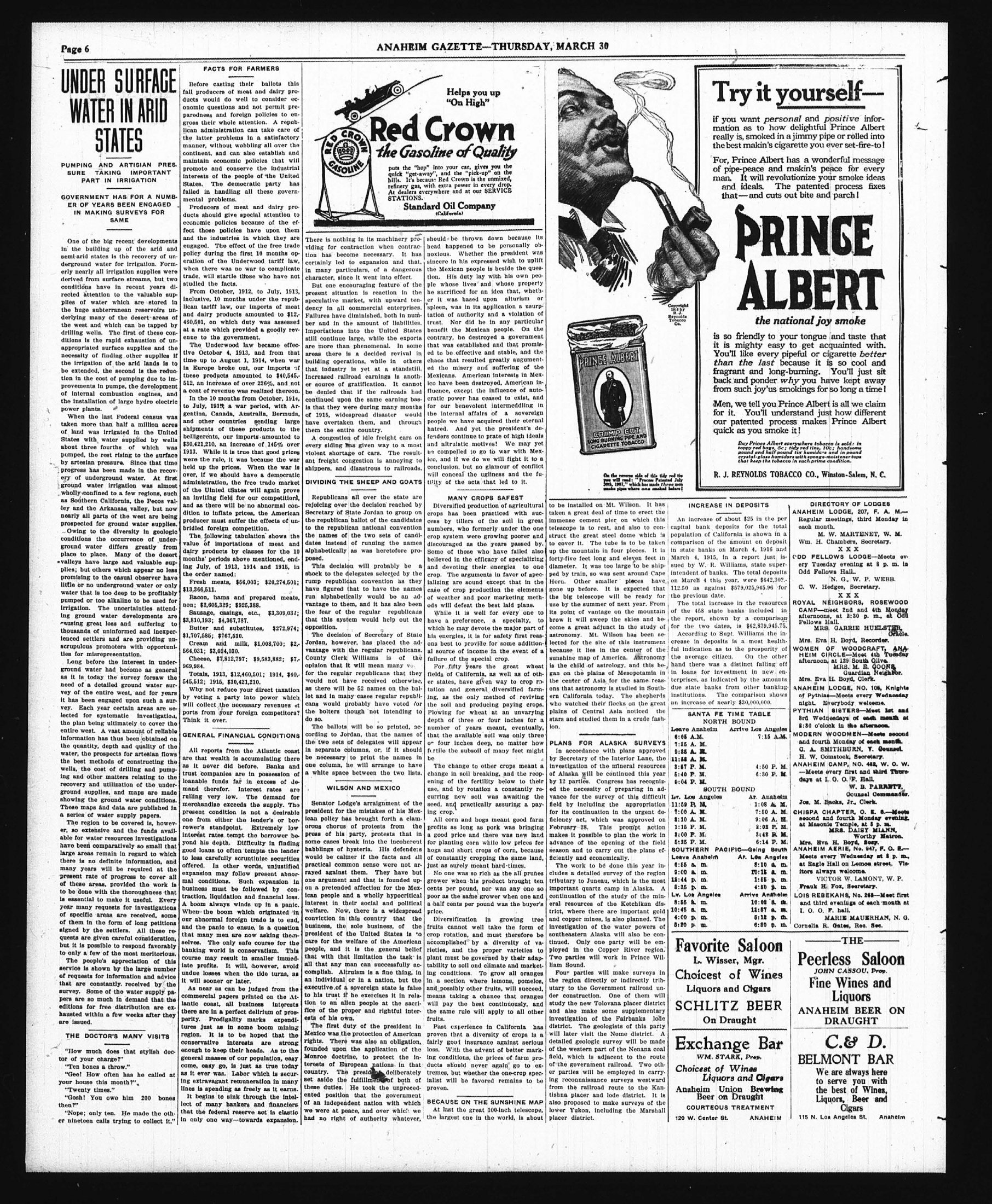
Searchable text
UNDER SURFACE WATER IN ARID STATES
PUMPING AND ARTISIAN PRESURE TAKING IMPORTANT PART IN IRRIGATION
GOVERNMENT HAS FOR A NUMBER OF YEARS BEEN ENGAGED IN MAKING SURVEYS FOR SAME
One of the big recent developments in the building up of the arid and semi-arid states is the recovery of underground water for irrigation. Formerly nearly all irrigation supplies were derived from surface streams, but two conditions have in recent years directed attention to the valuable supplies of water which are stored in the huge subterranean reservoirs underlying many of the desert areas of the west and which can be tapped by drilling wells. The first of these conditions is the rapid exhaustion of unappropriated surface supplies and the necessity of finding other supplies if the irrigation of the arid lands is to be extended, the second is the reduction in the cost of pumping due to improvements in pumps, the development of internal combustion engines, and the installation of large hydro electric power plants.
When the last Federal census was taken more than half a million acres of land was irrigated in the United States with water supplied by wells about three fourths of which was
FACTS FOR FARMERS
Before casting their ballots this fall producers of meat and dairy products would do well to consider economic questions and not permit preparedness and foreign policies to engross their whole attention. A republican administration can take care of the latter problems in a satisfactory manner, without wobbling all over the continent, and can also establish and maintain economic policies that will promote and conserve the industrial interests of the people of the United States. The democratic party has failed in handling all these governmental problems.
Producers of meat and dairy products should give special attention to economic policies because of the effect those policies have upon them and the industries in which they are engaged. The effect of the free trade policy during the first 10 months operation of the Underwood tariff law, when there was no war to complicate trade, will startle those who have not studied the facts.
From October, 1912, to July, 1913, inclusive, 10 months under the republican tariff law, our imports of meat and dairy products amounted to $12,460,501, on which duty was assessed at a rate which provided a goodly revenue to the government.
The Underwood law became effective October 4, 1913, and from that time up to August 1, 1914, when war in Europe broke out, our imports of these products amounted to $40,545,512, an increase of over 226%, and not a cent of revenue was realized thereon.
In the 10 months from October, 1914, to July, 1915, a war period, with Argentina, Canada, Australia, Bermuda, and other countries sending large shipments of these products to the belligerents, our imports amounted to $30,421,210, an increase of 145% over
There is nothing in it viding for contraction has become new certainly led to expansion in many particulars, character, since it we But one encouraging present situation is speculative market, wideny in all commercial failures have diminished and in the amount Importations into this still continue large, we are more than phenom areas there is a deep building operations, that industry is yet Increased railroad easier source of gratification be denied that if this continued upon the sale is that they were duly of 1915, widespread have overtaken them them the entire country.
A congestion of idle every sliding has given
necessity of finding other supplies if the irrigation of the arid lands is to be extended, the second is the reduction in the cost of pumping due to improvements in pumps, the development of internal combustion engines, and the installation of large hydro electric power plants.
When the last Federal census was taken more than half a million acres of land was irrigated in the United States with water supplied by wells about three fourths of which was pumped, the rest rising to the surface by artesian pressure. Since that time progress has been made in the recovery of underground water. At first ground water irrigation was almost wholly confined to a few regions, such as Southern California, the Pecos valley and the Arkansas valley, but now nearly all parts of the west are being prospected for ground water supplies.
Owing to the diversity in geologic conditions the occurrence of underground water differs greatly from place to place. Many of the desert valleys have large and valuable supplies; but others which appear no less promising to the casual observer have little or no underground water or only water that is too deep to be profitably pumped or too alkaline to be used for irrigation. The uncertainties attending ground water developments are causing great loss and suffering to thousands of uninformed and inexperienced settlers and are providing unscrupulous promoters with opportunities for misrepresentation.
Long before the interest in underground water had become as general as it is today the surveyors saw the need of a detailed ground water survey of the entire west, and for years it has been engaged upon such a survey. Each year certain areas are selected for systematic investigation, the plan being ultimately to cover the entire west. A vast amount of reliable information has thus been obtained on the quantity, depth and quality of the water, the prospects for artesian flows the best methods of constructing the wells, the cost of drilling and pumping and other matters relating to the recovery and utilization of the underground supplies, and maps are made showing the ground water conditions. These maps and data are published in a series of water supply papers.
The region to be covered is, however, so extensive and the funds available for water resources investigations have been comparatively so small that necessity of finding other supplies if the irrigation of the arid lands is to be extended, the second is the reduction in the cost of pumping due to improvements in pumps, the development of internal combustion engines, and the installation of large hydro electric power plants.
When the last Federal census was taken more than half a million acres of land was irrigated in the United States with water supplied by wells about three fourths of which was pumped, the rest rising to the surface by artesian pressure. Since that time progress has been made in the recovery of underground water. At first ground water irrigation was almost wholly confined to a few regions, such as Southern California, the Pecos valley and the Arkansas valley, but now nearly all parts of the west are being prospected for ground water supplies.
Owing to the diversity in geologic conditions the occurrence of underground water differs greatly from place to place. Many of the desert valleys have large and valuable supplies; but others which appear no less promising to the casual observer have little or no underground water or only water that is too deep to be profitably pumped or too alkaline to be used for irrigation. The uncertainties attending ground water developments are causing great loss and suffering to thousands of uninformed and inexperienced settlers and are providing unscrupulous promoters with opportunities for misrepresentation.
Long before the interest in underground water had become as general as it is today the surveyors saw the need of a detailed ground water survey of the entire west, and for years it has been engaged upon such a survey. Each year certain areas are selected for systematic investigation, the plan being ultimately to cover the entire west. A vast amount of reliable information has thus been obtained on the quantity, depth and quality of the water, the prospects for artesian flows the best methods of constructing the wells, the cost of drilling and pumping and other matters relating to the recovery and utilization of the underground supplies, and maps are made showing the ground water conditions. These maps and data are published in a series of water supply papers.
The region to be covered is, however, so extensive and the funds available for water resources investigations have been comparatively so small that necessity of finding other supplies if the irrigation of the arid lands is to be extended, the second is the reduction in the cost of pumping due to improvements in pumps, the development of internal combustion engines, and the installation of large hydro electric power plants.
When the last Federal census was taken more than half a million acres of land was irrigated in the United States with water supplied by wells about three fourths of which was pumped, the rest rising to the surface by artesian pressure. Since that time progress has been made in the recovery of underground water. At first ground water irrigation was almost wholly confined to a few regions, such as Southern California, the Pecos valley and the Arkansas valley, but now nearly all parts of the west are being prospected for ground water supplies.
Owing to the diversity in geologic conditions the occurrence of underground water differs greatly from place to place. Many of the desert valleys have large and valuable supplies; but others which appear no less promising to the casual observer have little or no underground水 or only water that is too deep to be profitably pumped or too alkaline to be used for irrigation. The uncertainties attending ground water developments are causing great loss and suffering to thousands of uninformed and inexperienced settlers and are providing unscrupulous promoters with opportunities for misrepresentation.
Long before the interest in underground water had become as general as it is today the surveyors saw the need of a detailed ground water survey of the entire west, and for years it has been engaged upon such a survey. Each year certain areas are selected for systematic investigation, the plan being ultimately to cover the entire west. A vast amount of reliable information has thus been obtained on the quantity, depth and quality of the water, the prospects for artesian flows the best methods of constructing the wells, the cost of drilling and pumping and other matters relating to the recovery and utilization of the underground supplies, and maps are made showing the ground water conditions. These maps and data are published in a series of water supply papers.
The region to be covered is, however, so extensive and the funds available for water resources investigations have been comparatively so small that necessity of finding other supplies if the irrigation of the arid lands is to be extended, the second is the reduction in the cost of pumping due to improvements in pumps, the development of internal combustion engines, and the installation of large hydro electric power plants.
In October 4, 1916, and from that time up to August 1, 1914, when war in Europe broke out, our imports of these products amounted to $40,545.12, an increase of over 226%, and not a cent of revenue was realized thereon.
In the 10 months from October, 1914, to July, 1915, a war period, with Argentina, Canada, Australia, Bermuda, and other countries sending large shipments of these products to the belligerents, our imports amounted to $30,421.210, an increase of 145% over 1913. While it is true that good prices were the rule, it was because the war held up the prices. When the war is over, if we should have a democratic administration, free trade market ofthe Uinted tSates will again prove an inviting field for our competitors, and as there will be no abnormal condition to inflate prices, the American producer must suffer the effects of unbridled foreign competition.
The following tabulation shows value of importations of meat and dairy products by classes for 10 months' periods above mentioned, ending July, of 1913, 1914 and 1915, in order named:
Fresh meats,$56,003; $20,274,501; $13,366,511.
Bacon,hams and prepared meats,non;$2,605,329;$925,388.
Sausage,casings,ect.,$3,309,031;$3,810,193;$4,367,787.
Butterand substitutes,$272,974;$1,707,585;$767,510.
Creamand milk,$1,008,700;$2-564,031;$3,024,030.
Cheese,$7,812,797;$9,583,882;$7-969,984.
Totals,1913,$12,460,501;1914,$40-545,512;1915,$30,421,210.
Why not reduce your direct taxation by voting a party into power which will collect necessary revenues at ports from your foreign competitors? Think it over.
GENERAL FINANCIAL CONDITIONS
All reports fromthe Atlantic coast are that wealth is accumulating there as it never did before. Banks and trust companies are in possession of loanable funds far in excess of demand therefor. Interest rates are rulling very low. The demand for merchandise exceedsthe supply. The present condition is not a desirable one from eitherthe lender'sor borrower's standpoint. Extremely low interest rates temptthe borrower beyond his depth. Difficulty in finding good loansto often temptthe lender
Republicans all over rejoicing overthe decision SecretaryofStateJointthe republican ballottothe republican nationthe namesofthe two dates insteadofrun alphabeticallyaswarsposed.
This decisionwill shocktothe delegatesrumprepublicancongarehalfvantagewiththeregionalpublisherwouldnothaverecoursetherewillbe52m lotandin manycasescanswouldprobablyboltersthoughnodo so.
The ballots willbe cordingtoJordan,thetwo setsofdelegatesinseparatecolumns,benecessarytoprintonecolumnhewillawhitespacebetween
WILSON AND
Senator Lodge's army president forthe mistican policyhas broughtorous chorusofprogressthis party,some casesbreakinto babblingsofhysteria
THE DOCTOR'S MANY VISITS
"How much does that stylish doctor of your charge?"
"Ten bones a throw."
"Gee! How often has he called at your house this month?"
"Twenty times."
"Gosh! You owe him 200 bones then?"
"Nope; only ten. He made the other nineteen calls trying to collect it."
As near as can be judged from the commercial papers printed on the Atlantic coast, all business interests there are in a perfect delirium of prosperity. Prodigality marks expenditures just as in some boom mining region. It is to be hoped that the conservative interests are strong enough to keep their heads. As to the general masses of our population, easy come, easy go, is just as true today as it ever was. Labor which is securing extravagant remuneration in many lines is spending as freely as it earns.
It begins to sink through the intellect of many bankers and financiers that the federal reserve act is elastic in only one way—towards expansion.
Senator Lodge's aristocratic president for the mistaken policy has brought orous chorus of pro- press of his party, some cases break into babblings of hysteria would be calmer if the practical common serv- rayed against them. One argument and thus on a pretended affect Ican people and a wh interest in their social welfare. Now, there conviction in this co- business, the sole b president of the Uni care for the welfare people, and it is th that with that limit all that any man can compilish. Altruism is an individual or in an executive.of a sovereign to his trust if he exe- tion to an alien people fice of the proper an ests of his own.
The first duty of Mexico was the protec- rights. There was al founded upon the ap Monroe doctrine, to terests of European country. The presi- set aside the fulfilling these duties. He took ented position that of an independent na we were at peace, and had no right of aut-
ANAHEIM GAZETTE—THURSDAY, MARCH 30
Helps you up
"On High"
Red Crown
the Gasoline of Quality
puts the "hop" into your car, gives you the quick "get-away", and the "pick-up" on the hills. It's because Red Crown is the unmixed, refinery gas, with extra power in every drop. At dealers everywhere and at our SERVICE STATIONS.
Standard Oil Company
(California)
There is nothing in its machinery providing for contraction when contraction has become necessary. It has certainly led to expansion and that, in many particulars, of a dangerous character, since it went into effect.
But one encouraging feature of the present situation is reaction in the speculative market, with upward tendency in all commercial enterprises. Failures have diminished, both in number and in the amount of liabilities. Importations into the United States still continue large, while the exports are more than phenomenal. In some areas there is a decided revival in building operations, while in others that industry is yet at a standstill. Increased railroad earnings is another source of gratification. It cannot be denied that if the railroads had continued upon the same earning basis that they were during many months of 1915, widespread disaster would have overtaken them, and through them the entire country.
A congestion of idle freight cars on every sideline has given way to a most should be thrown down because its head happened to be personally obnoxious. Whether the president was sincere in his expressed wish to uplift the Mexican people is beside the question. His duty lay with his own people whose lives and whose property he sacrificed for an idea that, whether it was based upon alturism or spleen, was in its application a usurpation of authority and a violation of trust. Nor did he in any particular benefit the Mexican people. On the contrary, he destroyed a government that was established and that promised to be effective and stable, and the chaos that resulted greatly augmented the misery and suffering of the Mexicans. American interests in Mexico have been destroyed, American influence, except the influence of autocratic power has ceased to exist, and for our benevolent intermeddling in the internal affairs of a sovereign people we have acquired their eternal hatred. And yet the president's defenders continue to prate of high ideals and altruistic motives! We may yet
DIVIDING THE SHEEP AND GOATS
Republicans all over the state are rejoicing over the decision reached by Secretary of State Jordan to group on the republican ballot of the candidates to the republican national convention the names of the two sets of candidates instead of running the names alphabetically as was heretofore proposed.
This decision will probably be a shock to the delegates selected by the rump republican convention as they have figured that to have the names run alphabetically would be an advantage to them, and it has also been the fear of the regular republicans that this system would help out the opposition.
The decision of Secretary of State Jordan, however, has placed the advantage with the regular republicans. County Clerk Williams is of the opinion that it will mean many votes for the regular republicans that they would not have received otherwise, as there will be 52 names on the ballot and in many cases regular republicans would probably have voted for the bolters though not intending to do so.
The ballots will be so printed, according to Jordan, that the names of the two sets of delegates will appear in separate columns, or, if it should be necessary to print the names in one column, he will arrange to have a white space between the two lists.
WILSON AND MEXICO
Senator Lodge's arraignment of the president for the mistakes of his Mexican policy has brought forth a clamorous chorus of protests from the press of his party, protests that in some cases break into the incoherent babblings of hysteria. His defenders there is a decided revival in building operations, while in others that industry is yet at a standstill. Increased railroad earnings is another source of gratification. It cannot be denied that if the railroads had continued upon the same earning basis that they were during many months of 1915, widespread disaster would have overtaken them, and through them the entire country.
A congestion of idle freight cars on every siding has given way to a most violent shortage of cars. The resultant freight congestion is annoying to shippers, and disastrous to railroads.
MANY CROPS SAFEST
Diversified production of agricultural crops has been practiced with success by tillers of the soil in great numbers, who formerly under the one crop system were growing poorer and discouraged as the years passed by. Some of those who have failed also believed in the efficacy of specializing and devoting their energies to one crop. The arguments in favor of specializing are sound except that in the case of crop production the elements of weather and poor marketing methods will defeat the best laid plans.
While it is well for every one to have a preference, a specialty, to which he may devote the major part of his energies, it is for safety first reasons best to provide for some additional source of income in the event of a failure of the special crop.
For fifty years the great wheat fields of California, as well as other states, have given way to crop rotation and general diversified farming, as the only method of reviving the soil and producing paying crops. Plowing for wheat at an unvarying depth of three or four inches for a number of years meant, eventually, that the available soil was only three or four inches deep, no matter how fertile the subsoil of many feet might be.
The change to other crops meant a change in soil breaking, and the reopening of the fertility below to their use, and by rotation a constantly recurring new soil was awaiting the seed, and practically assuring a paying crop.
All corn and hogs meant good farm profits as long as pork was bringing a good price and there was new land for planting corn while low prices for hogs and short crops of corn because chaos that resulted greatly augmented the misery and suffering of the Mexicans. American interests in Mexico have been destroyed, American influence, except the influence of autocratic power has ceased to exist, and for our benevolent intermeddling in the internal affairs of a sovereign people we have acquired their eternal hatred. And yet the president’s defenders continue to prate of high ideals and altruistic motives! We may yet be compelled to go to war with Mexico, and if we do we will fight it to a conclusion, but no glamour of conflict will conceal the ugleness and the futility of the acts that led to it.
PLANS FOR ALASKA SURVEYS
In accordance with plans approved by Secretary of the Interior Lane, the investigation of the mineral resources of Alaska will be continued this year by 12 parties. Congress has recognized the necessity of preparing in advance for the survey of this difficult field by including the appropriation for its continuation in the urgent deficiency act, which was approved on February 28. This prompt action makes it possible to plan the work in advance of the opening of the field season and to carry out the plans ef-
WILSON AND MEXICO
Senator Lodge's arraignment of the president for the mistakes of his Mexican policy has brought forth a clamorous chorus of protests from the press of his party, protests that in some cases break into the incoherent babblings of hysteria. His defender would be calmer if the facts and all practical common sense were not arrayed against them. They have but one argument and that is founded upon a pretended affection for the Mexican people and a wholly hypocritical interest in their social and political welfare. Now, there is a widespread conviction in this country that the business, the sole business, of the president of the United States is to care for the welfare of the American people, and it is the general belief that with that limitation the task is all that any man can successfully accomplish. Altruism is a fine thing, in an individual or in a nation, but the executive of a sovereign state is false to his trust if he exercises it in relation to an alien people at the sacrifice of the proper and rightful interests of his own.
The first duty of the president in Mexico was the protection of American rights. There was also an obligation, founded upon the application of the Monroe doctrine, to protect the interests of European nations in that country. The president deliberately set aside the fulfillment of both of these duties. He took the unprecedented position that the government of an independent nation with which we were at peace, and over which we had no right of authority whatever,
The change to other crops meant a change in soil breaking, and the reopening of the fertility below to their use, and by rotation a constantly recurring new soil was awaiting the seed, and practically assuring a paying crop.
All corn and hogs meant good farm profits as long as pork was bringing a good price and there was new land for planting corn while low prices for hogs and short crops of corn, because of constantly cropping the same land, just as surely meant hard times.
No one was so rich as the all prunes grower when his product brought ten cents per pound, nor was any one so poor as the same grower when one and a half cents per pound was the buyer's price.
Diversification in growing tree fruits cannot well take the form of crop rotation, and must therefore be accomplished by a diversity of varieties, and the proper varieties to plant must be governed by their adaptability to soil and climate and marketing conditions. To grow all oranges in a section where lemons, pomelos, and possibly other fruits, will succeed, means taking a chance that oranges will pay the best continuously, and the same rule will apply to all other fruits.
Past experience in California has proven that a diversity of crops is a fairly good insurance against serious loss. With the advent of better marking conditions, the prices of farm products should never again go to extremes, but whether the one-crop specialist will be favored remains to be proven.
BECAUSE ON THE SUNSHINE MAP
At last the great 100-inch telescope, the largest one in the world, is about by Secretary of the Interior Lane, the investigation of the mineral resources of Alaska will be continued this year by 12 parties. Congress has recognized the necessity of preparing in advance for the survey of this difficult field by including the appropriation for its continuation in the urgent deficiency act, which was approved on February 28. This prompt action makes it possible to plan the work in advance of the opening of the field season and to carry out the plans efficiently and economically.
The work to be done this year includes a detailed survey of the region tributary to Juneau, which is the most important quartz camp in Alaska. A continuation of the study of the mineral resources of the Ketchikan district, where there are important gold and copper mines, is also planned. The investigation of the water powers of southeastern Alaska will also be continued. Only one party will be employed in the Copper River region. Two parties will work in Prince William Sound.
Four parties will make surveys in the region directly or indirectly tributary to the Government railroad under construction. One of them will study the new Tolovana placer district and also make some supplementary investigation of the Fairbanks lode district. The geologists of this party will later visit the Nome district. A detailed geologic survey will be made of the western part of the Nenana coal field, which is adjacent to the route of the government railroad. Two other parties will be employed in carrying reconnaissance surveys westward from the railroad route to the Kanishna placer and lode district. It is also proposed to make surveys of the lower Yukon, including the Marshall placer district.
Try it yourself—
if you want personal and positive information as to how delightful Prince Albert really is, smoked in a jimmy pipe or rolled into the best makin's cigarette you ever set-fire-to!
For, Prince Albert has a wonderful message of pipe-peace and makin's peace for every man. It will revolutionize your smoke ideas and ideals. The patented process fixes that—and cuts out bite and parch!
PRINCE ALBERT
the national joy smoke
is so friendly to your tongue and taste that it is mighty easy to get acquainted with. You'll like every pipeful or cigarette better than the last because it is so cool and fragrant and long-burning. You'll just sit back and ponder why you have kept away from such joy'us smokings for so long a time!
Men, we tell you Prince Albert is all we claim for it. You'll understand just how different our patented process makes Prince Albert quick as you smoke it!
INCREASE IN DEPOSITS
An increase of about $25 in the per capital bank deposits for the total population of California is shown in a comparison of the amount on deposit in state banks on March 4, 1916 and March 4, 1915, in a report just issued by W. R. Williams, state superintendent of banks. The total deposits on March 4 this year, were $642,302.112.50 as against $579,025,945.96 for the previous date.
The total increase in the resources of the 458 state banks included in the report, shown by a comparison for the two dates, is $62,839,945.75.
According to Supt. Williams the increase in deposits is a most healthful indication as to the prosperity of the average citizen. On the other hand there was a distinct falling off in loans for investment in new enterprises, as indicated by the amounts due state banks from other banking institutions. The comparison shows an increase of nearly $30,000,000.
SANTA FE TIME TABLE
NORTH BOUND
Leave Anaheim Arrive Los Angeles
6:05 A.M. 7:15 A.M.
7:35 A.M.
9:35 A.M.
11:58 A.M.
8:57 P.M. 4:50 P.M.
5:40 P.M. 6:30 P.M.
9:04 P.M.
SOUTH BOUND
Lv. Los Angeles Ar. Anaheim
11:59 P.M. 1:08 A.M.
7:00 A.M. 7:50 A.M.
8:10 A.M. 9:06 A.M.
1:15 P.M. 2:02 P.M.
8:00 P.M. 3:42 P.M.
5:25 P.M. 6:14 P.M.
DIRECTORY OF LODGES
ANAHEIM LODGE, 207, F. A. M.—Regular meetings, third Monday in each month.
M. W. MARTENET, W. M.
Wm. H. Chambers, Secretary.
X X X
CDD FELLOWS LODGE—Meets every Tuesday evening at 8 p.m. in Odd Fellows Hall..
N. G., W. P. WEBB.
C. W. Hedges, Secretary.
X X X
ROYAL NEIGHBORS, ROSEWOOD CAMP—meet 2nd and 4th Monday afternoons, at 2:30 p.m., at Odd Fellows Hall.
MRS. CARRIE HUELSTER,
Oracle.
Mrs. Eva H. Boyd, Recorder.
WOMEN OF WOODCRAFT, ANAHEIM CIRCLE—meet 4th Tuesday afternoon, at 129 South Olive.
MRS. M. E. GOONS,
Guardian Neighbor.
Mrs. Eva H. Boyd, Clerk.
ANAHEIM LODGE, NO. 106, Knights of Pythias—meets every Wednesday night. Everybody welcome.
PYTHIAN SISTERS—meet last and 8rd Wednesdays of each month at 8:30 o'clock in the afternoon.
MODERN WOODMEN—meets second and fourth Monday of each month.
G. A. SMITHBURN, V. Counsel.
H. W. Comstock, Secretary.
ANAHEIM CAMP, NO. 482, W. O.W.—meets every first and third Thursday at L. O. O. F. Hall.
W. B. PARANTEP,
Counsel Commander.
Jos. M. Baoka, Jr., Clerk.
CHISPA CHAPTER, O. K. S.—meets second and fourth Monday evening at Masonic Temple, at 8 p.m.
MRS. DAISY MIANN,
Worthy Matron.
Mrs. Eva H. Boyd, Secy.
ANAHEIM AERIE, No. 947, F. O.E.-
11:58 A.M.
8:57 P.M.
5:40 P.M.
6:30 P.M.
9:04 P.M.
SOUTH BOUND
Lv. Los Angeles Ar. Anaheim
11:59 P.M.
1:08 A.M.
7:00 A.M.
7:50 A.M.
8:10 A.M.
9:06 A.M.
1:15 P.M.
2:02 P.M.
8:00 P.M.
3:42 P.M.
5:25 P.M.
6:14 P.M.
SOUTHERN PACIFIC—Going South
Leave Anaheim Ar. Los Angeles
6:55 a.m.
8:10 a.m.
9:00 a.m.
10:15 a.m.
12:44 p.m.
1:55 p.m.
8:35 p.m.
4:50 p.m.
Lv. Los Angeles Arrive Anaheim
8:55 a.m.
10:08 a.m.
10:45 a.m.
11:57 a.m.
4:00 p.m.
5:12 p.m.
6:20 p.m.
Favorite Saloon
L. Wisser, Mgr.
Choicest of Wines
Liquors and Cigars
SCHLITZ BEER
On Draught
Exchange Bar
WM. STARK, Prop.
Choicest of Wines
Liquors and Cigars
Anaheim Union Brewing
Beer on Draught
COURTEOUS TREATMENT
120 W. Center St. ANAHEIM
THE
Peerless Saloon
JOHN CASSOU, Prop.
Fine Wines and Liquors
ANAHEIM BEER ON DRAUGHT
C.& D.
BELMONT BAR
We are always here to serve you with the best of Wines,
Liquors, Beer and Cigars
115 N. Los Angeles St. Anaheim