anaheim-gazette 1916-03-23
Scanned page
Searchable text
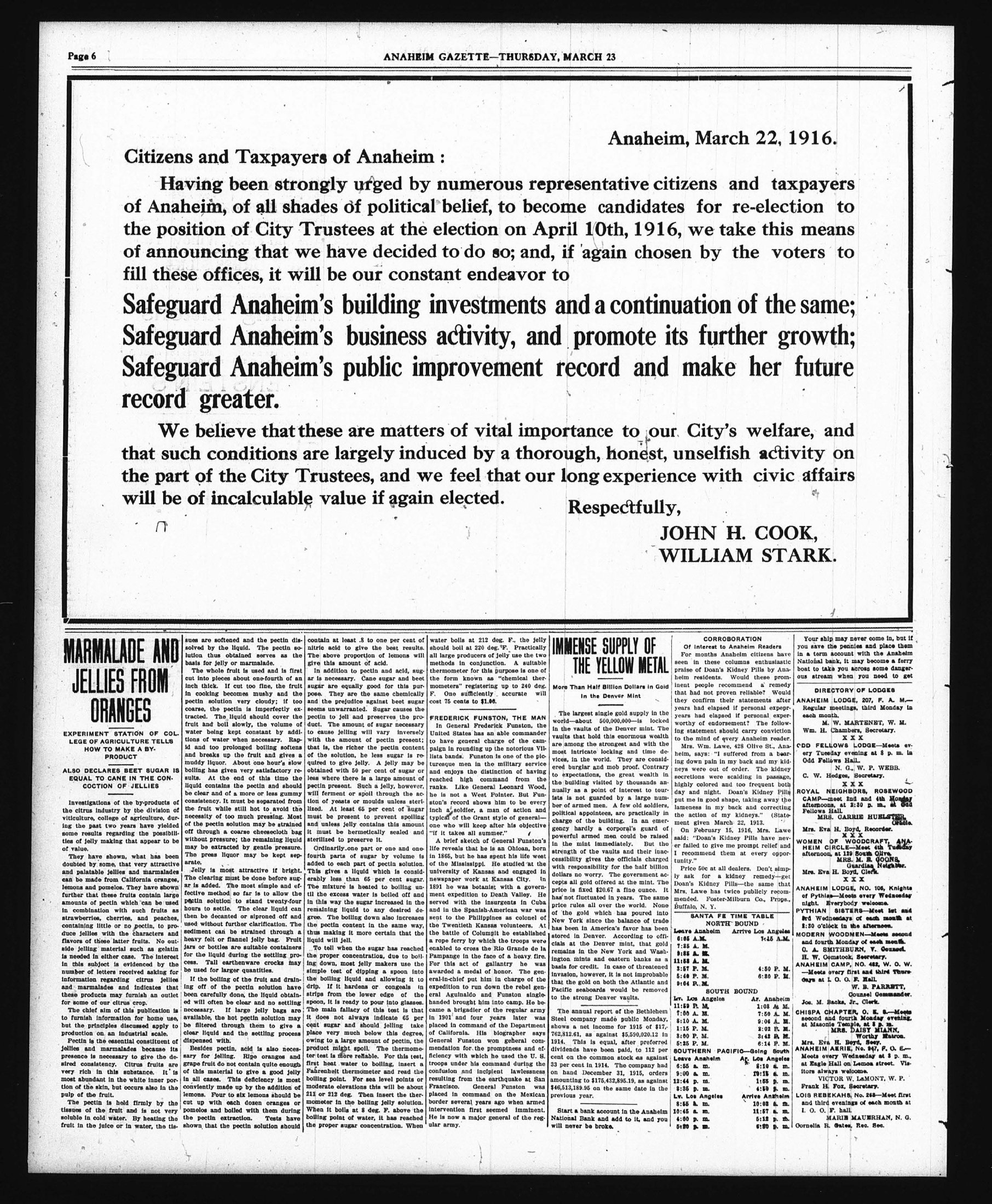
Citizens and Taxpayers of A
Having been strongly un
of Anaheim, of all shades of p
the position of City Trustees
of announcing that we have
fill these offices, it will be ou
Safeguard Anaheim's bui
Safeguard Anaheim's bu
Safeguard Anaheim's pu
record greater.
We believe that these are
Safeguard Anaheim’s public record greater.
We believe that these are that such conditions are large the part of the City Trustees will be of incalculable value
MARMALADE AND JELLIES FROM ORANGES
EXPERIMENT STATION OF COLLEGE OF AGRICULTURE TELLS HOW TO MAKE A BY-PRODUCT
ALSO DECLARES BEET SUGAR IS EQUAL TO CANE IN THE CONCOCTION OF JELLIES
Investigations of the by-products of the citrus industry by the division of viticulture, college of agriculture, during the past two years have yielded some results regarding the possibilities of jelly making that appear to be of value.
Sues are softened and the pectin dissolved by the liquid. The pectin solution thus obtained serves as the basis for jelly or marmalade.
The whole fruit is used and is first cut into pieces about one-fourth of an inch thick. If cut too fine, the fruit in cooking becomes mushy and the pectin solution very cloudy; if too coarse, the pectin is imperfectly extracted. The liquid should cover the fruit and boil slowly, the volume of water being kept constant by additions of water when necessary. Rapid and too prolonged boiling softens and breaks up the fruit and gives a muddy liquor. About one hour's slow boiling has given very satisfactory results. At the end of this time the liquid contains the pectin and should be clear and of a more or less gummy consistency. It must be separated from the fruit while still hot to avoid the necessity of too much pressing. Most of the pectin solution may be strained off through a coarse cheesecloth bag without pressure; the remaining liquid may be extracted by gentle pressure.
contain at least .8 to nitric acid to give The above proportion give this amount of In addition to pectar is necessary. Can sugar are equally good. They are the and the prejudice a seems unwarranted. Pectin to jell and product. The amount o to cause jelling will with the amount o that is, the richer t of the solution, he required to give jelly. obtained with 50 per cent where there is a pectin present. Such will ferment or spoil of yeasts or molized. At least 65 p must be present to and unless jelly cont it must be hermeth sterilized to preserve Ordinarily one par
ALSO DECLARES BEET SUGAR IS EQUAL TO CANE IN THE CONCOCTION OF JELLIES
Investigations of the by-products of the citrus industry by the division of viticulture, college of agriculture, during the past two years have yielded some results regarding the possibilities of jelly making that appear to be of value.
They have shown, what has been doubted by some, that very attractive and palatable jellies and marmalades can be made from California oranges, lemons and pomelos. They have shown further that these fruits contain large amounts of pectin which can be used in combination with such fruits as strawberries, cherries, and peaches, containing little or no pectin, to produce jellies with the characters and flavors of these latter fruits. No outside jelling material such as gelatin is needed in either case. The interest in this subject is evidenced by the number of letters received asking for information regarding citrus jellies and marmalades and indicates that these products may furnish an outlet for some of our citrus crop.
The chief aim of this publication is to furnish information for home use, but the principles discussed apply to production on an industrial scale.
Pectin is the essential constituent of jellies and marmalades because its presence is necessary to give the desired consistency. Citrus fruits are very rich in this substance. It is most abundant in the white inner portion of the skin, but occurs also in the pulp of the fruit.
The pectin is held firmly by the tissues of the fruit and is not very soluble in cold water. By heating the fruit in the juice or in water, the tis-
ANAHEIM GAZETTE—THURSDAY, MARCH 23
Anaheim, M
layers of Anaheim :
strongly urged by numerous representative citizen
hades of political belief, to become candidates f
Trustees at the election on April 10th, 1916, w
we have decided to do so; and, if again chosen
will be our constant endeavor to
heim's building investments and a continuation
heim's business activity, and promote its
heim's public improvement record and m
At these are matters of vital importance to our C
At these are matters of vital importance to our Cities are largely induced by a thorough, honest, unsuspecting Trustees, and we feel that our long experience is valuable if again elected.
Respectfully,
JOHN WILLIAMS
contain at least .8 to one per cent of nitric acid to give the best results. The above proportion of lemons will give this amount of acid.
In addition to pectin and acid, sugar is necessary. Cane sugar and beet sugar are equally good for this purpose. They are the same chemically and the prejudice against beet sugar seems unwarranted. Sugar causes the pectin to jell and preserves the product. The amount of sugar necessary to cause jelling will vary inversely with the amount of pectin present; that is, the richer the pectin content of the solution, he less sugar is required to give jelly. A jelly may be obtained with 50 per cent of sugar or less where there is a large amount of pectin present. Such a jelly, however, will ferment or spoil through the action of yeasts or moulds unless sterilized. At least 65 per cent of sugar must be present to prevent spoiling and unless jelly contains this amount it must be hermetically sealed and sterilized to preserve it.
Ordinarily one part or one and one water boils at 212 deg. F., the jelly should boil at 220 deg. F. Practically all large producers of jelly use the two methods in conjunction. A suitable thermometer for this purpose is one of the form known as "chemical thermometers" registering up to 240 deg. F. One sufficiently accurate will cost 75 cents to $1.00.
FREDERICK FUNSTON, THE MAN
In General Frederick Funston, the United States has an able commander to have general charge of the campaign in rounding up the notorious Villista bands. Funston is one of the picturesque men in the military service and enjoys the distinction of having reached high command from the ranks. Like General Leonard Wood, he is not a West Pointer. But Funston's record shows him to be every inch a soldier, a man of action and typical of the Grant style of general—one who will keep after his objective "if it takes all summer."
A brief sketch of General Funston's life reveals that he is an Ohlooan, born
IMMENSE SUPPLY OF THE YELLOW METAL
More Than Half Billion Dollars In Gold In the Denver Mint
The largest single gold supply in the world—about 500,000,000—is locked in the vaults of the Denver mint. The vaults that hold this enormous wealth are among the strongest and with the most intricate locking and time devices, in the world. They are considered burglar and mob proof. Contrary to expectations, the great wealth in the building visited by thousands annually as a point of interest tourists is not guarded by a large number of armed men. A few old soldiers, political appointees, are practically in charge of the building. In an emergency hardly a corporal's guard of powerful armed men could be raised in the mint immediately. But the strength of the vaults and their ingresses
Ordinarily one part or one and one-fourth parts of sugar by volume is added to each part of pectin solution. This gives a liquid which is considerably less than 65 per cent sugar. The mixture is heated to boiling until the excess water is boiled off and in this way the sugar increased in the remaining liquid to any desired degree. The boiling down also increases the pectin content in the same way, thus making it more certain that the liquid will jell.
To tell when the sugar has reached the proper concentration, due to boiling down, most jelly makers use the simple test of dipping a spoon into the boiling liquid and allowing it to drip. If it hardens or congeals in strips from the lower edge of the spoon, it is ready to pour into glasses. The main fallacy of this test is that it does not always indicate 65 per cent sugar and should jelling take place very much below this degree, owing to a large amount of pectin, the product might spoil. The thermometer test is more reliable. For this test, first heat water to boiling, insert a Fahrenheit thermometer and read the boiling point. For sea level points or moderate elevations this will be about 211 or 212 deg. Then insert the thermometer in the boiling jelly solution. When it boils at 8 deg. F. above the boiling point of water, it has reached the proper sugar concentration. When Funston is one of the picturesque men in the military service and enjoys the distinction of having reached high command from the ranks. Like General Leonard Wood, he is not a West Pointer. But Funston's record shows him to be every inch a soldier, a man of action and typical of the Grant style of general—one who will keep after his objective "if it takes all summer."
A brief sketch of General Funston's life reveals that he is an Ohioan, born in 1865, but he has spent his life west of the Mississippi. He studied at the university of Kansas and engaged in newspaper work at Kansas City. In 1891 he was botanist with a government expedition to Death Valley. He served with the insurgents in Cuba and in the Spanish-American war was sent to the Philippines as colonel of the Twentieth Kansas volunteers. At the battle of Columpit he established a rope ferry by which the troops were enabled to cross the Rio Grande de la Pampanga in the face of a heavy fire. For this act of gallantry he was awarded a medal of honor. The general-in-chief put him in charge of the expedition to run down the rebel general Aguinaldo and Funston single-handed brought him into camp. He became a brigadier of the regular army in 1901 and four years later was placed in command of the Department of California. His biographer says General Funston won general commendation for the promptness and efficiency with which he used the U.S. troops under his command during the confusion and incipient lawlessness resulting from the earthquake at San Francisco. General Funston was placed in command on the Mexican border several years ago when armed intervention first seemed imminent. He is now a major general of the regular army.
The annual report of the Bethlehem Steel company made public Monday, shows a net income for 1915 of $17,762,812.61, as against $5,590,020.12 in 1914. This is equal, after preferred dividends have been paid, to 112 per cent on the common stock as against 33 per cent in 1914. The company had on hand December 31, 1915, orders amounting to $175,432,895.19, as against $46,513,189.95 on the same date in the previous year.
Start a bank account in the Anaheim National Bank and add to it, and you will never be broke.
naheim, March 22, 1916.
active citizens and taxpayers
candidates for re-election to
1916, we take this means
chosen by the voters to
continuation of the same;
note its further growth;
and make her future
to our City's welfare, and
and make her future
to our City’s welfare, and
honest, unselfish activity on
experience with civic affairs
actfully,
JOHN H. COOK,
WILLIAM STARK.
CORROBORATION
Of Interest to Anaheim Readers
For months Anaheim citizens have seen in these columns enthusiastic praise of Doan's Kidney Pills by Anaheim residents. Would these prominent people recommend a remedy that had not proven reliable? Would they confirm their statements after years had elapsed if personal experience had elapsed if personal experience worthy of endorsement? The following statement should carry conviction to the mind of every Anaheim reader.
Mrs. Wm. Lawe, 428 Olive St., Anaheim, says: "I suffered from a bearing down pain in my back and my kidneys were out of order. The kidney secretions were scalding in passage, highly colored and too frequent both day and night. Doan's Kidney Pills put me in good shape, taking away the lameness in my back and correcting the action of my kidneys." (Statement given March 22, 1913).
On February 15, 1916, Mrs. Lawe said: "Doan's Kidney Pills have never failed to give me prompt relief andYour ship may never come in, but if you save the pennies and place them in a term account with the Anaheim National bank, it may become a ferry boat to take you across some dangerous stream when you need to get
DIRECTORY OF LODGES
ANAHEIM LODGE, 207, F. A. M.
Regular meetings, third Monday in each month.
M. W. MARTENET, W. M.
Wm. H. Chambers, Secretary.
XX X
CDD FELLOWS LODGE—Meets every Tuesday evening at 8 p.m. in Odd Fellows Hall.
N. G., W. P. WEBB.
C. W. Hedges, Secretary.
XX X
ROYAL NEIGHBORS, ROSEWOOD CAMP—meet 2nd and 4th Mondays afternoons, at 2:30 p.m., at Odd Fellows Hall.
MRS. CARRIE HUELSTER,
Oracle.
Mrs. Eva H. Boyd, Recorder.
XX X
WOMEN OF WOODCRAFT, ANAHEIM CIRCLE—Meet 4th Tuesday
they are considered proof. Contrary
great wealth in
many thousands annterest to tourby a large number of old soldiers,
are practically in
the world. In an emergal's guard of
could be raised
likely. But the
and their inacflicious officials charged
the half billion
government acct
at the mint. The
fine ounce. It
ears. The same
world. None
was poured into
balance of trade
favor has been
recording to offiminant, that gold
work and Washern banks as a
me of threatened
not improbable
the Atlantic and
old be removed
fraughts.
SANTA FE TIME TABLE
NORTH BOUND
Leave Anaheim Arrive Los Angeles
6:05 A.M. 7:25 A.M.
7:35 A.M.
9:85 A.M.
11:58 A.M.
3:57 P.M. 4:50 P.M.
5:40 P.M. 6:80 P.M.
9:04 P.M.
SOUTH BOUND
Lv. Los Angeles Ar. Anaheim
11:59 P.M. 1:08 A.M.
7:00 A.M. 7:50 A.M.
8:10 A.M. 9:06 A.M.
1:15 P.M. 2:02 P.M.
8:00 P.M. 3:42 P.M.
5:25 P.M. 6:14 P.M.
SOUTHERN PACIFIC—Going South
Leave Anaheim Arrive Los Angeles
6:55 a.m. 8:10 a.m.
9:00 a.m. 10:15 a.m.
12:44 p.m. 1:55 p.m.
8:35 p.m. 4:59 p.m.
Lv. Los Angeles Arrive Anaheim
8:55 a.m. 10:08 a.m.
10:45 a.m. 11:57 a.m.
4:00 p.m. 5:12 p.m.
5:20 p.m. 6:80 p.m.
Odd Fellows Hall.
N. G., W. P. WEBB.
C. W. Hedges, Secretary.
XX X
ROYAL NEIGHBORS, ROSEWOOD
CAMP—meet 2nd and 4th Monday afternoons, at 2:30 p.m., at Odd Fellows Hall.
MRS. CARRIE HUELSTER, Oracle.
Mrs. Eva H. Boyd, Recorder.
XX X
WOMEN OF WOODCRAFT, ANAHEIM CIRCLE—Meet 4th Tuesday afternoon, at 129 South Olive.
MRS. M. B. GOONS, Guardian Neighbor.
Mrs. Eva H. Boyd, Clerk.
XX X
ANAHEIM LODGE, NO. 105, Knights of Pythias—Meets every Wednesday night. Everybody welcome.
PYTHIAN SISTERS—Meet 1st and 3rd Wednesdays of each month at 2:30 o'clock in the afternoon.
MODERN WOODMEN—Meets second and fourth Monday of each month.
G. A. SMITHBURN, V. Counsed.
H. W. Comstock, Secretary.
ANAHEIM CAMP, NO. 482, W. O. W.
—Meets every first and third Thursday at L O. O. R. Hall.
W. B. PARRETT, Counsel Commander.
Jos. M. Backs, Jr., Clerk.
CHISPA CHAPTER, O. E. S—Meets second and fourth Monday evening, at Masonie Temple, at 8 p.m.
MRS. DAISY MIANN, Worthy Matron.
Mrs. Eva H. Boyd, Secy.
ANAHEIM AERIE, No. 947, F. O. E—Meets every Wednesday at 8 p.m., at Eagle Hall on Lemon street. Visitors always welcome.
VICTOR W. LAMONT, W. P.
Frank H. Fox, Secretary.
LOIS REBEKAHS, No. 268—Meet first and third evenings of each month at I. O. O. F. hall.
MARIE MAUERHAN, N. G.
Gornella R. Gates, Rec. Sec.