anaheim-gazette 1916-03-02
Scanned page
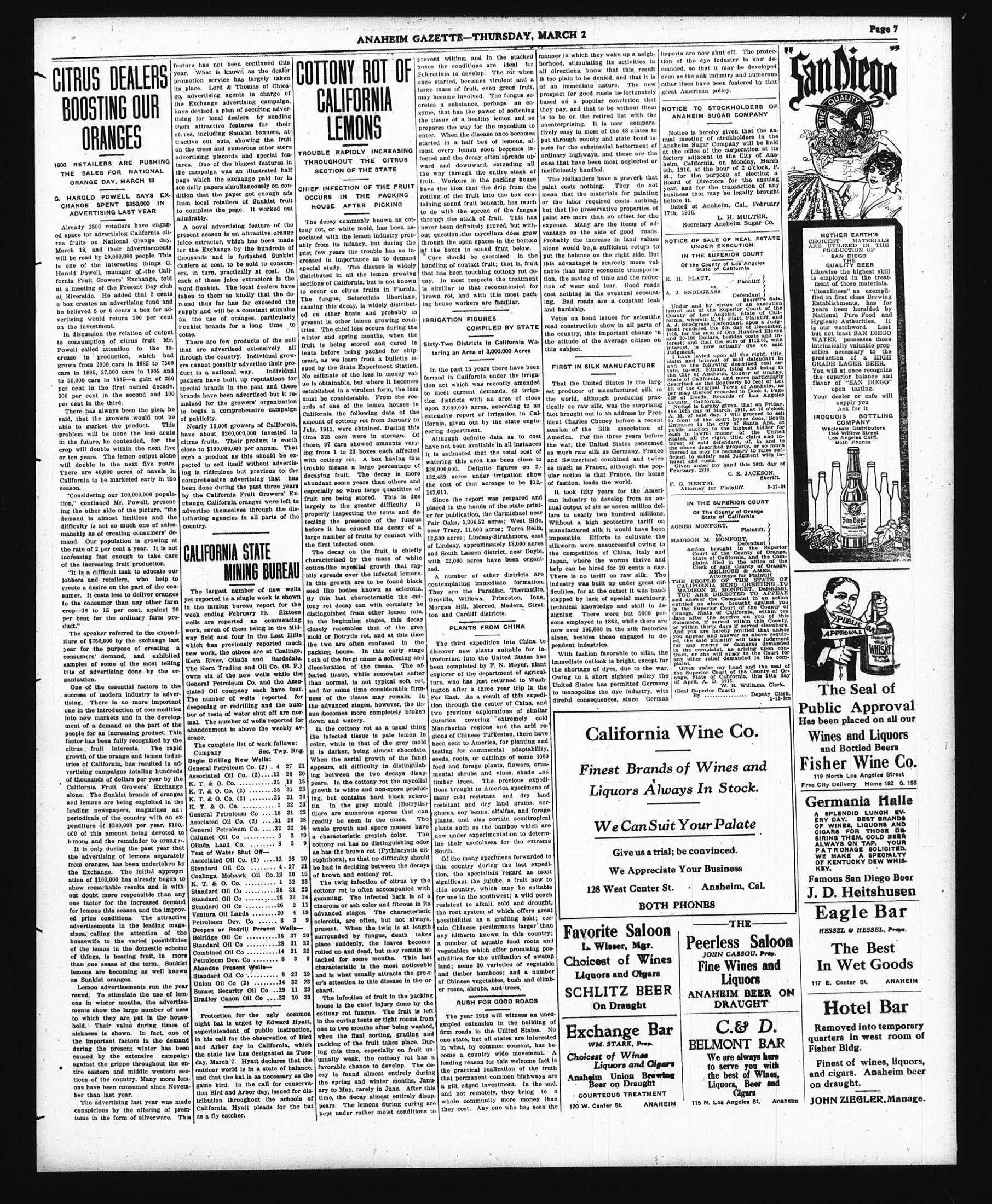
Searchable text
CITRUS DEALERS BOOSTING OUR ORANGES
1800 RETAILERS ARE PUSHING THE SALES FOR NATIONAL ORANGE DAY, MARCH 18
G. HAROLD POWELL SAYS EXCHANGE SPENT $350,000 IN ADVERTISING LAST YEAR
Already 1800 retailers have engaged space for advertising California citrus fruits on National Orange day, March 18, and their advertisements will be read by 10,000,000 people. This is one of the interesting things G. Harold Powell, manager of the California Fruit Growers' Exchange, told at a meeting of the Present Day club at Riverside. He added that 2 cents a box creates an advertising fund and he believed 5 or 6 cents a box for advertising would return 100 per cent on the investment.
In discussion the relation of output to consumption of citrus fruit Mr. Powell called attention to the increase in production, which had grown from 2000 cars in 1885 to 7500 cars in 1895, 27,000 cars in 1905 and to 50,000 cars in 1915—a gain of 250 per cent in the first named decade, 300 per cent in the second and 100 per cent in the third.
There has always been the plea, he said, that the growers would not be able to market the product. This problem will be none the less acute in the future, he contended, for the crop will double within the next five feature has not been continued this year. What is known as the dealer promotion service has largely taken its place. Lord & Thomas of Chicago, advertising agents in charge of the Exchange advertising campaign, have devised a plan of securing advertising for local dealers by sending them attractive features for their stores, including Sunkist banners, attractive cut outs, showing the fruit on the trees and numerous other store advertising placards and special features. One of the biggest features in the campaign was an illustrated half page which the exchange paid for in 400 daily papers simultaneously on condition that the paper got enough ads from local retailers of Sunkist fruit to complete the page. It worked out admirably.
A novel advertising feature of the present season is an attractive orange juice extractor, which has been made for the Exchange by the hundreds of thousands and is furinshed Sunkist dealers at cost, to be sold to consumers, in turn, practically at cost. On each of these juice extractors is the word Sunkist. The local dealers have taken to them so kindly that the den and thus far has far exceeded the supply and will be a constant stimulus for the use of oranges, particularly Sunkist brands for a long time to come.
There are few products of the soil that are advertised extensively all through the country. Individual growers cannot possibly advertise their product in a national way. Individual packers have built up reputations for special brands in the past and these brands have been advertised but it remained for the growers' organization to begin a comprehensive campaign of publicity.
Nearly 15,000 growers of California, have about $200,000,000 invested in citrus fruits. Their product is worth close to $100,000,000 per annum. That
COTTONY RAPIDLY THROUGHOUT THE SECTION OF THE CHIEF INFECTION OF OCCURS IN THE HOUSE AFTER
The decay commonly tony rot, or white mold associated with the lemonably from its infancy, past few years the trot creased in importance and special study. The distribution in all the sections of California, be to occur on citrus fruit. The fungus, Selerotia causing this decay, is wied on other hosts and present in other lemons tries. The chief loss occurs winter and spring month fruit is being stored before being payment, as we learn from sued by the State Expense No estimate of the loss due is obtainable, but we established in a virulent must be considerable. Orders of one of the low California the following amount of cottony rot July, 1911, were obtained time 325 cars were these, 97 cars showed
crease in production, which had grown from 2000 cars in 1885 to 7500 cars in 1895, 27,000 cars in 1905 and to 50,000 cars in 1915—a gain of 250 per cent in the first named decade, 300 per cent in the second and 100 per cent in the third.
There has always been the plea, he said, that the growers would not be able to market the product. This problem will be none the less acute in the future, he contended, for the crop will double within the next five or ten years. The lemon output alone will double in the next five years. There are 40,000 acres of navels in California to be marketed early in the season.
"Considering our 100,000,000 population," continued Mr. Powell, presenting the other side of the picture, "the demand is almost limitless and the difficulty is not so much one of salesmanship as of creating consumers' demand. Our population is growing at the rate of 2 per cent a year. It is not increasing fast enough to take care of the increasing fruit production.
"It is a difficult task to educate our jobbers and retailers, who help to create a desire on the part of the consumer. It costs less to deliver oranges to the consumer than any other farm crop—19 to 15 per cent, against 20 per cent for the ordinary farm product."
The speaker referred to the expenditure of $350,000 by the exchange last year for the purpose of creating a consumers' demand, and exhibited samples of some of the most telling bits of advertising done by the organization.
One of the essential factors in the success of modern industry is advertising. There is no more important one in the introduction of commodities into new markets and in the development of a demand on the part of the people for an increasing product. This factor has been fully recognized by the citrus fruit interests. The rapid growth of the orange and lemon industries of California, has resulted in advertising campaigns totaling hundreds of thousands of dollars per year by the California Fruit Growers' Exchange alone. The Sunkist brands of oranges and lemons are being exploited in the leading newspapers, magazines and periodicals of the country with an expenditure of $300,000 per year, $100,000 of this amount being devoted to lemons and the remainder to oranges.
It is only during the past year that increase in production, which had grown from 2000 cars in 1885 to 7500 cars in 1895, 27,000 cars in 1905 and to 50,000 cars in 1915—a gain of 250 per cent in the first named decade, 300 per cent in the second and 100 per cent in the third.
There has always been the plea, he said, that the growers would not be able to market the product. This problem will be none the less acute in the future, he contended, for the crop will double within the next five or ten years. The lemon output alone will double in the next five years. There are 40,000 acres of navels in California to be marketed early in the season.
"Considering our 100,000,000 population," continued Mr. Powell, presenting the other side of the picture, "the demand is almost limitless and the difficulty is not so much one of salesmanship as of creating consumers' demand. Our population is growing at the rate of 2 per cent a year. It is not increasing fast enough to take care of the increasing fruit production.
"It is a difficult task to educate our jobbers and retailers, who help to create a desire on the part of the consumer. It costs less to deliver oranges to the consumer than any other farm crop—19 to 15 per cent, against 20 per cent for the ordinary farm product."
The speaker referred to the expenditure of $350,000 by the exchange last year for the purpose of creating a consumers' demand, and exhibited samples of some of the most telling bits of advertising done by the organization.
One of the essential factors in the success of modern industry is advertising. There is no more important one in the introduction of commodities into new markets and in the development of a demand on the part of the people for an increasing product. This factor has been fully recognized by the citrus fruit interests. The rapid growth of the orange and lemon industries of California, has resulted in advertising campaigns totaling hundreds of thousands of dollars per year by the California Fruit Growers' Exchange alone. The Sunkist brands of oranges and lemons are being exploited in the leading newspapers, magazines and periodicals of the country with an expenditure of $300,000 per year, $100,000 of this amount being devoted to lemons and the remainder to oranges.
It is only during the past year that increase in production, which had grown from 2000 cars in 1885 to 7500 cars in 1895, 27,000 cars in 1905 and to 50,000 cars in 1915—a gain of 250 per cent in the first named decade, 300 per cent in the second and 100 per cent in the third.
There has always been the plea, he said, that the growers would not be able to market the product. This problem will be none the less acute in the future, he contended, for the crop will double within the next five or ten years. The lemon output alone will double in the next five years. There are 40,000 acres of navels in California to be marketed early in the season.
"Considering our 100,000,000 population," continued Mr. Powell, presenting the other side of the picture, "the demand is almost limitless and the difficulty is not so much one of salesmanship as of creating consumers' demand. Our population is growing at the rate of 2 per cent a year. It is not increasing fast enough to take care of the increasing fruit production.
"It is a difficult task to educate our jobbers and retailers, who help to create a desire on the part of the consumer. It costs less to deliver oranges to the consumer than any other farm crop—19 to 15 per cent, against 20 per cent for the ordinary farm product."
The speaker referred to the expenditure of $350,000 by the exchange last year for the purpose of creating a consumers' demand, and exhibited samples of some of the most telling bits of advertising done by the organization.
One of the essential factors in the success of modern industry is advertising. There is no more important one in the introduction of commodities into new markets and in the development of a demand on the part of the people for an increasing product. This factor has been fully recognized by the citrus fruit interests. The rapid growth of the orange and lemon industries of California, has resulted in advertising campaigns totaling hundreds of thousands of dollars per year by the California Fruit Growers' Exchange alone. The Sunkist brands of oranges and lemons are being exploited in the leading newspapers, magazines and periodicals of the country with an expenditure of $300,000 per year, $100,
It is only during the past year that the advertising of lemons separately from oranges, has been undertaken by the Exchange. The initial appropriation of $100,000 has already begun to show remarkable results and is without doubt more responsible than any one factor for the increased demand for lemons this season and the improved price conditions. The attractive advertisements in the leading magazines, calling the attention of the housewife to the varied possibilities of the lemon in the domestic scheme of things, is bearing fruit, in more than one sense of the term. Sunkist lemons are becoming as well known as Sunkist oranges.
Lemon advertisements run the year round. To stimulate the use of lemons in winter months, the advertisements show the large number of uses to which they are put in the household. Their value during times of sickness is shown. In fact, one of the important factors in the demand during the present winter has been caused by the extensive campaign against the grippe throughout the entire eastern and middle western sections of the country. Many more lemons have been consumed since November than last year.
The advertising last year was made conspicious by the offering of premiums in the form of silverware. This
Begin Drilling New Wells:
General Petroleum Co. (2) . 4 27 21
Associated Oil Co. (2) ...13 26 20
K. T. & O. Co. ...35 19 15
K. T. & O. Co. (2) ...25 31 23
K. T. & O. Co. (2) ...35 31 23
K. T. & O. Co. ...1 32 23
General Petroleum Co ...15 31 22
Associated Oil Co. (2) ...31 28 28
General Petroleum Co...32 32 24
Calumet Oil Co ...3 3 19
Olinda Land Co ...8 3 9
Test of Water Shut Off—
Associated Oil Co. (2) ...13 26 20
Standard Oil Co ...4 27 21
Coalinga Mohawk Oil Co.12 20 15
K. T. & O. Co. ...1 32 23
Standard Oil Co ...36 31 23
Standard Oil Co ...28 32 24
Standard Oil Co ...26 2 11
Ventura Oil Lands ...20 4 19
Petroleum Dev. Co ...8 3 9
Deepen or Redrill Present Wells—
Belridge Oil Co ...35 27 20
Standard Oil Co ...28 31 22
Combined Oil Co ...14 31 22
Petroleum Dev. Co ...8 3 9
Abandon Present Wells—
Standard Oil Co ...8 27 19
Union Oil Co (2) ...14 32 23
Sunset Security Oil Co ..29 11 23
Bradley Canon Oil Co ..33 10 33
Protection for the ugly common night bat is urged by Edward Hyatt, superintendent of public instruction, in his call for the observation of Bird and Arbor day in California, which the state law has designated as Tuesday, March 7. Hyatt declares that the outdoor world is in a state of balance, and that the bat is as necessary as the game bird. In the call for conservation Bird and Arbor day, issued for distribution throughout the schools of California, Hyatt pleads for the bat as a fly catcher.
When the aerial growth appears, all difficultying between the trees pears. In the cotton growth is white and ing, but contains tia In the grey there are numerous readily be seen in whole growth and a characteristic green cottony rot has no as has the brown rophthora), so that he had in deciding of brown and cotton.
The twig infection cottony rot is often gumming. The incinerous or ash collar advanced stages. Sclerotia, are often present. When ther surrounded by fur place suddenly, the rolled up and dead tached for some characteristic is true and is what usually er's attention to the chard.
The infection of house is the chief cottony rot fungus in the curing tenture one to two months when the final packing of the frieing this time, usually weak, then favorable chance cay is found almthe spring and wary to May, rarely time, the decay pears. The lemo kept under rather
COTTONY ROT OF CALIFORNIA LEMONS
TROUBLE RAPIDLY INCREASING THROUGHOUT THE CITRUS SECTION OF THE STATE
CHIEF INFECTION OF THE FRUIT OCCURS IN THE PACKING HOUSE AFTER PICKING
The decay commonly known as cottony rot, or white mold, has been associated with the lemon industry probably from its infancy, but during the past few years the trouble has so increased in importance as to demand special study. The disease is widely distributed in all the lemon growing sections of California, but is not known to occur on citrus fruits in Florida. The fungus, Selerotinia libertiana, causing this decay, is widely distributed on other hosts and probably is present in other lemon growing countries. The chief loss occurs during the winter and spring months, when the fruit is being stored and cured in tents before being packed for shipment, as we learn from a bulletin issued by the State Experiment Station. No estimate of the loss in money value is obtainable, but where it becomes established in a virulent form, the loss must be considerable. From the records of one of the lemon houses in California the following data of the amount of cottony rot from January to July, 1911, were obtained. During this time 325 cars were in storage. Of these, 97 cars showed amounts vary prevent wilting, and in the stacked boxes the conditions are ideal for Sclerotinia to develop. The rot when once started, becomes virulent and a large mass of fruit, even green fruit, may become involved. The fungus secretes a substance, perhaps an enzyme, that has the power of softening the tissue of a healthy lemon and so prepares the way for the mycelium to enter. When the disease once becomes started in a half box of lemons, almost every lemon soon becomes infected and the decay often spreads upward and downward, extending all the way through the entire stack of fruit. Workers in the packing house have the idea that the drip from the rotting of the fruit into the box containing sound fruit beneath, has much to do with the spread of the fungus through the stack of fruit. This has never been definitely proved, but without question, the mycelium does grow through the open spaces in the bottom of the boxes to sound fruit below.
Care should be exercised in the handling of contact fruit; that is, fruit that has been touching cottony rot decay. In most respects the treatment is similar to that recommended for brown rot, and with this most packing house workers are familiar.
IRRIGATION FIGURES
COMPILED BY STATE
Sixty-Two Districts In California Watering an Area of 3,000,000 Acres
In the past 15 years there have been formed in California under the irrigation act which was recently amended to meet current demands. 62 irrigation districts with an area of close upon 3,000,000 acres, according to an extensive report of irrigation in California, given out by the state engineering department.
Although definite data as to cost have not been available in all instances manner in which they wake up a neighborhood, stimulating its activities in all directions, know that this result is too plain to be denied, and that it is of an immediate nature. The new prospect for good roads is fortunately based on a popular conviction that they pay, and that to be without them is to be on the retired list with the unenterprising. It is now comparatively easy in most of the 48 states to put through county and state bond issues for the substantial betterment of ordinary highways, and these are the ones that have been most neglected or inefficiently handled.
The Hollanders have a proverb that paint costs nothing. They do not mean that the materials for painting or the labor required costs nothing, but that the preservative properties of paint are more than an offset for the expense. Many are the items of advantage on the side of good roads. Probably the increase in land values alone would be a sufficient return to put the balance on the right side. But this advantage is scarcely more valuable than more economic transportation, the saving of time and the reduction of wear and tear. Good roads cost nothing in the eventual accounting. Bad roads are a constant leak and hardship.
Votes on bond issues for scientific road construction show in all parts of the country, this important change in the attitude of the average citizen on this subject.
FIRST IN SILK MANUFACTURE
That the United States is the largest producer of manufactured silk in the world, although producing practically no raw silk, was the surprising fact brought out in an address by President Charles Cheney before a recent session of the Silk association of America. For the three years before the war, the United States consumed imports are not mandated so even as the slim other lines have great American importation.
NOTICE TO ANAHEIM
Notice is final meeting Anaheim Suggs at the office of Deerheim, California 6th, 1916, at M., for the Board of Dearman business than before it.
Dated at 17th, 1916.
Secret
NOTICE OF UNDERSTANDING
IN THIS ISSUE OF THE NOTICE OF ANAHEIM
Of the 80
E. H. PLATAN
A. J. SNODDY
Under and issued out of County where Anaheim Suggs at the office of Deerheim, California 6th, 1916, at M., for the Board of Dearman business than before it.
Dated at 17th, 1916.
Secret
NOTICE OF UNDERSTANDING
IN THIS ISSUE OF THE NOTICE OF ANAHEIM
Of the 80
E. H. PLATAN
A. J. SNODDY
Under and issued out of County where Anaheim Suggs at the office of Deerheim, California 6th, 1916, at M., for the Board of Dearman business than before it.
Dated at 17th, 1916.
Secret
In the past 15 years there have been formed in California under the irrigation act which was recently amended to meet current demands, 62 irrigation districts with an area of close upon 3,000,000 acres, according to an extensive report of irrigation in California, given out by the state engineering department.
Although definite data as to cost have not been available in all instances it is estimated that the total cost of watering this area has been close to $20,000,000. Definite figures on 2,132,489 acres under irrigation show the cost of that acreage to be $12,142,011.
Since the report was perpared and placed in the hands of the state printer for publication, the Carmichael near Fair Oaks, 1,306.52 acres; West Side, near Tracy, 11,500 acres; Terra Bella, 12,500 acres; Lindsay-Strathmore, east of Lindsay, approximately 18,000 acres and South Lassen district, near Doyle, with 22,000 acres have been organized.
A number of other districts are contemplating immediate formation. They are the Paradise, Thermalito, Oroville, Willows, Princeton, Ione, Morgan Hill, Merced, Madera, Stratton and Cardiff districts.
PLANTS FROM CHINA
The third expedition into China to discover new plants suitable for introduction into the United States has been completed by F. N. Meyer, plant explorer of the department of agriculture, who has just returned to Washington after a three year trip in the Far East. As a result of this expedition through the center of China, and two previous explorations of similar duration covering extremely cold Manchurian regions and the arid regions of Chinese Turkestan, there have been sent to America, for planting and testing for commercial adaptability, seeds, roots, or cuttings of some 3000 food and forage plants, flowers, ornamental shrubs and vines, shade and timber trees. The previous expeditions brought to America specimens of many cold resistant and dry land resistant and dry land grains, sorghums, soy beans, alfalfas, and forage plants, and also certain semitropical plants such as the bamboo which are now under experimentation to determine their usefulness for the extreme South.
FIRST IN SILK MANUFACTURE
That the United States is the largest producer of manufactured silk in the world, although producing practically no raw silk, was the surprising fact brought out in an address by President Charles Cheney before a recent session of the Silk association of America. For the three years before the war, the United States consumed as much raw silk as Germany, France and Switzerland combined and twice as much as France, although the popular notion is that France, the home of fashion, leads the world.
It took fifty years for the American industry to develop from an annual output of six or seven million dollars to nearly two hundred millions. Without a high protective tariff on manufactured silk it would have been impossible. Efforts to cultivate the silkworm were unsuccessful owing to the competition of China, Italy and Japan, where the worms thrive and help can be hired for 20 cents a day. There is no tariff on raw silk. The industry was built up under great difficulties, for at the outset it was handicapped by lack of special machinery, technical knowledge and skill in designing. There were but 5000 persons employed in 1862, while there are now over 105,000 in the silk factories alone, besides those engaged in dependent industries.
With fashion favorable to silks, the immediate outlook is bright, except for the shortage of dyes, due to the war. Owing to a short sighted policy the United States has permitted Germany to monopolize the dye industry, with direful consequences, since German
When the aerial growth of the fungi appears, all difficulty in distinguishing between the two decays disappears. In the cottony rot the mycelial growth is white and non-spore producing, but contains hard black sclerotia. In the grey mould (Botrytis), there are numerous spores that can readily be seen in the mass. The whole growth and spore masses have a characteristic greyish color. The cottony rot has no distinguishing odor as has the brown rot (Pythlacystis citrophthora), so that no difficulty should be had in deciding between the decays of brown and cottony rot.
The twig infection of citrus by the cottony rot is often accompanied with gumming. The infected bark is of a cinerous or ash color and fibrous in its advanced stages. The characteristic sclerotia, are often, but not always, present. When the twig is at length surrounded by fungus, death takes place suddenly, the leaves become rolled up and dead, but may remain attached for some months. This last characteristic is the most noticeable and is what usually attracts the grower's attention to this disease in the orchard.
The infection of fruit in the packing house is the chief injury done by the cottony rot fungus. The fruit is left in the curing tents or tight rooms from one to two months after being washed, when the final sorting, grading and packing of the fruit takes place. During this time, especially on fruit unusually weak, the cottony rot has a favorable chance to develop. The decay is found almost entirely during the spring and winter months, January to May, rarely in June. After this time, the decay almost entirely disappears. The lemons during curing are kept under rather moist conditions to seeds, roots, or cuttings of some 3000 food and forage plants, flowers, ornamental shrubs and vines, shade and timber trees. The previous expeditions brought to America specimens of many cold resistant and dry land resistant and dry land grains, sorghums, soy beans, alfalfas, and forage plants, and also certain semitropical plants such as the bamboo which are now under experimentation to determine their usefulness for the extreme South.
Of the many specimens forwarded to this country during the last expedition, the specialists regard as most significant the jujube, a fruit new to this country, which may be suitable for use in the southwest; a wild peach resistant to alkali, cold and drought, the root system of which offers great possibilities as a grafting host; certain Chinese persimmons larger than any hitherto known in this country; a number of aquatic food roots and vegetables which offer promising possibilities for the utilization of swamp land; some 30 varieties of vegetable and timber bamboos; and a number of Chinese vegetables, bush and climber roses, shrubs, and trees.
RUSH FOR GOOD ROADS
The year 1916 will witness an unexamined extension in the building of firm roads in the United States. No one state, but all states are interested in what, by common consent, has become a country wide movement. A leading reason for this welcome fact is the practical realization of the truth that permanent common highways are a gilt edged investment. In the end, and not remotely, they bring to a whole community more money than they cost. Any one who has seen the
NOTICE TO STOCKHOLDERS OF ANAHEIM SUGAR COMPANY
Notice is hereby given that the annual meeting of stockholders in the Anaheim Sugar Company will be held at the office of the corporation at its factory adjacent to the City of Anaheim, California, on Monday, March 6th, 1916, at the hour of 2 o'clock, P.M., for the purpose of electing a Board of Directors for the ensuing year, and for the transaction of any business that may be legally brought before it.
Dated at Anaheim, Cal., February 17th, 1916.
L. H. MULTER,
Secretary Anaheim Sugar Co.
NOTICE OF SALE OF REAL ESTATE UNDER EXECUTION
IN THE SUPERIOR COURT
Of the County of Los Angeles State of California
E. H. PLATT.
Plaintiff
vs.
A. J. SNODGRASS
Defendant
Sheriff's Sale.
Under and by virtue of an execution issued out of the Superior Court of the County of Los Angeles, State of California, wherein E. H. Platt, Plaintiff, and A. J. Snodgrass, Defendant, upon a Judgment rendered the 6th day of December, 1915, for the sum of One Hundred Eleven and 20-100 Dollars, besides costs and interest; and that the sum of $113.05, with interest, is now actually due on said Judgment.
I have levied upon all the right, title, claim and interest of said defendant in and to the following described real estate to-wit: Situate, lying and being in the City of Anaheim, County of Orange, State of California, and more particularly described as the Southerly 50 feet of Lot 12, of the Original Town of Anaheim, as per map thereof recorded in Book 4, Page 629 of Deeds, Records of Los Angeles County, California.
Notice is hereby given that on Friday, the 10th day of March, 1916, at 10 o'clock A. M. of said day, I will proceed to sell in front of the court house door, South Entrance in the city of Santa Ana, at public auction to the highest bidder for cash in lawful money of the United States, all the right, title, claim and interest of said defendant, of, in and to the above described property, or so much imports are now shut off. The protection of the dye industry is now demanded, so that it may be developed even as the silk industry and numerous other lines have been fostered by that great American policy.
MOTHER EARTH'S CHOICEST MATERIALS ARE UTILIZED IN THE PRODUCTION OF SAN DIEGO
THE QUALITY BEER
Likewise the highest skill is employed in the treatment of those materials. "Cleanliness" as exemplified in first class Brewing Establishments, has for years been heralded by National Pure Food and Hygienic Authorities. It is our watchword. Last but not least SAN DIEGO WATER possesses those intrinsically valuable properties necessary to the production of a HIGH GRADE LAGER BEER.
You will at once recognize the superior balance and flavor of "SAN DIEGO" upon tasting.
Your dealer or cafe will supply you Ask for it
IROQUOIS BOTTLING COMPANY
Wholesale Distributors
1344 Willow Street
Los Angeles Calif.
Both Phones
I have levied upon all the right, title, claim and interest of said defendant in and to the following described real estate, to-wit: Situate, lying and being in the City of Anaheim, County of Orange, State of California, and more particularly described as the Southerly 50 feet of Lot 12, of the Original Town of Anaheim, as per map thereof recorded in Book 4, Page 699 of Deeds, Records of Los Angeles County, California.
Notice is hereby given, that on Friday, the 10th day of March, 1916, at 10 o'clock A.M. of said day, I will proceed to sell in front of the court house door, South Entrance in the city of Santa Ana, at public auction to the highest bidder for cash in lawful money of the United States, all the right, title, claim and interest of said defendant, of, in and to the above described property, or so much thereof as may be necessary to raise sufficient to satisfy said judgment with interest and costs.
Given under my hand this 10th day of February, 1916.
C. E. JACKSON,
Sheriff.
F. G. HENTIG,
Attorney for Plaintiff.
IN THE SUPERIOR COURT
Of The County of Orange
State of California
AGNES MONFORT.
vs.
MADISON M. MONFORT,
Defendant)
Action brought in the Superior Court of the County of Orange, State of California, and the Complaint filed in the office of the Clerk of said County of Orange, MELROSE & AMES.
Attorneys for Plaintiff
THE PEOPLE OF THE STATE OF CALIFORNIA SEND GREETING TO MADISON M. MONFORT, Defendant.
YOU ARE DIRECTED TO APPEAR and answer the Complaint in an action entitled as above, brought against you in the Superior Court of the County of Orange, State of California within ten days after the servee on you of this Summons, if served within this County, or within thirty days if served elsewhere.
And you are hereby notified that unless you appear and answer as above required, the said plaintiff will take judgment for any money or damages demanded in the complaint, as arising upon contract, or she will apply to the Court for any other relief demanded in the complaint.
Given under my hand and the seal of the Superior Court of the County of Orange, State of California, this 14th day of April, A.D. 1916.
W. B. Williams, Clerk.
(Seal Superior Court)
By ..... Deputy Clerk.
1-13-2m
The Seal of Public Approval Has been placed on all our Wines and Liquors and Bottled Beers
Fisher Wine Co.
119 North Los Angeles Street
Free City Delivery Home 182 S. 198
Germania Halle
A SPLENDID LUNCH EVERY DAY. BEST BRANDS OF WINES, LIQUORS AND CIGARS FOR THOSE DESIRING THEM. COLD BEER ALWAYS ON TAP. YOUR PA TRONAGE SOLICITED.
Brands of Wines and
Viners Always In Stock.
Can Suit Your Palate
Live us a trial; be convinced.
Appreciate Your Business
Center St. Anaheim, Cal.
BOTH PHONES
Saloon
Mr, Mgr.
of Wines
and Cigars
Z BEER
draught
Eagle Bar
RK, Prop.
Wines
and Cigars
ion Brewing
Draught
TREATMENT
ANAHEIM
THE
Peerless Saloon
JOHN CASSOU, Prep.
Fine Wines and
Liquors
ANAHEIM BEER ON
DRAUGHT
C. & D.
BELMONT BAR
We are always here to serve you with the best of Wines,
Liquors, Beer and
Cigars
115 N. Los Angeles St. Anaheim
Fisher Wine Co.
119 North Los Angeles Street
Free City Delivery Home 182 S. 198
Germania Halle
A SPLENDID LUNCH EVERY DAY. BEST BRANDS OF WINES, LIQUORS AND CIGARS FOR THOSE DESIRING THEM. COLD BEER ALWAYS ON TAP. YOUR PATRONAGE SOLICITED.
WE MAKE A SPECIALTY OF KENTUCKY DEW WHISKEY.
Famous San Diego Beer
J. D. Heitshusen
Eagle Bar
HESSEL & HESSEL, Props.
The Best
In Wet Goods
117 E. Center St. ANAHEIM
Hotel Bar
Removed into temporary quarters in west room of Fisher Bldg.
Finest of wines, liquors,
and cigars. Anaheim beer on draught.
JOHN ZIEGLER, Manage.