anaheim-gazette 1916-01-06
Scanned page
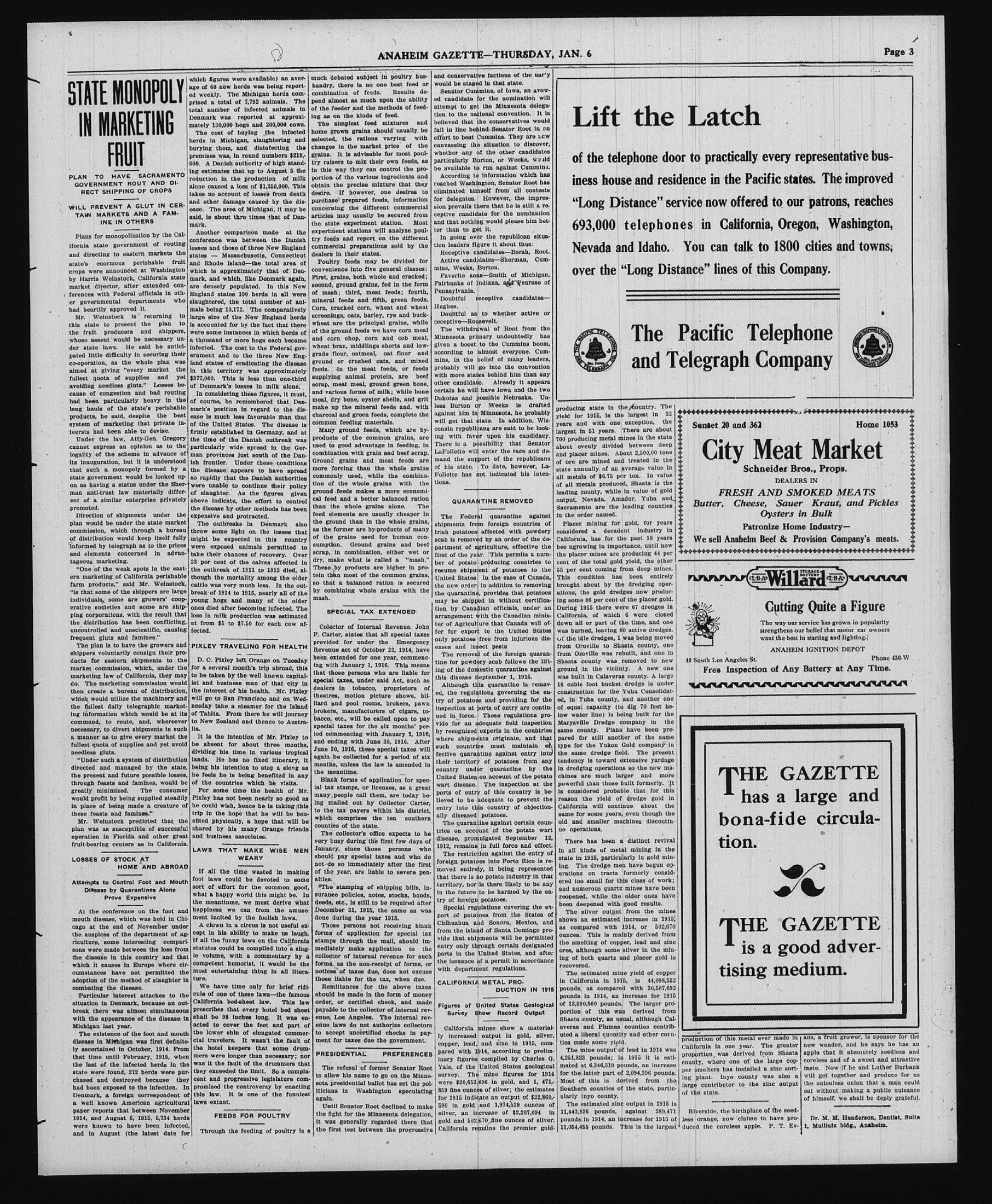
Searchable text
STATE MONOPOLY IN MARKETING FRUIT
PLAN TO HAVE SACRAMENTO GOVERNMENT ROUT AND DIRECT SHIPPING OF CROPS
WILL PREVENT A GLUT IN CERTAIN MARKETS AND A FAMINE IN OTHERS
Plans for monopolization by the California state government of routing and directing to eastern markets the state's enormous perishable fruit crops were announced at Washington by Harris Weinstock, California state market director, after extended conferences with Federal officials in other governmental departments who had heartily approved it.
Mr. Weinstock is returning to this state to present the plan to the fruit producers and shippers, whose assent would be necessary under state laws. He said he anticipated little difficulty in securing their co-operation, as the whole plan was aimed at giving "every market the fullest quota of supplies and yet avoiding needless gluts." Losses because of congestion and bad routing had been particularly heavy in the long hauls of the state's perishable products, he said, despite the best system of marketing that private interests had been able to devise.
Under the law, Atty-Gen. Gregory cannot express an opinion as to the which figures were available) an average of 60 new herds was being reported weekly. The Michigan herds comprised a total of 7,792 animals. The total number of infected animals in Denmark was reported at approximately 130,000 hogs and 200,000 cows.
The cost of buying the infected herds in Michigan, slaughtering and burying them, and disinfecting the premises was, in round numbers $218,000. A Danish authority of high standing estimates that up to August 5 the reduction in the production of milk alone caused a loss of $1,250,000. This takes no account of losses from death and other damage caused by the disease. The area of Michigan, it may be said, is about three times that of Denmark.
Another comparison made at the conference was between the Danish losses and those of three New England states — Massachusetts, Connecticut and Rhode Island—the total area of which is approximately that of Denmark, and which, like Denmark again, are densely populated. In this New England states 190 herds in all were slaughtered, the total number of animals being 10,172. The comparatively large size of the New England herds is accounted for by the fact that there were some instances in which herds of a thousand or more hogs each became infected. The cost to the Federal government and to the three New England states of eradicating the disease in this territory was approximately $377,000. This is less than one-third of Denmark's losses in milk alone.
In considering these figures, it must, of course, be remembered that Denmark's position in regard to the disease is much less favorable than that of the United States. The disease is firmly established in Germany, and at the time of the Danish outbreak was particularly wide spread in the Ger-much debated subject bandry, there is no combination of feeder pend almost as much of the feeder and ther ing as on the kind.
The simplest feed home grown grains selected, the ration changes in the main grains. It is advised try raisers to mix them in this way they can portion of the variety obtain the precise desire. If however purchase prepared concerning the different articles may usually the state experiment stations try feeds and report commercial preparers in their sta-ture.
Poultry feeds must convenience into five First, grains, both two second, ground grain of mash; third, mineral feeds and Corn, cracked corn screenings, oats, bar wheat are the primary of the ground feeds and corn chop, corn wheat bran, middling grade flour, oatmeal ground or crushed feeds. In the meantime supplying animal scrap, meat meal, grit and various forms of meal, dry bone, oyster make up the mineral charcoal and green common feeding matter.
Many ground feed products of the co-used to good advantage.
pated little difficulty in securing their co-operation, as the whole plan was aimed at giving "every market the fullest quota of supplies and yet avoiding needless gluts." Losses because of congestion and bad routing had been particularly heavy in the long hauls of the state's perishable products, he said, despite the best system of marketing that private interests had been able to devise.
Under the law, Atty-Gen. Gregory cannot express an opinion as to the legality of the scheme in advance of its inauguration, but it is understood that such a monopoly formed by a state government would be looked upon as having a status under the Sherman anti-trust law materially different of a similar enterprise privately promoted.
Direction of shipments under the plan would be under the state market commission, which through a bureau of distribution would keep itself fully informed by telegraph as to the prices and elements concerned in advantageous marketing.
"One of the weak spots in the eastern marketing of California perishable farm products," said Mr. Weinstock, "is that some of the shippers are large individuals, some are growers' cooperative societies and some are shipping corporations, with the result that the distribution has been conflicting, uncontrolled and unscientific, causing frequent gluts and famines."
The plan is to have the growers and shippers voluntarily consign their products for eastern shipments to the market commission, which, under the marketing law of California, they may do. The marketing commission would then create a bureau of distribution, which would utilize the machinery and the fullest daily telegraphic marketing information which would be at its command, to route, and, whereever necessary, to divert shipments in such a manner as to give every market the fullest quota of supplies and yet avoid needless gluts.
"Under such a system of distribution directed and managed by the state, the present and future possible losses, through feasts and famines, would be greatly minimized. The consumer would profit by being supplied steadily in place of being made a creature of these feasts and famines."
Mr. Weinstock predicted that the plan was as susceptible of successful operation in Florida and other great fruit-bearing centers as in California.
PIXLEY TRAVELING FOR HEALTH
D. C. Pixley left Orange on Tuesday for a several month's trip abroad, this to be taken by the well known capitalist and business man of that city in the interest of his health. Mr. Pixley will go to San Francisco and on Wednesday take a steamer for the Island of Tabita. From there he will journey to New Zealand and thence to Australia.
It is the intention of Mr. Pixley to be absent for about three months, dividing his time in various tropical lands. He has no fixed itinerary, it being his intention to stop a slong as he feels he is being benefited in any of the countries which he visits.
For some time the health of Mr. Pixley has not been nearly so good as he could wish, hence he is taking this trip in the hope that he will be benefited physically, a hope that will be shared by his many Orange friends and business associates.
LAWS THAT MAKE WISE MEN
Many ground feed products of the co-used to good advance combination with ground grains and more forcing than commonly used, wition of the whole ground feeds make cal feed and a better than the whole gut feed elements are the ground than in as the former are bof the grains use sumption. Ground scrap, in combination dry, make what is These by products tein than most of foe so that a balanced by combining who mash.
SPECIAL TAX
Colector of InterP. Carter, states tha provided for under Revenue act of Octobe been extended for being with January 1st that those persons special taxes, under dealers in tobacco theatres, motion liard and pool rook brokers, manufactures bacco, etc., will be special taxes for tho lod commencing ww and ending with June 30, 1916,these again be collected months, unless ther meantime.
Blank forms of al tax stamps, or many people call ing mailed out bto the tax payers which comprises s counties of the sta-
"Under such a system of distribution directed and managed by the state, the present and future possible losses, through feasts and famines, would be greatly minimized. The consumer would profit by being supplied steadily in place of being made a creature of these feasts and famines."
Mr. Weinstock predicted that the plan was as susceptible of successful operation in Florida and other great fruit-bearing centers as in California.
LOSSES OF STOCK AT HOME AND ABROAD
Attempts to Control Foot and Mouth Disease by Quarantines Alone Prove Expensive
At the conference on the foot and mouth disease, which was held in Chicago at the end of November under the auspices of the department of agriculture, some interesting comparisons were made between the loss from the disease in this country and that which it causes in Europe where circumstances have not permitted the adoption of the method of slaughter in combating the disease.
Particular interest attaches to the situation in Denmark, because an outbreak there was almost simultaneous with the appearance of the disease in Michigan last year.
The existence of the foot and mouth disease in Michigan was first definitely ascertained in October, 1914. From that time until February, 1915, when the last of the infected herds in the state were found, 272 herds were purchased and destroyed because they had been exposed to the infection. In Denmark, a foreign correspondent of a well known American agricultural paper reports that between November 1914, and August 5, 1915, 5,734 herds were known to have been infected, and in August (the latest date for lands. He has no fixed itinerary, it being his intention to stop a long as he feels he is being benefited in any of the countries which he visits.
For some time the health of Mr. Pixley has not been nearly so good as he could wish, hence he is taking this trip in the hope that he will be benefited physically, a hope that will be shared by his many Orange friends and business associates.
LAWS THAT MAKE WISE MEN WEARY
If all the time wasted in making fool laws could be devoted to some sort of effort for the common good, what a happy world this might be. In the meantime, we must derive what happiness we can from the amusement incited by the foolish laws.
A clown in a circus is not useful except in his ability to make us laugh. If all the funny laws on the California statutes could be compiled into a single volume, with a commentary by a competent humorist, it would be the most entertaining thing in all literature.
We have time only for brief ridicule of one of these laws—the famous California bed-sheet law. This law prescribes that every hotel bed sheet shall be 98 inches long. It was enacted to cover the feet and part of the lower shin of elongated commercial travelers. It wasn't the fault of the hotel keepers that some drummers were longer than necessary; nor was it the fault of the drummers that they exceeded the limit. So a complacent and progressive legislature compromised the controversy by enacting this law. It is one of the funniest laws extant.
FEEDS FOR POULTRY
Through the feeding of poultry is a
ANAHEIM GAZETTE—THURSDAY, JAN. 6
much debated subject in poultry husbandry, there is no one best feed or combination of feeds. Results depend almost as much upon the ability of the feeder and the methods of feeding as on the kinds of feed.
The simplest feed mixtures and home grown grains should usually be selected, the rations varying with changes in the market price of the grains. It is advisable for most poultry raisers to mix their own feeds, as in this way they can control the proportion of the various ingredients and obtain the precise mixture that they desire. If however, one desires to purchase prepared feeds, information concerning the different commercial articles may usually be secured from the state experiment station. Most experiment stations will analyze poultry feeds and report on the different commercial preparations sold by the dealers in their states.
Poultry feeds may be divided for convenience into five general classes: First, grains, both whole and cracked; second, ground grains, fed in the form of maash; third, meat feeds; fourth, mineral feeds and fifth, green feeds. Corn, cracked corn, wheat and wheat screenings, oats, barley, rye and buckwheat are the principal grains, while of the ground feeds we have corn meal and corn chop, corn and cob meal, wheat bran, middlings shorts and low-grade flour, oatmeal, oat flour and ground or crushed oats, and mixed feeds. In the meat feeds, or feeds supplying animal protein, are beef scrap, meat meal, ground green bone, and various forms of milk; while bone meal, dry bone, oyster shells, and grit make up the mineral feeds and, with charcoal and green feeds, complete the common feeding materials.
Many ground feeds, which are by-products of the common grains, are used to good advantage in feeding, in and conservative factions of the party would be staged in that state.
Senator Cummins, of Iowa, an avowed candidate for the nomination will attempt to get the Minnesota delegation to the national convention. It is believed that the conservatives would fall in line behind Senator Root in an effort to beat Cummins. They are low canvassing the situation to discover whether any of the other candidates particularly Burton, or Weeks, would be available to run against Cummins.
According to information which has reached Washington, Senator Root has eliminated himself from all contests for delegates. However, the impression prevails there that he is still a receptive candidate for the nomination and that nothing would please him better than to get it.
In going over the republican situation leaders figure it about thus:
Receptive candidates—Borah, Root.
Active candidates—Sherman, Cummins, Weeks, Burton.
Favorite soas—Smith of Michigan, Fairbanks of Indiana, and Penrose of Pennsylvania.
Doubtful receptive candidates—Hughes.
Doubtful as to whether active or receptive—Roosevelt.
The withdrawal of Root from the Minnesota primary undoubtedly has given a boost to the Cummins boom, according to almost everyone. Cummins, in the belief of many leaders, probably will go into the convention with more states behind him than any other candidate. Already it appears certain he will have Iowa and the two Dakotas and possible Nebraska. Unless Burton or Weeks is drafted against him in Minnesota, he probably will get that state. In addition, Wisconsin republicans are said to be looking with favor upon his candidacy. There is a possibility that Senator
SPECIAL TAX EXTENDED
Colector of Internal Revenue, John P. Carter, states that all special taxes provided for under the Emergency Revenue act of October 22, 1914, have been extended for one year, commencing with January 1, 1916. This means that those persons who are liable for special taxes, under said Act, such as dealers in tobacco, proprietors of theatres, motion picture shows, billiard and pool rooms, brokers, pawn brokers, manufacturers of cigars, tobacco, etc., will be called upon to pay special taxes for the six months' period commencing with January 1, 1916, and ending with June 30, 1916. After June 30, 1916, these special taxes will again be collected for a period of six months, unless the law is amended in the meantime.
Blank forms of application for special tax stamps, or licenses, as a great many people call them, are today being mailed out by Collector Carter, to the tax payers within his district, which comprises the ten southern counties of the state.
The collector's office expects to be very busy during the first few days of January, since those persons who grade flour, oatmeal, oat flour and ground or crushed oats, and mixed feeds. In the meat feeds, or feeds supplying animal protein, are beef scrap, meat meal, ground green bone, and various forms of milk; while bone meal, dry bone, oyster shells, and grit make up the mineral feeds and, with charcoal and green feeds, complete the common feeding materials.
Many ground feeds, which are by-products of the common grains, are used to good advantage in feeding, in combination with grain and beef scrap. Ground grains and meat feeds are more forcing than the whole grains commonly used, while the combination of the whole grains with the ground feeds makes a more economical feed and a better balanced ration than the whole grains alone. The feed elements are usually cheaper in the ground than in the whole grains, as the former are by-products of many of the grains used for human consumption. Ground grains and beef scrap, in combination, either wet or dry, make what is called a "mash." These by products are higher in protein than most of the common grains, so that a balanced ration is secured by combining whole grains with the mash.
QUARANTINE REMOVED
The Federal quarantine against shipments from foreign countries of Irish potatoes affected with powdery scab is removed by an order of the department of agriculture, effective the first of the year. This permits a number of potato producing countries to resume shipment of potatoes to the United States. In the case of Canada, the new order in addition to removing the quarantine, provides that potatoes may be shipped in without certification by Canadian officials, under an arrangement with the Canadian minister of Agriculture that Canada will offer for export to the United States only potatoes free from injurious diseases and insect pests.
The removal of the foreign quarantine for powdery scab follows the lifting of the domestic quarantine against this disease September 1, 1915.
Although this quarantine is removed, the regulations governing the entry of potatoes and providing for the inspection at ports of entry are continued in force. These regulations provide for an adequate field inspection by recognized experts in the countries where shipments originate, and that such countries must maintain effective quarantine against entry into their territory of potatoes from any country under quarantine by the United States on account of the potato wart disease. The inspection at the ports of entry of this country is believed to be adequate to prevent the entry into this country of objectionally diseased potatoes.
The quarantine against certain countries on account of the potato wart disease, promulgated September 12, 1912, remains in full force and effect.
producing state in the country. The yield for 1915, is the largest in 32 years and with one exception, the largest in 51 years. There are about 700 producing metal mines in the state about evenly divided between deep and placer mines. About 2,500.00 tons of ore are mined and treated in the state annually of an average value in all metals of $6.75 per ton. In value of all metals produced, Shasta is the leading county, while in value of gold output, Nevada, Amador, Yuba and Sacramento are the leading counties in the order named.
Placer mining for gold, for years considered a decadent industry in California, has for the past 18 years bee ngrowing in importance, until now the placer mines are producing 44 per cent of the total gold yield, the other 55 per cent coming from deep mines. This condition has been entirely brought about by the dredging operations, the gold dredges now producing some 86 per cent of the placer gold. During 1915 there were 67 dredges in California, of which 6 were closed down all or part of the time, and one was burned, leaving 60 active dredges. Of the idle dredges, 1 was being moved from Oroville to Shasta county, one from Oroville was rebuilt, and one in Shasta county was removed to new ground in the vicinity. A new one was built in Calaveras county. A large 16 cubic foot bucket dredge is under construction for the Yuba Consolidated, in Yuba county, and another one of equal capacity (to dig 70 feet below water line) is being built for the Marysville Dredge company in the same county. Plans have been prepared for still another of the same type for the Yukon Gold company in the same dredge field. The present tendency is toward extensive yardage in dredging operations so the new machines are much larger and more powerful than those built formerly. It is considered probable that for this reason the yield of dredge gold in California will continue about the same for some years, even though the old and smaller machines discontinue operations.
There has been a distinct revival in all kinds of metal mining in the
again be collected for a period of six months, unless the law is amended in the meantime.
Blank forms of application for special tax stamps, or licenses, as a great many people call them, are today being mailed out by Collector Carter, to the tax payers within his district, which comprises the ten southern counties of the state.
The collector's office expects to be very busy during the first few days of January, since those persons who should pay special taxes and who do not do so immediately after the first of the year, are liable to severe penalties.
The stamping of shipping bills, insurance policies, notes, stocks, bonds, deeds, etc., is still to be required after December 31, 1915, the same as was done during the year 1915.
Those persons not receiving blank forms of application for special tax stamps through the mail, should immediately make application to the collector of internal revenue for such forms, as the non-receipt of forms, or notices of taxes due, does not excuse those liable for the tax, when due.
Remittances for the above taxes should be made in the form of money order, or certified check, and made payable to the collector of internal revenue, Los Angeles. The internal revenue laws do not authorize collectors to accept uncertified checks in payment for taxes due the government.
PRESIDENTIAL PREFERENCES
The refusal of former Senator Root to allow his name to go on the Minnesota presidential ballot has set the politicians in Washington speculating again.
Until Senator Root declined to make the fight for the Minnesota delegation, it was generally regarded there that the first test between the progressive their territory of potatoes from any country under quarantine by the United States on account of the potato wart disease. The inspection at the ports of entry of this country is believed to be adequate to prevent the entry into this country of objectionally diseased potatoes.
The quarantine against certain countries on account of the potato wart disease, promulgated September 12, 1912, remains in full force and effect.
The restriction against the entry of foreign potatoes into Porto Rico is removed entirely, it being represented that there is no potato industry in that territory, nor is there likely to be any in the future to be harmed by the entry of foreign potatoes.
Special regulations covering the export of potatoes from the States of Chihuahua and Sonora, Mexico, and from the island of Santa Domingo provide that shipments will be permitted entry only through certain designated ports in the United States, and after the issuance of a permit in accordance with department regulations.
CALIFORNIA METAL PRODUCTION IN 1915
Figures of United States Geological Survey Show Record Output
California mines show a materially increased output in gold, silver, copper, lead, and zinc in 1915, compared with 1914, according to preliminary figures compiled by Charles G. Yale, of the United States geological survey. The mine figures for 1914 were $20,653,496 in gold, and 1,471,859 fine ounces of silver; the estimates for 1915 indicate an output of $22,860.590 in gold and 1,974,529 ounces of silver, an increase of $2,207,094 in gold and 502,670 fine ounces of silver. California remains the premier gold-tendency is toward extensive yardage in dredging operations so the new machines are much larger and more powerful than those built formerly. It is considered probable that for this reason the yield of dredge gold in California will continue about the same for some years, even though the old and smaller machines discontinue operations.
There has been a distinct revival in all kinds of metal mining in the state in 1915, particularly in gold mining. The dredge men have begun operations on tracts formerly considered too small for this class of work; and numerous quartz mines have been reopened, while the older ones have been deepened with good results.
The silver output from the mines shows an estimated increase in 1915; as compared with 1914, or 502,670 ounces. This is mainly derived from the smelting of copper, lead and zinc ores, although some silver in the mining of both quartz and placer gold is recovered.
The estimated mine yield of copper in California in 1915 is 4,251,823 pounds; in 1915 it is estimated at 6,346,319 pounds, an increase for the latter part of 2,094,396 pounds. Most of this is derived from the Southern counties of the state, particularly Inyo county.
The mine output of lead in 1914 was 4,251,823 pounds; in 1915 it is estimated at 6,346,319 pounds, an increase for the latter part of 2,094,396 pounds. Most of this is derived from the Southern counties of the state, particularly Inyo county.
The estimated zinc output in 1915 is 11,443,926 pounds; against 389,471 pounds in 1914, an increase for 1915 of 11,054,455 pounds. This is the largest
the Latch
telephone door to practically every representative busse and residence in the Pacific states. The improved
istance" service now offered to our patrons, reaches
telephones in California, Oregon, Washington,
and Idaho. You can talk to 1800 cities and towns,
"Long Distance" lines of this Company.
The Pacific Telephone
and Telegraph Company
Sunset 20 and 362 Home 1053
Sunset 20 and 362 Home 1053
City Meat Market
Schneider Bros., Props.
DEALERS IN
FRESH AND SMOKED MEATS
Butter, Cheese, Sauer Kraut, and Pickles
Oysters in Bulk
Patronize Home Industry—
We sell Anaheim Beef & Provision Company’s meats.
Willard Storage Battery
Cutting Quite a Figure
The way our service has grown in popularity
strengthens our belief that motor car owners
want the best in starting and lighting.
ANAHEIM IGNITION DEPOT
40 South Los Angeles St.
Phone 430-W
Free Inspection of Any Battery at Any Time.
THE GAZETTE
has a large and
bona-fide circulation.
THE GAZETTE has a large and bona-fide circulation.
THE GAZETTE is a good advertising medium.
production of this metal ever made in California in one year. The greater proportion was derived from Shasta county, where one of the large copper smelters has installed a zinc sorting plant. Inyo county was also a large contributor to the zinc output of the state.
Riverside, the birthplace of the seedless orange, now claims to have produced the coreless apple. P. T. Evans, a fruit grower, is sponsor for the new wonder, and he says he has an apple that it absolutely seedless and coreless and of a sweet and attractive taste. Now if he and Luther Burbank will get together and produce for us the onionless onion that a man could eat without making a public nuisance of himself, we shall be deply grateful.
Dr. M. M. Henderson, Dentist, Suite 1, Mullinix bldg., Anaheim.