anaheim-gazette 1916-01-06
Scanned page
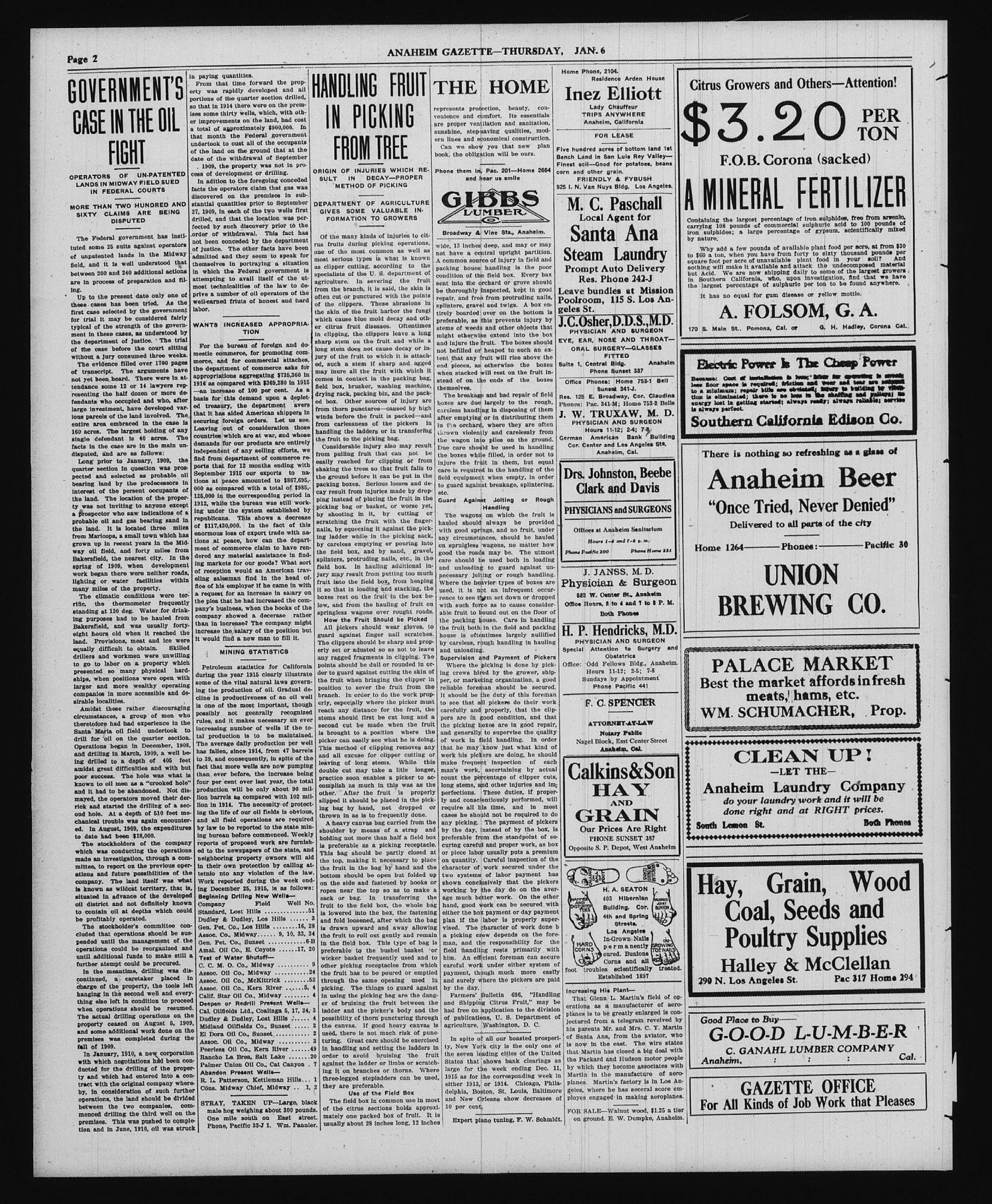
Searchable text
GOVERNMENT'S CASE IN THE OIL FIGHT
OPERATORS OF UN-PATENTED LANDS IN MIDWAY FIELD SUED IN FEDERAL COURTS
MORE THAN TWO HUNDRED AND SIXTY CLAIMS ARE BEING DISPUTED
The Federal government has instituted some 25 suits against operators of unpatented lands in the Midway field, and it is well understood that between 200 and 240 additional actions are in process of preparation and filing.
Up to the present date only one of these cases has been tried. As the first case selected by the government for trial it may be considered fairly typical of the strength of the government in these cases, as understood by the department of justice. The trial of the case before the court sitting without a jury consumed three weeks.
The evidence filled over 1700 pages of transcript. The arguments have not yet been heard. There were in attendance some 12 or 14 lawyers representing the half dozen or more defendants who occupied and who, after large investment, have developed various parcels of the land involved. The entire area embraced in the case is 160 acres. The largest holding of any single defendant is 40 acres. The facts in the case are in the main unpaying quantities.
From that time forward the property was rapidly developed and all portions of the quarter section drilled, so that in 1914 there were on the premises some thirty wells, which, with other improvements on the land, had cost a total of approximately $900,000. In that month the Federal government undertook to cust all of the occupants of the land on the ground that at the date of the withdrawal of September 1909, the property was not in process of development or drilling.
In addition to the foregoing conceded facts the operators claim that gas was discovered on the premises in substantial quantities prior to September 27, 1909, in each of the two wells first drilled, and that the location was perfected by such discovery prior to the order of withdrawal. This fact has not been conceded by the department of justice. The other facts have been admitted and they seem to speak for themselves in portraying a situation in which the Federal government is attempting to avail itself of the utmost technicalities of the law to deprive a number of oil operators of the well-earned friuts of honest and hard labor.
WANTS INCREASED APPROPRIATION
For the bureau of foreign and domestic commerce, for promoting commerce, and for commercial attaches, the department of commerce asks for appropriations aggregating $735,360 in 1916 as compared with $369,280 in 1915—an increase of 100 per cent. As a basis for this demand upon a depleted treasury, the department avers that it has alded American shippers in securing foreign orders. Let us see. Leaving out of consideration those countries which are at war, and whose demands for our products are entirely
HANDLING IN PIC FROM
ORIGIN OF INJUCTION
SULT IN DEMAND
METHOD OR
DEPARTMENT OF GIVES SOME FORMATION
Of the many kinds fruits during one of the most serious types as clipper cutting, specialists of the agriculture. In some from the branch, it often cut or puncture of the clippers. The skin of the fruit which cause blue rer citrus fruit dipping in clipping, the sharp stem on the long stem does no injury of the fruit tended, such a stem may incur all these comes in contact with field box, brush drying rack, packing box. Other so from thorn puncture winds before the from carlessness handling the ladder the fruit to the pick Considerable inj
The evidence filled over 1700 pages of transcript. The arguments have not yet been heard. There were in attendance some 12 or 14 lawyers representing the half dozen or more defendants who occupied and who, after large investment, have developed various parcels of the land involved. The entire area embraced in the case is 160 acres. The largest holding of any single defendant is 40 acres. The facts in the case are in the main undisputed, and are as follows:
Long prior to January, 1909, the quarter section in question was prospected and selected as probable oil bearing land by the predecessors in interest of the persent occupants of the land. The location of the property was not inviting to anyone except a prospector who saw indications of a probable oil and gas bearing sand in the land. It is located three miles from Maricopa, a small town which has grown up in recent years in the Midway oil field, and forty miles from Bakersfield, the nearest city. In the spring of 1909, when development work began there were neither roads, lighting or water facilities within many miles of the property.
The climatic conditions were terrific, the thermometer frequently standing at 120 deg. Water for drinking purposes had to be hauled from Bakersfield, and was usually forty-eight hours old when it reached the land. Provisions, meat and ice were equally difficult to obtain. Skilled drillers and workmen were unwilling to go to labor on a property which presented so many physical hardships, when positions were open with larger and more wealthy operating companies in more accessible and desirable localities.
Amidst these rather discouraging circumstances, a group of men who theretofore had had experience in the Santa Maria oil field undertook to drill for oil on the quarter section. Operations began in December, 1908, and drilling in March, 1909, a well being drilled to a depth of 405 feet amidst great difficulties and with but poor success. The hole was what is known to oil men as a "crooked hole" and it had to be abandoned. Not dismayed, the operators moved their derrick and started the drilling of a second hole. At a depth of 510 feet mechanical trouble was again encountered. In August, 1909, the expenditures to date had been $18,000.
The stockholders of the company which was conducting the operations mastic commerce, for promoting commerce, and for commercial attaches, the department of commerce asks for appropriations aggregating $735,360 in 1916 as compared with $369,280 in 1915—an increase of 100 per cent. As a basis for this demand upon a depleted treasury, the department avers that it has aided American shippers in securing foreign orders. Let us see. Leaving out of consideration those countries which are at war, and whose demands for our products are entirely independent of any selling efforts, we find from department of commerce reports that for 12 months ending with September 1915 our exports to nations at peace amounted to $867,695,000 as compared with a total of $985,125,000 in the corresponding period in 1912, while the bureau was still working under the system established by republicans. This shows a decrease of $117,430,000. In the fact of this enormous loss of export trade with nations at peace, how can the department of commerce claim to have rendered any material assistance in finding markets for our goods? What sort of reception would an American traveling salesman find in the head office of his employer if he came in with a request for an increase in salary on the plea that he had increased the company's business, when the books of the company showed a decrease rather than in increase? The company might increase the salary of the position but it would find a new man to fill it.
MINING STATISTICS
Petroleum statistics for California during the year 1915 clearly illustrate some of the vital natural laws governing the production of oil. Gradual decline in productiveness of an oil well is one of the most important, though possibly not geenrally recognized rules, and it makes necessary an ever increasing number of wells if the total production is to be maintained. The average daily production per well has fallen since 1914, from 47 barrels to 33, and consequently, in spite of the fact that more wells are now pumping than ever before, the increase being four per cent over last year, the total production will be only about 90 million barrels as compared with 102 million in 1914. The necessity of protecting the life of our oil fields is obvious, and all field operations are required by law to be reported to the state mining bureau before commenced. Weekly reports of proposed work are furnished to the newsapers of the state and jury of the fruit to ed, such a stem may insure all these comes in contact with field box, brusher drying rack, packing box. Other soils from thorn puncture winds before they from carlessness handling the ladder the fruit to the pick.
Considerable injury from pulling fruits easily reached for shaking the trees on ground before packing boxes. Soy cay result from ingling instead of plinking bag or bar by shooting in it scratching the fronds by squeezing ladder while by careless empty the field box, and splinters; protruding field box. In ha jury may result from fruit into the field it so that in load boxes rest on the low, and from the springless wagon.
How the Fruit
All pickers should guard against flipping. The clippers should easily set or adjust any ragged fragment points should be held to guard against the fruit when brushing position to several branch. In order erarly, especially when reach any distance stems should first second cut be made is brought to a picker can easily This method of o and all excuse f leaving of long double cut may practice soon en complish as much other. After thie slipped it should bag by hand thrown in as is t
A heavy canvass shoulder by means holding not more is preferable as
and drilling to a depth of 405 feet amidst great difficulties and with but poor success. The hole was what is known to oil men as a "crooked hole" and it had to be abandoned. Not dismayed, the operators moved their derick and started the drilling of a second hole. At a depth of 510 feet mechanical trouble was again encountered. In August, 1909, the expenditures to date had been $18,000.
The stockholders of the company which was conducting the operations made an investigation, through a committee, to report on the previous operations and future possibilities of the company. The land itself was what is known as wildcat territory, that is, situated in advance of the developed oil district and not definitely known to contain oil at depths which could be profitably operated.
The stockholder's committee concluded that operations should be suspended until the management of the operations could be reorganized and until additional funds to make still a further attempt could be procured.
In the meantime, drilling was discontinued, a caretaker placed in charge of the property, the tools left hanging in the second well and everything else left in condition to proceed when operations should be resumed. The actual drilling operations on the property ceased on August 5, 1909, and some additional work done on the premises was completed during the fall of 1909.
In January, 1910, a new corporation with which negotiations had been conducted for the drilling of the property and which had entered into a contract with the original company whereby, in consideration of such further operations, the land should be divided between the two companies, commenced drilling the third well on the premises. This was pushed to completion and in June, 1910, oil was struck to 39, and consequently, in spite of the fact that more wells are now pumping than ever before, the increase being four per cent over last year, the total production will be only about 90 million barrels as compared with 102 million in 1914. The necessity of protecting the life of our oil fields is obvious, and all field operations are required by law to be reported to the state mining bureau before commenced. Weekly reports of proposed work are furnished to the newspapers of the state, and neighboring property owners will aid in their own protection by calling attention into any violation of the law. Work reported during the week ending December 25, 1915, is as follows:
Beginning Drilling New Wells—
Company Field Well No.
Standard, Lost Hills ... 51
Dudley & Dudley, Los Hills ... 3
Gen. Pet. Co., Los Hills ... 16, 28
Assoc. Co., Midway ... 9, 10, 33, 34
Gen. Pet. Co., Sunset ... 6-B
Amal. Oil Co., E. Coyote ... 17, 20
Test of Water Shutoff—
C. C. M. O. Co., Midway ... 9
Assoc. Oil Co., Midway ... 24
Assoc. Oil Co., McKittrick ... 52
Assoc. Oil Co., Kern River ... 5, 4
Calif. Star Oil Co., Midway ... 4
Deepen or Redrill Present Wells—
Cal. Oilfields Ltd., Coalinga 5, 17, 24, 3
Dudley & Dudley, Lost Hills ... 4
Midland Oilfields Co., Sunset ... 3
El Dora Oil Co., Sunset ... 2
Assoc. Oil Co., Midway ... 3
Peerless Oil Co., Kern River ... 49
Rancho La Brea, Salt Lake ... 20
Palmer Union Oil Co., Cat Canyon .7
Abandon Present Wells—
R. L. Patterson, Kettleman Hills... 1
Cons. Midway Chief, Midway ..... 1, 2
STRAY, TAKEN UP—Large, black male hog weighing about 300 pounds. One mile south on East street. Phone, Pacific 33-J 1. Wm. Pannier.
Use of
The field box of the citrus s mately one pack usually about 29
HANDLING FRUIT IN PICKING FROM TREE
ORIGIN OF INJURIES WHICH RESULT IN DECAY—PROPER METHOD OF PICKING
DEPARTMENT OF AGRICULTURE GIVES SOME VALUABLE INFORMATION TO GROWERS
Of the many kinds of injuries to citrus fruits during picking operations, one of the most common as well as most serious types is what is known as clipper cutting, according to the specialists of the U. S. department of agriculture. In severing the fruit from the branch, it is said, the skin is often cut or punctured with the points of the clippers. These abrasions in the skin of the fruit harbor the fungi which cause blue mold decay and other citrus fruit diseases. Oftentimes in clipping, the clippers leave a long sharp stem on the fruit and while a long stem does not cause decay or injury of the fruit to which it is attached, such a stem if sharp and agged may injure all the fruit with which it comes in contact in the packing bag, field box, brusher, washing machine, drying rack, packing bin, and the packed box. Other sources of injury are from thorn punctures—caused by high winds before the fruit is packed—and from carlessness of the pickers in handling the ladders or in transferring the fruit to the picking bag.
Considerable injury also may result
THE HOME
represents protection, beauty, convenience and comfort. Its essentials are proper ventilation and sanitation, sunshine, step-saving qualities, modern lines and economical construction.
Can we show you that new plan book, the obligation will be ours.
Phone them In, Pac. 201—Home 2664 and hear us smile
GIBBS LUMBER
Broadway & Vine Sts., Anaheim.
wide, 13 inches deep, and may or may not have a central upright partition. A common source of injury in field and packing houses handling is the poor condition of the field box. Every bax sent into the orchard or grove should be thoroughly inspected, kept in good repair, and free from protruding nails, splinters, gravel and twigs. A box entirely boarded over on the bottom is preferable, as this prevents injury by stems of weeds and other objects that might otherwise extend into the box and injure the fruit. The boxes should not be filled or heaped to such an extent that any fruit will rise above the end pieces, as otherwise the boxes when stacked will rest on the fruit instead of on the ends of the boxes themselves.
The breakage and bad repair of field boxes are due largely to the rough, careless handling in disposing of them after emptying or in distributing them in the orchard, where they are often thrown violently and carelessly from the wagon into piles on the ground. Due care should be used in handling
Home Phone, 2104.
Residence Arden House
Inez Elliott
Lady Chauffeur
TRIPS ANYWHERE
Anaheim, California
FOR LEASE
Five hundred acres of bottom land 1st Bench Land in San Luis Rey Valley—Finest soil—Good for potatoes, beans corn and other grain.
FRIENDLY & FYBUSH
925 I. N. Van Nuys Bldg. Los Angeles.
M. C. Paschall Local Agent for Santa Ana Steam Laundry Prompt Auto Delivery Res. Phone 242-J
Leave bundles at Mission Poolroom, 115 S. Los Angeles St.
J.C.Osher,D.D.S.,M.D.
PHYSICIAN AND SURGEON
EYE, EAR, NOSE AND THROAT—ORAL SURGERY—GLASSES FITTED
Suite 1, Central Bldg. Anaheim
Phone Sunset 337
Office Phones: Home 753-1 Bell Sunset 341-J.
Res. 125 E. Broadway, Cor. Claudina Phones: Pac. 341-M; Home 753-2 Bells
J. W. TRUXAW, M. D.
PHYSICIAN AND SURGEON
Hours 11-12; 2-4; 7-8
German American Bank Building Cor. Center and Los Angeles St.
jury of the fruit to which it is attached, such a stem if sharp and agged may inure all the fruit with which it comes in contact in the packing bag, field box, brusher, washing machine, drying rack, packing bin, and the packed box. Other sources of injury are from thorn punctures—caused by high winds before the fruit is packed—and from carlessness of the pickers in handling the ladders or in transferring the fruit to the picking bag.
Considerable injury also may result from pulling fruit that can not be easily reached for clipping or from shaking the trees so that fruit falls to the ground before it can be put in the packing boxes. Serious losses and decay result from injuries made by dropping instead of placing the fruit in the picking bag or basket, or worse yet, by shooting in it, by cutting or scratching the fruit with the finger-nails, by squeezing it against the picking ladder while in the picking sack, by careless emptying or pouring into the field box, and by sand, gravel, splinters, protruding nails, etc., in the field box. In hauling additional injury may result from putting too much fruit into the field box, from heaping it so that in loading and stacking, the boxes rest on the fruit in the box below, and from the hauling of fruit on springless wagons over rought roads.
How the Fruit Should be Picked
All pickers should wear gloves, to guard against finger nail scratches. The clippers should be sharp and properly set or adjusted so as not to leave any ragged fragments in clipping. The points should be dull or rounded in order to guard against cutting the skin of the fruit when bringing the clipper in position to sever the fruit from the branch. In order to do the work properly, especially where the picker must reach any distance for the fruit, the stems should first be cut long and a second cut be made when the fruit is brought to a position where the picker can easily see what he is doing. This method of clipping removes any and all excuse for clipper cutting or leaving of long stems. While this double cut may take a little longer, practice soon enables a picker to accomplish as much in this was as the other. After the fruit is properly slipped it should be placed in the picking bag by hand, not dropped or thrown in as is to frequently done.
A heavy canvas bag carried from the shoulder by means of a strap and holding not more than half a field box is preferable as a picking receptacle.
The breakage and bad repair of field boxes are due largely to the rough, careless handling in disposing of them after emptying or in distributing them in the orchard, where they are often thrown violently and carelessly from the wagon into piles on the ground. Due care should be used in handling the boxes while filled, in order not to injure the fruit in them, but equal care is required in the handling of the field equipment when empty, in order to guard against breakage, splintering, etc.
Guard Against Jolting or Rough Handling
The wagons on which the fruit is hauled should always be provided with good springs, and no fruit, under any circumstances, should be hauled on sprignless wagons, no matter how good the roads may be. The utmost care should be used both in loading and unloading to guard against unnecessary jolting or rough handling. Where the heavier types of boxes are used, it is not an infrequent occurrence to see them set down or dropped with such force as to cause considerable fruit to bound out on the floor of the packing house. Care in handling the fruit both in the field and packing house is oftentimes largely nullified by careless, rough handling in hauling and unloading.
Supervision and Payment of Pickers
Where the picking is done by picking crews hired by the grower, shipper, or marketing organization, a good reliable foreman should be secured. It should be the duty of this foreman to see that all pickers do their work carefully and properly, that the clippers are in good condition, and that the picking boxes are in good repair, and generally to supervise the quality of work in field handling. In order that he may know just what kind of work his pickers are doing, he should make frequent inspection of each man's work, ascertaining by actual count the percentage of clipper cuts, long stems, and other injuries and imperfections. These duties, if properly and conscientiously performed, will require all his time, and in most cases he should not be required to do any picking. The payment of pickers by the day, instead of by the box, is preferable from the standpoint of securing careful and proper work, as box tent that any fruit will rise above the end pieces, as otherwise the boxes when stacked will rest on the fruit instead of on the ends of the boxes themselves.
The breakage and bad repair of field boxes are due largely to the rough, careless handling in disposing of them after emptying or in distributing them in the orchard, where they are often thrown violently and carelessly from the wagon into piles on the ground. Due care should be used in handling the boxes while filled, in order not to injure the fruit in them, but equal care is required in the handling of the field equipment when empty, in order to guard against breakage, splintering, etc.
Guard Against Jolting or Rough Handling
The wagons on which the fruit is hauled should always be provided with good springs, and no fruit, under any circumstances, should be hauled on sprignless wagons, no matter how good the roads may be. The utmost care should be used both in loading and unloading to guard against unnecessary jolting or rough handling. Where the heavier types of boxes are used, it is not an infrequent occurrence to see them set down or dropped with such force as to cause considerable fruit to bound out on the floor of the packing house. Care in handling the fruit both in the field and packing house is oftentimes largely nullified by careless, rough handling in hauling and unloading.
Supervision and Payment of Pickers
Where the picking is done by picking crews hired by the grower, shipper, or marketing organization, a good reliable foreman should be secured. It should be the duty of this foreman to see that all pickers do their work carefully and properly, that the clippers are in good condition, and that the picking boxes are in good repair, and generally to supervise the quality of work in field handling. In order that he may know just what kind of work his pickers are doing, he should make frequent inspection of each man's work, ascertaining by actual count the percentage of clipper cuts, long stems, and other injuries and imperfections. These duties, if properly and conscientiously performed, will require all his time, and in most cases he should not be required to do any picking. The payment of pickers by the day, instead of by the box, is preferable from the standpoint of securing careful and proper work, as box tent that any fruit will rise above the end pieces, as otherwise the boxes when stacked will rest on the fruit instead of on the ends of the boxes themselves.
The breakage and bad repair of field boxes are due largely to the rough, careless handling in disposing of them after emptying or in distributing them in the orchard, where they are often thrown violently and carelessly from the wagon into piles on the ground. Due care should be used in handling the boxes while filled, in order not to injure the fruit in them, but equal care is required in the handling of the field equipment when empty, in order to guard against breakage, splintering, etc.
Guard Against Jolting or Rough Handling
The wagons on which the fruit is hauled should always be provided with good springs, and no fruit, under any circumstances, should be hauled on sprignless wagons, no matter how good the roads may be. The utmost care should be used both in loading and unloading to guard against unnecessary jolting or rough handling. Where the heavier types of boxes are used, it is not an infrequent occurrence to see them set down or dropped with such force as to cause considerable fruit to bound out on the floor of the packing house. Care in handling the fruit both in the field and packing house is oftentimes largely nullified by careless, rough handling in hauling and unloading.
Supervision and Payment of Pickers
Where the picking is done by picking crews hired by the grower, shipper, or marketing organization, a good reliable foreman should be secured. It should be the duty of this foreman to see that all pickers do their work carefully and properly, that the clippers are in good condition, and that the picking boxes are in good repair, and generally to supervise the quality of work in field handling. In order that he may know just what kind of work his pickers are doing, he should make frequent inspection of each man's work, ascertaining by actual count the percentage of clipper cuts, long stems, and other injuries and imperfections. These duties, if properly and conscientiously performed, will require all his time, and in most cases he should not be required to do any picking. The payment of pickers by the day, instead of by the box, is preferable from the standpoint of securing careful and proper work, as box tent that any fruit will rise above the end pieces, as otherwise the boxes when stacked will rest on the fruit instead of on the ends of the boxes themselves.
The breakage and bad repair of field boxes are due largely to the rough, careless handling in disposing of them after emptying or in distributing them in the orchard, where they are often thrown violently and carelessly from the wagon into piles on the ground. Due care should be used in handling the boxes while filled, in order not to injure the fruit in them, but equal care is required in the handling ofthe field equipment when empty, in order to guard against breakage,splintering,ect.
Guard Against Jolting or Rough Handling
The wagons on which the fruit is hauled should always be provided with good springs,and no fruit,under any circumstances,should be hauled on sprignless wagons,no matter how goodthe roads maybe.The utmostcareshouldbeusedbothinloadingandunloadingtoguardagainstnecessaryjoltingorroughhandling.MeantheheaviesttypesofboxesareusedifnotaninfrequentoccurrencetoseethenthreetypesofboxesareusedifnotaninfrequentoccurrencetoseethenthreetypesofboxesareusedifnotaninfrequentoccurrencetoseethenthreetypesofboxesareusedifnotaninfrequentoccurrencetoseethenthreetypesofboxesareusedifnotaninfrequentoccurrencetoseethenthreetypesofboxesareusedifnotaninfrequentoccurrencetoseethenthreetypesofboxesareusedifnotaninfrequentoccurrencetoseethenthreetypesofboxesareusedifnotaninfrequentoccurrencetoseethenthreetypesofboxesareusedifnotaninfrequentoccurrencetoseethenthreetypesofboxesareusedifnotaninfrequentoccurrencetoseethenthreetypesofboxesareusedifnotaninfrequentoccurrencetoseethenthreetypesofboxesareusedifnotaninfrequentoccurrencetoseethenthreetypesofboxesareusedifnotaninfrequentoccurrencetoseethenthreetypesofboxesareusedifnotaninfrequentoccurrencetoseethenthreetypesofboxesareusedifnotaninfrequentoccurrencetoseethenthreetypesofboxesareusedifnotaninfrequentoccurrencetoseethenthreetypesofboxesareusedifnotaninfrequentoccurrencetoseethenthreetypesofboxesareusedifnotaninfrequentoccurrencetoseethenthreetypesofboxesareusedifnotaninfrequentoccurrencetoseethenthreetypesofboxesareusedifnotaninfrequentoccurrencetoseethenthreetypesofboxesareusedifnotaninfrequentoccurrencetoseethenthreetypesofboxesareusedifnotaninfrequentoccurrencetoseethenthreetypesofboxesareusedifnotaninfrequentoccurrencetoseethenthreetypesofboxesareusedifnotaninfrequentoccurrencetoseethenthreetypesofboxesareusedifnotaninfrequentoccurrencetoseethenthreetypesofboxesareusedifnotaninfrequentoccurrencetoseethenthreetypesofboxesareusedifnotaninfrequentoccurrencetoseethenthreetypesofboxesareusedifnotaninfrequentoccurrencetoseethenthreetypesofboxesareusedifnotaninfrequentoccurrencetoseethenthreetypesofboxesareusedifnotaninfrequentoccurrencetoseethenthreetypesofboxesareusedifnotaninfrequentoccurrencetoseethenthreetypesofboxesareusedifnotaninfrequentoccurrencetoseethenthreetypesofboxesareusedifnotaninfrequentoccurrencetoseethenthreetypesofboxesareusedifnotaninfrequentoccurrencetoseethenthreetypesofboxesareusedifnotaninfrequentoccurrencetoseethenthreetypesofboxesareusedifnotaninfrequentoccurrencetoseethenthreetypesofboxesareusedifnotaninfrequentoccurrencetoseethenthreetypesofboxesareusedifnotaninfrequentoccurrencetoseethenthreetypesofboxesareusedifnotaninfrequentoccurrencetoseethenthREETypesOfBoxesAreUsedIfNotAnInfrequentOccasionTowardsFindingTheFruitToWhichItIsAttachedSuchAsStemOrNutPinchingTheFruitIntoThePickingBagOrBasketOrWheelInThePickingBagOrBasketOrWheelInThePickingBagOrBasketOrWheelInThePickingBagOrBasketOrWheelInThePickingBagOrBasketOrWheelInThePickingBagOrBasketOrWheelInThePickingBagOrBasketOrWheelInThePickingBagOrBasketOrWheelInThePickingBagOrBasketOrWheelInThePickingBagOrBasketOrWheelInThePickingBagOrBasketOrWheelInThePickingBagOrBasketOrWheelInThePickingBagOrBasketOrWheelInThePickingBagOrBasketOrWheelInThePickingBagOrBasketOrWheelInThePickingBagOrBasketOrWheelInThePickingBagOrBasketOrWheelInThePickingBagOrBasketOrWheelInThePickingBagOrBasketOrWheelInThePickingBagOrBasketOrWheelInThePickingBagOrBasketOrWheelInThePickingBagOrBasketOrWheelInThePickingBagOrBasketOrWheelInThePickingBagOrBasketOrWheelInThePickingBagOrBasketOrWheelInThePickingBagOrBasketOrWheelInThePickingBagOrBasketOrWheelInThePickingBagORBasketORBasketORBasketORBasketORBasketORB basketORb basketORb basketORb basketORb basketORb basketORb basketORb basketORb basketORb basketORb basketORb basketORb basketORb basketORb basketORb basketORb basketORb basketORb basketORb basketORb basketORb basketORb basketORb basketORb basketORb basketORb basketORb basketORb basketORb basketORb basketORb basketORb basketORb basketORb basketORb basketORb basketORb basketORb basketORb basketORb basketORb basketORb basketORb basketORb basket OR b b b b b b b b b b b b b b b b b b b b b b b b b b b b b b b b b b b b b b b b b b b b b b b b b b b b b b b b b b b b b b b b b b b b b b b b b b b b b b b b b b b b b b b b b b b b b b b b b
These details were extracted from a document containing information about various aspects related to a specific task involving multiple components (such as different materials like wood for making a tree trunk) across several fields (like agriculture). Each component has its own unique characteristics (like hardness for pine logs vs softwood for oak logs), which affect how they interact within a system (like soil composition for pine logs vs oak logs). The document also includes references (like "Physician & Surgeon") that provide further context about these tasks.
This type of document typically includes:
- A header indicating who created it (e.g., author).
- A title describing its content (e.g., "Governmental Dept.").
- A description explaining why certain parts were selected (e.g., "Foraging").
A heavy canvas bag carried from the shoulder by means of a strap and holding not more than half a field box is preferable as a picking receptacle. This bag should be partly closed at the top, making it necessary to place the fruit in the bag by hand and the bottom should be open but folded up on the side and fastened by hooks or ropes near the top so as to make a sack or bag. In transferring the fruit to the field box, the whole bag is lowered into the box, the fastening and fold loosened, after which the bag is drawn upward and away allowing the fruit to roll out gently and remain in the field box. This type of bag is preferable to the bushel basket or wicker basket frequently used and to other picking receptacles from which the fruit has to be poured or emptied through the same opening used in picking. The things to guard against in using the picking bag are the danger of bruising the fruit between the ladder and the picker's body and the possibility of thorn puncturing through the canvas. If good heavy canvas is used, there is not much risk of puncturing. Great care should be exercised in handling and setting the ladders in order to avoid bruising the fruit against the ladder or limbs or scratching it on branches or thorns. Where three-legged stepladders can be used, they are preferable.
Use of the Field Box
The field box in common use in most of the citrus sections holds approximately one packed box of fruit. It is usually about 28 inches long, 12 inches work his pickers are doing, he should make frequent inspection of each man's work, ascertaining by actual count the percentage of clipper cuts, long stems, and other injuries and imperfections. These duties, if properly and conscientiously performed, will require all his time, and in most cases he should not be required to do any picking. The payment of pickers by the day, instead of by the box, is preferable from the standpoint of securing careful and proper work, as box or piece labor usually puts a premium on quantity. Careful inspection of the character of work secured under the two systems of labor payment has shown conclusively that the pickers working by the day do on the average much better work. On the other hand, good work can be secured with either the box payment or day payment plan if the labor is properly supervised. The character of work done by a picking crew depends on the foreman, and the responsibility for the field handling rests primarily with him. An efficient foreman can secure careful work under either system of payment, though much more easily and surely where the pickers are paid by the day.
Farmers' Bulletin 696, "Handling and Shipping Citrus Fruit," may be had free on application to the division of publications, U.S. Department of agriculture, Washington, D.C.
In spite of all our boasted prosperity, New York city is the only one of the seven leading cities of the United States that shows bank clearings as large for the week ending Dec. 11, 1915 as for the corresponding week in either 1913, or 1914. Chicago, Philadelphia, Boston, St. Louis, Baltimore and New Orleans show decreases of 10 per cent.
Expert piano tuning, F. W. Schmidt.
Increasing His Plant—
That Glenn L. Martin's field of operations as a manufacturer of aeroplanes is to be greatly enlarged is conjectured from a telegram received by his parents Mr. and Mrs. C. Y. Martin of Santa Ana, from the aviator, who is now in the east. The wire states that Martin has closed a big deal with the Packard and Hudson motor people by which they become associates with Martin in the manufacture of aeroplanes. Martin's factory is in Los Angeles, where he has several score employees engaged in making aeroplanes.
FOR SALE—Walnut wood, $1.25 a tier on ground. E. W. Dumpke, Anaheim.
Citrus Growers and Others—Attention!
$3.20 PER TON
F.O.B. Corona (sacked)
A MINERAL FERTILIZER
Containing the largest percentage of iron sulphides, free from arsenic,
carrying 108 pounds of commercial sulphuric acid to 100 pounds of
iron sulphides; a large percentage of gypsum, scientifically mixed
by nature.
Why add a few pounds of available plant food per acre, at from $30
to $60 a ton, when you have from forty to sixty thousand pounds per
square foot per acre of unavailable plant food in your soil? And
nothing will make it available and attack the undecomposed material
but Acid. We are now shipping daily to some of the largest growers
in Southern California, who, upon investigation, find that we have
the largest percentage of sulphuric per ton to be found anywhere.
It has no equal for gum disease or yellow mottle.
A. FOLSOM, G. A.
170 S. Main St., Pomona, Cal. or G. H. Hadley, Corona Cal.
Electric Power is The Cheap Power
Because: Cost of installation is lower; better for operating in smooth
less floor space is required; friction and wear and tear are reduced
to a minimum; repair bills are obviated; injury to building by vitition is eliminated; there is no loss in the shuffling and pallets; no
energy lost in getting started; always ready; always reliable; service
is always perfect.
Southern California Edison Co.
Electric Power is The Chapp Power
Because: Out of installation is here; labor for operating is already less floor space is required; friction and wear and tear are required to a minimum; repair bills are obviated; library to building by vibration is eliminated; there is no loss in the shuffling and pallet; no energy lost in getting started; always ready; always reliable; service is always perfect.
Southern California Edison Co.
There is nothing so refreshing as a glass of
Anaheim Beer
“Once Tried, Never Denied”
Delivered to all parts of the city
Home 1264——Phones:——Pacific 30
UNION
BREWING CO.
PALACE MARKET
Best the market affords fresh meats, hams, etc.
WM. SCHUMACHER, Prop.
CLEAN UP!
—LET THE—
Anaheim Laundry Company
do your laundry work and it will be done right and at RIGHT prices.
South Lemon St. Both Phones
CLEAN UP!
—LET THE—
Anaheim Laundry Company
do your laundry work and it will be
done right and at RIGHT prices.
South Lemon St. Both Phones
Hay, Grain, Wood
Coal, Seeds and
Poultry Supplies
Halley & McClellan
290 N. Los Angeles St. Pac 317 Home 294
Good Place to Buy—
G-O-O-D L-U-M-B-E-R
C. GANAHL LUMBER COMPANY
Anaheim. : : : Cal.
GAZETTE OFFICE
For All Kinds of Job Work that Pleases