anaheim-gazette 1915-11-25
Scanned page
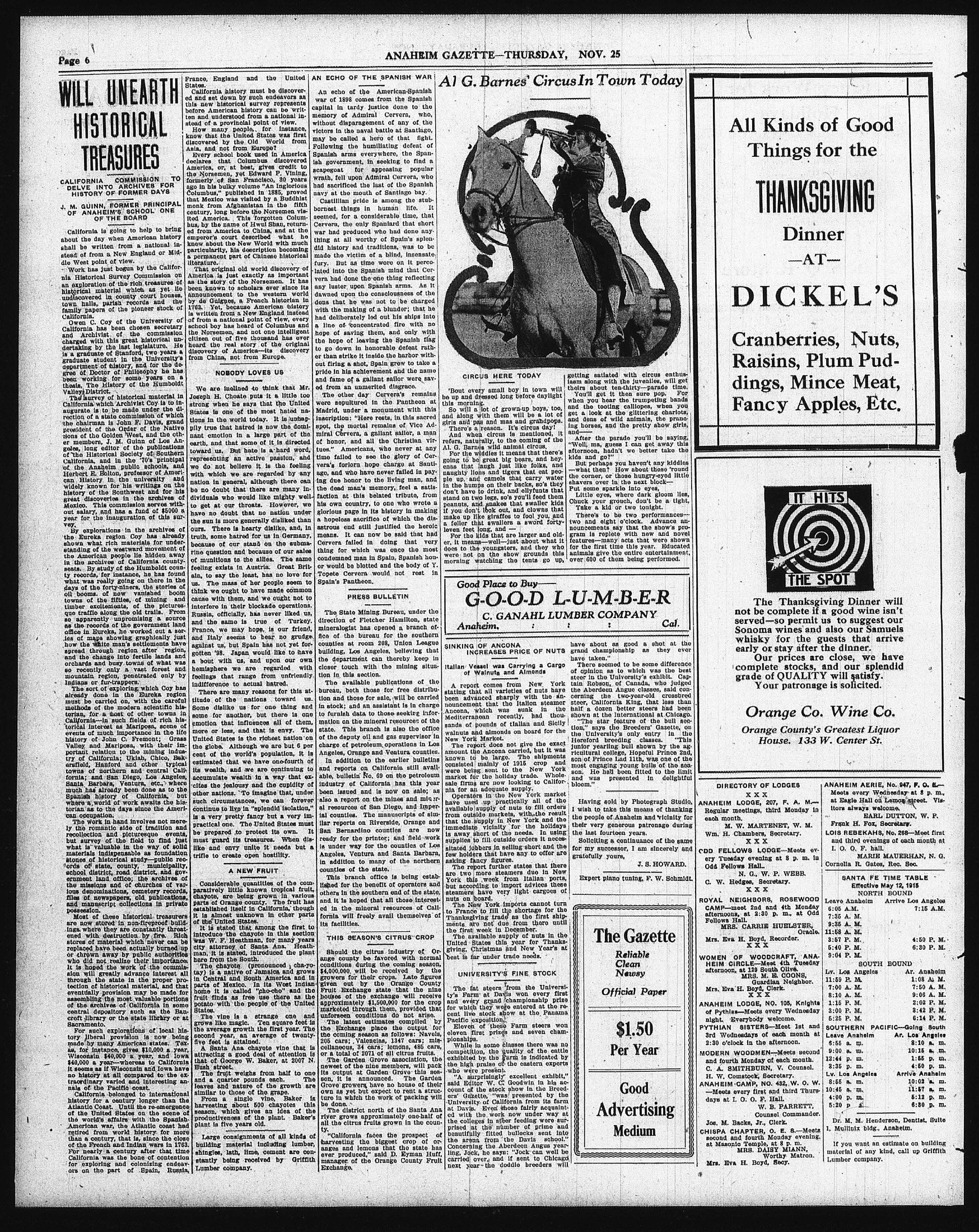
Searchable text
WILL UNEARTH HISTORICAL TREASURES
CALIFORNIA COMMISSION TO DELVE INTO ARCHIVES FOR HISTORY OF FORMER DAYS
J. M. GUINN, FORMER PRINCIPAL OF ANAHEIM’S SCHOOL ONE OF THE BOARD
California is going to help to bring about the day when American history shall be written from a national instead of from a New England or Middle West point of view.
Work has just begun by the California Historical Survey Commission on an exploration of the rich treasures of historical material which as yet lie undiscovered in county court houses, town halls, parish records and the family papers of the pioneer stock of California.
Owen C. Coy of the University of California has been chosen secretary and Archivist of the commission charged with this great historical undertaking by the last legislature. He is a graduate of Stanford, two years a graduate student in the University’s department of history, and for the degree of Doctor of Philosophy he has been working for some years on a thesis, The History of the Humboldt Valley District.
The survey of historical material in California which Archivist Coy is to inaugurate is to be made under the direction of a state commission of which the chairman is John F. Davis, grand president of the Order of the Native Sons of the Golden West, and the other members, J. M. Guinn of Los Angeles, long editor of the publications of the Historical Society of Southern France, England and the United States.
California history must be discovered and set down by such endeavors as this new historical survey represents before American history can be written and understood from a national instead of a provincial point of view.
How many people, for instance, know that the United States was first discovered by the Old World from Asia, and not from Europe?
Every school book used in America declares that Columbus discovered America, or, at best, gives credit to the Norsemen, yet Edward P. Vining, formerly of San Francisco, 30 years ago in his bulky volume "An Inglorious Columbus," published in 1885, proved that Mexico was visited by a Buddhist monk from Afghanistan in the fifth century, long before the Norsemen visited America. This forgotten Columbus, by the name of Hwul Shan, returned from America to China, and at the emperor’s court described what he knew about the New World with much particularity, his description becoming a permanent part of Chinese historical literature.
That original old world discovery of America is just exactly as important as the story of the Norsemen. It has been known to scholars ever since its announcement to the western world by de Gulgnes, a French historian in 1763. Yet, because American history is written from a New England instead of from a national point of view, every school boy has heard of Columbus and the Norsemen, and not one intelligent citizen out of five thousand has ever heard the real story of the original discovery of America—its discovery from China, not from Europe.
NOBODY LOVES US
We are inclined to think that Mr. Joseph H. Choate puts it a little too strong when he says that the United States is one of the most hated nations in the world today. It is unhappily true that hatred is now the dominant emotion in a large part of the earth, and that some of it is directed toward us. But hate is a hard word, representing an active passion, and an echo of the war of 1898 conspiracy capital in tardy memory of Admiral without disparague victors in the navy may be called after Following the bishop Spanish arms evenlish government, scapegoat for wrath, fell upon had sacrificed the navy at the mount Castillian pride bornest things seemed, for a coervera, the only war had produced thing at all work did history and made the victim fury. But as thilated into the Sierra had done that any luster upon dawned upon those dons that he wished with the making had deliberately a line of conceal hope of saving the hope of lead to go down in er than strike it out firing a shot pride in his achilles and fame of a girded from an unmine.
The other days were sepultured Madrid, under inscription: "He spot, the mortal miral Cervera, of honor, and tues." American time failed to
The survey of historical material in California which Archivist Coy is to inaugurate is to be made under the direction of a state commission of which the chairman is John F. Davis, grand president of the Order of the Native Sons of the Golden West, and the other members, J. M. Guinn of Los Angeles, long editor of the publications of the Historical Society of Southern California, and in the '70's principal of the Anaheim public schools, Herbert E. Bolton, professor of American History in the university and widely known for his writings on the history of the Southwest and for his great discoveries in the archives of Mexico. This commission serves without salary, and has a fund of $5000 a year for the inauguration of this survey.
By explorations in the archives of the Eureka region Coy has already shown what rich materials for understanding of the westward movement of the American people lie hidden away in the archives of California county seats. By study of the Humboldt county records, for instance, he has found what was really going on there in the days of the forty-niners, the stories of oil booms, of now vanished boom towns of the fifties, of mining and timber excitementes, of the picturesque traffic along the old trails. From so apparently unpromising a source as the records of the government land office in Eureka, he worked out a series of maps showing graphically just how the white man's settlements have spread through region after region, and the change into fertile lands and orchards and busy towns of what was so recently only a vast forest and mountain region, penetrated only by Indians or fur-trappers.
The sort of exploring which Coy has already done in the Eureka region must be carried on, with the careful methods of the modern scientific historian, for a host of other towns in California—in such fields of rich historical interest as Mariposa, scene of events of much importance in the life history of John C. Fremont; Grass Valley and Mariposa, with their important relation to the mining industry of California; Ukiah, Chico, Bakerfield, Hanford and other typical towns of northern and central California; and San Diego, Los Angeles, Santa Barbara, Ventura, etc., where much has already been done as to the Spanish history of California, but where a world of work awaits the historian as to the days since the American occupation.
The work in hand involves not merely the romantic side of tradition and recollection and picturesque events, but survey of the field to find just what is valuable in the way of solid materials indispensable as foundation stones of historical study—public records of state, county, municipality,
NOBODY LOVES US
We are inclined to think that Mr. Joseph H. Choate puts it a little too strong when he says that the United States is one of the most hated nations in the world today. It is unhappily true that hatred is now the dominant emotion in a large part of the earth, and that some of it is directed toward us. But hate is a hard word, representing an active passion, and we do not believe it is the feeling with which we are regarded by any nation in general, although there can be no doubt that there are many individuals who would like mighty well to get at our throats. However, we have no doubt that no nation under the sun is more generally disliked than ours. There is hearty dislike, and, in truth, some hatred for us in Germany, because of our stand on the submarine question and because of our sales of munitions to the allies. The same feeling exists in Austria. Great Britain, to say the least, has no love for us. The mass of her people seem to think we ought to have made common cause with them, and we ought not to interfere in their blockade operations. Russia, officially, has never liked us, and the same is true of Turkey. France, we may hope, is our friend, and Italy seems to bear no grudge against us, but Spain has not yet forgotten '98. Japan would like to have a bout with us, and upon our own hemisphere we are regarded with feelings that range from unfriendly indifference to actual hatred.
There are many reasons for this attitude of the nations toward us. Some dislike us for one thing and some for another, but there is one emotion that influences all of them, more or less, and that is envy. The United States is the richest nation on the globe. Although we are but 6 percent of the world's population, it is estimated that we have one-fourth of its wealth, and we are continuing to accumulate wealth in a way that excites the jealousy and the cupidity of other nations. To imagine that, under such circumstances, we can forever continue to live in "splendid isolation," is a very pretty fancy but a very impractical one. The United States must be prepared to protect its own. It must guard its treasures. When dislike and envy unite it needs but a trifle to create open hostility.
The other day were sepultured Madrid, under an inscription: "He spot, the mortal miral Cervera, a gift of honor, and tues." America time failed to overhaul its forlorn ago, and who had ing due honor to the dead man's faction at this time his own country glorious page in a hopeless sacriest astrous end still means. It can Cervera failed thing for which condemned man or would be blown Topet Cervera Spain's Panther.
PRESENTS
The State MIDirection of Florida mineralogist has flice of the bus counties at roc building Los Angeles department closer touch vation in this section.
The available bureau, both tion and those in stock; and also to furnish data maton on the state. This brok off the deputy charge of petroleum Angeles, Orange.
In addition I am reports on San Bernardino ready for the use under way Angeles, Ventura in addition to counties of th
formia; and San Diego, Los Angeles,
Santa Barbara, Ventura, etc., where much has already been done as to the Spanish history of California, but where a world of work awaits the historian as to the days since the American occupation.
The work in hand involves not merely the romantic side of tradition and recollection and picturesque events, but survey of the field to find just what is valuable in the way of solid materials indispensable as foundation stones of historical study—public records of state, county, municipality, school district, road district, and government land office; the archives of the missions and of churches of various denominations, cemetery records, files of newspapers, old publications, and manuscript collections in private possession.
Most of these historical treasurers are now stored in non-fireproof buildings, where they are constantly threatened with destruction by fire. Rich stores of material which never can be replaced have been actually burned up or thrown away by public authorities who did not realize their importance. It is hoped the work of the commission will greatly advance interest all through the state in the proper protection of historical material, and that eventually provision may be made for assembling the most valuable portions of the archives of California in some central depository such as the Bancroft library or the state library or at Sacramento.
For such explorations of local history liberal provision is now being made by many American states. Texas, for instance, gives $10,000 a year, Wisconsin $40,000 a year, Iowa $40,000 a year—whereas California it seems as if Wisconsin and Iowa have no history at all compared to the extraordinary varied and interesting annals of the Pacific coast.
California belonged to international history for a century longer than the Atlantic Coast. Until the re-emergence of the United States on the scene of the world's affairs with the Spanish-American war, the Atlantic coast had retired from world history for more than a century, that is, since the close of the French and Indian wars in 1763. For nearly a century after that time California was the bone of contention for exploring and colonizing endeavors on the part of Spain, Russia,
accumulate wealth in a way that excites the jealousy and the cupidity of other nations. To imagine that, under such circumstances, we can forever continue to live in "splendid isolation," is a very pretty fancy but a very impractical one. The United States must be prepared to protect its own. It must guard its treasures. When dislike and envy unite it needs but a trifle to create open hostility.
A NEW FRUIT
Considerable quantities of the comparatively little known tropical fruit, chayote, are being grown in various parts of Orange county. The fruit has established itself in California, though it is almost unknown in other parts of the United States.
It is stated that among the first to introduce the chayote in this section was W. F. Heathman, for many years city attorney of Santa Ana. Heathman, it is stated, introduced the plant here from the South.
The chayote (pronounced cha-yotay) is a native of Jamaica and grows in Central and South America and in parts of Mexico. In its West Indian home it is called "cho-cho" and the fruit finds as free use there as the potato with the people of the United States.
The vine is a strange one and grows like magic. Ten square feet is the average growth the first year. The second year, an average of twenty-five feet is attained.
A Santa Ana chayote vine that is attracting a good deal of attention is that of George W. Baker, at 2007 N. Bush street.
The fruit weighs from half to one and a quarter pounds each. The leaves and nature of the growth are similar to those of the grape.
From a single vine, Baker is harvesting about 500 chayotes this season, which gives an idea of the productiveness of the plant. Baker's plant is five years old.
Large consignments of all kinds of building material including lumber, shingles, lath, lime, cement are constantly being received by Griffith Lumber company.
AN ECHO OF THE SPANISH WAR
An echo of the American-Spanish war of 1898 comes from the Spanish capital in tardy justice done to the memory of Admiral Cervera, who, without disparagement of any of the victors in the naval battle at Santiago, may be called a hero of that fight. Following the humiliating defeat of Spanish arms everywhere, the Spanish government, in seeking to find a scapegoat for appeasing popular wrath, fell upon Admiral Cervera, who had sacrificed the last of the Spanish navy at the mouth of Santiago bay.
Castillian pride is among the stubbornest things in human life. It seemed, for a considerable time, that Cervera, the only Spaniard that short war had produced who had done anything at all worthy of Spain's splendid history and traditions, was to be made the victim of a blind, insensate fury. But as time wore on it percolated into the Spanish mind that Cervera had done the one thing reflecting any luster upon Spanish arms. As it dawned upon the consciousness of the dons that he was not to be charged with the making of a blunder; that he had deliberately led out his ships into a line of concentrated fire with no hope of saving them, and only with the hope of leaving the Spanish flag to go down in honorable defeat rather than strike it inside the harbor without firing a shot, Spain grew to take a pride in his achievement and the name and fame of a gallant sailor were saved from an unmerited disgrace.
The other day Cervera's remains were sepultured in the Pantheon at Madrid, under a monument with this inscription: "Here rests, in this sacred spot, the mortal remains of Vice Admiral Cervera, a gallant sailor, a man of honor, and all the Christian virtues." Americans, who never at any time failed to see the glory of Cerva,
Al G. Barnes' Circus In Town Today
'Bout every small boy in town will be up and dressed long before daylight this morning.
So will a lot of grown-up boys, too, and along with them will be a lot of girls and pas and mas and grandpops.
There’s a reason. It’s circus day!
And when circus is mentioned, it refers naturally, to the coming of the Al G. Barnes wild animal circus.
For the widdies it means that there’s going to be great big bears and how getting satiated with circus enthusiasm along with the juveniles, will get theirs about ten-thirty—parade time.
You’ll get it then sure pop. For when you hear the trumpeting bands and the tooting calliope, when you get a look at the glittering charlots, and dens of wild animals, the prancing horses, and the pretty show girls, and——
After the parade you'll be saying,
"Well, ma, guess I can get away this afternoon, hadn’t we better take the kids and go?"
out firing a shot, Spain grow to take a pride in his achievement and the name and fame of a gallant sailor were saved from an unmerited disgrace.
The other day Cervera's remains were sepultured in the Pantheon at Madrid, under a monument with this inscription: "Here rests, in this sacred spot, the mortal remains of Vice Admiral Cervera, a gallant sailor, a man of honor, and all the Christian virtues." Americans, who never at any time failed to see the glory of Cervera's forlorn hope charge at Santiago, and who have never failed in paying due honor to the living man, and the dead man's memory, feel a satisfaction at this belated tribute, from his own country, to one who wrote a glorious page in its history in making a hopeless sacrifice of which the astrosous end still justified the heroic means. It can now be said that had Cervera failed in doing that very thing for which was once the most condemned man in Spain, Spanish honor would be blotted and the body of Y. Topete Cervera would not rest in Spain's Pantheon.
PRESS BULLETIN
The State Mining Bureau, under the direction of Fletcher Hamilton, state mineralogist has opened a branch office of the bureau for the southern counties at room 208, Union League building, Los Angeles, believing that the department can thereby keep in closer touch with the mining situation in this section.
The available publications of the bureau, both those for free distribution and those for sale, will be carried in stock; and an assistant is in charge to furnish data to those seeking information on the mineral resources of the state. This branch is also the office of the deputy oil and gas supervisor in charge of petroleum operations in Los Angeles, Orange and Ventura counties.
In addition to the earlier bulletins and reports on California still available, bulletin No. 69 on the petroleum industry of California has this year been issued and is now on sale; as also a report on the mines and mineral resources of San Diego, and Imperial counties. The manuscripts of similar reports on Riverside, Orange and San Bernardino counties are now ready for the printer; and field work is under way for the counties of Los Angeles, Ventura and Santa Barbara, in addition to many of the northern counties of the state.
CIRCUS HERE TODAY
'Bout every small boy in town will be up and dressed long before daylight this morning.
So will a lot of grown-up boys; too, and along with them will be a lot of girls and pas and mas and granddrops.
There’s a reason. It’s circus day!
And when circus is mentioned, it refers naturally, to the coming of the Al. G. Barnes wild animal circus.
For the widdles it means that there’s going to be great big bears, and heyenas that laugh just like folks, and naughty lions and tigers that eat people up, and camels that carry water in the humps on their backs, so’s they don’t have to drink, and ellyfunts that stand on two legs, so’s you’ll feed them peanuts, and snakes that swaller kids if you don’t look out, and clowns that make up like giraffes to fool you, and a feller that swallers a sword forty-leven feet long, and —
For the kids that are larger and older, it means—well—just about what it does to the youngsters, and they who were not on the show grounds this morning watching the tents go up,
SINKING OF ANCONA INCREASES PRICE OF NUTS
Italian Vessel was Carrying a Cargo of Walnuts and Almonds
A report comes from New York stating that all varieties of nuts have been advanced sharply with the announcement that the Italian steamer Ancona, which was sunk in the Mediterranean recently, had thousands of pounds of Italian and Sicily walnuts and almonds on board for the New York Market.
The report does not give the exact amount the Ancona carried, but it was known to be large. The shipments consisted mainly of 1915 crop and were being sent to the New York market for the holiday trade. Wholesale firms are now looking to California for an adequate supply.
Operators in the New York market have used up practically all of the available supply of nuts to fill orders from outside markets, with the result that the supply in New York and the immediate vicinity for the holidays is away short of the needs. In using supplies to fill outside orders it necessitated jobbers in selling short and the few holders that have any to offer are asking fancy figures.
The report further states that there have about as good a shot at the grand championship as they ever have taken."
There seemed to be some difference of opinion as to which was the best steer in the University’s exhibit. Captain Robson of Canada, who judged the Aberdeen Angue classes, said concerning the two-year-old crossbred steer, California King, that less than half a dozen better steers had been shown at the International at Chicago.
"The star feature of the bull section," says the Breeders’ Gazette, on the University’s only entry in the Hereford breeding classes. "This junior yearling bull shown by the agricultural college, Hopeful Prince 2nd, son of Prince Lad 11th, was one of the most engaging young bulls of the season. He had been fitted to the limit and was presented in delightful bloom."
Having sold by Photograph Studio, I wish to take this means of thanks to the people of Anaheim and vicinity for their very generous patronage during the last fourteen years.
Solliciting a continuance of the same for my successor, I am sincerely and gratefully yours,
J. S. HOWARD.
able, bulletin No. 69 on the petroleum industry of California has this year been issued and is now on sale; as also report on the mines and mineral resources of San Diego, Imperial counties. The manuscripts of similar reports on Riverside, Orange and San Bernardino counties are now ready for the printer; and field work is under way for the counties of Los Angeles, Ventura and Santa Barbara, in addition to many of the northern counties of the state.
This branch office is being established for the benefit of operators and others in the southern end of the state, and it is hoped that all those interested in the mineral resources of California will freely avail themselves of its facilities.
THIS SEASON'S CITRUS CROP
Should the citrus industry of Orange county be favored with normal conditions during the coming season, $4,000,000 will be received by the growers for their crops. Late figures given out by the Orange County Fruit Exchange state that the nine houses of the exchange will receive approximately $1,500,000 for the crop marketed through them, provided that unforeseen conditions do not arise.
The latest estimates compiled by the Exchange place the output for the coming season as follows: Navels, 205 cars; Valencias, 1347 cars; miscellaneous, 34 cars; lemons, 485 cars, or a total of 2071 of all citrus fruits.
The Garden Grove association, the newest of the nine members, will pack its output at Garden Grove this season, it is announced. The Garden Grove growers have no house of their own as yet but expect to rent a structure in which the work of packing will be done.
The district north of the Santa Ana river grows approximately one-half of all the citrus fruits grown in the county.
"California faces the prospect of harvesting the biggest crop of oranges and lemons that the state has ever produced," said D. Eyman Huff, manager of the Orange County Fruit Exchange.
Operators in the New York market have used up practically all of the available supply of nuts to fill orders from outside markets, with the result that the supply in New York and the immediate vicinity for the holidays is away short of the needs. In using supplies to fill outside orders it necessitated jobbers in selling short and the few holders that have any to offer are asking fancy figures.
The report further states that there are two more steamers due in New York this week from Italian ports, but according to import advices these steamers have very light cargoes of nuts on board.
The New York imports cannot turn to France to fill the shortage for the Thanksgiving trade as the first shipments are not due from there until the first week in December.
The available supply of nuts in the United States this year for Thanksgiving, Christmas and New Year's at best is far under trade needs.
UNIVERSITY'S FINE STOCK
The fat steers from the University's Farm at Davis won every first and every grand championship prize for which they were entered at the recent live stock show at the Panama Pacific exposition.
Eleven of these Farm steers won eleven first prizes and seven championships.
While in some classes there was no competition, the quality of the cattle exhibited by the farm is indicated by the high praise of the eastern experts who were present.
"A surprisingly excellent exhibit," said Editor W. C. Goodwin in his account of the stock show in the Breeders' Gazette, "was presented by the University of California from its farm at Davis. Even those fairly acquainted with the work now under way at the colleges in steer feeding were surprised at the number of prime and beautifully fitted bullocks sent into the arena from the Davis school."
Concerning the Aberdeen Angus yearling, Jack, he says: "Jock can well be carried over, and if sent to Chicago next year—the doddle breeders will
All Kinds of Good Things for the
THANKSGIVING
Dinner
—AT—
DICKEL'S
Cranberries, Nuts,
Raisins, Plum Puddings, Mince Meat,
Fancy Apples, Etc.
IT HITS
THE SPOT
The Thanksgiving Dinner will not be complete if a good wine isn't served—so permit us to suggest our Sonoma wines and also our Samuels whisky for the guests that arrive early or stay after the dinner.
Our prices are close, we have complete stocks, and our splendid grade of QUALITY will satisfy.
Your patronage is solicited.
Orange Co. Wine Co.
Orange County's Greatest Liquor
House. 133 W. Center St.
DIRECTORY OF LODGES
XXX
ANAHEIM LODGE, 207, F. A. M.—Regular meetings, third Monday in each month.
M. W. MARTENET, W. M.
Wm. H. Chambers, Secretary.
XXX
CDD FELLOWS LODGE—Meets every Tuesday evening at 8 p.m. in Odd Fellows Hall...
ANAHEIM AERIE, No. 947, F. O. E—Meets every Wednesday at 8 p.m., at Eagle Hall on Lemon street. Visitors always welcome.
EARL DUTTON, W. P.
Frank H. Fox, Secretary.
LOIS REBEKAHS, No. 268—Meet first and third evenings of each month at I. O. O. F. hall.
MARIE MAUERHAN, N. G.
Cornella R. Gates, Rec. Sec.
DIRECTORY OF LODGES
XX X
ANAHEIM LODGE, 207, F. A. M.—Regular meetings, third Monday in each month.
M. W. MARTENET, W. M.
Wm. H. Chambers, Secretary.
XX X
CDD FELLOWS LODGE—Meets every Tuesday evening at 8 p.m. in Odd Fellows Hall..
N. G., W. P. WEBB.
C. W. Hedges, Secretary.
XX X
ROYAL NEIGHBORS, ROSEWOOD CAMP—meet 2nd and 4th Monday afternoons, at 2:30 p.m., at Odd Follows Hall.
MRS. CARRIE HUELSTER, Oracle.
Mrs. Eva H. Boyd, Recorder.
XX X
WOMEN OF WOODCRAFT, ANAHEIM CIRCLE—Meet 4th Tuesday afternoon, at 129 South Olive.
MRS. M. E. COONS, Guardian Neighbor.
Mrs. Eva H. Boyd, Clerk.
XX X
ANAHEIM LODGE, NO. 105, Knights of Pythias—Meets every Wednesday night. Everybody welcome.
PYTHIAN SISTERS—Meet 1st and 3rd Wednesdays of each month at 2:30 o'clock in the afternoon.
MODERN WOODMEN—Meets second and fourth Monday of each month.
C. A. SMITHBURN, V. Counsel.
H. W. Comstock, Secretary.
ANAHEIM CAMP, NO. 432, W. O. W.—Meets every first and third Thursdays at I. O. O. F. Hall.
W. B. PARRETT, Counsel Commander.
Jos. M. Backs, Jr., Clerk.
CHISPA CHAPTER, O. E. S.—Meets second and fourth Monday evening, at Masonle Temple, at 8 p.m.
MRS. DAISY MIANN, Worthy Matron.
Mrs. Eva H. Boyd, Secy.
ANAHEIM AERIE, No. 947, F. O. E. Meets every Wednesday at 8 p.m., at Eagle Hall on Lemon street. Visitors always welcome.
EARL DUTTON, W. P.
Frank H. Fox, Secretary.
LOIS REBEKAHS, No. 268—Meet first and third evenings of each month at I. O. O. F. hall.
MARIE MAUERHAN, N. G.
Cornelia R. Gates, Rec. Sec.
SANTA FE TIME TABLE
Effective May 12, 1915
NORTH BOUND
Leave Anaheim Arrive Los Angeles
6:05 A.M. 7:15 A.M.
7:35 A.M.
9:35 A.M.
11:58 A.M.
3:57 P.M. 4:50 P.M.
5:40 P.M. 6:30 P.M.
9:04 P.M.
SOUTH BOUND
Lv. Los Angeles Ar. Anaheim
11:59 P.M. 1:08 A.M.
7:00 A.M. 7:50 A.M.
8:10 A.M. 9:06 A.M.
1:15 P.M. 2:02 P.M.
3:00 P.M. 3:42 P.M.
5:25 P.M. 6:14 P.M.
SOUTHERN PACIFIC—Going South
Leave Anaheim Arrive Anaheim
6:55 a.m. 8:10 a.m.
9:00 a.m. 10:15 a.m.
12:44 p.m. 1:55 p.m.
8:35 p.m. 4:50 p.m.
Lv. Los Angeles Arrive Anaheim
8:55 a.m. 10:02 a.m.
10:45 a.m. 11:57 a.m.
4:00 p.m. 5:12 p.m.
5:20 p.m. 6:30 p.m.
Dr. M. M. Henderson, Dentist, Suite 1, Mullinix bldg., Anaheim.
If you want an estimate on building material of any kind, call up Griffith Lumber company.
Reliable Clean Newsy
Good Advertising Medium