anaheim-gazette 1915-06-24
Scanned page
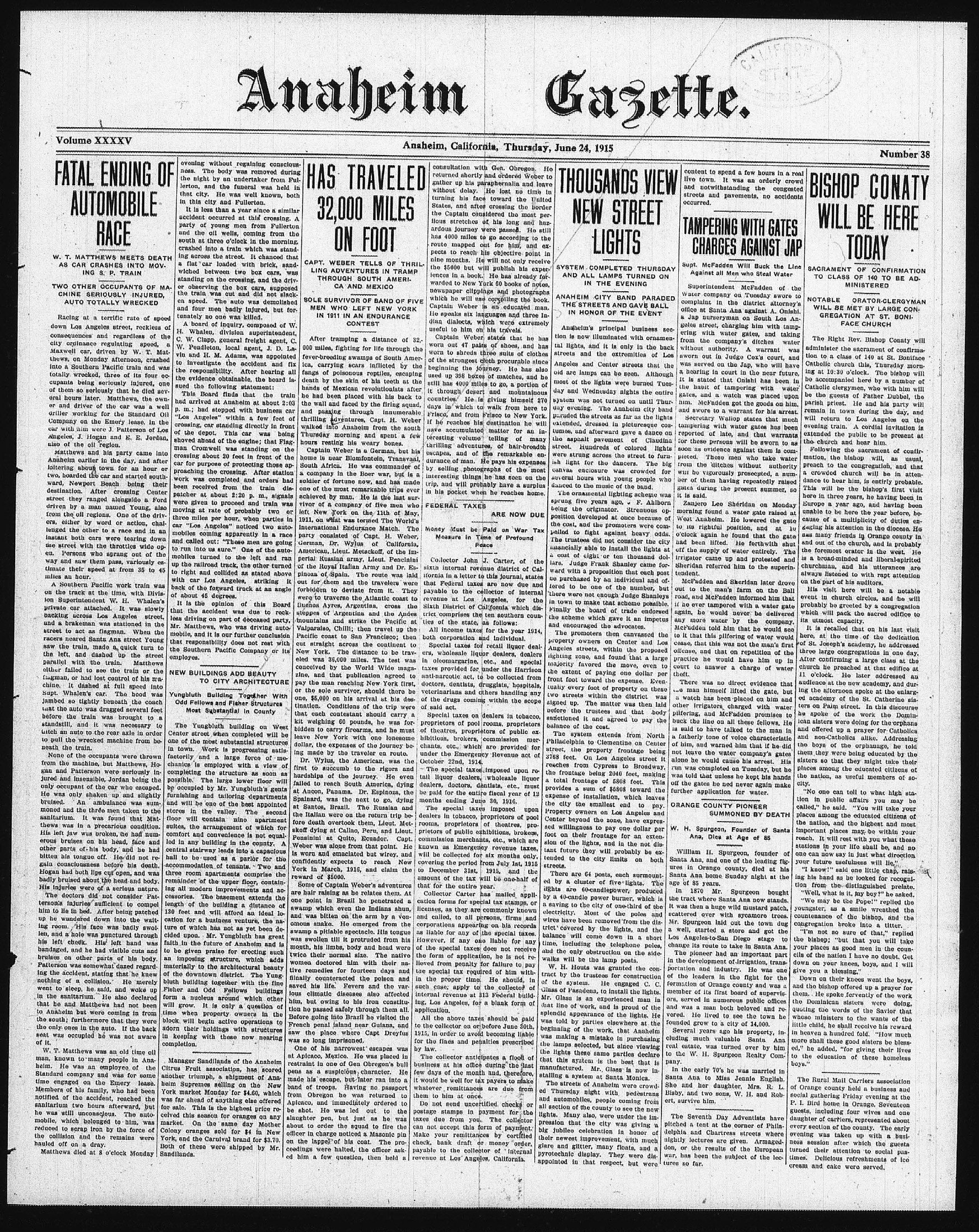
Searchable text
FATAL ENDING OF AUTOMOBILE RACE
W. T. MATTHEWS MEETS DEATH AS CAR CRASHES INTO MOVING S. P. TRAIN
TWO OTHER OCCUPANTS OF MACHINE SERIOUSLY INJURED, AUTO TOTALLY WRECKED
Racing at a terrific rate of speed down Los Angeles street, reckless of consequences and regardless of the city ordinance regulating speed, a Maxwell car, driven by W. T. Matthews, on Monday afternoon, crashed into a Southern Pacific train and was totally wrecked, three of its four occupants being seriously injured, one of them so seriously that he died several hours later. Matthews, the owner and driver of the car was a well driller working for the Standard Oil Company on the Emery lease. In the car with him were J. Patterson of Los Angeles, J. Hogan and E. E. Jordan, also of the oil region.
Matthews and his party came into evening without regaining consciousness. The body was removed during the night by an undertaker from Fullerton, and the funeral was held in that city. He was well known, both in this city and Fullerton.
It is less than a year since a similar accident occurred at this crossing. A party of young men from Fullerton and the oil wells, coming from the south at three o'clock in the morning, crashed into a train which was standing across the street. It chanced that a flat car loaded with brick, sandwiched between two box cars, was standing on the crossing, and the driver observing the box cars, supposed the train was cut and did not slacken speed. The auto was demolished and four men badly injured, but fortunately no one was killed.
A board of inquiry, composed of W. H. Whalen, division superintendent, C. W. Clapp, general freight agent, C. W. Pendleton, local agent, J. D. Lavin and H. M. Adams, was appointed to investigate the accident and fix the responsibility. After hearing all the evidence obtainable, the board issued the following statement:
This Board finds that the train had arrived at Anaheim at about 2:03 p.m.; had stopped with business car "Los Angeles" within a few feet of crossing, car standing directly in front of the depot. This car was being shoved ahead of the engine; that Flagman Cromwell was standing on the crossing about 20 feet in front of the
into a Southern Pacific train and was totally wrecked, three of its four occupants being seriously injured, one of them so seriously that he died several hours later. Matthews, the owner and driver of the car was a well driller working for the Standard Oil Company on the Emery lease. In the car with him were J. Patterson of Los Angeles, J. Hogan and E. E. Jordan, also of the oil region.
Matthews and his party came into Anaheim earlier in the day, and after loitering about town for an hour or two, boarded the car and started southward, Newport Beach being their destination. After crossing Center street they ranged alongside a Ford driven by a man named Young, also from the oil regions. One of the drivers, either by word or action, challenged the other to a race and in an instant both cars were tearing down the street with the throttles wide open. Persons who sprang out of the way and saw them pass, variously estimate their speed at from 35 to 45 miles an hour.
A Southern Pacific work train was on the track at the time, with Division Superintendent W. H. Whalen's private car attached. It was slowly backing across Los Angeles street, and a brakeman was stationed in the street to act as flagman. When the racers neared Santa Ana street Young saw the train, made a quick turn to the left, and dashed up the street parallel with the train. Matthews either failed to see the train or the flagman, or had lost control of his machine. It dashed at full speed into Supt. Whalen's car. The hood was jammed so tightly beneath the coach that the auto was dragged several feet before the train was brought to a standstill, and it was necessary to latch an auto to the rear axle in order to pull the wrecked machine from beneath the train.
None of the occupants were thrown from the machine, but Matthews, Hogan and Patterson were seriously injured and insensible, Jordan being the only occupant of the car who escaped. He was only shaken up and slightly bruised. An ambulance was summoned and the three men taken to the sanitarium. It was found that Matthews was in a precarious condition. His left jaw was broken, he had numerous bruises on his head, face and other parts of his body, and he had bitten his tongue off. He did not regain consciousness before his death.
NEW BUILDINGS ADD BEAUTY TO CITY ARCHITECTURE
Yungbluth Building Together With Odd Fellows and Fisher Structures Most Substantial in County
The Yungbluth building on West Center street when completed will be one of the most substantial structures in town. Work is progressing satisfactorily and a large force of mechanics is employed with a view of completing the structure as soon as possible. The large lower floor will be occupied by Mr. Yungbluth's gents furnishing and tailoring departments and will be one of the best appointed stores in the valley. The second floor will contain nine apartment suites, the arrangement of which for comfort and convenience is not equaled in any building in the county. A central stairway leads into a capacious hall to be used as a parlor for the accommodation of tenants. Two and to investigate the accident and fix the responsibility. After hearing all the evidence obtainable, the board issued the following statement:
This Board finds that the train had arrived at Anaheim at about 2:03 p.m.; had stopped with business car "Los Angeles" within a few feet of crossing, car standing directly in front of the depot. This car was being shoved ahead of the engine; that Flagman Cromwell was standing on the crossing about 20 feet in front of the car for purpose of protecting those approaching the crossing. After station work was completed and orders had been received from the train dispatcher at about 2:20 p.m., signals were given to proceed and train was moving at rate of probably two or three miles per hour, when parties in car "Los Angeles" noticed two automobiles coming apparently in a race and called out: "These men are going to run into us sure." One of the automobiles turned to the left and ran up the railroad track, the other turned to right and collided as stated above with car Los Angeles, striking it back of the forward truck at an angle of about 45 degrees.
It is the opinion of this Board that the accident was due to reckless driving on part of deceased party, Mr. Matthews, who was driving automobile, and it is our further conclusion that responsibility does not rest with the Southern Pacific Company or its employes.
Buenos Ayres, Argentina stops of Argentina mountains and strikes Valparaiso, Chili; the Pacific coast to San Francisco; Spain; Italy; forbidden to deviate were to traverse the Buenos Ayres, Argentina stops of Argentina mountains and strikes Valparaiso, Chili; the Pacific coast to San Francisco; Spain; Italy; forbidden to deviate were to traverse the Buenos Ayres, Argentina stops of Argentina mountains and strikes Valparaiso, Chili; the Pacific coast to San Francisco; Spain; Italy; forbidden to deviate were to traverse the Buenos Ayres, Argentina stops of Argentina mountains and strikes Valparaiso, Chili; the Pacific coast to San Francisco; Spain; Italy; forbidden to deviate were to traverse the Buenos Ayres, Argentina stops of Argentina mountains and strikes Valparaiso, Chili; the Pacific coast to San Francisco; Spain; Italy; forbidden to deviate were to traverse the Buenos Ayres, Argentina stops of Argentina mountains and strikes Valparaiso, Chili; the Pacific coast to San Francisco; Spain; Italy; forbidden to deviate were to traverse the Buenos Ayres, Argentina stops of Argentina mountains and strikes Valparaiso, Chili; the Pacific coast to San Francisco; Spain; Italy; forbidden to deviate were to traverse the Buenos Ayres, Argentina stops of Argentina mountains and strikes Valparaiso, Chili; the Pacific coast to San Francisco; Spain; Italy; forbidden to deviate were to traverse the Buenos Ayres, Argentina stops of Argentina mountains and strikes Valparaiso, Chili; the Pacific coast to San Francisco; Spain; Italy; forbidden to deviate were to traverse the Buenos Ayres, Argentina stops of Argentina mountains and strikes Valparaiso, Chili; the Pacific coast to San Francisco; Spain; Italy; forbidden to deviate were to traverse the Buenos Ayres, Argentina stops of Argentina mountains and strikes Valparaiso, Chili; the Pacific coast to San Francisco; Spain; Italy; forbidden to deviate were to traverse the Buenos Ayres, Argentina stops of Argentina mountains and strikes Valparaiso, Chili; the Pacific coast to San Francisco; Spain; Italy; forbidden to deviate were to traverse the Buenos Ayres, Argentina stops of Argentina mountains and strikes Valparaiso, Chili; the Pacific coast to San Francisco; Spain; Italy; forbidden to deviate were to traverse the Buenos Ayres, Argentina stops of Argentina mountains and strikes Valparaiso, Chili; the Pacific coast to San Francisco; Spain; Italy; forbidden to deviate were to traverse the Buenos Ayres, Argentina stops of Argentina mountains and strikes Valparaiso, Chili; the Pacific coast to San Francisco; Spain; Italy; forbidden to deviate were to traverse the Buenos Ayres, Argentina stops of Argentina mountains and strikes Valparaiso, Chili; the Pacific coast to San Francisco; Spain; Italy; forbidden to deviate were to traverse the Buenos Ayres, Argentina stops of Argentina mountains and strikes Valparaiso, Chili; the Pacific coast to San Francisco; Spain; Italy; forbidden to deviate were into a Southern Pacific train and was totally wrecked, three of its four occupants being seriously injured, one of them so seriously that he died several hours later. Matthews and his party came into Anaheim earlier in the day, after loitering about town for an hour or two, boarded the car and started southward, Newport Beach being their destination. After crossing Center street they ranged alongside a Ford driven by a man named Young, also from the oil regions. One of the drivers, either by word or action, challenged the other to a race and in an instant both cars were tearing down one street with the throttles wide open. Persons who sprang out of the way and saw them pass, variously estimate their speed at from 35 to 45 miles an hour.
A Southern Pacific work train was on the track at the time, with Division Superintendent W. H. Whalen's private car attached. It was slowly backing across Los Angeles street, and a brakeman was stationed in the street to act as flagman. When the racers neared Santa Ana street Young saw the train, made a quick turn to the left, and dashed up the street parallel with the train. Matthews either failed to see the train or the flagman, or had lost control of his machine. It dashed at full speed into Supt. Whalen's car. The hood was jambed so tightly beneath the coach that the auto was dragged several feet before the train was brought to a standstill, and it was necessary to latch an auto to the rear axle in order to pull the wrecked machine from beneath the train.
None of the occupants were thrown from the machine, but Matthews, Hogan and Patterson were seriously injured and insensible, Jordan beingthe only occupant ofthe car who escaped. He was only shaken up and slightly bruised. An ambulance was summoned andthe three men takentothe sanitarium. It was found that Matthews was in a precarious condition.His left jaw was broken,the had numerous bruises on his head,faceand other partsofhisbody,andhehadbittenhistongueoff.Hew didnotregainconsciousnessbeforehisdeath.
NEW BUILDINGS ADD BEAUTY TO CITY ARCHITECTURE
Yungbluth Building Together With Odd Fellows and Fisher Structures Most Substantial in County
The Yungbluth building on West Center street when completed will be one ofthe most substantial structuresin town.Work is progressing satisfactorilyand a large forceofmechanics is employedwitha viewofcompletingthestructureassoonaspossible.ThelargelowerfloorwillbeoccupiedbyMr.Yungbluth'sgentsfurnishingandtailoringdepartmentsandwillbeoneofthebestappointedstoresinthevalley.Thesecondfloorwillcontainnineapartmentsuites,thearrangementofwhichforcomfortandconvenienceisnotequalledinanybuildinginthecounty.Acentralstairwayleadstoacapacioushalltobeusedasaparlorfortheaccommodationoftenants.Twoandtoinvestigatetheaccidentandfixthe Responsibility.Afterhearingalltheevidenceobtainable,theboardissuedthefollowingstatement:
This Board finds thatthetrainhadarrivedatAnaheimatabout2:03p.m.;hadstoppedwithbusinesscar"LosAngeles"withinafewfeetofcrossingcarstandingdirectlyinfrontofthedepot.atabout2:20p.m.,signalsweregiventoproceedandtrainwasmovingatrateofprobablytwoorthreemilesperhour,whenpartiesincar"LosAngeles"noticedtwoworldscomingapparentlyinatraceandcalledout:"Thesemenaregoingtorunintoussure."Oneoftheautomobilesturnedtotheleftandranuptherailroadtrack,theotherturnedtorightandcollidedasstatedabovewithcarLosAngeles,strikingitbackoftheforwardtruckatanangleofabout45degrees.
It istheopinionofthisBoardthattheaccidentwasduetocrecklessdrivingonpartofdeceasedparty,Mr.Matthews,whowasdrivingautomobile,anditisourfurtherconclusionthatresponsibilitydoesnotrestwiththeSouthernPacificCompanyoritsemployees.
Dr.Wylus,theAmericafirstto succumbtohardshipsofthejournfailedtoreachSouthAtAncon,Panama.DrSpainard,wasthenextatSantos,Brazil.TheItalianwereonthereforedeathoverookthiskoff dyingAtCallao,PeninsiniatQuito,EWeberwasalonefromiswornandemaciatedconfidentlyexpectstoYorkinMarch1916.
The doctors did not consider Patterson's injuries sufficient to compel him to lie in bed. After being patched up he wandered down into the waiting room. His face was badly swollen, and a hole was punctured through his left cheek. His left hand was bandaged, and he had visible cuts and bruises on other parts of his body. Patterson was somewhat dazed regarding the accident, stating that he knew nothing of a collision. He merely went to sleep, he said, and woke up in the sanitarium. He also declared that he and Matthews had not been to Anaheim but were coming in from the south; furthermore that they were the only ones in the auto. If the back seat was occupied he was not aware of it.
W. T. Matthews was an old time oil man, known to many people in Anaheim. He was an employee of the Standard company and was for some time engaged on the Emery lease. Members of his family, who had been notified of the accident, reached the sanitarium two hours afterward, but he was still unconscious. The automobile, which belonged to him, was reduced to scrap iron by the force of the collision and the remains were hauled off on a dray.
Matthews died at 8 o'clock Monday
Manager Sandilands of the Anaheim Citrus Fruit association, has scored another triumph, a shipment of Anaheim Supremes selling on the New York market Monday for $4.60, which was far ahead of anything else offered for sale. This is the highest price received this season for oranges on any market. On the same day Mother Colony oranges sold for $4 in New York, and the Carnival brand for $3.70. Both of these were shipped by Mr. Sandilands.
The large lower floor will be occupied by Mr. Yungbluth's gents furnishing and tailoring departments and will be one of the best appointed stores in the valley. The second floor will contain nine apartment suites, the arrangement of which for comfort and convenience is not equalled in any building in the county. A central stairway leads into a capacious hall to be used as a parlor for the accommodation of tenants. Two and three room apartments comprise the remainder of the upper floor, containing all modern improvements and accessories. The basement extends the length of the building a distance of 130 feet and will afford an ideal location for a business venture, the nature of which has not as yet been decided upon. Mr. Yungbluth has great faith in the future of Anaheim and is to be given praise for erecting such an imposing structure, which adds materially to the architectural beauty of the downtown district. The Yungbluth building together with the fine Fisher and Odd Fellows buildings form a nucleus around which other will grow. It is only a question of time when property owners in the block will begin active operations to adorn their holdings with structures in keeping with these now nearing completion.
Some of Captain Webb are hair raising as he reeves one point in Brazil here swamp which even there and was bitten on the omous snake. He emerged swamp a pitilable spectacle was swollen till it protruded mouth, his limbs, body twice their normal size women doctored him with vive remedies for fourth finally counteracted tha saved his life. Feversulous climatic diseases him, but owing to his tion he passed safely there Before going into Brazil French penal island near saw the place where was so long imprisoned.
One of his narrowest at Aplicaco, Mexico. He restraint in one of Gen O pens as a suspicious clique made his escape, but later band of troops. Having from Obregon he was Aplicaco, and immediately be shot. He was led slaughter pen, but just about to order the squaw officer in charge noticed a on the lappel of his coeceedings were halted, tha ed him a few question,
Anaheim, California, Thursday, June 24, 1915
HAS TRAVELED
32,000 MILES ON FOOT
CAPT. WEBER TELLS OF THRILLING ADVENTURES IN TRAMP THROUGH SOUTH AMERICA AND MEXICO
SOLE SURVIVOR OF BAND OF FIVE MEN WHO LEFT NEW YORK IN 1911 IN AN ENDURANCE CONTEST
After trampling a distance of 32,000 miles, fighting for life through the fever-breeding swamps of South America, carrying scars inflicted by the fangs of poisonous reptiles, escaping death by the skin of his teeth at the hands of Mexican revolutionists after he had been placed with his back to the wall and faced by the firing squad, and passing through innumerable thrilling adventures, Capt. H. Weber walked into Anaheim from the south Thursday morning and spent a few hours resting his weary bones.
Captain Weber is a German, but his home is near Blomfontein. Transvaal consultation with Gen. Obregon. He returned shortly and ordered Weber to gather up his paraphernalia and leave without delay. He lost no time in turning his face toward the United States, and after crossing the border the Captain considered the most perilous stretches of his long and hazardous journey were passed. He still has 4000 miles to go according to the route mapped out for him, and expects to reach his objective point in nine months. He will not only receive the $5000 but will publish his experiences in a book. He has already forwarded to New York 60 books of notes, newspaper clippings and photographs which he will use corpiling the book. Captain Weber is an educated man. He speaks six languages and three Indian dialects, which were extremely useful to him on his travels.
Captain Weber states that he has worn out 47 pairs of shoes, and has worn to shreds three suits of clothes of the strongest cloth procurable since beginning the journey. He has also used 398 boxes of matches, and he still has 4000 miles to go, a portion of it through desert and mountainous countries. He is giving himself 270 days in which to walk from here to Frisco, and from Frisco to New York. If he reaches his destination he will have accumulated matter for an interesting volume telling of many thrilling adventures, of hair-breadth escapes, and of the remarkable encounters with Gen. Obregon. He returned shortly and ordered Weber to gather up his paraphernalia and leave without delay. He lost no time in turning his face toward the United States, and after crossing the border the Captain considered the most perilous stretches of his long and hazardous journey were passed. He still has 4000 miles to go according to the route mapped out for him, and expects to reach his objective point in nine months. He will not only receive the $5000 but will publish his experiences in a book. He has already forwarded to New York 60 books of notes, newspaper clippings and photographs which he will use corpilling the book. Captain Weber is an educated man. He speaks six languages and three Indian dialects, which were extremely useful to him on his travels.
Captain Weber states that he has worn out 47 pairs of shoes, and has worn to shreds three suits of clothes of the strongest cloth procurable since beginning the journey. He has also used 398 boxes of matches, and he still has 4000 miles to go, a portion of it through desert and mountainous countries. He is giving himself 270 days in which to walk from here to Frisco, and from Frisco to New York. If he reaches his destination he will have accumulated matter for an interesting volume telling of many thrilling adventures, of hair-breadth escapes, and of the remarkable encounters with Gen. Obregon. He returned shortly and ordered Weber to gather up his paraphernalia and leave without delay. He lost no time in turning his face toward the United States, and after crossing the border the Captain considered the most perilous stretches of his long and hazardous journey were passed. He still has 4000 miles to go according to the route mapped out for him, and expects to reach his objective point in nine months. He will not only receive the $5000 but will publish his experiences in a book. He has already forwarded to New York 60 books of notes, newspaper clippings and photographs which he will use corpilling the book. Captain Weber is an educated man. He speaks six languages and three Indian dialects, which were extremely useful to him on his travels.
Captain Weber states that he has worn out 47 pairs of shoes, and has worn to shreds three suits of clothes of the strongest cloth procurable since beginning the journey. He has also used 398 boxes of matches, and he still has 4000 miles to go, a portion of it through desert and mountainous countries. He is giving himself 270 days in which to walk from here to Frisco, and from Frisco to New York. If he reaches his destination he will have accumulated matter for an interesting volume telling of many thrilling adventures, of hair-breadth escapes, and of the remarkable encounters with Gen. Obregon. He returned shortly and ordered Weber to gather up his paraphernalia and leave without delay. He lost no time in turning his face toward the United States, and after crossing the border the Captain considered the most perilous stretches of his long and hazardous journey were passed. He still has 4000 miles to go according to the route mapped out for him, and expects to reach his objective point in nine months. He will not only receive the $5000 but will publish his experiences in a book. He has already forwarded to New York 60 books of notes, newspaper clippings and photographs which he will use corpilling the book. Captain Weber is an educated man. He speaks six languages and three Indian dialects, which were extremely useful to him on his travels.
Captain Weber states that he has worn out 47 pairs of shoes, and has worn to shreds three suits of clothes of the strongest cloth procurable since beginning the journey. He has also used 398 boxes of matches, and he still has 4000 miles to go, a portion of it through desert and mountainous countries. He is giving himself 270 days in which to walk from here to Frisco, and from Frisco to New York. If he reaches his destination he will have accumulated matter for an interesting volume telling of many thrilling adventures, of hair-breadth escapes, and of the remarkable encounters with Gen. Obregon. He returned shortly and ordered Weber to gather up his paraphernalia and leave without delay. He lost no time in turning his face toward the United States, and after crossing the border the Captain considered the most perilous stretches of his long and hazardous journey were passed. He still has 4000 miles to go according to the route mapped out for him, and expects to reach his objective point in nine months. He will not only receive the $5000 but will publish his experiences in a book. He has already forwarded to New York 60 books of notes, newspaper clippings and photographs which he will use corpilling the book. Captain Weber is an educated man. He speaks six languages and three Indian dialects, which were extremely useful to him on his travels.
Captain Weber states that he has worn out 47 pairs of shoes, and has worn to shreds three suits of clothes of the strongest cloth procurable since beginning the journey. He has also used 398 boxes of matches, and he still has 4000 miles to go, a portion of it through desert and mountainous countries. He is giving himself 270 days in which to walk from here to Frisco, and from Frisco to New York. If he reaches his destination he will have accumulated matter for an interesting volume telling of many thrilling adventures, of hair-breadth escapes, and of the remarkable encounters with Gen. Obregon. He returned shortly and ordered Weber to gather up his paraphernalia and leave without delay. He lost no time in turning his face toward the United States, and after crossing the border the Captain considered the most perilous stretches of his long and hazardous journey were passed. He still has 4000 miles to go according to the route mapped out for him, and expects to reach his objective point in nine months. He will not only receive the $5000 but will publish his experiences in a book. He has already forwarded to New York 60 books of notes, newspaper clippings and photographs which he will use corpilling the book. Captain Weber is an educated man. He speaks six languages and three Indian dialects, which were extremely useful to him on his travels.
Captain Weber states that he has worn out 47 pairs of shoes, and has worn to shreds three suits of clothes of the strongest cloth procurable since beginning the journey. He has also used 398 boxes of matches, and he still has 4000 miles to go, a portion of it through desert and mountainous countries. He is giving himself 270 days in which to walk from here to Frisco, and from Frisco to New York. If he reaches his destination he will have accumulated matter for an interesting volume telling of many thrilling adventures, of hair-breadth escapes, and of the remarkable encounters with Gen. Obregon. He returned shortly and ordered Weber to gather up his paraphernalia and leave without delay. He lost no time in turning his face toward the United States, and after crossing the border the Captain considered the most perilous stretches of his long and hazardous journey were passed. He still has 4000 miles to go according to the route mapped out for him, and expects to reach his objective point in nine months. He will not only receive the $5000 but will publish his experiences in a book. He has already forwarded to New York 60 books of notes, newspaper clippings and photographs which he will use corpilling the book. Captain Weber is an educated man. He speaks six languages and three Indian dialects, which were extremely useful to him on his travels.
Captain Weber states that he has worn out 47 pairs of shoes, and has worn to shreds three suits of clothes of the strongest cloth procurable since beginning the journey. He has also used 398 boxes of matches, and he still has 4000 miles to go, a portion of it through desert and mountainous countries. He is giving himself 270 days in which to walk from here to Frisco, and from Frisco to New York. If he reaches his destination he will have accumulated matter for an interesting volume telling of many thrilling adventures, of hair-breadth escapes, and of the remarkable encounters with Gen. Obregon. He returned shortly and ordered Weber to gather up his paraphernalia and leave without delay. He lost no time in turning his face toward the United States, and after crossing the border the Captain considered the most perilous stretches of his long和 hazardous journey were passed. He still has 4000 miles to go according to the route mapped out for him, and expects to reach his objective point in nine months. He will not only receive the $5000 but will publish his experiences in a book. He has already forwarded to New York 60 books of notes, newspaper clippings and photographs which he will use corpilling the book. Captain Weber is an educated man. He speaks six languages and three Indian dialects, which were extremely useful to him on his travels.
Captain Weber states that he has worn out 47 pairs of shoes, and has worn to shreds three suits of clothes of the strongest cloth procurable since beginning the journey. He has also used 398 boxes of matches, and he still has 4000 miles to go,a portion of it through desert和 mountainous countries.He is giving himself 270 days in which to walk from here to Frisco,and from Frisco to New York.Inflectional events are now illuminated with ornamental lights,and it is only in the back streetsandthe extremitiesof Los Angelesand Center streetsthatthe old arc lamps can be seen.AlthoughmostofthelightswereburnedTuesdayandWednesdaynightstheentiresystemwasnotturnedonuntilThursdayevening.TheAnaheimcitybandparadedthestreetsasfarasthelightsextended,dressedinpicturesquecostumes,andafterwardgaveadanceontheaspalt PavementofClaudina street.Hundredsofcoloredlightswerestrungacrossthestreettofuurnature.Anaheim'sprincipalbusinesssectionisnowilluminatedwithornamentallights,anditisonlyinthebackstreetsandthe extremitiesofLosAngelesandCenterstreetsthattheoldarclampscanbeseen.AlthoughmostofthelightswereburnedTuesdayandWednesdaynightstheentiresystemwasnotturnedonuntilThursdayevening.TheAnaheimcitybandparadedthestreetsasfarasthelightsextended,dressedinpicturesquecostumes,andafterwardgaveadanceontheaspalt PavementofClaudina street.Hundredsofcoloredlightswerestrungacrossthestreettofuurnature.Anaheim'sprincipalbusinesssectionisnowilluminatedwithornamentallights,anditisonlyinthebackstreetsandthe extremitiesofLosAngelesandCenterstreetsthattheoldarclampscanbeseen.AlthoughmostofthelightswereburnedTuesdayandWednesdaynightstheentiresystemwasnotturnedonuntilThursdayevening.TheAnaheimcitybandparadedthestreetsasfarasthelightsextended,dressedinpicturesquecostumes,andafterwardgaveadanceontheaspalt PavementofClaudina street.Hundredsofcoloredlightswerestrungacrossthestreettofuurnature.Anaheim'sprincipalbusinesssectionisnowilluminatedwithornamentallights,anditisonlyinthebackstreetsandthe extremitiesofLosAngelesandCenterstreetsthattheoldarclampscanbeseen.AlthoughmostofthelightswereburnedTuesdayandWednesdaynightstheentiresystemwasnotturnedonuntilThursdayevening.TheAnaheimcitybandparadedthestreetsasfarasthelightsextended,dressedinpicturesquecostumes,andafterwardgaveadanceontheaspalt PavementofClaudina street.Hundredsofcoloredlightswerestrungacrossthestreettofuurnature.Anaheim'sprincipalbusinesssectionisnowilluminatedwithornamentallights,anditisonlyinthebackstreetsandthe extremitiesofLosAngelesandCenterstreetsthattheoldarclampscanbeseen.AlthoughmostofthelightswereburnedTuesdayandWednesdaynightstheentiresystemwasnotturnedonuntilThursdayevening.TheAnaheimcity bandparadedthestreetsasfarasthelightsextended,dressedinpicturesquecostumes,andafterwardgaveadanceontheaspalt PavementofClaudina street.Hundredsofcoloredlightswerestrungacrossthestreettofuurnature.Anaheim'sprincipalbusinesssectionisnowilluminatedwithornamental lights,anditisonlyinthe backstreetsandthe extremitiesofLosAngelesandCenterstreetsthattheoldarclampscanbeseen.AlthoughmostofthelightswereburnedTuesdayandWednesdaynightstheentiresystemwasnotturnedonuntilThursdayevening.TheAnaheimcity bandparadedthestreetsas farasthe lightsextended,dressedinpicturesquecostumes,andafterwardgaveadanceontheaspalt PavementofClaudina street.Hundredsofcolored lightswerestrungacrossthestreettofuurnature.Anaheim'sprincipalbusinesssectionisnowilluminatedwithornamental lights,anditisonlyinthe backstreetsandthe extremitiesofLosAnglesandCenterstreetsthattheoldarclampscanbeseen.AlthoughmostofthelightswereburnedTuesdayandWednesdaynightstheentire system was not turned on until Thursday evening.The Anaheim city band paraded the streets as far as the lights extended,dressed in picturesque costumes,and afterward gave a dance on the asphalt pavement of Claudina street.Hundredsof colored lights were strung across the street to furnish them.Saw comforter with white sweater was held by gate him;and Seen tamp report for this event pennant
ICA, carrying scars inflicted by the fangs of poisonous reptiles, escaping death by the skin of his teeth at the hands of Mexican revolutionists after he had been placed with his back to the wall and faced by the firing squad, and passing through innumerable thrilling adventures, Capt. H. Weber walked into Anaheim from the south Thursday morning and spent a few hours resting his weary bones.
Captain Weber is a German, but his home is near Blomfontein, Transvaal, South Africa. He was commander of a company in the Boer war, but is a soldier of fortune now, and has made one of the most remarkable trips ever achieved by man. He is the last survivor of a company of five men who left New York on the 11th of May, 1911, on what was termed The World's International Endurance Match. The party consisted of Capt. H. Weber, German, Dr. Wylus of California, American, Lieut. Metsckoff, of the Imperial Russian army, Lieut. Pencinii of the Royal Italian Army and Dr. Espinoza of Spain. The route was laid out for them and the travelers were forbidden to deviate from it. They were to traverse the Atlantic coast to Buenos Ayres, Argentina, cross the steppes of Argentina and the Andes mountains and strike the Pacific at Valparaiso, Chilll; then travel up the Pacific coast to San Francisco; then cut straight across the continent to New York. The distance to be traveled was 36,000 miles. The test was conceived by the World Wide magazine, and that publication agreed to pay the man reaching New York first, or the sole survivor, should there be one, $5,000 on his arrival at his destination. Conditions of the trip were that each contestant should carry a kit weighing 60 pounds, he was forbidden to carry firearms, and he must leave New York with one lonesome dollar, the expenses of the journey being made by the traveler en route.
Dr. Wylus, the American, was the first to succumb to the rigors and hardships of the journey. He even failed to reach South America, dying at Ancon, Panama. Dr. Espinoza, the Spainard, was the next to go, dying at Santos, Brazil. The Russian and the Italian were on the return trip before death overtook them, Lieut. Metskoff dying at Callao, Peru, and Lieut. Pensinil at Quito, Ecuador. Capt. Weber was alone from that point. He is worn and emaciated but wiresy, and confidently expects to reach New York in March, 1916, and claim the strongest dust precruble since beginning the journey. He has also used up 398 boxes of matches, and he still has 4000 miles to go, a portion of it through desert and mountainous countries. He is giving himself 270 days in which to walk from here to Frisco, and from Frisco to New York. If he reaches his destination he will have accumulated matter for an interesting volume telling of many thrilling adventures, of hair-breadth escapes, and of the remarkable endurance of man. He pays his expenses by selling photographs of the most interesting things he has seen on the trip, and will probably have a surplus in his pocket when he reaches home.
FEDERAL TAXES
ARE NOW DUE
Money Must be Paid on War Tax
Measure in Time of Profound Peace
Collector John J. Carter, of the sixth internal revenue district of California in a letter to this journal, states that Federal taxes are now due and payable to the collector of internal revenue at Los Angeles, for the Sixth District of California which district comprises the ten southern counties of the state, as follows:
All income taxes for the year 1914, both corporation and individual.
Special taxes for retail liquor dealers, wholesale liquor dealers, oleomargarine, etc., and special taxes provided for under the Harrison anti-narcotic act, to be collected from doctors, dentists, druggists, hospitals, veterinarians and others handling any of the drugs coming within the scope of said act.
Special taxes on dealers in tobacco, proprietors of pool rooms, proprietors of theatres, proprietors of public exhibitions, brokers, commission merchants, etc., which are provided for under the Emergency Revenue act of October 22nd, 1914.
The special taxes imposed upon retail liquor dealers, wholesale liquor dealers, doctors, dentists, etc., must be paid for the entire fiscal year of 12 months ending June 30, 1916.
The special taxes imposed upon dealers in tobacco, proprietors of pool rooms, proprietors of theatres, proprietors of public exhibitions, brokers, commission merchants, etc., which are known as Emergency revenue taxes, will be collected for six months only, covering the period from July 1st, 1915 to December 31st, 1915.
Angeles and Center streets that the old arc lamps can be seen. Although most of the lights were burned Tuesday and Wednesday nights the entire system was not turned on until Thursday evening. The Anaheim city band paraded the streets as far as the lights extended, dressed in picturesque costumes, and afterward gave a dance on the aspault pavement of Claudina street. Hundreds of colored lights were strung across the street to furnish light for the dancers. The big canvas enclosure was crowded for several hours with young people who danced to the music of the band.
The ornamental lighting scheme was sprung five years ago. J.F. Ahlborn being the originator. Strenuous opposition developed at once because of the cost, and the promoters were compelled to fight against heavy odds. The trustees did not consider the city financially able to install the lights at a cost of eight or ten thousand dollars. Judge Frank Shanley came forward with a proposition that each post purchase by an individual and offered to be one of the number, but there were not enough Judge Shanleys in town to make that scheme possible. Finally the board of trade endorsed the scheme which gave it an impetus and encouraged the advocates.
The promoters then canvassed the property owners on Center and Los Angeles streets, within the proposedighting zone,and found that a largemajority favored the move,even tothe extentof paying one dollar perfront foot towardthe expense.Eventually every foot of property on these two streets withinthe districtwas signed up.The matter was then laidbeforethetrusteesandthatbody sanctioneditandagreedtopaythebalanceofthecost.
The system extends from North Philadelphia to Clementine on Center street,the property frontage being3768 feet.On Los Angeles street it reachesfrom Cypress to Broadway,thefrontagebeing2040feet,makinga totalfrontageof5808feetThisprovidesa sumof$5808towardtheexpenseofinstallationwhichleavesthecitythesmallestendtopay.PropteryownersonLosAnglesandCenterbeyondthezone,haveexpressedwillingnesstopayonedollarperfootonthefrontageforanextensionofthelights,andinthenot distantuturetheywillprobablybeextendedtothecitylimitsonbothstreets.
hardships of the journey. He even failed to reach South America, dying at Ancon, Panama. Dr. Espinoza, the Spainard, was the next to go, dying at Santos, Brazil. The Russian and the Italian were on the return trip before death overtook them, Lieut. Metskoff dying at Callao, Peru, and Lieut. Pensinini at Quito, Ecuador. Capt. Weber was alone from that point. He is worn and emaciated but wirey, and confidently expects to reach New York in March, 1916, and claim the reward of $5000.
Some of Captain Weber's adventures are hair raising as he relates them. At one point in Brazil he penetrated a swamp which even the Indians shun, and was bitten on the arm by a venomous snake. He emerged from the swamp a pitiable spectacle. His tongue was swollen till it protruded from his mouth, his limbs, body and head were twice their normal size. The native women doctored him with their native remedies for fourteen days and finally counteracted the poison and saved his life. Fevers and the various climatic diseases also affected him, but owing to his iron constitution he passed safely through them all. Before going into Brazil he visited the French penal island near Guiana, and saw the place where Capt Dreyfus was so long imprisoned.
One of his narrowest escapes was at Aplicaco, Mexico. He was placed in restraint in one of Gen Obregon's bull pens as a suspicious character. He made his escape, but later ran into a band of troops. Having no passport from Obregon he was returned to Aplicaco, and immediately ordered to be shot. He was led out to the slaughter pen, but just as he was about to order the squad to fire the officer in charge noticed a Masonic pin on the lappel of his coat. The proceedings were halted, the officer asked him a few question, then held a tail liquor dealers, wholesale liquor dealers, doctors, dentists, etc., must be paid for the entire fiscal year of 12 months ending June 30, 1916.
The special taxes imposed upon dealers in tobacco, proprietors of pool rooms, proprietors of thetheatres, proprietors of public exhibitions, brokers, commission merchants, etc., which are known as Emergency revenue taxes, will be collected for six months only, covering the period from July 1st, 1915 to December 31st, 1915, and the amount of the tax will be one-half of that for the entire year.
Collector Carter has mailed application forms for special tax stamps, or licenses, as they are commonly known and called, to all persons, firms and corporations appearing on his records as liable for any of the special taxes. However, if any one liable for any of the special taxes does not receive the form of application, he is not relieved from penalty for failure to pay the special tax required of him within the proper time. He should, in such case, apply to the collector of internal revenue at 313 Federal building, Los Angeles, for a blank form of application.
All the above taxes should be paid to the collector on or before June 30th, 1915, in order to avoid becoming liable for the fines and penalties prescribed by law.
The collector anticipates a flood of business at his office during the last few days of the month and, therefore, it would be well for tax payers to make whatever remittances are due from them to him at once.
Do not send uncertified checks or postage stamps in payment for the taxes due from you. The collector cannot accept this form of payment. Make your remittances by certified check, bank draft or money order, payable to the collector of internal revenue at Los Angeles, California.
There are 64 posts each surmounted by a cluster of five lights. The lights are 60-candlepower, produced by a 40-candle power burner, which is a saving to the city of one-third of the electricity. Most of the poles and wires have been removed from the district covered by the lights, and the balance will come down in a short time, including the telephone poles, and the only obstruction on the sidewalks will be the lamp posts.
W. H. Houts was granted the contract by the trustees for construction of the system. He engaged C. C. Glass of Pasadena, to install the lights. Mr. Glass is an experienced man in boat line of work, and is proud of the splendid appearance of the lights. He was told by parties elsewhere at the beginning of the work, that Anaheim was making a mistake in purchasing the lamps selected, but since viewing the lights these same parties declare that this system is the best that is manufactured. Mr. Glass is now installing a system at Santa Monica.
The streets of Anaheim were crowded Thursday night with pedestrians and automobiles, people coming from all section of the county to see the new lights. Many also, were under the impression that the city was giving a big jubilee celebration in honor of their newest improvement, with much glare and glitter, many floats, and a pyrotechnic display. They were disappointed in that respect, but were
BISHOP CONATY WILL BE HERE TODAY
SACRAMENT OF CONFIRMATION TO CLASS OF 140 TO BE ADMINISTERED
NOTABLE ORATOR-CLERGYMAN WILL BE MET BY LARGE CONGREGATION AT ST. BONI-FACE CHURCH
The Right Rev. Bishop Conaty will administer the sacrament of confirmation to a class of 140 at St. Boniface Catholic church this Thursday morning at 10:30 o'clock. The bishop will be accompanied here by a number of Catholic clergymen, who with him will be the guests of Father Dubbel, the parish priest. He and his party will remain in town during the day, and will return to Los Angeles on the evening train. A cordial invitation is extended the public to be present at the church and hear him.
Following the sacrament of confirmation, the bishop will as usual...
or streets that the be seen. Although were burned Tuesday nights the entire town on until Thursday Anaheim city band was far as the lights in picturesque cosed gave a dance on event of Claudina of colored lights the street to furnishers. The big was crowded for young people who of the band.
Lighting scheme was ago, F. Ahlborn Jr. Strenuous opit once because of promoters were com- insist heavy odds. He consider the city install the lights at ten thousand dol-Shanley came forlon that each post individual and off-the number, but Judge Shanleys scheme possible. Of trade endorsed have it an impetus advocates.
Can canvassed the Center and Loshin the proposed bound that a large move, even to bring one dollar per expense. Even-property on these the district was later was then laid and that body agreed to pay the funds from North Ventine on Center frontage being Angeles street it was to Broadway, 040 feet, making 5808 feet. This 5808 toward the man, which leaves end to pay. Los Angeles and none, have expressly one dollar per fee for an extent in the not dis-probably be ex-mits on both was served on the Jap, who will have a hearing in court in the near future. It is stated that Onishi has been in the habit of tampering with water gates, and a watch was placed upon him. McFadden got the goods on him, and swore to a warrant for his arrest.
Secretary Walli states that much tampering with water gates has been reported of late, and that warrants for these persons will be sworn to as soon as evidence against them is completed. These men who take water from the ditches without authority will be vigorously prosecuted, a number of them having repeatedly raised gates during the present summer, so it is said.
Zanjero Leo Sheridan on Monday morning found a water gate raised at West Anaheim. He lowered the gate to its rightful position, and at 10 o'clock again he found that the gate had been lifted. He forthwith shut off the supply of water entirely. The irrigator came up and protested and Sheridan referred him to the superintendent.
McFadden and Sheridan later drove out to the man's farm on the Ball road, and McFadden informed him that if he ever tampered with a water gate again, he would never be delivered any more water by the company. McFadden told him that he would see to it that this plifering of water would cease, that this was not the man's first offense, and that on repetition of the practice he would have him up in court to answer a charge of water theft.
There was no direct evidence that man himself lifted the gate, but a watch has been placed on him and other irrigators charged with water pilfering, and McFadden promises to buck the line on all these fellows. He is said to have talked to the man in a fatherly tone of voice characteristic of him, and warned him that if he did not leave the water company's gates alone he would cause his arrest. His run was completed on Tuesday, but he was told that unless he kept his hands off the gates he ned never again make further application for water.
ORANGE COUNTY PIONEER
SUMMONED BY DEATH
W. H. Spurgeon, Founder of Santa Ana, Dies at Age of 85
William H. Spurgeon, founder of Santa Ana, and one of the leading figures in Orange county, died at his Catholic church this, Thursday morning at 10:30 o'clock. The bishop will be accompanied here by a number of Catholic clergymen, who with him will be the guests of Father Dubbel, the parish priest. He and his party will remain in town during the day, and will return to Los Angeles on the evening train. A cordial invitation is extended the public to be present at the church and hear him.
Following the sacrament of confirmation, the bishop will, as usual, preach to the congregation, and that a crowded church will be in attendance to hear him, is entirely probable. This will be the bishop's first visit here in three years, he having been in Europe a year ago, and having been unable to be here the year before, because of a multiplicity of duties engaging his attention in the diocese. He has many friends in Orange county in and out of the church, and is probably the foremost orator in the west. He is a broad-minded and liberal-spirited churchman, and his utterances are always listened to with rapt attention on the part of his auditors.
His visit here will be a notable event in church circles, and he will probably be greeted by a congregation which will pack the sacred edifice to its utmost capacity.
It is recalled that on his last visit here, at the time of the dedication of St. Joseph's academy, he addressed three large congregations in one day. After confirming a large class at the church he preached at that edifice at 11 o'clock. He later addressed an audience at the new academy, and during the afternoon spoke at the enlarged academy of the St. Catherine sisters on Palm street. In this discourse he spoke of the work the Dominican sisters were doing for the orphans and offered up a prayer for Catholics and non-Catholics alike. Addressing the boys of the orphanage, he told them they were being educated by the sisters so that they might take their places among the educated citizens of the nation, as useful members of society.
"No one can tell to what high station in public affairs you may be called," he said. "You will take your places among the educated citizens of the nation, and the highest and most important places may be within your reach. It will rest with you what these stations in your life shall be, and no one can now say in just what direction your future usefulness will lie."
"I know!" said one little charl
ORANGE COUNTY PIONEER
SUMMONED BY DEATH
W. H. Spurgeon, Founder of Santa Ana, Dies at Age of 85
William H. Spurgeon, founder of Santa Ana, and one of the leading figures in Orange county, died at his Santa Ana home Sunday night at the age of 85 years.
In 1870 Mr. Spurgeon bought the tract where Santa Ana now stands. It was then a huge wild mustard patch, scattered over with sycamore trees. Mr. Spurgeon laid out the town dug a well, started a store and got the Los Angeles-to-San Diego stage to change its route to take in Santa Ana.
The pioneer had an important part in the development of irrigation, transportation and industry. He was one of the leaders in the fight for the formation of Orange county and was a member of its first board of supervisors, served in numerous public offices and was a man both beloved and revered. He lived to see the town he founded grow to a city of 14,000.
Several years ago his property, including much valuable Santa Ana real estate, was turned over by him to the W. H. Spurgeon Realty Company.
In the early 70's he was married in Santa Ana to Miss Jennie English. She and her daughter, Mrs. R. L. Bisby, and two sons, W. H. and Robert, survive him.
The Seventh Day Adventists have pitched a tent at the corner of Philadelphia and Chartress streets where nightly lectures are given. Armageddon, or the results of the European war, has been the subject of the lectures so far.
The Rural Mail Carriers association of Orange county held a business and social gathering Friday evening at the P. I. Bird home in Orange. Seventeen guests, including four wives and one daughter of carriers, represented about every section of the county. The early evening was taken up with a business session after which the guests turned their attention to social pastimes. Delicious refreshments of ice cream and cake were served.