anaheim-gazette 1915-06-03
Scanned page
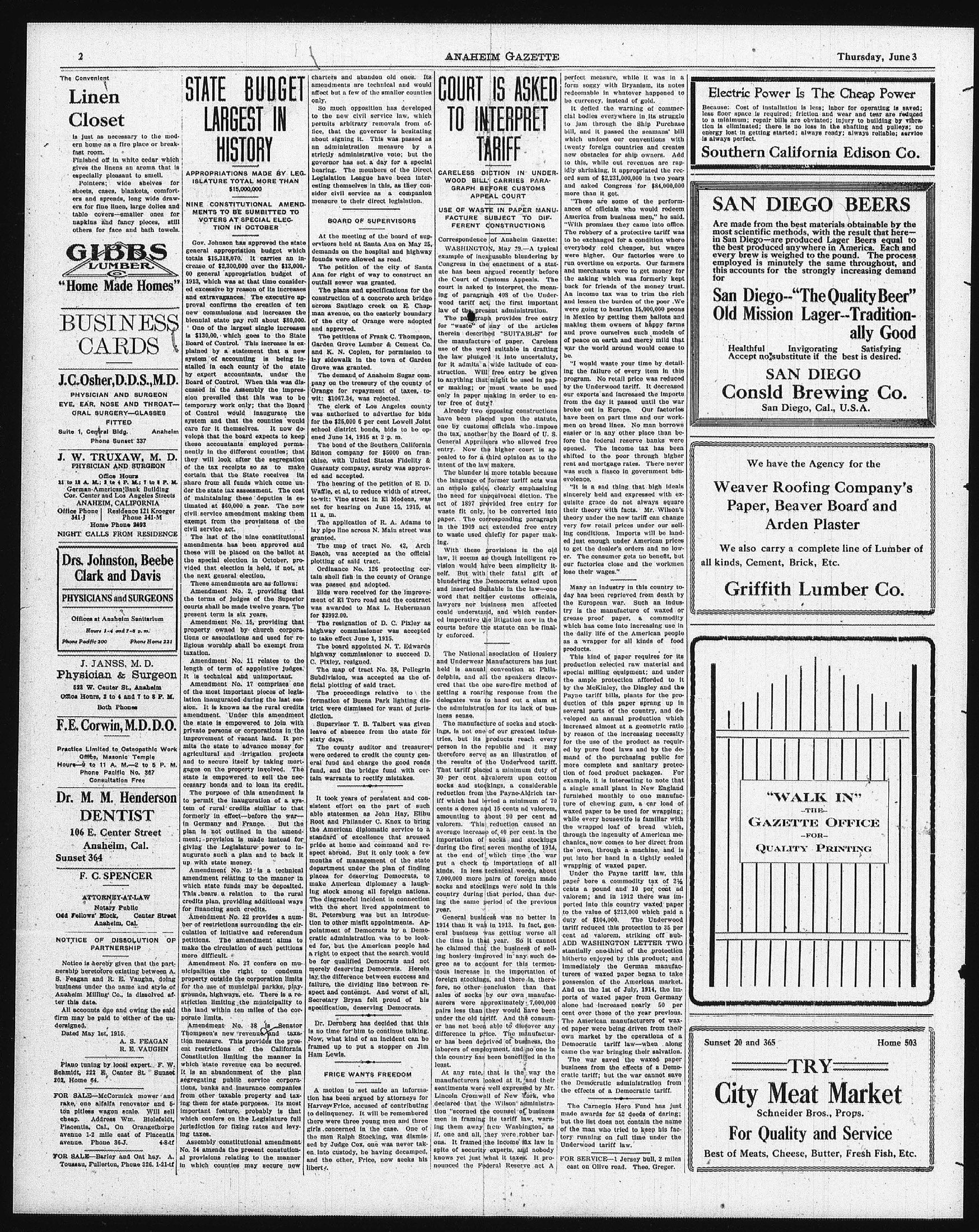
Searchable text
The Convenient
Linen Closet
Is just as necessary to the modern home as a fire place or breakfast room.
Finished off in white cedar which gives the linens an aroma that is especially pleasant to smell.
Pointers; wide shelves for sheets, cases, blankets, comforters and spreads, long wide drawers for fine linen, large dolles and table covers—smaller ones for napkins and fancy pieces, still others for face and bath towels.
GIBBS LUMBER
"Home Made Homes"
BUSINESS CARDS
J.C.Osher,D.D.S.,M.D.
PHYSICIAN AND SURGEON
EYE, EAR, NOSE AND THROAT—ORAL SURGERY—GLASSES FITTED
Suite 1, Central Bldg. Anaheim
Phone Sunset 337
J.W. TRUXAW, M.D.
STATE BUDGET LARGEST IN HISTORY
APPROPRIATIONS MADE BY LEGISLATURE TOTAL MORE THAN $15,000,000
NINE CONSTITUTIONAL AMENDMENTS TO BE SUMMITTED TO VOTERS AT SPECIAL ELECTION IN OCTOBER
Gov. Johnson has approved the state general appropriation budget which totals $15,318,070. It carries an increase of $2,300,000 over the $13,000,-00 general appropriation budget of 1913, which was at that time considered excessive by reason of its increases and extravagances. The executive approval confirms the creation of ten new commissions and increases the biennial state pay roll about $80,000.
One of the largest single increases is $130,000, which goes to the State Board of Control. This increase is explained by a statement that a new system of accounting is being installed in each county of the state by expert accountants, under the Board of Control. When this was discussed in the Assembly the impression prevailed that this was to be temporary work only; that the Board of Control would inaugurate the system and that the counties would care for it themselves. It now develops that the board expects to keep these accountants employed permanently in the different counties; that they will look after the segregation charters and abide by amendments are not affect but a few only.
So much oppose to the new civil permits arbitrary fice, that the go about signing it. An administration strictly administrates governor has set hearing. The most Legislation League eating themselves sider civil service measure to their BOARD OF
At the meeting advisors held at S demands on the founds were allow The petition o Ana for right of outfall sewer war The plans and construction of across Santiago man avenue, on t of the city of C and approved. The petitions of Garden Grove Lu and K. N. Copple lay sidewalk in Grove was granted The demand of pany on the treas Orange for repair wit: $1067.34; was The clerk of was authorized for the $25,000 6 school district be ened June 14, 1919 The bond of the Edison company blinks with Unite
J.C.Osher,D.D.S.,M.D.
PHYSICIAN AND SURGEON
EYE, EAR, NOSE AND THROAT—ORAL SURGERY—GLASSES FITTED
Suite 1, Central Bldg. Anaheim
Phone Sunset 337
J. W. TRUXAW, M. D.
PHYSICIAN AND SURGEON
Office Hours
11 to 12 A.M.; 2 to 4 P.M.; 7 to 8 P.M.
German-American Bank Building
Cor. Center and Los Angeles Streets
ANAHEIM, CALIFORNIA
Office Phone Residence 121 Kroeger
Phone 341-M
Home Phone 2093
NIGHT CALLS FROM RESIDENCE
Drs. Johnston, Beebe Clark and Davis
PHYSICIANS and SURGEON
Offices at Anaheim Sanitarium
Hours 1-4 and 7-8 p.m.
Phone Pacific 200 Phone Home 221
J. JANSS, M.D.
Physician & Surgeon
523 W. Center St., Anaheim
Office Hours, 2 to 4 and 7 to 8 P.M.
Both Phones
F.E. Corwin, M.D.D.O.
Practice Limited to Osteopathic Work
Office, Masonic Temple
Hours—9 to 11 A.M.—2 to 5 P.M.
Phone Pacific No. 367
Consultation Free
Dr. M. M. Henderson
DENTIST
106 E. Center Street
Anaheim, Cal.
Sunset 364
stalled in each county of the state by expert accountants, under the Board of Control. When this was discussed in the Assembly the impression prevailed that this was to be temporary work only; that the Board of Control would inaugurate the system and that the counties would care for it themselves. It now develops that the board expects to keep these accountants employed permanently in the different counties; that they will look after the segregation of the tax receipts so as to make certain that the State receives its share from all funds which come under the state tax assessment. The cost of maintaining these deputies is estimated at $60,000 a year. The new civil service amendment making them exempt from the provisions of the civil service act.
The last of the nine constitutional amendments has been approved and these will be placed on the ballot at the special election in October, provided that election is held, if not, at the next general election.
These amendments are as follows:
Amendment No. 2, providing that the terms of judges of the Superior courts shall be made twelve years. The present term is six years.
Amendment No. 15, providing that property owned by church corporations or associations and used for religious worship shall be exempt from taxation.
Amendment No. 11 relates to the length of term of appointive judges. It is technical and unimportant.
Amendment No. 17 comprises one of the most important pieces of legislation inaugurated during the last session. It is known as the rural credits amendment. Under this amendment the state is empowered to join with private persons or corporations in the improvement of vacant land. It permits the state to advance money for agricultural and irrigation projects and to secure itself by taking mortgages on the property involved. The state is empowered to sell the necessary bonds and to loan its credit.
The purpose of this amendment is to permit the inauguration of a system of rural credits similar to that formerly in effect—before the war—in Germany and France. But the plan is not outlined in the amendment; provision is made instead for giving the Legislature power to inaugurate such a plan and to back it up with state money.
Amendment No. 19 is a technical
Dr. M. M. Henderson
DENTIST
106 E. Center Street
Anaheim, Cal.
Sunset 364
F. C. SPENCER
ATTORNEY-AT-LAW
Notary Public
Odd Fellows' Block, Center Street
Anaheim, Cal.
NOTICE OF DISSOLUTION OF PARTNERSHIP
Notice is hereby given that the partnership heretofore existing between A. S. Feagan and R. E. Vaughn, doing business under the name and style of Anaheim Milling Co., is dissolved after this date.
All accounts due and owing the said firm may be paid to either of the undersigned.
Dated May 1st, 1915.
A. S. FEAGAN
R. E. VAUGHN
Plano tuning by local expert. F. W. Schmidt, 222 E. Center St. Sunset 202, Home 64.
FOR SALE—McCormick mower and rake, one alfalfa renovator and 5-ton pitless wagon scale. Will sell cheap. Address Wm. Bielefeldt, Placentia, Cal., On Orangethorpe avenue 1-2 mile east of Placentia avenue. Phone 36-J.
FOR SALE—Barley and Oat hay. A. Toussau, Fullerton, Phone 326. 1-21-tf
The purpose of this amendment is to permit the inauguration of a system of rural credits similar to that formerly in effect—before the war—in Germany and France. But the plan is not outlined in the amendment; provision is made instead for giving the Legislature power to inaugurate such a plan and to back it up with state money.
Amendment No. 19 is a technical amendment relating to the manner in which state funds may be deposited. This bears a relation to the rural credits plan, providing additional ways for financing such credits.
Amendment No. 22 provides a number of restrictions surrounding the circulation of initiative and referendum petitions. The amendment aims to make the circulation of such petitions more difficult.
Amendment No. 27 confers on municipalities the right to condemn property outside the corporation limits for the use of municipal parkks, playgrounds, highways, etc. There is a restriction limiting the municipality to the land within ten miles of the corporate limits.
Amendment No. 38 is Senator Thompson's new revenue and taxation measure. This provides the present restrictions of the California Constitution limiting the manner in which state revenue can be secured.
It is an abandonment of the plan segregating public service corporations, banks and insurance companies from other taxable property and taxing them for state purposes. Its most important feature, probably is that which confers on the Legislature full jurisdiction for fixing rates and levying taxes.
Assembly constitutional amendment No. 34 amends the present constitutional provisions relating to the manner in which counties may secure now
ANAHEIM GAZETTE
ET
LEGAN
MEND-TO
C
state which in new state the was disprepte to be Board the would new keep derma that
charters and abandon old ones. Its amendments are technical and would affect but a few of the smaller counties only.
So much opposition has developed to the new civil service law, which permits arbitrary removals from office, that the governor is hesitating about signing it. This was passed as an administration measure by a strictly administrative vote; but the governor has set a day for a special hearing. The members of the Direct Legislation League have been interesting themselves in this, as they consider civil service as a companion measure to their direct legislation.
BOARD OF SUPERVISORS
At the meeting of the board of supervisors held at Santa Ana on May 25, demands on the hospital and highway founds were allowed as read.
The petition of the city of Santa Ana for right of way to construct an outfall sewer was granted.
The plans and specifications for the construction of a concrete arch bridge across Santiago creek on E. Chapman avenue, on the easterly boundary of the city of Orange were adopted and approved.
The petitions of Frank C. Thompson, Garden Grove Lumber & Cement Co. and K. N. Coplen, for permission to lay sidewalk in the town of Garden Grove was granted.
The demand of Anaheim Sugar company on the treasury of the county of Orange for repayment of taxes, to wit: $1067.34, was rejected.
The clerk of Los Angeles county was authorized to advertise for bids for the $25,000 6 per cent Lowell Joint school district bonds, bids to be opened June 14, 1915 at 2 p.m.
The bond of the Southern California Edison company for $5000 on franchise with United States Fidelity &
COURT IS ASKED TO INTERPRET TARIFF
CARELESS DICTION IN UNDERWOOD BILL CARRIES PARAGRAPH BEFORE CUSTOMS APPEAL COURT
USE OF WASTE IN PAPER MANUFACTURE SUBJECT TO DIFFERENT CONSTRUCTIONS
Correspondence of Anaheim Gazette:
WASHINGTON, May 29.—A typical example of inexpusable blundering by Congress in the enactment of a statute has been argued recently before the Court of Customs Appeals. The court is asked to interpret the meaning of paragraph 408 of the Underwood tariff act, the first important law of the present administration.
The paragraph provides free entry for "waste" of any of the articles therein described "SUITABLE" for the manufacture of paper. Careless use of the word suitable in drafting the law plunged it into uncertainty, for it admits a wide latitude of construction. Will free entry be given to anything that might be used in paper making; or must waste be used only in paper making in order to enter free of duty?
Already two opposing constructions have been placed upon the statute, one by customs officials who impose the tax, another by the Board of U. S. General Appraisalers who allowed free entry. Now the higher court is appealed to for a third opinion as to the perfect measure, while it was in a form soggy with Bryanism, its notes redeemable in whatever happened to be currency, instead of gold.
It defied the warning of commercial bodies everywhere in its struggle to jam through the Ship Purchase bill, and it passed the seamans' bill which undoes our conventions with twenty foreign countries and creates new obstacles for ship owners. Add to this, while out revenues are rapidly shrinking, it appropriated the record sum of $2,231,000,000 in two years and asked Congress for $84,000,000 more than it got.
"These are some of the performances of officials who would redeem America from business men," he said. "With promises they came into office. The robbery of a protective tariff was to be exchanged for a condition where everybody cold cheaper, but wages were higher. Our factories were to run overtime on exports. Our farmers and merchants were to get money for the asking which was formerly kept back for friends of the money trust. An income tax was to trim the rich and lessen the burden of the poor. We were going to hearten 15,000,000 peons in Mexico by getting them ballots and making them owners of happy farms and prove ourselves such models of peace on earth and mercy mild that war the world around would cease to be.
"I would waste your time by detailing the failure of every item in this program. No retail price was reduced by the Underwood tariff. It decreased our exports and increased the imports from the day it passed until the war broke out in Europe. Our factories have been on part time and our workmen on bread lines. No man borrows easier or in any other place than before the federal reserve banks were opened. The income tax has been shifted to the poor through higher
Grove was granted.
The demand of Anaheim Sugar company on the treasury of the county of Orange for repayment of taxes, to wit: $1067.34, was rejected.
The clerk of Los Angeles county was authorized to advertise for bids for the $25,000 6 per cent Lowell Joint school district bonds, bids to be opened June 14, 1915 at 2 p.m.
The bond of the Southern California Edison company for $5000 on franchise, with United States Fidelity & Guaranty company, surety was approved and accepted.
The hearing of the petition of E. D. Waffle, et al, to reduce width of street, to-wit: Vine street in El Modena, was set for hearing on June 15, 1915, at 11 a.m.
The application of R. A. Adams to lay pipe line across N. Main street was granted.
The map of tract No. 42, Arch Beach, was accepted as the official plotting of said tract.
Ordinance No. 126 protecting certain shell fish in the county of Orange was passed and adopted.
Bids were received for the improvement of El Toro road and the contract was awarded to Max L. Hubermann for $2992.00.
The resignation of D. C. Pixley as highway commissioner was accepted to take effect June 1, 1915.
The board appointed N. T. Edwards highway commissioner to succeed D. C. Pixley, resigned.
The map of tract No. 38, Pellegrin Subdivision, was accepted as the official plotting of said tract.
The proceedings relative to the formation of Buena Park lighting district were dismissed for want of jurisdiction.
Supervisor T. B. Talbert was given leave of absence from the state for sixty days.
The county auditor and treasurer were ordered to credit the county general fund and charge the good roads fund, and the bridge fund with certain warrants to rectify mistakes.
It took years of persistent and consistent effort on the part of such able statesmen as John Hay, Elihu Root and Philander C. Knox to bring the American diplomatic service to a standard of excellence that aroused pride at home and command and respect abroad. But it only took a few months of management of the state department under the plan of finding for it admits a wide latitude of construction. Will free entry be given to anything that might be used in paper making; or must waste be used only in paper making in order to enter free of duty?
Already two opposing constructions have been placed upon the statute, one by customs officials who impose the tax, another by the Board of U. S. General Appraisers who allowed free entry. Now the higher court is appealed to for a third opinion as to the intent of the law makers.
The blunder is more totable because the language of former tariff acts was an ample guide, clearly emphasizing the need for unequivocal diction. The act of 1897 provided free entry for waste fit only, to be converted into paper. The corresponding paragraph in the 1909 act extended free entry to waste used chiefly for paper making.
With these provisions in the old law, it seems as though intelligent revision would have been simplicity itself. But with their fatal gift of blundering the Democrats seized upon and inserted Suitable in the law—one word that neither customs officials, lawyers nor business men affected could understand, and which rendered imperative the litigation now in the courts before the statute can be finally enforced.
The National association of Hosiery and Underwear Manufacturers has just held is annual convention at Philadelphia, and all the speakers discovered that the one sure-fire method of getting a roaring response from the delegates was to hand out a slam at the administration for its lack of business sense.
The manufacture of socks and stockings, is not one of our greatest industries, but its products reach every person in the republic and it may therefore serve as an illustration of the results of the Underwood tariff. That tariff placed a minimum duty of 30 per cent advalorem upon cotton socks and stockings, a considerable reduction from the Payne-Aldrich tariff which had levied a minimum of 70 cents a dozen and 15 cents ad valorem, amounting to about 90 per cent ad valorem. This reduction caused an average increase of 40 per cent in the importation of socks and stockings during the first seven months of 1914, at the end of which time the war put a check to importations of all kinds. In less technical words about
"I would waste your time by detailing the failure of every item in this program. No retail price was reduced by the Underwood tariff. It decreased our exports and increased the imports from the day it passed until the war broke out in Europe. Our factories have been on part time and our workmen on bread lines. No man borrows easier or in any other place than before the federal reserve banks were opened. The income tax has been shifted to the poor through higher rent and mortgage rates. There never was such a flasco in government benevolence."
"It is a sad thing that high ideals sincerely held and expressed with exquisite grace do not always square their theory with facts. Mr. Wilson's theory under the new tariff can change very few retail prices under our selling conditions. Imports will be landed just enough under American prices to get the dealer's orders and no lower. The consumer gets no benefit, but our factories close and the workmen lose their wages."
Many an industry in this country today has been reprieved from death by the European war. Such an industry is the manufacture of waxed or grease proof paper, a commodity which has come into increasing use in the daily life of the American people as a wrapper for all kinds of food products.
This kind of paper requires for its production selected raw material and special milling equipment; and under the ample protection afforded to it by the McKinley, the Dingley and the Payne tariff bills, plants for the production of this paper sprang up in several parts of the country, and developed an annual production which increased almost at a geometric ratio by reason of the increasing necessity for the use of the product as required by pure food laws and by the demand of the purchasing public for more complete and sanitary protection of food product packages. For example, it is interesting to note that a single small plant in New England furnished monthly to one manufacture of chewing gum, a car load of waxed paper to be used for wrapping; while every housewife is familiar with the wrapped loaf of bread which, through the ingenuity of American mechanics, now comes to her direct from the oven, through a machine, and is put into her hand in a tightly sealed wrapping of waxed paper."
It took years of persistent and consistent effort on the part of such able statesmen as John Hay, Elihu Root and Philander C. Knox to bring the American diplomatic service to a standard of excellence that aroused pride at home and command and respect abroad. But it only took a few months of management of the state department under the plan of finding places for deserving Democrats, to make American diplomacy a laughing stock among all foreign nations. The disgraceful incident in connection with the short lived appointment to St. Petersburg was but an introduction to other misfit appointments. Appointment of Democrats by a Democratic administration was to be looked for, but the American people had a right to expect that the search would be for qualified Democrats and not merely deserving Democrats. Herein lay the difference between success and failure, the dividing line between respect and contempt. And worst of all, Secretary Bryan felt proud of his specification, deserving Democrats.
Dr. Dernberg has decided that this is no time for him to continue talking. Now, what kind of an incident can be framed up to put a stopper on Jim Ham Lewis.
FRICE WANTS FREEDOM
A motion to set aside an information has been argued by attorneys for Harvey Price, accused of contributing to delinquency. It will be remembered there were three young men and three girls concerned in the case. One of the men Ralph Stocking, was dismissed by Judge Cox, one was never taken into custody, he having decamped, and the other, Frice, now seeks his liberty.
At any rate, that is the way the manufacturers looked at it, and their sentiments were well expressed by Mr. Lincoln Cromwell of New York, who declared that the Wilson administration "scorned the counsel of business men in framing its tariff law, warning them away from Washington, as if, one and all, they were robber barons. It framed the income tax law in spite of security experts, and nobody knows yet what it taxes. It pronounced the Federal Reserve act A 30 per cent advalorem upon cotton socks and stockings, a considerable reduction from the Payne-Aldrich tariff which had levied a minimum of 70 cents a dozen and 15 cents ad valorem, amounting to about 90 per cent ad valorem. This reduction caused an average increase of 40 per cent in the importation of socks and stockings during the first seven months of 1914, at the end of which time the war put a check to importations of all kinds. In less technical words, about 7,000,000 more pairs of foreign made socks and stockings were sold in this country during that period, than during the same period of the previous year.
General business was no better in 1914 than it was in 1913. In fact, general business was getting worse all the time in that year. So it cannot be claimed that the business of selling hoslery improved in any such degree as to account for this tremendous increase in the importation of foreign stockings, and there is, therefore, no other conclusion than that sales of socks by our own manufacturers were approximately 7,000,000 pairs less than they would have been under the old tariff. And the consumer has not been able to discover any difference in price. The manufacturer has been deprived of business, the laborers of employment, and no one in this country has been benefited in the least.
At any rate, that is the way the manufacturers looked at it, and their sentiments were well expressed by Mr. Lincoln Cromwell of New York, who declared that the Wilson administration "scorned the counsel of business men in framing its tariff law, warning them away from Washington, as if, one and all, they were robber barons. It framed the income tax law in spite of security experts, and nobody knows yet what it taxes. It pronounced the Federal Reserve act A 30 per cent advalorem upon cotton socks and stockings, a considerable reduction from the Payne-Aldrich tariff which had levied a minimum of 70 cents a dozen and 15 cents ad valorem, amounting to about 90 per cent ad valorem. This reduction caused an average increase of 40 per cent in the importation of socks and stockings during the first seven months of 1914, at the end of which time the war put a check to importations of all kinds. In less technical words, about 7,000,000 more pairs of foreign made socks and stockings were sold in this country during that period, than during the same period of the previous year.
General business was no better in 1914 than it was in 1913. In fact, general business was getting worse all the time in that year. So it cannot be claimed that the business of selling hoslery improved in any such degree as to account for this tremendous increase in the importation of foreign stockings, and there is, therefore, no other conclusion than that sales of socks by our own manufacturers were approximately 7,000,000 pairs less than they would have been under the old tariff. And the consumer has not been able to discover any difference in price. The manufacturer has been deprived of business, the laborers of employment, and no one in this country has been benefited in the least.
At any rate, that is the way the manufacturers looked at it, and their sentiments were well expressed by Mr. Lincoln Cromwell of New York, who declared that the Wilson administration "scorned the counsel of business men in framing its tariff law, warning them away from Washington, as if, one and all, they were robber barons. It framed the income tax law in spite of security experts, and nobody knows yet what it taxes. It pronounced the Federal Reserve act A 30 per cent advalorem upon cotton socks and stockings, a considerable reduction from the Payne-Aldrich tariff which had levied a minimum of 70 cents a dozen and 15 cents ad valorem, amounting to about 90 per cent ad valorem. This reduction caused an average increase of 40 per cent in the importation of socks and stockings during the first seven months of 1914, at the end of which time the war put a check to importations of all kinds. In less technical words, about 7,000,000 more pairs of foreign made socks and stockings were sold in this country during that period, than during the same period of the previous year.
General business was no better in 1914 than it was in 1913. In fact, general business was getting worse all the time in that year. So it cannot be claimed that the business of selling hoslery improved in any such degree as to account for this tremendous increase in the importation of foreign stockings, and there is, therefore, no other conclusion than that sales of socks by our own manufacturers were approximately 7,000,000 pairs less than they would have been under the old tariff. And the consumer has not been able to discover any difference in price. The manufacturer has been deprived of business, the laborers of employment, and no one in this country has been benefited in the least.
At any rate, that is the way the manufacturers looked at it, and their sentiments were well expressed by Mr. Lincoln Cromwell of New York, who declared that the Wilson administration "scorned the counsel of business men in framing its tariff law, warning them away from Washington, as if, one and all, they were robber barons. It framed the income tax law in spite of security experts, and nobody knows yet what it taxes. It pronounced the Federal Reserve act A 30 per cent advalorem upon cotton socks and stockings, a considerable reduction from the Payne-Aldrich tariff which had levied a minimum of 70 cents a dozen and 15 cents ad valorem, amounting to about 90 per cent ad valorem. This reduction caused an average increase of 40 per cent in the importation of socks and stockings during the first seven months of 1914, at the end of which time the war put a check to importations of all kinds. In less technical words, about 7,000,000 more pairs of foreign made socks and stockings were sold in this country during that period, than during the same period of the previous year.
General business was no better in 1914 than it was in 1913. In fact, general business was getting worse all the time in that year. So it cannot be claimed that the business of selling hoslery improved in any such degree as to account for this tremendous increase in the importation of foreign stockings, and there is, therefore, no other conclusion than that sales of socks by our own manufacturers were approximately 7,000,000 pairs less than they would have been under the old tariff. And on the 1st of July, 1914,the imports of waxed paper from Germany alone had increased nearly 50 percent over those of the year previous. The American manufacturers of waxed paper were being driven from their own market by the operations of a Democratic tariff law—when along came the war bringing their salvation.
The war saved the waxed paper business from the effects of a Democratic tariff; but the war cannot save the Democratic administration from the effects of a Democratic tariff.
The Carnegie Hero Fund has just made awards for 52 deeds of daring; but the list does not contain the name of the man who tried to keep his factory running on full time under the Underwood tariff law.
FOR SERVICE—1 Jersey bull; 2 miles east on Olive road. Theo. Greger.
Thursday, June 3
Electric Power Is The Cheap Power
Because: Cost of installation is less; labor for operating is saved;
less floor space is required; friction and wear and tear are reduced
to a minimum; repair bills are obviated; injury to building by vibration is eliminated; there is no loss in the shafting and pulleys; no
energy lost in getting started; always ready; always reliable; service
is always perfect.
Southern California Edison Co.
SAN DIEGO BEERS
Are made from the best materials obtainable by the most scientific methods, with the result that here—in San Diego—are produced Lager Beers equal to
the best produced anywhere in America. Each and every brew is weighed to the pound. The process employed is minutely the same throughout, and
this accounts for the strongly increasing demand for
San Diego--“The Quality Beer”
Old Mission Lager--Traditionally Good
Healthful Invigorating Satisfying
Accept no substitute if the best is desired.
SAN DIEGO
Consld Brewing Co.
San Diego, Cal., U.S.A.
SAN DIEGO
Consld Brewing Co.
San Diego, Cal., U.S.A.
We have the Agency for the
Weaver Roofing Company's
Paper, Beaver Board and
Arden Plaster
We also carry a complete line of Lumber of
all kinds, Cement, Brick, Etc.
Griffith Lumber Co.
"WALK IN"
-THEGAZETTE OFFICE
-FORQUALITY PRINTING
"WALK IN"
THE
GAZETTE OFFICE
FOR
QUALITY PRINTING
Sunset 20 and 365 Home 503
TRY
City Meat Market
Schneider Bros., Props.
For Quality and Service
Best of Meats, Cheese, Butter, Fresh Fish, Etc.