anaheim-gazette 1915-05-13
Scanned page
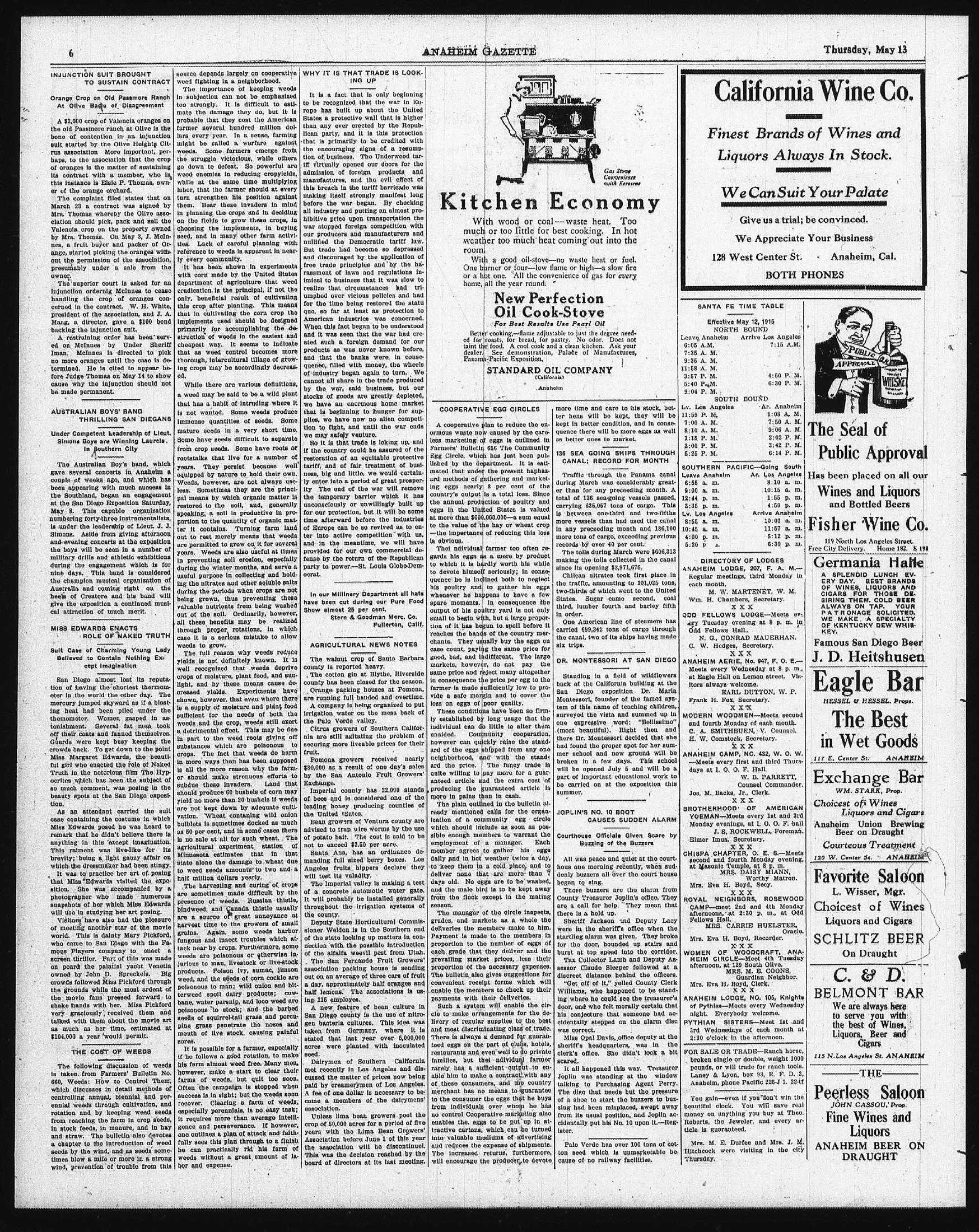
Searchable text
INJUNCTION SUIT BROUGHT TO SUSTAIN CONTRACT
Orange Crop on Old Passmore Ranch At Olive Basics of Disagreement
A $3,000 crop of Valencia oranges on the old Passmore ranch at Olive is the bone of contention in an injunction suit started by the Olive Height Citrus association More important, perhaps, to the association that the crop of oranges is the matter of sustaining its contract with a member, who in this instance is Elsie P. Thomas, owner of the orange orchard.
The complaint filed states that on March 23 a contract was signed by Mrs. Thomas whereby the Olive association should pick, pack and sell the Valencia crop on the property owned by Mrs. Thomas. On May 3, J. McInnes, a fruit buyer and packer of Orange, started picking the oranges without the permission of the association, presumably under a sale from the owner.
The superior court is asked for an injunction ordernig McInnes to cease handling the crop of oranges concerned in the contract. W. H. White, president of the association, and J. A. Maag, a director, gave a $100 bond backing the injunction suit.
A restraining order has been served on McInnes by Under Sheriff Iman. McInnes is directed to pick no more oranges until the case is determined. He is cited to appear before Judge Thomas on May 14 to show cause why the injunction should not be made permanent.
AUSTRALIAN BOYS' BAND THRILLING SAN DIEGANS
Under Competent Leadership of Lieut. Simons Boys are Winning Laurels In Southern City
source depends largely on cooperative weed fighting in a neighborhood.
The importance of keeping weeds in subjection can not be emphasized too strongly. It is difficult to estimate the damage they do, but it is probable that they cost the American farmer several hundred million dollars every year. In a sense, farming might be called a warfare against weeds. Some farmers emerge from the struggle victorious, while others go down to defeat. So powerful are weed enemies in reducing crop yields, while at the same time multiplying labor, that the farmer should at every turn strengthen his position against them. Bear these invaders in mind in planning the crops and in deciding on the fields to grow these crops, in choosing the implements, in buying seed, and in many other farm activities. Lack of careful planning with reference to weeds is apparent in nearly every community.
It has been shown in experiments with corn made by the United States department of agriculture that weed eradication is the principal, if not the only, beneficial result of cultivating this crop after planting. This means that in cultivating the corn crop the implements used should be designed primarily for accomplishing the destruction of weeds in the easiest and cheapest way. It seems to indicate that as weed control becomes more thorough, intercultural tillage of growing crops may be accordingly decreased.
While there are various definitions, a weed may be said to be a wild plant that has a habit of intruding where it is not wanted. Some weeds produce immense quantities of seeds. Some mature seeds in a very short time. Some have seeds difficult to separate from crop seeds. Some have roots or rootstalks that live for a number of source depends largely on cooperative weed fighting in a neighborhood.
WHY IT IS THAT INGREDIENTS
It is a fact that it to be recognized that rope has built up States a protective than any ever erected party, and it that is primarily to the encouraging situation of business. The lift virtually opened admission of foreign manufactures, and this breach in the making itself strong before the war began all industry and puthibitive price upon war stopped foreign our producers and nullified the Democ But trade had been discouraged by free trade principlesassessment of laws as imical to business to realize that circumumped over vicious for the time being quo, so far at least American industries. When this fact began and it was seen that dated such a foreign products as was new and that the bank quenece, filled with of industry began cannot all share in by the war, said stocks of goods are we have an enormity that is beginning to plies, we have now tion to fight, and we may safely venture.
So it is that trade if the country could restoration of an e
AUSTRALIAN BOYS' BAND
THRILLING SAN DIEGANS
Under Competent Leadership of Lieut.
Simons Boys are Winning Laurels.
In Southern City
The Australian Boy's band, which gave several concerts in Anaheim a couple of weeks ago, and which has been appearing with much success in the Southland, began an engagement at the San Diego Exposition Saturday, May 8. This capable organization numbering forty-three instrumentalists, is under the leadership of Lieut. J. J. Simons. Aside from giving afternoon and evening concerts at the exposition the boys will be seen in a number of military drills and athletic exhibitions during the engagement which is for nine days. This band is considered the champion musical organization of Australia and coming right on the heels of Creatore and his band will give the exposition a continued musical attraction of much merit.
MISS EDWARDS ENACTS
ROLE OF NAKED TRUTH
Suit Case of Charming Young Lady Believed to Contain Nothing Except Imagination
San Diego almost lost its reputation of having the shortest thermometer in the world the other day. The mercury jumped skyward as if a blasting heat had been piled under the themometer. Women gasped in astonishment. Several fat men took off their coats and fanned themselves. Guards were kept busy keeping the crowds back. To get down to the point Miss Margaret Edwards, the beautiful girl who enacted the role of Naked Truth in the notorious film The Hypocrites which has been the subject of so much comment, was posing in the beauty spots at the San Diego exposition.
As an attendant carried the suit case containing the costume in which Miss Edwards posed he was heard to remark that he didn't believe there is anything in this except imagination. This ralment was Eve-like for its brevity; being a light gauzy affair on which the dressmaker had been stingy.
While there are various definitions, a weed may be said to be a wild plant that has a habit of intruding where it is not wanted. Some weeds produce immense quantities of seeds. Some mature seeds in a very short time. Some have seeds difficult to separate from crop seeds. Some have roots or rootstalks that live for a number of years. They persist because well equipped by nature to hold their own. Weeds, however, are not always useless. Sometimes they are the principal means by which organic matter is restored to the soil, and generally speaking, a soil is productive in proportion to the quantity of organic matter it contains. Turning farm land out to rest merely means that weeds are permitted to grow on it for several years. Weeds are also useful at times in preventing soil erosion, especially during the winter months, and serve a useful purpose in collecting and holding the nitrates and other soluble salts during the periods when crops are not being grown, thus preventing these valuable nutrients from being washed out of the soil. Ordinarily, however, all these benefits may be realized through proper rotations, in which case it is a serious mistake to allow weeds to grow.
The full reason why weeds reduce yields is not definitely known. It is well recognized that weeds deprive crops of moisture, plant food, and sunlight, and by these means cause decreased yields. Experiments have shown, however, that even where there is a supply of moisture and plant food sufficient for the needs of both the weeds and the crop, weeds still exert a detrimental effect. This may be due in part to the weed roots giving off substances which are poisonous to crops. The fact that weeds do harm in more ways than has been supposed is all the more reason why the farmer should make strenuous efforts to subdue these invaders. Land that should produce 60 bushels of corn may yield no more than 20 bushels if weeds are not kept down by adequate cultivation. Wheat containing wild onion bulblets is sometimes docked as much as 50 per cent, and in some cases there is no sale at all for such wheat. The agricultural experiment station of Minnesota estimates that in that state alone the damage to wheat due to weed seeds amounts to two and a quarter million crops may be accordingly decreased.
While there are various definitions, a weed may be said to be a wild plant that has a habit of intruding where it is not wanted. Some weeds produce immense quantities of seeds. Some mature seeds in a very short time. Some have seeds difficult to separate from crop seeds. Some have roots or rootstalks that live for a number of years. They persist because well equipped by nature to hold their own. Weeds, however, are not always useless. Sometimes they are the principal means by which organic matter is restored to the soil, and generally speaking, a soil is productive in proportion to the quantity of organic matter it contains. Turning farm land out to rest merely means that weeds are permitted to grow on it for several years. Weeds are also useful at times in preventing soil erosion, especially during the winter months, and serve a useful purpose in collecting and holding the nitrates and other soluble salts during the periods when crops are not being grown, thus preventing these valuable nutrients from being washed out of the soil. Ordinarily, however, all these benefits may be realized through proper rotations, in which case it is a serious mistake to allow weeds to grow.
The full reason why weeds reduce yields is not definitely known. It is well recognized that weeds deprive crops of moisture, plant food, and sunlight, and by these means cause decreased yields. Experiments have shown, however, that even where there is a supply of moisture and plant food sufficient for the needs of both the weeds and the crop, weeds still exert a detrimental effect. This may be due in part to the weed roots giving off substances which are poisonous to crops. The fact that weeds do harm in more ways than has been supposed is all the more reason why the farmer should make strenuous efforts to subdue these invaders. Land that should produce 60 bushels of corn may yield no more than 20 bushels if weeds are not kept down by adequate cultivation. Wheat containing wild onion bulblets is sometimes docked as much as 50 per cent, and in some cases there is no sale at all for such wheat. The agricultural experiment station of Minnesota estimates that in that state alone the damage to wheat due to weed seeds amounts to two and a quarter million crops may be accordingly decreased.
While there are various definitions, a weed may be said to be a wild plant that has a habit of intruding where it is not wanted. Some weeds produce immense quantities of seeds. Some mature seeds in a very short time. Some have seeds difficult to separate from crop seeds. Some have roots or rootstalks that live for a number of years. They persist because well equipped by nature to hold their own. Weeds, however, are not always useless. Sometimes they are the principal means by which organic matter is restored to the soil, and generally speaking, a soil is productive in proportion to the quantity of organic matter it contains. Turning farm land out to rest merely means that weeds are permitted to grow on it for several years. Weeds are also useful at times in preventing soil erosion, especially during the winter months, and serve a useful purpose in collecting and holding the nitrates and other soluble salts during the periods when crops are not being grown, thus preventing these valuable nutrients from being washed out of the soil. Ordinarily, however, all these benefits may be realized through proper rotations, in which case it is a serious mistake to allow weeds to grow.
The full reason why weeds reduce yields is not definitely known. It is well recognized that weeds deprive crops of moisture, plant food, and sunlight, and by these means cause decreased yields. Experiments have shown, however, that even where there is a supply of moisture and plant food sufficient for the needs of both the weeds and the crop, weeds still exert a detrimental effect. This may be due in part to the weed roots giving off substances which are poisonous to crops. The fact that weeds do harm in more ways than has been supposed is all the more reason why the farmer should make strenuous efforts to subdue these invaders. Land that should produce 60 bushels of corn may yield no more than 20 bushels if weeds are not kept down by adequate cultivation. Wheat containing wild onion bulblets is sometimes docked as much as 50 per cent, and in some cases there is no sale at all for such wheat. The agricultural experiment station of Minnesota estimates that in that state alone the damage to wheat due to weed seeds amounts to two and a quarter million crops may be accordingly decreased.
So it is that trade if the country could restoreation of an earliff, and of fairness, big and little, by enter into a periodity The end of this temporary barring unconsciously or unfit for our protection, time afterward before Europe can be seized into active control and in the meantime provided for our own defense by the return party to power—Stocrat.
In our Millinery Dare have been cut duril Show almost 25 per cent Stern & Go
AGRICULTURAL
The walnut crop county is reported The cotton gin at county has been closed Orange packing line are running full harp A company is being irrigation water on the Palo Verde valley Citrus growers on nla are still agitating securing more livestock fruit.
Pomona growers $30,000 as a result by the San Antonio Exchange.
Imperial county of bees and is commonly leading honey production United tates.
Bean growers of T advised to trap wired potato bait The not to exceed $3.50 Santa Ana has mandling full sized Angeles fruits hlp
THE COST OF WEEDS
The following discussion of weeds is taken from Farmers' Bulletin No. 660, Weeds: How to Control Them, which discusses in detail methods of controlling annual, biennial and perennial weeds through cultivation, and rotation and by keeping weed seeds from reaching the farm in crop seeds, in stock feeds, in manure, and in hay and straw. The bulletin also devotes a chapter to the introduction of weed seeds by the wind, and as seeds sometimes blow a mile or more in a strong wind, prevention of trouble from this er should make strenuous efforts to subdue these invaders. Land that should produce 60 bushels of corn may yield no more than 20 bushels if weeds are not kept down by adequate cultivation. Wheat containing wild onion bulblets is sometimes docked as much as 50 per cent, and in some cases there is no sale at all for such wheat. The agricultural experiment station of Minnesota estimates that in that state alone the damage to wheat due to weed seeds amounts to two and a half million dollars yearly.
The harvesting and curing of crops are sometimes made difficult by the presence of weeds. Russian thistle, bindweed, and Canada thistle usually are a source of great annoyance at harvest time to the growers of small grains. Again, some weeds harbor fungous and insect troubles which attack near by crops. Furthermore, some weeds are poisonous or otherwise injurious to man, livestock or live-stock products. Poison ivy, sumac, jimson weed, and the seeds of corn cockle are poisonous to man; wild onion and bitterweed spoil dairy products; cowbane, water parsnip, and loco weed are poisonous to stock; and the barbed seeds of squirrel-tail grass and porcupine grass penetrate the noses and mouth of live stock, causing painful sores.
It is possible for a farmer, especially if he follows a good rotation, to make his farm almost weed free. Many men, however, make a start to clear their farms of weeds, but quit too soon. Often the campaign is stopped when success is in sight; but the weeds soon recover. Clearing a farm of weeds, especially perennials, is no easy task; it requires more than average intelligence and perseverance. If however, one outlines a plan of attack and faithfully sees this plan through to a finish he can practically rid his farm of weeds without a great amount of labor and expense.
Dairymen of Sommet recently in LoCussed the matter of paid by creamerymen. A fee of one dollar come a members association.
Unless lima bean crop of 50,000 acres years with the Lilia Association before the association will This was the decision board of directors
WHY IT IS THAT TRADE IS LOOKING UP
It is a fact that is only beginning to be recognized that the war in Europe has built up about the United States a protective wall that is higher than any ever erected by the Republican party, and it is this protection that is primarily to be credited with the encouraging signs of a resumption of business. The Underwood tariff virtually opened our doors for the admission of foreign products and manufactures, and the evil effect of this breach in the tariff barricade was making itself strongly manifest long before the war began. By checking all industry and putting an almost prohibitive price upon transportation the war stopped foreign competition with our producers and manufacturers and nullified the Democratic tariff law. But trade had become so depressed and discouraged by the application of free trade principles and by the harassment of laws and regulations inimical to business that it was slow to realize that circumstances had triumphed over vicious policies and had for the time being restored the status quo, so far at least as protection to American industries was concerned. When this fact began to be understood and it was seen that the war had created such a foreign demand for our products as was never known before, and that the banks were, in consequence, filled with money, the wheels of industry began again to turn. We cannot all share in the trade produced by the war, said business, but our stocks of goods are greatly depleted, we have an enormous home market that is beginning to hunger for supplies, we have now no alien competition to fight, and until the war ends we may safely venture.
So it is that trade is loking up, and if the country could be assured of the restoration of an equitable protective more time and care to his stock, better hens will be kept, they will be kept in better condition, and in consequence there will be more eggs as well as better ones to market.
Kitchen Economy
With wood or coal—waste heat. Too much or too little for best cooking. In hot weather too much heat coming out into the room.
With a good oil-stove—no waste heat or fuel. One burner or four—low flame or high—a slow fire or a hot one. All the convenience of gas for every home, all the year round.
New Perfection Oil Cook-Stove
For Best Results Use Pearl Oil
Better cooking—flame adjustable to just the degree needed for roasts, for bread, for pastry. No odor. Does not taint the food. A cool cook and a clean kitchen. Ask your dealer. See demonstration, Palaeo of Manufactures, Panama-Pacific Exposition.
STANDARD OIL COMPANY
(California)
Anaheim
COOPERATIVE EGG CIRCLES
A cooperative plan to reduce the enormous waste now caused by the careless marketing of eggs is outlined in Farmers' Bulletin 656 The Community Egg Circle, which has just been published more time and care to his stock, better hens will be kept, they will be kept in better condition, and in consequence there will be more eggs as well as better ones to market.
136 SEA GOING SHIPS THROUGH
quenec, filled with money, the wheels of industry began again to turn. We cannot all share in the trade produced by the war, said business, but our stocks of goods are greatly depleted, we have an enormous home market that is beginning to hunger for supplies, we have now no alien competition to fight, and until the war ends we may safely venture.
So it is that trade is loking up, and if the country could be assured of the restoration of an equitable protective tariff, and of fair treatment of business, big and little, we would certainly enter into a period of great prosperity. The end of the war will remove the temporary barrier which it has unconsciously or unwillingly built up for our protection, but it will be some time afterward before the industries of Europe can be so revived as to enter into active competition with us, and in the meantime, we will have provided for our own commercial defense by the return of the Republican party to power.—St. Louis Globe-Democrat.
In our Millinery Department all hats have been cut during our Pure Food Show almost 25 per cent.
Stern & Goodman Merc. Co.
Fullerton, Calif.
AGRICULTURAL NEWS NOTES
The walnut crop of Santa Barbara county is reported heavy.
The cotton gin at Blythe, Riverside county has been closed for the season.
Orange packing houses at Pomona, are running full handed and overtime.
A company is being organized to put irrigation water on the mesa back of the Palo Verde valley.
Citrus growers of Southern California are still agitating the problem of securing more liveable prices for their fruit.
Pomona growers received nearly $30,000 as a result of one day's sales by the San Antonio Fruit Growers' Exchange.
Imperial county has 22,000 stands of bees and is considered one of the leading honey producing counties of the United States.
Bean growers of Ventura county are advised to trap wire worms by the use of potato bait. The cost is said to be not to exceed $3.50 per acre.
Santa Ana, has an ordinance demanding full sized berry boxes. Los Angeles fruits hippers declare they more time and care to his stock, better hens will be kept, they will be kept in better condition, and in consequence there will be more eggs as well as better ones to market.
136 SEA GOING SHIPS THROUGH CANAL; RECORD FOR MONTH
Traffic through the Panama canal during March was considerably greater than for any preceding month. A total of 136 sea-going vessels passed, carrying 635,057 tons of cargo. This is between one-third and two-fifths more vessels than had used the canal in any preceding month and 186,100 more tons of cargo, exceeding previous records by over 40 per cent.
The tolls during March were $606,313 making the tolls collected in the canal since its opening $2,971,675.
Chilean nitrates took first place in the traffic, amounting to 101,025 tons, two-thirds of which went to the United States. Sugar came second, coal third, lumber fourth and barley fifth in order.
One American line of steamers has carried 699,342 tons of cargo through the canal, two of its ships having made six trips.
DR. MONTESSORI AT SAN DIEGO
Standing in a field of wildflowers back of the California building at the San Diego exposition Dr. Maria Montessori, founder of the famed system of this name of teaching children, surveyed the vista and summed up in one expressive word: "Bellissimo" (most beautiful). Right then and there Dr. Montessori decided that she had found the proper spot for her summer school and now ground will be broken in a few days. This school will be opened July 5 and will be a part of important educational work to be carried on at the exposition this summer.
JOPLIN'S NO. 10 BOOT CAUSES SUDDEN ALARM
Courthouse Officials Given Scare by Buzzing of the Buzzers
All was peace and quiet at the courthouse one morning recently, when sud-
by the San Antonio Fruit Growers' Exchange.
Imperial county has 22,000 stands of bees and is considered one of the leading honey producing counties of the United States.
Bean growers of Ventura county are advised to trap wire worms by the use of potato bait. The cost is said to be not to exceed $3.50 per acre.
Santa Ana, has an ordinance demanding full sized berry boxes. Los Angeles fruits hippers declare they will test its validity.
The Imperial valley is making a test of a concrete automatic water gate. It will probably be installed generally throughout the irrigation systems of the county.
Deputy State Horticultural Commissioner Weldon is in the Southern end of the state looking up matters in connection with the possible introduction of the alfalfa weevil pest from Utah.
The San Fernando Fruit Growers' association packing house is sending out on an average of three cars of fruit a day, approximately half oranges and half lemons. The associations is using 115 employees.
A new feature of bean culture in San Diego county is the use of nitrogen bacteria cultures. This idea was taken from Germany, where it is stated that last year over 5,000,000 acres were planted with inoculated seed.
Dairymen of Southern California met recently in Los Angeles and discussed the matter of prices now being paid by creamerymen of Los Angeles. A fee of one dollar is necessary to become a members of the dairymens' association.
Unless lima bean growers pool the crop of 50,000 acres for a period of five years with the Lima Bean Growers' Association before June 1 of this year the association will be discontinued. This was the decision reached by the board of directors at its last meeting.
The plain outlined in the bulletin already mentioned calls for the organization of a community egg circle which should include as soon as possible enough members to warrant the employment of a manager. Each member agrees to gather his eggs daily and in hot weather twice a day, to keep them in a cold place, and to deliver none that are more than 7 days old. No eggs are to be washed, and the male bird is to be kept away from the flock except in the mating season.
The manager of the circle inspects, grades, and markets as a whole the deliveries the members make to him. Payment is made to the members in proportion to the number of eggs of each grade that they deliver and the prevailing market prices, less their proportion of the necessary expenses. The bulletin also gives suggestions for convenient receipt forms which will enable the members to check up their payments with their deliveries.
Such a system will enable the circle to make arrangements for the delivery of regular supplies to the best and most discriminating class of trade. There is always a demand for guaranteed eggs on the part of clubs, hotels, restaurants and even well to do private families, but their individual farmer rarely has a sufficient output to enable him to make a contract with any of these consumers, and the country merchant has no means to guarantee to the consumer the eggs that he buys from individuals over whom he has no control Cooperative marketing also enables the eggs to be put up in attractive cartons, which can be turned into valuable mediums of advertising and reduces the expense of shipments. The increased returns, furthermore, will encourage the producer to devote part of important educational work to be carried on at the exposition this summer.
JOPLIN'S NO. 10 BOOT CAUSES SUDDEN ALARM
Courthouse Officials Given Scare by Buzzing of the Buzzers
All was peace and quiet at the courthouse one morning recently, when suddenly buzzers all over the court house began to sing.
Those buzzers are the alarm from County Treasurer Joplin's office. They are a call for help. They mean that there is a hold up.
Sheriff Jackson and Deputy Lacy were in the sheriff's office when the startling alarm was given. They broke for the door, bounded up stairs and burst at top speed into the corridor.
Tax Collector Lamb and Deputy Assessor Claude Sleeper followed at a discreet distance behind the officers.
"Get off of it," yelled County Clerk Williams, who happened to be standing where he could see the treasurer's door, and who felt morally certain that his conjecture that someone had accidentally stepped on the alarm disc was correct.
Miss Opal Davis, office deputy at the Sheriff's headquarters, was in the clerk's office. She didn't look a bit scared.
It all happened this way. Treasurer Joplin was standing at the window talking to Purchasing Agent Perry. The disc that needs but the pressure of a shoe to start the buzzers to buzzing had been misplaced, swept away from its usual position, and Joplin accidentally put his No. 10 upon it.—Register.
Palo Verde has over 100 tons of cotton seed which is unmarketable because of no railway facilities.
California Wine Co.
Finest Brands of Wines and
Liquors Always In Stock.
We Can Suit Your Palate
Give us a trial; be convinced.
We Appreciate Your Business
128 West Center St. Anaheim, Cal.
BOTH PHONES
SANTA FE TIME TABLE
Effective May 12, 1915
NORTH BOUND
Leave Anaheim Arrive Los Angeles
6:05 A.M. 7:15 A.M.
7:35 A.M.
9:35 A.M.
11:58 A.M.
3:57 P.M. 4:50 P.M.
5:40 P.M. 6:30 P.M.
9:04 P.M.
SOUTH BOUND
Lv. Los Angeles Ar. Anaheim
11:59 P.M. 1:08 A.M.
7:00 A.M. 7:50 A.M.
8:10 A.M. 9:06 A.M.
1:15 P.M. 2:02 P.M.
3:00 P.M. 3:42 P.M.
5:25 P.M. 6:14 P.M.
The Seal of Public Approval
The Seal of Public Approval
Has been placed on all our Wines and Liquors and Bottled Beers
Fisher Wine Co.
119 North Los Angeles Street.
Free City Delivery.
Germania Hall
A SPLENDID LUNCH EVERY DAY. BEST BRANDS OF WINES, LIQUORS AND CIGARS FOR THOSE DE-SIRING THEM. COLD BEER ALWAYS ON TAP. YOUR PATRONAGE SOLICITED. WE MAKE A SPECIALTY OF KENTUCKY DEW WHISKEY.
Famous San Diego Beer
J. D. Heitshusen
Eagle Bar
HESSEL & HESSEL. Props.
The Best in Wet Goods
117 E. Center St. ANAHEIM
Exchange Bar
WM. STARK, Prop.
Choicest of Wines
Liquors and Cigars
Anaheim Union Brewing
Beer on Draught
Courteous Treatment
120 W. Center St. ANAHEIM
W. B. PARRETT,
Counsel Commander.
Jos. M. Backs, Jr., Clerk.
BROTHERHOOD OF AMERICAN YOEMAN—Meets every 1st and 3rd Monday evenings, at I. O. O. F. hall
J. S. ROCKWELL, Foreman.
Elmer Imus, Secretary.
CHISPA CHAPTER, O. E. 8.—Meets second and fourth Monday evening, at Masonic Temple, at 8 p.m.
MRS. DAISY MIANN,
Worthy Matron.
Mrs. Eva H. Boyd, Secy.
ROYAL NEIGHBORS, ROSEWOOD CAMP—meet 2nd and 4th Monday afternoon, at 2:30 p.m., at Odd Fellows Hall.
MRS. CARRIE HUELSTER,
Oracle.
Mrs. Eva H. Boyd, Recorder.
WOMEN OF WOODCRAFT, ANAHEIM CIRCLE—Meet 4th Tuesday afternoon, at 129 South Olive.
MRS. M. E. COONS,
Guardian Neighbor.
Mrs. Eva H. Boyd, Clerk.
ANAHEIM LODGE, NO. 105, Knights of Pythlas—Meets every Wednesday night. Everybody welcome.
PYTHIAN SISTERS—Meet 1st and 3rd Wednesdays of each month at 2:30 o'clock in the afternoon.
FOR SALE OR TRADE—Ranch horse, broken single or double, weight 1000 pounds, or will trade for ranch tools.
Laney & Lyon, box 93, R. F. D. 3,
Anaheim, phone Pacific 225-J 1. 22-tf
You gain—even if you don't win the beautiful clock. You will save real money on anything you buy at Theo.
Roberts, the Jeweler, and every article is guaranteed.
Mrs. M. E. Durfee and Mrs. J. M. Hitchcock were visiting in the city Thursday.
Exchange Bar
WM. STARK, Prop.
Choicest of Wines
Liquors and Cigars
Anaheim Union Brewing
Beer on Draught
Courteous Treatment
120 W. Center St. ANAHEIM
Favorite Saloon
L. Wisser, Mgr.
Choicest of Wines
Liquors and Cigars
SCHLITZ BEER
On Draught
C. & D.
BELMONT BAR
We are always here to serve you with the best of Wines,
Liquors, Beer and Cigars
115 N.Los Angeles St. ANAHEIM
THE
Peerless Saloon
JOHN CASSOU, Prop.
Fine Wines and Liquors
ANAHEIM BEER ON DRAUGHT