anaheim-gazette 1915-05-06
Scanned page
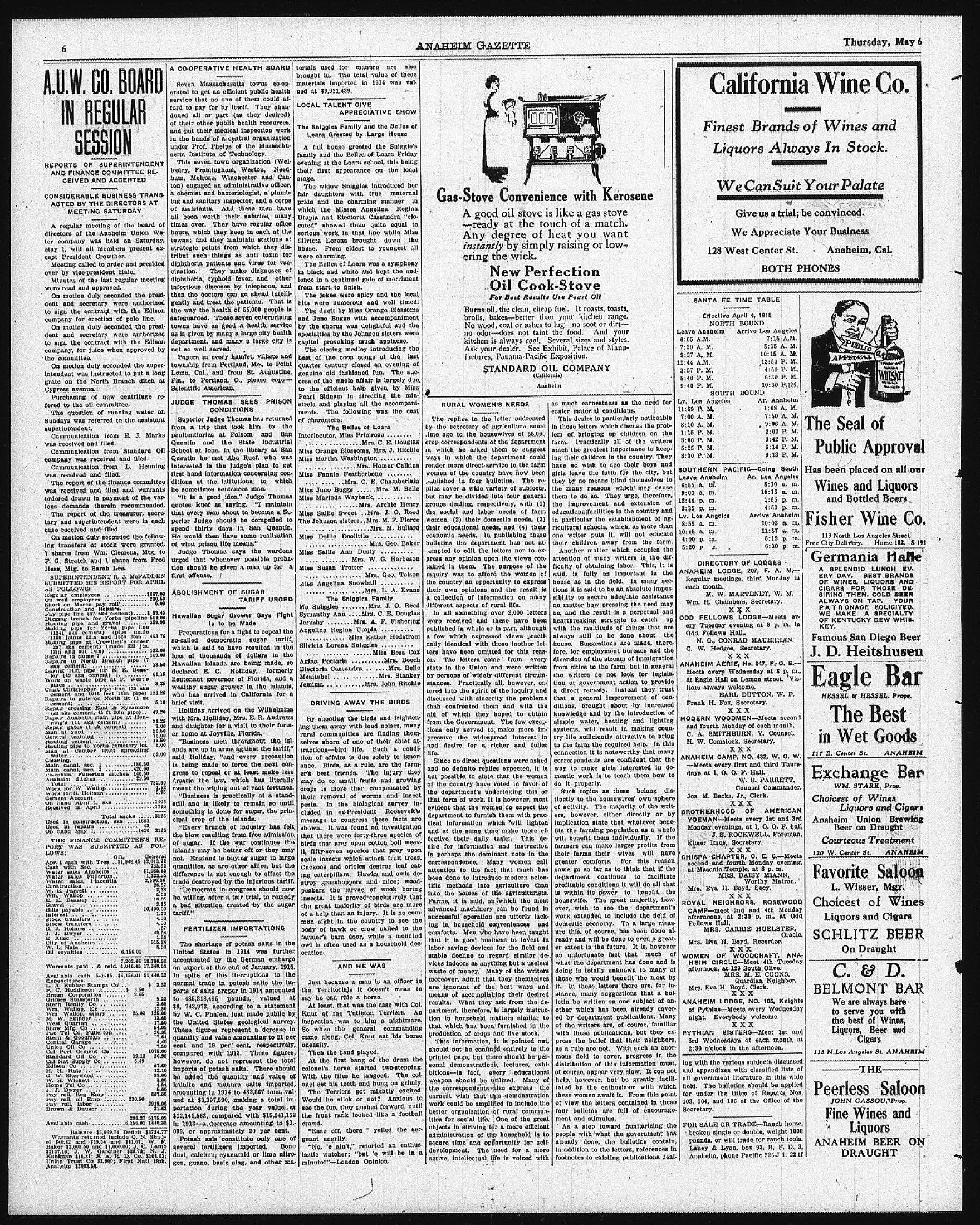
Searchable text
A.U.W. CO. BOARD IN REGULAR SESSION
REPORTS OF SUPERINTENDENT AND FINANCE COMMITTEE RECEIVED AND ACCEPTED
CONSIDERABLE BUSINESS TRANSFACTED BY THE DIRECTORS AT MEETING SATURDAY
A regular meeting of the board of directors of the Anaheim Union Water company was held on Saturday, May 1, will all members present except President Crowther.
Meeting called to order and presided over by vice-president Hale.
Minutes of the last regular meeting were read and approved.
On motion duly seconded the president and secretary were authorized to sign the contract with the Edison company for erection of pole line.
On motion duly seconded the president and secretary were authorized to sign the contract with the Edison company, for juice when approved by the committee.
On motion duly seconded the super-intendent was instructed to put a long grate on the North Branch ditch at Cypress avenue.
Purchasing of new centrifuge referred to the oil committee.
The question of running water on Sundays was referred to the assistant superintendent.
Communication from E. J. Marks was received and filed.
Communication from Standard Oil Company.
A CO-OPERATIVE HEALTH BOARD
Seven Massachusetts towns co-operated to get an efficient public health service that no one of them could afford to pay for by itself. They abandoned all or part (as they desired) of their other public health resources, and put their medical inspection work in the hands of a central organization under Prof. Phelps of the Massachusetts Institute of Technology.
This seven town organization (Wellesley, Framingham, Weston, Needham, Melrose, Winchester and Canton) engaged an administrative officer, a chemist and bacteriologist, a plumbing and sanitary inspector, and a corps of assistants. And these men have all been worth their salaries, many times over. They have regular office hours, which they keep in each of the towns; and they maintain stations at strategic points from which they distribute such things as anti toxin for diphtheria patients and virus for vaccination. They make diagnoses of diphtheria, typhoid fever, and other infectious diseases by telephone, and then the doctors can go ahead intelligently and treat the patients. That is the way the health of 55,000 people is safeguarded. These seven enterprising towns have as good a health service as is given by many a large city health department, and many a large city is not so well served.
Papers in every hamlet, village and township from Portland, Me., to Point Loma, Cal., and from St. Augustine, Fla., to Portland, O., please copy—Scientific American.
JUDGE THOMAS SEES PRISON CONDITIONS
Superior Judge Thomas has returned from a trip that took him to the penitentiaries at Folsom and San Quentin and the State Industrial School at Ione. In the library at San Francisco, he was briefed on theBUF who used materials for man-made brought in. The total materials imported used at $9,921,439.
LOCAL TALENT GIVE APPROCED
The Sniggles Family and Loara Greeted by A full house greeted family and the Belles evening at the Loara sage their first appearance stage.
The widow Sniggles fair daughters with pride and the charm which the Misses A Utopia and Electoria cuted" showed them serious work in that Silvicta Lorena broughed house. From eldest were charming.
The Belles of Loara in black and white silence in a continual gaze from start to finish.
The jokes were spilt were numerous.
The duett by Miss A Juno Buggs with by the chorus was done specialties by the John capital provoking music.
The closing medley best of the coon son quarter century close genuine old fashionedcess of the whole affair to the efficient help Pearl Sidman in dire strelts and playing allments. The following of characters:
The Belles of Interlocutor, Miss Priest...Miss Orange Blossoms...
On motion duly seconded the superintendent was instructed to put a long grate on the North Branch ditch at Cypress avenue.
Purchasing of new centrifuge referred to the oil committee.
The question of running water on Sundays was referred to the assistant superintendent.
Communication from E. J. Marks was received and filed.
Communication from Standard Oil company was received and filed.
Communication from L. Henning was received and filed.
The report of the finance committee was received and filed and warrants ordered drawn in payment of the various demands therein recommended.
The report of the treasurer, secretary and superintendent were in each case received and filed.
On motion duly seconded the following transfers of stock were granted: 7 shares from Wm. Clemens, Mtg. to F. G. Stretch and 1 share from Fred Hess, Mtg. to Sarah Lee.
SUPERINTENDENT R. J. McFADDEN SUBMITTED HIS REPORT FOR APRIL AS FOLLOWS:
Regular employees ... $667.00
Oil well employees ... 220.00
Short on March pay roll ... 5.00
Construction and Repairs.
Pay pipe line (37 sks cement) ... $9.45
Logging branch for Norla pipeline ... 504.90
Mining pipe and gravel ... 359.95
Making pipe for Yorba pipe line (1241 sks cement) (pipe made 1159 joints 22in and 1520 20in)
Making pipe for Corner's corrugated 27 sks cement) (made 223 Jts 12in and 801 14in)
Repairs to flume ... 109.00
Repairs to North Branch pipe (7 sks cement) ... 18.50
Leaving Alta pipe for E. E. Beaquet (49 sks cement) ... 61.15
Work on waste pipe at F. West's place ... 8.25
Craft Christopher pipe line (39 sks cement and kept for 14in pipe) ... 123.25
Repairs to gate on North St (1 sks cement) ... 6.10
Repair crossing East & Sycamore (23 sks cement, 46 ft 30in pipe) ... 49.20
Repair Anahalmain main pipe at Henning's plant ... 21.25
Repair gates (1 sks cement) ... 7.00
Main at yard ... 26.50
General teaming ... 76.00
Hauling cement ... 19.50
Hauling pipe to Yorba cemetery lot animal chamber tree spreading water ... 52.00
Cleaning:
Main canal, sec. 1 ... 186.50
Main canal, sec. 2 ... 420.00
Fuccunion pitches on ditches ... 146.50
Anahalmain ditches ... 29.50
Total ... 782.50
Work for W. Wallop ... 1.92
Work for S. Holman ... 6.75
Cement Account ... 8.00
Utility April 1, sks ... 1406
Received in April ... 1720
Total sacks ... 3126
Used in construction, sks ... 1663
Used in repairs ... 42
On hand May I ... 1420
THE FINANCE COMMITTEE'S REPORT WAS SUBMITTED AS FOLLOWS:
OIL General Apr.1 cash with Tres... $1,946.45 $2,013.72
JUDGE THOMAS SEES PRISON CONDITIONS
Superior Judge Thomas has returned from a trip that took him to the penitentiaries at Folsom and San Quentin and the State Industrial School at Ione. In the library at San Quentin he met Abe Ruef, who was interested in the judge's plan to get first hand information concerning conditions at the institutions to which he sometimes sentences men.
"It is a good idea," Judge Thomas quotes Ruef as saying. "I maintain that every man about to become a Superior Judge should be compelled to spend thirty days in San Quentin. He would then have some realization of what prison life means."
Judge Thomas says the wardens urged that whenever possible probation should be given a man up for a first offense.
ABOLISHMENT OF SUGAR TARIFF URGED
Hawaiian Sugar Grower Says Fight is to be Made
Preparations for a fight to repeal the so-called democratic sugar tariff, which is said to have resulted in the loss of thousands of dollars in the Hawaiian islands are being made, so declared E. C. Holliday, formerly lieutenant governor of Florida, and a wealthy sugar grower in the islands, who has arrived in California for a brief visit.
Holliday arrived on the Wilhelmina with Mrs. Holliday, Mrs. E. R. Andrews and daughter for a visit to their former home at Joyville, Florida.
"Businessmen throughout the islands are up in arms against the tariff," said Holiday, "and every precaution is being made to force the next congress to repeal or at least make less drastic the law, which has literally meant the wilping out of vast fortunes."
"Business is practically at a standstill and is likely to remain so until something is done for sugar, the principal crop of the islands."
Every branch of industry has felt the blow resulting from free admission of sugar. If the war continues the islands may be better off or they may not. England is buying sugar in large quantities as are other allies but the township from Portland, Me., to Point Loma, Cal., and from St Augustine, Fla., to Portland, O., please copy—Scientific American.
JUDGE THOMAS SEES PRISON CONDITIONS
Superior Judge Thomas has returned from a trip that took him to the penitentiaries at Folsom and San Quentin and the State Industrial School at Ione. In the library at San Quentin he met Abe Ruef, who was interested in the judge's plan to get first hand information concerning conditions at the institutions to which he sometimes sentences men.
"It is a good idea," Judge Thomas quotes Ruef as saying. "I maintain that every man about to become a Superior Judge should be compelled to spend thirty days in San Quentin. He would then have some realization of what prison life means."
Judge Thomas says the wardens urged that whenever possible probation should be given a man up for a first offense.
ABOLISHMENT OF SUGAR TARIFF URGED
Hawaiian Sugar Grower Says Fight is to be Made
Preparations for a fight to repeal the so-called democratic sugar tariff, which is said to have resulted in the loss of thousands of dollars in the Hawaiian islands are being made, so declared E. C. Holliday, formerly lieutenant governor of Florida, and a wealthy sugar grower in the islands, who has arrived in California for a brief visit.
Holliday arrived on the Wilhelmina with Mrs. Holliday, Mrs. E. R. Andrews and daughter for a visit to their former home at Joyville, Florida.
"Businessmen throughout the islands are up in arms against the tariff," said Holiday, "and every precaution is being made to force the next congress to repeal or at least make less drastic the law, which has literally meant the wilping out of vast fortunes."
"Business is practically at a standstill and is likely to remain so until something is done for sugar, the principal crop of the islands."
Every branch of industry has felt the blow resulting from free admission of sugar. If the war continues the islands may be better off or they may not. England is buying sugar in large quantities as are other allies but the township from Portland, Me., to Point Loma, Cal., and from St Augustine, Fla., to Portland, O., please copy—Scientific American.
DRIVING AWAY
By shooting the blinkening them away with rural communities as selves shorn of one traction—bird life, traction of affairs is dueance. Birds, as a ruler's best friends, may do to small fricks crops is more than their removal of worms.
In the blobs cluded in ex-President message to congress shown. It was found that there were forty birds that prey upon it, fifty-seven species scale insects which...
Main canal, sec. 2 ... 420.50
Fluentia, Fulerton ditches 146.50
Anamalit ditches ... 22.50
Total ... 782.50
Work for W. Wallop ... 1.92
Work for S. Holman ... 6.75
Cement Account ... 1406
On hand April 1, sks ... 1720
Received in April ... 1720
Total sacks ... 3126
Used in construction, sks ... 1683
Used in repairs ... 43
On hand May 1 ... 3126
THE FINANCE COMMITTEE'S REPORT WAS SUBMITTED AS FOLLOWS:
OIL General
Apr. I cash with Tres $1,046.45 $2,013.72
Cash with Sec. ... 733.52
Water sales Anaheim ... $1,096.56
Water sales Pelletton ... 1,223.95
Water sales, Placentia ... 2,596.36
Construction ... 26.57
W. B. Parrett ... 2.38
Wm. Wallop ... 6.50
E. E. Beasley ... 19.75
Gravel ... 2.15
Bills payable ... 10,400.00
Interest ... 1.70
Stock transfers ... 4.00
Stock transfers ... 4.00
G. J. Holmes ... 7.7
J. J. Dwyer ... 49.54
E. Allee ... 1.50
City of Anaheim ... 515.24
W. L. Hale ... 8.50
Oil royalties ... 6,156.01
Warrants paid & retd. 1,046.45 17,340.53
Available cash 5-1-15... $6,156.01 $1,440.32
J.M. Huber Stamps Co ... $3.22
R.C. Huddlesson ... $3.50
Braun Corporation ... 2.65
Grimes Stassforth ... 9.23
Stern Reality Co ... 2.68
Wm. Wallop, Ex ... 12.86
Wm. Walnut Palary ... 25.00 125.00
M.W. Skinner ... 13.65
West Quarton ... 17.50
Snow Mfg. Co ... 64.05
Pac Tel Co, Fullerton ... 26.35
Stern & Goodman ... 7.44
Central Georgia ... 4.40
Union Oil Co ... 7.50
Cal Port Cement Co ... 1075.00
Standard Oil Co ... 19.13 36.38
Cal Nat Supply Co ... 5.49
Edison Co ... 67.60
M.H. Hale ... 12.10
G.W. Sherwood ... 89.00
W.H. Wickett ... 3.00
Home Tel Co ... 4.54
J.J.Dwyer ... 6.00
Pay roll Reg Emp ... 667.00
Pay roll Oil Emp ... 230.50
Pay roll labor ... 2919.06
Brown & Dauer ... 21.63
Balance $5,869.74 Defect $3734.77
Warrants returned include Q.N.Shadel $40.82 and $39.54 and $41.07; W.F.Baker $2,008.50 and $1,000.00; J.C.Lamb $2,089.W.Gardiner $90.73; N.J.Kahlman $18.81; S.A.R.D.Co.$164.03;
Union Trust Co $3,000; First Natl Bnk,Anaheim $3,088.50.
gress to repeal or at least make less drastic the law, which has literally meant the wilping out of vast fortunes.
"Business is practically at a standstill and is likely to remain so until something is done for sugar, the principal crop of the islands.
"Every branch of industry has felt the blow resulting from free admission of sugar. If the war continues the islands may be better off or they may not England is buying sugar in large quantities, as are other allies, but the difference is not enough to offset the trade destroyed by the injurious tariff.
"Democrats in congress should now be willing, after a fair trial, to remedy a bad situation created by the sugar tariff."
FERTILIZER IMPORTATIONS
The shortage of potash salts in the United States in 1914 was further accentuated by the German embargo on export at the end of January, 1915.
In spite of the iterations to the normal trade in potash salts the imports of salts proper in 1914 amounted to 485,818,495 pounds, valued at $8,743,973, according to a statement by W.C.Phalen, just made public by the United States geological survey.
These figures represent a decrease in quantity and value amounting to 21 per cent and 19 per cent, respectively, compared with 1913.
These figures, however, do not represent the total imports of potash salts There should be added the quantity and value of kainite and manure salts imported, amounting in 1914 to 482,867 tons, valued at $3,397,590, making a total importation during the year value at $12,141,563, compared with $15,241,152 in 1913—a decrease amounting to $3,099, or approximately 20 per cent.
Potash salts constitute only one of several fertilizers imported.
Bone dust, calcium cyanamid or lime nitrogen, guano, basic slag, and other materials best friends may do to small farms crops is more than their removal of worms.
In the bloccluded in ex-President message to congress shown.
It was found that there were forty birds that prey upon all fifty-seven species scale insects which Cuckoo and orioles ing caterpillars.
Hastroy grasshoppers peckers the larvae in insects It is proved the great majority of of a help than an infusion sight in the body of hawk or crab farmer's barn door owl is often used as oration.
AND HEALTH
Just because a man the Territorialists it say he can ride a horse At least that was Knot of the Tutleins inspection was to lo So when the genie came along Col.K.Kune easily.
Then the band plays At the first bang colonel's horse stands With the fives he touches onel set his teeth and The Terriers got Would he stick or see the fun they push the front rank look crowd.
"Ease off, there geant angrily.
"No,' e aln't,' re lactic watcher; 'bus minute!"—London O
ANAHEIM GAZETTE
LOCAL TALENT GIVE
APPRECIATIVE SHOW
The Sniggles Family and the Belles of Loara Greeted by Large House
A full house greeted the Sniggle's family and the Belles of Loara Friday evening at the Loara school, this being their first appearance on the local stage.
The widow Sniggles introduced her fair daughters with true maternal pride and the charming manner in which the Misses Angellina Regina Utopia and Electoria Cassandra "elocuted" showed them quite equal to serious work in that line while Miss Silvicta Lorena brought down the house. From eldest to youngest all were charming.
The Belles of Loara was a symphony in black and white and kept the audience in a continual gale of merriment from start to finish.
The jokes were spicy and the local hits were numerous and well timed.
The duett by Miss Orange Blossoms and Juno Buggs with accompaniment by the chorus was delightful and the specialties by the Johnson sisters were capital provoking much applause.
The closing modley introducing the best of the coon songs of the last quarter century closed an evening of genuine old fashioned fun. The success of the whole affair is largely due to the efficient help given by Miss Pearl Sidnam in directing the minstrels and playing all the accompaniments. The following was the cast of characters:
The Belles of Loara
Interlocutor, Miss Primrose ...
Mrs. C. E. Douglas
Miss Orange Blossoms, Mrs. J. Ritchie
Gas-Stove Convenience with Kerosene
A good oil stove is like a gas stove —ready at the touch of a match. Any degree of heat you want instantly by simply raising or lowering the wick.
New Perfection Oil Cook-Stove
For Best Results Use Pearl Oil
Burns oil, the clean, cheap fuel. It roasts, toasts, broils, bakes—better than your kitchen range. No wood, coal or ashes to lug—no soot or dirt—no odor—does not taint the food. And your kitchen is always cool. Several sizes and styles. Ask your dealer. See Exhibit, Palace of Manufactures, Panama-Pacific Exposition.
STANDARD OIL COMPANY
(California)
Analiese
RURAL WOMEN'S NEEDS
The replies to the letter addressed by the secretary of agriculture some time ago to the housewives of 55,000 crop correspondents of the department in which he asked them to suggest as much earnestness as the need for easier material conditions.
This desire is particularly noticeable in those letters which discuss the problem of bringing up children on the farm. Practically all of the writers attach the greatest importance to keeping their children in the country.
quarter century closed an evening of genuine old fashioned fun. The success of the whole affair is largely due to the efficient help given by Miss Pearl Sidnam in directing the minstrels and playing all the accompaniments. The following was the cast of characters:
The Belles of Loara
Interlocutor, Miss Primrose ...
Mrs. C. E. Douglas
Miss Orange Blossoms, Mrs. J. Ritchie
Miss Martha Washington ...
Mrs. Homer Calkins
Miss Fannie Featherbone ...
Mrs. C. E. Chamberlain
Miss Juno Buggs ... Mrs. M. Belle
Miss Marinda Wayback ...
Mrs. Archie Henry
Miss Sallie Sweet ... Mrs. J. O. Reed
The Johnson sisters... Mrs. M. F. Pierce ...
Mrs. M. Bullard
Miss Dollle Doolittle ...
Mrs. Geo. Baker
Miss Sallie Ann Dusty ...
Mrs. W. G. Harbeson
Miss Susan Trotter ...
Mrs. Geo. Tolson
Miss Angelina Snowball ...
Mrs. L. A. Evans
The Sniggles Family
Ma Sniggle ... Mrs. J. O. Reed
Symanthy Ann ... Mrs. C. E. Douglas
Jerushy ... Mrs. A. F. Fishering
Angelina Regina Utopia ...
Miss Esther Hedatrom
Silvicta Lorena Sniggle ...
Miss Bess Cox
Agina Pectoris ... Mrs. Beech
Electoria Cassandra ... Mrs. Belle
Meaitabel ... Mrs. Stankey
Jemima ... Mrs. John Ritchle
DRIVING AWAY THE BIRDS
By shooting the birds and frightening them away with loud noises, many rural communities are finding themselves shorn of one of their chief attractions—bird life. Such a condition of affairs is due solely to ignorance. Birds, as a rule, are the farmer's best friends. The injury they may do to small fruits and growing crops is more than compensated by their removal of worms and insect posts. In the biological survey included in ex-President Roosevelt's message to congress these facts are shown. It was found on investigation that there were forty-three species of birds that prey upon cotton boll weevil, fifty-seven species that prey upon scale insects which attack fruit trees, and another destroy leaf eat.
RURAL WOMEN'S NEEDS
The replies to the letter addressed by the secretary of agriculture some time ago to the housewives of 55,000 crop correspondents of the department in which he asked them to suggest ways in which the department could render more direct service to the farm women of the country have now been published in four bulletins. The replies cover a wide variety of subjects, but may be divided into four general groups dealing, respectively, with (1) the social and labor needs of farm women, (2) their domestic needs, (3) their educational needs, and (4) their economic needs. In publishing these bulletins the department has not attempted to edit the letters nor to express any opinion upon the views contained in them. The purpose of the inquiry was to afford the women of the country an opportunity to express their own opinions and the result is a collection of information on many different aspects of rural life.
In all something over 2,000 letters were received and these have been published in whole or in part, although a few which expressed views practically identical with those other letters have been omitted for this reason. The letters come from every state in the Union and were written by persons of widely different circumstances. Practically all, however, entered into the spirit of the inquiry and discussed with sincerity the problems that confronted them and with the aid of which they hoped to obtain from the Government. The few exceptions only served to make more impressive the widespread interest in and desire for a richer and fuller life.
Since no direct questions were asked and no definite replies expected, it is not possible to state that the women of the country have voted in favor of the department's undertaking this or that form of work. It is however, most evident that the women do expect the department to furnish them with practical information which will lighten and at the same time make more effective their daily tasks. This desire for information and instruction is perhaps the dominant note in the correspondence. Many women call as much earnestness as the need for easier material conditions.
This desire is particularly noticeable in those letters which discuss the problem of bringing up children on the farm. Practically all of the writers attach the greatest importance to keeping their children in the country. They have no wish to see their boys and girls leave the farm for the city, but they by no means blind themselves to the many reasons which may cause them to do so. They urge, therefore, the improvement and extension of educational facilities in the country and in particular the establishment of agricultural schools, which, as more than one writer puts it, will not educate their children away from the farm.
Another matter which occupies the attention of many writers is the difficulty of obtaining labor. This, it is said, is fully as important in the house as in the field. In many sections it is said to be an absolute impossibility to secure adequate assistance no matter how pressing the need may be, and the result is a perpetual and heartbreaking struggle to catch up with the multitude of things that are always still to be done about the house. Suggestions are made, therefore, for employment bureau and the diversion of the stream of immigration from cities to the farm, but in general the writers do not look for legislation or government action to provide a direct remedy. Instead they trust that a general improvement of conditions, brought about by increased knowledge and by the introduction of simple water, heating and lighting systems, will result in making country life sufficiently attractive to bring to the farm the required help. In this connection it is noteworthy that many correspondents are confident that the way to make girls interested in domestic work is to teach them how to do it properly.
Such topics as these belong distinctly to the housewives' own sphere of activity. The majority of the writers, however, either directly or by implication state that whatever benefits the farming population as a whole will benefit them individually. If the farmers can make larger profits from their farms their wives will have greater comforts. For this reason
or's best friends. The injury they may do to small fruits and growing crops is more than compensated by their removal of worms and insect pests. In the biological survey included in ex-President Roosevelt's message to congress these facts are shown. It was found on investigation that there were forty-three species of birds that prey upon cotton boll weevil, fifty-seven species that prey upon scale insects which attack fruit trees. Cuckoos and orioles destroy leaf eating caterpillars. Hawks and owls destroy grasshoppers and mice; woodpeckers the larvae of wook boring insects. It is proved conclusively that the great majority of birds are more of a help than an injury. It is no common sight in the country to see the body of hawk or crow nailed to the farmer's barn door, while a mounted owl is often used as a household decoration.
AND HE WAS
Just because a man is an officer in the Territorials it doesn't mean to say he can ride a horse.
At least, that was the case with Col. Knut of the Tutleton Terriers. An inspection was to him a nightmare. So when the general command came along, Col. Knut sat his horse uneasily.
Then the band played.
At the first bang of the drum the colonel's horse started two stepping. With the fives he tangged. The colonel set his teeth and hung on grimly.
The Terriers got mightly excited. Would be stick or not? Anxious to see the fun, they pushed forward, until the front rank looked like a football crowd.
"Ease off, there " yelled the sergeant angrily.
"No, 'e ain't," retorted an enthusiastic watcher; "but 'e will be in a minute!"—London Opinion.
This information, it is pointed out, should not be confined entirely to the printed page, but there should be personal demonstrations, lectures, exhibitions—in fact, every educational weapon should be utilized. Many of the correspondents also express the earnest wish that this demonstration work could be amplified to include the better organization of rural communities for social life. One of the great objects in striving for a more efficient administration of the household is to secure time and opportunity for self-development. The need for a more active, intellectual life is volced with no doubt replies expected, it is not possible to state that the women of the country have voted in favor of the department's undertaking this or that form of work. It is however, most evident that the women do expect the department to furnish them with practical information which will lighten and at the same time make more effective their daily tasks. This desire for information and instruction is perhaps the dominant note in the correspondence. Many women call attention to the fact that much has been done to introduce modern scientific methods into agriculture than into the homes of the agriculturists. Farms, it is said, on which the most advanced machinery can be found in successful operation are utterly lacking in household conveniences and comforts. Men who have been taught that it is good business to invest in labor saving devices for the field and stable decline to regard similar devices indoors as anything but a useless waste of money. Many of the writers moreover, admit that they themselves are ignorant of the best ways and means of accomplishing their desired results. What they ask from the department, therefore, is largely instruction in household matters similar to that which has been furnished in the production of crops and live stock.
This information, it is pointed out, should not be confined entirely to the printed page, but there should be personal demonstrations, lectures, exhibitions—in fact, every educational weapon should be utilized. Many of the correspondents also express the earnest wish that this demonstration work could be amplified to include the better organization of rural communities for social life. One of the great objects in striving for a more efficient administration of the household is to secure time and opportunity for self-development. The need for a more active, intellectual life is volced with no doubt replies expected, it is not possible to state that the women of the country have voted in favor of the department's undertaking this or that form of work. It is however, most evident that the women do expect the department to furnish them with practical information which will lighten and at the same time make more effective their daily tasks. This desire for information and instruction is perhaps the dominant note in the correspondence. Many women call attention to the fact that much has been done to introduce modern scientific methods into agriculture than into the homes of the agriculturists. Farms, it is said, on which the most advanced machinery can be found in successful operation are utterly lacking in household conveniences and comforts. Men who have been taught that it is good business to invest in labor saving devices for the field and stable decline to regard similar devices indoors as anything but a useless waste of money. Many of the writers moreover, admit that they themselves are ignorant of the best ways and means of accomplishting their desired results. What they ask from the department, therefore, is largely instruction in household matters similar to that which has been furnished in the production of crops and live stock.
This information, it is pointed out, should not be confined entirely to the printed page, but there should be personal demonstrations, lectures, exhibitions—in fact, every educational weapon should be utilized. Many of the correspondents also express the earnest wish that this demonstration work could be amplified to include the better organization of rural communities for social life. One of the great objects in striving for a more efficient administration of the household is to secure time and opportunity for self-development. The need for a more active, intellectual life is volced with no doubt replies expected, it is not possible to state that the women of the country have voted in favor of the department's undertaking this or that form of work. It is however, most evident that the women do expect the department to furnish them with practical information which will lighten and at the same time make more effective their daily tasks. This desire for information and instruction is perhaps the dominant note in the correspondence. Many women call attention to the fact that much has been done to introduce modern scientific methods into agriculture than into the homes of the agriculturists. Farms, it is said, on which the most advanced machinery can be found in successful operation are utterly lacking in household conveniences and comforts. Men who have been taught that it is good business to invest in labor saving devices for the field and stable decline to regard similar devices indoors as anything but a useless waste of money. Many of the writers moreover, admit that they themselves are ignorant of the best ways and means of accomplishting their desired results. What they ask from the department, therefore, is largely instruction in household matters similar to that which has been furnished in the production of crops and live stock.
This information, it is pointed out, should not be confined entirely to the printed page, but there should be personal demonstrations, lectures, exhibitions—in fact, every educational weapon should be utilized. Many of the correspondents also express the earnest wish that this demonstration work could be amplified to include the better organization of rural communities for social life. One of the great objects in striving for a more efficient administration of the household is to secure time and opportunity for self-development. The need for a more active, intellectual life is volced with no doubt replies expected, it is not possible to state that the women of the country have voted in favor of the department's undertaking this or that form of work. It is however, most evident that the women do expect the department to furnish them with practical information which will lighten and at the same time make more effective their daily tasks. This desire for information and instruction is perhaps the dominant note in the correspondence. Many women call attention to the fact that much has been done to introduce modern scientific methods into agriculture than into the homes of the agriculturists. Farms, it is said, on which the most advanced machinery can be found in successful operation are utterly lacking in household conveniences and comforts. Men who have been taught that it is good business to invest in labor saving devices for the field and stable decline to regard similar devices indoors as anything but a useless waste of money. Many of the writers moreover, admit that they themselves are ignorant of the best ways and means of accomplishting their desired results. What they ask from the department, therefore, is largely instruction in household matters similar to that which has been furnished in the production of crops and live stock.
This information, it is pointed out, should not be confined entirely to the printed page, but there should be personal demonstrations, lectures, exhibitions—in fact, every educational weapon should be utilized. Many of the correspondents also express the earnest wish that this demonstration work could be amplified to include the better organization of rural communities for social life. One of the great objects in striving for a more efficient administration of the household is to secure time and opportunity for self-development. The need for a more active, intellectual life is volced with no doubt replies expected, it is not possible to state that the women of the country have voted in favor of the department's undertaking this or that form of work. It is however, most evident that the women do expect the department to furnish them with practical information which will lighten and at the same time make more effective their daily tasks. This desire for information and instruction is perhaps the dominant note in the correspondence. Many women call attention to the fact that much has been done to introduce modern scientific methods into agriculture than into the homes of the agriculturists. Farms, it is said, on which the most advanced machinery can be found in successful operation are utterly lacking in household conveniences and comforts. Men who have been taught that it is good business to invest in labor saving devices for the field and stable decline to regard similar devices indoors as anything but a useless waste of money. Many of the writers moreover, admit that they themselves are ignorant of the best ways and means of accomplishting their desired results. What they ask from the department, therefore, is largely instruction in household matters similar to that which has been furnished in the production of crops and live stock.
This information, it is pointed out, should not be confined entirely to the printed page, but there should be personal demonstrations, lectures, exhibitions—in fact, every educational weapon should be utilized. Many ofthe correspondents also expressthe earnest wishthatthisdemonstrationworkcouldbeamplifiedtoincludethebetterorganizationofruralcommunitiesforsociallife.Oneofthegreatobjectsinstrivingforamoreefficientadministrationofthehouseholdistosecuretimeandopportunityforself-development.Theneedforamoreactive,intellectuallifewisolvedwithno doubtrepliesexpected.itisnotpossibleto坐 directlytothehousewives'ownsphereofactivity.Themajorityofthewritershowever,eitherdirectlyorbyimplicationstatethatwhateverbenefitsthefarmingpopulationasawholewillbenefittheindividuals.Ifthefarmerscanmakelargerprofitsfromtheirfarmstheirwiveswillhavegreatercomforts.Forthisreasonsomego so farastothinkthatiffthedepartmentcontinutesfacilitateprofitableconditionsitwilldoallthatiswithinitspowertobenefitthehousewife.Thegreatmajority,however,s wishtoseethedepartment'sworkextendedtoincludethefieldofdomestic economy.Toalargemeasurethis,fourseasonhasbeenedalreadyandwillbedoneevenagreaterextentinthefuture.Ishowanunfortunatefactthatmuchofwhatthedepartmenthasdoneandisdoingistotallyunknowntomanyofthosewhowouldbenefitthemostbyit.Intheselettersthereare,forsinstance,many suggestionsthatabulletinbewrittenononesubjectofanotherwhichhasbeenalreadycoveredbydepartmentpublications.Manyofthewritersare,ofcourse,familiarwiththesepublications,但theyexpressthebeliefthattheirneighbors,as Rulearenot.Withsuchan enormousfieldtocover,progressinthedistributionthisinformationmustofcourseappearverylowItconnothelp,however,bethegreatfacilitatedbytheenthusiasmwithwhichthesewomenawaitit.Fromthispointofviewtheletterscontainedinthesefourbulletnsarefullofencouragementandstimulus.Asastesteptowardfamiliarizingthepeoplewithwhatthegovernmenthasalreadydone,thebulletinscontainInadditiontotheletters.referencesinfootnotestoexistingpublicationsdeal-
California Wine Co.
Finest Brands of Wines and
Liquors Always In Stock.
We Can Suit Your Palate
Give us a trial; be convinced.
We Appreciate Your Business
128 West Center St. Anaheim, Cal.
BOTH PHONES
SANTA FE TIME TABLE
Effective April 4, 1915
NORTH BOUND
Leave Anaheim Arrive Los Angeles
6:05 A.M. 7:15 A.M.
7:20 A.M. 8:15 A.M.
9:27 A.M. 10:15 A.M.
11:44 A.M. 12:50 P.M.
3:57 P.M. 4:50 P.M.
5:40 P.M. 6:30 P.M.
9:40 P.M. 10:30 P.M.
SOUTH BOUND
Lv. Los Angeles Ar. Anaheim
11:59 P.M. 1:08 A.M.
7:00 A.M. 7:50 A.M.
8:10 A.M. 9:06 A.M.
1:15 P.M. 2:02 P.M.
3:00 P.M. 3:42 P.M.
5:25 P.M. 6:14 P.M.
8:30 P.M. 9:13 P.M.
The Seal of Public Approval
as the need for
conditions.
particularly noticeable
which discuss the probchildren on the
all of the writers
importance to keep
the country. They
seize their boys and
for the city, but bind themselves to
which may cause
they urge, therefore,
and extension of
in the country and
establishment of agwhich, as more than
will not educate
from the farm.
which occupies the
writers is the diflabor. This, it is
important in the
old. In many secon an absolute imposdequate assistance
using the need may
is a perpetual and
toggle to catch up
of things that are
done about the
are made, theretent bureaus and the
team of immigration
arm, but in general
it look for legislataction to provide
Instead they trust
improvement of conbout by increased
the introduction of
telling and lighting
in making counattractive to bring
required help. In this
newworthy that many
confident that the
interested in doteach them how to
these belong distwives' own sphere
majority of the writer directly or by
what whatever benepopulation as a whole
individually. If the
larger profits from
wives will have
For this reason
11:44 A.M. 12:50 P.M.
3:57 P.M. 4:50 P.M.
5:40 P.M. 6:30 P.M.
9:40 P.M. 10:30 P.M.
SOUTH BOUND
Lv. Los Angeles Ar. Anaheim
11:59 P.M. 1:08 A.M.
7:00 A.M. 7:50 A.M.
8:10 A.M. 9:06 A.M.
1:15 P.M. 2:02 P.M.
3:00 P.M. 3:42 P.M.
5:25 P.M. 6:14 P.M.
8:30 P.M. 9:13 P.M.
SOUTHERN PACIFIC—Going South
Leave Anaheim Ar. Los Angeles
6:55 a.m. 8:10 a.m.
9:00 a.m. 10:15 a.m.
12:44 p.m. 1:55 p.m.
3:35 p.m. 4:50 p.m.
Lv. Los Angeles Arrive Anaheim
8:55 a.m. 10:02 a.m.
10:45 a.m. 11:57 a.m.
4:00 p.m. 5:12 p.m.
5:20 p.m. 6:30 p.m.
DIRECTORY OF LODGES
ANAHEIM LODGE, 207, F. A. M.—Regular meetings, third Monday in each month.
M. W. MARTENET, W. M.
Wm. H. Chambers, Secretary.
XX X
ODD FELLOWS LODGE—Meets every Tuesday evening at 8 p.m. in Odd Fellows Hall.
N. G., CONRAD MAUERHAN.
C. W. Hedges, Secretary.
XX X
ANAHEIM AERIE, No. 947, F. O. E.—Meets every Wednesday at 8 p.m., at Eagle Hall on Lemon street. Visitors always welcome.
EARL DUTTON, W. P.
Frank H. Fox, Secretary.
XX X
MODERN WOODMEN—Meets second and fourth Monday of each month.
C. A. SMITHBURN, V. Counsel.
H. W. Comstock, Secretary.
XX X
ANAHEIM CAMP, NO. 432, W. O. W.—Meets every first and third Thursdays at I. O. O. F. Hall.
W. B. PARRETT, Counsel Commander.
Jos. M. Backs, Jr., Clerk.
XX X
BROTHERHOOD OF AMERICAN YOEMAN—Meets every 1st and 3rd Monday evenings, at I. O. O. F. hall J. S. ROCKWELL, Foreman.
Elmer Imus, Secretary.
XX X
CHISPA CHAPTER, O. E. S.—Meets second and fourth Monday evening.
The Seal of Public Approval
Has been placed on all our Wines and Liquors and Bottled Beers
Fisher Wine Co.
119 North Los Angeles Street.
Free City Delivery.
Germania Hall
A SPLENDID LUNCH EVEY DAY. BEST BRANDS OF WINES, LIQUORS AND CIGARS FOR THOSE DESIRING THEM. COLD BEER ALWAYS ON TAP.YOUR PATRONAGE SOLICITED.WE MAKE A SPECIALTY OF KENTUCKY DEW WHISKEY.
Famous San Diego Beer
J. D. Heitshusen
Eagle Bar
HESSEL & HESSEL, Props.
The Best in Wet Goods
117 E. Center St.
Exchange Bar
WM. STARK, Prop.
Choicest of Wines
Liquors and Cigars
Anaheim Union Brewing Beer on Draught
Courteous Treatment
120 W. Center St.
ANAHEIM
these belong disselves' own sphere
majority of the writter directly or by
what whatever benepopulation as a whole
individually. If the
larger profits from
wives will have
For this reason
to think that if the
nues to facilitate
it will do all that
or to benefit the
great majority, howthe department's
include the field of
To a large meashas been done alone to even a greatture. It is, however
that much of
ment has done and is
unknown to many of
benefit the most by
there are, for ingestions that a bulone subject of anbeen already coverpublications. Many
of course, familiar
instations, but they extain their neighbors,
With such an enorger, progress in the
information must,
very slow. It con not
't be greatly faciliusiasm with which
It. From this point
contained in these
full of encouragerd familiarizing the
government has
bulletins contain,
letters, references in
publications deal-
days at I. O. O. F. Hall.
W. B. PARRETT,
Counsel Commander.
Jos. M. Backs, Jr., Clerk.
XX X
BROTHERHOOD OF AMERICAN
YOEMAN—Meets every 1st and 3rd Monday evenings, at I. O. O. F. hall.
J. S. ROCKWELL, Foreman.
Elmer Imus, Secretary.
XX X
CHISPA CHAPTER, O. E. S.—Meets second and fourth Monday evening,
at Masonic Temple, at 8 p.m.
MRS. DAISY MIANN,
Worthy Matron.
Mrs. Eva H. Boyd, Secy.
XX X
ROYAL NEIGHBORS, ROSEWOOD CAMP—meet 2nd and 4th Monday afternoons, at 2:30 p.m., at Odd Fellows Hall.
MRS. CARRIE HUELSTER,
Oracle.
Mrs. Eva H. Boyd, Recorder.
XX X
WOMEN OF WOODCRAFT, ANAHEIM CIRCLE—Meet 4th Tuesday afternoon, at 129 South Olive.
MRS. M. E. COONS,
Guardian Neighbor.
Mrs. Eva H. Boyd, Clerk.
XX X
ANAHEIM LODGE, NO. 105, Knights of Pythias—Meets every Wednesday night. Everybody welcome.
XX X
PYTHIAN SISTERS—Meet 1st and 3rd Wednesdays of each month at 2:30 o'clock in the afternoon.
ing with the various subjects discussed,
and appendixes with classified lists of all government literature in this wide field. The bulletins should be applied for under the titles of Reports Nos.
103, 104, and 106 of the Office of the Secretary.
FOR SALE OR TRADE—Ranch horse,
broken single or double, weight 1000 pounds, or will trade for ranch tools.
Laney & Lyon, box 93, R. F. D. 3,
Anaheim, phone Pacific 225-J 1. 22-tf
Exchange Bar
WM. STARK, Prop.
Choicest of Wines
Liquors and Cigars
Anaheim Union Brewing
Beer on Draught
Courteous Treatment
120 W. Center St. ANAHEIM
Favorite Saloon
L. Wisser, Mgr.
Choicest of Wines
Liquors and Cigars
SCHLITZ BEER On Draught
C. & D.
BELMONT BAR
We are always here to serve you with the best of Wines,
Liquors, Beer and Cigars
115 N.Los Angeles St. ANAHEIM
THE
Peerless Saloon
JOHN CASSOU,'Prop.
Fine Wines and Liquors
ANAHEIM BEER ON DRAUGHT