anaheim-gazette 1915-04-08
Scanned page
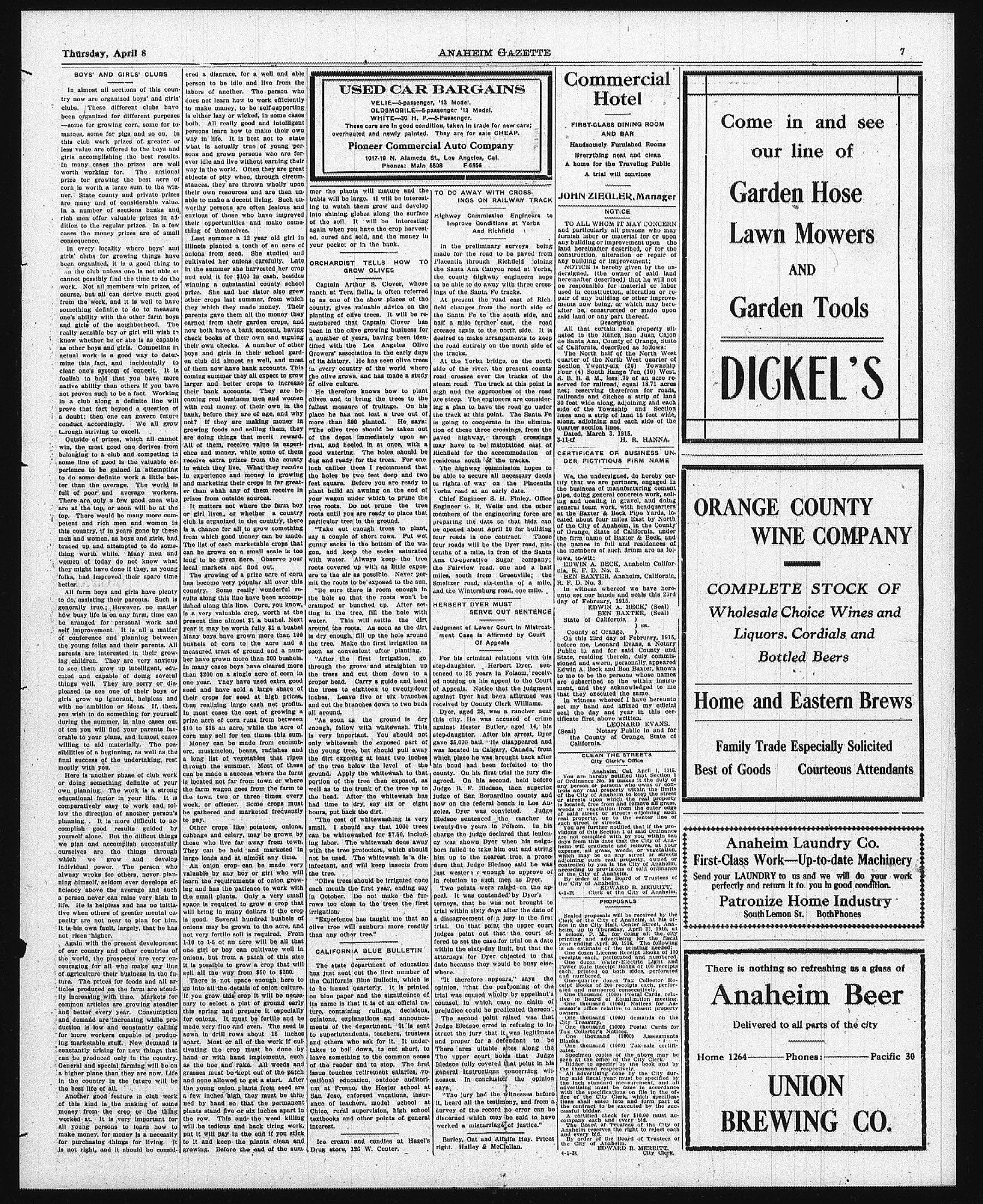
Searchable text
BOYS' AND GIRLS' CLUBS
In almost all sections of this country now are organized boys' and girls' clubs. These different clubs have been organized for different purposes—some for growing corn, some for tomatoes, some for pigs and so on. In this club work prizes of greater or less value are offered to the boys and girls accomplishing the best results. In many cases the prizes are well worth working for. The national prize for growing the best acre of corn is worth a large sum to the winner. State county and private prizes are many and of considerable value. In a number of sections banks and rich men offer valuable prizes in addition to the regular prizes. In a few cases the money prizes are of small consequence.
In every locality where boys' and girls' clubs for growing things have been organized, it is a good thing to the club unless one is not able or cannot possibly find the time to do the work. Not all members win prizes, of course, but all can derive much good from the work, and it is well to have something definite to do to measure one's ability with the other farm boys and girls of the neighborhood. The really sensible boy or girl will wish to know whether he or she is as capable as other boys and girls. Competing in actual work is a good way to determine this fact, and incidentally to clear one's system of conceit. It is foolish to hold that you have more native ability than others if you have not proven such to be a fact. Working in a club along a definite line will prove that fact beyond a question of a doubt; then one can govern future conduct accordingly. We all grow through striving to excel.
Outside of prizes, which all cannot win, the most good one derives from ered a disgrace, for a well and able person to be idle and live from the labors of another. The person who does not learn how to work efficiently to make many, to be self-supporting is either lazy or wicked, in some cases both. All really good and intelligent persons learn how to make their own way in life. It is best not to state what is actually true of young persons and grown persons who are forever idle and live without earning their way in the world. Often they are great objects of pity when, through circumstances, they are thrown wholly upon their own resources and are then unable to make a decent living. Such unworthy persons are often jealous and envious of those who have improved their opportunities and make something of themselves.
Last summer a 12 year old girl in Illinois planted a tenth of an acre of onions from seed. She studied and cultivated her onions carefully. Late in the summer she harvested her crop and sold it for $100 in cash, besides winning a substantial county school prize. She and her sister also grew other crops last summer, from which they which they made money. Their parents gave them all the money they earned from their garden crops, and now both have a bank account, having check books of their own and signing their own checks. A number of other boys and girls in their school garden did almost as well, and most of them now have bank accounts. This coming summer they all expect to grow larger and better crops to increase their bank accounts. They are becoming real business men and women with real money of their own in the bank, before they are of age, and why not? If they are making money in growing foods and selling them, they are doing things that merit reward. All of them, receive value in experi-
ORCHARDIST T GROW
Captain Arthur ranch at Tera Bell will as one of the county, gives value planting of olive tree membered that C been in the olive grap number of years tiffied with the L Growers' association of its history. He in every country o the olive grows, am olive culture.
He therefore know olives and to bring fullest measure of place he has not more than 800 pl The olive tree sh of the depot imm rival, and heeled
actual work is a good way to determine this fact, and incidentally to clear one's system of conceit. It is foolish to hold that you have more native ability than others if you have not proven such to be a fact. Working in a club along a definite line will prove that fact beyond a question of doubt; then one can govern future conduct accordingly. We all grow through striving to excel.
Outside of prizes, which all cannot win, the most good one derives from belonging to a club and competing in some line of good is the valuable experience to be gained in attempting to do some definite work a little better than the average. The world is full of poor and average workers. There are only a few good ones who are at the top, or soon will be at the top. There would be many more competent and rich men and women in this country, if in years gone by these men and women, as boys and girls, had braced up and attempted to do something worth while. Many men and women of today do not know what they might have done if they, as young folks, had improved their spare time better.
All farm boys and girls have plenty to do, assisting their parents. Such is generally true.; However, no matter how busy life is on any farm, time can be arranged for personal work and self improvement. It is all a matter of conference and planning between the young folks and their parents. All parents are interested in their growing children. They are very anxious to see them grow up intelligent, educated and capable of doing several things well. They are sorry or displeased to see one of their boys or girls grow up ignorant, helpless and with no ambition or ideas. If, then, you wish to do something for yourself during the summer, in nine cases out of ten you will find your parents favorable to your plans, and inmost cases willing to aid materially. The possibilities of a beginning, as well as the final success of the undertaking, rest mostly with you.
Here is another phase of club work or doing something definite of your own planning. The work is a strong educational factor in your life. It is comparatively easy to work and follow the direction of another person's planning. It is more difficult to accomplish good results guided by yourself alone. But the difficult things we plan and accomplish successfully turn out to be things through
It matters not where the farm boy or girl lives., or whether a country club is organized in the country, there is a chance for all to grow something from which good money can be made. The list of cash marketable crops that can be grown on a small scale is too long to be given here. Observe your local markets and find out.
The growing of a prize acre of corn has become very popular all over this country. Some really wonderful results along this line have been accomplished along this line. Corn, you know, is a very valuable crop, worth at the present time almost $1 a bushel. Next year it may be worth fully $1 a bushel. Many boys have grown more than 100 bushels of corn to the acre and a measured tract of ground and a number have grown more than 200 bushels. In many cases boys have cleared more than $200 on a single acre of corn in one year. They have used extra good seed and have sold a large share of their crops for seed at high prices, thus realizing large cash net profits. In most cases the cost of growing a prize acre of corn runs from between $10 to $15 an acre, while the acre of corn may sell for ten times this sum.
Money can be made from cucumber, muskmelon, beans, radishes and a long list of vegetables that ripen through the summer. Most of these can be made a success where the farm is located not far from town or where the farm wagon goes from the farm to the town two or three times every week, or oftener. Some crops must be gathered and marketed frequently to pay.
Other crops like potatoes, onions, cabbage and celery, may be grown by those who live far away from town. They can be held and marketed in
he therefore knew olives and to bring fullest measure of place he has not more than 800 plums. "The olive tree she of the depot immigrant, and heeled good watering. The dug and ready for inch caliber trees the holes be two feet square. Before plant build an awake your wagon under tree roots. Do not roots until you are particular tree in t.
"Take out enough say a couple of shiny gummy sacks in the goon, and keep them with water. Allow roots covered up w ure to the air as p mit the roots to be."
"Be sure there is the hole so that it cramped or bunching in the tree, water. This will around the roots. Is dry enough, fill the tree. Make the soon as convenient."
"After the first through the groove the trees and cut proper head. Carry the trees to eight inches. Leave five and cut the branches all around."
"As soon as the enough, follow with it is very important only whitewash the young tree, but the dirt exposing of the tree below ground. Apply the portion of the tree well as to the trunk the head. After he had time to dry hours, put back the root."
"The cost of whi small. I should s can be whitewashed ing labor. The whi with the树 prote."
final success of the undertaking, rest mostly with you.
Here is another phase of club work or doing something definite of your own planning. The work is a strong educational factor in your life. It is comparatively easy to work and follow the direction of another person's planning. It is more difficult to accomplish good results guided by yourself alone. But the difficult things we plan and accomplish successfully ourselves are the things through which we grow and develop individual power. The person who always wroks for others, never planning himself, seldom ever develops efficiency above the average and such a person never can raise very high in life. He is helpless and has no initiative when others of greater mental capacity are not near to plan for him. It is his own fault, largely, that he has not risen higher.
Again with the present development of our country and other countries of the world, the prospects are very encouraging for all who make any line of agriculture their business in the future. The prices for foods and all articles produced on the farm are steadily increasing with time. Markets for common articles are growing steadier and better every year. Consumption and demand are increasing while production is low and constantly calling for more workers capable of producing marketable stuff. New demand is constantly arising for new things that can be produced only in the country. General and special farming will be on a higher plane than they are now. Life in the country in the future will be the best life of all.
Another good feature in club work of this kind is the making of some money from the crop or the thing worked at. It is very important for all young persons to learn how to make money, for money is a necessity for purchasing things for living. It is not right, and it should be consid-
a long list of vegetables that ripen through the summer. Most of these can be made a success where the farm is located far from town or where the farm wagon goes from the farm to the town two or three times every week, or oftener. Some crops must be gathered and marketed frequently to pay.
Other crops like potatoes, onions, cabbage and celery, may be grown by those who live far away from town. They can be held and marketed in large loads and at almost any time.
An onion crop can be made very valuable by any boy or girl who will learn the requirements of onion growing and has the patience to work with the small plants. Only a very small space is required to grow a crop that will bring in many dollars if the crop is good. Several hundred bushels of onions may be grown to the acre, and not very fertile soil is required. From 1-10 to 1-5 of an acre will be all that one girl or boy can cultivate well in onions, but from a patch of this size it is possible to grow a crop that will sell all the way from $50 to $200.
There is not space enough here to go into all the details of onion culture. If you grow this crop it will be necessary to select a plot of ground early this spring and prepare it especially for onions. It must be fertile and be made very fine and even. The seed is sown in drill rows about 18 inches apart. Most or all of the work if cultivating the crop must be done by hand or with hand implements, such as the hoe and rake. All weeds and grasses must be kept out of the patch and none allowed to get a start. After the young onion plants from seed are a few inches high they must be thinned by hand so that the permanent plants stand five or six inches apart in the row. This and the weed killing will be tedious and back tiring work, put it will pay in the end if you stick to it and keep the plants clean and growing. Before the end of the sum-
USED CAR BARGAINS
VELIE—5-passenger, '13 Model.
OLDSMOBILE—5-passenger, '13 Model.
WHITE—30 H. P.—5-Passenger.
These cars are in good condition, taken in trade for new cars; overhauled and newly painted. They are for sale CHEAP.
Pioneer Commercial Auto Company
1017-19 N. Alameda St., Los Angeles, Cal.
Phones: Main 5508 F-6656
ORCHARDIST TELLS HOW TO GROW OLIVES
Captain Arthur S. Clover, whose ranch at Terna Bella, is often referred to as one of the show places of the county, gives valuable advice on the planting of olive trees. It will be remembered that Captain Clover has been in the olive growing business for a number of years, having been identified with the Los Angeles Olive Growers' association in the early days of its history. He has seen olive trees in every country of the world where the olive grows, and has made a study of olive culture.
He therefore knows how to plant olives and to bring the trees to the fullest measure of fruitage. On his place he has not lost a tree out of more than 800 planted. He says:
"The olive tree should be taken out of the depot immediately upon arrival, and heeled in at once, with a mer the plants will mature and the bulbs will be large. It will be interesting to watch them grow and develop into shining globes along the surface of the soil. It will be interesting again when you have the crop harvested, cured and sold, and the money in your pocket or in the bank.
TO DO AWAY WITH CROSSINGS ON RAILWAY TRACK
Highway Commission Engineers to Improve Conditions at Yorba And Richfield
In the preliminary surveys being made for the road to be paved from Placentia through Richfield joining the Santa Ana Canyon road at Yorba, the county highway engineers hope to be able to do away with three crossings of the Santa Fe tracks.
At present the road east of Richfield changes from the north side of the Santa Fe to the south side, and half a mile further east, the road crosses again to the north side. It is desired to make arrangements to keep the road entirely on the north side of the tracks.
At the Yorba bridge, on the north side of the river, the present county road crosses over the tracks of the steam road. The track at this point is high and the approaches of the road are steep. The engineers are considering a plan to have the road go under the track at this point. The Santa Fe is going to cooperate in the elimination of these three crossings, from the paved highway, through crossings may have to be maintained east of
COMMERCIAL Hotel
FIRST-CLASS DINING ROOM AND BAR
Handsomely Furnished Rooms Everything neat and clean A home for the Travelling Public A trial will convince
JOHN ZIEGLER, Manager
NOTICE
TO ALL WHOM IT MAY CONCERN and particularly all persons who may furnish labor or material for or upon any building or improvement upon the land hereinafter described, or for the construction, alteration or repair of any building or improvement;
NOTICE is hereby given by the undersigned, (the owner of said land hereinafter described) that he will not be responsible for material or labor used in construction, alteration or repair of any building or other improvements now being, or which may hereafter be, constructed or made upon said land or any part thereof.
Description
All that certain real property situated in the Ranch San Juan Cajon de Santa Ana, County of Orange, State of California, described as follows:
The North half of the North West quarter of the North West quarter of Section Twenty-six (26) Township Four (4) South Range Ten, (10) West, S. B. B. & M., less .79 of an acre reserved for railroad, equal 18.71 acres net; reserving therefrom for roads, railroads and ditches a strip of land 30 feet wide along, adjoining and each side of the Township and Section lines and a strip of land 15 feet wide, along, adjoining and each side of the quarter section lines.
Dated, March 3, 1915.
3-11-tf
H. R. HANNA.
This is the first page of a newspaper article. It discusses how to plant olives and bring trees to the fullest measure of fruitage. The author explains that he has not lost a tree out of more than 800 planted. He says: "The olive tree should be taken out of the depot immediately upon arrival, and heeled in at once, with a good watering. The holes should be dug and ready for the trees. For one-inch caliber trees I recommend that the holes be two feet deep and two feet square. Before you are ready to plant build an awning on the end of your wagon under which to prune the tree roots. Do not prune the tree roots until you are ready to place that particular tree in the ground."
The article continues with advice on planting olives, mentioning that they can be grown in a hole so that the roots won't be cramped or bunched up. After setting in the tree, fill the hole with water. This will settle the dirt around the roots. As soon as the dirt is dry enough, fill up the hole around the tree. Make the first irrigation as soon as convenient after planting.
After the first irrigation, go through the grove and straighten up the trees and cut them down to a proper head. Carry a guide and head the trees to eighteen to twenty-four inches. Leave five or six branches and cut the branches down to two buds all around.
As soon as the ground is dry enough, follow with whitewash. This is very important. You should not only whitewash the exposed part of the young tree, but should pull away the dirt exposing at least two inches of the tree below the level of the ground. Apply the whitewash to that portion of the tree then exposed, as well as to the trunk of the tree up to the head. After the whitewash has had time to dry, say six or eight hours, put back the dirt.
"The cost of whitewashing is very small. I should say that 1000 trees can be whitewashed for $7.50, including labor. The whitewash does away with the tree protectors, which should
At the Yorba bridge, on the north side of the river, the present county road crosses over the tracks of the steam road. The track at this point is high and the approaches of the road are steep. The engineers are considering a plan to have the road go under the track at this point. The Santa Fe is going to cooperate in the elimination of these three crossings, from the paved highway, through crossings may have to be maintained east of Richfield for the accommodation of residents south of the tracks.
The highway commission hopes to be able to secure all necessary deeds to rights of way on the Placentia Yorba road at an early date.
Chief Engineer S. H. Finley, Office Engineer G. R. Wells and the other members of the engineering force are preparing the data so that bids can be opened about April 20 for building four roads in one contract. Those four roads will be the Dyer road, ninth-of-a-mile, in iron of the Santa Ana Co-operative Sugar company; the Fairview road, one and a half miles, south from Greenville; the Smeltzer road, six-tenths of a mile, and the Wintersburg road, one mile.
HERBERT DYER MUST SERVE OUT SENTENCE
Judgment of Lower Court in Mistreatment Case is Affirmed by Court Of Appeals
For his criminal relations with his step-daughter, Herbert Dyer, sentenced to 25 years in Folsom, received nothing on his appeal to the Court Of Appeals. Notice that the judgment against Dyer had been affirmed was received by County Clerk Williams.
Dyer, aged 28, was a rancher near this city. He was accused of crime against Hester Butler, aged 14, his step-daughter. After his arrest, Dyer gave $5,000 bail. He disappeared and was located in Calgary, Canada, from which place he was brought back after his bond had been forfeited to the county. On his first trial the jury disagreed. On his second, held before Judge B. F. Bledsoe, then superior judge of San Bernardino county and now on the federal bench in Los Angeles, Dyer was convicted. Judge Bledsoe sentenced the rancher to twenty-five years in Folsom. In his charge the judge declared that lenency was shown Dyer when his neighbors failed to take him out and string
CERTIFICATE OF BUSINESS UNDER FICTITIOUS FIRM NAME
We, the undersigned, do hereby certify that we are partners, engaged in the business of manufacturing cement pipe, doing general concrete work, selling and dealing in gravel, and doing general team work, with headquarters at the Baxter & Beck Pipe Yards, located about four miles East by North of the City of Anahiem, in the County of Orange, State of California, under the firm name of Baxter & Beck, and the names in full and residences of the members of such firm are as follows: to-wit:
EDWIN A. BECK, Anaheim California, R.F.D.NO.3.
BEN BAXTER, Anaheim California, R.F.D.NO.3.
In witness whereof we have hereunto set our hands and seals this 23rd day of February, 1915.
EDWIN A. BECK (Seal)
BEN BAXTER (Seal)
State of California)
County of Orange,
On this 23rd day of February, 1915,
before me, Leonard Evans, a Notary Public in and for said County and State, residing therein, duly commissioned and sworn personally, appeared Edwin A. Beck and Ben Baxter, known to me to be the persons whose names are subscribed to the within instrument, and they acknowledged to me that they executed the same.
In witness whereof I have hereunto set my hand and affixed my official seal the day and year in this certificate first above written.
LEONARD EVANS.
(Seal)
Notary Public in and for the County of Orange, State of California.
CLEAN THE STREETS
City Clerk's Office
Anahiem, Cal., April 1, 1915.
You are hereby notified that Section 1 of Ordinance No. 96 makes it the duty of any person or persons who own or control any real property in cities of the City of Anahiem will keep the street or streets upon which real property is located, free from and remove all grass, weeds or vegetation from the outer edge of said street or streets adjoining such real property, or your own grass or vegetation.
You are further notified that if the provisions of Section 1 of said Ordinance are not complied with by you within ten days from this date that the City of Anahiem will enclose at your own property your own grass or vegetation.
the dirt exposing at least two inches of the tree below the level of the ground. Apply the whitewash to that portion of the tree then exposed, as well as to the trunk of the tree up to the head. After the whitewash has had time to dry, say six or eight hours, put back the dirt.
"The cost of whitewashing is very small. I should say that 1000 trees can be whitewashed for $7.50, including labor. The whitewash does away with the tree protectors, which should not be used. The whitewash is a disinfectant, and will keep insects from the tree."
"Olive trees should be irrigated once each month the first year, ending say in October. Do not make the furrows too close to the trees the first irrigation."
"Experience has taught me that an olive tree will sunburn more readily than any other tree."
CALIFORNIA BLUE BULLETIN
The state department of education has just sent out the first number of the California Blue Bulletin, which is to be issued quarterly. It is printed on blue paper and the significance of its name is that it is of an official nature, containing rulings, decisions, opinions, explanations and announcements of the department. It is sent to superintendents, teachers, trustees and others who ask for it. It undertakes to boll down, to cut short, to leave something to the common sense of the reader and to stop. The first issue touches retirement salaries, vocational education, outdoor auditorium at Fresno, the Hester school at San Jose, enforced vacations, insurance of teachers, model school at Chico, rural supervision, high school textbooks and other points of general interest.
Ice cream and candles at Hazel's Drug store, 126 W. Center.
"It therefore appears," says the opinion, "that the postponing of the trial was caused wholly by appellant's counsel, in which case no claim of prejudice could be predicated thereon."
The second point raised was that Judge Bledsoe erred in refusing to instruct the jury that it was legitimate and proper for a defendant to be There are suitable sites along the Upper court holds that Judge Bledsoe fully covered that point in his general instructions concerning witnesses. In conclusion the opinion says:
"The jury had witnesses before it, heard all the testimony, and from a survey of the record no error can be discerned which may be said to have worked a miscarriage of justice."
Barley, Oat and Alfalfa Hay. Prices right. Halley & McClellan.
CLEAN THE STREETS
City Clerk's Office
Anahelm, Cal., April 1, 1915.
You are hereby notified that Section 1 of Ordinance No. 96 makes it the duty of any person or persons who owns or controls any real property within the limits of the City of Anaheim to keep the street which the real property is located, free from and remove all grass, weeds or vegetation from the outer edge of said street or streets adjoining such real property, up to the center line of such street.
Further notified if the provisions of this Section 1 of Ordinance are not complied with by you within ten days from this date that the City of Anaheim will eradicate and remove at once any property on any street or streets adjoining such real property owned or controlled by you in the City of Anaheim, according to provisions of said ordinance of the City of Anaheim.
By order of the Board of Trustees of the City of Anahelm.
EDWARD B. MERRITT
Clerk of the City of Anahelm.
PROPOSALS
Sealed proposals will be received by the Clerk of the City of Anaheim, at his office in the City Hall, Center Street, Anaheim up to Thursday, April 23, 1916 at Coloane P.M. Gr. doing all the city printing and advertising for the fiscal year ending April 30, 1916. The following is an estimate of the printing needed:
One dozen License Receipt Books of 100 reprints and every day all the city printing and advertising for the fiscal year ending April 30, 1916.
One dozen Water-Electric Light and Power Rate Receipt Books of 100 receipts each, printed on both sides, perforated and numbered.
One quarterer dozen Tax Collector Receipt Books of 200 receipts each, perforated and numbered consecutively.
One thousand (1000) Postal Cards relative to Board of Equalization meeting.
One thousand (1000) Notices for Assessors office relative to absent property owners.
One thousand (1000) demands on the City Treasury.
One thousand (1000) Postal Cards for Tax Collector's Notices.
Thousand (1000) Assessment Blanks.
One thousand (1000) Tax-sale certificates.
Specimen copies of the above may be seen at the office of the City Clerk. The book and by the thousand respectively.
All advertising done by the City during said fiscal year must be specified by the inch standard measurement, and all advertising must be done in accordance with the offence listed in the Office of the City Clerk, which specifications shall enter into and form part of the contract to be executed by the successful bidder.
A certified check for $10.00 must accompany each bid.
The Board of Trustees of the City of Anaheim reserves the right to reject each and every bid.
By order of the Board of Trustees of the City of Anahelm.
EDWARD B. MERRITT
City Clerk.
Come in and see our line of
Garden Hose
Lawn Mowers
AND
Garden Tools
DICKEL'S
DICKEL'S
ORANGE COUNTY
WINE COMPANY
COMPLETE STOCK OF
Wholesale Choice Wines and
Liquors, Cordials and
Bottled Beers
Home and Eastern Brews
Family Trade Especially Solicited
Best of Goods Courteous Attendants
Anaheim Laundry Co.
Best of Goods Courteous Attendants
Anaheim Laundry Co.
First-Class Work—Up-to-date Machinery
Send your LAUNDRY to us and we will do your work perfectly and return it to you in good condition.
Patronize Home Industry
South Lemon St. BothPhones
There is nothing so refreshing as a glass of Anaheim Beer
Delivered to all parts of the city
Home 1264——Phones:——Pacific 30
UNION BREWING CO.