anaheim-gazette 1915-04-08
Scanned page
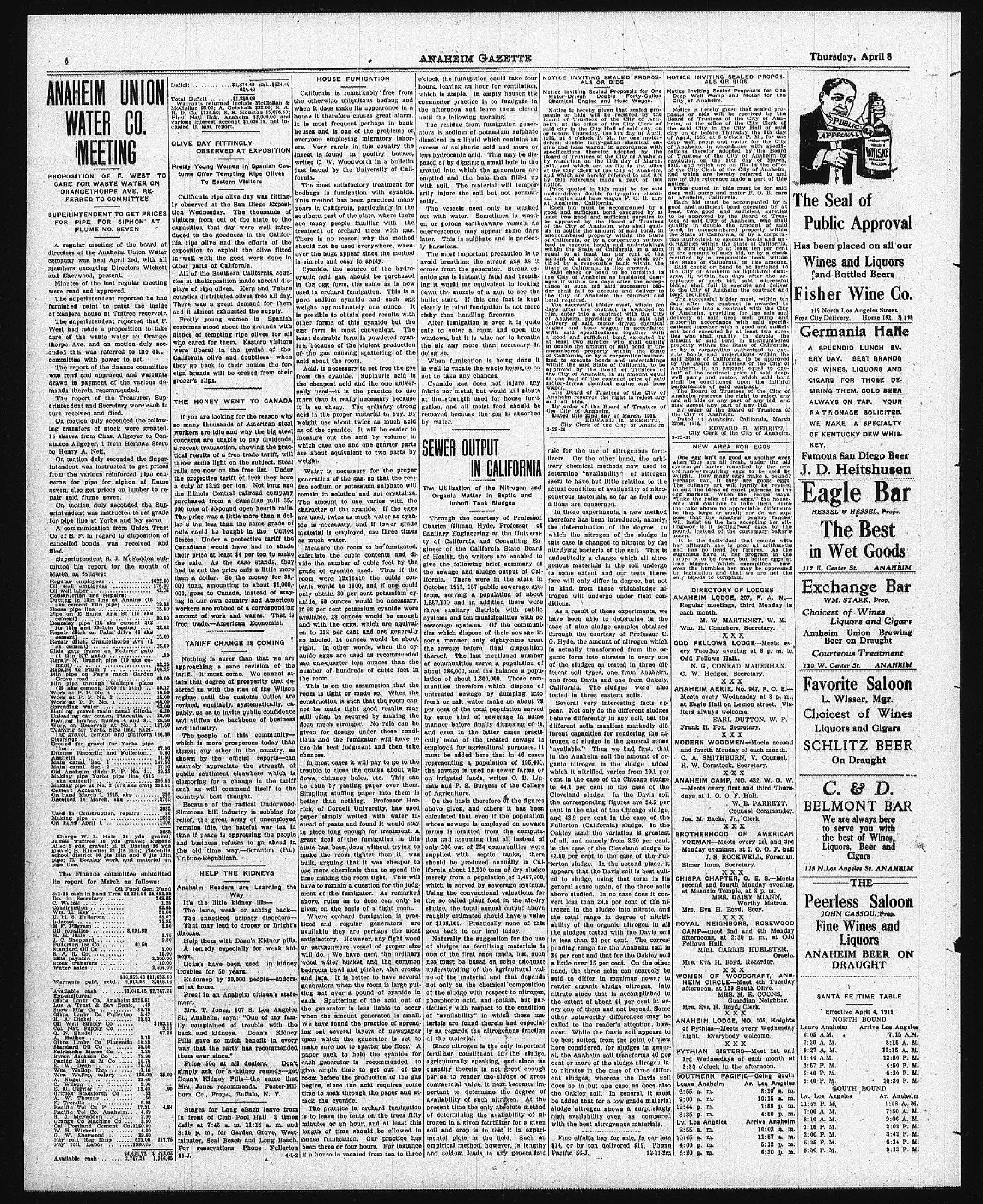
Searchable text
ANAHEIM UNION
WATER CO.
MEETING
PROPOSITION OF F. WEST TO CARE FOR WASTE WATER ON ORANGETHORPE AVE. REFERRED TO COMMITTEE
SUPERINTENDENT TO GET PRICES FOR PIPE FOR SIPHON AT FLUME NO. SEVEN
A regular meeting of the board of directors of the Anaheim Union Water company was held April 3rd, with all members excepting Directors Wickett and Sherwood, present.
Minutes of the last regular meeting were read and approved.
The superintendent reported he had furnished paint to paint the inside of Zanjero house at Tuffree reservoir.
The superintendent reported that F. West had made a proposition to take care of the waste water an Orange-thorpe Ave. and on motion duly seconded this was referred to the diocese committee with power to act.
The report of the finance committee was read and approved and warrants drawn in payment of the various demands therein recommended.
The report of the Treasurer, Superintendent and Secretary were each in turn received and filed.
On motion duly seconded the following transfers of stock were granted: 15 shares from Chas. Allgeyer to Constance Allgeyer, 1 from Herman Stern
Deficit ... $1,874.49 Bal...$624.40
Total Deficit ... $1,250.09
Warrants returned include McClellan & McClellan $6.00, A Gethnaik $22.09, S A.R. Co. $136.60, S. B. Houston $5,076.50; First Natl Bank, Anaheim $2,000.00 and various interest account $1,036.18, not included in last report.
OLIVE DAY FITTINGLY OBSERVED AT EXPOSITION
Pretty Young Women in Spanish Costume Offer Tempting Ripe Olives To Eastern Visitors
California ripe olive day was fittingly observed at the San Diego Exposition Wednesday. The thousands of visitors from out of the state to the exposition that day were well introduced to the goodness in the California ripe olive and the efforts of the exposition to exploit the olive fitted in well with the good work done in other parts of California.
All of the Southern California counties at the Exposition made special displays of ripe olives. Kern and Tulare counties distributed olives free all day. There was a great demand for them and it almost exhausted the supply.
Pretty young women in Spanish costumes stood about the grounds with dishes of tempting ripe olives for all who cared for them. Eastern visitors were liberal in the praise of the California olive and doubtless when they go back to their homes the foreign brands will be erased from their grocer's alips.
THE MONEY WENT TO CANADA
If you are looking for the reason why so many thousands of American steel workers are idle and why the big steel concerns are unable to pay dividends, a recent transaction, showing the prac-
HOUSE FUMIGATION
California is remarked the otherwise ubiquitous when it does make its house it therefore causes it is most frequent poor houses and is one of the everyone employing masters. Very rarely in the insect is found in paper writes C. W. Woodwork just issued by the Uni-formia.
The most satisfactory bedbugs is fumigation This method has been years in California, part southern part of the state are many people famine treatment of orchard trees There is no reason worm should not be used ever the bugs appear she is simple and easy to a Cyanide, the source cyanic acid gas, should in the egg form, the used in orchard fumigation pure sodium syriacide weighs approximately y is possible to obtain other forms of this c egg form is most coe least desirable form is ilea, because of the viole of the gas causing spic acid about the room.
Acid, is necessary to from the cyanide. Suche cheapest acid and is usually used—it is more than is really need it is so cheap. The acid is the proper mat weight use about twice as of the cyanide. It measure out the acid which case one and o
The report of the finance committee was read and approved and warrants drawn in payment of the various demands therein recommended.
The report of the Treasurer, Superintendent and Secretary were each in turn received and filed.
On motion duly seconded the following transfers of stock were granted. 15 shares from Chas. Allgeyer to Constance Allgeyer, 1 from Herman Stern to Henry A. Neff.
On motion duly seconded the Superintendent was instructed to get prices from the various reinforced pipe concerns for pipe for siphon at flume seven; also get prices on lumber to repair said flume seven.
On motion duly seconded the Superintendent was instructed to set grade for pipe line at Yorba and lay same.
A communication from Union Trust Co of S. F. in regard to disposition of cancelled bonds was received and filed.
Superintendent R. J. McFadden submitted his report for the month of March as follows:
Regular employees ... $625.00
Oil well employees ... 178.00
Oil well labor ... 42.75
Construction and Repairs:
Putting in 12ln lins at Annins (15 sks cement 12ln pipe) ... 79.98
Boose pipe line ... 15.50
Pipe on E Santa Ana St (10 sks cement) ... 20.50
Beazley pipe (15 sks cement 312 lts 12ln and 20-20ln basins) ... 32.82
Repair ditch on Palm drive (6 sks cement) ... 15.00
Repair ditch: Orangeshorpe Ave (1 sks cement) ... 15.50
Slide gate frame on Federer gate (1 12ln KT gate) ... 50
Repair N. Branch pipe (10 sks cement) ... 62.25
Repairs to Flum 7 ... 108.25
14ln pipe on Pay's ranch Garden Grove road ... 69.00
14ln pipe through Wallop's place (20 sks cement, 1000 ft 14ln) ... 59.17
Work at P. P. No. 4 ... 16.50
Work at P. P. No. 2 ... 16.50
Work at P. P. No. 1 ... 16.50
Spreading water ... 62.00
Hauling gravel main canal Olinda ... 62.00
Using hauling equipment, Olinda ... 62.00
Hauling number, flumes 4 and 8 ... 25.50
Work on Reservoir at No. 1 ... 127.50
Teaming for Yorba pipe line, hauling gravel, cement and platform ... 146.88
Cleaning:
Ground for gravel for Yorba pipe line ... 27.00
Ditches Placentia and Fullerton ... 5.60
Anaheim ... 31.50
Main canal Sec ... 147.50
Main canal Sec. 2 ... 147.50
Old Anaheim ditch P. P. No. 1 ... 39.35
Making pipe Yorba pipe line (915 sks cement) ... $365.55
Making pipe at No. 2 (678 sks cnt) ... $293.80
Cement Account ...
On hand March 1, 1915, sks ... 325
Received in March, sks ... 2760
Used in Construction, repairs ... 85
Making pipe ... 1683
On hand April 1 ... 1408
Charge W. L. Hale 34 yds gravel;
James Tuffree 16 yds gravel;
Eugene Anaheim ditch D.; Eugene Anaheim ditch E.; Eugene Anaheim ditch F.
Gravel: S.Kramer II, its Inclinable
California olive and doubtless when they go back to their homes the foreign brands will be erased from their grocer's slips.
THE MONEY WENT TO CANADA
If you are looking for the reason why so many thousands of American steel workers are idle and why the big steel concerns are unable to pay dividends, a recent transaction, showing the practical results of a free trade tariff, will throw some light on the subject. Steel rails are now on the free list. Under the projective tariff of 1909 they bore a duty of $3.92 per ton. Not long ago the Illinois Central railroad company purchased from a Canadian mill 35,000 tons of 90-pound open hearth rails. The price was a little more than a dollar a ton less than the same grade of rails could be bought in the United States. Under a protective tariff the Canadians would have had to shade their price at least $4 per ton to make the sale. As the case stands, they had to cut the price only a little more than a dollar. So the money for 36,000 tons, amounting to about $1,000,000, goes to Canada, instead of staying in our own country and American workers are robbed of a corresponding amount of work and wages. That is free trade—American Economist.
TARIFF CHANGE IS COMING
Nothing is surer than that we are approaching a sane revision of the tariff. It must come. We cannot attain that degree of prosperity that desert us with the rise of the Wilson regime until the customs duties are revised, equitably, systematically, capably, so as to invite public confidence and stiffen the backbone of business and industry.
The people of this community—which is more prosperous today than almost any other in the country, as shown by the official reports—can scarcely appreciate the strength of public sentiment elsewhere which is clamoring for a change in the tariff such as will commend itself to the country's best thought.
Because of the radical Underwood-Simmons bill industry is sobbing for relief, the great army of unemployed remains idle, the hateful war tax in time if peace is oppressing the people and business refuses to go ahead in the old time way—Scranton (Pa.)
Anaheim
Main canal, Sec. 1 147.50
Main canal, Sec. 2 37.10
Old Anaheim Coh P. P. No. 1 39.35
Making pipe Yorba pipe line (915 sks cement) 365.55
Making pipe at No. 2 (678 sks cmt) 293.80
Cement Account.
On hand March 1, 1915, sks 285
Received in March, sks 2760
Used in Construction, repairs 86
Making pipe 1593
On hand April 1 1406
Charge W. L. Hale 34 yds gravel; James Tuffree 16 yds gravel; Eugene Alleso 6 yds gravel; E. S. Basten 36 yds gravel; Kirkman Jr. (Its Milfoil school district 80 its 15th and 6 its 12th pipe; E. Beazley work and material on pipe line.
The Finance committee submitted its report for March as follows:
Oil Fund Gen. Fund
Do. In Secretary 2,224.04 $5,452.89
C. Wetzel 1.25
Construction 62.65
W. H. Kroyer 21.00
U. H. S. Fullerton 48.07
Interest 13.55
M F. Pilgram 1.50
Oil royalties 8,694.89
H. H. Hale 1.75
J. C. Shepard 9.80
Fullerton ice Co 40.50
Standard Oil Co 3.00
B A R Co 15.00
Bills payable 3,300.00
Stock transfers 10.00
Water sales 2,404.90
Warrants paid, retd. 9,912.98 8,946.16
Available cash $1,046.45 $2,747.24
Expenditures:
Glbbs Limbr Co, Anaheim $226.13
Los A Trust & Sav Bank .49
Snow Mfg Co 80.75
Glbbs Limbr Co Fullerton 5.47
L A Dekalel 35.53
Oil Well Supply Co $103.11
Cal Nat Supply Co 3.10
Q N Shadel 67.26
A Mathes 2.15
Glbbs Limbr Co Placentia 13.49
Standard Oil Co 38.50
Pairbanks Morse Co 7.20
Byron Jackson Co 79.90
Pacific Mill & M Co 10.78
E W Dean 76.03
Wm Wallop Exp .713
Wm Wallop salary 125.00 25.00
A Nagel 33.60
C Wilson 2.00
E D Currier 13.40 .90
Grimes Stasforth Co .63
A W Thomas .60
F Trends .695
Pacific Tel Co F 17.31 4.84
Pacific Tel Co, Anaheim 4.69
R J McFadden 2.00
Orange Co Machine Co 2.80
Cal Mement Co (1159.00)
W H Wickett 4.00
G W Sherwood 29.80
Pay roll Reg Emp 623.00 217.75
Pay roll, Labor .1980.75
$4,621.73 $432.05 Available cash 2,747.24 1,046.45
shown by the official reports—can scarcely appreciate the strength of public sentiment elsewhere which is olamoring for a change in the tariff such as will commend itself to the country's best thought.
Because of the radical Underwood-Simmons bill industry is sobbing for relief, the great army of unemployed remains idle, the hateful war tax in time if peace is oppressing the people and business refuses to go ahead in the old time way—Scranton (Pa.) Tribune-Republican.
HELP THE KIDNEYS
Anaheim Readers are Learning the Way
It's the little kidney illis—the lame, weak or aching back—the unnoticed urinary disorders—That may lead to dropsy or Bright's disease.
Help them with Doan's Kidney pills.A remedy especially for weak kidneys.
Doan's have been used in kidney troubles for 50 years.Endorsep by 30,000 people—andorsed at home.
Proof in an Anaheim citizen's statement.
Mrs T Jones, 507 S Los Angeles St., Anaheim, says: "One of my family complained of trouble with the back and kidneys.Doan's Kidney Pills gave so much benefit in every way that the party has recommended them ever since."
Price 50c at all dealers.Dont simply ask for a kidney remedy—get Doan's Kidney Pills—the same that Mrs Jones recommends.Foster-Milburn Co., Propa., Buffalo, N.Y.
Stages for Long eBach leave from in front of Club Pool Hall three times daily at 7:45 a.m.M:11:15 a.m.M:3:15 p.m.Garden Grove, Westminster, Seal Beach and Long BeachFor reservations Phone Fullerton 15-J.
4-1-2
HOUSE FUMIGATION
California is remarkably free from the otherwise ubiquitous bedbug and when it does make its appearance in a house it therefore causes great alarm. It is most frequent perhaps in bunk houses and is one of the problems of everyone employing migratory laborers. Very rarely in this country the insect is found in poultry houses, writes C. W. Woodworth in a bulletin just issued by the University of California.
The most satisfactory treatment for bedbugs is fumigation with cyanide. This method has been practiced many years in California, particularly in the southern part of the state, where there are many people familiar with the treatment of orchard trees with gas. There is no reason why the method should not be used everywhere, whenever the bugs appear since the method is simple and easy to apply.
Cyanide, the source of the hydrocyanic acid gas, should be purchased in the egg form, the same as is now used in orchard fumigation. This is a pure sodium syanide and each egg weighs approximately one ounce. It is possible to obtain good results with other forms of this cyanide but the egg form is most convenient. The least desirable form is powdered cyanide, because of the violent production of the gas causing spattering of the acid about the room.
Acid, is necessary to set free the gas from the cyanide. Sulphuric acid is the cheapest acid and the one universally used—it is the practice to use more than is really necessary because it is so cheap. The ordinary strong acid is the proper material to buy. By weight use about twice as much acid as of the cyanide. It will be easier to measure out the acid by volume in which case one and one quarter parts o'clock the fumigation could take four hours, leaving an hour for ventilation, which is ample. In empty houses the commoner practice is to fumigate in the afternoon and leave them closed until the following morning.
The residue from fumigation generators is sodium of potassium sulphate dissolved in a liquid which contains an excess of sulphuric acid and more or less hydrocric acid. This may be disposed of by digging a small hole in the ground into which the generators are emptied and the hole then filled up with soil. The material will temporarily injure the soil but not permanently.
The vessels need only be washed out with water. Sometimes in wooden or porous earthenware vessels an overvessence may appear some days later. This is sulphate and is perfectly harmless.
The most important precaution is to avoid breathing the strong gas as it comes from the generator. Strong cyanide gas is instantly fatal and breathing it would me equivalent to looking down the muzzle of a gun to see the bullet start. If this one fact is kept clearly in mind fumigation is not more risky than handling firearms.
After fumigation is over it is quite safe to enter a room and open the windows, but it is wise not to breathe the air any more than necessary in doing so.
When fumigation is being done it will be vacated the whole house, so as not to take any chances.
Cyanide gas does not injure any fabric nor metal, but would kill plants at the strength used for house fumigation, and all moist food should be removed because the gas is absorbed by water.
NOTICE INVITING SEALED PROPOSALS OR BIDS
Notice Inviting Sealed Proposals for One Motor-Driven Double Forty-Gallon Chemical Engine and Hose Wagon.
Notice is hereby given that sealed proposals or bids will be received by the board of Trustees of the City of Anaheim on behalf of said city in the City Hall of said city, on or before Thursday, the 8th day of April, 1916, at 8 o'clock P.M., for one motor-driven double forty-gallon chemical engine and hose wagon, in accordance with less hydrocric acid. This may be disposed of by digging a small hole in the ground into which the generators are emptied and the hole then filled up with soil. The material will temporarily injure the soil but not permanently.
The vessels need only be washed out with water. Sometimes in wooden or porous earthenware vessels an overvessence may appear some days later. This is sulphate and is perfectly harmless.
The most important precaution is to avoid breathing the strong gas as it comes from the generator. Strong cyanide gas is instantly fatal and breathing it would me equivalent to looking down the muzzle of a gun to see the bullet start. If this one fact is kept clearly in mind fumigation is not more risky than handling firearms.
After fumigation is over it is quite safe to enter a room and open the windows, but it is wise not to breathe the air any more than necessary in doing so.
When fumigation is being done it will be vacated the whole house, so as not to take any chances.
Cyanide gas does not injure any fabric nor metal, but would kill plants at the strength used for house fumigation, and all moist food should be removed because the gas is absorbed by water.
Said check or bond to be forfeited to the City of Anaheim as liquidated damages if within ten days after the acceptance of such specification together with food and tallow or unencumbered property within the State of California, or by a corporation authorized to execute bonds and undertakings by a responsible bank within the State of California, in like amount equal to at least ten per cent of the amount due by a responsible bank within the State of California, or by a corporation authorized to execute bonds and undertakings by a responsible bank within the State of California, or by a corporation authorized to execute bonds and undertakings by a responsible bank within the State of California, or by a corporation authorized to execute bonds and undertakings by a responsible bank within the State of California, or by a corporation authorized to execute bonds and undertakings by a responsible bank within the State of California, or by a corporation authorized to execute bonds and undertakings by a responsible bank within
Acid, is necessary to set free the gas from the cyanide. Sulphuric acid is the cheapest acid and the one universally used—it is the practice to use more than is really necessary because it is so cheap. The ordinary strong acid is the proper material to buy. By weight use about twice as much acid as of the cyanide. It will be easier to measure out the acid by volume in which case one and one quarter parts are about equivalent to two parts by weight.
Water is necessary for the proper generation of the gas, so that the residue sodium or potassium sulphate will remain in solution and not crystallize. The amount to use varies with the character of the cyanide. If the eggs are used, twice as much water as cyanide is necessary, and if lower grade material is employed, use three times as much water.
Measure the room to be fumigated, calculate the cubic contents and divide the number of cubic feet by the grade of cyanide used. Thus if the room were 12x15x10 the cubic contents would be 1800, and if one could only obtain 30 per cent potassium cyanide, 60 ounces would be necessary. If 98 per cent potassium cyanide were available, 18 ounces would be enough and with the eggs, which are equivailen to 128 per cent and are generally so labeled, 14 ounces would be about right. In other words, when the cyanide eggs are used as recommended use one-quarter less ounces than the number of hundreds of cubic feet in the room.
This is on the assumption that the room is tight or made so. When the construction is such that the room cannot be made tight good results may still often be secured by making the dose much stronger. No rule can be given for dosage under these conditions and the fumigator will have to use his best judgment and then take chances.
In most cases it will pay to go to the trouble to close the cracks about windows, chimney holes, etc. This can be done by pasting paper over them. Simplifying stuffing paper into them is better than nothing. Professor Herrick, of Cornell University, has used paper simply wetted with water instead of paste and found it would stay in place long enough for treatment. A great deal of the fumigation in this state has been done without trying to
When fumigation is being done it is well to vacate the whole house, so as not to take any chances.
Cyanine gas does not injure any fabric nor metal, but would kill plants at the strength used for house fumigation, and all moist food should be removed because the gas is absorbed by water.
SEWER OUTPUT IN CALIFORNIA
The Utilization of the Nitrogen and Organic Matter in Septic and Imhoff Tank Sludges
Through the courtesy of Professor Charles Gilman Hyde, Professor of Sanitary Engineering at the University of California and Consulting Engineer of the California State Board of Health. The writers are enabled to give the following brief summary of the sewage and sludge output of California. There were in the state in October 1913, 157 public sewerage systems, serving a population of about 1,557,100 and in addition there were three sanitary districts with public systems and ten municipalities with no sewerage systems. Of the communities which dispose of their sewage in some manner only eighty-nine treat the sewage before final disposition thereof. The last mentioned number of communities serve a population of about 284,000, and the balance a population of about 1,300,000. Those communities therefore which dispose of untreated sewage by dumping into fresh or salt water make up about 78 per cent of the total population served by some kind of sewerage in some manner before finally disposing of it, and even in the latter cases practically none of the treated sewage is employed for agricultural purposes. It must be added here that in 46 cases representing a population of 195,400, the sewage is used on sewer farms or on irrigated lands, writes C. B. Lipman and P. S. Burgess of the College of Agriculture.
On the basis therefore of the figures above given, and others it has been calculated that even if the population whose sewage is employed on sewage farms is omitted from the computation and assuming that all instead of only 100 out of 234 communities were rule for the use of nitrogenous fertilizers. On the other hand, the arbitrary chemical methods now used to determine "availability" of nitrogen seem to have but little relation to the actual condition of availability of nitrogenous materials, so far as field conditions are concerned.
In these experiments, a new method therefore has been introduced, namely, the determination of the degree to which the nitrogen of the sludge in this case is changed to nitrates by the nitrifying bacteria of the soil. This is undoubtedly a change which all nitrogenous materials in the soil undergo to some extent and our tests therefore will only differ in degree, but not in kind, from those whichsludge nitrogen will undergo under field conditions.
As a result of these experiments, we have been able to determine in the case of nine sludge samples obtained through the courtesy of Professor C. G. Hyde, the amount of nitrogen which is actually transformed from the organic form into nitrates in every one of the sludges as tested in three different soil types, one from Anaheim, one from Davis and one from Oakley, California. The sludges were also tested in three eastern soils.
Several very interesting facts appear. Not only do the different sludges behave differently in any soil, but the different soils manifest markedly different capacities for rendering the nitrogen of sludge in the general sense "available." Thus we find first, that in Anaheim soil the amount of organic nitrogen in the sludge added which it nitrified, varies from 10.1 per cent in the case of the Chicago sludge to 44.1 per cent in the case of the Cleveland sludge. In the Davis soil corresponding figures are 24.5 per cent in the cast of the Chicago sludge, and 43.9 per cent in the case of the Fullerton (California) sludge. In the Oakley sand the variation is greatest of all, and namely from 8.30 per cent, in the case of the Cleveland sludge to
In most cases it will pay to go to the trouble to close the cracks about windows, chimney holes, etc. This can be done by pasting paper over them. Simplifying stuffing paper into them is better than nothing. Professor Herrick, of Cornell University, has used paper simply wetted with water instead of paste and found it would stay in place long enough for treatment. A great deal of the fumigation in this state has been done without trying to make the room tighter than it was built, arguing that it was cheaper to use more chemicals than to spend the time making the room tight. This will have to remain a question for the judgment of the fumigator. As remarked above, rules as to dose can only be given on the basis of a tight room.
Where orchard fumigation is practiced and regular generators are available they are perhaps the most satisfactory. However, any light wood or earthenware vessel of proper size will do. We have used the ordinary wood water bucket and the common bedroom bowl and pitcher, also crocks and jars. It is better to have several generators when the room is large putting not over a pound of cyanide in each. Spattering of the acid out of the generator is less liable to occur when the amount generated is small. We have found the practice of spreading out several layers of newspaper upon which the generator is set to make sure not to spatter the floor. A paper sack to hold the cyanide for each generator is recommended to give ample time to get out of the room before the production of the gas begins, since the acid requires some time to soak through the paper and attack the cyanide.
The practice in orchard fumigation is to leave the tents on the trees fifty minutes or an hour, and at least this length of time should be allowed in house fumigation. Our practice has been three or four hours. For instance if a house is vacated from ten to three must be added here that in 40 cases representing a population of 195,400, the sewage is used on sewer farms or on irrigated lands, writes C. B. Lipman and P. S. Burgess of the College of Agriculture.
On the basis therefore of the figures above given, and others it has been calculated that even if the population whose sewage is employed on sewage farms is omitted from the computation and assuming that all instead of only 100 out of 234 communities were supplied with septic tanks, there should be produced annually in California about 12,100 tons of dry sludge merely from a population of 1,467,900, which is served by sewerage systems. Using the conventional valuations, for the so called plant food in the air-dry sludge, the total annual output above roughly estimated should have a value of $108,100. Practically none of this goes back to our land today.
Naturally the suggestion for the use of sludges as fertilizing materials is one of the first ones made, but such use must be based on some adequate understanding of the agricultural value of the material and that depends not only on the chemical composition of the sludge with respect to nitrogen, phosphoric acid, and potash, but particularly with respect to the condition of "availability" in which those materials are found therein and especially as regards the nitrogenous fraction of the material.
Since nitrogen is the only important fertilizer constituent in the sludge, agriculturally speaking, and since its quantity therein is not great enough per se to render the sludge of great commercial value, it next becomes important to determine the degree of availability of such nitrogen. At the present time the only absolute method of determining the availability of nitrogen in a given fertilizer for a given soil and crop is to test it in experimental plots in the field. Such an empirical method, however, is lengthy and seldom leads to any generalized
Fine alfalfa hay for sale. In car lots $14, or by ton delivered $15. Phone Pacific 56-J.
12-31-2m
NOTICE INVITING SEALED PROPOSALS OR BIDS
Notice Inviting Sealed Proposals for One Deep Well Pump and Motor for the City of Anaheim.
Notice is hereby given that sealed proposals or bids will be received by the Board of Trustees of the City of Anaheim at the office of the City Clerk of the said City in the City Hall of said city on or before Thursday the 8th day of April, 1915, at 8 o'clock P.M., for one deep well pump and motor for the City of Anaheim in accordance with applicable thereof adopted by the Board of Trustees of the City of Anaheim on resolution on the 11th day of March, 1915, and which are on file in the office of the City Clerk of the City of Anaheim, and which are hereby referred to are by this reference made a part of this notice.
Price quoted in bids must be for said deep well pump and motor F. O. B. cars at Anaheim, California.
Each bid must be accompanied by a good and sufficient bond executed by at least two good and sufficient sureties to be approved by the Board of Trustees of said City of Anaheim, who shall qualify in double amount of such bond in unencumbered property within the State of California, or by a corporation authorized to execute bonds and undertakings within the State of California, in a sum equal to at least ten per cent of such bond, by a corporation certified by a responsible bank within the State of California, in like amount.
Said check or bond to be forfeited to the City of Anaheim as liquidated damages, if, within ten days after the acceptance of such bond, a successful bidder shall fail to execute and deliver to the City of Anaheim the contract and bond required.
The successful bidder must, within ten days after the acceptance of such bond, enter into a contract with the City of Anaheim, providing for the sale and delivery of said deep well pump and motor in accordance with specified conditions together with a good and sufficient bond executed by at least two sureties who shall qualify in double amount of such bond in unencumbered property within the State of California, or by a corporation authorized to execute bonds and undertakings within the State of California, in a sum equal to at least ten per cent of such bond, by a corporation certified by a responsible bank within the State of California, in like amount.
The Board of Trustees of the City of Anaheim reserves the right to reject any and all bids or any part of any bid, and may accept any part of any bid.
Order: The Board of Trustees of the City of Anaheim,
Dated at Anaheim, California, March 22nd, 1915.
EDWARD B. MERRITT,
City Clerk of the City of Anaheim.
3-25-3t
NEW AREA FOR EGGS
NEW AREA FOR EGGS
One egg isn't as good as another even when they are all fresh, under the old state of California, but by the new ordinance requiring eggs to be sold by weight. How many eggs make a pound? Perhaps two, if they are goose eggs. The culinary art will hardly be revised for the ease of exotic paleness in the egg markets. When the recipe says, "Take the yolks of six eggs," the housewife will continue to take them, since the cake shows no appreciable difference because large or small; nor do we suppose that the master's reaction will insist on the hen accepting her sitting—or is it setting?—of eggs by the pound, instead of the customary baker's dozen.
It is the individual that counts with her although she is poor at arithmetic and has no head for figures. As the eugenists have it, her program in the future is to be fewer, but better eggs at less bigger. Which exemplifies how then humble men may be oppressed by legislation and that we are not the only bipeds to complain.
DIRECTORY OF LODGES
ANAHEIM LODGE, 207, F. A. M. Regular meetings, third Monday in each month.
M. W. MARTENET, W. M. Wm. H. Chambers, Secretary.
XX X
ODD FELLOWS LODGE—Meets every Tuesday evening at 8 p.m. in Odd Fellows Hall.
N. G., CONRAD MAUERHAN.
C. W. Hedges, Secretary.
XX X
ANAHEIM AERIE, No. 947, F. O. E. Meets every Wednesday at 8 p.m., at Eagle Hall on Lemon street. Visitors always welcome.
EARL DUTTON, W. P.
Frank H. Fox, Secretary.
XX X
MODERN WOODMEN—Meets second and fourth Monday of each month.
C. A. SMITHBURN, V. Counsel.
H. W. Comstock, Secretary.
XX X
ANAHEIM CAMP, NO. 432, W. O. W. Meets every first and third Thursday at I. O. O. F. Hall.
W. B. PARRETT, Counsel Commander.
Jos. M. Backs, Jr., Clerk.
XX X
BROTHERHOOD OF AMERICAN YOEMAN—Meets every 1st and 3rd Monday evenings, at I. O. O. F hall
ERY DAY. BEST BRANDS OF WINES, LIQUORS AND CIGARS FOR THOSE DESIRED THEM. COLD BEER ALWAYS ON TAP. YOUR PATRONAGE SOLICITED. WE MAKE A SPECIALTY OF KENTUCKY DEW WHISKEY.
Famous San Diego Beer J. D. Heitshusen
Eagle Bar
HESSEL & HESSEL, Props.
The Best in Wet Goods
117 E. Center St. ANAHEIM
Exchange Bar
WM. STARK, Prop.
Choicest of Wines Liquors and Cigars
Anaheim Union Brewing Beer on Draught
Courteous Treatment
120 W. Center St. ANAHEIM
Favorite Saloon
L. Wisser, Mgr.
Choicest of Wines Liquors and Cigars
SCHLITZ BEER On Draught
C. & D.
BELMONT BAR
We are always here to serve you with the best of Wines, Liquors, Beer and
C. A. SMITHBURN, V. Counsel.
H. W. Comstock, Secretary.
ANAHEIM CAMP, NO. 432, W. O. W.
—Meets every first and third Thursdays at I. O. O. F. Hall.
W. B. PARRETT,
Counsel Commander.
Jos. M. Backs, Jr., Clerk.
BROTHERHOOD OF AMERICAN YOEMAN—Meets every 1st and 3rd Monday evenings, at I. O. O. F. hall.
J. S. ROCKWELL, Foreman.
Elmer Imus, Secretary.
CHISPA CHAPTER, O. E. S.—Meets second and fourth Monday evening, at Masonic Temple, at 8 p.m.
MRS. DAISY MIANN,
Worthy Matron.
Mrs. Eva H. Boyd, Secy.
ROYAL NEIGHBORS, ROSEWOOD CAMP—meet 2nd and 4th Monday afternoons, at 2:30 p.m., at Odd Fellows Hall.
MRS. CARRIE HUELSTER,
Oracle.
Mrs. Eva H. Boyd, Recorder.
WOMEN OF WOODCRAFT, ANAHEIM CIRCLE—Meet 4th Tuesday afternoon, at 129 South Olive.
MRS. M. E. COONS,
Guardian Neighbor.
Mrs. Eva H. Boyd, Clerk.
ANAHEIM LODGE, NO. 105, Knights of Pythias—Meets every Wednesday night. Everybody welcome.
PYTHIAN SISTERS—Meet 1st and 3rd Wednesdays of each month at 2:30 o'clock in the afternoon.
SOUTHERN PACIFIC—Going South
Leave Anaheim Ar. Los Angeles
6:55 a.m.
8:10 a.m.
9:00 a.m.
10:15 a.m.
12:44 p.m.
1:55 p.m.
3:35 p.m.
Lv. Los Angeles Arrive Anaheim
8:55 a.m.
10:02 a.m.
10:45 a.m.
11:57 a.m.
4:00 p.m.
5:12 p.m.
5:20 p.m.
6:30 p.m.
On Draught
C. & D.
BELMONT BAR
We are always here to serve you with the best of Wines,
Liquors, Beer and Cigars
115 N.Los Angeles St. ANAHRIM
THE
Peerless Saloon
JOHN CASSOU.: Prep.
Fine Wines and Liquors
ANAHEIM BEER ON DRAUGHT
SANTA FE TIME TABLE
Effective April 4, 1915
NORTH BOUND
Leave Anaheim Arrive Los Angeles
6:05 A.M.
7:15 A.M.
7:20 A.M.
8:15 A.M.
9:27 A.M.
10:15 A.M.
11:44 A.M.
12:50 P.M.
3:57 P.M.
4:50 P.M.
5:40 P.M.
6:30 P.M.
9:40 P.M.
10:30 P.M.
South BOUND
Lv. Los Angeles Arrive Anaheim
11:59 P.M.
1:08 A.M.
7:00 A.M.
7:50 A.M.
8:10 A.M.
9:06 A.M.
1:15 P.M.
2:02 P.M.
3:00 P.M.
3:42 P.M.
5:25 P.M.
6:14 P.M.
8:30 P.M.
9:13 P.M.