anaheim-gazette 1915-02-25
Scanned page
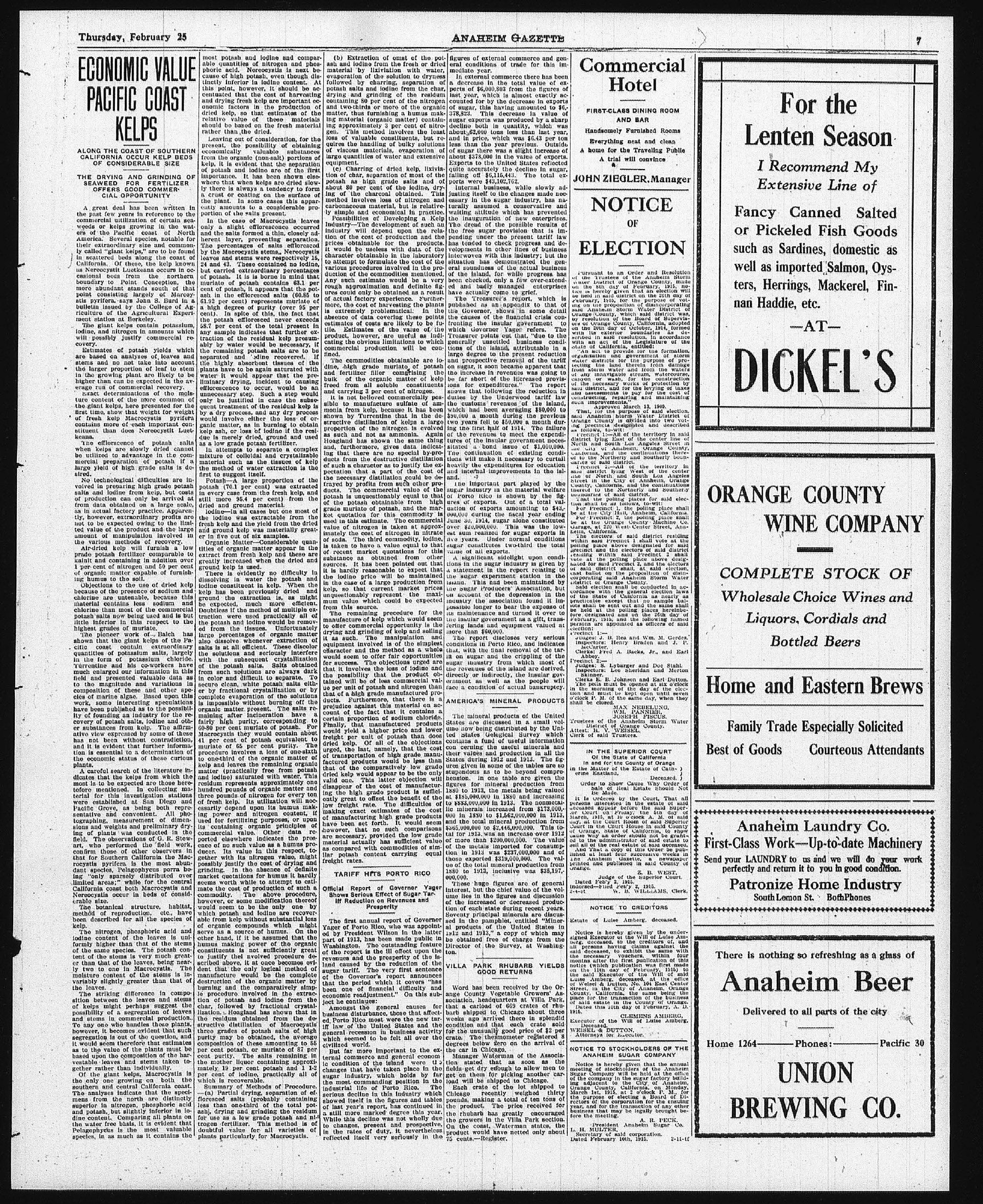
Searchable text
ECONOMIC VALUE
PACIFIC COAST
KELPS
ALONG THE COAST OF SOUTHERN
CALIFORNIA OCCUR KELP BEDS
OF CONSIDERABLE SIZE
THE DRYING AND GRINDING OF
SEAWEED FOR FERTILIZER
OFFERS GOOD COMMERCIAL OPPORTUNITY
A great deal has been written in the past few years in reference to the commercial utilization of certain seaweeds or kelps growing in the waters of the Pacific coast of North America. Several species, notable for their extraordinary size and commonly called "giant kelps," are to be found in scattered beds along the coast of California. Of these, the kelp known as Nereocystit Luetkeanna occurs in occasional beds from the northern boundary to Point Conception, the more abundant stands south of that point consisting largely of Marcostis pyrifera, says Jonn S. Burd in a bulletin issued by the College of Agriculture of the Agricultural Experiment station at Berkeley.
The giant kelps contain potassium, iodine, and nitrogen in amounts which will possibly justify commercial recovery.
Estimates of potash yields which are based on analyses of leaves and stems and do not take into account the larger proportion of leaf to stem in the growing plant are likely to be higher than can be expected in the average run of commercial recovery.
Exact determinations of the moisture content of the more common of the giant kelps, here presented for the first time, show that weight for weight of fresh kelp Macrocystis pyrifera contains more of each important constituent than does Nereocystit Luetkeanna.
The efflorescence of potash salts when kelps are slowly dried cannot most potash and iodine and comparable quantities of nitrogen and phosphoric acid. Nereocystitis is next because of high potash, even though distinctly inferior in iodine content. At this point, however, it should be accentuated that the cost of harvesting and drying fresh kelp are important economic factors in the production of dried kelp, so that estimates of the relative value of these materials should be based on the fresh material rather than the dried.
Leaving out of consideration, for the present, the possibility of obtaining economically valuable substances from the organic (non-salt) portions of kelp, it is evident that the separation of potash and iodine are of the first importance. It has been shown elsewhere that when kelps are dried slowly there is always a tendency to form a crust or coating on the surface of the plant. In some cases this apparently amounts to a considerable proportion of the salts present.
In the case of Macrocystis leaves only a slight efflorescence occurred and the salts formed a thin, closely adherent layer, preventing separation. The percentages of salts efflorescenced by the Macrocystis stems, Nereocystis leaves and iodine were respectively 15, 24 and 43. These contained no iodine, but carried extraordinary percentages of potash. It is born in mind that murate of potash contains 63.1 per cent of potash, it appears that the potash in the effloresced salts (60.85 to 61.92 per cent) represents murate of a high degree of purity (over 95 per cent). In spite of this, the fact that the potash effloresced never exceeds 58.7 per cent of the total present in any sample indicates that further extraction of the residual kelp presumably by water would be necessary, if the remaining potash salts are to be separated and iodine recovered. If the highly absorbent tissues of the plants have to be again saturated with water it would appear that the preliminary drying, incident to causing efflorescence to occur, would be an unnecessary step. Such a step would only be justified in case the subsequent treatment of the residual kelp is by a dry process, and any dry process would involve either the loss of organic matter, as in burning to obtain kelp ash, or loss of iodine if the residue is merely dried, ground and used as a low grade potash fertilizer.
(b) Extracts ash and iodine material by evaporation followed by potash salts by drying and two-thirds matter, thus making material less ingraining approximately.
(c) Charring tion of char, potash as he as about 80 per cent of the method involving carbonaceous simple and possibilities industry—The industry will treat the prices obtained it would be a character obtended to attempt to avoid various processesduction of the esth Any such rough approximate could out-of actual fact more, the cost is extremely absence of data estimates of Q title. Estimation product, however cating the obsolete commercial refined.
The common dime, high grit and fertilizer bulk of the freed from a carrying 3It is not being able to manage monia from kelp shown by Turstructive distortion proportion of as such and Hoagland has and furtherm
are based on analyses of leaves and stems and no not take into account the larger proportion of leaf to stem in the growing plant are likely to be higher than can be expected in the average run of commercial recovery.
Exact determinations of the moisture content of the more common of the giant kelps, here presented for the first time, show that weight for weight of fresh kelp Macrocystis pyrenaica contains more of each important constituent than does Nereocystis Luetkeana.
The efflorescence of potash salts when kelps are slowly dried cannot be utilized to advantage in the commercial preparation of potash if a large yield of high grade salts is desired.
No technological difficulties are involved in preparing high grade potash salts and lodine from kelp, but costs of production can only be arrived at from data obtained on a large scale, as in actual factory practice. Apparently, however, extraordinary profits are not to be expected owing to the limited value of the product and the large amount of manipulation involved in the various methods of recovery.
Air-dried kelp will furnish a low prade potash fertilizer comparable to kainit and containing in addition over 1 per cent of nitrogen and 50 per cent of organic matter capable of furnishing humus to the soil.
Objections to the use of dried kelp because of the presence of sodium and chlorine are untenable, because this material contains less sodium and chlorine than most of the commercial potash salts now being used and is but little inferior in this respect to the highest grades of muriate.
The pioneer work of Balch has shown that the giant kelps of the Pacific coast contain extraordinary quantities of potassium salts, largely in the form of potassium chloride. Turrentine and his co-workers have much enlarged our information in this field and presented valuable data as to the magnitude and variations in composition of these and other species of marine algae. Based upon this work, some interesting speculations have been published as to the possibility of founding an industry for the recovery of potash salts, lodine and other substances from kelp. The affirmative view expressed by some of these has not been without contradiction, and it is evident that further information is essential to a determination of the economic status of these curious plants.
A careful search of the literature indicates that the kelps from which the most is to be expected are those hereof mentioned. In collecting material for this investigation stations were established at San Diego and Pacific Grove, as being both representative and convenient. All photographing, measurement of dimensions and weights and preliminary drying of plants was conducted in the field. The observations of G. R. Stewart, who performed the field work, informed those of other observers, in separated and iodine recovered. If the highly absorbent tissues of the plants have to be again saturated with water it would appear that the preliminary drying, incident to causing efflorescence to occur, would be an unnecessary step. Such a step would only be justified in case the subsequent treatment of the residual kelp is by a dry process, and any dry process would involve either the loss of organic matter, as in burning to obtain kelp ash, or loss of iodine if the residue is merely dried, ground and used as a low grade potash fertilizer.
In attempts to separate a complex mixture of colloidal and crystallizable material such as the tissues of kelp the method of water extraction is the first to suggest itself.
Potash—A large proportion of the potash (70.1 per cent) was extracted in every case from the fresh kelp, and still more 95.4 per cent) from the dried and ground material.
Iodine—In all cases but one most of the iodine was extractable from the fresh kelp and the yield from the dried and ground kelp was materially greater in five out of six samples.
Organic Matter—Considerable quantities of organic matter appear in the extract from fresh kelp and these are greatly increased when the dried and ground kelp is used.
There is evidently no difficulty in dissolving in water the potash and iodine constituent in kelp. When the kelp has been previously dried and ground the extraction is, as might be expected, much more efficient. Doubtless if the method of multiple extraction were used practically all of the potash and iodine would be removed from the tissues. Unfortunately large percentages of organic matter also dissolve whenever extraction of salts is at all efficient. These discoloration the solutions and seriously interfere with the subsequent crystallization of the potash salts. Salts obtained from such solutions are always dark in color and difficult to separate. To secure clean, white potash salts either by fractional crystallization or by complete evaporation of the solutions is impossible without burning off the organic matter present. The salts remaining after incineration have a fairly high purity, corresponding to 60-80 per cent muricate of potash. For Macrocystis they would contain about 41 per cent of potash equivalent to muricate of 65 per cent purity. The procedure involves a loss of one-sixth to one-third of the organic matter of kelp and leaves the remaining organic matter (practically free from potash and iodine) saturated with water. This residuum represents approximately one hundred pounds of organic matter and three pounds of nitrogen for every ton of fresh kelp. Its utilization will necessarily depend upon its humus making power and nitrogen content, if used for fertilizing purposes, or upon its containing organic principles of commercial value. Other data reported elsewhere indicates the presence of no such value as a humus producer. Its value in this respect too.
The common dune, high grit and fertilizer bulk of the freed from a carrying tank. It is not possible to maintain monia from known by Tünstructive distillation proportion as such and in Hoagland has had, furthermore that there ducts from there such as charcoal pecetation that necessary frayed by products. The co-potash is unique of the potash grade murinate lot quotation used in this evalue of nitrate imately the co-feeded soda. The co-is taken to hand in recent man substance as sources. It has it hardly relied on the iodine pre-treatment in the case of kelp, so that unquestionably mum value from this source.
The remain manufacture oo to offer commi drying and grilt it as such. Equipment invl character and would seem to for success. That it involve the possibility tained will be due per unit oo that of a high ducts. Further prejudice against Finally, that it would yield a freight per unit dried kelp. Or urged, the last transport factured product that of the co-dried kelp would valid one. The disappear of U ing the high h o low freight ro making exact oo manufacture have been set however, that are necessary, material actua compared w
A careful search of the literature indicates that the kelps from which the most is to be expected are those herefore mentioned. In collecting material for this investigation stations were established at San Diego and Pacific Grove, as being both representative and convenient. All photographing, measurement of dimensions and weights and preliminary drying of plants was conducted in the field. The observations of G. R. Stowart, who performed the field work, confirm those of other observers in that for Southern California the Macrocystis pyrifera is the most abundant species, Pelagophycus porra being "only sparsely distributed over limited areas;" while for the central California coast both Macrocystis and Nereocystis occur in beds of considerable size.
The botanical structure, habitat, method of reproduction, etc., have been described for all the species of kelp.
The nitrogen, phosphoric acid and lodine content of the leaves is uniformly higher than that of the stems of the same species. The potash content of the stems is very much greater than that of the leaves, being nearly two to one in Macrocystis. The moisture content of the stems is invariably slightly greater than that of the leaves.
The striking difference in composition between the leaves and stems of kelps might perhaps suggest the possibility of a segregation of leaves and stems in commercial production. To any one who handles these plants, however, it becomes evident that such segregation is out of the question, and it would seem therefore that estimates as to the value of the plants must be based upon the composition of the harvestable leaves and stems taken together rather than individually.
Of the giant kelps, Macrocystis is the only one growing on both the southern and central California coast. The analyses indicate that the specimens from the north are distinctly superior in nitrogen, phosphoric acid and potash, but slightly inferior in lodine content. Comparing all plants on the water free basis, it is evident that Pelagophycus is the most valuable species, in as much as it contains the
Summary of Methods of Procedure.
(a) Partial drying, separation of offloresced salts (probably containing less than one-third of the total potash), drying and grinding the residuum for use as a low grade potash and nitrogen fertilizer. This method is of doubtful value for all varieties of plants particularly for Macrocystis.
ANAHEIM GAZETTE
Commercial Hotel
FIRST-CLASS DINING ROOM AND BAR
Handsomely Furnished Rooms
Everything neat and clean
A home for the Traveling Public
A trial will convince
JOHN ZIEGLER, Manager
NOTICE OF ELECTION
Pursuant to an Order and Resolution of the Trustees of the Anaheim Storm Water District of Orange County, made in契章 by the Governor, 1915, for the purpose of voting on the proposition of disincorporating said Anaheim County, which said district was by resolution of the Board of Supervisors of Orange County, California, adopted on the 20th day of October, 1914, formed with its exterior boundaries as described in契章 by the levying taxes of constructing, repairing and maintaining such improvements.
Approved March 13, 1909.
That, for the purpose of said election, said Anaheim County is divided into two voting precincts designated and described as follows, to-wit:
First recite: All-of-the territory in said district lying East of the center line of North and South Entrances according to契章 of Anaheim, Orange County.
(b) Extraction of osm of the potash and lixiation from the fresh or dried material by lixivation with water, evaporation of the solution to dryness followed by charring, separation of potash salts and lixiation from the char, drying and grinding of the residuum containing 80 per cent of the nitrogen and two-thirds or more of the organic matter, thus furnishing a humus making material (organic matter) containing approximately 3 per cent of nitrogen. This method involves the least loss of valuable constituents, but requires the handling of bulky solutions of viscous materials, evaporation of large quantities of water and extensive equipment.
(c) Charring of dried kelp, lixivation of char, separation of most of the potash as high grade salts and of about 80 per cent of the lixoline, drying of the charcoal obtained. This method involves loss of nitrogen and carbonaceous material, but is relatively simple and economical in practice.
Possibilities of Developing a Kelp Industry—The development of such an industry will depend upon the relation of the cost of production and the prices obtainable for the products. It would be useless with data of the character obtainable in the laboratory to attempt to formulate the cost of the various procedures involved in the production of the commodities mentioned. Any such estimate would be a very rough approximation and definite figures could only be obtained as a result of actual factory experience. Furthermore, the cost of harvesting the plants is extremely problematical. In the absence of data covering these points estimates of costs are likely to be futile. Estimates of the value of the product, however, are useful as indicating the obvious limitations to which commercial production will be confined.
The commodities obtainable are iodine, high grade muriate of potash and fertilizer filler comprising the bulk of the organic matter of kelp freed from all soluble constituents and carrying 3 per cent of nitrogen.
It is not believed commercially possible to manufacture sulfate of ammonia from kelp, because it has been shown by Turrentine that in the destructive distillation of kelps a large proportion of the nitrogen is evolved as such and not as ammonia. Again Hoagland has shown the same thing, and furthermore, gives data indicative of external commerce and general conditions of trade for this immediate year.
In internal commerce there has been a decrease in the total value of exports of $6,000,803 from the figures of last year, which is almost exactly accounted for by the decrease in exports of sugar, this having amounted to $6,378,823. This decrease in value of sugar exports was produced by a sharp decline both in quantity, which was about 62,000 tons less than last year, and in price, which was $6.43 per ton less than the year previous. Outside of sugar there was a slight increase in the value of exports. Exports to the United States reflected quite accurately the decline in sugar, falling off $6,115,443. The total exports were $43,102,762.
Internal business, while slowly adjusting itself to the changes made necessary in the sugar industry, has naturally assumed a conservative and waiting attitude which has prevented the inauguration of new enterprises. The dread of the possible results of the free sugar provision that is impending under the present tariff law has tended to check progress and developments in other lines of business interwoven with this industry; but the situation has demonstrated the general soundness of the actual business of the island, for while progress has been checked, only a few over-extended and badly managed enterprises have actually come to grief.
The Treasurer's report, which is published as an appendix to that of the Governor, shows in some detail the causes of the financial crisis confronting the insular government to which Governor Yager refers. The Treasurer points out that, "due to the generally unsettled business conditions of the islands attributable in a large degree to the present reduction and prospective removal of the tariff on sugar, it soon became apparent that the increase in revenues was going to be far short of the increased provisions for expenditures." The report shows that following the reduction in duties by the Underwood tariff law the customs revenues of the island, which had been averaging $80,000 to $90,000 a month during the previous two years fell to $50,000 a month during the first half of 1914. The failure of the revenues to meet the expenditures of the insular government necessated a bond issue of $1,000,000.
Frecinct 1—All-of the territory in said district lying East of the center line of North and South Entrances according to契章 of Anaheim, Orange County.
The commodities obtainable are iodine, high grade muriate of potash and fertilizer filler comprising the bulk of the organic matter of kelp freed from all soluble constituents and carrying 3 per cent of nitrogen.
It is not believed commercially possible to manufacture sulfate of ammonia from kelp, because it has been shown by Turrentine that in the destructive distillation of kelps a large proportion of the nitrogen is evolved as such and not as ammonia. Again Hoagland has shown the same thing, furthermore, gives data indicating that there are no special by-products from the destructive distillation of such a character as to justify the expectation that a part of the cost of the necessary distillation could be defrayed by profits from such other products. The commercial value of the potash is unquestionably equal to that of the potash obtainable from high grade muriate of potash, and the market quotation for this commodity is used in this estimate. The commercial value of nitrogen is taken at approximately the cost of nitrogen in nitrate of soda. The third commodity, iodine, is taken to have a value equal to that of recent market quotations for this substance as obtained from other sources. It has been pointed out that it is hardly reasonable to expect that the iodine price will be maintained in the case of a large production from kelp, so that current market prices unquestionably represent the maximum value which could be expected from this source.
The remaining procedure for the manufacture of kelp which would seem to offer commercial opportunity is the drying and grinding of kelp and selling it as such. The manipulation and equipment involved is of the simplest character and the method as a whole would seem to offer fair opportunities for success. The objections urged are that it involves the loss of iodine and the possibility that the product obtained will be of less commercial value per unit of potash and nitrogen than that of a high grade manufactured products. Furthermore, that there is a prejudice against this material on account of the fact that it contains a certain proportion of sodium chloride. Finally, that manufactured products would yield a higher price and lower freight per unit of potash than does dried kelp. Of all the objections urged, the last, namely, that the cost of transportation of high grade manufactured products would be less than that of the comparatively low grade dried kelp would appear to be the only valid one. This latter objection will disappear at the cost of manufacturing the high grade product is sufficiently great to offset the benefit of the low freight rate. The difficulties of making exact estimates of the cost of manufacturing high grade products have been set forth. It would seem however, that no comparisons are necessary, provided the low grade material actually has sufficient value as compared with commodities of similar degree to the present reduction and prospective removal of the tariff on sugar, it soon became apparent that the increase in revenues was going to be far short of the increased provisions for expenditures." The report shows that following the reduction in duties by the Underwood tariff law the customs revenues of the island, which had been averaging $80,000 to $90,000 a month during the previous two years fell to $50,000 a month during the first half of 1914. The failure of the revenues to meet the expenditures of the insular government necessitated a bond issue of $1,000,000. The continuation of existing conditions will make it necessary to curtail heavily the expenditures for education and internal improvements in the island.
The important part played by the sugar industry in the material welfare of Porto Itoica is shown by the figures of exports. Out of a total valuation of exports amounting to $43,000,000 during the fiscal year ending June 30, 1914, sugar alone constituted over $20,000,000. This was the lowest sum realized for sugar exports in five years. Under normal conditions sugar constitutes two-third the total value of all exports.
A significant sidelight upon conditions in the sugar industry is given by a statement in the report relating to the sugar experiment station in the islands. This had been maintained by the sugar Producers Association, but on account of the depression in industry the association found it impossible longer to bear the expense of maintenance and turned it over to the insular government as a gift, transferring lands and equipment valued at more than $60,000.
The report discloses very serious conditions in Porto Itoica, and indicates that, with the final removal of the tarin on sugar and the crippling of the sugar industry from which most of the revenues of the island are derived, directly or indirectly, the insular government as well as the people will face a condition of actual bankruptcy.
AMERICA'S MINERAL PRODUCTS
The mineral products of the United States are discussed in a small volume now distributed by the United States Geological Survey which contains a fund of useful information concerning the useful minerals and their values and production in all the States during 1912 and 1913. The figures given in some of the tables are so stupendous as to be beyond comprehension. In one table are given the figures for mineral production from 1890 to 1913, the metals being valued at $185,000,000 in 1880 and increasing to $883,000,000 in 1913. The nonmetallic minerals increased from $173,000,000 in 1890 to $1,562,000,000 in 1913, and the total mineral production from $655,000,000 to $2,446,000,000. This total for 1913 was an increase over 1912 of more than $200,000,000. The value of the metals imported for consumption for such purposes may not be granted allotment or sale without such improvements.
Approved March 13, 1999.
That, for the purpose of said election, saxon Orange City is divided into two voting precincts designated and described as follows, to-wit:
Precinct 1: All of the territory in said district lying East of the center line on the city of Anaheim, Orange County, California, and the continuations thereof to the Northeast and Southern boundaries of said district.
Precinct 2: All of the territory in said district lying West of the center line on North and South Los Angeles Street in the City of Anaheim, Orange County, California, and the continuations thereof to the Northeast and Southern boundaries of said district.
That the polling places for said election shall be as follows, to-wit:
For Precinct 1: The polling place shall be at the City Hall, Anaheim California. For Precinct 2: The polling place above designated for said precinct and the electors of said district residing within said Precinct 2 shall vote at the polling place above designated for said Precinct 2, and the electors cast ballot on the proposition of discontinuing Anaheim Storm Water District of Orange County.
Said election shall be conducted according to general election law as practicable except that no sample balances shall be sent out at both sides shall be held at the polling places herein before designated and on the 26th day of February; while both sides must be kept open until seven Policies M. M. of the same day, when they shall be closed.
MAX NEBELUNG,
WM PANNIER,
JOSHIN FISCUS,
TRUSTEES OF THE ORANGE STORM WATER DISTRICT OF ORANGE COUNTY.
Attest: H. V. WEISEL,
Clerk of said Trustees.
IN THE SUPERIOR COURT
Of The state of California
In and for the county of Orange
In the Matter ofthe Estateof Catnerine Eustand.
Deceased.
Order to Show Cause Why Order of Sale or Real Estate Should Not Be Made.
It is ordered by the Court. That all persons interested in the estate or said deceased appear before the said Superior Court on Friday at 6:34 p.m.; if any person appears before it on Saturday at 6:34 p.m., it may also appear before it on Sunday at 6:34 p.m.; if any person appears before it on Monday at 6:34 p.m., it may also appear before it on Tuesday at 6:34 p.m.; if any person appears before it on Wednesday at 6:34 p.m.; if any person appears before it on Thursday at 6:34 p.m.; if any person appears before it on Friday at 6:34 p.m.; if any person appears before it on Saturday at 6:34 p.m.; if any person appears before it on Monday at 6:34 p.m.; if any person appears before it on Tuesday at 6:34 p.m.; if any person appears before it on Wednesday at 6:34 p.m.; if any person appears before it on Thursday at 6:34 p.m.; if any person appears before it on Friday at 6:34 p.m.; if any person appears before it on Saturday at 6:34 p.m.; if any person appears before it on Monday at 6:34 p.m.; if any person appears before it on Tuesday at 6:34 p.m.; if any person appears before it on Wednesday at 6:34 p.m.; if any person appears before it on Thursday at 6:34 p.m.; if any person appears before it on Friday at 6:34 p.m.; if any person appears before it on Saturday at 6:34 p.m.; if any person appears before it on Monday at 6:34 p.m.; if any person appears before it on Tuesday at 6:34 p.m.; if any person appears before it on Wednesday at 6:34 p.m.; if any person appears before it on Thursday at 6:34 p.m.; if any person appears before it on Friday at 6:34 p.m.; if any person appears before it on Saturday at 6:34 p.m.; if any person appears before it on Monday at 6:34 p.m.; if any person appears before it on Tuesday at 6:34 p.m.; if any person appears before it on Wednesday at 6:34 p.m.; if any person appears before it on Thursday at 6:34 p.m.; if any person appears before it on Friday at 6:34 p.m.; if any person appears before it on Saturday at 6:34 p.m.; if any person appears before it on Monday at 6:34 p.m.; if any person appears before it on Tuesday at 6:34 p.m.; if any person appears before it on Wednesday at 6:34 p.m.; if any person appears before it on Thursday at 6:34 p.m.; if any person appears before it on Friday at 6:34 p.m.; if any person appears before it on Saturday at 6:34 p.m.; if any person appears before it on Monday at
Of the State of California
in and for the County of Orange
in the Matter of the Estate of Catterine Eastland.
Order to Show Cause Why Order of
State of Real Estate Should Not Be Made.
It is ordered by the Court, That all persons interested in the estate or said deceased appear before the said Superior Court on Friday, the 7th day of March, at the Court Room of said Superior Court in the Court House in said County of Orange, State of California, to show cause why an order should not be granted to the administrator of said estate to deal dearest to exhibit the same with the necessary vessels, within four months after the first publication of this notice (which publication was first made on the 11th day of February, 1916) to said Executor, the Will of Lulu Amberg, deceased, at the office of Weisel & Dutton, No. 104 East Center Street, in the City of Ananimeim, Orange County, California, the same being the place for the transaction of the business of said estate in the County of Orange. Dated this 10th day of February, A. D. 1916.
CLEMENS AMBERG,
Deceased.
WEINEL & DUTTON,
Attorneys for Executor.
NOTICE TO CREDITORS
Estate of Luise Amberg, deceased.
Notice is hereby given by the under-signed Executor of the Will of Lulu Amberg, deceased, to the creditors of and all persons having claims against the said deceased to exhibit the same with the necessary vessels, within four months after the first publication of this notice (which publication was first made on the 11th day of February, 1916) to said Executor, the Will of Lulu Amberg, deceased, at the office of Weisel & Dutton, No. 104 East Center Street, in the City of Ananimeim, Orange County, California, the same being the place for the transaction of the business of said estate in the County of Orange. Dated this 10th day of February, A. D. 1916.
CLEMENS AMBERG,
Deceased.
WEINEL & DUTTON,
Attorneys for Executor.
NOTICE TO STOCKHOLDERS OF THE ANAHEIM SUGAR COMPANY
Notice is hereby given that the annual meeting of stockholders of the Anaheim Sugar Company will be held at the office of the company in the sugar factory building adjacent to the City of Anaheim, Orange County, California, on Monday, May 28th, at 10:30 a.m. for the purpose of electing a Board of Directors of the corporation for the ensuing year, and for the transaction of any other business that may be legally brought before the meeting.
A. R. PECK,
President Anaheim Sugar Co.
L. H. MULTER,
Secretary of said corporation.
Dated February 10th, 1915.
2-11-1f
For the
Lenten Season
I Recommend My
Extensive Line of
Fancy Canned Salted
or Pickeled Fish Goods
such as Sardines, domestic as
well as imported Salmon, Oysters,
Herrings, Mackerel, Finnan Haddie, etc.
—AT—
DICKEL'S
DICKEL'S
ORANGE COUNTY
WINE COMPANY
COMPLETE STOCK OF
Wholesale Choice Wines and
Liquors, Cordials and
Bottled Beers
Home and Eastern Brews
Family Trade Especially Solicited
Best of Goods Courteous Attendants
Anaheim Laundry Co.
First-Class Work—Up-to-date Machinery
Anaheim Laundry Co.
First-Class Work—Up-to-date Machinery
Send your LAUNDRY to us and we will do your work perfectly and return it to you in good condition.
Patronize Home Industry
South Lemon St. BothPhones
There is nothing so refreshing as a glass of
Anaheim Beer
Delivered to all parts of the city
Home 1264 Phones: Pacific 30
UNION BREWING CO.