anaheim-gazette 1915-02-25
Scanned page
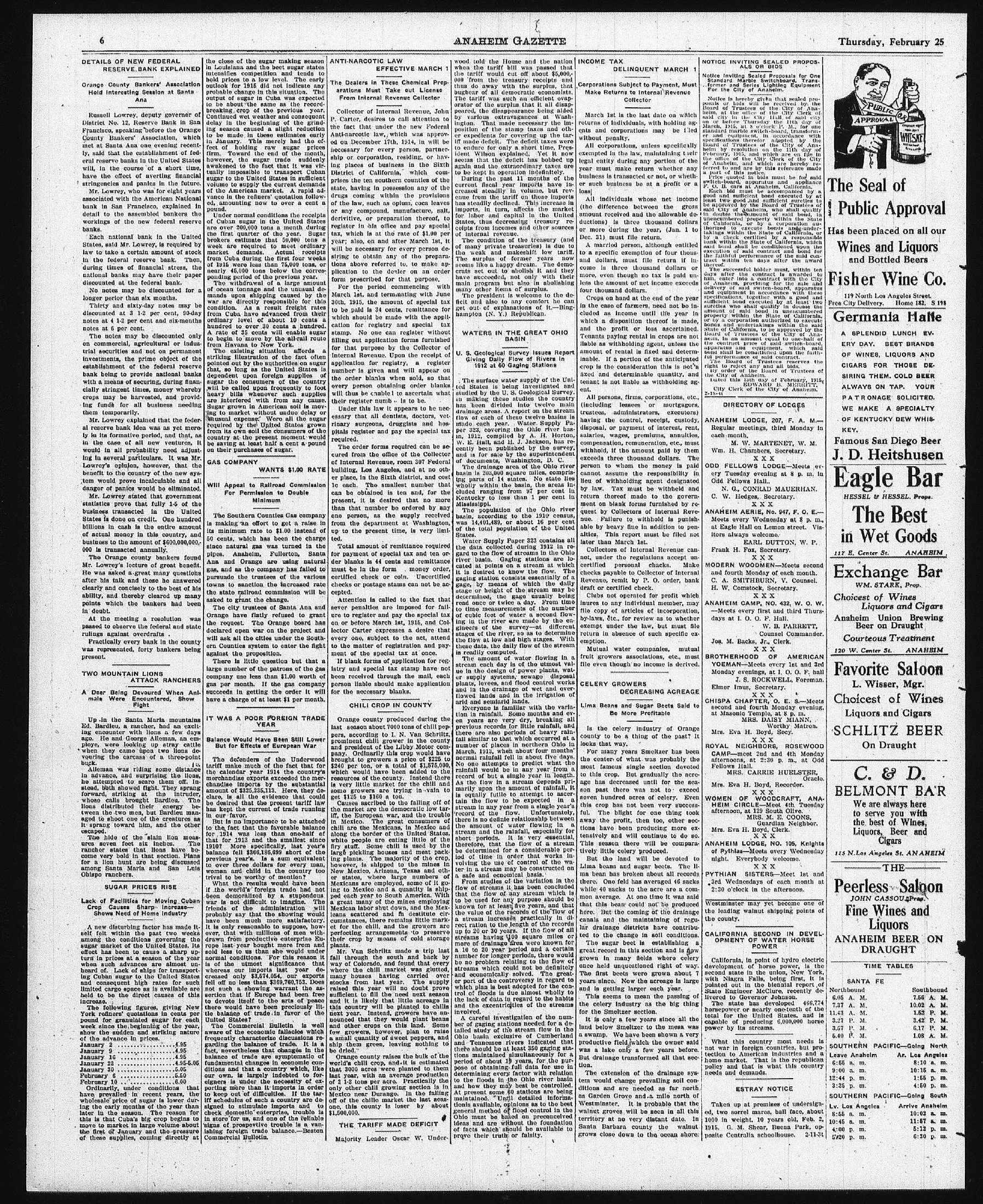
Searchable text
DETAILS OF NEW FEDERAL RESERVE BANK EXPLAINED
Orange County Bankers' Association Hold Interesting Session at Santa Ana
Russell Lowrey, deputy governor of District No. 12, Reserve Bank in San Francisco, speaking before the Orange County Bankers' Association, which met at Santa Ana one evening recently, said that the establishment of federal reserve banks in the United States will, in the course of a short time, have the effect of averting financial stringencies and panics in the future.
Mr. Lowrey, who was for eight years associated with the American National bank in San Francisco, explained in detail to the assembled bankers the workings of the new federal reserve banks.
Each national bank in the United States, said Mr. Lowrey, is required by law to take a certain amount of stock in the federal reserve bank. Then, during times of financial stress, the national banks may have their paper discounted at the federal bank.
No notes may be discounted for a longer period than six months.
Thirty and sixty-day notes may be discounted at 31-2 per cent, 90-day notes at 41-2 per cent and six-months notes at 6 per cent.
The notes may be discounted only on commercial, agricultural or industrial securities and not on permanent investments, the prime object of the establishment of the federal reserve bank being to provide national banks with a means of securing, during financially stringent times, money whereby crops may be harvested, and providing funds for all business needing them temporarily.
Mr. Lowrey explained that the federal reserve bank idea was as yet merely in its formative period, and that, as in the case of all new ventures, it would be all such and no other.
the close of the sugar making season in Louisiana and the beet sugar states intensifies competition and tends to hold prices to a low level. The early outlook for 1915 did not indicate any probable change in this situation. The output of sugar in Cuba was expected to be about the same as the record-breaking crop of the previous year. Continued wet weather and consequent delay in the beginning of the grinding season caused a slight reduction to be made in these estimates early in January. This merely had the effect of holding raw sugar prices firm. Toward the end of the month, however, the sugar trade suddenly awakened to the fact that it was virtually impossible to transport Cuban sugar to the United States in sufficient volume to supply the current demands of the American market. A rapid advance in the refiners' quotation followed, amounting now to over a cent a pound.
Under normal conditions the receipts of Cuban sugar in the United States are over 200,000 tons a month during the first quarter of the year. Sugar brokers estimate that 50,000 tons a week are required to meet ordinary market demands. Actual receipts from Cuba during the first four weeks of 1915 were less than 75,000 tons, or nearly 45,000 tons below the corresponding period of the previous year.
The withdrawal of a large amount of ocean tonnage and the unusual demands upon shipping caused by the war are directly responsible for this condition. As a result freight rates from Cuba have advanced from their ordinary level of about 10 cents a hundred to over 30 cents a hundred. A rate of 35 cents will enable sugar to begin to move by the all-rail route from Havana to New York.
The existing situation affords a striking illustration of the fact often pointed out by the authorities on sugar that, so long as the United States is dependent upon foreign supplies of sugar the consumers of the country will be called upon frequently to foot heavy bills whenever such supplies are interfered with from any cause. Sugar grown in American soil is moving to market without undue delay or unusual expense. Were all the sugar required by the United States grown from its own soil the consumers of the country at the present moment would be saving at least half a cent a pound.
ANTI-NARCOTIC
The Dealers' arations I From Intl
Collector P. Carter, duly fact that Anti-narcotics ed on December necessary for ship or corp ning places District of prises the to state, having drugs comi fled of the law, or any con derivitive, o register in tax, which year; also, will be necessi sring to o pitions above plication to form presc e for the March 1st, 30th, 1915, to be paid which shou ld cation for stamp. Not filling out as for that pur Internal Re application number is the order b every person will thus be their registr e Under tha essary that rinary surplus pitals regis tured.
Investments, the prime object of the establishment of the federal reserve bank being to provide national banks with a means of securing, during financially stringent times, money whereby crops may be harvested, and providing funds for all business needing them temporarily.
Mr. Lowrey explained that the federal reserve bank idea was as yet merely in its formative period, and that, as in the case of all new ventures, it would in all probability need adjusting in several particulars. It was Mr. Lowrey's opinion, however, that the benefit to the country of the new system would prove incalculable and all danger of panics would be eliminated.
Mr. Lowrey stated that government statistics prove that fully 1-5 of the business transacted in the United States is done on credit. One hundred billions in cash is the entire amount of actual money in this country, and business to the amount of $600,000,000,000 is transacted annually.
The Orange county bankers found Mr. Lowrey's lecture of great benefit. He was asked a great many questions after his talk and those he answered clearly and concisely to the beat of his ability, and thereby cleared up many points which the bankers had been in doubt.
At the meeting a resolution was passed to observe the federal and state rulings against overdrafts.
Practically every bank in the county was represented, forty bankers being present.
TWO MOUNTAIN LIONS ATTACK RANCHERS
A Deer Being Devoured When Animals Were Encountered, Show Flight
Up in the Santa Maria mountains Ed. Bardleu, a rancher, had an exciting encounter with lions a few days ago. He and George Alleman, an employee, were looking up stray cattle when they came upon two lions devouring the carcass of a three-point buck.
Alleman was riding some distance in advance, and surprising the lions, he attempted to scare them off. Instead, both showed flight. They sprang forward, striking at the intruder, whose calls brought Bardleu. The lions distributed their energy between the two men, but Bardleu managed to shoot one of the creatures as it sprang toward him, and the other escaped.
The hide of the slain lion measures seven feet six inches. The rancher states that lions have striking illustration of the fact often pointed out by the authorities on sugar that, so long as the United States is dependent upon foreign supplies of sugar the consumers of the country will be called upon frequently to foot heavy bills whenever such supplies are interfered with from any cause. Sugar grown in American soil is moving to market without undue delay or unusual expenser. Were all the sugar required by the United States grown from its own soil the consumers of the country at the present moment would be saving at least half a cent a pound on their purchases of sugar.
GAS COMPANY
WANTS $1.00 RATE
Will Appeal to Railroad Commission For Permission to Double Minimum
The Southern Counties Gas company is making an effort to get a raise in its minimum rate to $1.00 instead of 50 cents, which has been the charge since natural gas was turned in the pipes. Anaheim, Fullerton, Santa Ana and Orange are using natural gas, and as the company has failed to pursueuate the trustees of the various towns to sanction the increased rate the state railroad commission will be asked to grant the change.
The city trustees of Santa Ana and Orange have flatly refused to grant the request. The Orange board has declared open war on the project and will ask all the cities under the Southern Counties system to enter the fight against the proposition.
There is little question but that a large number of the patrons of the gas company use less than $1.00 worth of gas per month. If the gas company succeeds in getting the order it will have a charge of at least $1 per month.
IT WAS A POOR FOREIGN TRADE YEAR
Balance Would Have Been Still Lower But For Effects of European War
The defenders of the Underwood tariff make much of the fact that for the calendar year 1914 the country's merchandise exports exceeded the merchandise imports by the substantial amount of $325,235,113. Here, they declare, is all the evidence that could be desired that the present tariff law has kept the current of trade running in our favor.
But is no importance to be attached to the fact that the favorable balance for 1914 was less than one-half of that for 1913 and the smallest since 1910? More specifically, last year's striking illustration of the fact often pointed out by the authorities on sugar that, so long as the United States is dependent upon foreign supplies of sugar the consumers of the country will be called upon frequently to foot heavy bills whenever such supplies are interfered with from any cause. Sugar grown in American soil is moving to market without undue delay or unusual expenser. Were all the sugar required by the United States grown from its own soil the consumers of the country at the present moment would be saving at least half a cent a pound on their purchases of sugar.
GAS COMPANY
WANTS $1.00 RATE
Will Appeal to Railroad Commission For Permission to Double Minimum
The Southern Counties Gas company is making an effort to get a raise in its minimum rate to $1.00 instead of 50 cents, which has been the charge since natural gas was turned in the pipes. Anaheim, Fullerton, Santa Ana and Orange are using natural gas, and as the company has failed to pursueuate the trustees of the various towns to sanction the increased rate the state railroad commission will be asked to grant the change.
The city trustees of Santa Ana and Orange have flatly refused to grant the request. The Orange board has declared open war on the project and will ask all the cities under the Southern Counties system to enter the fight against the proposition.
There is little question but that a large number of the patrons of the gas company use less than $1.00 worth of gas per month. If the gas company succeeds in getting the order it will have a charge of at least $1 per month.
IT WAS A POOR FOREIGN TRADE YEAR
Balance Would Have Been Still Lower But For Effects of European War
The defenders of the Underwood tariff make much of the fact that for the calendar year 1914 the country's merchandise exports exceeded the merchandise imports by the substantial amount of $325,235,113. Here, they declare, is all the evidence that could be desired that the present tariff law has kept the current of trade running in our favor.
But is no importance to be attached to the fact that the favorable balance for 1914 was less than one-half of that for 1913 and the smallest since 1910? More specifically, last year's striking illustration of the fact often pointed out by the authorities on sugar that, so long as the United States is dependent upon foreign supplies of sugar the consumers of the country will be called upon frequently to foot heavy bills whenever such supplies are interfered with from any cause. Sugar grown in American soil is moving to market without undue delay or unusual expenser. Were all the sugar required by the United States grown from its own soil the consumers of the country at the present moment would be saving at least half a cent a pound on their purchases of sugar.
GAS COMPANY
WANTS $1.00 RATE
Will Appeal to Railroad Commission For Permission to Double Minimum
The Southern Counties Gas company is making an effort to get a raise in its minimum rate to $1.00 instead of 50 cents, which has been the charge since natural gas was turned in the pipes. Anaheim, Fullerton, Santa Ana and Orange are using natural gas, and as the company has failed to pursueuate the trustees of the various towns to sanction the increased rate the state railroad commission will be asked to grant the change.
The city trustees of Santa Ana and Orange have flatly refused to grant the request. The Orange board has declared open war on the project and will ask all the cities under the Southern Counties system to enter the fight against the proposition.
There is little question but that a large number of the patrons of the gas company use less than $1.00 worth of gas per month. If the gas company succeeds in getting the order it will have a charge of at least $1 per month.
IT WAS A POOR FOREIGN TRADE YEAR
Balance Would Have Been Still Lower But For Effects of European War
The defenders of the Underwood tariff make much of the fact that for the calendar year 1914the country's merchandise exports exceededthe merchandise imports bythe substantialamountof$325,235,113.Here,thedeclare.isalltheevidencethatcouldbedesiredthatthepresenttarifflawhaskeptthecurrentoftraderunninginourfavor.
But is no importance to be attached tothefactthatthefavorablebalancefor1914waslessthanone-halfofthatfor1913andthesmallestsince1910?Morespecificallylastyear'sstrikingillustrationofthefactoftenpointedoutbythatlongastheUnitedStatesisdependentupforeignsuppliesofsugartheconsumersofthecountrywillbecalleduponfrequentlytofootheywheneversuchsuppliesareinterferedwithfromanycause.SugargrowninAmericansoilismovingtomarketwithoutunduedelayorunusualexpenser.WereallthesugarrequiredbytheUnitedStatesgrownfromitsownsoiltheconsumersofthecountryatthepresentmomentwouldbesavingatleasthalfacentapoundontheirpurchasesofsugar.
Orange co.lastseasonpers,andcoreminentandpresidentpany.Ordit broughtto$240pertowhichwouldresourcesofforsiyverylittlesomegrowget$125tochausesasthemarketoffielfluffin.theEuroinMexico.chillaco alongthebehindwhitepeoplefry stuff.
Alleman was riding some distance in advance, and surprising the lions, he attempted to scare them off. Instead, bibth showed fight. They sprang forward, striking at the intruder, whose calls brought Bardieu. The lions distributed their energy between the two men, but Bardieu managed to shoot one of the creatures as it sprang toward him, and the other escaped.
The hide of the slain lion measures seven feet six inches. The rancher states that lions have become very bold in that section. Plans for a lion hunt are being discussed among Santa Marla and San Luis Obispo ranchers.
SUGAR PRICES RISE
Lack of Facilities for Moving Cuban Crop Causes Sharp Increase—Shows Need of Home Industry
A new disturbing factor has made itself felt within the past two weeks among the conditions governing the sugar market of the United States. Its effect has been to cause a sharp upturn in prices at a season of the year when such advances are almost unheard of. Lack of ships for transporting Cuban sugar to the United States and consequent high rates for such limited cargo space as is available are held to be the direct causes of this increase.
The following figures, giving New York refiners' quotations in cents per pound for granulated sugar for each week since the beginning of the year, show the sudden and striking nature of the advance in prices.
January 2 ... 4.95
January 9 ... 4.95
January 16 ... 4.95
January 23 ... 4.95-5.05
January 30 ... 5.05
February 6 ... 5.50
February 10 ... 6.00
Ordinarily, under conditions that have prevailed in recent years, the wholesale price of sugar is lower during the early months of the year than later in the season. The reason for this is that Cuba's big crop begins to move to market in large volume about the first of January and the pressure of these supplies, coming directly at
The defenders of the Underwood tariff make much of the fact that for the calendar year 1914 the country's merchandise exports exceeded the merchandise imports by the substantial amount of $325,235,113. Here, they declare, is all the evidence that could be desired that the present tariff law has kept the current of trade running in our favor.
But is no importance to be attached to the fact that the favorable balance for 1914 was less than one-half of that for 1913 and the smallest since 1910? More specifically, last year's balance fell $366,186,699 short of the previous year's. Is a sum equivalent to over three dollars for every man, woman and child in the country too trivial to be worthy of mention?
What the results would have been if the world's foreign trade had not been demoralized by a stupendous war is not difficult to imagine. The friends of the administration will probably say that the showing would have been much more satisfactory. It is only reasonable to suppose, however, that with millions of men withdrawn from productive enterprise Europe last year bought more from and sold less to us than she would under normal conditions. For this reason it is of the utmost significance that whereas our imports last year decreased only $3,574,054, our exports fell off no less than $369,760,753. Does not such a showing warrant the assertion that if Europe had been free to devote itself to the arts of peace there would have been previously little balance of trade in favor of the United States?
The Commercial Bulletin is well aware of the economic fallacies which frequently characterize discussions regarding the balance of trade. It is a fact, nevertheless that changes in the balance of trade are symptomatic of fundamental changes in economic conditions and that a country which, like our own, is largely indebted to foreigners is under the necessity of exporting more than it imports in order to keep out of difficulties. If the tariff schedules of such a country are designed to stimulate imports and to check domestic enterprise, trouble is in store for us, and one of the reliable signs of prosapevite trouble is a vanishing foreign trade balance—Boston Commercial Bulletin.
making season sugar states and tends to
The early record year, consequent of the grind-out reduction that matures early had the sugar prices the month, so suddenly it was virulent demands. A rapid adaptation follower a cent a receipts United States month during the year. Sugar is 1,000 tons a week ordinary receipts at four weeks or 4,000 tons, or the corrosive year. A large amount unusual depreciated by the table for this weight rates from their 10 cents a hundred. A manageable rail route k. affords a move delay or all the sugar states is supplies of the country mostly to foot any cause. Soil is movable delay or all the sugar states grown numbers of the moment would present a pound
ANTI-NARCOTIC LAW
EFFECTIVE MARCH 1
The Dealers In These Chemical Preparations Must Take out License From Internal Revenue Collector
Collector of Internal Revenue, John P. Carter, desires to call attention to the fact that under the new Federal Anti-narcotic law, which was approved on December 17th, 1914, in will be necessary for every person, partnership or corporation, residing, or having places of business in the Sixth District of California, which comprises the ten southern counties of the state, having in possession any of the drugs coming within the provisions of the law, such as opium, coca leaves or any compound, manufacture, salt, derivative, or preparation thereof, to register in his office and pay special tax, which is at the rate of $1.00 per year; also, on and after March 1st, it will be necessary for every person desiring to obtain any of the preparations above referred to, to make application to the dealer on an order form prescribed for that purpose.
For the period commencing with March 1st, and terminating with June 30th, 1915, the amount of special tax to be paid is 34 cents, remittance for which should be made with the application for registry and special tax stamp. No one can register without filling out application forms furnished for that purpose by the Collector of Internal Revenue. Upon the receipt of application for registry, a register number is given and will appear on the order blanks when sold, so that every person obtaining order blanks will thus be enabled to ascertain what their register number is to be.
Under this law it appears to be necessary that all dentists, doctors, veterinary surgeons, drummets and hospitals register and pay the special tax required.
The order forms required can be se-wood told the House and the nation when the tariff bill was passed that tariff would cut off about $5,000,000 from the treasury receipts and thus do away with the surplus, that bugbear of all democratic economists. The tariff is such an efficient evaporator of the surplus that it all disappeared, the disappearance being aided by various extravagances at Washington. That made necessary the imposition of the stamp taxes and other expedients for covering up the tariff deficit. The deficit taxes were to endure for only a short time, President Wilson explained. Yet it now seems that the deficit has bobbled up again and the extraordinary taxes are to be kept in operation indefinitely.
During the past 11 months of the current fiscal year imports have increased steadily in volume, but revenue from the tariff on those imports has steadily declined. This increase in imports, in turn, affects the market for labor and capital in the United States, thus decreasing treasury receipts from incomes and other sources of internal revenue.
The condition of the treasury (and of many private treasures) is due to the weak and makeshift low tariff. The surplus of former years now seems like a happy dream. The democrats set out to abolish it and they have succeeded, not only with their main program but also in abolishing many other items of surplus.
The president is welcome to the deficit and also to any comfort he can get out of explanations of it.—Binghamton (N. Y.) Republican.
WATERS IN THE GREAT OHIO BASIN
U.S. Geological Survey Issues Report Giving Daily Flow of Rivers in 1912 at 60 Gaging Stations
The surface water supply of the United States is being investigated and studied by the U.S. Geological Survey, in making these studies the country has been divided into twelve main drainage areas. A report on the stream flow of each of these twelve basins is made each year. Water Supply Paper 323, covering the Ohio river basin, 1912, compiled by A. H. Horton, W. E. Hall, and H. J. Jackson, has recently been published by the survey.
INCOME TAX
DELINQUENT MARCH
Corporations Subject to Payment, Must Make Returns to Internal Revenue Collector
March 1st is the last date on which returns of individuals, with holding agents and corporations may be filed without penalty.
All corporations, unless specifically exempted in the law, maintaining legal entity during any portion of the year must make return whether any business is transacted or not, or whether such business be at a profit or loss.
All individuals whose net income (the difference between the gross amount received and the allowable deductions) is three thousand dollars or more during the year, (Jan. 1 to Dec. 31) must file return.
A married person, although entitled to a specific exemption of four thousand dollars, must file return if in come is three thousand dollars or more even though no tax is paid unless the amount of net income exceedes four thousand dollars.
Crops on hand at the end of the year in the case of farmers need not be included as income until the year if which a disposition thereof is made and the profit or loss ascertained Tenants paying rental in crops are not liable as withholding agent, unless the amount of rental is fixed and determinate. If a portion of the anticipated crop is the consideration this is not fixed and determinable quantity, an tenant is not liable as withholding an ent.
All persons, firms, corporations, etc. (including lessees or mortgagor trustees, administrators, executors having the control, receipt, custodian disposal, or payment of interest, remuneration, remuneration, etc., must withhold all persons firms corporations etc.)
Internal Revenue. Upon the receipt of application for registry, a register number is given and will appear on the order blanks when sold, so that every person obtaining order blanks will thus be enabled to ascertain what their register number is to be.
Under this law it appears to be necessary that all dentists, doctors, veterinary surgeons, druggists and hospitals register and pay the special tax required.
The order forms required can be secured from the office of the Collector of Internal Revenue, room 307 Federal building, Los Angeles, and at no other place, in the Sixth district, and cost 1c each. The smallest number that can be obtained is ten and, for the present, it is desired that no more than that number be ordered by any one person, as the supply received from the department at Washington, up to the present time, is very limited.
Total amount of remittance required for payment of special tax and ten order blanks is 44 cents and remittance must be in the form money order, certified check or coin. Uncertified checks or postage stamps cannot be accepted.
Attention is called to the fact that sever penalties are imposed for failure to register and pay the special tax on or before March 1st, 1915, and Collector Carter expresses a desire that everyone subject to the act, attend to the matter of registration and payment of the special tax at once.
If blank forms of application for registry and special tax stamp have not been received through the mail, each person liable should make application for the necessary blanks.
CHILI CROP IN COUNTY
Orange county produced during the last season about 7000 tons of chill peppers, according to I. N. Van Schiltz, prominent chill grower in the county and president of the Libby Motor company. Ordinarily this crop would have brought to growers a price of $225 to $240 per ton, or a total of $1,575,000, which would have been added to the resources of the county. Instead there is very little market for the chill and some growers are trying in vain to get $125 to $160 a ton.
Causes ascribed to the falling off of the market are the democratic low tariff, the European war, and the trouble in Mexico. The great consumers of chill are the Mexicans, in Mexico and along the border of the United States, white people are eating little of the fry stuff. Some chill is used by the attached balance one-half of all last year's sales.
CELERY GROWERS
DECREASING ACREAGE
Lima Beans and Sugar Beets Said To Be More Profitable
Is the celery industry of Oranges county to be a thing of the past? looks that way.
For many years Smeltzer has been the center of what was probably the most famous single section devoted to this crop. But gradually the area has decreased until for the season past there was not to exceed seven hundred acres of celery. Even this crop has not been very successful.
The blight for one thing too away the profit, then too, other sales have been producing more intensively and will continue to do so. This season there will be comparable slightly little celery produced.
Underwood detect that for one country's added the merits substantial here, they deem that could at tariff law be running the attached balance some half of the largest since last year's short of the equivalent every man, country too question?
have been had not stupendousagine. The ration will drawing would satisfactory. suppose, how men with enterprise Europe from and would under this reason it is the year exports 800,753. Does the aid been free of peace occasionally litter of the is well circles which discussions relied to formosity of exports in order. If the tariff are deeds and to trouble is the reliable no is a vantage—Boston
THE TARIFF MADE DEFICIT
Majority Leader Oscar W. Under-
normal rainfall fell in about five days. No one attempts to predict what the rainfall would be in any year from a record of but a single year in length. As the flow in a stream depends primarily upon the amount of rainfall, it is equally futile to attempt to ascertain the flow to be expected in a stream in any year from a single year's record of the flow. Unfortunately, there is no definite relationship between the amount of water flowing in a stream and the rainfall, especially for short periods. It is very essential, therefore, that the flow of a stream be determined for a considerable period of time in order that works involving the use of control of the water in a stream may be constructed on a safe and economical basis.
From studies of the variation in the flow of streams it has been concluded that the flow of any stream which is to be used for any purpose should be known for at least five years, and that the value of the records of the flow of a stream increases practically in direct ration to the length of the records up to 20 or 30 years. If the flow of all streams having 100 square miles or more of drainage area were known for a 10 to 20 year period and a certain number for longer periods, there would be no problem relating to the flow of streams which could not be definitely and economically solved. The greater port of the controversy in regard to which plan is best adopted for the control of floods is due almost wholly to the lack of data in regard to the habits and the excentricities of the streams involved.
A careful investigation of the number of gaging stations needed for a detailed study of the stream flow in the Ohio basin exclusive of Cumberland and Tennessee rivers indicated that there should be at least 350 gaging stations maintained simultaneously for a period of about 10 years, for the purpose of obtaining full data for use in determining every factor with relation to the floods in the Ohio river basin and how they may best be controlled. At present some 60 stations are being maintained. Until detailed informations available, opinions as to the best general method of flood control in the Ohio must be based on preconceived ideas and are without the foundation of facts which should be available to prove their truth or falsity.
the center-of what was probably the most famous single section devoted to this crop. But gradually the age has decreased until for the season past there was not to exceed seven hundred acres of celery. Even this crop has not been very successful ful. The blight for one thing took away the profit, then too, other sections have been producing more extensively and will continue to do so. This season there will be compared tively little celery produced.
But the land will be devoted to Lima beans and sugar beets. The ma bean has broken about all records there. One feld has averaged 46 sacks while 40 sacks to the acre are common average. At one time it was said that this bean could not be produced here. But the coming of the drainage canals and the maintaining of regular drainage districts have contributed to the change in soil conditions.
The sugar beet is establishing great record in this section and is now grown in many fields where celery once held unquestioned right of way. The first beets were grown about 19 years since. Now the acreage is large and is getting larger each year.
This seems to mean the passing off the celery industry as the big thing for the Smoltzer section.
It is only a few years since all that land below Smeltzer to the mesa was swamp. We have been shown a very productive field which the owner sailed was a lake only a few years before. But drainage transformed all that section.
The extension of the drainage system would change prevailing soil conditions and are needed as far north as Garden Grove and a milo north of Westminster. It is probable that the walnut groves will be seen in all this territory at no very distant date. In Santa Barbara county the walnut grows close down to the ocean shore.
NOTICE INVITING SEALED PROPOSALS OR BIDS
Notice Inviting Sealed Proposals for One Standard Marble Switchboard, Transformer and Series Lighting Equipment For the City of Anaheim.
Notice is hereby given that sealed proposals or bids will be received by the Board of Trustees of the City of Anaheim at the office of the City Clerk said city in the City Hall of said city on or before Thursday the 11th day of March, 1915, at S o'clock P. M., for one standard marble switch-board, transformer and equipment, in accordance with specifications therefor suggested by the Board of Trustees of the City of Anaheim by resolution on the 11th day of February, 1915, and which are on file in the office of the City Clerk of the City of Anaheim, and which are hereby referred to and are by this reference made a part of this notice.
Price quoted in bids must be for said switch-board, apparatus and appliance P. O. B. cars at Anaheim, California.
Each bid must be accompanied by a good and sufficient bond executed by at least two good and sufficient sureties to be approved by the Board of Trustees of said City of Anaheim, who shall qualify in double the amount of said bond in accordance property within the State of California, or by a check certified by a responsible landowner the State of California, which said bond shall be conditioned upon the execution of said contract and bond for the faithful performance of the said contract within ten days after the award thereof.
The successful bidder must, within ten days after the contract is awarded to him, enter into a contract with the City of Anaheim, providing for the sale and delivery of said switen-board, apparatus and equipment in accordance with these specifications together with good and sufficient bond executed by at least two sureties who shall qualify in double the amount of said bond in unencumbered property within the State of California, in an amount equal to one-half of the contract price of said switch-board, apparatus and equipment, which said bond shall be conditioned upon the faithful performance of said contract.
The Board of Trustees reserves the right to reject any and all bids, order of the Board of Trustees of the City of Anaheim.
Lated this 15th day of February, 1915 EDWARD B. MERGITT City Clerk of the City of Anaheim.
DIRECTORY OF LODGES
ANAHEIM LODGE, 207, F. A. M.—Regular meetings, third Monday in each month.
M. W. MARTENET, W. M.
THE SEAL OF
Public Approval
Has been placed on all our Wines and Liquors and Bottled Beers
Fisher Wine Co.
119 North Los Angeles Street.
Free City Delivery. Home 182. S 198
Germania Halte
A SPLENDID LUNCH EVERY DAY. BEST BRANDS OF WINES, LIQUORS AND CIGARS FOR THOSE DESIRED THEM. COLD BEER ALWAYS ON TAP. YOUR PA TRONAGE SOLICITED. WE MAKE A SPECIALTY OF KENTUCKY DEW WHISKEY.
Famous San Diego Beer
DIRECTORY OF LODGES
ANAHEIM LODGE, 207, F. A. M.—Regular meetings, third Monday in each month.
M. W. MARTENET, W. M.
Wm. H. Chambers, Secretary.
ODD FELLOWS LODGE—Meets every Tuesday evening at 8 p.m. in Odd Fellows Hall.
N. G., CONRAD MAUERHAN.
C. W. Hedges, Secretary.
ANAHEIM AERIE, No. 947, F. O. E.—Meets every Wednesday at 8 p.m., at Eagle Hall on Lemon street. Visitors always welcome.
EARL DUTTON, W. P.
Frank H. Fox, Secretary.
MODERN WOODMEN—Meets second and fourth Monday of each month.
C. A. SMITHBURN, V. Counsel.
H. W. Comstock, Secretary.
ANAHEIM CAMP, NO. 432, W. O. W.—Meets every first and third Thursday at I. O. O. F. Hall.
W. B. PARRETT,
Counsel Commander.
Jos. M. Backs, Jr., Clerk.
BROTHERHOOD OF AMERICAN YOEMAN—Meets every 1st and 3rd Monday evenings, at I. O. O. F. hall.
J. S. ROCKWELL, Foreman.
Elmer Imus, Secretary.
CHISPA CHAPTER, O. E. S.—Meets second and fourth Monday evening, at Masonic Temple, at 8 p.m.
MRS. DAISY MIANN,
Worthy Matron.
Mrs. Eva H. Boyd, Secy.
ROYAL NEIGHBORS, ROSEWOOD CAMP—meet 2nd and 4th Monday afternoons, at 2:30 p.m., at Odd Fellows Hall.
MRS. CARRIE HUELSTER,
Oracle.
Mrs. Eva H. Boyd, Recorder.
WOMEN OF WOODCRAFT, ANAHEIM CIRCLE—Meet 4th Tuesday afternoon, at 129 South Olive.
MRS. M. E. COONS,
Guardian Neighbor.
Mrs. Eva H. Boyd, Clerk.
ANAHEIM LODGE, NO. 105, Knights of Butlers—meet any and all bids, order of the Board of Trustees of the City of Anaheim.
Lated this 15th day of February, 1915
EDWARD B. MERKITT,
City Clerk of the City of Anaheim.
2-15-41
Famous San Diego Beer J. D. Heitshusen
Eagle Bar
HESSEL & HESSEL. Props.
The Best in Wet Goods
117 E. Center St.
ANAHEIM
Exchange Bar
WM. STARK, Prop.
Choicest of Wines
Liquors and Cigars
Anaheim Union Brewing
Beer on Draught
Courteous Treatment
120 W. Center St.
ANAHEIM
Favorite Saloon
L. Wisser, Mgr.
Choicest of Wines
Liquors and Cigars
SCHLITZ BEER
On Draught
C. & D.
BELMONT BA'
We are always here to serve you with the best of Wines,
Liquors, Beer and Cigars
C. & D.
BELMONT BAR
We are always here to serve you with the best of Wines,
Liquors, Beer and Cigars
115 N.Los Angeles St. ANAHEIM
THE
Peerless Saloon
JOHN CASSOU.Pres.
Fine Wines and Liquors
ANAHEIM BEER ON DRAUGHT
TIME TABLES
SANTA FE
Northbound Southbound
6.05 A.M. 7.56 A.M.
7.37 A.M. 10.02 A.M.
11.43 A.M. 1.52 P.M.
3.27 P.M. 3.42 P.M.
3.57 P.M. 6.17 P.M.
5.40 P.M. 1.08 A.M.
SOUTHERN PACIFIC—Golng North
Leave Anaheim Ar. Los Angeles
6:55 a.m. 8:10 a.m.
9:00 a.m. 10:15 a.m.
12:44 p.m. 1:55 p.m.
3:35 p.m. 4:50 p.m.
SOUTHERN PACIFIC—Golng South
Lv. Los Angeles Arrive Anaheim
8:55 a.m. 10:02 a.m.
10:45 a.m. 11:57 a.m.
4:00 p.m. 5:12 p.m.
5:20 p.m. 6:30 p.m.