anaheim-gazette 1915-02-18
Scanned page
Searchable text
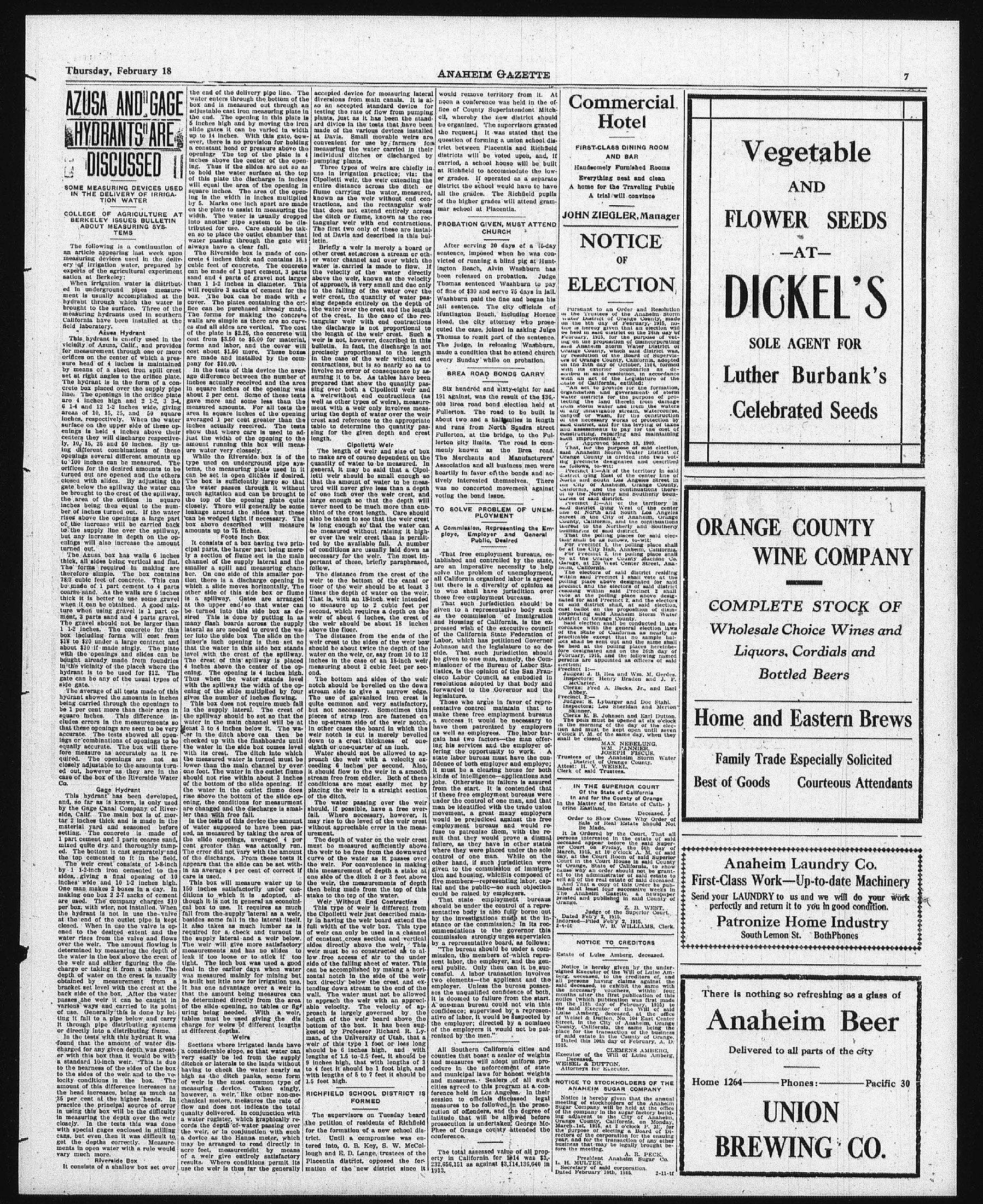
AZUSA AND GAGE HYDRANTS ARE DISCUSSED
SOME MEASURING DEVICES USED IN THE DELIVERY OF IRRIGATION WATER
COLLEGE OF AGRICULTURE AT BERKELEY ISSUES BULLETIN ABOUT MEASURING SYSTEMS
The following is a continuation of an article appearing last week upon measuring devices used in the delivery of irrigation water, prepared by experts of the agricultural experiment station at Berkeley:
When irrigation water is distributed in underground pipes measurement is usually accomplished at the hydrant through which the water is brought to the surface. Three of the measuring hydrants used in southern California have been installed at the field laboratory.
Azusa Hydrant
This hydrant is easily used in the vicinity of Azusa, Calif., and provides for measurement through one or more orifices on the center of which a pressure head of 4 inches is maintained by means of a sheet iron spill crest set at right angles to the orifice plate.
The hydrant is in the form of a concrete box placed over the supply pipe line. The openings in the orifice plate are 4 inches high and 2 1/2, 3 3/4, 6 1/4 and 12 1/2 inches wide, giving areas of 10, 15, 25, and 50 square inches, respectively. When the water surface on the upper side of these openings is held 4 inches above their centers they will discharge respectively, 10, 15, 25 and 50 inches. By using the end of the delivery pipe line, the water enters through the bottom of the box and is measured out through an adjustable cast iron measuring plate in the end. The opening in this plate is 5 inches high and by moving the iron slide gates it can be varied in width up to 14 inches. With this gate, however, there is no provision for holding a constant head or pressure above the opening. The top of the plate is 4 inches above the center of the opening. Thus if the slides are set so as to hold the water surface at the top of this plate the discharge in inches will equal the area of the opening in square inches. The area of the opening is the width in inches multiplied by 5. Marks one inch apart are made on the plate to assist in measuring the width. The water is usually dropped into another pipe system to be distributed for use. Care should be taken so to place the outlet chamber that water passing through the gate will always have a clear fall.
The Riverside box is made of concrete 4 inches thick and contains 18.1 cubic feet of concrete. The concrete can be made of 1 part cement, 3 parts sand and 4 parts gravel not larger than 1 1/2 inches in diameter. This will require 3 sacks of cement for the box. The box can be made with cover. The plates containing the office can be purchased already made. The forms for making the concrete walls are simple as there are no curves and all sides are vertical. The cost of the plate is $2.25, the concrete will cost from $3.50 to $5.00 for material, forms and labor, and the cover will cost about $1.50 more. These boxes are made and installed by the company for $10.00.
In the tests of this device the average difference between the number of inches actually received and the area in square inches of the opening was about 2 per cent. Some of these tests gave more and some less than the measured amounts. For all tests the area in square inches of the opening averaged 1 per cent greater than the inches actually received. The tests show that where care is used to adjust the width of the opening to the amount running this box will accept devices from most so an accepted device testing the rate of plants, just as it ard divice in them measuring the water individual ditches pumping plants.
Three types of use in irrigation Cipolletti weir, entire distance flume carrying known as the weir tractions, and that does not exert the ditch or flume individual ditches pumping plants.
Briefly a weir other crest set acer water channel water is carried the velocity of the above weir k of approach, is very to the falling of weir crest, the quiring depends entitle water over the of the crest. In a tangular weir with the discharge is the length of the weir not, however bulletin. In fact, precisely proportion in the case of the contractions, but involve no error or suming it to be prepared that shows sing over both a well without er well as other types ment with a weir using the depth of crest and reference table to determine sing for the give length.
Cipolletti
orifices on the center of which a pressure head of 4 inches is maintained by means of a sheet iron spill crest set at right angles to the orifice plate. The hydrant is in the form of a concrete box placed over the supply pipe line. The openings in the orifice plate are 4 inches high and 2-1/2, 3-3/4, 6-1/4 and 12-1/2 inches wide, giving areas of 10, 15, 25, and 50 square inches, respectively. When the water surface on the upper side of these openings is held 4 inches above their centers they will discharge respectively, 10, 15, 25 and 50 inches. By using different combinations of these openings several different amounts up to 100 inches can be measured. The orifices for the desired amounts to be turned out are opened and the others closed with slides. By adjusting the gate below the spillway the water can be brought to the crest of the spillway, the area of the orifices in square inches being then equal to the number of inches turned out. If the water rises above the openings a large part of the increase will be carried back to the supply line over the spillway, but any increase in depth on the openings will also increase the amount turned out.
The Axusa box has walls 6 inches thick, all sides being vertical and flat. The forms required in making are therefore simple. The box contains 78:3 cubic feet of concrete. This can be made of 1 part cement to 4 parts coarse sand. As the walls are 6 inches thick it is better to use some gravel when it can be obtained. A good mixture when using gravel is 1 part cement, 3 parts sand and 4 parts gravel. The gravel should not be larger than 1-1/2 inches. The concrete for this box including forms will cost from $18 to $20 under a large contract and about $30 if made singly. The plate with the openings and slides can be bought already made from foundries in the vicinity of the place where the hydrant is to be used for $12. The gate can be any of the usual types of slide gate.
The average of all tests made of this hydrant showed the amounts in inches being carried through the openings to be 1 per cent more than their area in square inches. This difference includes errors in the measurements so that these openings are seen to be very accurate. The tests showed all openings or combinations of openings to be equally accurate. The box will therefore measure as accurately as it required. The openings are not as closely adjustable to the amounts turned out, however as they are in the case of the box of the Riverside Water Co.
Gage Hydrant
This hydrant has been developed, and so far as is known, is only used by the Gage Canal Company of Riverside, Calif. The main box is of mortar 2 inches thick and is made in the material yard and seasoned before setting. The concrete is made of 1 part cement and 3 parts coarse sand, mixed quite dry and thoroughly tamped. The bottom is not sanded but installed by the company for $10.00.
In the tests of this device the average difference between the number of inches actually received and the area in square inches of the opening was about 2 per cent. Some of these tests gave more and some less than the measured amounts. For all tests the area in square inches of the opening averaged 1 per cent greater than the inches actually received. The tests show that where care is used to adjust the width of the opening to the amount running this box will measure water very closely.
While the Riverside box is of type used on underground pipe systems, the measuring plate used in it can be set in open ditches if desired. The box is sufficiently large so that the water passes through it without much agitation and can be brought to the top of the opening plate quite closely. There will generally be some leakage around the slides but these can be wedged tight if necessary. The box above described will measure amounts up to 75 inches.
Foot Inch Box
It consists of a box having two principal parts, the larger part being merely a section of flume set in the main channel of the supply lateral and the smaller a spill and measuring chamber. On one side of this smaller portion there is a discharge opening in which a slide moves horizontally. The other side of this side box or flume is a spillway. Gates are arranged at the upper end so that water can be turned into this side box as desired. This is done by putting in as many flash boards across the supply lateral as are needed to crowd the water into the side box. The slide on the miner's inch opening is then set so that the water in this side box stands level with the crest of the spillway. The crest of this spillway is placed 4 inches above the center of the opening. The opening is 4 inches high. Thus when the water stands level with the spillway the width of the opening of the slide multiplied by four gives the number of inches flowing.
This box does not require much fall in the supply lateral. The crest of the spillway should be set so that the water in the main channel will be at least 3 to 4 inches below it. The water in the ditch above can then be checked up with the flashboards until the water in the side box comes level with its crest. The ditch into which the measured water is turned must be lower than the main channel by over one foot. The water in the outlet flume should not rise within about 3 inches of the bottom of the slide opening. If the water in the outlet flume does rise above the bottom of the slide opening, the conditions for measurement are changed and the discharge is smaller than with free fall.
In the tests of this device the amount of water supposed to have been passed, as measured by taking the area of the slide openings, averaged 4 per cent greater than was actually run.
In the tests of this device the average difference between the number of inches actually received and the area in square inches of the opening was about 2 per cent. Some of these tests gave more and some less than the measured amounts. For all tests the area in square inches of the opening averaged 1 per cent greater than the inches actually received. The tests show that where care is used to adjust the width of the opening to the amount running this box will measure water very closely.
While the Riverside box is of type used on underground pipe systems, the measuring plate used in it can be set in open ditches if desired. The box is sufficiently large so that the water passes through it without much agitation and can be brought to the top of the opening plate quite closely. There will generally be some leakage around the slides but these can be wedged tight if necessary. The box above described will measure amounts up to 75 inches.
Foot Inch Box
It consists of a box having two principal parts, the larger part being merely a section of flume set in the main channel of the supply lateral and the smaller a spill and measuring chamber. On one side of this smaller portion there is a discharge opening in which a slide moves horizontally. The other side of this side box or flume is a spillway. Gates are arranged at the upper end so that water can be turned into this side box as desired. This is done by putting in as many flash boards across the supply lateral as are needed to crowd the water into the side box. The slide onthe miner's inch opening is then set so thatthe waterinthissideboxstandlevelwiththecrestofthespillway.Thecrestofthisspillwayisplaced4inchesabovethecenteroftheopening.Theopeningis4incheshighThuswhenthewaterstandlevelwiththespillwaythewidthoftheopeningoftheslidemultipledbyfourgivesthenumberofinchesflowing.
This box does not require much fall in the supply lateral. The crest ofthespillwayshouldbesetsothatthewaterinthissideboxstandlevelwiththecrestofthespillway.Thecrestofthisspillwayisplaced4inchesabovethecenteroftheopening.Theopeningis4incheshighThuswhenthewaterstandlevelwiththespillwaythewidthoftheopeningoftheslidemultipledbyfourgivesthenumberofinchesflowing.
This box does not require much fall in the supply lateral. The crest ofthespillwayshouldbesetso thatthewaterinthissideboxstandlevelwiththecrestofthespillway.Thecrestofthisspillwayisplaced4inchesabovethecenteroftheopening.Theopeningis4incheshighThuswhenthewaterstandlevelwiththespillwaythewidthoftheopeningoftheslidemultipledbyfourgivesthenumberofinchesflowing.
This box does not require much fall in the supply lateral. The crest ofthespillwayshouldbesetso thatthewaterinthissideboxstandlevelwiththecrestofthespillway.Thecrestofthisspillwayisplaced4inchesabovethecenteroftheopening.Theopeningis4incheshighThuswhenthewaterstandlevelwiththespillwaythewidthoftheopeningoftheslidemultipledbyfourgivesthenumberofinchesflowing.
This box does not require much fall in therupply lateral.ThecrestofthersupplylatelandshowedbetweenthewaterswithothertypesofsupplyandothertypesofsupplywithothertypesofsupplywithothertypesofsupplywithothertypesofsupplywithothertypesofsupplywithothertypesofsupplywithothertypesofsupplywithothertypesofsupplywithothertypesofsupplywithothertypesofsupplywithothertypesofsupplywithothertypesofsupplywithothertypesofsupplywithothertypesofsupplywithothertypesofsupplywithothertypesofsupplywithothertypesofsupplywithothertypesofsupplywithothertypesofsupplywithothertypesofsupplywithothertypesofsupplywithothertypesofsupplywithothertypesofsupplywithothertypesofsupplywithothertypesofsupplywithothertypesofsupplywithothertypesofsupplywithothertypesofsupplywithothertypesofsupplywithothertypesofsupplywithothertypesofsupplywithothertypesofsupplywithothertypesofsupplywithothertypesofsupplywithothertypesofsupplywithothertypesofsupplywithothertypesofsupplywithothertypesofsupplywithothertypesofsupplywithothertypesofsupplywithothertypesofsupplywithothertypesofsupplywithothertypesofsupplywithothertypesofsupplywithothertypesofsupplywithothertypesofsupplywithothertypesOfsupplyWithOtherTypesOfSupplyWithOtherTypesOfSupplyWithOtherTypesOfSupplyWithOtherTypesOfSupplyWithOtherTypesOfSupplyWithOtherTypesOfSupplyWithOtherTypesOfSupplyWithOtherTypesOfSupplyWithOtherTypesOfSupplyWithOtherTypesOfSupplyWithOtherTypesOfSupplyWithOtherTypesOfSupplyWithOtherTypesOfSupplyWithOtherTypesOfSupplyWithOtherTypesOfSupplyWithOtherTypesOfSupplyWithOtherTypesOfSupplyWithOtherTypesOfSupplyWithOtherTypesOfSupplyWithOtherTypesOfSupplyWithOtherTypesOfSupplyWithOtherTypesOfSupplyWithOtherTypesOfSupplyWithOtherTypesOfSupplyWithOtherTypesOfSupplyWithOtherTypesOfSupplyWithOtherTypesOfSupplyWithOtherTypesOfSupplyWithOtherTypesOfSupplieWithOtherTypesOfSupplieWithOtherTypesOfSupplieWithOtherTypesOf SupplieWithOther Types Of Supplie With Other Types Of Supplie With Other Types Of Supplie With Other Types Of Supplie With Other Types Of Supplie With Other Types Of Supplie With Other Types Of Supplie With Other Types Of Supplie With Other Types Of Supplie With Other Types Of Supplie With Other Types Of Supplie With Other Types Of Supplie With Other Types Of Supplie With Other Types Of Supplie With Other Types Of Supplie With Other Types Of Supplie With Other Types Of Supplie With Other Types Of Supplie With Other Types Of Supplie With Other Types Of Supplie With Other Types Of Supplie With Other Types Of Supplie With Other Types Of Supplie With Other Types Of Supplie With Other Types Of Supplie With Other Types Of Supplie With Other Types Of Supplie With Other Types Of Supplie With Other Types Of Supplie With Other Types Of Supplie With Other TypeS Of Supplie With Other Types Of Supplie With Other Types Of Supplie With Other Types Of Supplie With Other Types Of Supplie With Other Types Of Supplie With Other Types Of Supplie With Other Types Of Supplie With Other Types Of Supplie With Other Types Of Supplie With Other Types Of Supplie With Other Types Of Supplie With Other Types Of Supplie With Other Types Of Supplie With Other Types Of Supplie With Other Types Of Supplie With Other Types Of Supplie With Other Types Of Supplie With Other Types Of Supplie With Other Types Of Supplie With Other Types Of Supplies With Other Types Of Supplies With Other Types Of Supplies With Other Types Of Supplies With其他类型の suppliciesの suppliciesの suppliciesの suppliciesの suppliciesの suppliciesの suppliciesの suppliciesの suppliciesの suppliciesの suppliciesの suppliciesの suppliciesの suppliciesの suppliciesの suppliciesの suppliciesの suppliciesの suppliciesの suppliciesの suppliciesの suppliciesの suppliciesの suppliciesの suppliciesの suppliciesの suppliciesの suppliciesの supppliciesの supppliciesの supppliciesの supppliciesの supppliciesの supppliciesの supppliciesの suppressionsの suppressionsの suppressionsの suppressionsの suppressionsの suppressionsの suppressionsの suppressionsの suppressionsの suppressionsの suppressionsの suppressionsの suppressionsの suppressionsの suppressionsの suppressionsの suppressionsの suppressionsの suppressionsの suppressionsの suppressionsの suppressionsの suppressionsの suppressionsの suppressionsの suppressionsの suppressionsの suppressionsの suppressionsの suppressionsの suppressionsの suppressionsの suppressionsの suppressionsの suppressionsの suppressionsの suppressionsの suppressionsの suppressionsの suppressionsの suppressions の suppressions の suppressions の suppressions の suppressions の suppressions の suppressions の suppressions の suppressions の suppressions の suppressions の suppressions の suppressions の suppressions の suppressions の suppressIONS の suppressIONS の suppressIONS の suppressIONS の suppressIONS の suppressIONS の suppressIONS の suppressIONS の suppressIONS の suppressIONS の suppressIONS の suppressIONS の suppressIONS の suppressIONS の suppressIONS の suppressIONS の suppressIONS の suppressIONS の suppressIONS の suppressIONS の suppressIONS の suppressIONS の suppressIONS の suppressIONS の suppressIONS の suppressIONS の suppressIONS の suppressIONS の suppressIONS の suppressIONS の suppressIONS の suppressIONS の suppressIONS の suppressIONS の suppressIONS の suppressIONS の suppressIONS の suppressIONS の suppressIONS の suppressIONS の suppressIONS の suppressiones の suppressiones の suppressiones の suppressiones の suppressiones の suppressiones の suppressiones の suppressiones の suppressiones の裶捨捨捨捁捁捁捁捁捁捁捁捁捁捁捁捁捁捁捁捁捁捁捁捁捁捁捁捁捁捁捁捁捁捁捁捁捁捁捁捁捁捁捁捁捁捁捁捁捁捁捁捁捁捁捁捁捁捁捁捁捁捁捁捁捁捁捁捁捁捁捁捁捁捁捁捁捁捁捁捁捁捁捁捀捀捀捀捀捀捀捀捀捀捀捀捀捀捀捀捀捀捀捀捀捀捀捀捀捀捀捀捀捀捀捀捀捀捀捀捀捀捀捀捀捀捀捀捀捀捀捀捀搂搂搂搂搂搂搂損損損損損損損損損損損損損損損損損損損損損損損損損損損損損損損損損損損損損損損損損損損損損損損損損損損損損損損損損損損損損損損損損損損損損損損損損損損損損損損損損損損損損抡抡抡抡抡抡抡抡抡抡抡抡抡抡抡抡抡抡抡抡抡抡抡抡抡抡抡抡抡抡抲抲抲抲抲抲抲抲抲抲抲抲抲抲抲抲抲抲抲抲抲抲抲抲抲抲抲抲抲抲抲抲抲抲抲抲抲抲抲抲抲抲抲抲抲抲抲抲抲抲抲抲抲抲抲抲抲抲抲抲抲抲抲抻抉挝挝挝挝挝挝挝挝挝挝挝挝挝挝挝挝挝挝挝挝挝挝挝挝挝挝挝挝挝挝挝挝挝挝挝挝挝挝挝挝挝挝挝挝挝挝挝挝挝挝挝挝挝挝挝挝挝挝挝挝挝挝挝挝挝挝挝挝挞挝挝挝挝挈挈挈挈挈挈挈挈挈挈挈挈挈挈挈挈挈挈挈挈挈挈挈挈挈挈挈挈挈挈挈挈挈挈挈挈挈挈挈挈挈挈挈挈挈挈挈揪揪揪揪揪揪揪揪揪揪揪揪揪揪揪揪揪揪揪揪揪揪揪揪揪揪揪揪揪揪揪揪揪揪揪揪揪揪揪揪揪揪揪揪揪揪揪揪揪揪揪揪揪揪揪揪揪揪揪揪揪揪揪揪揪揪揪揪揪揪揪揪揪揪揪揪揪揪揩揩揩揩揩揩揤揩揤揤揤揤揤揤揤揤揤揤揤揤揤揤揤揤揤揤揤揤揤揤撇撇撇撇撇撇撇撇撇撇撇撇撇撇撇撇撇撇撇撇撇撇撇撇撇撇撇撇撇撇撇撇撇撇撇撇撇撇撇撇撇撇撇撇撇撇撇撇撇撇撇撇撇撇撇撇撇撇撇撇撦摛摺摛摺摛摛摛摛摛摛摛摛摛摛摛摛摛摛摛摛摛摛摛摛摛摛摛摛摛摛摛摛摛摕摚摛摕摕摕摕摕摕摕摕摕摕摕摕摕摕摕摕摕摕摕摕摕摕摕摕摕摕摕摕摕摕摕摕摕摕摕摕摗摌摗摗摗摗摗摗摗摗摗摗摗摗摗摗摗摗摗摗摗摗摗摗摗摗摗摗摗摗摗摗摗摗摗摗摗摗摗摗摗矯矽矽矽矽矽矽矽矽矽矽矽矽矽矽矽矽矽矽矽矽矽矽矽矽矽矽矽矽矽矽矽矽矽矽矽矽矽矽矽矽矽矽矽矽矽矽矽矽矽矽矽矽矽矽矽矽矽矽矽矽矽矽矽矽矽矽矽矽矽矽矽矽矽矽矽矽矽矽矽矽矽矽矽矽矽矽矽矽矽矽矽矽矽矽矽矽矽矽矽矽矹礖礖礖礖礖礖礖礖礖礖礖礖礖礖礖礖礖礖礖礖礖礖礖礖礖礖礖礖礖礖礖礖礖礖礖礖礖礖礖礖礖礖礖礖礖礖礖礖礖礖礖礖礖礖礖礖礖礖礖礖礖礖礖礖礖礖礖礖礖礖礖礖礘碴碼碴碼碼碼碼碼碼碼碼碼碼碼碼碼碼碼碼碼碼碼碼碼碼碼碼碼碼碼碼碼碼碼碼碼碼碼碼碼碼碼碼碼碼碼碼碼碼碴磋磋磋磋磋磋磋磋磋磋磋磋磋磋磋磋磋磋磋磋磋磋磋磋磋磋磋磋磋磋磋磋磋磋磋磋磋磋磋磋磋磋磋磋磋磋磋磋磋磋磋磋磋磋磋磋磋磋磋磋磋磋磋磋磋磋磋磋磋磋磋磋磋磋磋磋磋磋磋磋磋磋磋磋磋磋磋磋磋磋磋磋磋磌磋磌磌磌磌磌磌磌磌磌磌磌磌磌磌磌磌磌磌磌磌磌磌砷砷砷砷砷砷砷砷砷砷砷砷砷砷砷砷砷砷砷砷砷砷砷砷砷砷砷砷砷砷砷砷砷砷砷砷砷砷砷砷砷砷砷砷砷砷砷砷砷砷砒砒砒砒砒砒砒砒砒砒砒砒砒砒砒砒砒砒砒砒砒砒砒砒砒砒砒砒砒砒砒砒砒砒砒砒砒砒砒砒砒砒砒砒砒砒砒砒砒硎硎硎硎硎硎硎硎硎硎硎硎硎硎硎硎n硊硎n硊硃n硊硃n硊硃n硊硃n硊硃n硊硃n硊硃n硊硃n硊硃n硊硃n硊硃n硊硃n硊硃n硊硃n硊硃n硊硃n硊硃n硊硃n硊硃n硊硃n硊硃n硊硃n硊硃n硊硃n硿硃硳硳硳硳硳硳硳硳硳硳硳硳硳硳硳硳硳硳硳硳硳硳硳硳硳硳硳硳硳硳硳硳硳硳硳硳硳硳硳硳硳硳硳硳硳硳琶琶琶琶琶琶琶琶琶琶琶琶琶琶琶琶琶琶琶琶琶琶琶琶琶琶琶琶琶琶琶琶琶琶琶琶琶琶琶琶琶琶琶琶琶琶琶琶琶琶琶琶琶琶琶琶琶琶琶琶琶琶琶琶琶琶琶琶琶琶琶琶瑧瑧瑧瑧瑧瑧瑧瑧瑧瑧瑧瑧瑧瑧瑧瑧瑧瑧瑧瑧瑧瑧瑧瑧瑧瑧瑧瑧瑧瑧瑧瑧瑧瑧瑧瑧瑧瑧瑧瑧瑭瑭瑭瑭瑭瑭瑭瑭瑭
The openings are not as closely adjustable to the amounts turned out, however as they are in the case of the box of the Riverside Water Co.
Gage Hydrant
This hydrant has been developed, and so far as is known, is only used by the Gage Canal Company of Riverside, Calif. The main box is of mortar 2 inches thick and is made in the material yard and seasoned before setting. The concrete is made of 1 part cement and 3 parts coarse sand, mixed quite dry and thoroughly tamped. The bottom is cast separately and the top cemented to it in the field.
The weir crest consists of 1-8-inch by 1-2-inch iron cemented to the slides, giving a final opening of 10 inches wide and 10-12 inches high. One man makes 2 boxes in a day. In making one box 2-7 sacks of cement are used. The company charges $10 per box, with wier, not installed. When the hydrant is not in use the valve at the end of the outlet pipe is kept closed. When in use the valve is opened to the desired extent and the water rises from the valve and flows over the weir. The amount flowing is determined by measuring the depth of the water in the box above the crest of the weir and either figuring the discharge or taking it from a table. The depth of water on the crest is usually obtained by measurement from a bracket set level with the crest at the back side of the box. After the water passes the weir it can be caught in various ways and carried to its point of use. Generally this is done by letting it fall to a pipe below and carry it through pipe distributing systems or directly into a distributing flume.
In the tests with this hydrant it was found that the amount of water discharged for any given depth was greater with this box than it would be with a standard 10-inch weir. This is due to the nearness of the sides of the box to the sides of the weir and to the velocity conditions in the box. The amount of this difference increases as the head increases, being as much as 35 per cent at the higher heads. In practice the principal source of error in using this box will be the difficulty in measuring the depth over the weir closely. In the tests this was done with special gages enclosed in stilling cans, but even then it was difficult to get the depth correctly. Measurements in open water with a rule would vary much more.
Riverside Box
It consists of a shallow box set over
The length of the area tested is the width of the open-tipped parts made by concrete or material, and will be boxed.com.
Accepted device for measuring lateral diversions from main canals. It is also an accepted standard device for testing the rate of flow from pumping plants, just as it has been the standard divice in the tests that have been made of the various devices installed at Davia. Small movable weirs are convenient for use by farmers for measuring the water carried in their individual ditches or discharged by pumping plants.
Three types of weirs are chiefly in use in irrigation practice; viz: the Cipolletti weir, the weir extending the entire distance across the ditch or flume carrying the water, measured, known as the weir without end contractions, and the rectangular weir that does not extend entirely across the ditch or flume, known as the rectangular weir with end contractions. The first two only of these are installed at Davis and described in this bulletin.
Briefly a weir is merely a board or other crest set across a stream or other water channel and over which the water is carried is made to flow. If the velocity of the water directly above the weir, known as the velocity of approach, is very small and due only to the falling of the water over the weir crest, the quantity of water passing depends entirely on the depth of the water over the crest and the length of the crest. In the case of the rectangular weir with end contractions the discharge is not proportional to the length of the weir crest. Such a weir is not, however, described in this bulletin. In fact, the discharge is not precisely proportional to the length in the case of the weir without end contractions, but is so nearly so as to involve no error of consequence by assuming it to be. As tables have been prepared that show the quantity passing over both a Cipolletti weir and a weir without end contractions (as well as other types of weirs), measurement with a weir only involves measuring the depth of water over the weir crest and reference to the appropriate table to determine the quantity passing for the given depth and crest length.
Cipolletti Weir
After serving 20 days of a 75-day sentence, imposed when he was convicted of running a blind pig at Huntington Beach, Alvin Washburn has been released on probation. Judge Thomas sentenced Washburn to pay of fine of $30 and serve 75 days in jail. Washburn paid the fine and began his jail sentence. The city officials of Huntington Beach, including Horace Head, the city attorney who prosecuted the case, joined in asking Judge Thomas to remit part of the sentence. The judge, in releasing Washburn, made a condition that he attend church every Sunday while on probation.
BREA ROAD BONDS CARRY
Six hundred and sixty-eight for and 191 against, was the result of the $36,000 Brea road bond election held at Fullerton. The road to be built is about two and a half miles in length and runs from North Spadra street Fullerton, at the bridge, to the Fulerton city limits. The road is commonly known as Avenida de la Noche.
Commercial Hotel
FIRST-CLASS DINING ROOM AND BAR
Handsomely Furnished Rooms
Everything neat and clean
A home for the Traveling Public
A trial will convince
JOHN ZIEGLER, Manager
NOTICE OF ELECTION
Pursuant to an Order and Resolution on the Trustees of the Anaheim Storm Water District of Orange County, made on the 8th day of February, 1915, notice is hereby given that an election will be held in said district on the 26th day of February, 1916. On the purpose of voting on the proposition of disincorporating and Anaeim Storm Water District of Orange County, which said district was by resolution of the Board of Supervisors of Orange County, adopted on the 20th day of October, 1914, formed with its exterior boundaries as described in said resolution, in accordance with an act of the Legislature of the state of California, entitled:
An act to provide for the formation, organization and government of storm water districts for the purpose of protecting the land therein from damage from storm water and from the waters and in navigable stream. Watercourse support or improvement for construction on the necessary works of protection by district, and for levying of taxes and assessments to pay for the cost of constructing, repairing and maintaining such improvements.
Approved March 13, 1909.
The length of weir without end contractions, but is so nearly so as to involve no error of consequence by assuming it to be. As tables have been prepared that show the quantity passing over both a Cipolletti weir and a wielfront end contractions (as well as other types of weirs), measurement with a weir only involves measuring the depth of water over the weir crest and reference to the appropriate table to determine the quantity passing for the given depth and crest length.
Cipolletti Weir
The length of weir and size of box to make are of course dependent on the quantity of water to be measured. In general, it may be said that a Cipolletti weir should be small enough so that the amount of water to be measured will never give less than a depth of one inch over the weir crest, and large enough so that the depth will never need to be much more than one-third of the crest length. Care should also be taken to see that the weir crest is long enough so that the water can be measured without raising it higher over the weir crest than is permitted by the available fall. A number of conditions are usually laid down as necessary for the weir. The most important of these, briefly paraphrased, follow.
The distance from the crest of the weir to the bottom of the canal or floor of the weir should be at least 3 times the depth of water on the weir. That is, with an 18-inch weir intended to measure up to 2 cubic feet per second, which requires a depth on the weir of about 6 inches, the crest of the weir should be about 18 inches above the floor.
The distance from the ends of the weir crest to the sides of the weir box should be about twice the depth of the water on the weir, or say from 10 to 12 inches in the case of an 18-inch weir measuring about 2 cubic feet per second.
The bottom and sides of the weir notch should be bovelled on the down stream side to give a narrow edge. The use of galvanized iron crest is quite common and very satisfactory, but not necessary. Sometimes thin pieces of strap iron are fastened on the up-stream side of the weir notch. In other cases the board in which the weir notch is cut is merely bevelled down to a crest thickness of one-eighth or one-quarter of an inch.
Water should not be allowed to approach the weir with a velocity exceeding 6 inches per second. Also, it should flow to the weir in a smooth stream free from eddler. Both of these conditions are most easily met by placing the weir in a straight section of the ditch.
The water passing over the weir should, if possible, have a free overfall. Where necessary, however, it may rise to the level of the weir crest without appreciable error in the measurement.
The depth of water on the weir crest must be measured sufficiently above every Sunday while on probation.
BREA ROAD BONDS CARRY
Six hundred and sixty-eight for and 191 against, was the result of the $36,000 Brea road bond election held at Fullerton. The road to be built is about two and a half miles in length and runs from North Spadra street Fullerton, at the bridge, to the Fulerton city limits. The road is commonly known as the Brea road.
The Merchants and Manufacturers' Association and all business men were heartily in favor of the bonds and actively interested themselves. There was no concerted movement against voting the bond issue.
TO SOLVE PROBLEM OF UNEMPLOYMENT
A Commission, Representing the Employer, Employer and General Public, Desired
That free employment bureaus, established and controlled by the state, are an imperative necessity to help solve the problem of unemployment, all California organized labor is agreed but there is a diversity of opinion as to who shall have jurisdiction over these free employment bureaus.
That such jurisdiction should be given to a representative body such as the commission of Immigration and Housing of California, is expressed wish of the executive council of the California State Federation of Labor, which has petitioned Governor Johnson and the legislature to so decide. That such jurisdiction should be given to one man, namely, the Commissioner of the Bureau of Labor Statistics, is the opinion of the San Francisco Labor Council, as embodied in resolutions adopted by that body and forwarded to the Governor and the legislature.
Those who argue in favor of representative control maintain that to make these free employment bureaus a success it would be necessary to have them patronized by employers as well as employees. The labor bargain has two factors—the man offering his services and the employer offering the opportunity to work. A state labor bureau must have the confidence of both employer and employee; it must be a clearing house for both kinds of intelligence—applications and jobs. Otherwise its failure is assured from the start. It is contended that if these free employment bureaus were under the control of one man, and that man be identified with the trade union movement, a great many employers would be prejudiced against the free employment bureaus and would refuse to patronize them, with the result that they would prove a dismal failure, as they were placed under the sole responsibility of the Board of Supervisors or Orange County, California, adopted upon its exterior boundaries as described in said resolution, in accordance with an act of the Legislature of the state of California, entitled:
Accustomed to formulate organization and government of storm water districts for the purpose of protecting the land therein trom damage from storm water and from the waters only navigable stream; watercourse; onshore or offshore; onthe necessary works of protection by said district, and for the levying of taxes and assessments to pay for the cost of constructing, repairing and maintaining such amenities.
Approved March 13, 1909.
That, for the purpose of said election, said Anaheim Storm Water District of Orange County is divided into two voting districts designated and described as follows:
Precinct 1: All of the territory in said district lying East of the center line of North and south Los Angeles Street in the City of Anaheim; Orange County, California; and continues thereof to the Northernly and Southernly boundaries of said district.
Precinct 2: All or the territory in said district lying West of the center line of Nutmack and South Los Angeles Street in the City of Anaheim; Orange County, California; and continues thereof to the Northernly and Southernly boundaries of said district.
For precinct 1, the polling place shall be at the City Hall, Anaheim, California.
For precinct 2, the polling place shall be at the Orange County Machine Co., at West Center街, Anaheim, California.
The electors of said district residing within said Precinct 1 shall vote at the polling place above designated for said precinct and the electors of said district voting at the polling place above designated for said Precinct 2, and the electors of said district shall, at said election, cast ballots on the proposition of discontinuance for Storm Water District of Orange County.
Said election shall be conducted in accordance with the general election laws of the State of California as nearly as possible except that no sample bouts shall be allowed until seven o'clock P.M. of the same day, February 1915, and the following named persons are appointed as officers of said precinct:
Judges: J. B. Rea and Wm. M. Gerdes.
Henry Braden and J. P. McCarter.
Fred A. Backs, Jr., and Earl Abby.
Precinct 2:
Judges: S. Lybarger and Doc Stahl.
Inspectors: Leo Sheridan and Merton Skinner.
Gerald K. B. Johnson and Earl Dutton.
The polls must be opened at six o'clock in the morning of the day of the election and must be kept open until seven o'clock P.M. of the same day when they shall be closed.
MAX NEBELUNG,
WM.PANNIER,
JOSEPH FISCUS.
Trustees of the Anaheim Storm Water District of Orange County.
Attach: H.V.WILM.
Clerk of said Trustees.
proach the weir with a velocity exceeding 6 inches per second. Also, it should flow to the weir in a smooth stream free from eddler. Both of these conditions are most easily met by placing the weir in a straight section of the ditch.
The water passing over the weir should, if possible, have a free overfall. Where necessary, however, it may rise to the level of the weir crest without appreciable error in the measurement.
The depth of water on the weir crest must be measured sufficiently above the weir to be free from the downward curve of the water as it passes over the weir. For convenience in making this measurement of depth a stake at one side of the ditch or 3 feet above the weir, the measurements of depth then being made from the top of this stake to the top of the water.
Weir Without End Contracts
This type of weir is different from the Cipollotti weir just described mainly in having the weir board extend the full width of the weir box. This type of weir can only be used in a channel of constant cross section and vertical sides directly above the weir. This weir must be so constructed as to allow free access of air to the under side of the falling sheet of water. This can be accomplished by making a horizontal notch in the side of the weir box directly below the crest and extending downstream to the end of the wall. The water must not be allowed to approach the weir with an appreciable velocity. The velocity of approach is largely governed by the height of the weir board above the bottom of the box. It has been suggested by Professor Richard R. Lyman, of the University of Utah, that a weir of this type 1 foot or less long should be 6 inches high, and with lengths of 1.5 to 2.5 feet, it should be 9 inches high, that with lengths of 3 to 4 feet it should be 1 foot high, and with lengths of 5 to 7 feet it should be 1.5 feet high.
RICHFIELD SCHOOL DISTRICT IS FORMED
The supervisors on Tuesday heard the petition of residents of Richfield for the formation of a new school district. Until a compromise was entered into, G. B. Key, S. W. McColough and E. D. Lange, trustees of the Placentia district, opposed the formation of the new district since it
All Southern California cities and counties that boast a sealer of weights and measures will adopt uniform procedure in the enforcement of state and municipal laws for honest weights and measures. Sealers of all such cities agreed to this program at a conference held in Los Angeles. In their session to officials discussed legal measures to be followed in the prosecution of offenders, and the degree of latitude that will be allowed before prosecution is undertaken, George McPhee of Orange county attended the conference.
The total assessed value of all property in California for 1914 was $3,232,656,151 as against $3,114,136,640 in 1913.
IN THE SUPERIOR COURT
Of the State of California
In and for the County of Orange
In the Matter of the Estate of Cath-erine Eastland
Deceased.
Order to Show Cause Why Order of Sale or Real Estate Should Not Be Made.
It is Ordered by the Court That all persons interested in the estate of said deceased appear before the said Superior Court on Friday, the 5th day of March, at 10 o'clock A.M. of said day, at the Court Room of said Superior County in the Court House in real County of Orange, State of California, to cause why an order should not be granted to the administrator of said estate to sell all of the real estate of said deceased. And please give your opinion on this matter at least four successive weeks in The Anaheim Gazette, a newspaper printed and published in said County of Orange.
Z. B. WEST,
Judge of the Superior Court.
Dated Feby 2, 1915.
Indorsed—Filed Feby 2, 1915.
W. B. WILLIAMS, Clerk.
NOTICE TO CREDITORS
Estate of Lulse Amberg, deceased.
Notice is hereby given by the undersigned Executor of the Will of Lulse Amberg, deceased, to the creditors of, and all persons having claims against the deceased to exhibit the same with the necessary voucher or proof within months after the first publication of this notice (which publication was first made on the 11th day of February, 1915) to the said Executor of the Will of said Executor dearest at office of Weisel & Dutton, No. 104 East Center Street, in City of Anaheim, Orange County, California, the same being place for the transaction of the business of said estate in the County of Orange.
Dated this 10th day of February, A.D. 1915.
CLEMENS AMBERG,
Executor of the Will of Lulse Amberg,
deceased.
WEISEL & DUTTON,
Attorneys for Executor.
NOTICE TO STOCKHOLDERS OF THE ANAHEIM SUGAR COMPANY
Notice is hereby given that the annual meeting stockholders of the Anaheim Sugar Company will be held at the office of company in the sugar factory building adjacent to the City of Anaheim, Orange County, California on Monday, Jan. 14 at 10 o'clock A.M. for the purpose of selecting a Board of Directors for the corporation for ensuring year, and for the transaction of any other business that may be legally brought before the meeting.
A. R. PECK
President Anaheim Sugar Co.
L. H. MULTER.
Secretary of said corporation.
Dated February 10th, 1915.
2-11-tf
Vegetable
AND
FLOWER SEEDS
—AT—
DICKEL'S
SOLE AGENT FOR
Luther Burbank's
Celebrated Seeds
Luther Burbank’s
Celebrated Seeds
ORANGE COUNTY
WINE COMPANY
COMPLETE STOCK OF
Wholesale Choice Wines and
Liquors, Cordials and
Bottled Beers
Home and Eastern Brews
Family Trade Especially Solicited
Best of Goods Courteous Attendants
Family Trade Especially Solicited
Best of Goods Courteous Attendants
Anaheim Laundry Co.
First-Class Work—Up-to-date Machinery
Send your LAUNDRY to us and we will do your work perfectly and return it to you in good condition.
Patronize Home Industry
South Lemon St. BothPhones
There is nothing so refreshing as a glass of
Anaheim Beer
Delivered to all parts of the city
Home 1264 Phones: Pacific 30
UNION
BREWING CO.