anaheim-gazette 1915-02-18
Scanned page
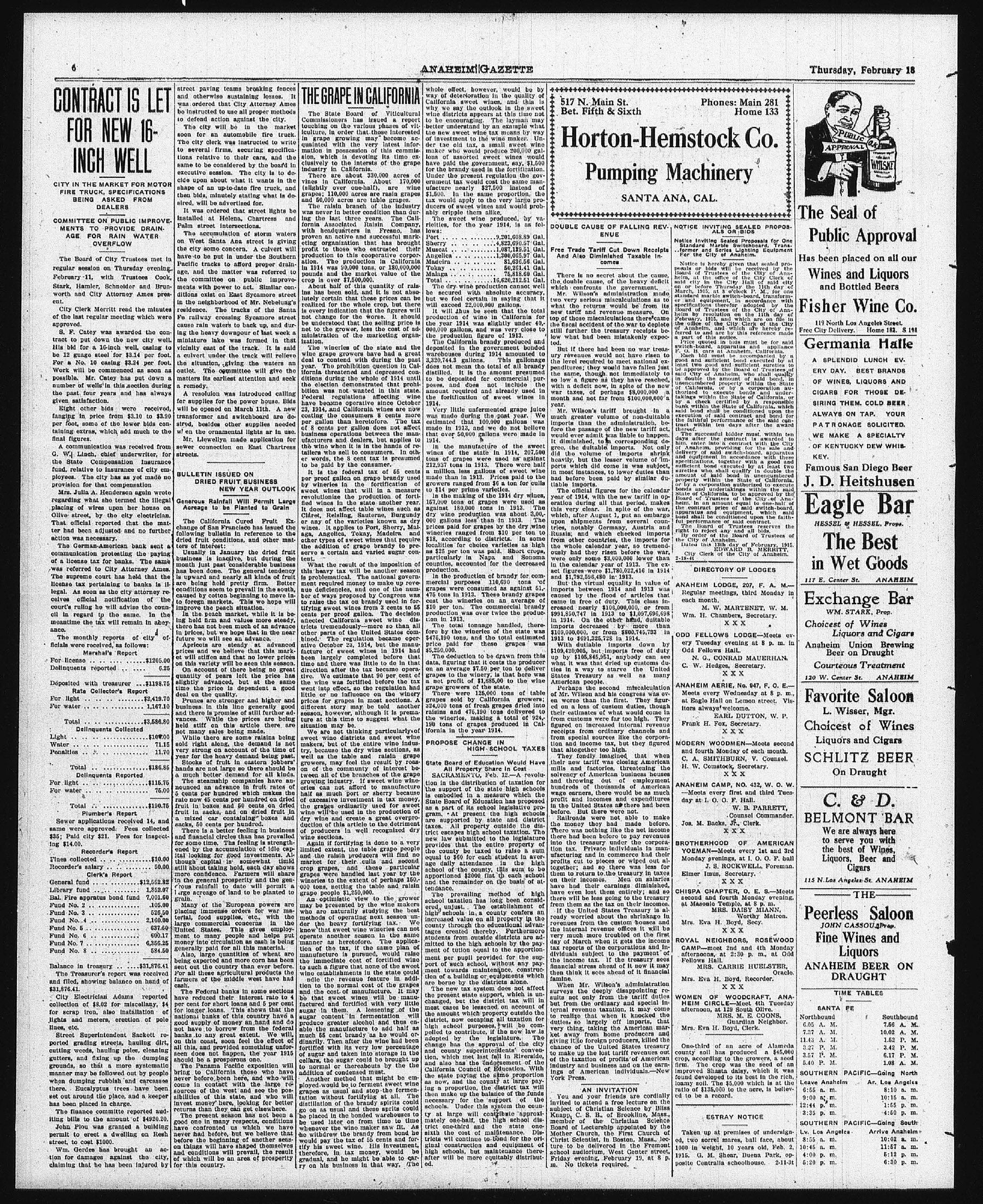
Searchable text
CONTRACT IS LET FOR NEW 16-INCH WELL
CITY IN THE MARKET FOR MOTOR FIRE TRUCK, SPECIFICATIONS BEING ASKED FROM DEALERS
COMMITTEE ON PUBLIC IMPROVEMENTS TO PROVIDE DRAINAGE FOR RAIN WATER OVERFLOW
The Board of City Trustees met in regular session on Thursday evening, February 11, with Truatees Cook, Stark, Hamler, Schneider and Brunworth and City Attorney Ames present.
City Clerk Merritt read the minutes of the last regular meeting which were approved.
S. F. Catey was awarded the contract to put down the new city well. His bid for a 16-inch well, casing to be 12 guage steel for $3.14 per foot. For a No. 10 casing $3.24 per foot. Work will be commenced as soon as possible. Mr. Catey has put down a number of wells in this section during the past four years and has always given satisfaction.
Eight other bids were received, fanging in price from $3.10 to $3.90 per foot, some of the lower bids containing extras, which add much to the final figures.
A communication was received from street paving teams breaking fences and otherwise sustaining losses. It was ordered that City Attorney Ames be instructed to use all proper methods to defend action against the city.
The city will be in the market soon for an automobile fire truck. The city clerk was instructed to write to several firms, securing specifications relative to their cars, and the same to be considered by the board in executive session. The city is to decide upon about what it wants in the shape of an up-to-date fire truck, and then bids, minutely stating what is desired, will be advertised for.
It was ordered that street lights be installed at Helena, Chartress and Palm street intersections.
The accumulation of storm waters on West Santa Ana street is giving the city some concern. A culvert will have to be put under the Southern Pacific tracks to afford proper drainage, and the matter was referred to the committee on public improvements with power to act. Similar conditions exist on East Sycamore street in the neighborhood of Mr. Nebelung's residence. The tracks of the Santa Fe railway crossing Sycamore street cause rain waters to back up, and during the heavy downpour of last week a miniature lake was formed in that vicinity east of the track. It is said a culvert under the track will relieve the situation, giving the waters an outlet. The committee will give the matters its earliest attention and seek a remedy.
A resolution was introduced calling for supplies for the power house. Bids will be opened on March 11th. A new transformer and switchboard are desired, besides other supplies needed when the ornamental lights ar in use.
Mr. Llewellyn made application for sewer connection on East Chartress
THE GRAPE IN CITY
The State Board Commissioners has touched on the variety of culture, in order that grape growing qualified with the mation in possession, which is devotively to the interest industry in California.
There are about nine vines in California (slightly over one-hundred grapes; 110,000 acres and 50,000 acres are raisin branches). There was never in better condition the last three years with headquarters for proven an active and eting organization profit to those who production to this coiation. The product in 1914 was 90,000 pounds and the man crop is over $7,500,000.
About half of this ins has been sold, and lately certain that the realized for the whole is every indication that not change for the w be understood that they not to the grower, less ministration of the location.
The wineries of the wine grape growers deal to contend with year. The prohibition forlorn threatened and ditions during the whethe election demonstration was not want Federal regulations have become operation 23, 1914, and California costing the consumer per gallon than here of 8 cents per gallon business operations manufacturers and dealers the wine when it is in
be 12 guage steel for $3.14 per foot.
For a No. 10 casing of $3.24 per foot.
Work will be commenced as soon as possible.
Mr. Catey has put down a number of wells in this section during the past four years and has always given satisfaction.
Eight other bids were received, fanging in price from $3.10 to $3.90 per foot, some of the lower bids containing extras, which add much to the final figures.
A communication was received from G. W. Linch, chief underwriter, for the State Compensation Insurance fund, relative to insurance of city employees. The city has as yet made no provision for that compensation.
Mrs. Julia A. Henderson again wrote regarding what she termed the illegal placing of wires upon her house on Olive street, by the city electrician. That official reported that the matter had been adjusted and no further action was necessary.
The German-American bank sent a communication protesting the paying of a license tax for banks. The same was referred to City Attorney Ames. The supreme court has held that the license tax pertaining to banks is illegal. As soon as the city attorney receives official notification of the court's ruling he will advise the council in regard to the same. In the meantime the tax will remain in abeyance.
The monthly reports of city officials were received, as follows:
Marshal's Report
For license ... $1205.00
Delinquents reported ... 6.25
Deposited with treasurer ... $1198.75
Rate Collector's Report
For light ... $2,419.70
For water ... 1,167.10
Total ... $3,586.80
Delinquents Collected
Light ... $10'00
Water ... 71.15
Penalties ... 11.70
Total ... $186.85
Delinquents Reported
For light ... $115.75
For water ... 75.00
Total ... $190.75
Plumber's Report
Sewer applications received 14, and same were approved. Fees collected $35; Paid city $21. Fees for inspecting $14.00.
BULLETIN ISSUED ON DRIED FRUIT BUSINESS NEW YEAR OUTLOOK
Generous Rainfall Will Permit Large Acreage to be Planted to Grain
The California Cured Fruit Exchange of San Francisco has issued the following bulletin in reference to the dried fruit conditions, and other matters of interest:
Usually in January the dried fruit business is inactive, but during the month just past considerable business has been done. The general tendency is upward and nearly all kinds of fruit are being held pretty firm. Better conditions seem to prevail in the south, caused by cotton beginning to move into foreign markets. This we hope will improve the peach situation.
In the peach market, while it is being held firm and values more steady, there has not been much of an advance in prices, but we hope that in the near future we will see an advance.
Apricots are steady at advanced prices and we believe that this market will stiffen and that no lower prices on this variety will be seen this season.
On account of there being no great quantity of pears left the price has slightly advanced, but at the same time the price is dependent a good deal on the quality.
Prunes are stronger and higher and business in this line generally good and there is promise of still further advances.
While the prices are being held stiff on this article there are not many sales being made.
While there are some raisins being sold right along, the demand is not very strong on account of the time of year for the heavy demand being past.
Stocks of fruit in eastern jobbers' hands are not large so there should be a much better demand for all kinds.
The steamship companies have announced an advance in fruit rates of 5 cents per hundred which makes the rate now 45 cents per hundred on dried fruit in boxes and 50 cents on dried fruit in sacks, and on dried fruit in a mixed car containing boxes and sacks, 50 cents per hundred.
There is a better feeling in business and financial circles than has prevailed for some time. This feeling is strengthened by the accumulation of idle capulets under the track will relieve the situation, giving the waters an outlet. The committee will give the matters its earliest attention and seek a remedy.
A resolution was introduced calling for supplies for the power house. Bids will be opened on March 11th. A new transformer and switchboard are desired, beheaded other supplies needed when the ornamental lights ar in use.
Mr. Llewellyn made application for sewer connection on East Chartress streets.
It is the federal law per proof gallon on grapes by wineries in the sweet wines that we revolutionize the protected wines in the state it does not affect tails Claret, Relishing Sauce or any of the varietés wines. It applies to baga, Angelica, Tokai other types of sweet wine the addition of grape serve a certain and vient.
What the result of this heavy tax will be is problematical. The ment required money and new deficiencies, and a number of ways proposed to raise the tax on brickyfying sweet wines for cents per proof gallon affected California's tricts tremendously—other parts of the United States.
The regulative October 23, 1911 facture of sweet wine been largely complete time and there was little direction after the taxive. We estimate that the wine was fortifile went into effect, so little or no influence prices for grapes in different story may season, however, alteration at this time to a situation may be.
We are not thinking sweet wine districts makers, but of the ctry because the dry well as the table and growers, may feel tha on of the community tween all of the brand growing industry. If erles can not afford half as much port oil of excessive investment the grapes ordinarily wine will be used in a dry wine and create duction of this article of producers in well wine sections.
Again if fortifying a limited extent, the ta
Total ... $186.85
Delinquents Reported
For light ... $115.75
For water ... 75.00
Total ... $190.75
Plumber's Report
Sewer applications received 14, and same were approved. Fees collected $35; Paid city $21. Fees for inspecting $14.00.
Recorder's Report
Fines collected ... $10.00
Recorder's salary ... 50.00
Clerk's Report
General fund ... $12,552.82
Library fund ... 1,352.07
Bal. Fire appraisus bond fund ... 7,001.60
Fund No. 2 ... 105.00
Fund No. 3 ... 526.50
Fund No. 4 ... 2,160.00
Fund No. 5 ... 637.60
Fund No. 6 ... 600.17
Fund No. 7 ... 6,356.25
Fund No. 8 ... 584.50
Balance in treasury ... $31,876.41
The Treasurer's report was received and filed, showing balance on hand of $31,876.41.
City Electrician Adams reported collection of $8.02 for miscellany, $4 for scrap iron, also installation of lights and meters, erection of pole lines, etc.
Street Superintendent Sackett reported grading streets, hauling dirt, cutting weeds, hauling poles, cleaning gutters, and fixing up the dumping grounds, so that a more systematic manner may be followed out by people when dumping rubbish and carcasses there.
Eucalyptus trees have been set out around the place, and a keeper has been placed in charge.
The finance committee reported auditing bills to the amount of $4920.20.
John Plou was granted a building permit to erect a dwelling on Resh street, to cost $1000.
Wm. Gerdes has brought an action for damages against the city, claiming that he has been injured by
Stocks of fruit in eastern jobbers' hands are not large so there should be a much better demand for all kinds.
The steamship companies have announced an advance in fruit rates of 5 cents per hundred which makes the rate now 45 cents per hundred on dried fruit in boxes and 50 cents on dried fruit in sacks, and on dried fruit in a mixed car containing boxes and sacks, 50 cents per hundred.
There is a better feeling in business and financial circles than has prevailed for some time. This feeling is strengthened by the accumulation of idle capital looking for good investments. Although capital is somewhat timid still about taking hold, each day shows more confidence. Farmers will share in the general prosperity and the generous rainfall to date will permit a large acreage of land to be planted to grain.
Many of the European powers are placing immense orders for war material, food supplies, etc., with the large commercial concerns in the United States. This gives employment to many people and helps put money into circulation as cash is being generally paid for all this material.
Also, large quantities of wheat are being exported and more corn has been sent out the country than ever before. For all these agricultural products the farmers of the middle west have had cash.
The Federal banks in some sections have reduced their interest rate to 4 per cent for short loans and 5 per cent for longer loans. This shows that the national banks of this country have a good supply of money an hand and do not have to borrow from the federal banks to any great extent. We will, on this coast, soon feel the effect of all this, and provided something unforeseen does not happen, the year 1915 should be a prosperous one.
The Panama Pacific exposition will bring to California those who have never before been here, and who will come in contact with the large resources of the west and see the possibilities of this state, and who will invest money here, looking for better returns than they can get elsewhere.
The present season has not been a good one in many respects, conditions have confronted us which we have never had before, but we believe that before the beginning of another season things will have shaped themselves and conditions will prevail, the result of which will be an area of prosperity for this country.
Again if fortifying is limited extent, the tax and the raisin produce market for their cut crop grapes, and the grapes were handled wineries to the extent 000 tons, netting the grape people $1,250,000.
An optimistic view may be presented by you who are naturally astute methods of operating der the heavy fortification know that sweet wine operate another season manner as heretoof the tax, if the manufacture is pursued the immediate cost o to such a figure that no wine establishments indule the revenue to the normal cost and the cost of manu be that sweet wines factured and fortified sugar in them. A sugar content in ferment produce greater alcohol able the manufacture much 55 cent brandy dinarily. Then after the fortified with its very of sugar and taken in cellars, the sugar course to normal or thereof addition of condensedAnother method tha ployed would be to ferry grapes as usual and distill without fortify distillation of the bran go on as usual and tha be placed in the bonshe be used later on fro whenever the wine ma he withdrew the bran would pay the tax of tify his sweet wine therefore, in tax mo gradual, and he might on his business im
THE GRAPE IN CALIFORNIA
The State Board of Viticultural Commissioners has issued a report touching on the various phases of viticulture, in order that those interested in grape growing may become acquainted with the very latest information in possession of this commission, which is devoting its time exclusively to the interests of the grape industry in California.
There are about 330,000 acres of vines in California. About 170,000 (alightly over one-half), are wine grapes; 110,000 acres are rasin grapes and 50,000 acres are table grapes.
The raisin branch of the industry was never in better condition than during the last three years. The California Associated Raisin Company, with headquarters in Fresno, has proven an active and successful marketing organization that has brought profit to those who entrusted their production to this cooperative corporation. The production in California in 1914 was 90,000 tons, or 180,000,000 pounds and the market value of the crop is over $7,500,000.
About half of this quantity of raisins has been sold, and it is not absolutely certain that those prices can be realized for the whole crop, but there is every indication that the figures will not change for the worse. It should be understood that the selling price is not to the grower, less the cost of administration of the marketing organization.
The wineries of the state and the wine grape growers have had a great deal to contend with during the past year. The prohibition question in California threatened and depressed conditions during the whole of 1914 until the election demonstrated that prohibition was not wanted in this state. Federal regulations affecting wine have become operative since October 23, 1914, and California wines are now costing the consumers eight more per gallon than heretofore. The tax of 8 cents per gallon does not affect business operations between the manufacturers and dealers, but applies to the wine when it is in the hands of rewhole effect, however, would be by way of deterioration in the quality of California sweet wines, and this is why we say the outlook in the sweet wine districts appears at this time not to be encouraging. The layman may better understand by an example what the new sweet wine tax means by way of investment to the wine maker. Under the old tax, a small sweet wine maker who would produce 200,000 gallons of assorted sweet wines would have paid the government, say, $1,500 for the brandy used in the fortification. Under the present regulation the government tax would cost the same manufacture nearly $27,500 instead of $1,500. In the same proportion, the tax would apply to the very large producers of sweet wines and would probably cripple them alike.
The sweet wine produced, by varieties, for the year 1914, is as follows:
Port ... 9,201,608.89 Gal.
Sherry ... 4,823,690.57 Gal.
Muscat ... 1,087,129.51 Gal.
Angelica ... 1,300,065.97 Gal.
Madeira ... 81,636.56 Gal.
Tokay ... 50,261.41 Gal.
Malaga ... 75,818.60 Gal.
Total ... 16,620,212.51 Gal.
The dry wine production cannot well be secured with absolute accuracy, but we feel certain in saying that it will exceed 22,000,000 gallons.
It will thus be seen that the total production of wine in California for the year 1914 was slightly under 40,000,000 gallons, and was very close to the production figure of 1913.
The California brandy produced and deposited in the government bonded warehouses during 1914 amounted to 3,320,744.3 gallons. This gallonage does not mean the total of all brandy distilled. It is the amount presumed to be deposited for commercial purposes, and does not include the amount required and already used in the fortification of sweet wines in 1914.
Very little unfermented grape juice was made during the past year. We estimated that 100,000 gallons was made in 1913, and we do not believe that over 50,000 gallons were made in 1914.
In the manufacture of the sweet whole effect, however, would be by way of deterioration in the quality of California sweet wines, and this is why we say the outlook in the sweet wine districts appears at this time not to be encouraging. The layman may better understand by an example what the new sweet wine tax means by way of investment to the wine maker. Under the old tax, a small sweet wine maker who would produce 200,000 gallons of assorted sweet wines would have paid the government, say, $1,500 for the brandy used in the fortification. Under the present regulation the government tax would cost the same manufacture nearly $27,500 instead of $1,500. In the same proportion, the tax would apply to the very large producers of sweet wines and would probably cripple them alike.
The sweet wine produced, by varieties, for the year 1914, is as follows:
Port ... 9,201,608.89 Gal.
Sherry ... 4,823,690.57 Gal.
Muscat ... 1,087,129.51 Gal.
Angelica ... 1,300,065.97 Gal.
Madeira ... 81,636.56 Gal.
Tokay ... 50,261.41 Gal.
Malaga ... 75,818.60 Gal.
Total ... 16,620,212.51 Gal.
The dry wine production cannot well be secured with absolute accuracy, but we feel certain in saying that it will exceed 22,000,000 gallons.
It will thus be seen that the total production of wine in California for the year 1914 was slightly under 40,000,000 gallons, and was very close to the production figure of 1913.
The California brandy produced and deposited in the government bonded warehouses during 1914 amounted to 3,320,744.3 gallons. This gallonage does not mean the total of all brandy distilled. It is the amount presumed to be deposited for commercial purposes, and does not include the amount required and already used in the fortification of sweet wines in 1914.
Very little unfermented grape juice was made during the past year. We estimated that 100,000 gallons was made in 1913,and we do not believe that over 50,000 gallons were made in 1914.
In the manufacture of the sweet whole effect, however, would be by way of deterioration in the quality of California sweet wines,and this is why we say the outlook in the sweet wine districts appears at this time not to be encouraging. The layman may better understand by an example what the new sweet wine tax means by way of investment to the wine maker. Under the old tax,a small sweet wine maker who would produce 200,oogallons of assorted sweet wines would have paid the government,say,$1,\text{5}oo\text{ for}the brandy used inthefortification.Underthepresentregulationthegovernmenttaxwouldcostthesamemanufacturenearly$27,\text{5}oo\text{ insteadof}$\text{$1},\text{5}oo\text{.$\text{1}}$,inthisseason,thetaxwouldapplytotheverylargeproducersofsweetwinesandwouldprobablycrippelthemallowwhathadbeenmistakenlyexpected.
But if there had been no war treasury revenues would not have risen to the level required to meet national expenditures; they would have fallen just the same though not immediately to so low a figure as they have reached with a deficit now.in spite ofthenewwartaxs.ofperhaps$ \text{8}, \text{ooo}, \text{oooo}\text{a monthandnotfarfrom$ \text{1}, \text{oooo}, \text{oooo}\text{ayear}.$
Mr.Wilson's tariff brought in a much greater volume of non-dultable imports than the administration,beforethepassageofthenewtariffact.wouldeveradmittawillabletohappen.itdiminished,totheincorrectdegree,dultableimports.Notonly
wine grape growers have had a great deal to contend with during the past year. The prohibition question in California threatened and depressed conditions during the whole of 1914 until the election demonstrated that prohibition was not wanted in this state. Federal regulations affecting wine have become operative since October 23, 1914, and California wines are now costing the consumers 8 cents more per gallon than heretofore. The tax of 8 cents per gallon does not affect business operations between manufacturers and dealers, but applies to the wine when it is in the hands of retailers who sell to consumers. In other words, the 8 cent tax is presumed to be paid by the consumer.
It is the federal tax of 55 cents per proof gallon on grape brandy used by wineries in the fortification of sweet wines that will in a measure revolutionize the production of fortified wines in the state another year. It does not affect table wines such as Claret, Relsling, Sauterne, Burgundy or any of the varieties known as dry wines. It applies to Port, Sherry, Malaga, Angelica, Tokay, Makra, and other types of sweet wines that require the addition of grape brandy to preserve a certain and varied sugar content.
What the result of the imposition of this heavy tax will be another season is problematic. The national government required money to make up revenue deficiencies, and one of the number of ways proposed by Congress was to raise the tax on brandy in fortifying sweet wines from 3 cents to 55 cents per proof gallon. The decision affected California sweet wine districts tremendously—more so than all other parts of the United States combined. The regulation became operative October 23, 1914, but the manufacture of sweet wines in 1914 had been largely completed before that time and there was little to do in that direction after the tax became operative. We estimate that 90 per cent of the wine was fortified before the tax went into effect, so the regulation had little or no influence on the winery prices for grapes in most sections. A different story may be told another season, however, although it is premature at this time to suggest what the situation may be.
We are not thinking particularly of sweet wine districts and sweet wine makers, but of the entire wine industry, because the dry wine sections, as well as the table and raisin grape growers, may feel the result by reason of the community of interest between all of the branches of the grape growing industry. If sweet wine wineries can not afford to manufacture half as much port or sherry because of excessive investment in tax money, the grapes ordinarily used for sweet wine will be used in the production of dry wine and create a great overproduction of this article to the detriment of producers in well recognized dry wine sections.
Again if fortifying is done to a very limited extent, the table grape people
PROPOSE CHANGE IN HIGH SCHOOL TAXES
State Board of Education Would Have All Property Share in Cost
SACRAMENTO, Feb. 12.—A revolution in the distribution of taxation for the support of the state high schools is embodied in a measure which the State Board of Education has proposed as a part of its school legislative program. At present the high schools are supported by state and district taxes. All property outside the district escapes high school taxation. The new law submitted to the legislature provides that the entire property of the county be taxed to raise a sum
ury revenues would not have risen to the level required to meet national expenditures; they would have fallen just the same, though not immediately to so low a figure as they have reached, with a deficit now, in spite of the new war taxes, of perhaps $8,000,000 a month and not far from $100,000,000 a year.
Mr. Wilson's tariff brought in a much greater volume of non-dultable imports than the administration, before the passage of the new tariff act, would ever admit was liable to happen. It diminished, to a corresponding degree, the dultable imports. Not only did the volume of imports shrink heavily, but the lesser volume of imports which did come in was subject, in most instances, to lower duties than had before been paid by similar dultable imports.
The official figures for the calendar year of 1914, with the new tariff in operation during all that period, makes this very clear. In spite of the war, which, after August 1, put an embargo upon shipments from several countries, notably Germany, Austria and Russia, and which checked imports from other countries, the imports for the whole calendar year, so tremendously had they risen before the war, were only some $3,000,000 lower than in the calendar year of 1913. The exact figures were $1,780,022,416 in 1914 and $1,792,596,480 in 1913.
But the virtual equality in value of imports between 1914 and 1913 was caused by the flood of articles that came in free of duty. This class increased nearly $106,000,000, or from $991,850,747 in 1913 to $1,097,696,698 in 1914. On the other hand, dultable imports decreased by more than $109,000,000, or from $800,746,733 in 1913 to $691,325,728 in 1914.
With dultable imports down by $109,420,005, but imports free of duty up by $105,845,951 anybody can see what it was that dried up customs duties in a way to starve the United States Treasury as well as many American people.
Perhaps the second miscalculation of Mr. Wilson and his congress was even worse than the first. They figured on a loss of custom duties, though their estimates of what would come in from customs were far too high. They figured on increased internal revenue receipts from ordinary channels and from special sources like the corporation and income tax, but they figured that altogether too high.
They fondly imagined that when their new tariff was closing American mills and factories, threatening the solvency of American business houses and throwing out of employment hundreds of thousands of American wage earners; there would be as much profit and incomes and expenditures in the United States there had been before. But there were not.
Railroads were not able to make money they had made before. There was nothing like the net income there had been before to pay revenues into the treasury under the corporation tax. Private individuals in man-
well as the table and raisin grape growers, may feel the result by resale on all of the branches of the grape growing industry. If sweet wine wineries can not afford to manufacture half as much port or sherry because of excessive investment in tax money, the grapes ordinarily used for sweet wine will be used in the production of dry wine and create a great overproduction of this article to the detriment of producers in well recognized dry wine sections.
Again if fortifying is done to a very limited extent, the table grape people and the raisin producers will find no market for their culls and second crop grapes, and these particular grapes were handled last year by the wineries to the extent of perhaps 150,000 tons, netting the table and raisin grape people $1,250,000.
An optimistic view to the grower may be presented by the wine makers who are naturally studying the best methods of operating next season under the heavy fortifying tax. We know that sweet wine wineries cannot operate another season in the same manner as heretofore. The application of the tax, if the same plan of manufacture is pursued, would raise the immediate cost of fortified wine to such a figure that none of the sweet wine establishments in the state could do the revenue feature in addition to the normal cost of the grapes and the cost of manufacture. It may be that sweet wines will be manufactured and fortified with very little sugar in them. A lessening of the sugar content in fermentation will produce greater alcohol and thus enable the manufacture to add half as much 55 cent brandy as he would ordinarily. Then after the wine had been fortified with its very low percentage of sugar and taken into storage in the cellars, the sugar could be brought up to normal or thereabouts by the addition of condensed must.
Another method that might be employed would be to ferment sweet wine grapes as usual and stop the fermentation without fortifying at all. The distillation of the brandy spirits could go on as usual and these spirits could be placed in the bonded warehouses to be used later on from time to time whenever the wine maker saw fit. As with the withdraw the brandy from bond he would pay the tax of 55 cents and fortify his sweet wine. His investment, therefore, in tax money, would be gradual, and he might be able to carry on his business in that way. The State Board of Education Would Have All Property Share In Cost
SACRAMENTO, Feb. 12.—A revolution in the distribution of taxation for the support of the state high schools is embodied in a measure which the State Board of Education has proposed as a part of its school legislative program. At present the high schools are supported by state and district taxes. All property outside the district escapes high school taxation. The new law submitted to the legislature provides that the entire property of the county be taxed to raise a sum equal to $60 for each student in average daily attendance in the high school of the county, this sum to be apportioned $2000 flat to each school and the remainder on the basis of attendance.
The prevailing method of high school taxation has long been considered unjust. The establishment of high schools in a county confers an increased value on all property in the county through the educational advantages created thereby. Furthermore students from outside districts are admitted to the high schools by the payment of tuition equal to the apportionment per pupil provided for the support of such school, without any payment towards maintenance, construction of a building or equipments which are borne by the districts alone.
The new tax system does not affect the present state support, which is unchanged, but the district tax will in most cases be lessened on account of the amount which property outside the district, now escaping all taxation for high school purposes, will be compelled to contribute, if the new law is adopted by the legislature. The change has the approval of the city and county superintendents' convention, which met last fall in Riverside, and also has the endorsement of the California Council of Education. With the state paying the same proportion as now, and the county at large paying a proportion, the district tax will then make up the balance of the funds necessary for the support of the schools. Under this system the county at large will contribute approximately one-third and the state one-sixth the cost of maintenance. Districts will continue to bond for the original construction and equipment of high schools, but maintenance thereafter will be more equitably distributed.
They fondly imagined that when their new tariff was closing American mills and factories, threatening the solvency of American business houses and throwing out of employment hundreds of thousands of American wage earners, there would be as much profit and incomes and expenditures in the United States as there had been before. But there were not.
Railroads were not able to make the money they had made before. There was nothing like the net income there had before to pay revenues into the treasury under the corporation tax. Private individuals in manufacturing and in commerce had their profits cut to pieces or wiped out altogether; and so there was less for them to return to the treasury in taxes on their incomes. Men on salaries have had their earnings diminished, have even lost them entirely; and so there will be less going to the treasury from them as tax on their incomes.
If the United States Treasury is already worried about the shrinkage in revenues from the custom houses and the internal revenue offices it will be very much more troubled on the first day of March when it gets the income tax reports of the corporations and individuals subject to the payment of the income tax. If the treasury sees financial stress ahead of it now it may think it sees ahead of it financial famine.
When Mr. Wilson's administration surveys not only from the tariff duties but from the ordinary and special internal revenue taxation, it may come to realize that when it knocked the dues so largely off imports, that very thing, taking the American market away from home producers and giving it to foreign producers, killed the chance of the United States treasure to make up the lost tariff revenues out of the taxation of profits of American industry and business on and among the earnings of American individuals.—New York Press.
AN INVITATION
You and your friends are cordially invited to attend a free lecture on the subject of Christian Science by Bliss Knapp, C. S.B., of Brookline, Mass., member of the Christian Science Board of Lectorship appointed by the Mother Church, the First Church of Christ Scientist, in Boston, Mass., lecture to be delivered in Fremont school auditorium, West Center street, Friday evening, February 19, at 8 p.m. No tickets required.
St. Phones: Main 281 Sixth Home 133
Non-Hemstock Co.
Camping Machinery
SANTA ANA, CAL.
FALLING REVIEWS
About the cause, the heavy deficit of government made calculations as to be from its une measure. On observations there came the war to deplete luxury receipts be mistakenly expected no war treasury not have risen to meet national exodus have fallen just immediately to they have reached, apotheke of the new prices $8,000,000 a from $100,000,000 a brought in a case of non-durable administration, be the new tariff act, liable to happen, corresponding depreciations. Not only
NOTICE INVITING SEALED PROPOSALS OR BIDS
Notice Inviting Sealed Proposals for One Standard Marble Switchboard, Transformer and Series Lighting Equipment For the City of Anaheim.
Notice is hereby given that sealed proposals or bids will be received by the Board of Trustees of the City of Anaheim, at the office of the City Clerk of said city in the City Hall of said city before Thursday the 11th day of March, 1915, at 8 o'clock P.M., for one standard marble switch-board, transformer and equipment. In accordance with specifications therefor adopted by the Board of Trustees of the City of Anaheim by regulation on the 11th day of February, 1915, and which are on file in the office of the City Clerk of the City of Anaheim, and which are hereby referred to and are by this reference made a notice.
Price quoted in bids must be for said switch-board, apparatus and appliance F. O. B. cars at Anaheim, California.
Each bid must be accompanied by a good and sufficient bond executed by at least two good and sufficient sureties to be approved by the Board of Trustees of said City of Anaheim, who shall qualify in double the amount of said bond, in unencumbered property within the State of California. Or by a corporation charged to execute bonds and undertakings within the State of California, or by a check certified by a responsible bank within the State of California, which said bond shall be conditioned upon the satisfaction of said contract and for the faithful performance of the said contract within ten days after the award thereof.
The successful bidder must, within ten days after the contract is awarded to him enter into a contract with the City of Anaheim, providing for the sale and
The Seal of Public Approval
Has been placed on all our Wines and Liquors and Bottled Beers
Fisher Wine Co.
119 North Los Angeles Street.
Free City Delivery.
Home 182. S 198
Germania Halle
A splendid lunch every day. Best brands of wines, liquors and cigars for those desiring them. Cold beer always on tap. Your patronage solicited. We make a special offer of Kentucky dew whiskey.
brought in a case of non-durable administration, be the new tariff act, applicable to happen, corresponding de-imports. Not only imports shrink over volume of imme-tery in was subject, lower duties than by similar du-ring for the calendar new tariff in op-portant period, makes despite of the war, put an embargo on several coun-try, Austria and checked imports, the imports for year, so tremend-ably before the war, 100,000 lower than in 1913. The ex-80,022,416 in 1914 quality in value of 144 and 1913 was of articles that. This class in-700,000, or from to $1,097,696,698 per hand, durable by more than $800,746,733 in 1914. Impports down byorts free of duty anybody can see up customs du-serve the United well as many miscalculation congress was evi-erst. They figur-ment duties, though that would come in too high. They internal revenue channels and like the corpora-but they figured high. Uned that when enclosing American threatening the business houses of employment bands of American would be as much and expenditures there had been not. Not able to make made before. Take the net income due to pay revenues under the corpora-dividuals in man-
Each bid must be accompanied by a good and sufficient bond executed by at least two good and sufficient awards to be approved by the Board of Trustees of said City of Anaheim, who shall qualify in double the amount of said bond, in unencumbered property within the State of California or by a corporation authorized to execute bonds and treat-takes within the State of California, or by a check certified by a responsible bank within the State of California, which said bond shall be conditioned upon the胶原 of said contract and bound for the faithful performance of the said contract within ten days after the award thereof.
The successful bidder must, within ten days after the offer is awarded to him, enter into a contract with the City of Anaheim, providing for the sale and delivery of said switch-board, apparatus and equipment in accordance with these specifications, together with a good and efficient board executive within local State of California, to be approved by the Board of Trustees of the City of Anaheim, in an amount equal to one-half of the contract price of said switch-board, apparatus and equipment, which said bond shall be conditioned upon the faithful performance of said contract.
The Board of Trustees reserves the right to reject any and all bids. By order of the Board of Trustees of the City of Anaheim. Dated this 13th day of February, 1915. EDWARD B. MERRITT. City Clerk of the City of Anaheim. 2-18-41.
DIRECTORY OF LODGES
ANAHEIM LODGE, 207, F. A. M.—Regular meetings, third Monday in each month.
M. W. MARTENET, W. M.
Wm. H. Chambers, Secretary.
X X X
ODD FELLOWS LODGE—Meets every Tuesday evening at 8 p.m. in Odd Fellows Hall.
N. G., CONRAD MAUERHAN.
C. W. Hedges, Secretary.
X X X
ANAHEIM AERIE, No. 947, F. O. E.—Meets every Wednesday at 8 p.m., at Eagle Hall on Lemon street. Visitors always welcome.
EARL DUTTON, W. P.
Frank H. Fox, Secretary.
X X X
MODERN WOODMEN—Meets second and fourth Monday of each month.
C. A. SMITHBURN, V. Counsel.
H. W. Comstock, Secretary.
X X X
ANAHEIM CAMP, NO. 432, W. O. W.—Meets every first and third Tuesday at L. O. O. F. Hall.
W. B. PARRETT,
Counsel Commander.
Jos. M. Backs, Jr., Clerk.
X X X
BROTHERHOOD OF AMERICAN YOEMAN—Meets every 1st and 3rd day.
A SPLENDID LUNCH EVERY DAY. BEST BRANDS OF WINES, LIQUORS AND CIGARS FOR THOSE DESIRED THEM. COLD BEER ALWAYS ON TAP. YOUR PATRONAGE SOLICITED. WE MAKE A SPECIALTY OF KENTUCKY DEW WHISKEY.
Famous San Diego Beer
J. D. Heitshusen
Eagle Bar
HESSEL & HESSEL, Props.
The Best in Wet Goods
117 E. Center St.
ANAHEIM
Exchange Bar
WM. STARK, Prop.
Choicest of Wines
Liquors and Cigars
Anaheim Union Brewing Beer on Draught
Courteous Treatment
120 W. Center St.
ANAHEIM
Favorite Saloon
L. Wisser, Mgr.
Choicest of Wines
Liquors and Cigars
SCHLITZ BEER On Draught
C. & D.
BELMONT BAR
We are always here to serve you with the best of Wines.
C. A. SMITHBURN, V. Counsel.
H. W. Comstock, Secretary.
X X X
ANAHEIM CAMP, NO. 432, W. O. W.
—Meets every first and third Tuesday at I. O. O. F. Hall.
W. B. PARRETT,
Counsel Commander.
Jos. M. Backs, Jr., Clerk.
X X X
BROTHERHOOD OF AMERICAN YOEMAN—Meets every 1st and 3rd Monday evenings, at I. O. O. F. hall.
J. S. ROCKWELL, Foreman.
Elmer Imus, Secretary.
X X X
CHISPA CHAPTER, O. E. S.—Meets second and fourth Monday evening, at Masonic Temple, at 8 p.m.
MRS. DAISY MIANN,
Worthy Matron.
Mrs. Eva H. Boyd, Secy.
X X X
ROYAL NEIGHBORS, ROSEWOOD CAMP—meet 2nd and 4th Monday afternoons, at 2:30 p.m., at Odd Fellows Hall.
MRS. CARRIE HUELSTER,
Oracle.
Mrs. Eva H. Boyd, Recorder.
X X X
WOMEN OF WOODCRAFT, ANAHEIM CIRCLE—Meet 4th Tuesday afternoon, at 129 South Olive.
MRS. M. E. COONS,
Guardian Neighbor.
Mrs. Eva H. Boyd, Clerk.
One-third of an acre of Alameda county soil has produced a $45,000 crop, according to the growers, a seed firm. The crop was the seed of an improved Shasta daisy, which it was found developed to its best in the rich, loamy soil. The $5,000 which is at the ratio of $135,000 to the acre, is believed to be a record.
ESTRAY NOTICE
Taken up at premises of undersigned, two sorrel mares, ball face, about 1000 in weight, 10 years old, Feb. 2,
1915. G. M. Shear, Buena Park, opposite Centralia schoolhouse. 2-11-3t