anaheim-gazette 1915-02-18
Scanned page
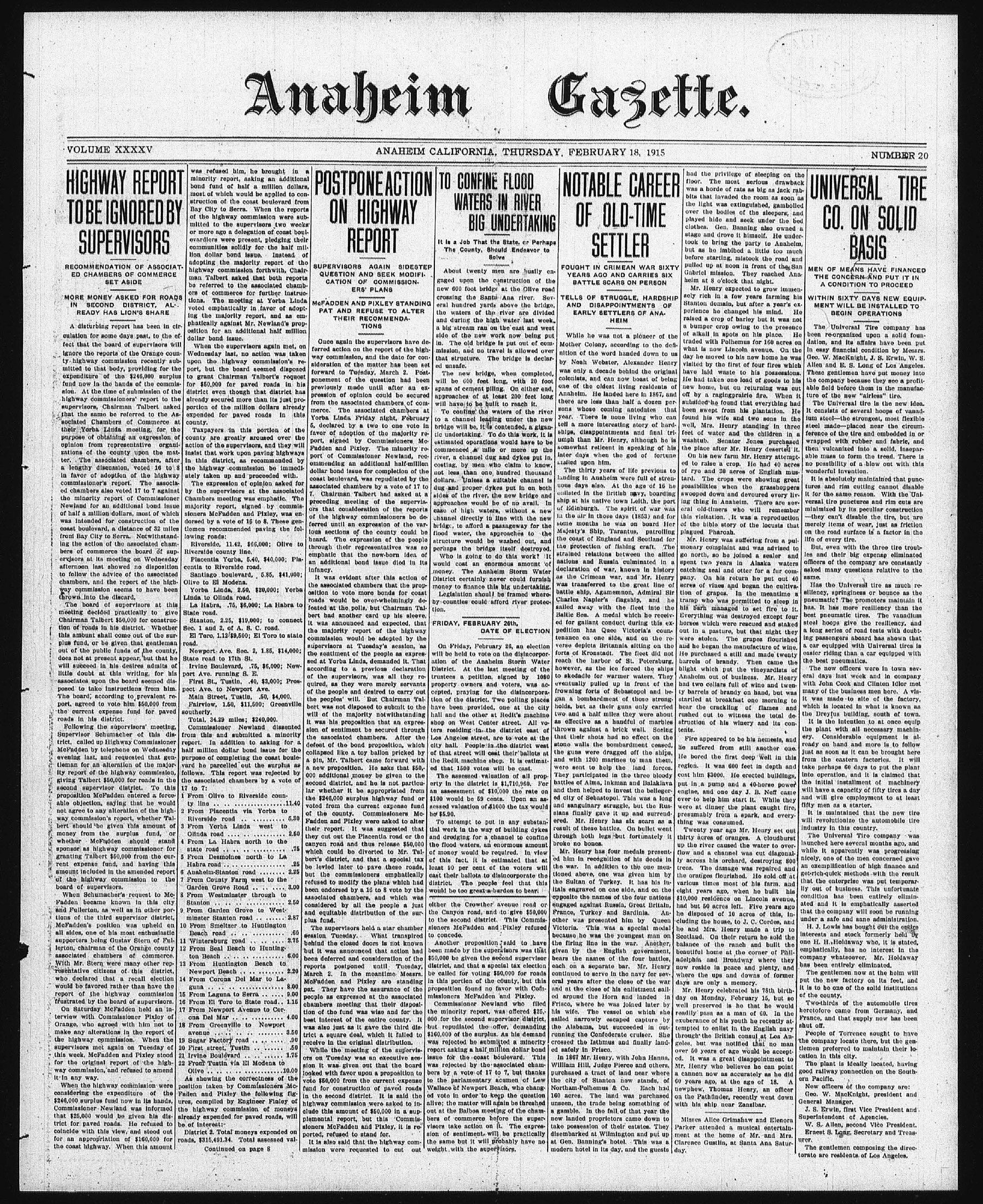
Searchable text
VOLUME XXXXV
HIGHWAY REPORT TO BE IGNORED BY SUPERVISORS
RECOMMENDATION OF ASSOCIATED CHAMBERS OF COMMERCE SET ASIDE
MORE MONEY ASKED FOR ROADS IN SECOND DISTRICT, ALREADY HAS LION'S SHARE
A disturbing report has been in circulation for some days past, to the effect that the board of supervisors will ignore the reports of the Orange county highway commission recently submitted to that body, providing for the expenditure of the $246,000 surplus fund now in the hands of the commission. At the time of submission of the highway commissioners' report to the supervisors, Chairman Talbert asked that the same be referred to the Associated Chambers of Commerce at their Yorba Linda meeting, for the purpose of obtaining an expression of opinion from representative organi-
was refused him, he brought in a minority report, asking an additional bond fund of half a million dollars, most of which would be applied to construction of the coast boulevard from Bay City to Serra. When the reports of the highway commission were submitted to the supervisors two weeks or more ago a delegation of coast boulevarders were present, pledging their communities solidly for the half million dollar bond issue. Instead of adopting the majority report of the highway commission forthwith, Chairman Talbert asked that both reports be referred to the associated chambers of commerce for further instructions. The meeting at Yorba Linda voted emphatically in favor of adopting the majority report, and as emphatically against Mr. Newland's proposition for an additional half million dollar bond issue.
When the supervisors again met, on Wednesday last, no action was taken upon the highway commission's report, but the board seemed disposed to grant Chairman Talbert's request for $50,000 for paved roads in his district even though that district has already secured more than its just proportion of the million dollars already expended for paved roads in this county.
Taxpayers in this portion of the county are greatly aroused over the action of the supervisors, and they will
POSTPONAL ON HIGHWAY RESEARCH
SUPERVISORS QUESTION AND CATION OF ERS'
McFADDEN AND PAT AND REMAIN THEIR RESULTS
Once again the referral action on the way commission, a sidereation of the forward to Tuesday ponement of the previously made procession of opinion from the associated merce. The association Yorba Linda Friday, declared by a favor of adoption port, signed by Fadden and Pirkle.
The reports of the Orange county highway commission recently submitted to that body, providing for the expenditure of the $246,000 surplus fund now in the hands of the commission. At the time of submission of the highway commissioners' report to the supervisors, Chairman Talbert asked that the same be referred to the Associated Chambers of Commerce at their Yorba Linda meeting, for the purpose of obtaining an expression of opinion from representative organizations of the county upon the matter. The associated chambers, after a lengthy discussion, voted 16 to 8 in favor of adoption of the highway commissioner's report. The associated chambers also voted 17 to 7 against the minority report of Commissioner Newland for an additional bond issue of half a million dollars, most of which was intended for construction of the coast boulevard, a distance of 32 miles from Bay City to Serra. Notwithstanding the action of the associated chambers of commerce the board of supervisors at its meeting on Wednesday afternoon last showed no disposition to follow the advice of the associated chambers, and the report of the highway commission seems to have been thrown into the discard.
The board of supervisors at this meeting decided practically to give Chairman Talbert $50,000 for construction of roads in his district. Whether this amount shall come out of the surplus fund, or be given that gentleman out of the public funds of the county, does not at present appear; but that he will succeed in his desires admits of little doubt at this writing, for his associates upon the board seemed disposed to take instructions from him. The board; according to prevalent report, agreed to vote him $50,000 from the current expense fund for paved roads in his district.
Following the supervisors' meeting, Supervisor Schumacher of this district, called up Highway Commissioner McFadden by telephone on Wednesday evening last, and requested that gentleman for an alteration of the majority report of the highway commission, giving Talbert $50,000 for roads in the second supervisor district. To this proposition McFadden entered a forceable objection, saying that he would not agree to any alteration of the highway commission's report, whether Talbert should be given this amount of money from the surplus fund, or whether McFadden should stand sponsor as highway commissioner for
Wednesday last, no action was taken upon the highway commission's report, but the board seemed disposed to grant Chairman Talbert's request for $50,000 for paved roads in his district even though that district has already secured more than its just proportion of the million dollars already expended for paved roads in this county.
Taxpayers in this portion of the county are greatly aroused over the action of the supervisors, and they will insist that work upon paying highways in this district, as recommended by the highway commission be immediately taken up and proceeded with.
The expression of opinion asked for by the supervisors at the associated Chambers meeting was emphatic. The majority report, signed by commissioners McFadden and Pixley, was endorsed by a vote of 16 to 8. These gentlemen recommended paving the following roads:
Riverside, 11.42; $60,000; Olive to Riverside county line.
Placentia Yorba, 5.40; $40,000; Placentia to Riverside road.
Santiago boulevard, 5.85; $41,000; Olive to El Modena.
Yorba Linda, 2.50; $20,000; Yorba Linda to Ollinda road.
La Habra, .75; $6,000; La Habra to State road.
Stanton, 2.25; $19,000; to connect Sec. 1 and 2, of A. S. C. road.
El Toro, 1.12/9,500; El Toro to state road.
Newport Ave. Sec. 2, 1.85; $14,000; State road to 17th St.
Irvine Boulevard, .75; $6,000; Newport Ave. running S. E.
First St., Tustin, .40; $3,000; Prospect Ave. to Newport Ave.
Main Street, Tustin, .50; $4,000.
Fairview, 1.50; $11,500; Greenville southly.
Total, 34.29 miles; $240,000.
Commissioner Newland dissented from this and submitted a minority report. In addition to asking for a half million dollar bond issue for the purpose of completing the coast boulevard he parcelled out the surplus as follows. This report was rejected by the associated chambers by a vote of 17 to 7:
1 From Olive to Riverside county line ... 11.40
2 From Placentia via Yorba to Riverside road ... 5.30
3 From Yorba Linda west to Ollinda road ... 2.50
4 From La Habra north to the state road ... .75
It was evident at the associated chamber to vote more roads would be feated at the polls, bert had another vote it was announced at the majority report commission would supervise at Tuesday's sentiment of the sedat Yorba Linda according to a proposal of the supervisors, quired as they were of the people and de the peoples' will. Bert was not dispossessed will of the majority it was his proposition of sentiment by the associated chamber defeat of the bond collapsed like a toy pin Mr. Talbert did a new proposition. 900 additional monies second district, and lar whether it be the $246,000 surplus voted from the curre
of the county. C Fadden and Pixley their report. It was they cut out the Placentia canyon road and which could be dis-
evening last, and requested that gentleman for an alteration of the majority report of the highway commission, giving Talbert $50,000 for roads in the second supervisor district. To this proposition McFadden entered a forceable objection, saying that he would not agree to any alteration of the highway commission's report, whether Talbert should be given this amount of money from the surplus fund, or whether McFadden should stand sponsor as highway commissioner for granting Talbert $50,000 from the current expense fund, and having this amount included in the amended report of the highway commission to the board of supervisors.
When Schumacher's request to McFadden became known in this city and Fullerton, as well as in other portions of the third supervisor district, McFadden's position was upheld on all sides, one of his most enthusiastic supporters being Gustav Stern of Fullerton, chairman of the Orange county associated chambers of commerce. With Mr. Stern were many other representative citizens of this district, who declared that a recall election would be favored rather than have the report of the highway commission frustrated by the board of supervisors.
On Saturday McFadden hold an interview with Commissioner Pixley of Orange, who agreed with him not to make any alterations in the report of the highway commission. When the supervisors met again on Tuesday of this week, McFadden and Pixley stood for the original report of the highway commission, and refused to amend it in any way.
When the highway commission were considering the expenditure of the $246,000 surplus fund now in its hands, Commissioner Newland was informed that $25,000 would be given his district for paved roads. He refused to coincide with this view, and stood out for an appropriation of $160,000 for the coast highway. When this amount purpose of completing the coast boulevard he parcelled out the surplus as follows. This report was rejected by the associated chambers by a vote of 17 to 7:
1. From Olive to Riverside county line ... 11.40
2. From Placentia via Yorba to Riverside road ... 5.30
3. From Yorba Linda west to Olinda road ... 2.50
4. From La Habra north to the state road ... 7.55
5. From Desmoines north to La Habra road ... 2.55
6. Anaheim-Stanton road ... 2.25
7. From County Farm west to the Garden Grove Road ... 3.00
8. From Westminster through Stanton ... 2.50
9. From Garden Grove to Westminster Stanton road ... 2.87
10. From Smeltzer to Huntington Beach road ... 6.00
11. Wintersburg road ... 2.75
12. From Seal Beach to Huntington Beach ... 6.00
13. From Huntington Beach to Newport Beach ... 2.20
14. From Corona Del Mar to Laguna ... 8.00
15. From Laguna to Serra ... 9.00
16. From El Toro to State road ... 1.15
17. From Newport Avenue to Corona Del Mar ... 4.00
18. From Greenville to Newport avenue ... 3.50
19. Sugar Factory road ... 9.00
20. First street, Tustin ... 6.50
21. Irvine Boulevard ... 1.75
22. From Tustin via El Modena to Olive ... 10.00
As showing the correctness of the position taken by Commissioners McFadden and Pixley the following figures, compiled by Engineer Finley of the highway commission of moneys already expended for paved roads, will be of interest:
District 2. Total moneys expended on roads, $315,491.34. Total assessed val-
Continued on page 8
ANAHEIM CALIFORNIA, THURSDAY, FEBRUARY 18, 1915
POSTPONE ACTION ON HIGHWAY REPORT
SUPERVISORS AGAIN SIDESTEP QUESTION AND SEEK MODIFIATION OF COMMISSIONERS' PLANS
McFADDEN AND PIXLEY STANDING PAT AND REFUSE TO ALTER THEIR RECOMMENDATIONS
Once again the supervisors have deferred action on the report of the highway commission, and the date for consideration of the matter has been set forward to Tuesday, March 2. Postponement of the question had been previously made until after an expression of opinion could be secured from the associated chambers of commerce. The associated chambers at Yorba Linda Friday night, February 5, declared by a two to one vote in favor of adoption of the majority report, signed by Commissioners McFadden and Pixley. The minority re-
TO CONFINE FLOOD WATERS IN RIVER BIG UNDERTAKING
It is a Job That the State, or Perhaps The County, Should Endeavor to Solve
About twenty men are usually engaged upon the construction of the new 600 foot bridge at the Olive road crossing the Santa Ana river. Several hundred yards above the bridge, the waters of the river are divided and during the high water last week, a big stream ran on the east and west side of the new work now being put in. The old bridge is put out of commission, and no travel is allowed over that structure. The bridge is declared unsafe.
The new bridge, when completed, will be 600 feet long, with 20 foot spans of cement piling. On either end, approaches of at least 200 feet long will have to be built to reach it.
To confine the waters of the river to a channel leading under the new bridge will be, it is contended, a gigantic undertaking. To do this work, it is estimated operations would have to be commenced with a mile or more of the
NOTABLE CAREER OF OLD-TIME SETTLER
FOUGHT IN CRIMEAN WAR SIXTY YEARS AGO AND CARRIES SIX BATTLE SCARS ON PERSON
TELLS OF STRUGGLE, HARDSHIP AND DISAPPOINTMENTS OF EARLY SETTLERS OF ANAHEIM
While he was not a pioneer of the Mother Colony, according to the definition of the word handed down to us by Noah Webster, Alexander Henry was only a decade behind the original colonists, and can now boast of being one of the oldest living residents of Anaheim. He landed here in 1867, and there are less than half a dozen persons whose coming antidates that year. There is none living who can tell a more interesting story of hardships, disappointments and final triumph than Mr. Henry, although he is somewhat reticent in speaking of his
way commission, and the date for consideration of the matter has been set forward to Tuesday, March 2. Postponement of the question had been previously made until after an expression of opinion could be secured from the associated chambers of commerce. The associated chambers at Yorba Linda Friday, February 5, declared by a two to one vote in favor of adoption of the majority report, signed by Commissioners McFadden and Pixley. The minority report of Commissioner Newland, recommending an additional half-million dollar bond issue for completion of the coast boulevard, was repudiated by the associated chambers by a vote of 17 to 7. Chairman Talbert had asked at a preceding meeting of the supervisors that consideration of the reports of the highway commissioners be deferred until an expression of the various sections of the county could be heard. The expression of the people through their representatives was so emphatic that the new-born idea of an additional bond issue died in its infancy.
It was evident after this action of the associated chambers that the proposition to vote more bonds for coastal roads would be over-whelmingly defeated at the polls, but Chairman Talbert had another card up his sleeve. It was announced and expected, that the majority report of the highway commission would be adopted by the supervisors at Tuesday's session, as the sentiment of the people as expressed at Yorba Linda, demanded it. That according to a previous declaration of the supervisors, was all they required, as they were merely servants of the people and desired to carry out the peoples' will. But Chairman Talbert was not disposed to submit to the will of the majority notwithstanding it was his proposition that an expression of sentiment be secured through the associated chambers. After the defeat of the bond proposition, which collapsed like a toy balloon pricked by a pin, Mr. Talbert came forward with a new proposition. He asks that $50,000 additional money be given to the second district, and he is not particularly whether it be appropriated from the $246,000 surplus highway fund or voted from the current expense fund of the county. Commissioners McFadden and Pixley were asked to alter their report. It was suggested that they cut out the Placentia road or the canyon road and thus release $50,000 which could be disrupted by Mr. Talbert.
FRIDAY, FEBRUARY 26th,
DATE OF ELECTION
On Friday, February 26, an election will be held to vote on the disincorporation of the Anaheim Storm Water District. At the last meeting of the trustees a petition, signed by 1080 property owners and voters, was accepted, praying for the disincorporation of the district. Two polling places have been provided, one at the city hall and the other at Redit's machine shop on West Center street. All voters residing in the district east of Los Angeles street, are to vote at the city hall. People in the district west of that street will cast their ballots at the Redit machine shop. It is estimated that 1500 votes will be cast.
The assessed valuation of all property in the district is $1,710,960. For an assessment of $10,000 the rate on $100 would be 59 cents. Upon an assessed valuation of $1000 the tax would be $5.90.
To attempt to put in any substantial work in the way of building dykes and dredging for a channel to confine the flood waters, an enormous amount that structure. The bridge is declared unsafe.
The new bridge, when completed, will be 600 feet long, with 20 foot spans of cement piling. On either end, approaches at least 200 feet long will have to be built to reach it.
To confine the waters of the river to a channel leading under the new bridge will be, it is contended, a gigantic undertaking. To do this work, it is estimated operations would have to be commenced a mile or more up the river, a channel dug and dykes put in coating, by men who claim to know, not less than one hundred thousand dollars. Unless a suitable channel is dug and proper dykes put in on both sides of the river, the new bridge and approaches would be no avail. In case of high waters, without a new channel directly in line with the new bridge, to afford a passageway for the flood water, the approaches to the structure would be washed out, and perhaps the bridge itself destroyed.
Who is going to do this work? It would cost an enormous amount of money. The Anaheim Storm Water District certainly never could furnish money to finance this big undertaking.
Legislation should be framed whereby counties could afford river protection.
The thirty years of life previous to landing in Anaheim were full of strenuous days also. At the age of 16 he enlisted in the British navy, boarding ship at his native town Leith, the port of Edinburgh. The spirit of war was in the air in those days (1853) and for some months he was on board Her Majesty's Ship, Tarantus, patrolling the coast of England and Scotland for the protection of fishing craft. The strained relations between the allied nations and Russia culminated in a declaration of war, known in history as the Crimean war, and Mr. Henry was transferred to the great line of battle ship, Agamemnon, Admiral Sir Charles Napler's flagship, and he sailed away with the fleet into the Baltic Sea. A medal which he received for gallant conduct during this expedition has Queo Victoria's countenance on one side, and on the reverse depicts Britannia slitting on the forts of Kronstadt. The fleet did not reach the harbor of St. Petersburg, however, as the ice forced the ships to skadadle for warmer waters. They eventually pulled up in front of the frowning forts of Sebastopol and began a bombardment of those strongholds, but as their guns only carried two and a half miles they were about as effective as a handful of marbles thrown against a brick wall. Seeing that their shots had no effect on the stone walls the bombardment ceased, the guns were dragged off the ships, and with 1200 marines to man them, were sent to help the land forces. They participated in the three bloody battles of Alma, Inkman and Balaklava and then helped to invest the bellegored city of Sebastopol. This was a long and sanguinary struggle, but the Russians finally gave it up and surrendered. Mr. Henry has six scars as a result of these battles. On bullet went through both legs but fortunately it broke no bones.
Mr. Henry has four medals present
a pin, Mr. Talbert came forward with a new proposition. He asks that $50,000 additional money be given to the second district, and he is not particular whether it be appropriated from the $240,000 surplus highway fund or voted from the current expense fund of the county. Commissioners McFadden and Pixley were asked to alter their report. It was suggested that they cut out the Placentia road or the canyon road and thus release $50,000 which could be diverted to Mr. Talbert's district, and that a special tax be levied later to pave these roads, but the commissioners emphatically refused to modify the plans which had been endorsed by a 10 to 8 vote by the associated chambers, and which was considered by all the people a just and equitable distribution of the surplus fund.
The supervisors hold a star chamber session Tuesday. What transpired behind the closed doors is not known but it was announced that action had been deferred and consideration of the reports postponed until Tuesday, March 2. In the meantime Messrs. McFadden and Pixley are standing pat. They have the assurance of the people as expressed at the associated chambers meeting that their disposition of the fund was wise and for the best interest of the entire county. It was also just as it gave the third district a square deal, which it failed to receive in the original distribution.
While the meeting of the supervisors on Tuesday was an executive session it was given out that the board looked with favor upon a proposition to vote $50,000 from the current expense fund for construction of paved roads in the second district. It is said the highway commission were asked to include this amount of $50,000 in a supplemental report, but this Commissioners McFadden and Pixley, it is reported, refused to stand for.
It is also said that the highway commission were requested to cut out the Redit machine shop. It is estimated that 1500 votes will be cast.
The assessed valuation of all property in the district is $1,710,960. For an assessment of $10,000 the rate on $100 would be 59 cents. Upon an assessed valuation of $1000 the tax would be $5.90.
To attempt to put in any substantial work in the way of building dykes and dredging for a channel to confine the flood waters, an enormous amount of money would be required. In view of this fact, it is estimated that at least 90 per cent of the voters will cast their ballots to disincorporate the district. The people feel that this would be too great a burden to bear.
either the Crowther avenue road or the Canyon road, and to give $50,000 to the second district. This Commissioners McFadden and Pixley refused to concede.
Another proposition said to have been made by the supervisors was that $50,000 be given the second supervisor district, and that a special tax election be called for voting $50,000 for roads in this portion of the county, but this proposition found no favor with Commissioners McFadden and Pixley.
Commissioner Newland who filed the minority report, was offered $25,000 for the second supervisor district, but repudiated the offer, demanding $160,000 of the surplus. As his demand was rejected he submitted a minority report asking a half million dollar bond issue for the coast boulevard. This was rejected by the associated chambers by a vote of 17 to 7, but thanks to the parliamentary acumen of Lew Wallace of Newport Beach, who changed vote in order to keep the question alive; the matter will again be threshed out at the Balboa meeting of the chambers of commerce before the supervisors take action on it. The expression of sentiment will be practically the same but it will probably have no weight with the supervisors.
In 1867 Mr. Henry, with John Hanna, William Hill, Judge Pierce and others, purchased a tract of land near where the city of Stanton now stands, of Northam-Polhemus & Co. Each had 160 acres. The land was purchased unseen, the trade being something of a gamble. In the fall of that year the new landed proprietors came down to take possession of their estates. They disembarked at Wilmington and put up at Gen. Banning's hotel. This was a modern hotel in its day, and the guests and with 1200 marines to man them, were sent to help the land forces. They participated in the three bloody battles of Alma, Inkman and Balaklava and then helped to invest the belegered city of Sebastopol. This was a long and sanguinary struggle, but the Russians finally gave it up and surrendered. Mr. Henry has six scars as a result of these battles. On bullet went through both legs but fortunately it broke no bones.
Mr. Henry has four medals presented him in recognition of his deeds in the war. In addition to the one mentioned above, one was given him by the Sultan of Turkey. It has his initials engraved on one side, and on the opposite names of the four nations engaged against Russia, Great Britain, France, Turkey and Sardinia. Another was presented him by Queen Victoria. This was a special medal because he was the youngest man on the firing line in the war. Another given by the English government, bears the names of the four battles each on a separate bar. Mr. Henry continued to serve in the navy for several years after the close of the war and at the close of his enlistment sailed around Horn and landed in Frisco, where he was joined later by his wife. The vessel on which she sailed narrowly escaped capture by the Alabama, but succeeded in outrunning the Confederate cruiser. She crossed the Isthmus and finally landed safely in Frisco.
In 1867 Mr. Henry, with John Hanna, William Hill, Judge Pierce and others, purchased a tract of land near where the city of Stanton now stands, of Northam-Polhemus & Co. Each had 160 acres. The land was purchased unseen, the trade being something of a gamble. In the fall of that year the new landed proprietors came down to take possession of their estates. They disembarked at Wilmington and put up at Gen. Banning's hotel. This was a modern hotel in its day, and the guests
THE CAREER
OLD-TIME
TOLLER
MEAN WAR SIXTY
AND CARRIES SIX
ERS ON PERSON
BUGGLE, HARDSHIP
POINTMENTS OF
MILERS OF ANAHEIM
Not a pioneer of the
recording to the defihanded down to us,
Alexander Henry
behind the original
now boast of being
living residents of
here in 1867, and
a half a dozen pering antodates that
one living who can
getting story of harddents and final trinery, although he is
in speaking of his
had the privilege of sleeping on the
floor. The most serious drawback
was a horde of rats as big as jack rabbits that invaded the room as soon as
the light was extinguished, gambolled
over the bodies of the sleepers, and
played hide and seek under the bed
clothes. Gen. Banning also owned a
stage and drove it himself. He undertook to bring the party to Anaheim,
but as he imbibed a little too much
before starting, mistook the road and
pulled up at noon in front of the San
Gabriel mission. They reached Anahelm at 8 o'clock that night.
Mr. Henry expected to grow immensely rich in a few years farming his Stanton domain, but after a year's experience he changed his mind. He raised a crop of barley but it was not a bumper crop owing to the presence of alkali in spots on his place. He traded with Polhemus for 160 acres on what is now Lincoln avenue. On the day he moved to his new home he was visited by the first of four fires which have laid waste to his possessions. He had taken one load of goods to his new home, but on returning was cut off by a raging prairie fire. When it subsided he found that everything had been swept from his plantation. He found his wife and two sons in the well, Mrs. Henry standing in three feet of water and the children in a washub. Senator Jones purchased the place after Mr. Henry deserted it.
UNIVERSAL TIRE
CO. ON SOLID
BASIS
MEN OF MEANS HAVE FINANCED
THE CONCERN AND PUT IT IN A CONDITION TO PROCEED
WITHIN SIXTY DAYS NEW EQUIPMENT WILL BE INSTALLED TO BEGIN OPERATIONS
The Universal Tire company has been re-organized upon a solid foundation, and its affairs have been put in easy financial condition by Messrs. Geo. W. MacKnight, J. S. Erwin, W. S. Allen and E. S. Long of Los Angeles. These gentlemen have put money into the company because they see a profitable field before them in the manufacture of the new "airless" tire.
The Universal tire is the new idea. It consists of several hoops of vanadium steel—the strongest, most flexible steel made—placed near the circumference of the tire and embedded in or wrapped with rubber and fabric, and then vulcanized into a solid insulating material.
of life previous to
were full of strent
t the age of 16 he
islish navy, boarding
own Leith, the port
spirit of war was
days (1853) and for
was on board Her
patrolting
and Scotland for
fishing craft. The
between the allied
a culminated in a
known in history
he war, and Mr. Henry
to the great line of
common, Admiral Sir
flagship, and he
the fleet into the
real which he receivd during this exVictoria's councile, and on the remainia sitting on the
The fleet did not
of St. Petersburg,
he forced the ships
former waters. They
up in front of the
debastopol and bet of those strongguns only carried
as they were about
handful of marbles
rick wall. Seeing
no effect on the
embardment ceased,
gled off the ships,
ones to man them,
the land forces,
the three bloody
man and Balaklava
invest the belligerlal. This was a long
juggle, but the Rust up and surrendas six scars as a
sus. On bullet went
but fortunately it
day he moved to his new home he was visited by the first of four fires which have laid waste to his possessions. He had taken one load of goods to his new home, but on returning was cut off by a raging prairie fire. When it subsided he found that everything had been swept from his plantation. He found his wife and two sons in the well, Mrs. Henry standing in three feet of water and the children in a washub. Senator Jones purchased the place after Mr. Henry deserted it.
On his new farm Mr. Henry attempted to raise a crop. He had 40 acres of rye and 30 acres of English mustard. The crops were showing great possibilities when the grasshoppers swooped down and devoured every living thing in Anahaim. There are several old-timers who will remember this visitation. It was a reproduction of the bible story of the locusts that plagued Pharoh.
Mr. Henry was suffering from a pulmonary complaint and was advised to go north, so he joined a sealer and spent two years in Alaska waters catching seal and otter for a fur company. On his return he put out 40 acres of vines and began the cultivation of grapes. In the meantime a tramp who was permitted to sleep in his barn managed to set fire to it. Everything was destroyed except four horses which were rescued and staked out in a pasture, but that night they were stolen. The grapes flourished and he began the manufacture of wine. He purchased a still and made twenty barrels of brandy. Then came the blight which put the vineyardists of Anahaim out of business. Mr. Henry had two collars full of wine and twenty barrels of brandy on hand, but was startled at breakfast one morning to hear the crackling of flames and rushed out to witness the total destruction of his winery and its contents.
Fire appeared to be his nemesis, and he suffered from still another one. He bored the first deep well in this region. It was 600 feet in depth and cost him $3000. He erected buildings, put in a pump and a 40-horse power engine, and one day J. B. Neff came over to help him start it. While they were at dinner the plant caught fire, presumably from a spark, and everything was consumed.
Twenty year ago Mr. Henry set out thirty acres of oranges. A cloudburst up the river caused the water to overflow.
Geo. W. MacKnight, J. S. Erwin, W. S. Allen and E. S. Long of Los Angeles.
These gentlemen have put money into the company because they see a profitable field before them in the manufacture of the new "airless" tire.
The Universal tire is the new idea. It consists of several hoops of vanadium steel—the strongest, most flexible steel made—placed near the circumference of the tire and embedded in or wrapped with rubber and fabric, and then vulcanized into a solid. Inseparable mass to form the tread. There is no possibility of a blow out with this wonderful invention.
It is absolutely maintained that punctures and rim cutting cannot disable it for the same reason. With the Universal tire punctures and rim cuts are minimized by its peculiar construction—they can't disable the tire, but are merely items of wear, just as friction on the road surface is a factor in the life of every tire.
But even with the three tire troubles and their big expensap eliminated officers of the company are constantly asked many questions relative to the same.
Has the Universal tire as much resiliency, springiness or bounce as the pneumatic? The promoters maintain it has. It has more resiliency than the best pneumatic tires. The vanadium steel hoops give the resiliency, and a long series of road tests with doubting passengers aboard has shown that a car equipped with Universal tires is easier riding than a car equipped with the best pneumatics.
The new officers were in town several days last week and in company with John Cook and Clinton Idlor mot many of the business men here. A visit was made to site of the factory, which is located in what is known as the Dreyfus building, south of town.
It is the intention to at once equip the plant with all necessary machinery.
Considerable equipment is already on hand and more is to follow just as soon as it can be brought here from the eastern factories. It will take perhaps 60 days to put the plant into operation, and it is claimed that the initial installment of machinery will have a capacity of fifty tires a day and will give employment to at least fifty men as a starter.
It is maintained that the new tire will revolutionize automobile tire industry in this country.
The Universal Tire company was launched here several months ago, and while it apparently was progressing
He bored the first deep well in this region. It was 600 feet in depth and cost him $3000. He erected buildings, put in a pump and a 40-horse power engine, and one day J. B. Neff came over to help him start it. While they were at dinner the plant caught fire, presumably from a spark, and everything was consumed.
Twenty year ago Mr. Henry set out thirty acres of oranges. A cloudburst up the river caused the water to overflow and a channel was cut diagonally across his orchard, destroying 800 trees. The damage was repaired and the oranges flourished. He sold off at various times most of his farm, and eight years ago, when he built his $10,000 residence on Lincoln avenue, had but 50 acres left. Five years ago he disposed of 10 acres of this, including the house, to J. C. Cordes, and he and Mrs. Henry made a trip to Scotland. On their return he sold the balance of the ranch and built the beautiful home at the corner of Philadelphia and Broadway where they now reside in peace and plenty, and where the ups and downs of former days are only a memory.
Mr. Henry celebrated his 78th birthday on Monday, February 15, but so well preserved is he that he would readily pass as a man of 60. In the exuberance of his youth he recently attempted to enlist in the English navy through the British consul at Los Angeles, but was notified that no man over 50 years of age would be accepted. It was a great disappointment to Mr. Henry who believes he can point a cannon now an accurately as he did 60 years ago, at the age of 18. A newhew, Thomas Henry, an officer on the Pathfinder, recently went down with his ship near Zanzibar.
Misses Alice Grimshaw and Elenora Parker attended a musical entertainment at the home of Mr. and Mrs. Clarence Gustlin, at Santa Ana Saturday.
The Universal Tire company was launched here several months ago, and while it apparently was progressing nicely, one of the men concerned gave an oxemplification of high finance and get-rich-quick methods with the result that the enterprise was put temporarily out of business. This unfortunate condition has been entirely eliminated and it is emphatically asserted that the company will soon be running under a safe and sane administration.
H. J. Lewis has bought out the entire interests and stock formerly held by one H. H. Holdaway who, it is stated, emphatically, has no interest in the company whatsoever. Mr. Holdaway has been entirely eliminated.
The gentlemen now at the helm will put the new factory on its feet, and it is to be one of the solid institutions of the county.
Two-thirds of the automobile tires horetofore came from Germany, and France, and that supply now has been shut off.
People of Torrence sought to have the company locate there, but the gentlemen preferred to maintain their location in this city.
The plant is ideally located, having good railway connection on the Southern Pacific.
New officers of the company are:
Geo. W. MacKnight, president and General Manager.
J. S. Erwin, first Vice President and Superintendent of Agencies.
W. S. Allen, second Vice President.
Ernest S. Long, Secretary and Treasurer.
The gentlemen composing the directorate are residents of Los Angeles.