anaheim-gazette 1915-02-11
Scanned page
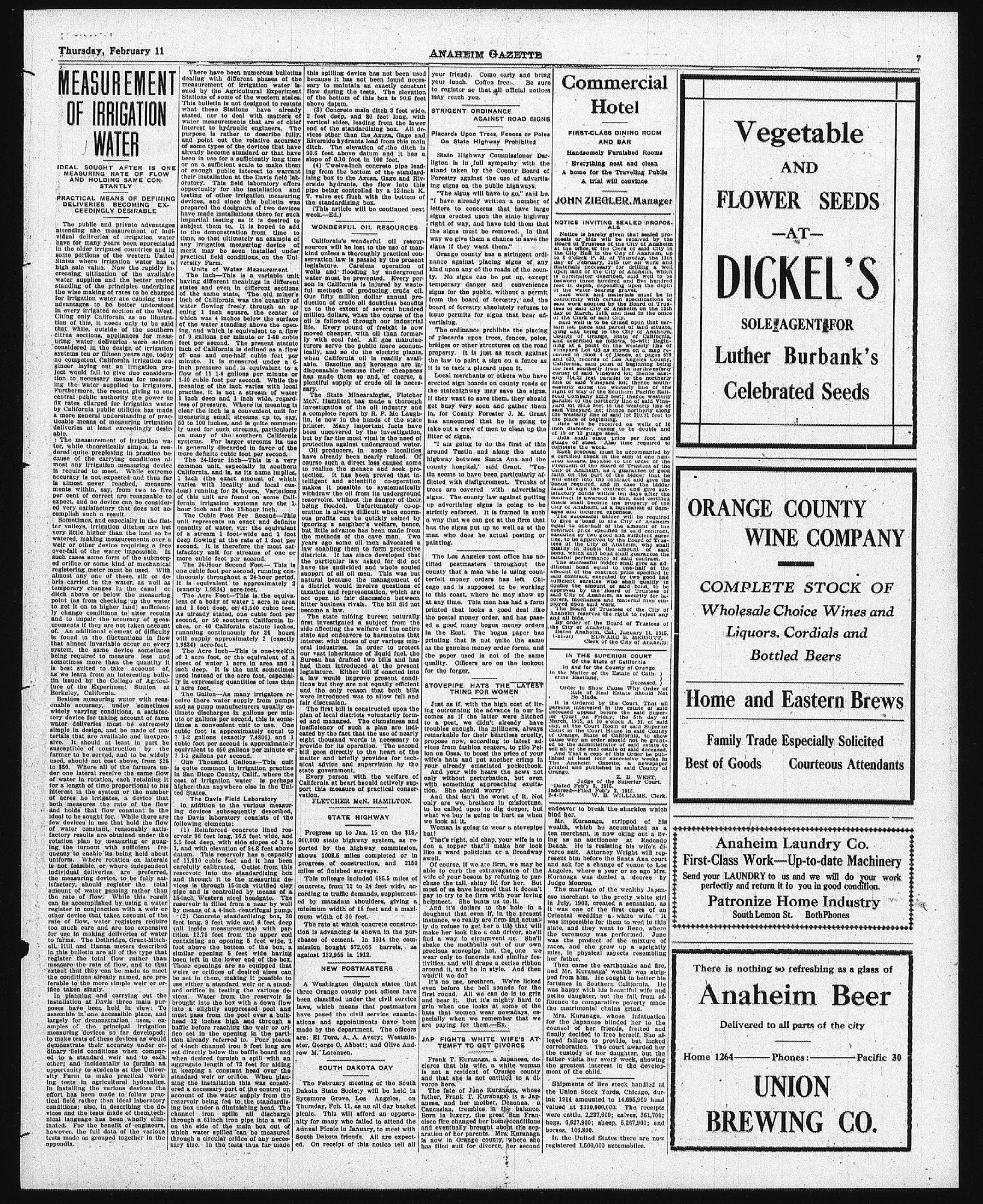
Searchable text
MEASUREMENT OF IRRIGATION WATER
IDEAL SOUGHT AFTER IS ONE MEASURING RATE OF FLOW AND HOLDING SAME CONSTANTLY
PRACTICAL MEANS OF DEFINING DELIVERIES BECOMING EXCEEDINGLY DESIRABLE
The public and private advantages attending the measurement of individual deliveries of irrigation water have for many years been appreciated in the older irrigated countries and in some portions of the western United States where irrigation water has a high sale value. Now the rapidly increasing utilization of the available water supplies and the better understanding of the principles underlying the wise making of rates to be charged for irrigation water are causing these advantages to be better understood in every irrigated section of the West. Citing only California as an illustration of this, it needs only to be said that while, outside of the southern citrus sections, appliances for measuring water deliveries were seldom considered in the design of irrigation systems ten or fifteen years ago, today no competent California irrigation engineer laying out an irrigation project would fail to give due consideration to necessary means for measuring the water supplied to irrigators. Furthermore, the recent giving to one central public authority the power to fix rates charged for irrigation water by California public utilities has made a more general understanding of practicable means of measuring irrigation deliveries at least exceedingly desirable.
The measurement of irrigation water, while theoretically simple, is renewed. There have been numerous bulletins dealing with different phases of the measurement of irrigation water issued by the Agricultural Experiment Stations of some of the western states. This bulletin is not designed to restate what these Stations have already stated, nor to deal with matters of water measurements that are of chief interest to hydraulic engineers. The purpose is rather to describe fully, and point out the relative accuracy of some types of the devices that have already become standard or that have been in use for a sufficiently long time or on a sufficient scale to make them of enough public interest to warrant their installation at the Davis field laboratory. This field laboratory offers opportunity for the installation and testing of other irrigation measuring devices, and since this bulletin was prepared the designers of two devices have made installations there for such impartial testing as it is desired to subject them to. It is hoped to add to the demonstration from time to time, so that ultimately an example of any irrigation measuring device of merit may be seen installed under practical field conditions on the University Farm.
Units of Water Measurement
The Inch—This is a variable unit having different meanings in different states and even in different sections of the same state. The old miner's inch of California was the quantity of water flowing freely through an opening 1 inch square, the center of which was 4 inches below the surface of the water standing above the opening, and which is equivalent to a flow of 9 gallons per minute or 1-50 cubic feet per second. The present statute inch of California is defined as a flow of one and one-half cubic feet per minute. It is measured under a 6-inch pressure and is equivalent to a flow of 11-14 gallons per minute or 1-40 cubic foot per second. While the meaning of the inch varies with local practise, it is not a stream of water 1 inch deep and 1 inch wide, regardless of pressure. Where its meaning is clear the inch is a convenient unit for measuring small streams up to, say, 50 to 100 inches, and is quite commonly used for such streams, particularly on many of the southern California systems. For larger streams its use is generally discarded in favor of this spilling device because it has not sary to maintain an airflow during the test of the bottom of the above datum.
(3) Concrete mains 2 feet deep, and in vertical slides, lead end of the standard vices other than the Riverside hydrants at ditch. The elevation 90.6 feet above day slope of 0.10 foot in.
(4) Twelve-inch owing from the bottomizing box to the Azzuride hydrants, the pipe being controlled. T valve set flush with the standardizing bolt (This article will week.-Ed.).
WONDERFUL ONES
California's wonders sources will be lost kind unless a thorough servation law is passed legislature. Careful wells and flooding water must be prevented in California is far from fulfilled methods of protection Our fifty million dollars depletion of crude oil us to the extent of million dollars, when oil is followed through life. Every pound moved cheaper, with low coal fuel. Turers serve the public locally, and so do they when California oil able. Gasoline and disposable because has made them so plentiful supply of oil.
The State Mines, McN. Hamilton has investigation of the complete report by lin, is now in the h printer. Many impure been uncovered by but by far the most w protection against un
systems ten or fifteen years ago, today no competent California irrigation engineer laying out an irrigation project would fail to give due consideration to necessary means for measuring the water supplied to irrigators. Furthermore, the recent giving to one central public authority the power to fix rates charged for irrigation water by California public utilities has made a more general understanding of practicable means of measuring irrigation deliveries at least exceedingly desirable.
The measurement of irrigation water, while theoretically simple, is rendered quite preplexing in practice because of the carrying conditions almost any irrigation measuring device is required to meet. While extreme accuracy is not expected and thus far is almost never reached, measurements within, say, from two to five per cent of correct are reasonable to expect, and no device can be considered very satisfactory that does not accomplish such a result.
Sometimes, and especially in the flatter valleys, irrigation ditches are but very little higher than the land to be watered, making measurements over a weir or other device requiring a free overfall of the water impossible. In such cases some form of the submerged orifice or some kind of mechanical registering meter must be used. With almost any one of these, silt or debris carried in the water, as well as temporary changes in the canal or ditch above or below the measuring point (as from checking up the water to get it on higher land) sufficiently change conditions to alter results and to impair the accuracy of measurements if they are not taken account of. An additional element of difficulty is found in the fluctuations in flow that almost invariable occur on every system, the same device sometimes being required to measure less and sometimes more than the quantity it is best suited to take account of, as we learn from an interesting bulletin issued by the College of Agriculture of the Experiment Station at Berkeley, California.
Besides measuring water with reasonable accuracy, under sometimes widely varying conditions, a satisfactory device for taking account of farm water deliveries must be extremely simple in design, and be made of materials that are available and inexpensive. It should at least in part be susceptible of construction by the farmer to be served, and to be widely used, should not cost above, from $25 to $50. Where all of the farmers under one lateral receive the same flow of water in rotation, each retaining it for a length of time proportional to his interest in the system or the number of acres he irrigates, a device that both measures the rate of the flow and holds that flow constant is the ideal to be sought for. While there are few devices in use that hold the flow of water constant, reasonably satisfactory results are obtained under the rotation plan by measuring or guaging the turnout with sufficient freeway systems ten or fifteen years ago, today no competent California irrigation engineer laying out an irrigation project would fail to give due consideration to necessary means for measuring the water supplied to irrigators.
Furthermore, the recent giving to one central public authority the power to fix rates charged for irrigation water by California public utilities has made a more general understanding of practicable means of measuring irrigation deliveries at least exceedingly desirable.
The measurement of irrigation water, while theoretically simple, is rendered quite preplexing in practice because of the carrying conditions almost any irrigation measuring device is required to meet. While extreme accuracy is not expected and thus far is almost never reached, measurements within, say, from two to five per cent of correct are reasonable to expect, and no device can be considered very satisfactory that does not accomplish such a result.
Sometimes, and especially in the flatter valleys, irrigation ditches are but very little higher than the land to be watered, making measurements over a weir or other device requiring a free overfall of the water impossible. In such cases some form of the submerged orifice or some kind of mechanical registering meter must be used. With almost any one of these, silt or debris carried in the water, as well as temporary changes in the canal or ditch above or below the measuring point (as from checking up the water to get it on higher land) sufficiently change conditions to alter results and to impair the accuracy of measurements if they are not taken account of. An additional element of difficulty is found in the fluctuations in flow that almost invariable occur on every system, the same device sometimes being required to measure less and sometimes more than the quantity it is best suited to take account of, as we learn from an interesting bulletin issued by the College of Agriculture of the Experiment Station at Berkeley, California.
Besides measuring water with reasonable accuracy, under sometimes widely varying conditions, a satisfactory device for taking account of farm water deliveries must be extremely simple in design, and be made of materials that are available and inexpensive. It should at least in part be susceptible of construction by the farmer to be served, and to be widely used, should not cost above, from $25 to $50. Where all of the farmers under one lateral receive the same flow of water in rotation, each retaining it for a length of time proportional to his interest in the system or the number of acres he irrigates, a device that both measures the rate of the flow and holds that flow constant is the ideal to be sought for. While there are few devices in use that hold the flow of water constant, reasonably satisfactory results are obtained under the rotation plan by measuring or guaging the turnout with sufficient freeway systems ten or fifteen years ago, today no competent California irrigation engineer laying out an irrigation project would fall due consideration to necessary means for measuring the water supplied to irrigators.
Furthermore, the recent giving to one central public authority the power to fix rates charged for irrigation water by California public utilities has made a more general understanding of practicable means of measuring irrigation deliveries at least exceedingly desirable.
The measurement of irrigation water, while theoretically simple, is rendered quite preplexing in practice because of the carrying conditions almost any irrigation measuring device is required to meet. While extreme accuracy is not expected and thus far is almost never reached, measurements within, say, from two to five per cent of correct are reasonable to expect, and no device can be considered very satisfactory that does not accomplish such a result.
Sometimes, and especially in the flatter valleys, irrigation ditches are but very little higher than the land to be watered, making measurements over a weir or other device requiring a free overfall of the water impossible. In such cases some form of the submerged orifice or some kind of mechanical registering meter must be used. With almost any one of these, silt or debris carried in the water, as well as temporary changes in the canal or ditch above or below the measuring point (as from checking up the water to get it on higher land) sufficiently change conditions to alter results and to impair the accuracy of measurements if they are not taken account of. An additional element of difficulty is found in the fluctuations in flow that almost invariable occur on every system, the same device sometimes being required to measure less and sometimes more than the quantity it is best suited to take account of, as we learn from an interesting bulletin issued by the College of Agriculture of the Experiment Station at Berkeley, California.
Besides measuring water with reasonable accuracy, under sometimes widely varying conditions, a satisfactory device for taking account of farm water deliveries must be extremely simple in design, and be made of materials that are available and inexpensive. It should at least in part be susceptible of construction by the farmer to be served, and to be widely used, should not cost above, from $25 to $50. Where all of the farmers under one lateral receive the same flow of water in rotation, each retaining it for a length of time proportional to his interest in the system or the number of acres he irrigates, a device that both measures the rate of the flow and holds that flow constant is the ideal to be sought for. While there are few devices in use that hold the flow of water constant, reasonably satisfactory results are obtained under the rotation plan by measuring or guaging the turnout with sufficient freeway systems ten or fifteen years ago, today no competent California irrigation engineer laying out an irrigation project would fall due consideration to necessary means for measuring the water supplied to irrigators.
Furthermore, the recent giving to one central public authority the power to fix rates charged for irrigation water by California public utilities has made a more general understanding of practicable means of measuring irrigation deliveries at least exceedingly desirable.
The measurement of irrigation water, while theoretically simple, is rendered quite preplexing in practice because of the carrying conditions almost any irrigation measuring device is required to meet. While extreme accuracy is not expected and thus far is almost never reached, measurements within, say, from two to five per cent of correct are reasonable to expect, and no device can be considered very satisfactory that does not accomplish such a result.
Sometimes, and especially in the flatter valleys, irrigation ditches are but very little higher than the land to be watered, making measurements over a weir or other device requiring a free overfall of the water impossible. In such cases some form of the submerged orifice or some kind of mechanical registering meter must be used. With almost any one of these, silt or debris carried in the water, as well as temporary changes in the canal or ditch above or below the measuring point (as from checking up the water to get it on higher land) sufficiently change conditions to alter results and to impair the accuracy of measurements if they are not taken account of. An additional element of difficulty is found in the fluctuations in flow that almost invariable occur on every system, the same device sometimes being required to measure less and sometimes more than the quantity it is best suited to take account of, as we learn from an interesting bulletin issued by the College of Agriculture of the Experiment Station at Berkeley, California.
Besides measuring water with reasonable accuracy, under sometimes widely varying conditions, a satisfactory device for taking account of farm water deliveries must be extremely simple in design, and be made of materials that are available and inexpensive. It should at least in part be susceptible of construction by the farmer to be served, and to be widely used, should not cost above, from $25 to $50. Where all of the farmers under one lateral receive the same flow of water in rotation, each retaining it for a length of time proportional to his interest in the system or the number of acres he irrigates, a device that both measures the rate of the flow and holds that flow constant is the ideal to be sought for. While there are few devices in use that hold the flow of water constant, reasonably satisfactory results are obtained under the rotation plan by measuring or guaging the turnout with sufficient freeway systems ten or fifteen years ago, today no competent California irrigation engineer laying out an irrigation project would fall due consideration to necessary means for measuring the water supplied to irrigators.
Furthermore, the recent giving to one central public authority the power to fix rates charged for irrigation water by California public utilities has made a more general understanding of practicable means of measuring irrigation deliveries at least exceedingly desirable.
The measurement of irrigation water, while theoretically simple, is rendered quite preplexing in practice because of the carrying conditions almost any irrigation measuring device is required to meet. While extreme accuracy is not expected and thus far is almost never reached, measurements within, say, from two to five per cent of correct are reasonable to expect, and no device can be considered very satisfactory that does not accomplish such a result.
Sometimes, and especially in the flatter valleys, irrigation ditches are but very little higher than the land to be watered, making measurements over a weir or other device requiring a free overfall of the water impossible. In such cases some form of the submerged orifice or some kind of mechanical registering meter must be used. With almost any one of these, silt or debris carried in the water, as well as temporary changes in the canal or ditch above or below the measuring point (as from checking up the water to get it on higher land) sufficiently change conditions to alter results and to impair the accuracy of measurements if they are not taken account of. An additional element of difficulty is found in the fluctuations in flow that almost invariable occur on every system, the same device sometimes being required to measure less and sometimes more than the quantity it is best suited to take account of, as we learn from an interesting bulletin issued by the College of Agriculture of the Experiment Station at Berkeley, California.
Besides measuring water with reasonable accuracy, under sometimes widely varying conditions, a satisfactory device for taking account of farm水 deliveries must be extremely simple in design,and be madeof materials that are available and inexpensive. It should at least in part be susceptibleof constructionbythe farmertobeserved,andtobewidelyused.shouldnotcostabove,从$25to$50.Wheretheallmereasonisdifficultousprofitscanbeneathignoringa neighborbutlittleadvancehasthemethodsoftheyearsomeolimeawillingthetowindreservoirswithoutthebeingflooded.Unerationisalwaysdiffusions profitscanbeneathignoringa neighborbutlittleadvancehasthemethodsoftheyearsomeolimeawillingthetowindreservoirswithoutthebeingflooded.Unerationisalwaysdiffusions profitscanbeneathignoringa neighborbutlittleadvancehasthemethodsoftheyearsomeolimeawillingthetowindreservoirswithoutthebeingflooded.Unerationisalwaysdiffusions profitscanbeneathignoringa neighborbutlittleadvancehasthemethodsoftheyearsomeolimeawillingthetowindreservoirswithoutthebeingflooded.Unerationisalwaysdiffusions profitscanbeneathignoringa neighborbutlittleadvancehasthemethodsoftheyearsomeolimeawillingthetowindreservoirswithoutthebeingflooded.Unerationisalwaysdiffusions profitscanbeneathignoringa neighborbutlittleadvancehasthemethodsoftheyearsomeolimeawillingthetowindreservoirswithoutthebeingflooded.Unerationisalwaysdiffusions profitscanbeneathignoringa neighborbutlittleadvancehasthemethodsoftheyearsomeolimeawillingthetowindreservoirswithoutthebeingflooded.Unerationisalwaysdiffusions profitscanbeneathignoringa neighborbutlittleadvancehasthemethodsoftheyearsomeolimeawillingthetowindreservoirswithoutthebeingflooded.Unerationisalwaysdiffusions profitscanbeneathignoringa neighborbutlittleadvancehasthemethodssoftheyearsomeolimeawillingthetowindreservoirswithoutthebeingflooded.Unerationisalwaysdiffusions profitscanbeneathignoringa neighborbutlittleadvancehasthemethods softheyearsomeolimeawillingthetowindreservoirswithoutthebeingflooded.Unerationisalwaysdiffusions profitscanbeneathignoringa neighborbutlittleadvancehasthemethods softheyearsomeolimeawillingthetowindreservoirswithoutthebeingflooded.Unerationisalwaysdiffusions profitscanbeneathignoringa neighborbutlittleadvancehasthemethods softheyearsomeolimeawillingthetowindreservoirswithoutthebeingflooded.Unerationisalwaysdiffusions profitscanbeneathignoringa neighborbutlittleadvancehasthemethods softheyearsomeolimeawillingthetowindreservoirswithoutthebeingflooded.Unerationisalwaysdiffusions profitscanbeneathignoringa neighborbutlittleadvancehasthemethods softheyearsomeolimeawillingthetowindreservoirs withoutthebeingflooded.Unerationisalwaysdiffusions profitscanbeneathignoringa neighborbutlittleadvancehasthemethods softheyearsomeolimeawillingthetowindreservoirs withoutthebeingflooded.Unerationisalwaysdiffusions profitscanbeneathignoringa neighborbutlittleadvancehasthemethods softheyearsomeolimeawillingthetowindreservoirs withoutthebeingflooded.Unerationisalwaysdiffusions profitscanbeneathignoringa neighborbutlittleadvancehasthemethods softheyearsomeolimeawillingthetowindreservoirs withoutthebeingflooded.Unerationisalwaysdiffusions profitscanbeneathignoringa neighborbutlittleadvancehasthemethods softheyearsomeolimeawillingthetowindreservoirs withoutthebeingflooded.Unerationisalwaysdiffusions profitscanbeneathignoringa neighborbutlittleadvancehasthemethods softheyearsomeolimeawillingthetowindreservoirs withoutthebeingflooded.Unerationisalwaysdiffusions profitscanbeneathignoringa neighborbutlittleadvancehasthemethods softheyearsomeolimeawillingthetowindreservoirs withoutthebeingflooded.Unerationisalwaysdiffusions profitscanbeneathignoringa neighborbutlittleadvancehasthemethods softheyearsomeolimeawillingthetowindreservoirs withoutthebeingflooded.Unerationisalwaysdiffusions profitscanbeneathignoringa neighborbutlittleadvancehasthemethods softheyearsomeolimeawillingthetowindreservoirs withoutthebeingflooded.Unerationisalwaysdiffusions profitscanbeneathignoringa neighborbutlittleadvancehasthemethods softheyearsomeolimeawillingthetowindreservoirs withoutthebeingflooded.Unerationisalwaysdiffusions profitscanbeneathignoringa neighborbutlittleadvancehasthemethods softheyearsomeolimeawillingthetowindreservoirs withoutthebeingflooded.Unerationisalwaysdiffusions profitscanbeneathignoringa neighborbutlittleadvancehasthemethods softheyearsomeolimeawillingthetowindreservoirs withoutthebeingflooded.Unerationisalwaysdiffusions profitscanbeneathignoringa neighborbutlittleadvancehasthemethods softheyearsomeolimeawillingthetowindreservoirs withoutthebeingflooded.Unerationisalwaysdiffusions profitscanbeneathignoringa neighborbutlittleadvancehasthemethods softheyearsomeolimeawillingthetowINDRESERVOIRS WITHOUTTHEMEDIUM OFSTATE HIGHWAY PORTIONED BY THE STATE HIGHWAY PORTIONED BY THE STATE HIGHWAY PORTIONED BY THE STATE HIGHWAY PORTIONED BY THE STATE HIGHWAY PORTIONED BY THE STATE HIGHWAY PORTIONED BY THE STATE HIGHWAY PORTIONED BY THE STATE HIGHWAY PORTIONED BY THE STATE HIGHWAY PORTIONED BY THE STATE HIGHWAY PORTIONED BY THE STATE HIGHWAY PORTIONED BY THE STATE HIGHWAY PORTIONED BY THE STATE HIGHWAY PORTIONED BY THE STATE HIGHWAY PORTIONED BY THE STATE HIGHWAY PORTIONED BY THE STATE HIGHWAY PORTIONED BY THE STATE HIGHWAY PORTIONED BY THE STATE HIGHWAY PORTIONED BY THE STATE HIGHWAY PORTIONED BY THE STATE HIGHWAY PORTIONED BY THE STATE HIGHWAY PORTIONED BY THE STATE HIGHWAY PORTIONED BY THE STATE HIGHWAY PORTIONED BY THE STATE HIGHWAY PORTIONED BY THE STATE HIGHWAYPORTIONEDBYTHESTATEHIGHWAYPORTIONEDBYTHESTATEHIGHWAYPORTIONEDBYTHESTATEHIGHWAYPORTIONEDBYTHESTATEHIGHWAYPORTIONEDBYTHESTATEHIGHWAYPORTIONEDBYTHESTATEHIGHWAYPORTIONEDBYTHESTATEHIGHWAYPORTIONEDBYTHESTATEHIGHWAYPORTIONEDBYTHESTATEHIGHWAYPORTIONEDBYTHESTATEHIGHWAYPORTIONEDBYTHESTATEHIGHWAYPORTIONEDBYTHESTATEHIGHWAYPORTIONEDBYTHESTATEHIGHWAYPORTIONEDBYTHESTATEHIGHWAYPORTIONEDBYTHESTATEHIGHWAYPORTIONEDBYTHESTATEHIGHWAYPORTIONEDBYTHESTATEHIGHWAYPORTIONEDBYTHESTATEHIGHWAYPORTIONSORTIONALBYTHESTATEHIGHWAYPORTIONSORTIONALBYTHESTATEHIGHWAYPORTIONSORTIONALBYTHESTATEHIGHWAYPORTIONSORTIONALBYTHESTATEHIGHWAYPORTIONSORTIONALBYTHESTATEHIGHWAYPORTIONSORTIONALBYTHESTATEHIGHWAYPORTIONSORTIONALBYTHESTATEHighWayPORTIONSORTIONALBYTHESTATEHighWayPORTIONSORTIONALBYTHESTATEHighWayPORTIONSORTIONALBYTHESTATEHighWayPORTIONSORTIONALBYTHESTATEHighWayPORTIONSORTIONALBYTHESTATEHighWayPORTIONSORTIONALBYTHESTATEHighWayPORTIONSORTIONALBYTHESTATEHighWayPORTIONSORTIONALBYTHESTATEHighWayPORTIONSORTIONALBYTHESTATEHighWayPORTIONSORTIONALBYTHESTATEHighWayPORTIONSORTIONALBYTHESTATESYSTEMSORTIONALBYTHESTATESYSTEMSORTIONALBYTHESTATESYSTEMSORTIONALBYTHESTATESYSTEMSORTIONALBYTHESTATESYSTEMSORTIONALBYTHESTATESYSTEMSORTIONALBYTHESTATESYSTEMSORTIONALBYTHESTATESYSTEMSORTIONALBYTHESTATESYSTEMSORTIONALBYTHESTATESYSTEMSORTIONALBYTHESTATESYSTEMSORTIONALBYTHESTATESYSTEMSORTIONALBYTHESTATESYSTEMSORTIONALBYTHESTATESYSTEMSORTIONALBYTHESTATESYSTEMSORTIONALBYSYSTEMSORTIONALBYSYSTEMSORTIONALBYSYSTEMSORTIONALBYSYSTEMS sortATIONBYSYSTEMS sortATIONBYSYSTEMS sortATIONBYSYSTEMS sortATIONBYSYSTEMS sortATIONBYSYSTEMS sortATIONBYSYSTEMS sortATIONBYSYSTEMS sortATIONBYSYSTEMS sortATIONBYSYSTEMS sortATIONBYSYSTEMS sortATIONBYSYSTEMS sortATIONBYSYSTEMS sortATIONBYSYSTEMS sortATIONBYSYSTEMS sortATIONBYSYSTEMS sortATIONBYSYSTEMS sortATIONBYSYSTEMS sortATIONBYSYSTEMS sortATIONBYSYSTEMS sortATIONBYSYSTEMS sortATIONBYSYSTEMS sortATIONBYSYSTEMS sortATIONBYSYSTEMS sortATIONBYSYSTEMS sortATIONBYSYSTEMS sortATIONBYSYSTEMS sortATIONBYSYSTEMS sortATIONBYSYSTEMS sortATIONBYSYSTEMS sortATIONBYSYSTEMS sortATIONBYSYSTEMS sortATIONBYSYSTEMS sortATIONBYSYSTEMS sortATIONBYSYSTEMS sortATIONBYSYSTEMS sortATIONBYSYSTEMS sortATIONBYSYSTEMS sortATIONBYSYSTEMS sortATIONBYSYSTEMS sortATIONBYSYSTEMS sortATIONBYSYSTEMS sortATIONBYSYSTEMS sortATIONBYSYSTEMS sortATIONBYSYSTEMS sortATIONBYSYSTEMS sortATIONBYSYSTEMS sortATIONBYSYSTEMS sortATIONBYSystemSEDITIONSsortATIONBVSITIONSsortICATIONBITIONSsortICATIONBITIONSsortICATIONBITIONSsortICATIONBITIONSsortICATIONBITIONSsortICATIONBITIONSsortICATIONBITIONSsortICATIONBITIONSsortICATIONBITIONSsortICATIONBITIONSsortICATIONBITIONSsortICATIONBITIONSsortICATIONBITIONSsortICATIONBITIONSsortICATIONBITIONSsortICATIONBITIONSsortICATIONBITIONSsortICATIONBITIONSsortICATIONBITIONSsortICATIONBITIONSsortICATIONBITIONSsortICATIONBITIONSsortICATIONBITIONSsortICATIONBITIONSsortICATIONBITIONSsortICATIONBITIONSsortICATIONBITIONSsortICATIONBITIONSsortICATIONBITIONSsortICATIONBITIONSsortICATIONBITIONSsortICATIONBITIONSsortICATIONBITIONSsortICATIONBITIONSsortICATIONBITIONSsortICATIONBITIONSsortICATIONBITIONSsortICATIONBITIONSsortICATIONBITIONSsortICATIONBITIONSsortICATIONBITIONSsortICATIONBITIONSsortICATIONBITIONSsortICATIONBITIONSsortICATIONBITIONSsortICATIONBITIONS.sortATIONBITSIONSEDITIONSsortATIONBITSIONSEDITIONSsortATIONBITSIONSEDITIONSsortATIONBITSIONSEDITIONSsortATIONBITSIONSEDITIONSsortATIONBITSIONSEDITIONSsortATIONBITSIONSEDITIONSsortATIONBITSIONSEDITIONSsortATIONBITSIONSEDITIONSsortATIONBITSIONSEDITIONSsortATIONBITSIONSEDITIONSsortATIONBITSIONSEDITIONSsortATIONBITSIONSEDITIONSsortATIONBITSIONSEDITIONSsortATIONBITSIONSEDITIONS.sortATIONBITSIONSEDITIONS.sortATIONBITSIONSEDITIONS.sortationenBitSIONSEDITIONS.sortationenBitSIONSEDITIONS.sortationenBitSIONSEDITIONS.sortationenBitSIONSEDITIONS.sortationenBitSIONSEDITIONS.sortationenBitSIONSEDITIONS.sortationenBitSIONSEDITIONS.sortationenBitSIONSEDITIONS.sortationenBitSIONSEDITIONS.sortationenBitSIONSEDITIONS.sortationenBitSIONSEDITIONS.sortationenBitSIONSEDITIONS.sortationenBitITIONSEDITIONS.sortationenBitITIONSEDITIONS.sortationenBitITIONSEDITIONS.sortationenBitITIONSEDITiones.sortationenBitITIONSEDITiones.sortationenBitITIONSEDITiones.sortationenBitITIONSEDITiones.sortationenBitITIONSEDITiones.sortationenBitITIONSEDITiones.sortationenBitITIONSEDITiones.sortationenBitITIONSEDITiones.sortationenBitITIONSEDITiones.sortationenBitITIONSEDITiones.sortationenBitITIONSEDITiones.sort仑_BITITIONSEDITiones.sort仑_BITITIONSEDITiones.sort仑_BITITIONSEditionseDITiones.sort仑_BITITIONSeDITionales.sort仑_BITITIONSeeditionseDITionales.sort仑_BITITIONSeeditionseDITionales.sort仑_BITITIONSeeditionseDITionales.sort仑_BITITIONSeeditionseDITionales.sort仑_BITITIONSeeditionseDITionales.sort仑_BITITIONSeeditionseDITionales.sort仑_BITITIONSeeditionseDITionales.sort仑_BITITIONSeeditionseDITionales.sort仑_BITITIONSeeditionseDITionales.sort仑_BITITIONSeeditionseDITionales.sort仑_BITITIONSeeditionseDITionales.sort仑_BITITIONSeeditionseDITionales.sort仑_BITITIONSeeditionseDITionales.sort仑_BITITIONSeeditionseDITionales.sort仑_BITITIONSeeditionseDITionales SortUNCTIONEEDITONSESortUNCTIONEEDITONSESortUNCTIONEEDITONSESortUNCTIONEEDITONSESortUNCTIONEEDITONSESortUNCTIONEEDITONSESortUNCTIONEEDITONSESortUNCTIONEEDITONSESortUNCTIONEEDITONSESortUNCTIONEEDITONSESortUNCTIONEEDITONSESortUNCTIONEEDITONSESortUNCTIONEEDITONSESortUNCTIONEEDITONSESortUNCTIONEEDITONSESortUNCTIONEEDITONSESortUNCTIONEEDITONSESortUNCTIONEEDITONSESortUNCTIONEEDITONSESSortUNCTIONEEDITONSESSortUNCTIONEEDITONSESSortUNCTIONEEDITONSESSortUNCTIONEEDITONSESSortUNCTIONEEDITONSESSortUNCTIONEEDITONSESSortUNCTIONEEDITONSESSortUNCTIONEEDITONSESSortUNCTIONEEDITONSESSortUNCTIONEEDITONSESSortUNCTIONEEDITONSESSortUNCTIONEEDITONSESSortUNCTIONEEDITONSESSortUNCTIONEEDITONSESSortUNCTIONEEDITONSESSortFunctionEEDITONSESSortFunctionE EDITONSES SortFunctionE EDITONSES SortFunctionE EDITONSES SortFunctionE EDITONSES SortFunctionE EDITONSES SortFunctionE EDITONSES SortFunctionE EDITONSES SortFunctionE EDITONSES SortFunctionE EDITONSES SortFunctionE EDITONSES SortFunctionE EDITONSES SortFunctionE EDITONSES SortFunctionE EDITONSES SortFunctionE EDITONSES SortFunctionE EDITONSES SortFunctionE EDITONSES SortFunctionE EDITONSES SortFunctionE Editon SEditon SEditon
used, should not cost above, from $25 to $50. Where all of the farmers under one lateral receive the same flow of water in rotation, each retaining it for a length of time proportional to his interest in the system or the number of acres he irrigates, a device that both measures the rate of the flow and holds that flow constant is the ideal to be sought for. While there are few devices in use that hold the flow of water constant, reasonably satisfactory results are obtained under the rotation plan by measuring or guaging the turnout with sufficient frequency to enable its being held about uniform. Where rotation on laterals is not feasible, or where independent individual deliveries are preferred, the measuring device, to be fully satisfactory, should register the total amount of water passing rather than the rate of flow. While this result can be accomplished by using a water register in conjunction with a weir or other device that takes account of the rate of flow, water registers require too much care and are too expensive for use in making deliveries of water to farms. The Dethridge, Grant-Mitchell, Hill and Hanna meters described in this bulletin are all of the type that register the total flow rather than measure the rate of flow, and to that extent that they can be made to meet the conditions already named, are preferable to the more simple weir or orifice taken singly.
In planning and carrying out the installation at Davis three main purposes have been held in view: To assemble in one accessible place, and largely for demonstration uses, examples of the principal irrigation measuring devices so far developed; to make tests of these devices as would demonstrate their accuracy under ordinary field conditions when compared to a standard weir and to each other; and incidentally to furnish an opportunity to students at the University Farm to make practical working tests in agricultural hydraulics. In installing the various devices the effort has been made to follow practical field rather than ideal laboratory conditions; also, in describing the devices and the tests made of them, technical language has been wholly eliminated. For the benefit of engineers, however, the full data of the various tests made as grouped together in the appendix.
One Thousand Gallons—This unit is quite common in irrigation practice in San Diego County, Calif., where the cost of irrigation water is perhaps higher than anywhere else in the United States.
The Davis Field Laboratory
In addition to the various measuring devices subsequently described, the Davis laboratory consists of the following elements:
(1) Reinforced concrete lined reservoir 96 feet long, 16.5 feet wide, and 5.5 feet deep, with side slopes of 1 to 1, and with elevation of 94.8 feet above datum. This reservoir has a capacity of 11,910 cubic feet and it has been carefully calibrated. Outlet from this reservoir into the standardizing box and through it to the measuring devices is through 15-inch vitrified clay pipe and is controlled by means of a 15-inch Western steel headgate. The reservoir is filled from a near by well by means of a 4-inch centrifugal pump.
(2) Concrete standardizing box, 30 feet long, 9 feet wide and 6 feet deep (all inside measurements) with partition 12.75 feet from the upper end containing an opening 5 feet wide, 1 foot above the bottom of the box, a similar opening 5 feet wide having been left in the lower end of the box. These openings are so equipped that weirs or orifices of desired sizes can be set in them, making it possible to use either a standard weir or a standard orifice in testing the various devices. Water from the reservoir is brought into the box with a down flow into a slightly suppressed pool and must pass from the pool over a bulkhead 12 inches high and through a baffle before reaching the weir or orifice set in the opening in the partition already referred to. Four pieces of 4-inch channel iron 9 feet long are set directly below the baffle board and when desired furnish a spill with an aggregate length of 72 feet for alding in keeping a constant head over the standard weir or orifice. When planning the installation this was considered a necessary part of the control on account of the water supply from the reservoir being fed to the standardizing box under a diminishing head. The channel iron spills all discharge through a 61 inch iron pipe into a well on the side of the main box out of which water spilled can be measured through a circular orifice of any necessary size. In the tests thus far made matter and briefly provide nical advice and support state government.
Every person with California at heart has port this measure of civilization.
FLETCHER McNEE
STATE HIGH
Progress up to Jan. 000,000 state highway ported by the highway shows 1008.5 miles of progress of construct miles of finished survey. This mileage includes concrete, from 12 to 2 cording to traffic demand by macadam shown minimum width of 18 mum width of 30 feet.
The rate at which construction is advancing is shaches of cement. In mission bought 572,000 against 132,955 in 1913.
NEW POSTMA
A Washington dispays three Orange county ponds been classified under laws, which means they have passed the civil actions and appointments made by the department are: El Toro, A. A. Aster, George C. Abbott; rew M. Lorenzen.
SOUTH DAKOTO
The February meeting Dakota State Society of Sycamore Grove, Los Thursday, Feb. 11, as a picnic. This will afford many who fail Annual Picnic in January South Dakota friends. On receipt of this
ANAHEIM GAZETTE
this spilling device has not been used because it has not been found necessary to maintain an exact constant flow during the tests. The elevation of the bottom of this box is 90.6 feet above datum.
(3) Concrete main ditch 3 feet wide, 2 feet deep, and 80 feet long, with vertical sides, leading from the lower end of the standardizing box. All devices other than the Azusa, Gage and Riverside hydrants lead from this main ditch. The elevation of the ditch is 90.6 feet above datum and it has a slope of 0.10 foot in 100 feet.
(4) Twelve-inch concrete pipe leading from the bottom of the standardizing box to the Azusa, Gage and Riverside hydrants, the flow into this pipe being controlled by a 12-inch K.T. valve set flush with the bottom of the standardizing box.
(This article will be continued next week.—Ed.)
WONDERFUL OIL RESOURCES
California's wonderful oil resources will be lost to the use of mankind unless a thoroughly practical conservation law is passed by the present legislature. Careless operation of wells and flooding by underground water must be prevented. Every person in California is injured by wasteful methods of producing crude oil. Our fifty million dollar annual production of crude oil doubtless benefits us to the extent of several hundred million dollars, when the course of the oil is followed through our industrial life. Every pound of freight is now moved cheaper, with oil than formerly with coal fuel. All gas manufacturers serve the public more economically, and so do the electric plants, when California oil is readily available. Gasoline and kerosene are indispensable because their cheapness has made them so and, of course, a plentiful supply of crude oil is necessary.
The State Minearologist, Fletcher McN. Hamilton has made a thorough investigation of the oil industry and a complete report by R.P. McLaughlin, is now in the hands of the state printer. Many important facts have been uncovered by the investigation, but by far the most vital is the need of protection against underground water.
your friends. Come early and bring your lunch. Coffee free. Be sure to register so that all official notices may reach you.
STRIGENT ORDINANCE AGAINST ROAD SIGNS
Placards Upon Trees, Fences or Poles On State Highway Prohibited
State Highway Commissioner Darlington is in full sympathy with the stand taken by the County Board of Forestry against the use of advertising signs on the public highways.
"The signs will have to go," said he. "I have already written a number of letters to concerns that have large signs erected upon the state highway right of way, and have told them that the signs must be removed. In that way we give them a chance to save the signs if they want them."
Orange county has a stringent ordinance against placing signs of any kind upon any of the roads of the county. No signs can be put up, except temporary danger and convenience signs for the public, without a permit from the board of forestry, and the board of forestry absolutely refuses to issue permits for signs that bear advertising.
The ordinance prohibits the placing of placards upon trees, fences, poles, bridges or other structures on the road property. It is just as much against the law to paint a sign on a fence as it is to tack a placard upon it.
Local merchants or others who have erected sign boards on county roads or the state highway may save the signs. If they want to save them, they should get busy very soon and gather them in, for County Forester J.M. Grant has announced that he is going to take out a crew of men to clean up the litter of signs.
"I am going to do the first of this
Commercial Hotel
FIRST-CLASS DINING ROOM AND BAR
Handsomely Furnished Rooms
Everything neat and clean
A home for the Traveling Public
A trial will convince
JOHN ZIEGLER, Manager
NOTICE INVITING SEALED PROPOSALS
Notice is hereby given that sealed proposals or bids will be received by the Board of Trustees of the City of Anaheim at the office of the Clerk of said City in the City Hall in the City of Thursday, the 11th day of February, 1915 for all work and materials necessary for drilling a well upon land of the City of Anaheim, which is nereferential described, said well to be between three hundred feet in depth, depending upon the depth of the water bearing gravel.
Said work and materials must be in conformity with certain specifications of work adopted by the Board of Trustees of said City of Anaheim on the 13th day of March, 1913, and hired in the once of the Clerk of said City.
Said well is to be drilled upon that certain lot, piece and parcel of land situate, yin and bound by its city hall in the City of Anaheim; the 11th day of February, 1915 for all work and materials necessary for drilling a well upon land of the City of Anaheim, which is nereferential described, said well to be between three hundred feet in depth, depending upon the depth of the water bearing gravel.
Said work and materials must be in conformity with certain specifications of work adopted by the Board of Trustees of said City of Anaheim on the 13th day of March, 1913, and hired in the once of the Clerk of said City.
Said well is to be drilled upon that certain lot, piece and parcel of land situate, yin and bound by its city hall in the City of Anaheim; the 11th day of February, 1915 for all work and materials necessary for drilling a well upon land of the City of Anaheim, which is nereferential described, said well to be between three hundred feet in depth, depending upon the depth of the water bearing gravel.
Said work and materials must be in conformity with certain specifications of work adopted by the Board of Trustees of said City of Anaheim on the 13th day of March, 1913, and hired in the once of the Clerk of said City.
Said well is to be drilled upon that certain lot, piece and parcel of land situate, yin and bound by its city hall in the City of Anaheim; the 11th day of February, 1915 for all work and materials necessary for drilling a well upon land of the City of Anaheim, which is nereferential described, said well to be between three hundred feet in depth, depending upon the depth of the water bearing gravel.
Said work and materials must be in conformity with certain specifications of work adopted by the Board of Trustees of said City of Anaheim on the 13th day of March, 1913, and hired in the once of the Clerk of said City.
Said well is to be drilled upon that certain lot, piece and parcel of land situate, yin and bound by its city hall in the City of Anaheim; the 11th day of February, 1915 for all work and materials necessary for drilling a well upon land of the City of Anaheim, which is nereferential described, said well to be between three hundred feet in depth, depending upon the depth of the water bearing gravel.
Said work and materials must be in conformity with certain specifications of work adopted by the Board of Trustees of said City of Anaheim on the 13th day of March, 1913, and hired in the once of the Clerk of said City.
Said well is to be drilled upon that certain lot, piece and parcel of land situate, yin and bound by its city hall in the City of Anaheim; the 11th day of February, 1915 for all work and materials necessary for drilling a well upon land of the City of Anaheim, which is nereferential described, said well to be between three hundred feet in depth, depending upon the depth of the water bearing gravel.
Said work and materials must be in conformity with certain specifications of work adopted by the Board of Trustees of said City of Anaheim on the 13th day of March, 1913, and hired in the once of the Clerk of said City.
Said well is to be drilled upon that certain lot, piece and parcel of land situate, yin and bound by its city hall in the Cityof Anaheim;the 11th dayof February,1915for allworkandmaterialsnecessaryfordrillingawelluponlandoftheCityofAnahiemwhichisnereferentialdescribed,saidwelltobebetweenthreehundredfeetindepthdependinguponthedepthofthewaterbearinggravel.SaidworkandmaterialsnecessaryfordrillingawelluponlandoftheCityofAnahiemwhichisnereferentialdescribed,saidwelltobebetweenthreehundredfeetindepthdependinguponthedepthofthewaterbearinggravel.SaidworkandmaterialsnecessaryfordrillingawelluponlandoftheCityofAnahiemwhichisnereferentialdescribed,saidwelltobebetweenthreehundredfeetindepthdependinguponthedepthofthewaterbearinggravel.SaidworkandmaterialsnecessaryfordrillingawelluponlandoftheCityofAnahiemwhichisnereferentialdescribed,saidwelltobebetweenthreehundredfeetindepthdependinguponthedepthofthewaterbearinggravel.SaidworkandmaterialsnecessaryfordrillingawelluponlandoftheCityofAnahiemwhichisnereferentialdescribed,saidwelltobebetweenthreehundredfeetindepthdependinguponthedepthofthewaterbearinggravel.SaidworkandmaterialsnecessaryfordrillingawelluponlandoftheCityofAnahiemwhichisnereferentialdescribed,saidwelltobebetweenthreehundredfeetindepthdependinguponthedepthofthewaterbearinggravel.SaidworkandmaterialsnecessaryfordrillingawelluponlandoftheCityofAnahiemwhichisnereferentialdescribed,saidwelltobebetweenthreehundredfeetindepthdependinguponthedepthofthewaterbearinggravel.SaidworkandmaterialsnecessaryfordrillingawelluponlandoftheCityofAnahiemwhichisnereferentialdescribed,saidwelltobebetweenthreehundredfeetindepthdependinguponthedepthofthewaterbearinggravel.SaidworkandmaterialsnecessaryfordrillingawelluponlandoftheCityofAnahiemwhichisnereferentialdescribed,saidwelltobebetweenthreehundredfeetindepthdependinguponthedepthofthewaterbearinggravel.SaidworkandmaterialsnecessaryfordrillingawelluponlandoftheCityofAnahiemwhichisnereferentialdescribed,saidwelltobebetweenthreehundredfeetindepthdependinguponthedepthofthewaterbearinggravel.SaidworkandmaterialsnecessaryfordrillingawelluponlandoftheCityofAnahiemwhichisnereferentialdescribed,saidwelltobebetweenthreehundredfeetindepthdependinguponthedepthofthewaterbearinggravel.SaidworkandmaterialsnecessaryfordrillingawelluponlandoftheCityofAnahiemwhichisnereferentialdescribed,saidwelltobebetweenthreehundredfeetindepthdependinguponthedepthofthewaterbearinggravel.SaidworkandmaterialsnecessaryfordrillingawelluponlandoftheCityofAnahiemwhichisnereferentialdescribed,saidwelltobebetweenthreehundredfeetindepthdependinguponthedepthofthewaterbearinggravel.SaidworkandmaterialsnecessaryfordrillingawelluponlandoftheCityofAnahiemwhichisnereferentialdescribed,saidwelltobebetweenthreehundredfeetindepthdependinguponthedepthofthewaterbearinggravel.SaidworkandmaterialsnecessaryfordrillingawelluponlandoftheCityofAnahiemwhichisnereferentialdescribed,saidwelltobebetweenthreehundredfeetindepthdependinguponthedepthofthewaterbearinggravel.SaidworkandmaterialsnecessaryfordrillingawelluponlandoftheCityofAnahiemwhichisnereferentialdescribed,saidwelltobebetweenthreehundredfeetindepthdependinguponthedepthofthewaterbearinggravel.SaidworkandmaterialsnecessaryfordrillingawelluponlandoftheCityofAnahiemwhichisnereferentialdescribed,saidwelltobebetweenthreehundredfeetindepthdependinguponthedepthofthewaterbearinggravel.SaidworkandmaterialsnecessaryfordrillingawelluponlandoftheCityofAnahiemwhichisnereferentialdescribed,saidwelltobebetweenthreehundredfeetindepthdependinguponthedepthofthewaterbearinggravel.SaidworkandmaterialsnecessaryfordrillingawelluponlandoftheCityOfAnahiemwhichisnereferentialdescribed,saidwelltobebetweenthreehundredfeetindepthdependinguponthedepthofthewaterbearinggravel.SaidworkandmaterialsnecessaryfordrillingawelluponlandoftheCityOfAnahiemwhichisnereferentialdescribed,saidwelltobebetweenthreehundredfeetindepthdependinguponthe深度ofthewaterbearinggravel.Said工作和材料必须在符合规定的情况下使用。注意保护环境。
JOHN ZIEGLER,Manager
NOTICE INVITING SEALED PROPOSALS
Notice is hereby given that sealed proposals or bids will be received by the Board or Trustees of the City or Anahiem at The Office at Lily Hall in Downtown Los Angeles. The proposal will be submitted to both offices within two weeks after receiving it. The proposal will be reviewed by both offices before publication.
COMMERCIAL HOTEL
FIRST-CLASS DINING ROOM AND BAR
Handsomely Furnished Rooms
Everything neat and clean
A home for the Traveling Public A trial will convince JOHN ZIEGLER,Manager
NOTICE INVITING SEALED PROPOSALS
Notice is hereby given that sealed proposals or bids will be received by the Board or Trustees of the City or Anahiem at The Office at Lily Hall in Downtown Los Angeles. The proposal will be submitted to both offices before publication.
COMMERCIAL HOTEL
FIRST-CLASS DINING ROOM AND BAR
Handsomely Furnished Rooms
Everything neat and clean
A home for the Traveling Public A trial will receive JOHN ZIEGLER,Manager
NOTICE INVITING SEALED PROPOSALS
Notice is hereby given that sealed proposals or bids will be received by the Board or Trustees of the City or Anahiem at The Office at Lily Hall in Downtown Los Angeles. The proposal will be submitted to both offices before publication.
COMMERCIAL HOTEL
FIRST-CLASS DINING ROOM AND BAR
Handsomely Furnished Rooms
Everything neat and clean
A home for the Traveling Public A trial will receive JOHN ZIEGLER,Manager
NOTICE INVITING SEALED PROPOSALS
Notice is hereby given that sealed proposals or bids will be received by the Board or Trustees of the City or Anahiem at The Office at Lily Hall in Downtown Los Angeles. The proposal will be submitted to both offices before publication.
COMMERCIAL HOTEL
FIRST-CLASS DINING ROOM AND BAR
Handsomely Furnished Rooms
Everything neat and clean
A home for the Traveling Public A trial will receive JOHN ZIEGLER,Manager
NOTICE INVITING SEALED PROPOSALS
Notice is hereby given that sealed proposals or bids will be received by the Board or Trustees of the City or Anahiem at The Office at Lily Hall in Downtown Los Angeles. The proposal will be submitted to both offices before publication.
COMMERCIAL HOTEL
FIRST-CLASS DINING ROOM AND BAR
Handsomely Furnished Rooms
Everything neat and clean
A home for the Traveling Public A trial will receive JOHN ZIEGLER,Manager
NOTICE INVITING SEALED PROPOSALS
Notice is hereby given that sealed proposals or bids will be received by the Board or Trustees of the City or Anahiem at The Office at Lily Hall in Downtown Los Angeles. The proposal will be submitted to both offices before publication.
COMMERCIAL HOTEL
FIRST-CLASS DINING ROOM AND BAR
Handsomely Furnished Rooms
Everything neat and clean
A home for the Traveling Public A trial will receive JOHN ZIEGLER,Manager
NOTICE INVITING SEALED PROPOSALS
Notice is hereby given that sealed proposals or bids will be received by the Board or Trustees of the City or Anahiem at The Office at Lily Hall in Downtown Los Angeles. The proposal will be submitted to both offices before publication.
COMMERCIAL HOTEL
FIRST-CLASS DINING ROOM AND BAR
Handsomely Furnished Rooms
Everything neat and clean
A home for the Traveling Public A trial will receive JOHN ZIEGLER,Manager
NOTICE INVITING SEALED PROPOSALS
Notice is hereby given that sealed proposals or bids will be received by the Board or Trustees of the City or Anahiem at The Office at Lily Hall in Downtown Los Angeles. The proposal will be submitted to both offices before publication.
COMMERCIAL HOTEL
FIRST-CLASS DINING ROOM AND BAR
Handsomely Furnished Rooms
Everything neat and clean
A home for travel
Bureau
Management
JOHN ZIEGLER,Manager
when California oil is readily available. Gasoline and kerosene are indispensable because their cheapness has made them so and, of course, a plentiful supply of crude oil is necessary.
The State Minearologist, Fletcher McN. Hamilton has made a thorough investigation of the oil industry and a complete report by R. P. McLaughlin, is now in the hands of the state printer. Many important facts have been uncovered by the investigation, but by far the most vital is the need of protection against underground water. Oil producers, in some localities have already been nearly ruined. Of course such a direct loss caused some to realize the menace and seek protection. It has been proved that intelligent and scientific co-operation makes it possible to systematically withdraw the oil from its underground reservoirs, without the danger of their being flooded. Unfortunately cooperation is always difficult when enormous profits can be quickly solicited by ignoring a neighbor's welfare, hence, but little advance has been made from the methods of the cave man. Two years ago some oil men advocated a law enabling them to form protective districts. It has since developed that the particular law asked for did not have the undivided and whole souled support of all oil men. This was but natural because the management of a district would involve questions of taxation and representation, which are not open to brief discussion between bitter business rivals. The bill did not become a law.
The state mining bureau naturally first investigated a subject from the side affecting the welfare of the entire state and endoavors to harmonize that interest with those of our various mineral industries. In order to protect our vast inheritance of liquid fuel, the Bureau has drafted two bills and has had them introduced at the present legislature. Either bill if enacted into a law would improve present conditions but they are not equally efficient and the only reason that both bills were introduced was to allow full and fair discussion.
The first bill is constructed upon the plan of local districts voluntarily formed and managed. The clumsiness and inefficiency of such a plan are indicated by the fact that the use of nearly eight thousand words is necessary to provide for its operation. The second bill goes directly to the heart of the matter and briefly provides for technical advice and supervision by the state government.
Every person with the welfare of California at heart should actively support this measure of practical conservation.
FLETCHER McN. HAMILTON.
STATE HIGHWAY
Progress up to Jan. 15 on the $18,000,000 state highway system, as reported by the highway commission,
Local merchants or others who have erected sign boards on county roads or the statehighway may save the signs. If they want to save them, they should get busy very soon and gather them in, for County Forester J. M. Grant has announced that he is going to take out a crew of men to clean up the litter of signs.
"I am going to do the first of this around Tustin and along the state highway between Santa Ana and the county hospital," said Grant. "Tustin seems to have been particularly afflicted with disfigurement. Trunks of trees are covered with advertising signs. The county law against putting up advertising signs is going to be strictly enforced. It is framed in such a way that we can get at the firm that has the signs put up as well as at the man who does he actual posting or painting.
The Los Angeles post office has notified postmasters throughout the county that a man who is using counterfeit money orders has left Chicago and is supposed to be working to this const, where he may show up at any time. This man has had a form printed that looks a good deal like the postal money order, and has passed a good many bogus money orders in the East. The bogus paper has printing that is not quite the same as the genuine money order forms, and the paper used is not of the same quality. Officers are on the lookout for the forger.
STOVEPIE HATS THE LATEST THING FOR WOMEN
Just as if, with the high cost of living outrunning the advance in our incomes as if the latter were hitched to a post, we didn't already have troubles enough, the milliners, always remarkable for their heartless cruelty, propose now, according to latest advances from fashion centers, to pile Pelion on Ossa, to boost the price of your wife's hats and put another crimp in your already emaciated pocketbook.
And your wife hears the news not only without perturbation, but even with something approaching exultation. She should worry!
And that isn't the worst of it. Not only are we, brothers in misfortune, to be called upon to dig deeper, but what we buy is going to hurt us when we look at it.
Woman is going to wear a stovepipe hat!
That's right, old chap, your wife is to don a topper that'll make her look in
Property to paint a sign on a fence as it is to tack a placard upon it.
Local merchants or others who have erected sign boards on county roads or the statehighway may save the signs. If they want to save them, they should get busy very soon and gather them in, for County Forester J. M. Grant has announced that he is going to take out a crew of men to clean up the litter of signs.
"I am going to do the first of this around Tustin and along the state highway between Santa Ana and the county hospital," said Grant. "Tustin seems to have been particularly afflicted with disfigurement. Trunks of trees are covered with advertising signs. The county law against putting up advertising signs is going to be strictly enforced. It is framed in such a way that we can get at the firm that has the signs put up as well as at the man who does he actual posting or painting.
The Los Angeles post office has notified postmasters throughout the county that a man who is using counterfeit money orders has left Chicago and is supposed to be working to this const, where he may show up at any time. This man has had a form printed that looks a good deal like the postal money order, and has passed a good many bogus money orders in the East. The bogus paper has printing that is not quite the same as the genuine money order forms, and the paper used is not of the same quality. Officers are on the lookout for the forger.
STOVEPIE HATS THE LATEST THING FOR WOMEN
Just as if, with the high cost of living outrunning the advance in our incomes as if the latter were hitched to a post, we didn't already have troubles enough, the milliners, always remarkable for their heartless cruelty, propose now, according to latest advances from fashion centers, to pile Pelion on Ossa, to boost the price of your wife's hats and put another crimp in your already emaciated pocketbook.
And your wife hears the news not only without perturbation, but even with something approaching exultation. She should worry!
And that isn't the worst of it. Not only are we, brothers in misfortune, to be called upon to dig deeper, but what we buy is going to hurt us when we look at it.
Woman is going to wear a stovepipe hat!
That's right, old chap, your wife is to don a topper that'll make her look in
Property to paint a sign on a fence as it is to tack a placard upon it.
Local merchants or others who have erected sign boards on county roads or the statehighway may save the signs. If they want to save them, they should get busy very soon and gather them in, for County Forester J. M. Grant has announced that he is going to take out a crew of men to clean up the litter of signs.
"I am going to do the first of this around Tustin and along the state highway between Santa Ana and the county hospital," said Grant. "Tustin seems to have been particularly afflicted with disfigurement. Trunks of trees are covered with advertising signs. The county law against putting up advertising signs is going to be strictly enforced. It is framed in such a way that we can get at the firm that has the signs put up as well as at the man who does he actual posting or painting.
The Los Angeles post office has notified postmasters throughout the county that a man who is using counterfeit money orders has left Chicago and is supposed to be working to this const, where he may show up at any time. This man has had a form printed that looks a good deal like the postal money order, and has passed a good many bogus money orders in the East. The bogus paper has printing that is not quite the same as the genuine money order forms, and the paper used is not of the same quality. Officers are on the lookout for the forger.
IN THE SUPERIOR COURT
Of the State of California
In and for the County of Orange
In the Matter of the Estate of Catheryne Eastland
Deceased.
Order to Show Cause Why Order of Sale of Real Estate Should Not Be Made.
It is Ordered by the Court That all persons interested in the estate of said deceased appear before the said Superior Court on Friday, at 5th day of April 1915; at 6th day of April 1915; at 7th day of April 1915; at 8th day of April 1915; at 9th day of April 1915; at 10th day of April 1915; at 11th day of April 1915; at 12th day of April 1915; at 13th day of April 1915; at 14th day of April 1915; at 15th day of April 1915; at 16th day of April 1915; at 17th day of April 1915; at 18th day of April 1915; at 19th day of April 1915; at 20th day of April 1915; at 21st day of April 1915; at 22nd day of April 1915; at 23rd day of April 1915; at 24th day of April 1915; at 25th day of April 1915; at 26th day of April 1915; at 27th day of April 1915; at 28th day of April 1915; at 29th day of April 1915; at 30th day of April 1915; at 31th day of April 1915; at 32th day of April 1915; at 33th day of April 1915; at 34th day of April 1915; at 35th day of April 1915; at 36th day of April 1915; at 37th day of April 1915; at 38th day of April 1915; at 39th day of April 1915; at 40th day of April 1915; at 41th day of April 1915; at 42th day of April 1915; at 43th day of April 1915; at 44th day of April 1915; at 45th day of April 1915; at 46th day of April 1915; at 47th day of April 1915; at 48th day of April 1915; at 49th day of April 1915; at
matter and briefly provides for technical advice and supervision by the state government.
Every person with the welfare of California at heart should actively support this measure of practical conservation.
FLETCHER McN. HAMILTON.
STATE HIGHWAY
Progress up to Jan. 15 on the $18,000,000 state highway system, as reported by the highway commission, shows 1008.5 miles completed or in progress of construction, and 2150 miles of finished surveys.
This mileage included 685.5 miles of concrete, from 12 to 24 feet wide, according to traffic demands, supplemented by macadam shoulders, giving a minimum width of 18 feet and a maximum width of 30 feet.
The rate at which concrete construction is advancing is shown in the purchases of cement. In 1914 the commission bought 572,066 barrels, as against 132,955 in 1912.
NEW POSTMASTERS
A Washington dispatch states that three Orange county post offices have been classified under the civil service laws, which means that postmasters have passed the civil service examinations and appointments have been made by the department. The officers are: El Toro, A. A. Avery; Westminster, George C. Abbott; and Olive Andrew M. Lorenzen.
SOUTH DAKOTA DAY
The February meeting of the South Dakota State Society will be held in Sycamore Grove, Los Angeles, on Thursday, Feb. 11, as an all day basket picnic. This will afford an opportunity for many who failed to attend the Annual Picnic in January, to meet with South Dakota friends. All are expected. On receipt of this notice tell all wife's hats and put another crimp in your already emaciated pocketbook.
And your wife hears the news not only without perturbation, but even with something approaching exultation. She should worry!
And that isn't the worst of it. Not only are we, brothers in misfortune, to be called upon to dig deeper, but what we buy is going to hurt us when we look at it.
Woman is going to wear a stovepipe hat!
That's right, old chap, your wife is to don a topper that'll make her look like a ward politician or a Broadway swell.
Of course, if we are firm, we may be able to curb the extravagance of the wife of your bosom by refusing to purchase the tall, shiny lid for her. But most of us have learned that it doesn't pay to try to be firm with your loving helpmeet. She braits us to it.
And its dollars to the hole in a doughnut that even if, in the present instance, we really are firm and actually do refuse to get her a tile that will make her look like a cab driver, she'll find a way to circumvent us. She'll shake the mothballs out of our own precious stovepipe hat, the one we wear only to funerals and similar festivities, and will drape a corise ribbon around it, and be in style. And then what we'll do?
It's no use, brethren. We're licked even before the bell sounds for the first round. All we can do is to grin and bear it. But it's mighty hard to grin when one looks at some of the hats that women wear nowadays, especially when we remember that we are paying for them.—Ex.
JAP FIGHTS WHITE WIFE'S ATTEMPT TO GET DIVORCE
Frank T. Kuranaga, a Japanese, declares that his wife, a white woman is not a resident of Orange county and that she is not entitled to a divorce here.
The fate of June Kuranaga, whose father, Frank T. Kuranagan is a Japanese, and her mother, Deaonna, a Caucasian, trembles. In the balance. Born in luxury, the great San Francisco fire changed her home conditions and eventually brought about the separation of her parents. Mrs. Kuranaga is now in Orange county, where she has filed suit for divorce, her second endeavor to break the shackles which bind her.
Mr. Kuranaga, stripped of his wealth, which he accumulated as a tea merchant, is now eking out a living as an auctioneer at Redondo Beach. He is resisting his wife's divorce suit. Attorney Wright will represent him before the Santa Ana court and ask for a change of venue to Los Angeles, where a year or so ago Mrs. Kuranaga was denied a decree by Judge Monroe.
The marriage of the wealthy Japanese merchant to the pretty white girl in July, 1903, created a sensation, as it was one of the first cases of an Oriental wedding a white wife. It was impossible for them to wed in this state, and they went to Reno, where the ceremony was performed. June was the product of the mixture of races, and she grew up a sprightly miss, in physical aspects resembling her father.
Then came the earthquake and fire, and Mr. Kuranaga' wealth was stripped from him. He sought to better his fortunes in Southern California. He was happy with his beautiful wife and petite daughter, but the fall from affluence to comparative poverty made the matrimonial chains grind.
Mrs. Kuranaga, whose infatuation for the Japanese blinded her to the counsel of her friends, fretted and finally decided to free herself. She alleged failure to provide, but lacked corroboration. The court awarded her the custody of her daughter, but the father visits her every week, showing the greatest interest in the development of the child.
Shipments of live stock handled at the Union Stock Yards, Chicago, during 1914 amounted to 14,695,900 head valued at $390,000,000. The receipts were cattle, 2,237,600; calves, 361,700; hogs, 6,627,900; sheep, 5,267,900; and horses, 106,800.
In the United States there are now registered 1,500,000 automobiles.
Vegetable
AND
FLOWER SEEDS
—AT—
DICKEL'S
SOLE AGENT FOR
Luther Burbank's
Celebrated Seeds
Luther Burbank's
Celebrated Seeds
ORANGE COUNTY
WINE COMPANY
COMPLETE STOCK OF
Wholesale Choice Wines and
Liquors, Cordials and
Bottled Beers
Home and Eastern Brews
Family Trade Especially Solicited
Best of Goods Courteous Attendants
Anaheim Laundry Co.
Best of Goods Courteous Attendants
Anaheim Laundry Co.
First-Class Work—Up-to-date Machinery
Send your LAUNDRY to us and we will do your work perfectly and return it to you in good condition.
Patronize Home Industry
South Lemon St. BothPhones
There is nothing so refreshing as a glass of
Anaheim Beer
Delivered to all parts of the city
Home 1264 Phones: Pacific 30
UNION
BREWING CO.