anaheim-gazette 1915-02-11
Scanned page
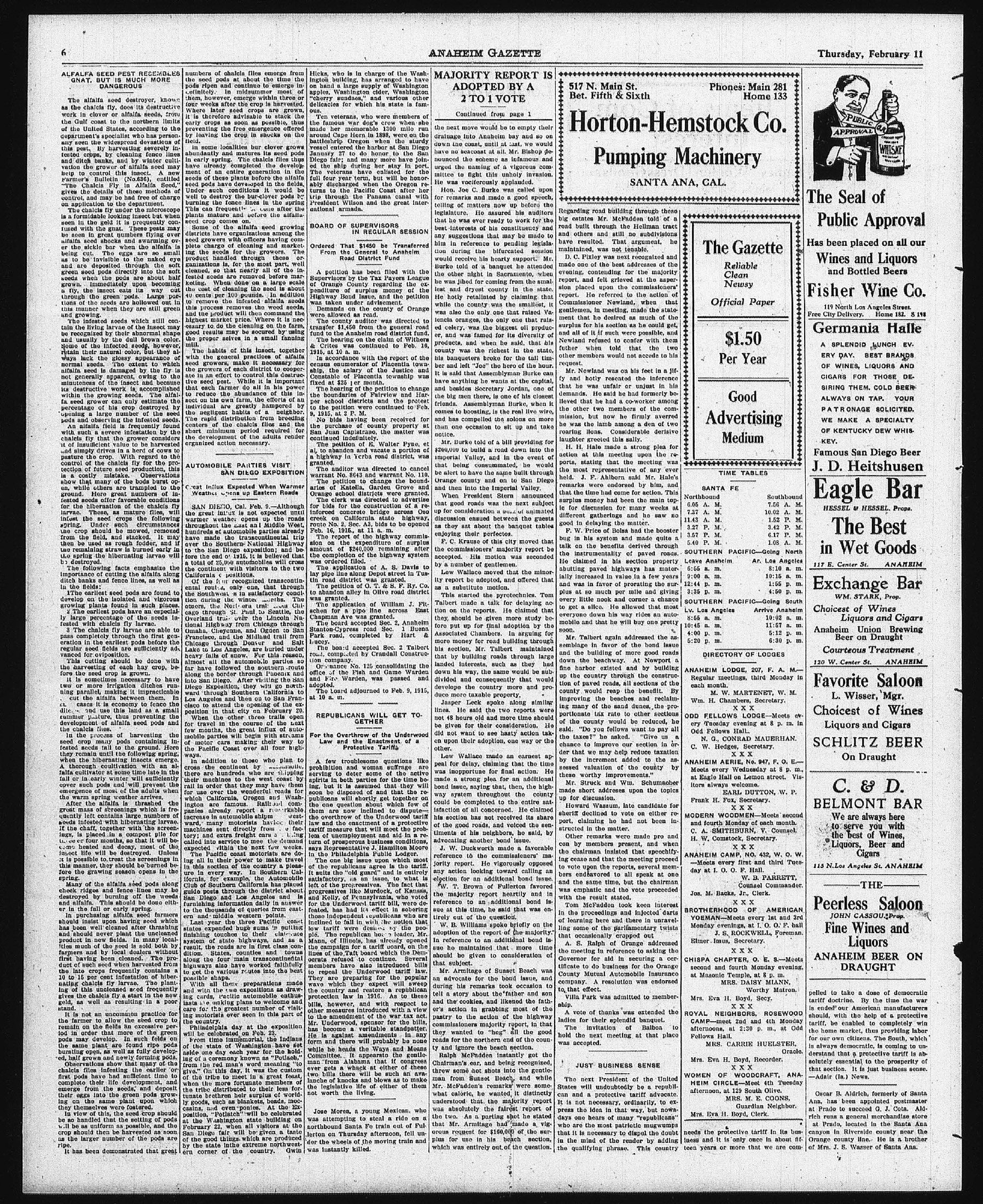
Searchable text
ALFALFA SEED PEST RECEMBLES GNAT, BUT IS MUCH MORE DANGEROUS
The alfalfa seed destroyer, known as the chalcis fly, does its destructive work in clover or alfalfa seeds, from the Gulf coast to the northern limits of the United States, according to the department's specialist who has personally seen the widespread devastation of this pest. By harvesting severely infested crops, by cleaning fence lines and ditch banks, and by winter cultivation the grower of alfalfa seed may help to control this insect. A new farmer's Bulletin (No.636), entitled "The Chalcis Fly in Alfalfa Seed," gives the details of these methods of control, and may be had free of charge on application to the department.
The chalcis fly under the microscope is a formidable looking insect but when seen in the gold it is frequently confused with the gnat. These pests may be seen in great numbers flying over alfalfa seed shocks and swarming over the sickle bar when the alfalfa is being cut. The eggs are so small as to be invisible to the naked eye and are deposited through the soft green seed pods directly into the soft seeds when the pods are about half grown. Immediately upon becoming a fly, the insect eats its way out through the green pods. Large portions of the seeds are hollowed out in this manner when they are still green and growing.
The infested seeds which still contain the living larvae of the insect may be recognized by their abnormal shape and usually by the dull brown color. Some of the infected seeds, however, retain their natural color, but they always lack the glossy appearance of normal seeds. The extent to which alfalfa seed is damaged by the fly is not generally apparent, owing to the minuteness of the insect and because its destructive work is accomplished within the growing seeds. The alfalfa seed grower can only estimate the percentage of his crop destroyed by opening a large number of the seed pods and observing the infested seeds.
An alfalfa field is frequently found with such a severe infestation by the chalcis fly that the grower considers it of insufficient value to be harvested numbers of chalcis flies emerge from the seed pods at about the time the pods ripen and continue to emerge indefinitely. In midsummer most of them, however, emerge within three or four weeks after the crop is harvested. It is therefore advisable to stack the early crops as soon as possible, thus preventing the free emergence offered by leaving the crop in shocks on the field.
In some localities bur clover grows abundantly and matures its seed pods in early spring. The chalcis flies thus have already completed the development of an entire generation in the seeds of these plants before the alfalfa seed pods have developed in the fields. Under such conditions it would be well to destroy the bur-clover pods by burning the fence lines in the spring. This can frequently come after the plants mature and before the alfalfa-seed crop comes on.
Some of the alfalfa seed growing districts have organizations among the seed growers with officers having complete charge of cleaning and marketing the seeds for the growers. The product handled through these organizations is, for the most part, well cleaned, so that nearly all of the infested seeds are removed before marketing. When done on a large scale the cost of cleaning the seed is about 40 cents per 100 pounds. In addition to remove the infested alfalfa seeds this process removes the weed seeds, and the product will then command the highest market price. Where it is necessary to do the cleaning on the farm, good results may be secured by using the proper solves in a small fanning mill.
The habits of this insect, together with the general practices of alfalfa seed growers, make it necessary for the growers of each district to cooperate in an effort to control this destructive seed pest. While it is important that each farmer do all in his power to reduce the abundance of this insect on his own farm, the efforts of an individual are greatly hampered by the negligent habits of a neighbor. The rapid distribution from breeding centers of the chalcis flies and the short minimum period required for the development of the adults render organized action necessary.
Hicks, who is inington building, has on hand a large suction apples, Washington "cherry sundae," delicacies for whous.
Ten veterans, who have famous war days made her memories around Cape Horn battleship Oregon vessel entered on January 27 to do Diego fair; and marked the ship during Veterans Day full four year term ably discharged w turns to the Pacific trip through the President Wilson national armada.
BOARD OF SUPERIOR IN R
Ordered That $14 From The General Road Disc
A petition has Supervisors by the Office Orange County penniture of surp Highway Bond Issued was taken under Demands on these were allowed as re
The county auditor transfer $1,450 from fund to the Anaheli.
The hearing on t & Crites was con- 1915, at 10 a.m.
In accordance with census enumerator sship, the salary Constable of Place fixed at $25 or m.
The hearing of th he boundaries of per school district to the petition week 9, 1915, at 2 P.M.
No bids having hvingthe purchase of San Juan Capistrano continued indefinite
the petition of
ways lack the glossy appearance of normal seeds. The extent to which alfalfa seed is damaged by the fly is not generally apparent, owing to the minuteness of the insect, and because its destructive work is accomplished within the growing seeds. The alfalfa seed grower can only estimate the percentage of his crop destroyed by opening a large number of the seed pods and observing the infested seeds.
An alfalfa field is frequently found with such a severe infestation by the chalcis fly that the grower considers it of insufficient value to be harvested and simply drives in a herd of cows to pasture the crop. With regard to the control of the chalcis fly for the protection of future seed production, this is a costly mistake. Observations show that many of the bods burst open, while others are trampled to the ground. Here great numbers of infested seeds offer favorable conditions for the hibernation of the chalcis fly larvae. These, as mature files, will infect the seed crops the following spring. Under such circumstances the crop should be mowed, removed from the field, and stacked. It may then be used as rough fodder, and if the remaining straw is burned early in the spring the hibernating larvae will be destroyed.
The following facts emphasize the importance of cutting the alfalfa along ditch banks and fence lines, as well as in the fields:
1. The earliest seed pods are found to develop on the isolated and vigorous growing plants found in such places.
2. The earliest pods have an especially large percentage of the seeds infested with chalcis fly larvae.
3. The chalcis fly larvae are able to pass completely through the first generation in the earliest pods before the regular seed fields are sufficiently advanced for oviposition.
4. This cutting should be done with the harvesting of each hay crop, before the seed crop is grown.
It is sometimes necessary to have two or more irrigation ditches running parallel, making it impracticable to cut the alfalfa between them. In cases it is economy to fence the ditches and use this land as a small summer pasture, thus preventing the development of alfalfa seed pods and the chalcis flies.
In the process of harvesting the seed crop many pods containing infested seeds fall to the ground. Here they remain until the following spring, when the hibernating insects emerge. A thorough countivation with an alfalfa cultivator at some time late in the fall or in early winter will sufficiently cover such pods and will prevent the emergence of most of the adults when the warm spring weather arrives.
After the alfalfa is thrashed the great mass of screenings which is frequently left contains large numbers of seeds infested with hibernating larvae. If the chaff, together with the screenings, is placed in a compost pile for three or four months, so that it will become heated and decay, most of the ways lack the glossy appearance of normal seeds. The extent to which alfalfa seed is damaged by the fly is not generally apparent, owing to the minuteness of the insect, and because its destructive work is accomplished within the growing seeds. The alfalfa seed grower can only estimate the percentage of his crop destroyed by opening a large number of the seed pods and observing the infested seeds.
An alfalfa field is frequently found with such a severe infestation by the chalcis fly that the grower considers it of insufficient value to be harvested and simply drives in a herd of cows to pasture the crop. With regard to the control of the chalcis fly for the protection of future seed production, this is a costly mistake. Observations show that many of the bods burst open, while others are trampled to the ground. Here great numbers of infested seeds offer favorable conditions for the hibernation of the chalcis fly larvae. These, as mature files, will infect the seed crops the following spring. Under such circumstances the crop should be mowed, removed from the field, and stacked. It may then be used as rough fodder, and if the remaining straw is burned early in the spring the hibernating larvae will be destroyed.
The following facts emphasize the importance of cutting the alfalfa along ditch banks and fence lines, as well as in the fields:
1. The earliest seed pods are found to develop on the isolated and vigorous growing plants found in such places.
2. The earliest pods have an especially large percentage of the seeds infested with chalcis fly larvae.
3. The chalcis fly larvae are able to pass completely through the first generation in the earliest pods before the regular seed fields are sufficiently advanced for oviposition.
4. This cutting should be done with the harvesting of each hay crop, before the seed crop is grown.
It is sometimes necessary to have two or more irrigation ditches running parallel, making it impracticable to cut the alfalfa between them. In cases it is economy to fence the ditches and use this land as a small summer pasture, thus preventing the development of alfalfa seed pods and the chalcis flies.
In the process of harvesting the seed crop many pods containing infested seeds fall to the ground. Here they remain until the following spring, when the hibernating insects emerge. A thorough countivation with an alfalfa cultivator at some time late in the fall or in early winter will sufficiently cover such pods and will prevent the emergence of most of the adults when the warm spring weather arrives.
After the alfalfa is thrashed the great mass of screenings which is frequently left contains large numbers of seeds infested with hibernating larvae. If the chaff, together with the screenings, is placed in a compost pile for three or four months, so that it will become heated and decay, most of these ways lack the glossy appearance of normal seeds. The extent to which alfalfa seed is damaged by the fly is not generally apparent, owing to the minuteness of the insect, and because its destructive work is accomplished within the growing seeds. The alfalfa seed grower can only estimate the percentage of his crop destroyed by opening a large number of the seed pods and observing the infested seeds.
An alfalfa field is frequently found with such a severe infestation by the chalcis fly that the grower considers it of insufficient value to be harvested and simply drives in a herd of cows to pasture the crop. With regard to the control of the chalcis fly for the protection of future seed production, this is a costly mistake. Observations show that many of the bods burst open, while others are trampled to the ground. Here great numbers of infested seeds offer favorable conditions for the hibernation of the chalcis fly larvae. These, as mature files, will infectthe seed cropsthe following spring.Under such circumstancesthe crop should be mowed, removed fromthe field,and stacked.It may thenbe used as rough fodder,and ifthe remaining straw is burnedearlyinthespringthehibernatinglarvaewillbdestroy.
The following facts emphasize the importance of cuttingthealfalfa along ditch banks and fence lines,as well as inthefields:
1.The earliest seed pods are found to develop onthe isolatedandvigorousgrowingplantsfoundinsuchplaces.
2.The earliestpodshaveanespeciallylargepercentageoftheseedsinfestedwithchalcisflylarvae.
3.Thechalcisflylarvaeareabletopasscompletelythroughthefirstgenerationintheearliestpodsbeforetheregularseedfieldsaresufficientlyadvancedforoviposition.
4Thiscuttingshouldbedonewiththeharvestingofeachhaycropbeforetheseedcropisgrown.
It is sometimes necessary to have two or more irrigation ditches running parallel,makingitimpracticableoutcutthealfalfabetweenthem.Incasesitiseconomytofencetheditchesandusethislandasasmumperpasture,tuspreventingthedevelopmentofalfalfaseedpodsandthechalcisflies.
Intheprocessofharvestingtheseedcropmanypodstaininginfestedseedsfalltotheground.Heretheyremainuntilthefollowingspring,thehibernatinginsectsmeregulatethroughthewinterroute duringthewintermonths.Theothers,theNortherntrail:anChicagothroughSt.PaultoSeattle,theOverlandtrailovertheLincolnNationalHighwayfromChicagothroughOmaha,Cheyenne,andOgdentoSanFrancisco,andtheMidlandtrailfromChicagothroughDenverandSaltLaketoLosAngeles,burriedunderheavyfallsof snow.Forthisreason.almostalltheautomobilepartiessofarhavefollowedthesouthernroutealongtheborderthroughPhoenixandintoSanDiego.AftervisitingtheSanDiegoExposition,theywillgonorthwardthroughSouthernCaliforniatoLosAngelesandthenontosanFranciscotocountleavingtheexpositioninthatcityonFebruary20.
Whenotherthreetrailsopenfortravelinthecourseofthenext fewmonths,thegreatinfluxofautomobileswillbeginwith streamsofmotorcarsmaking theirwaytothePacificCoastoverallfourhighways.
Inadditiontothemosewhoplantocrossthecontinentbyautomobilestherearehundredswhoareshippingthemachinestothewestcoastbyrailinorderthattheymayhavethemforuseoverthewonderfulroadsforsichalifornia.OregonandWashingtonare famous.Railroadcompaniesalreadyreportareremarkableinautomobileshipwestsward,manymotorshavethiermachinessentdirectlyfromfactory;andextrafreightcarscallingledintoservicetomee demandexpectedwithinthenext fewweeks.
A few troubles严禁和限制服务到 deterrentspiritsinbothpartingbutitisassuasive soonbe disposedpublicanswillshowtheonequestionathemarenowintherowthrowofthelawandtheenactirtariffmeasurethatlemofunemployermotionsturnofproposerssaysRepublicansGet
FortheOverthrowLawandtheProtection
A thorough cultivation with an alfalfa cultivator at some time late in the fall or in early winter will sufficiently cover such pods and will prevent the emergence of most of the adults when the warm spring weather arrives.
After the alfalfa is thrashed the great mass of screenings which is frequently left contains large numbers of seeds infested with hibernating larvae. If the chaff, together with the screenings, is placed in a compost pile for three or four months, so that it will become heated and decay, most of the insect life will be destroyed. Unless it is possible to treat the screenings in this manner, they should be burned before the growing season opens in the spring.
Many of the alfalfa seed pods along check ridges and fence lines may be destroyed by burning off the weeds and alfalfa. This should be done either in the fall or early spring.
In purchasing alfalfa seed farmers should insist upon having seed which has been well cleaned after thrashing and should never plant the uncleaned product in new fields. In many localities much of the seed is sold both by farmers and by local dealers without first having been cleaned. The product of such seed when harvested from the late crops frequently contains a 10 to 15 per cent infestation of hibernating chalcis fly larvae. The planting of this uncleaved seed frequently gives the chalcis fly a start in the new gold, as well as resulting in a poor stand.
It is not an uncommon practice for the farmer to allow the seed crop to remain on the fields an excessive period in order that more of the green pods may develop. In such fields on the same plant are found ripe pods bursting open, as well as fully developed, half grown and newly forming pods.
Observations show that many of the chalcis flies infesting the earlier or first pods have had sufficient time to complete their life development, and emerge from the seeds, and deposit their eggs into the green pods growing on the same plant upon which they themselves were fostered.
In view of this, the seed crop should be so handled that the setting of pods will be as uniform as possible, and the crop should then be harvested as soon as the larger number of the pods are ripe.
It has been demonstrated that great
In addition to those who plan to cross the continent by automobile, there are hundreds who are shipping their machines to the west coast by rail in order that they may have them for use over the wonderful roads for which California, Oregon and Washington are famous. Railroad companies already report a remarkable increase in automobile shipment, many motorists having their machines sent directly from a factory; and extra freight cars being called into service to meet the demand expected within the next few weeks.
The Pacific coast motorists are doing all in their power to make travel in this section of the country a pleasure in every way. In Southern California, for example, the Automobile Club of Southern California has placed guide posts through the district about San Diego and Los Angeles and is furnishing information daily in answer to the thousands of queries from eastern and middle western points.
Last year the three Pacific coast states expended huge sums in putting finishing touches to their elaborate system of state highways, and as a result, the roads are in first class condition. States, counties and towns along the four main transcontinental highways also have worked faithfully to get the various routes into the best possible shape.
With all these preparations made and with the two expositions as drawing cards, flexible automobile enthusiasts are making plans to welcome and care for the greatest number of visiting motorists ever seen in this part of the country.
Philadelphia day at the exposition will be celebrated on Feb. 23.
From time immemorial, the Indians of the state of Washington have set aside one day each year for the holding of a ceremony known as "Potlatch," from the red man's word meaning "to give." On this day, it was the custom of the tribe to meet in a great feast, when the more fortunate members of the tribe distributed to their less fortunate brethren heir surplus of worldly goods, such as blankets, beads, moccasins, and oven-ponies. At the Exposition, "Petlatch" will be celebrated at Washington state building on February 22, when all visitors at the San Diego fair will be given a taste of the good things which are produced by the state in extreme northwestern corner of the country.
A few troublesome prohibition and serving to deter spirits in both parties, but it is assured soon be disposed of publicans will show them one question at them are now in overthrow of the law and the enacture tariff measure that lem of unemployment turn of prosperous says Representative in the Philadelphia.
The one big issue of the republicans is it suits the "old gut satisfactory, as an aid of the progressives like M. Kennedy, of Penn. for the Underwood feated, has had if those independent inclined to fall in low tariff were done. The republicans Mann, of Illinois, is the campaign for all lines of the Taft botsocrates refused to join members have also to repeal the Unite They are preparing wave which they will take country and re-protection law in bills, however, and other measures intrude to the amendment Mr. Underwood, spells He has against ample form and there will while he heads the Committee. It app man from Alabama ever gets a whacky two bills there will lanche of knocks and the legislative life not worth the livelihood.
Jose Morea, a ye was attempting to northbound Santa Kelton on Thursday derer the wheels of tha was instantly killed
ANAHEIM GAZETTE
Hicks, who is in charge of the Washington building, has arranged to have on hand a large supply of Washington apples, Washington cider, Washington "cherry sundae," and various other delicacies for which his state is famous.
Ten veterans, who were members of the famous war dog's crew when she made her memorable 1300 mile run around Cape Horn in 1898, were on the battleship Oregon when the sturdy vessel entered the harbor at San Diego January 27 to do honor to the San Diego fair; and many more have joined the ship during her stay in port. The veterans have enlisted for the full four year term, but will be honorably discharged when the Oregon returns to the Pacific Coast after her trip through the Panama canal with President Wilson and the great international armada.
BOARD OF SUPERVISORS IN REGULAR SESSION
Ordered That $1450 be Transferred From the General to Anaheim Road District Fund
A petition has been filed with the Supervisors by the Tax Payers League of Orange County regarding the expenditure of surplus money of the Highway Bond Issue, and the petition was taken under advisement.
Demands on the county of Orange were allowed as read.
The county auditor was directed to transfer $1,450 from the general road fund to the Anaheim road district fund.
The hearing on the claim of Witners & Crites was continued to Feb. 16, 1915, at 10 a.m.
In accordance with the report of the census enumerator of Placentia township, the salary of the Justice and Constable of Placentia township was fixed at $25 or month.
The hearing of the petition to change the boundaries of Fairview and Harper school districts and the protest to the petition were continued to Feb. 9, 1915, at 2 P.M.
No bids having been received for the purchase of county property at San Juan Capistrano, the matter was continued indefinitely.
The petition of E. Walter Pyne, et al.
MAJORITY REPORT IS ADOPTED BY A 2 TO 1 VOTE
Continued from page 1
the next move would be to empty their drainage into Anaheim bay and so on down the coast, until at last, we would have no seacoast at all. Mr. Bishop denounced the scheme as infamous and urged the naming of a vigorous committee to fight this unholy invasion. He was vociferously applauded.
Hon. Joe C. Burke was called upon for remarks and made a good speech, telling of matters now up before the legislature. He assured his auditors that he was ever ready to work for the best interests of his constituency and any suggestions that may be made to him in reference to pending legislation during the bifurcated session would receive his hearty support. Mr. Burke told of a banquet he attended the other night in Sacramento, when he was jibed for coming from the smallest and dryest county in the state. He hotly retaliated by claiming that while the county was the smallest, it was also the only one that raised Valencia oranges, the only one that raised celery, was the biggest oil producer, and was famed for its diversity of products, and when he said, that his county was the richest in the state, his banquets broke for the tall timber and left "Joe" the hero of the hour.
It is said that Assemblyman Burke can have anything he wants at the capital, and besides Secretary Jordan, one of the big men there, is one of his closest friends. Assemblyman Burke, when it comes to boosting, is the real live wire, and has compelled the solons on more than one occasion to sit up and take notice.
Mr. Burke told of a bill providing for 517 N. Main St. Bet. Fifth & Sixth Horton-Hem Pumping Ma SANTA ANA
Regarding road building through these big estates Mr. McFadden told of a road built through the Hellman tract and others still no subdivisions have resulted. That argument, he maintained, was not tenable.
D. C. Pixley was next recognized and made one of the best addresses of the evening, contending for the majority report, and felt grieved at the asperSION placed upon the commissioners' report. He referred to the action of Commissioner Newland, when that gentlemen, in meeting, made the statement that he desired as much of the surplus for his section as he could get, and all of it if such were possible, and Newland refused to confer with them further when told that the two other members would not accede to his request.
Mr. Newland was on his feet in a jiffy and hotly resented the inference that he was unfair or unjust in his demands. He said he had formerly believed that he had a co-worker among the other two members of the commission, but now he firmly averred he was the lamb among a den of two roaring lions. Considerable derisive laughter greeted this sally.
H. H. Hale made a strong plea for
In accordance with the report of the census enumerator of Placentia township, the salary of the Justice and Constable of Placentia township was fixed at $25 | or month.
The hearing of the petition to change the boundaries of Fairview and Harper school districts and the protest to the petition were continued to Feb. 9, 1915, at 2 P.M.
No bids having been received for the purchase of county property at San Juan Capitrano, the matter was continued indefinitely.
The petition of E. Walter Pyne, et al., to abandon and vacate a portion of a highway in Yerba road district, was granted.
The auditor was directed to cancel warrant No. 8643 and warrant No. 110.
The petition to change the boundaries of Katella, Garden Grove and Orange school districts were granted.
The clerk was directed to advertise for bids for the construction of a reinforced concrete bridge across Osco creek on California state highway, route No. 2, Sec. A3, bids to be opened Feb. 16, Sec. A3, at 11 a.m.
The report of the highway commission on the expenditure of surplus amount of $240,000 remaining after the completion of the highway system was ordered filed.
The application of A. S. Davis to lay pipe line along Depot street in Tustin road district was granted.
The petition of O. T. & S. F. Ry. Co. to abandon alloy in Olive road district was granted.
The application of William J. Fitches for a pipe line across East Chapman Ave was granted.
The board accepted Sec. 2, Annheim Stanton-Cypress road Sec. 1 Buena Park road, completed by Hart & Lucey.
The board accepted Sec. 2 Talbert road, completed by Crandall Construction company.
Ordnance No. 125 consolidating the office of Fish and Game Warden and Fire Warden, was passed and adopted.
The Loaad adjourned to Feb. 9, 1915, at 10 a.m.
REPUBLICANS WILL GET TOGETHER
For the Overthrow of the Underwood Law and the Enactment of a Protective Tariff
A few troublesome questions like prohibition and woman suffrage are serving to deter some of the active spirits in both parties for the time being, but it is assumed that they will soon be disposed of and that the republicans will shortly get together on the one question about which few of them are now inclined to dispute—the overthrow of the Underwood tariff law and the enactment of a protective tariff measure that will meet the problem of unemployment and aid in a return of prosperous business conditions, says Representative J. Hamilton Moore
In his banquets broke for the tail timber and left "Joe" the hero of the hour.
It is said that Assemblyman Burke can have anything he wants at the capital, and besides Secretary Jordan, one of the big men there, is one of his closest friends. Assemblyman Burke, when it comes to boosting, is the real live wire, and has compelled the solons on more than one occasion to sit up and take notice.
Mr. Burke told of a bill providing for $200,000 to build a road down into the imperial Valley, and in the event of that being consummated, he would be alert to have the same built through Orange county and on to San Diego and then into the Imperial Valley.
When President Stern announced that good roads was the next subject up for consideration a bulk of animated discussion ensued between the guests as they sat about the banquet tables enjoying their perfectos.
F.C. Krause of this city moved that the commissioners' majority report be accepted. His motion was seconded by a number of gentlemen.
Lew Wallace moved that the minority report be adopted, and offered that as a substitute motion.
This started the pyrotechnics. Tom Talbert made a talk for delay action on the reports. He claimed that they should be given more study before put up for final adoption by the Associated Chambers. In arguing for more money for road building through his section, Mr. Talbert maintained that by building roads through large landed interests, such as they had down his way, the same would be subdivided and consequently that would develop the country more and produce more taxable property.
Jasper Leek spoke along similar lines. He said the two reports were not 48 hours old and more time should be given for their consideration. He did not want to see hasty action taken upon their adoption, one way or the other.
Lew Wallace made an earnest appeal for delay, claiming that the time was inopportune for final action. He made a strong plea for an additional bond issue, saying that, then, the highway system throughout the county could be completed to the entire satisfaction of all concerned. He claimed his section has not received its share of the good roads, and voiced the sentiments of his neighbors, he said, by advocating another bond issue.
J.W. Duckworth made a favorable other members would not accede to his request.
Mr. Newland was on his feet in a jiffy and hotly resented the inference that he was unfair or unjust in his demands. He said he had formerly believed that he had a co-worker among the other two members of the commission, but now he firmly averred he was the lamb among a den of two roaring lions. Considerable derisive laughter greeted this sally.
H.H. Halo made a strong plea for action at this meeting upon the reports, stating that the meeting was the most representative of any ever held. J.F. Ahlborn said Mr.Hale's remarks were endorsed by him, and that the time had come for action. This surplus money had been the main topic for discussion for many weeks at different gatherings and he saw no good in delaying the matter.
F.W. Price of Bolsa had the booster bug in his system and made quite a talk on the benefits derived through the instrumentality of paved roads. He claimed in his section property abutting paved highways has materially increased in value in a few years and was in favor of prorating the surplus at so much per mile and giving every little nook and corner a chance to get a slice. He allowed that most everyone down his way rides an automobile and that he will buy one pretty soon.
Mr.Talbert again addressed the assemblage in favor of the bond issue and the building of more good roads down the beachway. At Newport a fine harbor existed and by building up the country through the construction of paved roads, all sections of the county would reap the benefit. By improving the beaches and reclaiming many of the sand dunes, the proportionate tax rate to other sections of the county would be reduced, he said. "Do you fellows want to pay all the taxes?" he asked. "Give us a chance to improve our section in order that we may help reduce taxation by the increment added to the assessed valuation of the county by these worthy improvements."
Mr.Struck and Wm.Schumacher made short addresses upon the topics up for discussion.
Howard Wassum, late candidate for sheriff declined to vote on either report, claiming he had not been instructed in the matter.
Other remarks were made pro and con by members present, and when
A few troublesome questions like prohibition and woman suffrage are serving to deter some of the active spirits in both parties for the time being, but it is assumed that they will soon be disposed of and that the republicans will shortly get together on the one question about which few of them are now inclined to dispute—the overthrow of the Underwood tariff law and the enactment of a protective tariff measure that will meet the problem of unemployment and aid in a return of prosperous business conditions, says Representative J. Hamilton Moore in the Philadelphia Public Lodger.
The one big issue upon which most of the republicans agree is the tariff. It suits the "old guard" and is entirely satisfactory, as an issue, to what is left of the progressives. The fact that progressives like Murdock, of Kansas, and Kelly, of Pennsylvania, who voted for the Underwood tariff bill, were defeated, has had its effect in sobering those independent republicans who are inclined to fall in with the notion that low tariff were desired by the people. The Republican house leader, Mr. Mann, of Illinois, has already opened the campaign for a tariff board, on the lines of the Taft board which the Democrats refused to continue. Several members have also introduced bills to repeal the Underwood tariff law. They are preparing for the popular wave which they expect will sweep the country and restore a republican protection law in 1916. As to these bills, however, and with respect to other measures introduced with a view to the amendment of the war tax act. Mr. Underwood, sponsor for the bills, has become a veritable standpatter. He is against amendments in any form and there will probably be none while he heads the Ways and Means Committee. It appears to the gentleman from Alabama that if congress ever gets a whack at either of these two bills there will be such an availance of knocks and blows as to make the legislative life of either of them not worth the living.
Jose Morea, a young Mexican, who was attempting to steal a ride on a northbound Santa Fe train out of Fullerton on Thursday afternoon, fell under the wheels of the moving train and was instantly killed.
Low Wallace made an earnest appeal for delay, claiming that the time was inopportune for final action. He made a strong plea for an additional bond issue, saying that, then, the highway system throughout the county could be completed to the entire satisfaction of all concerned. He claimed his section has not received its share of the good roads, and voiced the sentiments of his neighbors, he said, by advocating another bond issue.
J. W. Duckworth made a favorable reference to the commissioners' majority report. He vigorously opposed any action looking toward calling an election for an additional bond issue.
W. T. Brown of Fullerton favored the majority report heartily and in reference to an additional bond issue at this time, he said that was entirely out of the question.
W. B. Williams spoke briefly on the adoption of the report of the majority: In reference to an additional bond issue he maintained that more time should be given to consideration of that subject.
Mr. Armitage of Sunset Beach was an advocate for the bond issue, and during his remarks took occasion to tell a story about the father and son and the cookies, and likened the father's action in grabbing most of the pastry to the action of the highway commissioners majority report, in that they wanted to "hog" all the good roads for the northern end of the county and ignore the beach section.
Ralph McFadden instantly got the Chairman's ear, and being recognized, threw some hot shots into the gentleman from Sunset Beach, and while Mr. McFadden's remarks were somewhat calorie, he wanted it distinctly understood that the majority report was absolutely the fairest report of the two. As a parting shot he stated that Mr. Armitage had made a vigorous request for $160,000 of the surplus for use in his beach section, which was entirely out of the question.
Mr. Struck and Wm. Schumacher made short addresses upon the topics up for discussion.
Howard Wassum, late candidate for sheriff declined to vote on either report, claiming he had not been instructed in the matter.
Other remarks were made pro and con by members present, and when the chairman insisted that speechifying cease and that the meeting proceed to vote upon the reports, several members endeavored to all speak at one and the same time, but the chairman was emphatic and the vote proceeded with the result stated.
Tom McFadden took keen interest in the proceedings and injected darts of learning here and there in unraveling some of the parliamentary twists that occasionally cropped out.
A. S. Ralph of Orange addressed the meeting in reference to asking the Governor for aid in securing a certificate to do business for the Orange County Mutual Automobile Insurance company. A resolution was endorsed to that effect.
Villa Park was admitted to membership.
A vote of thanks was extended to ladies for their splendid banquet.
The invitation of Balboa to hold the next meeting at that place was accepted.
JUST BUSINESS SENSE
The next President of the United States will undoubtedly be a republican and a protective tariff advocate. It is not necessary, ordinarily, to express the idea in that way, but nowadays one hears of many "ropublicans" who are the most patriotic mugwumps that it is necessary to dispel the doubt in the mind of the reader by adding the qualifying phrase. This country
Thursday, February 11
Hon-Hemstock Co.
Camping Machinery
SANTA ANA, CAL.
The Seal of Public Approval
Has been placed on all our Wines and Liquors and Bottled Beers
Fisher Wine Co.
119 North Los Angeles Street.
Free City Delivery. Home 182. S 198
Germania Halle
A SPLENDID LUNCH EVERY DAY. BEST BRANDS OF WINES, LIQUORS AND CIGARS FOR THOSE DESIRING THEM. COLD BEER ALWAYS ON TAP. YOUR PATRONAGE SOLICITED. WE MAKE A SPECIALTY OF KENTUCKY DEW WHISKEY.
The Gazette
Reliable
Clean
Newsy
Official Paper
$1.50
Per Year
Good Advertising Medium
Per Year
Good Advertising Medium
TIME TABLES
SANTA FE
Northbound Southbound
6.05 A. M. 7.56 A. M.
7.37 A. M. 10.02 A. M.
11.43 A. M. 1.52 P. M.
3.27 P. M. 3.42 P. M.
3.57 P. M. 6.17 P. M.
5.40 P. M. 1.08 A. M.
SOUTHERN PACIFIC—Going North
Leave Anaheim Ar. Los Angeles
6:55 a.m. 8:10 a.m.
9:00 a.m. 10:15 a.m.
12:44 p.m. 1:55 p.m.
3:35 p.m. 4:50 p.m.
SOUTHERN PACIFIC—Going South
Lv. Los Angeles Arrive Anaheim
8:55 a.m. 10:02 a.m.
10:45 a.m. 11:57 a.m.
4:00 p.m. 5:12 p.m.
5:20 p.m. 6:30 p.m.
DIRECTORY OF LODGES
ANAHEIM LODGE, 207, F. A. M.—Regular meetings, third Monday in each month.
M. W. MARTENET, W. M.
Wm. H. Chambers, Secretary.
XX X
ODD FELLOWS LODGE—Meets every Tuesday evening at 8 p.m. in Odd Fellows Hall.
N. G., CONRAD MAUERHAN.
C. W. Hedges, Secretary.
XX X
ANAHEIM AERIE, No. 947, F. O. E.—Meets every Wednesday at 8 p.m., at Eagle Hall on Lemon street. Visitors always welcome.
EARL DUTTON, W. P.
Frank H. Fox, Secretary.
XX X
MODERN WOODMEN—Meets second and fourth Monday of each month.
C. A. SMITHBURN, V. Counsel.
H. W. Comstock, Secretary.
XX X
ANAHEIM AERIE, No. 947, F. O. E.—Meets every Wednesday at 8 p.m., at Eagle Hall on Lemon street. Visitors always welcome.
EARL DUTTON, W. P.
Frank H. Fox, Secretary.
MODERN WOODMEN—Meets second and fourth Monday of each month.
C. A. SMITHBURN, V. Counsel.
H. W. Comstock, Secretary.
ANAHEIM CAMP, NO. 432, W. O. W.—Meets every first and third Tuesday at I. O. O. F. Hall.
W. B. PARRETT,
Counsel Commander.
Jos. M. Backs, Jr., Clerk.
BROTHERHOOD OF AMERICAN YOEMAN—Meets every 1st and 3rd Monday evenings, at I. O. O. F. hall.
J. S. ROCKWELL, Foreman.
Elmer Imus, Secretary.
CHISPA CHAPTER, O. E. S.—Meets second and fourth Monday evening, at Masonic Temple, at 8 p.m.
MRS. DAISY MIANN,
Worthy Matron.
Mrs. Eva H. Boyd, Secy.
ROYAL NEIGHBORS, ROSEWOOD CAMP—meet 2nd and 4th Monday afternoons, at 2:30 p.m., at Odd Fellows Hall.
MRS. CARRIE HUELSTER,
Oracle.
Mrs. Eva H. Boyd, Recorder.
WOMEN OF WOODCRAFT, ANAHEIM CIRCLE—Meet 4th Tuesday afternoon, at 129 South Olive.
MRS. M. E. COONS,
Guardian Neighbor.
Mrs. Eva H. Boyd, Clerk.
needs the protective tariff in its business and it is only once in about fifteen years or more that we are compelled to take a dose of democratic tariff doctrine. By the time the war is ended our American manufacturers should, with the help of a protective tariff, be enabled to completely win the home market, thus providing labor for our own citizens. The South, which is always democratic, is coming to understand that a protective tariff is absolutely essential to the prosperity of that section. It is just business sense.
Adair (Ia.) News.
Oscar B. Aldrich, formerly of Santa Ana, has been appointed postmaster at Prado to succeed G. J. Cota. Aldrich runs a general merchandise store at Prado, located in the Santa Ana canyon in Riverside county near the Orange county line. He is a brother of Mrs. J. S. Wasser of Santa Ana.