anaheim-gazette 1915-02-04
Scanned page
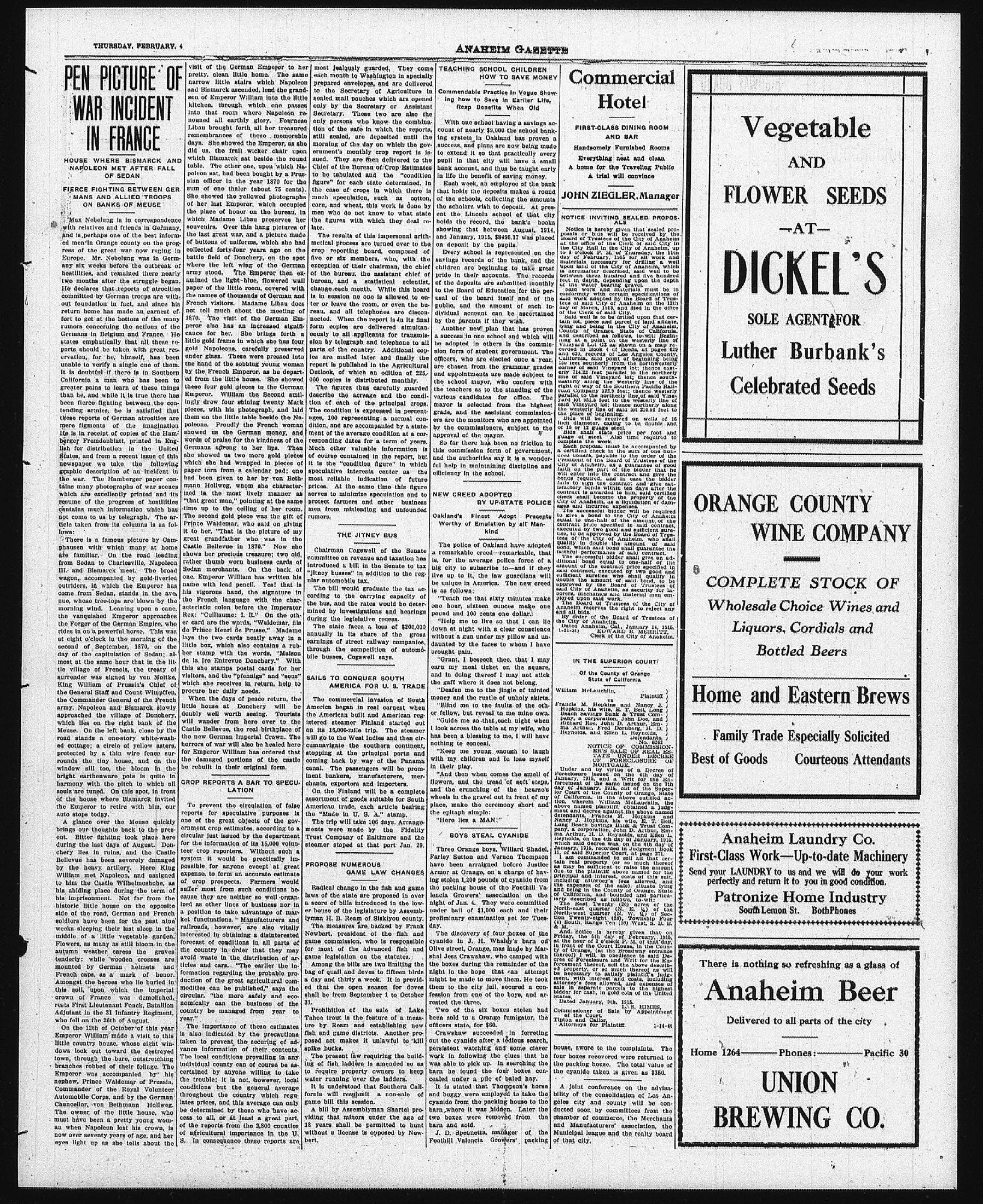
Searchable text
PEN PICTURE OF WAR INCIDENT IN FRANCE
HOUSE WHERE BISMARCK AND NAPOLEON MET AFTER FALL OF SEDAN
FIERCE FIGHTING BETWEEN GERMANS AND ALLIED TROOPS ON BANKS OF MEUSE
Max Nebelung is in correspondence with relatives and friends in Germany, and is perhaps one of the best informed men in Orange county on the progress of the great war now raging in Europe. Mr. Nebelung was in Germany six weeks before the outbreak of hostilities, and remained there nearly two months after the struggle began. He declares that reports of atrocities committed by German troops are without foundation in fact, and since his return home has made an earnest effort to get at the bottom of the many rumors concerning the actions of the Germans in Belgium and France. He states emphatically that all these reports should be taken with great reservation, for he, himself, has been unable to verify a single one of them. It is doubtful if there is in Southern California a man who has been to greater pains to learn of these things than he, and while it is true there has been fierce fighting between the contending armies, he is satisfied that these reports of German atrocities are more figments of the imagination. He is in receipt of copies of the Hamburg Fremdenblatt, printed in English for distribution in the United States.
visit of the German Emperor to her pretty, clean little home. The same narrow little stairs which Napoleon and Bismarck ascended, lead the grandson of Emperor William into the little kitchen, through which one passes into that room where Napoleon renounced all earthly glory. Fourneau Libau brought forth all her treasured remembrances of those memorable days. She showed the Emperor, as she did us, the frail wicker chair upon which Bismarck sat beside the round table. The other one, upon Napoleon sat, had been bought by a Prussian officer in the year 1870 for the sum of one thaler (about 75 cents). She showed the yellowed photographs of her last Emperor, which occupied the place of honor on the bureau, in which Madame Libau preserves her souvenirs. Over this hang pictures of the last great war, and a picture made of buttons of uniforms, which she had collected forty-four years ago on the battle field of Donchery, on the spot where the left wing of the German army stood. The Emperor then examined the light-blue, flowered wall paper of the little room, covered with the names of thousands of German and French visitors. Madame Libau does not tell much about the meeting of 1870. The visit of the German Emperor also has an increased significance for her. She brings forth a little gold frame in which she has four gold Napoleons, carefully preserved under glass. These were pressed into the hand of the sobbing young woman by the French Emperor, as he departed from the little house. She showed these four gold pieces to the German Emperor. William the Second smilingly drew four shining twenty Mark pieces, with his photograph, and laid them on the little table beside the Napoleons. Proudly the French woman showed us the German money, and words of praise for the kindness of the Germans sprang to her lips. Then most jealously gaze each month to WWI prepared envelope to the Secretary sealed mail pouches only by the Secretary. These only persons who tion of the safe still sealed, are no morning of the dawnment's monthly sued. They are to Chief of the Bureau to be tabulated as figure" for each case of crop much speculation corn, and wheat, men who do not take the figures with late.
The results of the metical process are crop reporting by five or six members exception of their of the bureau, the bureau, and a small change each month is in session no longer or leave the roeau, and all telecited. When they form copies are cohesively to all application by telegraph parts of the counties are mailed later report is published Outlook, of which 000 copies is distruted.
The figures thus describe the accretion of each of them. The condition is exages, 100 represent dition, and are account of the average responding dates for Much other values.
servation, for he, himself, has been unable to verify a single one of them.
It is doubtful if there is in Southern California a man who has been to greater pains to learn of these things than he, and while it is true there has been force fighting between the contending armies, he is satisfied that these reports of German atrocities are more pigments of the imagination He is in receipt of copies of the Hamburger Fremdenblatt, printed in English for distribution in the United States, and from a recent issue of this newspaper we take the following graphic description of an incident in the war. The Hamburger paper contains many photographs of war scenes which are excellently printed and its resume of the progress of hostilities contains much information which has not come to us by telegraph. The article taken from its columns is as follows:
There is a famous picture by Gamphausen with which many at home are familiar. On the road leading from Sedan to Charlesville, Napoleon III. and Blamark meet. The broad wagon, accompanied by gold-livered outriders, in which the Emperor has come from Sedan, stands in the avenue, whose tree-tops are blown by the morning wind. Leaning upon a cane, the vanquished Emperor approaches the Forger of the German Empire, who rides in on a powerful horse. This was at eight o'clock in the morning of the second of September, 1870, on the day of the capitulation of Sedan; almost at the same hour that in the little village of Frenois, the treaty of surrender was signed by von Moltke, King William of Prussia's Chief of the General Staff and Count Wimpffen, the Commander General of the French army. Napoleon and Blamark slowly approached the village of Donchery, which lies on the right bank of the Meuse. On the left bank, close by the road stands a one-story white-washed cottage; a circle of yellow asters, protected by a thin wire fence surrounds the tiny house, and on the window sill too, the bloom in the bright earthenware pots is quite in harmony with the pitch to which all souls are tuned. On this spot, in front of the house where Blamark invited the Emperor to retire with him, our auto stops today.
A glance over the Meuse quickly brings our thoughts back to the present. Bitter fighting took place here during the last days of August. Donchery under glass. These were pressed into the hand of the sobbing young woman by the French Emperor, as he departed from the little house. She showed these four gold pieces to the German Emperor. William the Second smilingly drew four shining twenty Mark pieces, with his photograph, and laid them on the little table beside the Napoleons. Proudly the French woman showed us the German money, and words of praise for the kindness of the Germans sprung to her lips. Then she showed us two more gold pieces which she had wrapped in pieces of paper torn from a calendar pad; one had been given to her by von Bethmann Hollweg, whom she characterized in the most lively manner as "that great man," pointing at the same time up to the ceiling of her room. The second gold piece was the gift of Prince Waldemar, who said on giving it to her, "That is the picture of my great grandfather who was in the Castle Bellevue in 1870." Now she shows her precious treasure; two old, rather thumb worn business cards of Sedan merchants. On the back of one, Emperor William has written his name with lead pencil. Yes! that is his vigorous hand, the signature in the French language with the characteristic colon before the Imperator Rex: "Cuillaume: I. R." On the other card are the words, "Waldemar, fils de Prince Henri de Prusse." Madame lays the two cards neatly away in a little box, which also contains a rubber stamp with the words, "Maison de la Ire Entrevue Donchery." With this she stamps postal cards for her visitors, and the "pfennigs" and "sous" which she receives in return, help to procure her daily needs.
When the days of peace return, the little house at Donchery will be doubly well worth seeing. Tourists will wander from here over to the Castle Bellevue, the real birthplace of the new German Imperial Crown. The horrors of war will also be healed here for Emperor William has ordered that the damaged portions of the castle be rebuilt in their original form.
CROP REPORTS A BAR TO SPECULATION
To prevent the circulation of false reports for speculative purposes is one of the great objects of the government crop estimates, according to a circular just issued by the department for the information of its 15,000 volunteer crop reporters. Without such a
rounds the tiny house, and on the window sill too, the bloom in the bright earthenware pots is quite in harmony with the pitch to which all souls are tuned. On this spot, in front of the house where Bismarck invited the Emperor to retire with him, our auto stops today.
A glance over the Meuse quickly brings our thoughts back to the present. Bitter fighting took place here during the last days of August. Donchery lies in ruins, and the Castle Bellevue has been severely damaged by the heavy artillery. Here King William met Napoleon, and assigned to him the Castle Wilhelmoshohe, as his abiding place during the term of his imprisonment. Not far from the historic little house on the opposite side of the road, German and French soldiers have been for the past nine weeks sleeping their last sleep in the middle of a little vegetable garden. Flowers, as many as still bloom in the autumn weather caress the graves tenderly: while wooden crosses are mounted by German helmets and French caps, as a mark of honor. Amongst the heroes who lie buried in this soil, upon which the imperial crown of France was demolished, rests First Lieutenant Fonck, Bataillon Adjutant in the 31 Infantry Regiment, who fell on the 26th of August.
On the 12th of October of this year Emperor William made a visit to this little country house, whose eight windows look out toward the destroyed town, through the bare, outstretching branches robbed of their foliage. The Emperor was accompanied by his nephew, Prince Waldemar of Prussia, Commander of the Royal Volunteer Automobile Corps, and by the German Chancellor, von Bethmann Hollweg. The owner of the little house, who must have been a pretty young woman when Napoleon lost his crown, is now over seventy years of age, and her eyes light up as she tells about the damaged portions of the castle be rebuilt in their original form.
CROP REPORTS A BAR TO SPECULATION
To prevent the circulation of false reports for speculative purposes is one of the great objects of the government crop estimates, according to a circular just issued by the department for the information of its 15,000 volunteer crop reporters. Without such a system it would be practically impossible for anyone except at great expense, to form an accurate estimate of crop prospects. Farmers would suffer most from such conditions because they are neither so well-organized as other lines of business nor in a position to take advantage of market fluctuations. Manufacturers and railroads, however, are also vitally interested in obtaining a disinterested forecast of conditions in all parts of the country in order that they may avoid waste in the distribution of articles and cars. "The earlier the information regarding the probable production of the great agricultural commodities can be published," says the circular, "the more safely and economically can the business of the country be managed from year to year."
The importance of these estimates is also indicated by the precautions taken to prevent the securing of advance information of their contents. The local conditions prevailing in any individual county can of course be ascertained by anyone willing to take the trouble; it is not, however, local conditions but the general average throughout the country which regulates prices, and this average can only be determined by those who have access to all, or at least a great part, of the reports from the 2,800 counties of agricultural importance in the U.S. In consequence these reports are
ANAHEIM GAZETTE
most jealously guarded. They come each month to Washington in specially prepared envelopes, and are delivered to the Secretary of Agriculture in sealed mail pouches which are opened only by the Secretary or Assistant Secretary. These two are also the only persons who know the combination of the safe in which the reports, still sealed, are deposited until the morning of the day on which the government's monthly crop report is issued. They are then delivered to the Chief of the Bureau of Crop Estimates to be tabulated and the "condition figure" for each state determined. In the case of crops in which there is much speculation, such as cotton, corn, and wheat, this work is done by men who do not know to what state the figures with which they deal relate.
The results of this impersonal arithmetical process are turned over to the crop reporting board, composed of five or six members, who, with the exception of their chairman, the chief of the bureau, the assistant chief of bureau, and a statistical scientist, change each month. While this board is in session no one is allowed to enter or leave the room, or even the bureau, and all telephones are disconnected. When the report is in its final form copies are delivered simultaneously to all applicants for transmission by telegraph and telephone to all parts of the country. Additional copies are mailed later and finally the report is published in the Agricultural Outlook, of which an edition of 225,000 copies is distributed monthly.
The figures thus carefully guarded describe the acreage and the condition of each of the principal crops. The condition is expressed in percentages, 100 representing a normal condition, and are accompanied by a statement of the average condition at a corresponding dates for a term of years. Much other valuable information is most jealously guarded. They come each month to Washington in specially prepared envelopes, and are delivered to the Secretary of Agriculture in sealed mail pouches which are opened only by the Secretary or Assistant Secretary. These two are also the only persons who know the combination of the safe in which the reports, still sealed, are deposited until the morning of the day on which the government's monthly crop report is issued. They are then delivered to the Chief of the Bureau of Crop Estimates to be tabulated and the "condition figure" for each state determined. In the case of crops in which there is much speculation, such as cotton, corn, and wheat, this work is done by men who do not know to what state the figures with which they deal relate.
The results of this impersonal arithmetical process are turned over to the crop reporting board, composed of five or six members, who, with the exception of their chairman, the chief of the bureau, the assistant chief of bureau, and a statistical scientist, change each month. While this board is in session no one is allowed to enter or leave the room, or even the bureau, and all telephones are disconnected. When the report is in its final form copies are delivered simultaneously to all applicants for transmission by telegraph and telephone to all parts of the country. Additional copies are mailed later and finally the report is published in the Agricultural Outlook, of which an edition of 225,000 copies is distributed monthly.
The figures thus carefully guarded describe the acreage and the condition of each of the principal crops. The condition is expressed in percentages, 100 representing a normal condition, and are accompanied by a statement of the average condition at a corresponding dates for a term of years. Much other valuable information is most jealously guarded. They come each month to Washington in specially prepared envelopes, and are delivered to the Secretary of Agriculture in sealed mail pouches which are opened only by the Secretary or Assistant Secretary. These two are also the only persons who know the combination of the safe in which the reports, still sealed, are deposited until the morning of the day on which the government's monthly crop report is issued. They are then delivered to the Chief of the Bureau of Crop Estimates to be tabulated and the "condition figure" for each state determined. In the case of crops in which there is much speculation, such as cotton, corn, and wheat, this work is done by men who do not know to what state the figures with which they deal relate.
The results of this impersonal arithmetical process are turned over to the crop reporting board, composed of five or six members, who, with the exception of their chairman, the chief of the bureau, the assistant chief of bureau, and a statistical scientist, change each month. While this board is in session no one is allowed to enter or leave the room, or even the bureau, and all telephones are disconnected. When the report is in its final form copies are delivered simultaneously to all applicants for transmission by telegraph and telephone to all parts of the country. Additional copies are mailed later and finally the report is published in the Agricultural Outlook, of which an edition of 225,000 copies is distributed monthly.
The figures thus carefully guarded describe the acreage and the condition of each of the principal crops. The condition is expressed in percentages, 100 representing a normal condition, and are accompanied by a statement of the average condition at a corresponding dates for a term of years. Much other valuable information is most jealously guarded. They come each month to Washington in specially prepared envelopes, and are delivered to the Secretary of Agriculture in sealed mail pouches which are opened only by the Secretary or Assistant Secretary. These two are also the only persons who know the combination of the safe in which the reports, still sealed, are deposited until the morning of the day on which the government's monthly crop report is issued. They are then delivered to the Chief of the Bureau of Crop Estimates to be tabulated and the "condition figure" for each state determined. In the case of crops in which there is much speculation, such as cotton, corn, and wheat, this work is done by men who do not know to what state the figures with which they deal relate.
The results of this impersonal arithmetical process are turned over to the crop reporting board, composed of five or six members, who, with the exception of their chairman, the chief of the bureau, the assistant chief of bureau, and a statistical scientist, change each month. While this board is in session no one is allowed to enter or leave the room, or even the bureau, and all telephones are disconnected. When the report is in its final form copies are delivered simultaneously to all applicants for transmission by telegraph and telephone to all parts of the country. Additional copies are mailed later and finally the report is published in the Agricultural Outlook, of which an edition of 225,000 copies is distributed monthly.
The figures thus carefully guarded describe the acreage and the condition of each of the principal crops. The condition is expressed in percentages, 100 representing a normal condition, and are accompanied by a statement of the average condition at a corresponding dates for a term of years. Much other valuable information is most jealously guarded. They come each month to Washington in specially prepared envelopes, and are delivered to the Secretary of Agriculture in sealed mail pouches which are opened only by the Secretary or Assistant Secretary. These two are also the only persons who know the combination of the safe in which the reports, still sealed, are deposited until the morning of the day on which the government's monthly crop report is issued. They are then delivered tothe Chief of the Bureau of Crop Estimates to be tabulated andthe "condition figure" for each state determined. Inthe caseof cropsinwhichthereismuchspeculation,suchascotton,corn,andwheat,theworkisdonebymenwhodo.notknowtowhatstatethefigureswithwhichtheydrelate.
The results of this impersonal arithmetical process are turned over tothe crop reporting board,composedoffiveor sixmembers,who,withtheexceptionofthechairman,thechiefofthebureau,theassistantchiefofbureau,andastatisticalscientist,changeeachmonth.Willone学校havinga savingsaccountofnearly$9,000theschoolbankingsysteminOaklandhasprovenasuccess,andplansarenowbeingmadetoextenditso thatpracticallyevery pupilinthatcitywillhaveasmallbankaccount,andthusbe taughtearlyinlifethebenefitofsavingmoney.
Each week,anemployeeofthebankthatholdsdepositsmakesaroundoftheschools,collectingtheamountthescholarswishto deposit.AtpresenttheLincolnschoolofthatcityholdstherecord,thebank'sbooksshowingthatbetweenAugust,1914,andJanuary,1915,$8495.17was placedon存款bythepupils.
Every schoolisrepresentedonthesavingsrecordsofthebank,andthechildrenarebeginningtotakegreatprideintheiraccounts.TherecordsofthedepositaressubmittedmonthlytotheBoardOfEducationforperusaloftheboarditselfandofthepublic,andtheamountofeachindividualaccountcanbescertainedbytheparentsiftheywish.
Anothernewplanthathas provenasuccessinoneschoolandwhichwillbeadoptedinothersisthecommissionformofstudentgovernment.Theofficerswhoareelectedonceyear,a chosenfromthegrammargradesandappointmentsaremadesubjecttotheschoolmayor,whoconferswiththeteachersastoaststandingofthevariouscandidatesforoffice.Themayorisselectedfromthehighestgrade,andtheassistantcommissionersarethemonitorswhoareappointedbythecommissioners.subjecttotheapprovalofthemayor.
So far there has been no frictioninthiscompetitionhowtosavemoney.NoticeinvitingsealedproposalsNoticeorbitswillbe receivedbytheBoardofTrusteesoftheCityofAnaheimattheofficeoftheClerkofsaidCityintheCityHallinTheCityofAnaheimupontheCityHallinTheCityofAnaheimupontheDayofFebruary,1915forallworkandmaterialsnecessaryfordrillingawellupontheCityofAnaheimisnerematterdescribed,saidwelltobeweartwetterthanliveshundredfeetindepth,drepond uponthedepthofthewaterbearinggrave.
SaidworkandmaterialsmustbeinconformitywithcertainspecificationsofsaidworkadoptedbytheBoardofTrusteesofsaidCityonBaltimoredayofMarch,1913,andfiledin.theofficeoftheClerkofsaidCity.
Saidwellistobedrilleduponthet certainlot,pieceandparcelofland situation,judgingandbeinginTheCityofAnaheimcountyandCaliforniafollowingaboveanddowntoTheCityHallinTheCityHallinTheCityHallinTheDayofFebruary,1915forallworkandmaterialsnecessaryfordrillingawellupontheCityHallinTheCityHallinTheDayofFebruary,1915forallworkandmaterialsnecessaryfordrillingawellupontheDayofFebruary,1915forallworkandmaterialsnecessaryfordrillingawellupontheDayofFebruary,1915forallworkandmaterialsnecessaryfordrillingawellupontheDayofFebruary,1915forallworkandmaterialsnecessaryfordrillingawellupontheDayofFebruary,1915forallworkandmaterialsnecessaryfordrillingawellupontheDayofFebruary,1915forallworkandmaterialsnecessaryfordrillingawellupontheDayofFebruary,1915forallworkandmaterialsnecessaryfordrillingawellupontheDayofFebruary,1915forallworkandmaterialsnecessaryfordrillingawellupontheDayofFebruary,1915forallworkandmaterialsnecessaryfordrillingawellupontheDayofFebruary,1915forallworkandmaterialsnecessaryfordrillingawellupontheDayofFebruary,1915forallworkandmaterialsnecessaryfordrillingawellupontheDayofFebruary,1915forallworkandmaterialsnecessaryfordrillingawellupontheDayofFebruary,1915forallworkandmaterialsnecessaryfordrillingawellupontheDayofFebruary,1915forallworkandmaterialsnecessaryfordrillingawellupontheDayofFebruary,1915forallworkandmaterialsnecessaryfordrillinga wellupontheDayofFebruary,1915forallworkandmaterialsnecessaryfordrillinga wellupontheDayofFebruary,1915forallworkandmaterialsnecessaryfordrillinga wellupontheDayofFebruary,1915forallworkandmaterialsnecessaryfordrillinga wellupontheDayofFebruary,1915forallworkandmaterialsnecessaryfordrillinga wellupontheDayofFebruary,1915forallworkandmaterialsnecessaryfordrillinga wellupontheDayofFebruary,1915forallworkandmaterialsnecessaryfordrillinga wellupontheDayofFebruary,1915forallworkandmaterialsnecessaryfordrillinga wellupontheDayofFebruary,1915forallworkandmaterialsnecessaryfordrillinga well upontheDayofFebruary,1915forallworkandmaterialsnecessaryfordrillinga well upontheDayofFebruary,1915forallwork和materialsnecessaryfordrillinga well upontheDayofFebruary,1915forallwork和materialsnecessaryfordrillinga well upontheDayofFebruary,1915forallwork和materialsnecessaryfordrillinga well upontheDayofFebruary,1915forallwork和materialsnecessaryfordrillinga well upontheDayofFebruary,1915forallwork和materialsnecessaryfordrillinga well upontheDayofFebruary,1915forallwork和materialsnecessaryfordrillinga well upontheDayofFebruary,1915forallwork和materialsnecessaryfordrillinga well up onthe DayOfFebruary,1915forallwork和materialsnecessaryfordrillinga well up onthe DayOfFebruary,1915forallwork和materialsnecessaryfordrillinga well up onthe DayOfFebruary,1915forallwork和materialsnecessaryfordrillinga well up onthe DayOfFebruary,1915forallwork和materialsnecessaryfordrillinga well up onthe DayOfFebruary,1915forallwork和materialsnecessaryfordrillinga well up onthe DayOfFebruary,1915forallwork和materialsnecessaryfor drillinga well up onthe DayOfFebruary,1915forallwork和materialsnecessaryfordrillinga well up onthe DayOfFebruary,1915forallwork和materialsnecessaryfordrillinga well up onthe DayOfFebruary,1915forallwork和materialsnecessaryfordrillinga well up onthe DayOfFebruary,1915forallwork和materialsnecessary for drillinga well up onthe DayOfFebruary,1915forallwork和 materialss necessary for driling a well up ont he Day Of F February , 19 15 for all work and materials necessary for driling a well up ont he Day Of F February , 19 15 for all work and materials necessary for driling a well up ont he Day Of F February , 19 15 for all work and materials necessary for driling a well up ont he Day Of F February , 19 15 for all work and materials necessary for driling a well up ont he Day Of F February , 19 15 for all work and materials necessary for driling a well up ont he Day Of F February , 20 20 for all work and materials necessary for driling a well up ont he Day Of F February , 20 20 for all work and materials necessary for driling a well up ont he Day Of F February , 20 20 for all work and materials necessary for driling a well up ont he Day Of F February , 20 20 for all work and materials necessary for driling a well up ont he Day Of F February , 20 20 for all work and materials necessary for driling a well up ont he Day Of F February , 20 20 for all work and materials necessary for driling a well up ont he Day Of F February , 20 20 for all work and materials necessary for driling a well up ont he Day Of F February , 20 20 for all work and materials necessary for driling a well up ont he Day Of F February , 20 20 for all work and materials necessary for driling a well up ont he Day Of F February ,20 20 for all work and materials necessary for driling a well up ont he Day Of F February ,20 20 for all work and materials necessary for driling a well up ont he Day Of F February ,20 20 for all work and materials necessary for driling a well up ont he Day Of F February ,20 20 for all work and materials necessary for driling a well up ont he Day Of F February ,20 20 for all work and materials necessary for driling a well up ont he Day Of F February ,20 20 for all work and materials necessary for driling a well up ont he Day Of F February ,20 20 for all work and materials necessary for driling a well up ont he Day Of F February ,20 20 for all work and materials necessary for driling a well up ont he Day Of F February ,20 20 for all work and materials necessary for driling a well up ont he Day Of F February ,20 20 for all work and materials necessary for driling a well up ont he Day Of F February ,20 20 for all work and materials necessary for driling a well up ont he Day Of F February ,20 20 for all work and materials necessary for driling a well up ont he Day Of F February ,20 20 for all work and materials necessary for driling a well up ont he Day Of F February ,20 20 for all work and materials necessary for driling a well up ont he Day Of F February ,20 20 for all work and materials necessary for driling a well up ont he Day Of F February ,20 20 for all work and materials necessary for driling a well up ont he Day Of F February ,20 20 for all work and materials necessary for driling a well up ont he Day Of F February ,20 20 for all work and materials necessary for driling a well up Ont he Day Of F February ,20 20 for all work and materials necessary for driling a well up Ont he Day Of F February ,20 20 for all work and materials necessary for driling a well up Ont he Day Of F February ,20 20 for all work and materials necessary for driling a well up Ont he Day Of F February ,20 20 for all work and materials necessary for driling a well up Ont he Day Of F February ,20 20 for all work and materials necessary For driling a well up Ont he Day Of F February ,20 20 for all work and materials necessary For driling a well up Ont he Day Of F February ,20 20 for all work and materials necessary For driling a well up Ont he Day Of F February ,20 20 for all work and materials necessary For driling a well up Ont he Day Of F February ,20 20 FORALLWORKANDMATERIALSNEEDTOBEDEPIREDBYTHEOFFICEROFSAYINGSEVEREYOURSELFEWELLOWFORALLWORKANDMATERIALSNEEDTOBEDEPIREDBYTHEOFFICEROFSAYINGSEVEREYOURSELFEWELLOWFORALLWORKANDMATERIALSNEEDTOBEDEPIREDBYTHEOFFICEROFSAYINGSEVEREYOURSELFEWELLOWFORALLWORKANDMATERIALSNEEDTOBEDEPIREDBYTHEOFFICEROFSAYINGSEVEREYOURSELFEWELLOWFORALLWORKANDMATERIALSNEEDTOBEDEPIREDBYTHEOFFICEROFSAYINGSEVEREYOURSELFEWELLOWFORALLWORKANDMATERIALSNEEDTOBEDEPIREDBYTHEOFFICEROFSAYINGSEVEREYOURSELFEWELLOWFORALLWORKANDMATERIALSNEEDTOBEDEPIREDBYTHEOFFICEROFSAYINGSEVEREYOURSELFEWELLOWFORALLWORKANDMATERIALSNEEDTOBEDEPIREDBYTHEOFFICEROFSAYINGSEVEREYOURSELFEWELLOWFORALLWORKANDMATERIALSNEEDTOBEDEPIREDBYTHEOFFICEROFSAYINGSEVEREYOURSELFEWELLOWFORALLWORKANDMATERIALSNEEDTOBEDEPIREDBYTHEOFFICEROFSAYINGSEVEREYOURSELFEWELLOWFORALLWORKANDMATERIALSNEEDTOBEDEPIREDBYTHEOFFICEROFSAYINGSEVEREYOURSELFEWELLOWFORALLWORKANDMATERIALSNEEDTOBEDEPIREDBYTHEOFFICEROFSAYINGSEVEREYOURSELFEWELLOWFORALLWORKANDMATERIALSNEEDTOBEDEPIREDBYTHEOFFICEROFSAYINGSEVEREYOURSELFEWELLOWFORALLWORKANDMATERIALSNEEDTOBEDEPIREDBYTHEOFFICEROFSAYINGSEVEREYOURSELFEWELLOWFORALLWORKANDMATERIALSNEEDTOBEDEPIREDBYTHEOFFICEROFSAYINGSEVEREYOURSELFEWELLOWFORALLWORKANDMATERIALSNEEDTOBEDEPIREDBYTHEOFFICEROFSAYINGSEVEREYOURSELFEWELLOWFORALLWORKANDMATERIALSNEEDTOBEDEPIREDBYTHEOFFICEROFSAYINGSEVEREYOURSELFEWELLOWFORALLWORKANDMATERIALSNEEDTOBEDEPIREDBYTHEOFFICEROFSAYINGSEVEREYOURSELFEWELLOWFORALLWORKANDMATERIALSNEEDTOBEDEPIREDBYTHEOFFICEROFSAYINGSEVEREYOURSELFEWELLOWFORALLWORKANDMATERIALSNEEDTOBEDEPIREDBYTHEOFFICEROFSAYINGSEVEREYOURSELFEWELLOWFORALLWORKANDMATERIALSNEEDTOBEDEPIREDBYTHEOFFICEROFSAYINGSEVEREYOURSELFEWELLOWFORALLWORKANDMATERIALSNEEDTOBEDEPIREDBYTHEOFFICEROFSAYINGSEVEREYOURSELFEWELLOWFORALLWORKANDMATERIALSNEEDTOBEDEPIREDBYTHEOFFICEROFSAYINGSEVEREYOURSELFEWELLOWFORALLWORKANDMATERIALSNEEDTOBEDEPIREDBYTHEOFFICEROFSAYINGSEVEREYOURSELFEWELLOWFORALLWORKANDMATERIALSNEEDTOBEDEPIREDBYTHEOFFICEROFSAYINGSEVEREYOURSELFEWELLOWFORALLWORKANDMATERIALSNEEDTOBEDEPIREDBYTHEOFFICEROFSAYINGSEVEREYOURSELFEWELLOWFORALLWORKANDMATERIALSNEEDTOBEDEPIREDBYTHEOFFICEROFSAYINGSEVEREYOURSELFEWELLOWFORALLWORKANDMATERIALSNEEDTOBEDEPIREDBYTHEOFFICEROFSAYINGSEVEREYOURSELFEWELLOWFORALLWORKANDMATERIALSNEEDTOBEDEPIREDBYTHEOFFICEROFSAYINGSEVEREYOURSELFEWELLOWFORALLWORKANDMATERIALSNEEDTOBEDEPIREDBYTHEOFFICEROFSAYINGSEVEREYOURSELFEWELLOWFORALLWORKANDMATERIALSNEEDTOBEDEPIREDBYTHEOFFICEROFSAYINGSEVEREYOURSELFEWELLOWFORALLWORKANDMATERIALSNEEDTOBEDEPIREDBYTHEOFFICEROFSAYINGSEVEREYOURSELFEWELLOWFORALLWORKANDMATERIALSNEEDTOBEDEPIREDBYTHEOFFICEROFSAYINGSEVEREYOURSELFEWELLOWFORALLWORKANDMATERIALSNEEDTOBEDEPIREDBYTHEOFFICEROFSAYINGSEVEREYOURSELFEWELLOWFORALLWORKANDMATERIALSNEEDTO BEDEPIREDBYTHEOFFICEROFSAYINGSEVEREYOUROWORK AND MATERIALS NEED TO BE DEPIRED BY THE OFFICER OF SAYING SEVENTH DAY OF THE WEEK END ON THURSDAY JUNE THIRD AT NOON AND EIGHT AT SATURDAY JUNE FIFTH AT NOON AND SIXTH AT SATURDAY JUNE SIXTH AT NOON AND EIGHT AT SATURDAY JUNE EIGHT AT NOON AND SIXTH AT SATURDAY JUNE TENTH AT NOON AND EIGHT AT SATURDAY JUNE TENTH AT NOON AND EIGHT AT SATURDAY JUNE TENTH AT NOON AND EIGHT AT SATURDAY JUNE TENTH AT NOON AND EIGHT AT SATURDAY JUNE TENTH AT NOON AND EIGHT AT SATURDAY JUNE TENTH AT NOON AND EIGHT AT SATURDAY JUNE TENTH AT NOON AND EIGHT AT SATURDAY JUNE TENTH AT NOON AND EIGHT AT SATURDAY JUNE TENTH AT NOON AND EIGHT AT SATURDAY JUNE TENTH AT NOON AND EIGHT AT SATURDAY JUNE TENTH AT NOON AND EIGHT AT SATURDAY JUNE TENTH AT NOON AND EIGHT AT SATURDAY JUNE TENTH AT NOON AND EIGHT AT SATURDAY JUNE TENTH AT NOON AND EIGHT AT SATURDAY JUNE TENTH AT NOON AND EIGHT AT SATURDAY JUNE TENTH AT NOON AND EIGHT AT SATURDAY JUNE TENTH AT NOON AND EIGHT AT SATURDAY JUNE TENTH AT NOON AND EIGHT AT SATURDAY JUNE TENTH AT NOON AND EIGHT AT SATURDAY JUNE TENTH AT NOON AND EIGHT AT SATURDAY JUNE TENTH AT NOON AND EIGHT AT SATURDAY JUNE TENTH AT NOON AND EIGHT AT SATURDAY JUNE
les are mailed later and finally the report is published in the Agricultural Outlook, of which an edition of 225,000 copies is distributed monthly.
The figures thus carefully guarded describe the acreage and the condition of each of the principal crops. The condition is expressed in percentages, 100 representing a normal condition, and accompanied by a statement of the average condition at a corresponding dates for a term of years. Much other valuable information is of course contained in the report, but it is the "condition figure" in which speculative interests center as the most reliable indication of future prices. At the same time this figure serves to minimize speculation and to protect farmers and other business men from misleading and unfounded rumors.
THE JITNEY BUS
Chairman Cogswell of the Senate committee on revenue and taxation has introduced a bill in the Senate to tax "jitney bushes" in addition to the regular automobile tax.
The bill would graduate the tax according to the carrying capacity of the bus, and the rates would be determined by investigations and hearings during the legislative recess.
The state faces a loss of $200,000 annually in its share of the gross earnings of street railway companies, through the competition of automobile busses, Cogswell says.
SAILS TO CONQUER SOUTH AMERICA FOR U. S. TRADE
The commercial invasion of South America began in real earnest when the American built and American registered steamer Finland started out on its 16,000-mile trip. The steamer will go to the West Indies and then circumnavigate the southern continent, stopping at the principal ports and coming back by way of the Panama canal. The passengers will be prominent bankers, manufacturers, merchants, exporters and importers.
On the Finland will be a complete assortment of goods suitable for South American trade, each article bearing the "Made in U. S. A." stamp.
The trip will take 106 days. Arrangements were made by the Fidelity Trust Company of Baltimore and the steamer stoped at that port Jan. 29.
NEW CREED ADOPTED BY UP-STATE POLICE
Oakland's Finest Adopt Precepts Worthy of Emulation by all Mankind
The police of Oakland have adopted a remarkable creed—remarkable, that is, for the average police force of a big city to subscribe to—and if they live up to it, the law guardians will be unique in America. The new creed is as follows:
"Teach me that sixty minutes make one hour, sixteen ounces make one pound and 100 cents one dollar."
"Help me to live so that I can lie down at night with a clear conscience without a gun under my pillow and undaunted by the faces to whom I have brought pain."
"Grant, I beseech thee, that I may earn my meal ticket on the square, and in doing thereof I may not stick the gaff where it does not belong."
"Deafen me to the jingle of tainted money and the rustle of unholy skirts."
"Blind me to the faults of the other fellow, but reveal to me mine own."
"Guide me so that, each night when I look across the table at my wife, who has been a blessing to me, I will have nothing to conceal."
"Keep me young enough to laugh with my children and to lose myself in their play."
"And then when comes the smell of flowers, and the tread of soft steps, and the crunching of the hearse's wheels in the gravel out in front of my place, make the ceremony short and the epitaph simple:
"Here lies a MAN!"
BOYS STEAL CYANIDE
Three Orange boys, Willard Shadel,
California, point of beginning being 12 feet southerly corner of said Vineyard lot; thence easterly line of said Vineyard lot; thence southward right of way of Southern Pacific Railroad Company 322.9 feet; thence westerly parallel to the northerly line of said Vineyard lot; thence northerly along the westerly line of said lot 210.91 feet to the place of beginning.
Bids will be received on well of 16 inch diameter, calling to be double and or 12 guage steel.
Bids shall be paid price per foot and guage of steel. Also time required to complete the work.
Each proposal must be accompanied by a certified check in the sum of one hundred dollars for good and sufficient surtees, to be approved by the Board of Trustees of the City of Anaheim, as a guarantee of good faith on the part of the bidder that he will enter into the contract and give the bonds required, and in case the bidder fails to sign the contract and gives defective bonds within ten days after the contract is awarded to him, said certified check shall become the property of the City of Anaheim, as a liquidation of damages and expenses.
The successful bidmer will be required to give a bond to the City of Anaheim equal to one-half of the amount, or the contract price specified in said contract, equivalent to one-half of the amount of good and sufficient surtees, to be approved by the Board of Trustees of the City of Anaheim, who shall qualify in double the amount of said bond, which said bond shall guarantee the faithful performance of said contract.
The successful surtees who shall qualify in double the amount of said bond, to be approved by the Board of Trustees of the City of Anaheim, as security for laborers, mechanics and material men employed upon said work.
By order of the Board of Trustees of the City of Anaheim, dated Anaheim, Cal., January 14, 1915 (12-31)
EDWARD B. MERRITT
Clerk of the City of Anaheim.
IN THE SUPERIOR COURT
Of the County of Orange State of California
William McLauchlin Plaintiff vs.
Francis M. Hopkins and Nancy J Hopkins, his wife E. T. Bull Long Beach Savings Bank & Trust Company, a corporation John Doe, and Richard Roe, John D. Arthur, Emma Arthur, Fred Dornberg, H. D. Heynolds, and Ellen L. Reynolds Dependents No. 6262
NOTICE OF COMMISSIONERS SALE OF REAL ESTATE DECREE PORECLOSURE OF MORTGAGE
Under and by virtue of a Decree of Foreclosure issued on the 4th day of January, 1915 and a Writet for the Enforcement of such foreclosure on January 1915, out of the Superior Court of the County of Orange, State of California, in the above entitled action wherein William McLauchlin, the master plaintiff obtained a judgment and decree against defendants Francis M. Hopkins and Nancy J Hopkins, his wife E. T. Bull Long Beach Savings Bank & Trust Company, a corporation John Doe, and Richard Roe, John D. Arthur, Emma Arthur, Fred Dornberg, H. D. Heynolds, and Ellen L. Reynolds Dependents No. 6262
PROPOSE NUMEROUS GAME LAW CHANGES
Radical change in the fish and game laws of the state are proposed in over a score of bills introduced in the lower house of the legislature by Assemblyman H. B. Ream of Siskiyou county.
The measures are backed by Frank Newbert, president of the fish and game commission, who is responsible for most of the advanced fish and game legislation on the statutes.
Among the bills are two limiting the bag of quail and doves to fifteen birds a day and thirty a week. It is provided that the open season for doves shall be from September 1 to October 31.
Prohibition of the sale of Lake Tahoe trout is the feature of a measure by Ream and establishing new fish and game districts. Another proposed act makes it unlawful to kill spike bucks.
The present law requiring the building of fish ladders is amended so as to require property owners to keep water running over the ladders.
It is understood that Southern California will resubmit a non-sale of game bill this session.
A bill by Assemblyman Shartel providing that minors under the age of 18 years shall be permitted to hunt without a license is opposed by Newbert.
BOYS STEAL CYANIDE
Three Orange boys, Willard Shadel, Farley Sutton and Vernon Thompson have been arraigned before Justice Armor at Orange, on a charge of having stolen 1,200 pounds of cyanide from the packing house of the Foothill Valencia Growers' association on the night of Jan. 4. They were committed under ball of $1,000 each and their preliminary examination set for Tuesday.
The discovery of four boxes of the cyanide in J. H. Whaley's barn off Olive street, Orange, was made by Marshal Jess Crawshaw, who camped with the boxes during the remainder of the night in the hope that can attempt might be made to move them. He took them to the city jail, secured a confession from one of the boys, and arrested the three.
Two of the six boxes stolen had been sold to a Orange fumigator, the officers state, for $60.
Crawshaw succeeded in ferreting out the cyanide after a tedious search, persistent watching and some clever work in following the clues that he was able to pick up. In searching the barn he found the four boxes concealed under a pile of baled hay.
It is stated that Thompson's horse and buggy were employed to take the cyanide from the packing house to the barn where it was hidden. Later the two boxes were removed from the barn and sold.
J. D. Spennetta, manager of the Foothill Valencia Growers' packing with my children and to lose myself in their play.
"And then when comes the smell of flowers, and the tread of soft steps, and the crunching of the hearse's wheels in the gravel out in front of my place, make the ceremony short and the epitaph simple:
"Here lies a MAN!"
BOYS STEAL CYANIDE
Three Orange boys, Willard Shadel, Farley Sutton and Vernon Thompson have been arraigned before Justice Armor at Orange, on a charge of having stolen 1,200 pounds of cyanide from the packing house of the Foothill Valencia Growers' association on the night of Jan. 4. They were committed under ball of $1,000 each and their preliminary examination set for Tuesday.
The discovery of four boxes of the cyanide in J. H. Whaley's barn off Olive street, Orange, was made by Marshal Jess Crawshaw, who camped with the boxes during the remainder of the night in the hope that can attempt might be made to move them. He took them to the city jail, secured a confession from one of the boys, and arrested the three.
Two of the six boxes stolen had been sold to a Orange fumigator, the officers state, for $60.
Crawshaw succeeded in ferreting out the cyanide after a tedious search, persistent watching and some clever work in following the clues that he was able to pick up. In searching the barn he found the four boxes concealed under a pile of baled hay.
It is stated that Thompson's horse and buggy were employed to take the cyanide from the packing house to the barn where it was hidden. Later the two boxes were removed from the barn and sold.
J. D. Spennetta, manager of the Foothill Valencia Growers' packing with my children and to lose myself in their play.
"And then when comes the smell of flowers, and the tread of soft steps, and the crunching of the hearse's wheels in the gravel out in front of my place, make the ceremony short and the epitaph simple:
"Here lies a MAN!"
Vegetable
AND
FLOWER SEEDS
—AT—
DICKEL'S
SOLE AGENT FOR
Luther Burbank's
Celebrated Seeds
ORANGE COUNTY
WINE COMPANY
COMPLETE STOCK OF
Wholesale Choice Wines and
Liquors, Cordials and
Bottled Beers
Home and Eastern Brews
Family Trade Especially Solicited
Best of Goods Courteous Attendants
Anaheim Laundry Co.
Best of Goods Courteous Attendants
Anaheim Laundry Co.
First-Class Work—Up-to-date Machinery
Send your LAUNDRY to us and we will do your work perfectly and return it to you in good condition.
Patronize Home Industry
South Lemon St. BothPhones
There is nothing so refreshing as a glass of
Anaheim Beer
Delivered to all parts of the city
Home 1264 Phones: Pacific 30
UNION BREWING CO.