anaheim-gazette 1915-02-04
Scanned page
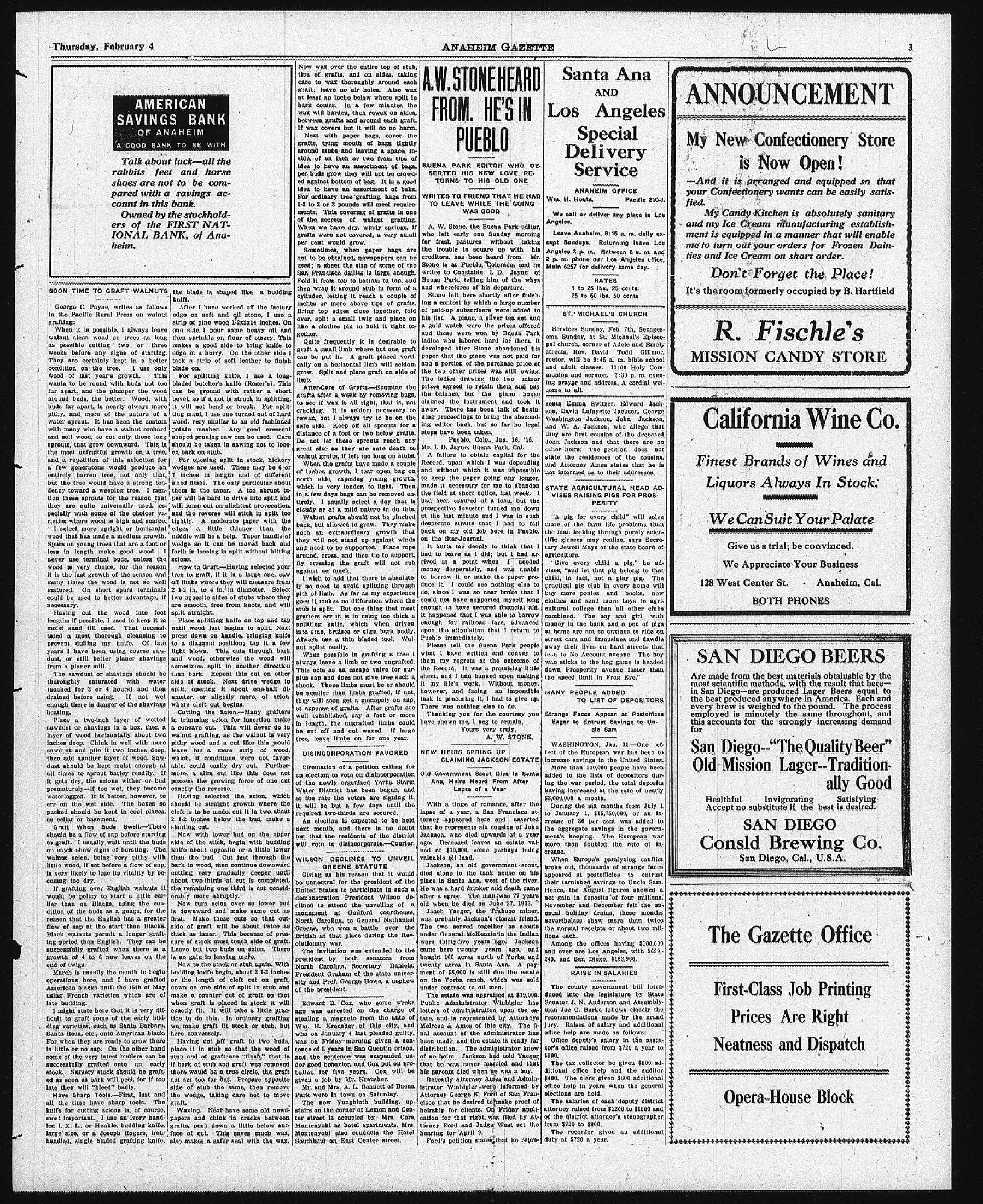
Searchable text
AMERICAN SAVINGS BANK
OF ANAHEIM
A GOOD BANK TO BE WITH
Talk about luck—all the rabbits feet and horse shoes are not to be compared with a savings account in this bank.
Owned by the stockholders of the FIRST NATIONAL BANK, of Anaheim.
SOON TIME TO GRAFT WALNUTS
Goorge C. Payne, writes as follows in the Pacific Rural Press on walnut grafting:
When it is possible, I always leave walnut slon wood on trees as long as possible cutting two or three weeks before any signs of starting. They are certainly kept in a better condition on the tree. I use only wood of last year's growth. This wants to be round with buds not too far apart, and the plumper the wood around buds, the better. Wood, with buds far apart, is nearly always more pithy, and more of the nature of a water sprout. It has been the custom with many who have a walnut orchard and sell wood, to cut only those long sprouts, that grow downward. This is the blade is shaped like a budding knift.
After I have worked off the factory edge on soft and oil stone, I use a strip of pine wood 1-2x2x14 inches. On one side I pour some heavy oil and then sprinkle on flour of emery. This makes a good side to bring knife to edge in a hurry. On the other side I tack a strip of soft leather to finish blade on.
For splitting knife, I use a long-bladed butcher's knife (Roger's). This can be ground with rather a short bevel, so if a not is struck in splitting, it will not bend or break. For splitting maul, I use one turned out of hard wood, very similar to an old fashioned potato maher. Any good crescent shaped pruning saw can be used. Care should be taken in sawing not to loosen wax over the edges tips of grafts, and care to wax thorough graft; leave no air hole at least an inch below bark comes. In a few wax will harden, then between grafts and are if wax covers but it wont with paper b grafts, tying mouth around stubs and leaves side, of an inch or two idea to have an assortment buds grow they wil ed against bottom of b idea to have an assortment For ordinary tree graft 1-2 to 2 or 3 pounds w mentals. This covering of the secrets of w When we have dry, w grafts were not covered per cent would grow.
Sometimes, when you do not to be obtained, new used; a sheet the size San Francisco dailies Fold it from top to bottom then wrap it around cylinder, letting it re inches or more above Bring top edges close over, split a small twi like a clothes pin to gether.
Quite frequently it graft a small limb where can be put in. A graftally on a horizontal l grow. Split and place limb.
After-Care of Grafts grafts after a week by to see if wax is all rie cracking. It is seldom rewax, but I always t safe side. Keep off a distance of a foot or two Do not let these spr great let us they
They are certainly kept in a better condition on the tree. I use only wood of last year's growth. This wants to be round with buds not too far apart, and the plumper the wood around buds, the better. Wood, with buds far apart, is nearly always more pithy, and more of the nature of a water sprout. It has been the custom with many who have a walnut orchard and sell wood, to cut only those long sprouts, that grow downward. This is the most unfruitful growth on a tree, and a repetition of this selection for a few generators would produce an entirely barren tree, not only that, but the tree would have a strong tendency toward a weeping tree. I mention these sprouts for the reason that they are quite universally used, especially with some of the choice varieties where wood is high and scarce.
I select more upright or horizontal wood that has made a medium growth. Spurs on young trees that are a foot or less in length make good wood. I never use terminal buds, unless the wood is very choice, for the reason it is the last growth of the season and many times the wood is not so well matured. On short spurs terminals could be used to better advantage, if necessary.
Having cut the wood into foot lengths if possible, I used to keep it in moist sand till used. That necessitated a most thorough cleansing to prevent dulling my knife. Of late years I have been using coarse sawdust, or still better planer shavings from a planer mill.
The sawdust or shavings should be thoroughly saturated with water (soaked for 3 or 4 hours) and then drained before using. If not wet enough there is danger of the shavings heating.
Place a two-inch layer of wetted sawdust or shavings in a box, then a layer of wood horizontally about two inches deep. Chink in well with more sawdust and pile it two inches deep, then add another layer of wood. Sawdust should be kept moist enough at all times to sprout barley readily. If it gets dry, the selons wilter or bud prematurely—if too wet, they become waterlogged. It is better, however, to err on the wet side. The boxes so packed should be kept in cool places, as cellar or basement.
Graft When Buds Swell. There should be a flow of sap before starting to graft. I usually wait until the buds on stock show signs of bursting. The
For splitting knife, I use a long-bladed butcher's knife (Roger's). This can be ground with rather a short bevel, so if a not is struck in splitting, it will not bend or break. For splitting maul, I use one turned out of hard wood, very similar to an old fashioned potato mahler. Any good crescent shaped pruning saw can be used. Care should be taken in sawing not to loosen bark on stub.
For opening split in stock, hickory wedges are used. These may be 6 or 7 inches in length and of different sized limbs. The only particular about them is the taper. A too abrupt taper will be hard to drive into split and will jump out on slightest provocation, and the reverse will stick in split too tightly. A moderate paper with the edges a little thinner than the middle will be a help. Taper handle of wedge so it can be moved back and forth in loosening in split without hitting scions.
How to Graft—Having selected your tree to graft, if it is a large one, saw off limbs where they will measure from 2-12 in, to 4 in in diameter. Select two opposite sides of stubs where they are smooth, free from knots, and will split straight.
Place splitting knife on top and tap until wood just begins to split. Next press down on handle, bringing knife to a diagonal position; tap it a few light blows. This cuts through bark and wood, otherwise the wood will sometimes split in another direction than bark. Repeat this cut on other side of stock. Next drive wedge in split, opening it about one-half diameter, or slightly more, of scion where cleft cut begins.
Cutting the Scion—Many grafters in trimming scion for insertion make a concave cut. This will never do in walnut grafting, as the walnut is very pithy wood and a cut like this would leave but a mere strip of wood, which, if conditions were not favorable, could easily dry out. Furthermore, a slim cut like this does not possess the growing force of one cut exactly the reverse.
Having selected the scion, which should be straight growth where the cleft is to be made, cut it in two about 2-1-2 inches below the bud, make a slanting cut.
Now with lower bud on the upper side of the stick, begin with budding knife about opposite or a little lower edge in a harry. On other side take a strip of soft leather to finish blade on.
For splitting knife, I use a long-bladed butcher's knife (Roger's). This can be ground with rather a short bevel, so if a not is struck in splitting, it will not bend or break. For splitting maul, I use one turned out of hard wood, very similar to an old fashioned potato mahler. Any good crescent shaped pruning saw can be used. Care should be taken in sawing not to loosen bark on stub.
For opening split in stock, hickory wedges are used. These may be 6 or 7 inches in length and of different sized limbs. The only particular about them is the taper. A too abrupt taper will be hard to drive into split and will jump out on slightest provocation, and the reverse will stick in split too tightly. A moderate paper with the edges a little thinner than the middle will be a help. Taper handle of wedge so it can be moved back and forth in loosening in split without hitting scions.
How to Graft—Having selected your tree to graft, if it is a large one, saw off limbs where they will measure from 2-12 in, to 4 in in diameter. Select two opposite sides of stubs where they are smooth, free from knots, and will split straight.
Place splitting knife on top and tap until wood just begins to split. Next press down on handle, bringing knife to a diagonal position; tap it a few light blows. This cuts through bark and wood, otherwise the wood will sometimes split in another direction than bark. Repeat this cut on other side of stock. Next drive wedge in split, opening it about one-half diameter, or slightly more, of scion where cleft cut begins.
Cutting the Scion—Many grafters in trimming scion for insertion make a concave cut. This will never do in walnut grafting, as the walnut is very pithy wood and a cut like this would leave but a mere strip of wood, which, if conditions were not favorable, could easily dry out. Furthermore, a slim cut like this does not possess the growing force of one cut exactly the reverse.
Having selected the scion, which should be straight growth where the cleft is to be made, cut it in two about 2-1-2 inches below the bud, make a slanting cut.
Now with lower bud on the upper side of the stick, begin with budding knife about opposite or a little lower edge in a harry. On other side take a strip of soft leather to finish blade on.
For splitting knife, I use a long-bladed butcher's knife (Roger's). This can be ground with rather a short bevel, so if a not is struck in splitting, it will not bend or break. For splitting maul, I use one turned out of hard wood, very similar to an old fashioned potato mahler. Any good crescent shaped pruning saw can be used. Care should be taken in sawing not to loosen bark on stub.
For opening split in stock, hickory wedges are used. These may be 6 or 7 inches in length and of different sized limbs. The only particular about them is the taper. A too abrupt taper will be hard to drive into split and will jump out on slightest provocation, and the reverse will stick in split too tightly. A moderate paper with the edges a little thinner than the middle will be a help. Taper handle of wedge so it can be moved back and forth in loosening inSplit without hitting scions.
How to Graft—Having selected your tree to graft, if it is a large one, saw off limbs where they will measure from 2-12 in, to 4 in in diameter. Select two opposite sides of stubs where they are smooth, free from knots, and will split straight.
Place splitting knife on top and tap until wood just begins to split. Next press down on handle, bringing knife to a diagonal position; tap it a few light blows. This cuts through bark and wood, otherwise the wood will sometimes split in another direction than bark. Repeat this cut on other side of stock. Next drive wedge in split, opening it about one-half diameter, or slightly more, of scion where cleft cut begins.
Cutting the Scion—Many grafters in trimming scion for insertion make a concave cut. This will never do in walnut grafting, as the walnut is very pithy wood and a cut like this would leave but a mere strip of wood, which, if conditions were not favorable, could easily dry out. Furthermore, a slim cut like this does not possess the growing force of one cut exactly the reverse.
Having selected the scion which should be straight growth where the cleft is to be made, cut it in two about 2-1-2 inches below the bud, make a slanting cut.
Now with lower bud on the upper side of the stick, begin with budding knife about opposite or a little lower edge in a harry. On other side take a strip of soft leather to finish blade on.
For splitting knife, I use a long-bladed butcher's knife (Roger's). This can be ground with rather a short bevel, so if a not is struck in splitting, it will not bend or break. For splitting maul, I use one turned out of hard wood, very similar to an old fashioned potato mahler. Any good crescent shaped pruning saw can be used. Care should be taken in sawing not to loosen bark on stub.
For opening split in stock, hickory wedges are used. These may be 6 or 7 inches in length and of different sized limbs. The only particular about them is the taper. A too abrupt taper will be hard to drive into split and will jump out on slightest provocation, and the reverse will stick in split too tightly. A moderate paper with the edges a little thinner than the middle will be a help. Taper handle of wedge so it can be moved back and forth in loosening inSplit without hitting scions.
How to Graft—Having selected your tree to graft, if it is a large one, saw off limbs where they will measure from 2-12 in, to 4 in in diameter. Select two opposite sides of stubs where they are smooth, free from knots, and will split straight.
Place splitting knife on top and tap until wood just begins to split. Next press down on handle,bringing knife to a diagonal position; tap it a few light blows. This cuts through bark and wood,otherwise the wood will sometimes split in another direction than bark.Repeat this cut on other side of stock.Negative case.Walnut grafters should back,但 allowed to grow such an extraordinarily they will not stand up and need to be supported around,cross,and there By crossing the graft against so much.
I wish to add that lily no need to avoid spilt of limb.As far as goes it makes no difference stub is split.But one grafters errin is in use splitting knife,which into stub,brushes or sits Always use a thin blunt nut splist easily.
When possible in graft always leave a limb or this acts as an escape plus sap and does not shock.The limbs must be smaller than limbs they will soon get at expense of grafts.A well established,say no length,the ungraftedbe cut off and out tree,leave limbs on l
DISINCORPORATION
Circulation of a petit an election to vote on o o f the newly organized Water District has been at the rate the voters it will be but a few required two-thirds are An election is expected next month,and there but that the residents will vote to disincorpor
then add another layer of wood. Sawdust should be kept moist enough at all times to sprout barley readily. If it gets dry, the selons wither or bud prematurely—if too wet, they become waterlogged. It is better, however, to err on the wet side. The boxes so packed should be kept in cool places, as cellar or basement.
Graft When Buds Swell. There should be a flow of sap before starting to graft. I usually wait until the buds on stock show signs of bursting. The walnut scion, being very pithy with little wood, if set before a flow of sap, is very likely to lose its vitality by becoming too dry.
If grafting over English walnuts it would be policy to start a little earlier than on Blacks, using the condition of the buds as a guage, for the reason that the English has a greater flow of sap at the start than Blacks. Black walnuts permit a longer grafting period than English. They can be successfully grafted when there is a growth of 4 to 6 new leaves on the end of twigs.
March is usually the month to begin operations here, and I have grafted American blacks until the 15th of May using French varieties which are of late budding.
I might state here that it is very difficult to graft some of the early budding varieties, such as Santa Barbara, Santa Rosa, etc., onto American black. For when they are ready to grow there is little or no sap. On the other hand some of the very latest budders can be successfully grafted onto an early stock. Nursery stock should be grafted as soon as bark will peel, for if too late they will "bleed" badly.
Have Sharp Tools. First, last and all the time have sharp tools. The knife for cutting scions is, of course, most important. I use an ivory handled I. X. L., or Henkle, budding knife, large size, or a Joseph Rogers, iron-handed, single bladed grafting knife,
which, if conditions were not favorable, could easily dry out. Furthermore, a slim cut like this does not possess the growing force of one cut exactly the reverse.
Having selected the scion, which should be straight growth where the cleft is to be made, cut it in two about 2 1-2 inches below the bud, make a slanting cut.
Now with lower bud on the upper side of the stick, begin with budding knife about opposite or a little lower than the bud. Cut just through the bark to wood, then continue downward cutting very gradually deeper until about two-thirds of cut is completed, the remaining one third is cut considerably more abruptly.
Now turn scion over so lower bud is downward and make same cut as first. Make these cuts so that outside of graft will be about twice as thick as inner. This because of pressure of stock must touch side of graft. Leave but two buds on scion. There is no gain in leaving more.
Now to the stock or stub again. With budding knife begin, about 2 1-2 inches or the length of cleft cut on graft, down on one side of split in stub and make a counter cut of graft so that when graft is placed in stock it will exactly fit. It will take a little practice to do this. In ordinary grafting we make graft fit stock or stub, but here conversely.
Having cut off graft to two buds, place it in stub so that the wood of stub and of graft are "flush," that is if bark of stub and graft was removed there would be a true circle, the graft not set too far out. Prepare opposite side of stub the same, then remove the wedge, taking care not to move graft.
Waxing. Next have some old newspapers and chink in cracks between grafts, push down a little below surface of cut. This saves much wax, also makes a safer seal with the wax.
Circulation of a petal an election to vote on or of the newly organized Water District has been at the rate the voters it will be but a few required two-thirds are An election is expected next month, and there but that the residents will vote to disincorp
WILSON DECLINES GREENE STA
Giving as his reason be unneutral for the president demonstration President clined to attend the w monument at Guilford North Carolina, to Ger Greene, who won a bad British at that place olutionary war.
The invitation was o president by both in North Carolina, Secreta President Graham of the city and Prof. George K of the president.
Edward B. Cox, who ago was arrested on his stealing a magneto from Wm. H. Kreusher, of who on January 4 last was on Friday morning tenence of 5 years in San and the sentence was der good behavior, and bation for five years given a job by Mr. Kr Mr. and Mrs. A. L. Be Park were in town on The new Yungbluth stairs on the corner of Ter street is occupied Montenyohl as hotel ap Montenyohl also cond Soutland on East Cent
Now wax over the entire top of stub, tips of grafts, and on sides, taking care to wax thoroughly around each graft; leave no air holes. Also wax at least an inch below where split in bark comes. In a few minutes the wax will harden, then rewax on sides, between grafts and around each graft. If wax covers but it will do no harm.
Next with paper bags, cover the grafts, tying mouth of bags tightly around stubs and leaving a space inside of an inch or two from tips of idea to have an assortment of bags. Per buds grow they will not be crowded against bottom of bag. It is a good idea to have an assortment of baks. For ordinary tree grafting, bags from 1-2 to 2 or 3 pounds will meet requirements. This covering of grafts is one of the secrets of walnut grafting. When we have dry, windy springs, if grafts were not covered, a very small per cent would grow.
Sometimes, when paper bags are not to be obtained, newspapers can be used; a sheet the size of some of the San Francisco dailies is large enough. Fold it from top to bottom to top, and then wrap it around stub in form of a cylinder, letting it reach a couple of inches or more above tips of grafts. Bring top edges close together, fold over, split a small twig and place on like a clothes pin to hold it tight together.
Quite frequently it is desirable to graft a small limb where but one graft can be put in. A graft placed vertically on a horizontal limb will seldom grow. Split and place graft on side of limb.
After-Care of Grafts.—Examine the grafts after a week by removing bags, to see if wax is all right, that is, not cracking. It is seldom necessary to rewax, but I always try to be on the safe side. Keep off all sprouts for a distance of a foot or two below grafts. Do not let these sprouts reach any great size as they are sure death to
A.W. STONE HEARD FROM. HE'S IN PUEBLO
BUENA PARK EDITOR WHO DESERTED HIS NEW LOVE RETURNS TO HIS OLD ONE
WRITES TO FRIEND THAT HE HAD TO LEAVE WHILE THE GOING WAS GOOD
A. W. Stone, the Buena Park editor, who left early one Sunday morning for fresh pastures without taking the trouble to square up with his creditors, has been heard from. Mr. Stone is at Pueblo, Colorado, and he writes to Constable I. D. Jayne of Buena Park, telling him of the whys and wherefores of his departure.
Stone left here shortly after finishing a contest by which a large number of paid-up subscribers were added to his list. A piano, a silver tea set and a gold watch were the prizes offered and these were won by Buena Park ladies who labored hard for them. It developed after Stone abandoned his paper that the piano was not paid for and a portion of the purchase price of the two other prizes was still owing.
The ladies drawing the two minor prizes agreed to retain them and pay the balance, but the plano house claimed the instrument and took it away. There has been talk of beginning proceedings to bring the absconding editor back, but so far no legal steps have been taken.
Pueblo, Colo., Jan. 16, '15.
Mr. I. D. Jayne, Buena Park, Cal.
Santa Ana AND Los Angeles Special Delivery Service
ANAHEIM OFFICE
Wm. H. Houtz,
Pacific 210-J.
We call or deliver any place in Los Angeles.
Leave Anaheim, 8:15 a.m. daily except Sundays. Returning leave Los Angeles 3 p.m. Between 8 a.m. and 2 p.m. phone our Los Angeles office, Main 6257 for delivery same day.
RATES
1 to 25 lbs., 25 cents.
25 to 50 lbs., 50 cents
ST· MICHAEL'S CHURCH
Services Sunday, Feb. 7th, Sexagesema Sunday, at St. Michael's Episcopal church, corner of Adele and Emely streets, Rev. David Todd Gillmor, rector, will be 9:45 a.m. bible school and adult classes. 11:00 Holy Communion and sermon. 7:30 p.m. evening prayer and address. A cordial welcome to all.
sements Emma Switzer, Edward Jackson, David Lafayette Jackson, George Washington Jackson, John Jackson, and W. A. Jackson, who allege that they are first cousins of the deceased Joan Jackson and that there are no
can be put in. A graft placed vertically on a horizontal limb will seldom grow. Split and place graft on side of limb.
After-Care of Grafts.—Examine the grafts after a week by removing bags, to see if wax is all right, that is, not cracking. It is seldom necessary to rewax, but I always try to be on the safe side. Keep off all sprouts for a distance of a foot or two below grafts. Do not let these sprouts reach any great size as they are sure death to walnut grafts, if left too long on stubs.
When the grafts have made a couple of inches growth, I tear open bag on north side, exposing young growth, which is very tender, to light. Then in a few days bags can be removed entirely. I usually select a day that is cloudy or of a mild nature to do this.
Walnut grafts should not be pinched back, but allowed to grow. They make such an extraordinary growth that they will not stand up against winds and need to be supported. Place rope around, cross, and then tie to support. By crossing the graft will not rub against so much.
I wish to add that there is absolutely no need to avoid splitting through pith of limb. As far as my experience goes it makes no difference where the stub is split. But one thing that most grafters err in is in using too thick a splitting knife, which when driven into stub, bruises or slips bark badly. Always use a thin bladed tool. Walnut splist easily.
When possible in grafting a tree I always leave a limb or two ungrafted. This acts as an escape valve for surplus sap and does not give tree such a shock. These limbs must be or should be smaller than limbs grafted, if not, they will soon get a monopoly on sap, at expense of grafts. After grafts are well established, say a foot or more in length, the ungrafted limbs could be cut off and cut waxed. If large tree, leave limbs on for one year.
DISINCORPORATION FAVORED
Circulation of a petition calling for an election to vote on disincorporation of the newly organized Yorba Storm Water District has been begun, and at the rate the voters are signing it, it will be but a few days until the required two-thirds are secured.
An election is expected to be held next month, and there is no doubt but that the residents of the district will vote to disincorporate.—Courier.
NEW HEIRS SPRING UP
CLAIMING JACKSON ESTATE
Old Government Scout Dies In Santa Ana, Heirs Heard From After Lapse of a Year
With a tinge of romance, after the lapse of a year, a San Francisco attorney appeared here and asserted that he represents six cousins of John Jackson, who died upwards of a year ago. Deceased leaves an estate valued at $19,000, some perhaps being paper that the piano was not paid for and a portion of the purchase price of the two other prizes was still owing. The ladies drawing the two minor prizes agreed to retain them and pay the balance, but the plano house claimed the instrument and took it away. There has been talk of beginning proceedings to bring the absconding editor back, but so far no legal steps have been taken.
Pueblo, Colo., Jan. 16, '15.
Mr. I. D. Jayne, Buena Park, Cal.
A failure to obtain capital for the Record, upon which I was depending and without which it was impossible to keep the paper going any longer, made it necessary for me to abandon the field at short notice, last week. I had been assured of a loan, but the prospective investor turned me down at the last minute and I was in such desperate straits that I had to fall back on my old job here in Pueblo, on the Star-Journal.
It hurts me deeply to think that I had to leave as I did; but I had arrived at a point when I needed money desperately, and was unable to borrow it or make the paper produce it. I could see nothing else to do since I was so near broke that I could not have supported myself long enough to have secured financial aid. It happened that I was able to borrow enough for railroad fare, advanced upon the stipulation that I return to Pueblo immediately.
Please tell the Buena Park people what I have written and convey to them my regrets at the outcome of the Record. It was a promising little sheet, and I had banked upon making it my life's work. Without money, however, and facing an impossible task in procuring it, I had to give up. There was nothing else to do.
Thanking you for the courteous you have shown me, I beg to remain.
Yours very truly,
A. W. STONE.
NEW HEIRS SPRING UP
CLAIMING JACKSON ESTATE
Old Government Scout Dies In Santa Ana, Heirs Heard From After Lapse of a Year
With a tinge of romance, after the lapse of a year, a San Francisco attorney appeared here and asserted that he represents six cousins of John Jackson, who died upwards of a year ago. Deceased leaves an estate valued at $19,000, some perhaps being paper that the piano was not paid for and a portion of the purchase price of the two other prizes was still owing. The ladies drawing the two minor prizes agreed to retain them and pay the balance, but the plano house claimed the instrument and took it away. There has been talk of beginning proceedings to bring the absconding editor back, but so far no legal steps have been taken.
Pueblo, Colo., Jan. 16, '15.
Mr. I. D. Jayne, Buena Park, Cal.
A failure to obtain capital for the Record, upon which I was depending and without which it was impossible to keep the paper going any longer, made it necessary for me to abandon the field at short notice, last week. I had been assured of a loan, but the prospective investor turned me down at the last minute and I was in such desperate straits that I had to fall back on my old job here in Pueblo, on the Star-Journal.
It hurts me deeply to think that I had to leave as I did; but I had arrived at a point when I needed money desperately, and was unable to borrow it or make the paper produce it. I could see nothing else to do since I was so near broke that I could not have supported myself long enough to have secured financial aid. It happened that I was able to borrow enough for railroad fare, advanced upon the stipulation that I return to Pueblo immediately.
Please tell the Buena Park people what I have written and convey to them my regrets at the outcome of the Record. It was a promising little sheet, and I had banked upon making it my life's work. Without money, however, and facing an impossible task in procuring it, I had to give up. There was nothing else to do.
Thanking you for the courteous you have shown me, I beg to remain.
Yours very truly,
A. W. STONE.
STATE AGRICULTURAL HEAD ADVISES RAISING PIGS FOR PROSPERITY
"A pig for every child" will solve more of the farm life problems than the man looking through purely scientific glasses may realize, says Secretary Jewell Mays of the state board of agriculture.
"Give every child a pig," he advises, "and let that pig belong to that child, in fact, not a play pig. The practical pig club in every home will buy more ponies and books, new clothes and send more boys to agricultural college than all other chubs combined. The boy and girl with money in the bank and a pen of pigs at home are not so anxious to ride on street cars and limousines and dawdle away their lives on hard streets that lead to No Account avenue. The boy who sticks to the hog game is headed down Prosperity avenue faster than the speed limit in Frog Eye."
MANY PEOPLE ADDED TO LIST OF DEPOSITORS
Strange Faces Appear at Postoffices Eager to Entrust Savings to Uncle Sam
WASHINGTON, Jan. 31.-One effect of the European war has been to increase savings in the United States. More than 100,000 people have been added to the lists of depositors during the war period, the total deposits having increased at the rate of nearly $3,000,000 a month.
During the six months from July 1 to January 1,$15,750,000, or an increase of 36 per cent was added to the aggregate savings in the government's keeping. The European war more than doubled the rate of income...
Circulation of a petition calling for an election to vote on disincorporation of the newly organized Yorba Storm Water District has been begun, and at the rate the voters are signing it, it will be but a few days until the required two-thirds are secured.
An election is expected to be held next month, and there is no doubt but that the residents of the district will vote to disincorporate.—Courier.
WILSON DECLINES TO UNVEIL GREENE STATUTE
Giving as his reason that it would be unneutral for the president of the United States to participate in such a demonstration President Wilson declined to attend the unveiling of a monument at Guilford courthouse, North Carolina, to General Nathanael Greene, who won a battle over the British at that place during the Revolutionary war.
The invitation was extended to the president by both senators from North Carolina, Secretary Daniels, President Graham of the state university and Prof. George Howe, a nephew of the president.
Edward B. Cox, who some weeks ago was arrested on the charge of stealing a magneto from the auto of Wm. H. Kreusher of this city, and who on January 4 last pleaded guilty, was on Friday morning given a sentence of 5 years in San Quentin prison, and the sentence was suspended under good behavior, and Cox put on probation for five years. Cox will be given a job by Mr. Kreusher.
Mr. and Mrs. A. L. Bennett of Buena Park were in town on Saturday.
The new Yungbluth building, upstairs on the corner of Lemon and Center street is occupied by Mrs. Cora Montenyohl as hotel apartments. Mrs. Montenyohl also conducts the Hotel Southland on East Center street.
CLAIMING JACKSON ESTATE
Old Government Scout Died In Santa Ana, Heirs Heard From After Lapse of a Year
With a tinge of romance, after the lapse of a year, a San Francisco attorney appeared here and asserted that he represents six cousins of John Jackson, who died upwards of a year ago. Deceased leaves an estate valued at $10,000, some perhaps being valuable oil land.
Jackson, an old government scout, died alone in the tank house on his place in Santa Ana, west of the river. He was a hard drinker and death came after a spree. The man was 77 years old when he died on June 27, 1913.
Jacob Yaeger, the Trabuco miner, was probably Jackson's closest friend. The two served together as scouts under General McKenzie in the Indian wars thirty-five years ago. Jackson came here twenty years ago, and bought 160 acres north of Yorba and twenty acres in Santa Ana. A payment of $8,000 is still due the estate on the Yorba ranch, which was sold under contract to oil men.
The estate was appraised at $19,000. Public Administrator Winbigler has letters of administration upon the estate, and is represented by Attorneys Melrose & Ames of this city. The final account of the administrator has been made, and the estate is ready for distribution. The administrator knew of no heirs. Jackson had told Yaeger that he was never married and that his parents died when he was a boy.
Recently Attorney Ames and Administrator Winbigler were informed by Attorney George K. Ford of San Francisco that he desired to make proof of heirship for clients. On Friday application for that right, was filed by Attorney Ford and Judge West set the hearing for April 9.
Ford's petition states that he repro-
increase savings in the United States.
More than 100,000 people have been added to the lists of depositors during the war period, the total deposits having increased at the rate of nearly $3,000,000 a month.
During the six months from July 1 to January 1, $15,750,000, or an increase of 36 per cent was added to the aggregate savings in the government's keeping. The European war more than doubled the rate of increase.
When Europe's paralyzing conflict broke out, thousands of strange faces appeared at postoffice to entrust their tarnished savings to Uncle Sam. Hence, the August figures showed a net gain in deposits of four millions, November and December felt the unusual holiday drains; these months nevertheless show more than twice the normal receipts or about two millions each.
Among the offices having $100,000 and over are Los Angeles, with $699,243, and San Diego, $182,966.
RAISE IN SALARIES
The county government bill introduced into the legislature by State Senator J. N. Anderson and Assemblyman Joe C. Burke follows closely the recommendations made by the grand jury. Raises of salary and additional office help are as follows:
Office deputy's salary in the assessor's office raised from $720 a year to $900.
The tax collector be given $500 additional office help and the auditor $400. The clerk given $600 additional office help in years when the general elections are held.
The salaries of each deputy district attorney raised from $1200 to $1500 and of the district attorney's stenographer from $720 to $900.
The recorder given an additional duty at $720 a year.
ANNOUNCEMENT
My New Confectionery Store is Now Open!
—And it is arranged and equipped so that your Confectionery wants can be easily satisfied.
My Candy Kitchen is absolutely sanitary and my Ice Cream manufacturing establishment is equipped in a manner that will enable me to turn out your orders for Frozen Dainties and Ice Cream on short order.
Don't Forget the Place!
It's the room formerly occupied by B. Hartfield
R. Fischle's
MISSION CANDY STORE
California Wine Co.
California Wine Co.
Finest Brands of Wines and
Liquors Always In Stock:
We Can Suit Your Palate
Give us a trial; be convinced.
We Appreciate Your Business
128 West Center St. Anaheim, Cal.
BOTH PHONES
SAN DIEGO BEERS
Are made from the best materials obtainable by the most scientific methods, with the result that here—in San Diego—are produced Lager Beers equal to the best produced anywhere in America. Each and every brew is weighed to the pound. The process employed is minutely the same throughout, and this accounts for the strongly increasing demand for
San Diego--"The Quality Beer"
Old Mission Lager--Traditionally Good
Healthful Invigorating Satisfying
Accept no substitute if the best is desired.
SAN DIEGO
Consld Brewing Co.
Old Mission Lager--Traditionally Good
Healthful Invigorating Satisfying
Accept no substitute if the best is desired.
SAN DIEGO
Consld Brewing Co.
San Diego, Cal., U.S.A.
The Gazette Office
First-Class Job Printing
Prices Are Right
Neatness and Dispatch
Opera-House Block